
Marignane Airport Landing
On the night of January 4, 1954, an on-duty fireman at Marignane Airport near Marseille watched a silvery, self-luminous discoidal object descend, touch down on the runway, bounce several times, and vanish while he telephoned the control tower. The next morning, investigators recovered roughly a hundred small metal fragments scattered across the presumed landing spot — debris that would remain officially unidentified for more than a year.
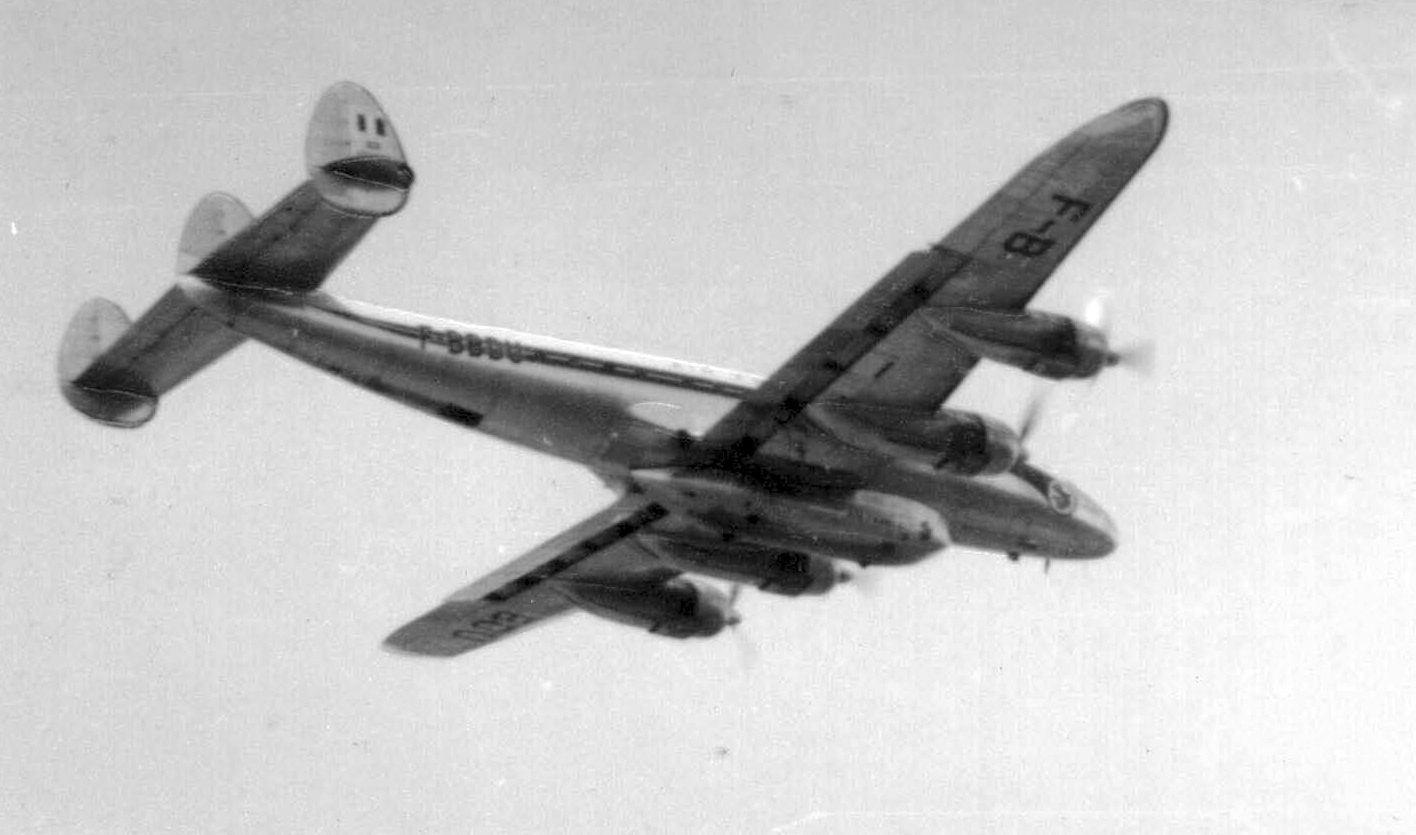
Pictured: an Air France Lockheed Constellation of the type photographed circa 1954–55 — not a photograph of the object Chesneau reported, nor of the actual aircraft involved. No photograph of the incident, the witness, or the recovered debris is known to survive. The type is shown here because the metal fragments found on the runway the next morning were identified more than a year later as anti-static discharge hardware of the kind fitted to Lockheed Constellation airliners, the class of piston-engined airliner then operating scheduled service through Marseille–Marignane.
Theoretical Alignment
The case aligns most strongly with a mundane, misperception-driven framework: a single, isolated night-shift observer watching an ambiguous aerial event at range, whose account was later compounded by a conventionally-identified debris field. It retains only weak alignment with the Extraterrestrial or Interdimensional Hypotheses, both of which must explain away a specific, dated, and independently corroborated identification of the physical evidence as ordinary aircraft hardware.
Background
By January 1954, France had not yet entered the "great wave" for which that year is now best remembered in ufological history — the concentrated run of several hundred reports, over 200 of them close encounters, that swept the country from late August through November and is chronicled in this site's own Great French UFO Wave of 1954 file. The Marignane incident predates that main concentration by roughly eight months, sitting instead within a smaller, quieter current of "flying disc" reports that had persisted across France and much of the world, at a low background level, since Kenneth Arnold's original June 1947 sighting in Washington State. French ufology itself was still in its infancy: the Commission Ouranos, founded in 1951 by Marc Thirouin and headed on the investigative side by a young writer named Jimmy Guieu, was one of only a small handful of organized groups anywhere in the country attempting to systematically collect and check reports as they came in, years before the government itself would create any comparable body — GEPAN, the Groupe d'Etudes des Phenomenes Aerospatiaux Non-identifies, would not be founded inside the French space agency CNES until 1977.
Marignane, a commune roughly 18 km northwest of Marseille in the Bouches-du-Rhône department, had been home to a major civil aerodrome since October 1922, one of France's first dedicated airports and, through the 1920s and 1930s, one of the country's principal bases for transatlantic and Mediterranean flying-boat operations under Aeropostale and Air Union before the Marseille-Provence Chamber of Commerce and Industry took over its management in 1934. By 1954 it was operating as a conventional, growing mixed-traffic civil airport serving Marseille, with scheduled Air France routes and the associated ground infrastructure — hangars, a control tower, and a fire and rescue detachment — expected of a mid-century regional airport of its size. It was into that ordinary, unremarkable night-shift routine that the airport's small fire crew, including a man recorded in every surviving source only by his surname, Chesneau, was posted on the evening of January 4, 1954.
France in early 1954 also sat within a specific, tense Cold War moment: NATO's integrated air-defense structure was still being built out across Western Europe, French forces were fighting an increasingly costly colonial war in Indochina that would end in defeat at Dien Bien Phu that May, and the country's civil aviation and meteorological services were only slowly modernizing beyond wartime-era equipment. None of the sources consulted for this file describe any specific link between that broader geopolitical backdrop and the Marignane report itself, and this file does not speculate about one; it is noted here only because the same general climate of limited civil radar coverage, patchy inter-agency communication, and a public and press primed by nearly seven years of "flying saucer" reporting since Kenneth Arnold's 1947 sighting recurs across nearly every case file this site covers from the period, Marignane included.
This was, moreover, not the airfield's first brush with an unexplained aerial report. Fourteen months earlier, in the small hours of October 27, 1952, a customs officer working the overnight shift, Gabriel Gachignard, had reported a small, dark, cigar-shaped object with four flickering lit windows briefly touching down on the tarmac roughly 100 meters from his position before departing within two seconds amid sparks and a noise he compared to a small Bastille Day rocket. That earlier case, discussed in more detail in the Historical Precedents section below, was investigated separately by Guieu and published in the Commission Ouranos's own bulletin in January 1953 — meaning that, by the time Chesneau's report reached French ufological circles in early 1954, Marignane already had a reputation, however small and localized, as an airfield with an unresolved prior incident on its own books.
Complete Timeline
| Date / Time | Event |
|---|---|
| Oct. 27, 1952, ~02:03 | Customs officer Gabriel Gachignard reports a small cigar-shaped, lit object briefly touching down on the Marignane tarmac — the airfield's first, less-documented precedent incident. |
| Jan. 4, 1954, ~21:00 | Fireman Chesneau, on duty near the Boussiron hangar at Marignane Airport, watches a silvery, self-luminous discoidal object descend from the south, touch down on the runway, bounce several times, and come to rest. |
| Jan. 4, 1954, ~21:00 (during the call) | As Chesneau telephones the control tower to report the object, it silently disappears; an officer who investigates immediately afterward finds nothing on the runway. |
| Jan. 4, 1954, ~22:45 | A Marseille resident driving from Arles toward Marseille separately reports a large, round, reddish fireball in the sky — a loosely corroborating account that is mismatched with Chesneau's in both time (by roughly 105 minutes) and description (a reddish fireball in flight, rather than a silvery object at rest on a runway). |
| Jan. 5, 1954, morning | At the spot Chesneau indicated, investigators find roughly a hundred small metallic fragments scattered across the runway — slender rods about 15 cm long, curved at one end and tipped with a small ball of a contrasting yellow metal. |
| Jan. 8, 1954 | Radio-Marseille broadcasts the airport police's official explanation: the January 4 phenomenon was caused by a "classic rocket." |
| Late Jan.–early Feb. 1954 | Jimmy Guieu begins investigating for the Commission Ouranos, reporting that eleven separate phone calls to airport and police contacts within a single hour produced only denials, redirections, and a "wall of silence." |
| Feb. 4, 1954 | La Bourgogne Républicaine publishes a detailed account of the case, including the rejected rocket, meteor, weather-balloon, and (sarcastically) goat-bell-clapper explanations. |
| Feb. 1954 | Le Provençal reporter Constant Vautravers arranges a direct interview with Chesneau; on arrival, another fireman redirects him elsewhere and the witness never appears. |
| 1955 | An Air France mechanic identifies the recovered debris as static-discharge hardware of a type fitted to Lockheed Constellation airliners; the Bulletin de l'Aéroport de Marseille formally acknowledges the identification after "more than a year" of failed inquiries. |
| 1956 | Guieu publishes his findings on the case in Black-Out sur les Soucoupes Volantes (Fleuve Noir), prefaced by Jean Cocteau. |
| Apr. 20, 1954 | The case is reportedly logged, per researcher Patrick Gross's citation of a contemporary CIA intelligence report, among a wider digest of European "unidentified flying object" press reports collected by the U.S. Central Intelligence Agency that spring. |
| 1969 | Jacques Vallée catalogs the case in Passport to Magonia (p. 205), cross-referencing it against Guieu's original French-language account. |
The Night of January 4, 1954
Shortly after 9:00 p.m. on a cold, clear January evening, Chesneau — posted, as fire crews at the time routinely were, near one of the airfield's operational hangars, in his case the Boussiron hangar on the airport's western perimeter — noticed a round, self-luminous object approaching from the south. Contemporary press accounts, reconstructed in detail from the transcribed Le Provençal, France Soir, and La Bourgogne Républicaine reporting later archived by researcher Patrick Gross, describe the object as silvery and radiating a steady white light, descending toward the runway at a moderate, unhurried speed — a description investigators would later note was itself consistent with a controlled approach rather than a ballistic fall or an aircraft in distress.
The object's behavior on reaching the ground was, according to every surviving account, the case's single most specific and repeatable detail: it touched down, bounced three or four times in a manner press accounts explicitly compared to "a conventional airplane," and then came to rest on the tarmac. Chesneau, by his own account as relayed through the investigators who spoke with him, did not approach it. Instead, treating it as exactly the kind of unscheduled or unidentified arrival his job existed to flag, he went to a telephone and called the control tower. It was during that call — while his attention was necessarily divided between the object and the receiver — that the object silently vanished. When a control-tower officer arrived at the scene minutes later to investigate the report, the runway was empty.
No photograph, sketch made in the moment, or contemporaneous written statement from Chesneau himself is known to survive in any source consulted for this file; what exists instead is the secondhand record built from press interviews, the airport's own internal (and largely unrecorded) reaction, and Guieu's investigative notes, compiled in the weeks and months that followed. This chain of transmission — witness to airport officials to press to independent investigator to later archival compilation — is itself a material fact about the case's evidentiary strength, discussed further in Observer Credibility below.
The Search for the Debris
The following morning, investigators — drawn from press accounts, it is unclear whether these were airport police, gendarmerie, or simply airfield staff acting on their own initiative — searched the runway at the spot Chesneau had indicated. They found what press accounts describe as roughly a hundred small metallic fragments scattered across the presumed landing area: slender rods approximately 15 centimeters long, curved at one end, and terminated at the other by a small ball roughly the size of a pinhead or marble, made of a yellow metal that contrasted visibly against the darker, blackish-gray coloring of the rod itself. Several later descriptions noted that the ball appeared to have been soldered or brazed onto the rod rather than cast as a single piece — a detail that would later prove decisive in identifying the objects' true origin.
No blast crater, scorch mark, or compressed-soil signature is described in any source consulted, a detail contemporary investigators themselves treated as significant: a genuine "classic rocket" impacting or exploding at that range would be expected to leave more dramatic ground disturbance than a light scattering of small metal fragments, and to have been both seen and heard by more than one distant witness. The debris field's own physical character — light, scattered, non-explosive, non-cratering — is one of the strongest single pieces of evidence in the entire case, and it points as clearly toward the eventual 1955 identification as it does away from either a rocket strike or a alien craft's structural failure.
Jimmy Guieu's Investigation and the "Wall of Silence"
Jimmy Guieu, then heading the investigation service of the Commission Ouranos, took up the case within weeks of the sighting. His own later account of the process, incorporated into his 1956 book Black-Out sur les Soucoupes Volantes, describes a specifically obstructive pattern of response from airport and police contacts: in his words, "in less than an hour, I was making eleven phone calls that each brought me to a wall of silence." Some officials he reached denied that a fireman named Chesneau even worked at the airport; others redirected his inquiries to a different department, and then another, in what he characterized as a deliberate runaround rather than genuine ignorance.
The pattern repeated itself with the contemporary press. Le Provençal journalist Constant Vautravers succeeded, where Guieu's phone calls had not, in arranging what was meant to be a direct, in-person interview with Chesneau. When Vautravers arrived at the agreed meeting point, however, a different fireman intercepted him, redirected him to another location, and Chesneau himself never appeared for the appointment — the clearest documented instance of the witness being actively kept from independent questioners, as opposed to simply being unavailable or reluctant on his own account.
This obstructive pattern is genuinely ambiguous evidence rather than a smoking gun in either direction. It is fully consistent with a mid-century French civil-aviation bureaucracy's ordinary institutional aversion to publicity, liability, and outside interference in operational matters — airport management in any era has reason to avoid feeding a "flying saucer" story that could unsettle passengers or draw ridicule, entirely independent of whether anything unusual actually happened. It is equally consistent, however, with an institution that simply did not know what its own fireman had seen and preferred silence to admitting that uncertainty publicly. Nothing in the record consulted for this file supports a stronger reading — such as a coordinated cover-up of a confirmed anomalous event — and this file does not adopt one.
The airport's own official statement, broadcast over Radio-Marseille on January 8, 1954, was that the January 4 phenomenon had been caused by a "classic rocket." Guieu challenged this explanation directly and, on the specific physical grounds discussed above, persuasively: neither a conventional rocket nor a V-2-derived design would be expected to scatter a hundred small, non-explosive metal fragments across a runway without a crater, blast damage, or an audible detonation heard by anyone besides the one on-duty fireman. Contemporary press coverage also floated, and just as quickly discarded, a stray weather balloon (its reported motion ran against, not with, the night's prevailing mistral wind) and a meteor (whose expected steep, fast, near-vertical trajectory and impact signature did not match the slow, controlled, bounce-and-rest landing Chesneau described). One account even sarcastically noted a suggestion that the fragments were goat-bell clappers — a proposal Guieu dismissed by pointing out that it would require "hundreds of goats and sheep" to graze, improbably, on an active airport runway.
A Year Unresolved: Identifying the Constellation Hardware
The debris itself remained formally unidentified for more than a year. According to Gross's summary of the case's later record, it was an Air France mechanic who eventually recognized the rod-and-ball fragments for what they were: static-discharge hardware of a type then fitted to piston-engined airliners, including the Lockheed Constellation, a four-engine airliner in widespread commercial service through Marseille–Marignane during the mid-1950s. Devices of this kind — simple metal-rod discharge points, distinct in construction from the carbon-fiber "static wicks" standard on jet airliners today, though functionally the same — are designed to bleed off airframe static electricity that builds up during flight, and they are known, even in the modern era, to work loose and detach during routine ground operations; a modern aircraft is commonly permitted to fly with up to roughly a fifth of its static dischargers missing before maintenance action is required. The Bulletin de l'Aéroport de Marseille, in a 1955 notice, formally acknowledged the identification, stating plainly that "for more than a year, all the research carried out to identify these 'mysterious stems with balls' remained in vain."
This identification resolves the debris field convincingly, but it does not, by itself, resolve the sighting. A scattering of aircraft anti-static hardware on an active runway is exactly what would be expected on any airport tarmac that hosts routine airliner traffic, whether or not anything unusual happened there on the night of January 4 — these fragments could, in principle, have been shed by ordinary landings on entirely unrelated occasions and simply discovered, coincidentally, at the spot Chesneau pointed investigators toward. The alternative, and the reading this file treats as more probable, is that the debris and the sighting are directly connected: that what Chesneau actually watched land, bounce, and come briefly to rest before disappearing into the darkness was itself a real aircraft — very plausibly a Constellation or comparable type — executing an unscheduled, unlit, or otherwise unusual approach that a lone observer, at night, at range, and without the benefit of any control-tower confirmation, misread as something else. That candidate explanation, its strengths, and its own remaining gaps are addressed at length in the Conventional Explanation Candidate section below.
Marignane and the Opening of France's 1954 Wave
The Marignane case occupies an unusual chronological position within this site's own coverage of French ufology's most consequential year. It significantly predates the wave's main autumn concentration — by some eight months — and this site's Great French UFO Wave of 1954 file explicitly treats it as a separate, earlier matter reserved for its own case file rather than folding it into that later synthesis. Read together, however, the two cases bookend a single calendar year in which France went from a solitary, contested airport report in January to, by autumn, a genuinely national phenomenon generating hundreds of sightings and international press coverage, with the September 10, 1954 Marius Dewilde Sighting at Quarouble in the Nord department serving as the autumn wave's own opening case in the way Marignane, in a much smaller and more contested way, opened the year.
The specific investigative infrastructure that handled Marignane — Guieu and the Commission Ouranos, working independently of any government body, cross-referenced years later by international researchers like Vallée — is the same amateur, pre-GEPAN apparatus that would go on to document the autumn wave's far larger body of reports. Marignane is, in that sense, a small early test case for exactly the pattern of citizen-led investigation, official reticence, and slow, retrospective conventional identification that would recur, at a much larger scale, throughout the rest of 1954 and for decades of French ufology afterward.
Key Witnesses
Chesneau
The case's sole primary witness. An on-duty member of the airport's fire and rescue detachment, posted near the Boussiron hangar, who watched the object descend, land, bounce, and vanish over a span of roughly a minute or two. No source consulted preserves his first name, age, or years of service, and no first-person written statement from him is known to survive — his account reaches the historical record entirely through airport officials' relay of it, contemporary press paraphrase, and Guieu's investigative notes. His occupational role gives his testimony some structural credibility: an airport fireman's job specifically requires him to notice, assess, and report unscheduled activity on an active runway, and he responded exactly as his training would dictate — going immediately to a telephone rather than approaching the object himself. Attempts by both Guieu and journalist Constant Vautravers to reach him directly for a fuller, independently-recorded account were unsuccessful; Vautravers's planned interview specifically fell through when another fireman redirected him and Chesneau failed to appear, discussed further above and in Observer Credibility below.
No second named witness exists for the landing itself. The only loosely corroborating account — an unnamed Marseille resident driving from Arles who reported a large, round, reddish fireball in the sky — describes a materially different phenomenon (a fireball in flight, rather than a silvery disc at rest on a runway) at a materially different time (around 10:45 p.m., roughly 105 minutes after Chesneau's report), and this file treats it as weak, uncertain corroboration at best rather than independent confirmation of the same event. Gabriel Gachignard, the customs officer who reported the airfield's earlier 1952 incident, is a historical precedent witness rather than a witness to this specific event, and is discussed separately in Historical Precedents below.
The Five Observables Assessment
The Five Observables framework is applied to the performance characteristics reported in this case:
Assessment: The reported approach and landing were, by every account, gradual and aircraft-like — a moderate-speed descent followed by a bounced touchdown — showing no anti-gravity lift, no hypersonic velocity, and no medium transition of any kind. The one genuinely striking performance claim is the object's disappearance during Chesneau's brief telephone call, which this file classifies as "Present" only in the narrow, literal sense that a rapid, undetected departure was reported; it is equally, and this file argues more probably, explained by a real aircraft simply taxiing, lifting off, or moving out of Chesneau's direct line of sight during the seconds his attention was on the telephone, in full darkness, with no other observer present to track it. Low observability is speculative rather than confirmed, since the "object" was never tracked by radar or any second observer capable of corroborating that it was genuinely undetectable rather than simply unwatched.
Evidence Assessment
Supporting Anomalous Origin
- A trained airport fireman, whose job specifically requires distinguishing routine from unscheduled runway activity, reported an object he did not recognize as a conventional aircraft
- The object's disappearance during a brief telephone call, with no aircraft subsequently logged as having departed the runway at that time, is not conclusively accounted for by any single surviving record
- Physical debris was recovered at the precise location the witness indicated, corroborating that something concrete happened at that spot rather than a purely subjective misperception
- Contemporary investigators (Guieu, and the press covering the story) specifically and persuasively ruled out the era's most obvious mundane candidates — rocket, meteor, weather balloon — on physical grounds before any conventional explanation for the debris itself had been found
- Airport and police officials' documented pattern of stonewalling and redirection toward independent investigators is, at minimum, consistent with an institution uncertain of what had actually happened, rather than one confident it could offer a clean mundane explanation
Supporting Conventional Explanation
- The recovered debris was conventionally and specifically identified, more than a year later, as aircraft anti-static discharge hardware of a type fitted to Lockheed Constellation airliners then flying scheduled routes through the same airport
- There is exactly one primary witness, no first-person written statement from him survives, and no second observer corroborates his account in matching detail, time, or description
- No radar, camera, or any other instrument recorded the object; the case rests entirely on one man's account as relayed through officials and journalists rather than directly recorded
- A landing-bounce-and-rest profile, followed by a disappearance during a brief distraction, in full darkness, is a well-documented behavioral pattern consistent with a real, unlit or minimally-lit aircraft simply departing the witness's direct line of sight
Why "Disputed"
Marignane earns a Disputed stamp rather than Credible, Debunked, or Verified because its two central evidentiary threads point in different directions and neither fully resolves the other. The physical debris — the case's only tangible, testable evidence — was specifically and convincingly identified in 1955 as ordinary aircraft hardware, a conventional identification this file accepts as solid. That identification, however, explains the debris field, not the sighting itself: it does not, on its own, tell us what Chesneau actually watched land, bounce, and vanish. A single uncorroborated witness, whose account survives only secondhand through officials and journalists rather than in his own words, is a genuinely weak evidentiary foundation by this site's own standards — markedly weaker than multiply-corroborated cases like Coyne Helicopter, but the case is not simply "explained away," either. The strongest conventional candidate (a real, unscheduled aircraft misperceived at night) remains a plausible inference rather than a documented, dated, source-confirmed fact the way the debris identification is, and the airport's own contemporaneous "classic rocket" cover story was demonstrably weak and was directly and persuasively challenged, on physical grounds, by contemporary investigators. That combination — a real, physically-grounded event; a solid conventional identification for its trace evidence; a plausible but not fully nailed-down conventional identification for the visual sighting itself; and a documented pattern of official obstruction that is suggestive without being conclusive — is precisely the profile of a Disputed case rather than one that can be confidently closed in either direction.
Sensor & Instrumentation Detection Profile
No radar, camera, film, or any other instrumented sensor recorded any part of this event. Marseille–Marignane's control tower was alerted only after the object had already touched down, and its own personnel arrived at the runway to find nothing present — meaning the tower's own equipment and staff never had eyes on the object at any point during the sighting. No source consulted describes any contemporaneous air-defense radar coverage of the immediate area being consulted or cross-checked against the report, consistent with the relatively limited, non-integrated state of French civil and military radar infrastructure in early 1954, several years before the more systematic NATO-era air-defense radar network of the later 1950s and 1960s was in place. The entire sensory record of the event is therefore a single witness's unaided, naked-eye night observation, with no independent instrumented data of any kind to corroborate, refute, or add precision to his account. This is a genuine limitation on how confidently any distance, altitude, size, or speed figure attached to the object in later retellings can be trusted, since none of those figures derive from a measuring instrument of any kind — they are, at best, one man's visual estimate under difficult night-viewing conditions, filtered through officials and journalists before reaching the written record.
Environmental & Geospatial Context
Marseille–Marignane sits on the low, flat coastal plain northwest of Marseille proper, near the eastern shore of the Étang de Berre lagoon, a setting that afforded Chesneau an open, largely unobstructed sightline across the airfield rather than a sight-line broken up by hills or dense urban structures. Provence's Mediterranean climate produces cold, generally dry, and frequently clear winter nights, and January 4, 1954 is described in every account consulted as clear, consistent with good, unobstructed visual conditions for a night sighting. The region is also characterized by the mistral, a strong, dry, cold wind that funnels down the Rhône corridor from the northwest with particular intensity in winter; contemporary investigators specifically cited the night's prevailing mistral conditions as a reason to rule out a stray weather balloon, since a balloon adrift on that wind would have been carried from the northwest, not approached from the south the way Chesneau described the object doing. No solar or geomagnetic activity data specific to this date is discussed in any source consulted, and this file does not speculate about any connection in the absence of that data.
The airport's own runway infrastructure by the mid-1950s consisted of the paved surfaces built up progressively since the field's 1922 opening and its 1934 transfer to Chamber of Commerce management, serving the same mix of Air France domestic and Mediterranean routes, general aviation, and residual flying-boat-era ground facilities that had made Marignane one of France's most important interwar aerodromes. The Boussiron hangar where Chesneau was posted sat on the airfield's western perimeter, a detail that, combined with the object's reported approach from the south, places the sighting on the side of the airfield facing generally away from central Marseille and toward the Étang de Berre and the open Provençal countryside beyond it — a setting with comparatively little ambient light pollution by later standards, which would have made a genuinely self-luminous object, or the landing lights of a real approaching aircraft, more conspicuous against a dark winter sky than the same object would be over a modern, more built-up stretch of the same coastline.
Observer Credibility & Occupational Profile
Chesneau's occupational role is a genuine, if modest, point in his account's favor: an airport fire and rescue crew member is trained specifically to monitor the airfield for unscheduled or hazardous activity, and his response — going immediately to a telephone to alert the control tower rather than approaching an unidentified object himself — is exactly the behavior his position would call for, whatever the object turned out to be. That said, the record surrounding him is thin in ways that matter. No source consulted preserves his first name, his age, his length of service, or any prior reputation for either reliability or embellishment. No first-person written statement from him survives; his account is known only through the relay of airport officials, contemporary press paraphrase, and independent investigator Jimmy Guieu's own notes taken from those secondhand sources, never from a direct, recorded interview with the man himself. Two independent attempts to reach him directly — Guieu's phone calls and journalist Constant Vautravers's arranged in-person meeting — both failed, the latter specifically because Chesneau was redirected away from the appointment by a colleague. This leaves an observer whose immediate occupational response supports his basic credibility, but whose testimony was never independently tested through direct questioning by any outside party on record, a materially weaker evidentiary position than cases built on multiple, separately-interviewed, credentialed witnesses.
The secondary, loosely corroborating witness — the unnamed Marseille motorist driving from Arles — carries essentially no independently assessable credibility profile at all: no name, occupation, or other biographical detail survives beyond the bare fact of the report and the mismatched time and description already discussed. This file weighs that account accordingly, as background context for the general prevalence of aerial reports in the region that night rather than as meaningful, independent confirmation of what Chesneau specifically watched land on the runway.
Physical & Material Assays
The only physical evidence in the case is the debris field recovered from the runway on the morning of January 5, 1954: roughly a hundred small metal fragments, described as slender rods approximately 15 centimeters long, curved at one end, and tipped at the other with a small ball of a yellow metal that contrasted with the rod's own darker, blackish-gray coloring, with the ball apparently soldered or brazed to the rod rather than cast in one piece. No period-contemporary laboratory analysis report (spectrographic, metallurgical, or otherwise) is described in the sources consulted for this file, despite press references to samples being sent for study; if such a formal report exists in an archive not accessed for this file, its findings are not part of the public record this case file could verify. What is documented is the eventual, non-laboratory identification: an Air France mechanic recognizing the fragments' construction as matching static-discharge hardware fitted to Lockheed Constellation airliners, an identification the Bulletin de l'Aéroport de Marseille formally adopted in 1955 after what it described as more than a year of failed technical inquiries by "multiple services." This file treats that identification as reliable circumstantial evidence — a specific, mechanically-informed match to a real, contemporaneously-operating aircraft type — rather than as a rigorously chain-of-custody-documented forensic result, since no surviving source describes formal photographic documentation, sample retention, or an independently reviewable laboratory report for the debris itself.
Historical Precedents & Archive Matches
The most directly relevant precedent, within this site's own catalogue and within the airfield's own history, is Gabriel Gachignard's October 27, 1952 report from the same airport: a small, dark, cigar-shaped object, roughly 5 meters long and 1 meter high, with four lit windows that "flickered on and off," which touched down briefly on the tarmac about 100 meters from his position before departing within roughly two seconds amid sparks and a noise he compared to a small Bastille Day rocket. Gachignard provided a written statement with sketches to investigators on October 31, 1952, and his account was published in the Commission Ouranos's own bulletin in January 1953; a later corroborating statement from an airport controller, identified only by the initials "R.G.," appeared in the French magazine Nostra in March 1977, confirming the broad outline of the incident while separately noting that Marignane's control tower possessed no radar capable of tracking the object at that time. The two incidents share a landing-and-rapid-departure structure and the same airfield, but differ substantially in object description (a small cigar-shaped, multi-windowed craft versus a self-luminous discoidal one) and in witness occupation (a customs officer versus a fireman), and this file does not treat them as necessarily the same phenomenon recurring, only as a documented pattern of two separate, unresolved airfield reports roughly fourteen months apart.
Beyond the airfield's own history, Marignane sits at the very beginning of the extraordinary run of French reports that would define 1954 nationally, discussed above in Background and in "Marignane and the Opening of France's 1954 Wave." The U.S. Central Intelligence Agency's own contemporaneous interest in the broader pattern of European sightings that spring — reflected in the general "Sightings of Unidentified Flying Objects" intelligence-digest series it compiled from foreign press throughout 1954, now declassified and held in the CIA's FOIA Electronic Reading Room — situates Marignane within a documented period of active U.S. intelligence-community monitoring of the French and broader European press for this category of report, whatever conclusions, if any, that monitoring ultimately reached about any individual case. One surviving digest in that same series, covering January 19 through May 15, 1954, illustrates the kind of report the CIA was routinely logging that spring without independent evaluation: press-sourced accounts of an elongated, cone-shaped object seen by residents of a commune in the Corrèze department on April 15; a cigar-shaped object near the Pyrenees on April 26; and luminous objects over northern Norway on May 13, none evaluated for accuracy by the compiling analysts, all simply relayed from foreign newspapers exactly as reported. That is the same uncritical, press-relay character Gross attributes to the CIA's separate citation of the Marignane case in a different report from earlier that spring, and it is a useful caution against treating "the CIA logged this" as evidence of any official assessment of the case's reality, one way or the other — the agency's own digest series functioned as a press clipping service for this category of report, not an investigative body reaching conclusions.
Material Analysis
The debris field is the case's only physical evidence, and its own internal characteristics are informative independent of the eventual 1955 identification. The fragments' small, uniform, repeated design — a curved rod of one material paired with a small ball of a visibly different, contrasting metal, apparently joined by soldering or brazing — is a manufactured, purpose-built object's signature, not the irregular, ad hoc profile one would expect from a structural failure, an explosive fragmentation event, or debris improvised on the spot from unrelated material. Scattered lightly across a runway surface with no accompanying crater, scorch mark, or compressed-soil disturbance, the field is also inconsistent with either a high-energy impact or an in-place detonation, ruling out the contemporary "classic rocket" explanation on physical grounds well before any conventional identification for the objects themselves had been reached.
What the 1955 Identification Found
The identification an Air France mechanic eventually supplied — static-discharge hardware from a Lockheed Constellation-type airliner — fits every one of those physical characteristics precisely: a manufactured, standardized part; a curved metal rod terminating in a small conductive ball, exactly the kind of simple discharge-point design used on piston-engine airliners of the period to bleed off airframe static electricity, distinct in material and construction from the carbon-fiber "static wick" standard on jet aircraft today but functionally identical in purpose; and a part genuinely prone, then as now, to working loose and detaching during ordinary ground operations rather than requiring any dramatic failure event to explain its presence on a runway.
What the Identification Does Not Resolve
What the identification does not, by itself, establish is why a hundred such fragments would be concentrated at one specific spot rather than distributed across the wider apron the way ordinary, cumulative in-flight wear would predict. The two readings this file considers most probable are addressed in detail in the Conventional Explanation Candidate section below: either the debris and the sighting are coincidentally unconnected (fragments shed by unrelated routine landings over time, simply discovered at the spot Chesneau happened to indicate), or they are directly connected (a real aircraft, very plausibly the Constellation type itself, performing the unscheduled approach-and-landing Chesneau actually watched, shedding this hardware during that specific touchdown). No source consulted for this file definitively settles which reading is correct, and this file does not claim more certainty on that specific point than the record supports.
Supporting Non-Terrestrial Origin
- No source consulted offers direct, first-hand documentation ruling out every possible mundane origin for the initial visual sighting itself, as opposed to the debris
- The object's disappearance during Chesneau's brief telephone call is not independently tracked or explained by any surviving instrumented record
Supporting Terrestrial Origin
- The recovered debris was specifically and mechanically identified as standard Lockheed Constellation anti-static discharge hardware, a real, contemporaneously-operating aircraft type at the same airport
- The debris field's manufactured, non-explosive, non-cratering physical character is inconsistent with either a rocket impact or a structural failure of an unknown craft, and consistent with ordinary aircraft-part shedding
- Static-discharge hardware working loose and detaching during ground operations is a real, independently documented aviation-maintenance phenomenon, not a speculative or invented mechanism
The Conventional Explanation Candidate: Misidentified Night Aircraft Operation
The strongest overall candidate explanation treats Chesneau's sighting and the recovered debris as two aspects of a single, real, terrestrial event: an actual aircraft — plausibly a Lockheed Constellation or a comparable piston-engined airliner of the type then serving Marseille–Marignane — performing an unscheduled, unusually-lit, or otherwise unlogged approach and landing that a single distant observer, at night, misread as a self-luminous discoidal object. This candidate directly explains the sighting's most specific behavioral detail (a controlled, moderate-speed descent followed by a bounced touchdown, described in press accounts as resembling "a conventional airplane") without requiring any exotic mechanism, and it directly and specifically explains the debris field via the documented 1955 identification of the recovered fragments as Constellation-type anti-static discharge hardware — hardware that plausibly detached during precisely the kind of hard, bouncing touchdown Chesneau described. Its principal weakness is that no specific flight, diversion, test, or military movement has been identified and dated to match the reported time, leaving the "which aircraft, and why was it there unlogged" question open rather than closed with a named, documented flight.
The Official "Classic Rocket" Explanation
The airport police's own contemporaneous explanation, broadcast over Radio-Marseille on January 8, 1954, held that the sighting was caused by a "classic rocket." This candidate is directly undermined by the debris field's own physical character: a genuine rocket impact or in-flight failure at that range would be expected to produce a crater, blast damage, and an audible detonation, none of which is described in any source, while the recovered fragments' light, non-explosive scattering and manufactured, repeated design are inconsistent with rocket wreckage of any kind. Guieu's contemporaneous challenge to this explanation, on precisely these grounds, is itself part of the historical record, not merely this file's own retrospective judgment.
Meteor or Fireball
A meteor or bolide was floated and discarded by contemporary press investigation at the time, on the reasoning that a genuine meteor's expected trajectory (steep, fast, and essentially vertical on final approach) and impact signature do not match Chesneau's description of a slow, controlled, moderate-speed descent ending in a bounced landing and a period at rest on the runway. This candidate fits better, though still imperfectly on timing and description, with the separate, unnamed Marseille motorist's report of a large, round, reddish fireball roughly 105 minutes later — a detail this file treats as most likely an unrelated meteor sighting rather than genuine corroboration of Chesneau's own, materially different account.
Misidentified Night Aircraft Operation
PlausibleDirectly explains both the sighting's controlled, aircraft-like landing behavior and the debris field's specific 1955 identification as Constellation-type hardware, though no specific matching flight has been named or dated.
Official "Classic Rocket" Explanation
ImplausibleContradicted by the debris field's own non-explosive, non-cratering physical character, and directly challenged on these same grounds by contemporary investigators at the time.
Meteor / Fireball
ImplausibleRejected by contemporary press investigation on trajectory and impact-signature grounds; fits the separate, later, mismatched motorist's account better than it fits Chesneau's own description.
Related Cases
Confirmed Documents & Official Records
The CIA's own declassified collection of UFO-related intelligence reports, including its 1954 "Information from Foreign Documents or Radio Broadcasts — Sightings of Unidentified Flying Objects" digest series, compiled from European press coverage that spring. Researcher Patrick Gross cites one such digest, report 00-W-29903 of April 20, 1954, as the source for the CIA's own brief notation of the Marignane report; this file links the general collection rather than that specific, unconfirmed document, since the exact digest could not be independently located and read in full for this file.
A directly-verified example from the same digest series (document number 0005516189), independently confirmed to contain uncritical, press-relayed French, Norwegian, South African, and Malayan sighting reports from this exact window — illustrating the character of CIA UFO-monitoring activity contemporaneous with the Marignane case, discussed further in Historical Precedents below. This specific document was independently read for this file; it was not confirmed to contain the Marignane report itself.
Related Archival & Bibliographic Records
The French national library's own catalog entry for Jimmy Guieu's 1956 book, the original published source for his Marignane investigation notes and the "wall of silence" account of his contacts with airport and police officials.
Further Reading — Recommended Literature
Passport to Magonia
Vallée's own computerized catalog of historical aerial-phenomena reports lists the Marignane case directly (p. 205), cross-referencing Jimmy Guieu's original French investigation and situating it within the wider run of pre-1954-wave "flying disc" reports this file discusses in Background.
Flying Saucers and the Straight-Line Mystery
The original English translation of French ufology pioneer Aimé Michel's chronicle of the era's French sightings, written by a contemporary of Jimmy Guieu working the same small, pre-GEPAN investigative circle that first looked into the Marignane report.
The Emergence of a Phenomenon: UFOs from the Beginning Through 1959
The relevant volume of Clark's comprehensive reference encyclopedia, covering the exact 1947–1959 window this case sits within and providing the wider American and international context against which an isolated early-1954 French airport report can be assessed.
Watch the Skies! A Chronicle of the Flying Saucer Myth
A Smithsonian aerospace historian's skeptically-minded history of the flying-saucer phenomenon, useful here for its treatment of how period aviation hardware, routine military activity, and press sensationalism repeatedly combined to generate cases like Marignane's.
The UFO Controversy in America
A historian's account of how official secrecy, press coverage, and civilian ufologist investigation collided throughout the 1950s — the same three-way dynamic (airport/police stonewalling, sensational press, and independent investigator Jimmy Guieu) documented in Marignane's own record.
Essential Viewing
No Videos Available
No video genuinely, primarily focused on the January 4, 1954 Marignane airport landing itself was located after a reasonable search effort. Existing French-language UFO video content covering 1954 focuses either on the much better-documented autumn wave generally (including the September 1954 Quarouble/Marius Dewilde case) or on unrelated incidents; no dedicated treatment of Marignane specifically was found.
Sources
- Patrick Gross, "UFOs at Close Sight: The 1954 French Flap — January 4, Marignane, Bouches-du-Rhône," ufologie.patrickgross.org. Link
- Patrick Gross, "Les OVNIS vus de près: France 1954, 4 janvier 1954, Marignane, Bouches-du-Rhône" (French original), ufologie.patrickgross.org. Link
- Patrick Gross, "The Newspapers: The 1954 French Flap in the Press" (transcription of La Bourgogne Républicaine, Feb. 4, 1954), ufology.patrickgross.org. Link
- La Bourgogne Républicaine, February 4, 1954 (contemporary press account of the case, official "classic rocket" explanation, and rejected meteor/balloon/goat-bell theories, as transcribed and archived by Patrick Gross).
- Le Provençal, January–February 1954 (contemporary Marseille daily; reporter Constant Vautravers's attempted interview with witness Chesneau, as summarized by Patrick Gross's archive).
- France Soir, January 1954 (contemporary national press coverage of the case, as summarized by Patrick Gross's archive).
- Radio-Marseille broadcast, January 8, 1954 (airport police's official "classic rocket" explanation, as cited in contemporary press and by Patrick Gross's archive).
- Bulletin de l'Aéroport de Marseille, 1955 notice acknowledging the identification of the runway debris as Lockheed Constellation anti-static discharge hardware (as cited in Patrick Gross's archive).
- rr0.org, "Observation à l'aéroport de Marignane" (October 27, 1952 precedent incident involving customs officer Gabriel Gachignard). Link
- Commission Ouranos bulletin, January 1953 (original published account of Gabriel Gachignard's October 1952 Marignane report, per rr0.org).
- NICAP, "1954 UFOCAT" listing (catalog entry for the January 4, 1954 Marignane case, citing Jimmy Guieu and Jacques Vallée). Link
- Jacques Vallée, Passport to Magonia, Henry Regnery Co., 1969, p. 205 (catalog entry cross-referencing the Marignane case).
- Jimmy Guieu, Black-Out sur les Soucoupes Volantes, Fleuve Noir, 1956 (original published investigation notes, including the "wall of silence" account of official obstruction).
- Bibliothèque nationale de France, catalog record for Black-Out sur les Soucoupes Volantes. Link
- Central Intelligence Agency, "UFOs: Fact or Fiction?" FOIA Electronic Reading Room collection, including its 1954 "Sightings of Unidentified Flying Objects" press-digest series. Link
- Wikipedia, "Marseille Provence Airport" (background on the airport's history, 1950s-era operations, and original "Marseille–Marignane" name). Link
- Wikipedia, "Marignane" (background on the commune's location, population, and relationship to Marseille). Link
- Wikipédia (French), "Jimmy Guieu" (biographical background on Guieu's role in French ufology and the Commission Ouranos). Link
- SimpleFlying, "What Are Those Metal Rods On The Aircraft Wing?" (background on the design and function of aircraft static-discharge hardware). Link
- IBTimes UK, "'Martians Are Here!' Inside France's 1954 UFO Frenzy with Humanoids and Face-to-Face Encounters" (general background on the scale and character of the autumn 1954 French wave). Link
- The Omni Ledger, "The Great French UFO Wave of 1954" (this site's own related case file, explicitly reserving the January 4 Marignane report as a separate matter from the autumn wave).
See something inaccurate? Have additional information or sources?
Suggest an Edit →Last Updated: August 2026