
Michigan “Swamp Gas” UFO Wave
On the nights of March 20 and 21, 1966, more than 140 people across southern Michigan — including twelve law-enforcement officers, a truck driver and his son, and 87 residents of a women's dormitory at Hillsdale College — reported a maneuvering, color-changing object hovering low over marshland near Dexter and Hillsdale. When Northwestern University astronomer Dr. J. Allen Hynek, the U.S. Air Force's own scientific consultant, offered "swamp gas" as a tentative, partial explanation at a chaotic Detroit press conference, the phrase became a national punchline, a symbol of institutional contempt for ordinary witnesses, and the direct spark for Michigan Congressman Gerald R. Ford's demand for the first open Congressional hearing on UFOs — a chain of events that also pushed Hynek himself, by his own later admission, toward taking the phenomenon far more seriously than the Air Force ever wanted him to.
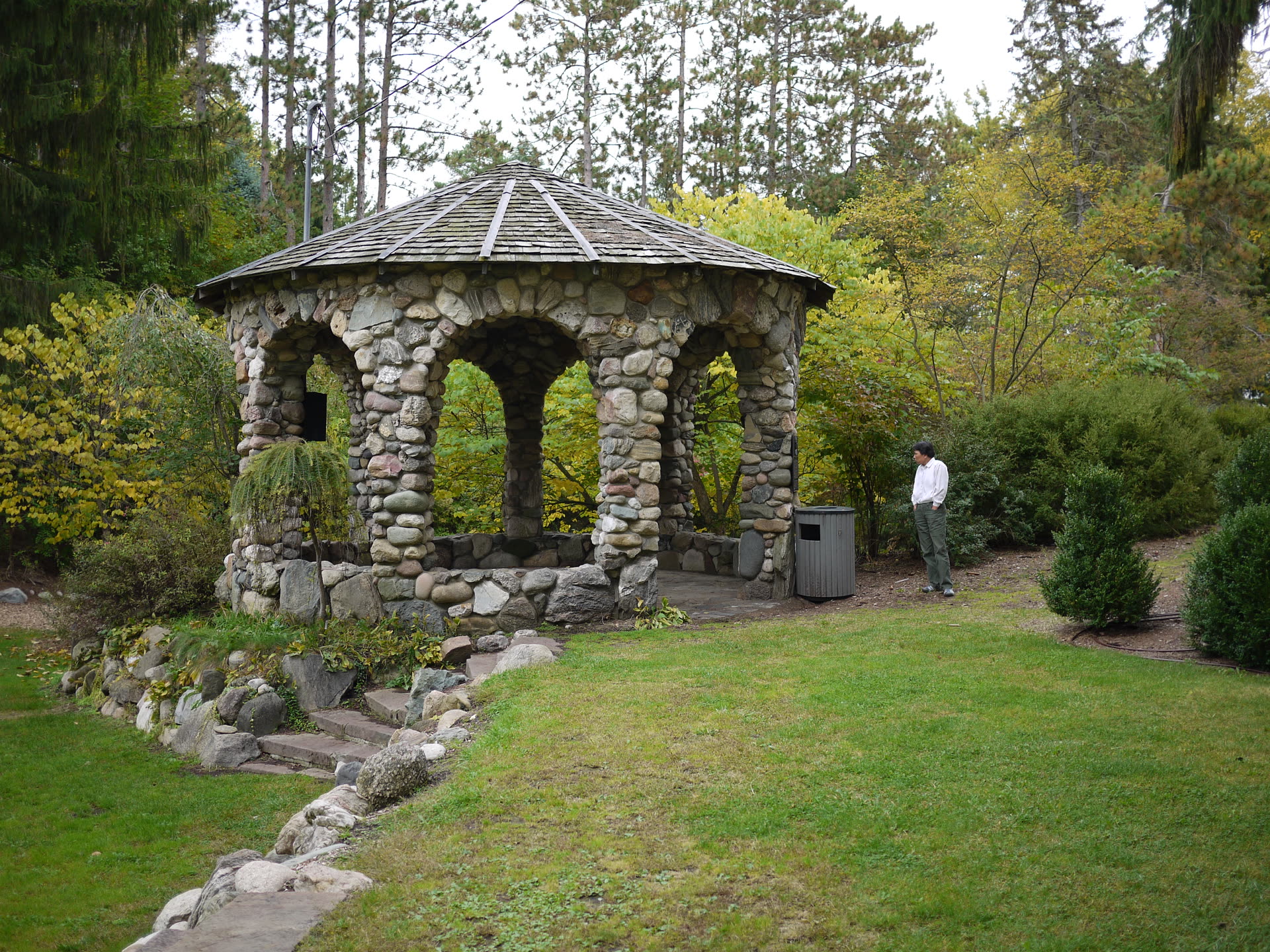
Pictured: the Slayton Arboretum, the wooded, swampy tract adjoining the Hillsdale College campus over which 87 women in McIntyre Residence Hall watched a glowing object for roughly four hours on March 21, 1966 — not the object itself. No photograph of either the Dexter or Hillsdale object is known to be rights-clear: Deputy David Fitzpatrick's March 16 photographs of lights near Milan remain in newspaper-archive custody with no confirmed public-domain or Creative Commons release, and Hynek himself dismissed those particular frames as the Moon and Venus. This Wikimedia Commons photograph (CC BY-SA 2.0, F. D. Richards) is used instead to honestly show the actual terrain at the center of the case's most famous sighting.
Theoretical Alignment
The case aligns most strongly with a mixed psycho-social/misidentification framework layered on top of at least one or two genuinely anomalous stimuli: the sheer number of independent, credentialed witnesses across two separate nights argues against pure fabrication or delusion, but the absence of any radar, photographic, or instrumented corroboration, combined with real, still-unresolved candidate misidentifications (bright stars low on the horizon, a possible prank, and the demonstrated human tendency toward socially reinforced observation once a "UFO flap" is already underway), keeps the Extraterrestrial Hypothesis a live but minority-weighted explanation rather than a leading one.
Background
By March 1966, the American UFO phenomenon had already survived nearly two decades of on-and-off Air Force study under Project Blue Book, the low-budget, chronically under-resourced investigative office headquartered at Wright-Patterson Air Force Base and, since 1963, run by Major (later Lieutenant Colonel) Hector Quintanilla. Blue Book's public mandate was narrow and defensive: determine whether reported sightings posed any threat to national security, and close as many cases as possible under conventional, mundane explanations. Its part-time scientific consultant since 1952 was Dr. J. Allen Hynek, an astronomer at Northwestern University's Dearborn Observatory who had joined the project as a professional skeptic and, by his own later account, spent most of the 1950s dutifully explaining away sightings with only occasional private unease about the ones that did not fit.
Southern Michigan in the mid-1960s was solidly rural and small-town outside Detroit and Ann Arbor: Dexter Township, in Washtenaw County, was farm country dotted with wetlands and second-growth woodlots; Hillsdale, sixty road miles south, was a small liberal-arts college town anchored by Hillsdale College, a private institution then (as now) known for its traditionalist curriculum and strict, closely supervised residential life for its women students, who lived under dormitory curfews and the direct daily authority of the college's dean of women and campus civil-defense apparatus. Both places had exactly the kind of quiet, low-density, agrarian geography in which a genuinely novel aerial phenomenon would draw immediate, sustained attention from exactly the people whose job was to notice things out of place: police officers on rural patrol routes and dormitory residents with an unobstructed view of dark countryside outside their windows.
The specific week of the Michigan sightings did not begin in a vacuum. Washtenaw County sheriff's deputies had already logged unusual aerial reports as early as March 14, six days before the Dexter incident, and by March 17 multiple law-enforcement observers in neighboring counties, plus deputies as far away as Sylvania, Ohio, and even personnel connected to Selfridge Air Force Base, had reported fast-moving, color-changing lights performing maneuvers inconsistent with any aircraft or celestial body they could identify. The stage was already set, in other words, for an intensely publicized regional "flap" before the two mass sightings that would make the case famous even occurred.
Complete Timeline
| Date | Event |
|---|---|
| March 14, 1966 (pre-dawn) | Washtenaw County sheriff's deputies report four objects moving erratically over Lima Township, southwest of Ann Arbor — the opening report of the flap. |
| March 16, 1966 (3–7 AM) | Deputy David Fitzpatrick and Sergeant Nuel Schneider observe lights over Milan and take two tripod photographs; Hynek later attributes the images to the Moon and Venus. |
| March 17, 1966 | Additional sheriff's deputies report four hovering, multi-colored objects; sightings also reported by Ohio police and personnel connected to Selfridge Air Force Base. |
| March 20, 1966, ~8:30 PM | Farmer/truck driver Frank Mannor and his teenage son Ronald, alerted by barking dogs, observe a pyramid- or football-shaped object with red, white, and blue-green lights hovering roughly 500 yards away over swampland on their Dexter Township farm. |
| March 20, 1966 (evening) | Dexter Chief of Police Robert Taylor, Patrolmen N.G. Lee and Robert Hunawill, Sheriff Douglas Harvey, and Deputies Stanley McFadden and Fitzpatrick respond; roughly 40–60 people, including 12 sworn officers, converge on the swamp and independently report lights and movement. |
| March 21, 1966, ~9:00–10:30 PM | Sixty miles south, residents of McIntyre Residence Hall at Hillsdale College spot a glowing, pulsating object over the swampy Slayton Arboretum and alert Civil Defense Director William "Bud" Van Horn. |
| March 21–22, 1966 (overnight, until ~5:10 AM) | Approximately 87 students, Van Horn, and Hillsdale police officers Harold Hess and Jerry Wise watch the object intermittently for roughly four hours; several students write contemporaneous notes. |
| March 22–23, 1966 | National wire coverage explodes; Michigan Congressman Weston Vivian, whose district included Dexter, formally requests Air Force assistance through Project Blue Book. Dr. J. Allen Hynek is dispatched and arrives in Michigan on March 23, touring both sighting sites and describing the public mood as "near hysteria." |
| March 25, 1966 | Hynek holds a press conference at the Detroit Press Club before roughly 60 reporters, the largest in the club's history to that point. He states that decomposing marsh gas ("swamp gas") is a plausible explanation for some of the Dexter lights, while stressing he cannot prove it "in a court of law" and that it does not explain every report. |
| March 25–28, 1966 | Wire services and headline writers compress Hynek's hedged statement into a single word — "swamp gas" — triggering nationwide ridicule of both Hynek and the Air Force. Van Horn publicly rejects the explanation and begins compiling a 15-point rebuttal. |
| March 28, 1966 | Congressman Gerald R. Ford, House Minority Leader, issues a public statement calling the swamp gas explanation inadequate and demanding "a full committee investigation" of the Michigan sightings. |
| April 3, 1966 | Ford issues a second, more detailed statement reiterating his call for hearings, stating the public deserved "a better explanation" than the Air Force had offered. |
| April 5, 1966 | The House Committee on Armed Services, chaired by Rep. L. Mendel Rivers, holds the first open Congressional hearing devoted to UFOs. Secretary of the Air Force Harold Brown, Major Hector Quintanilla, and Hynek testify; Hynek breaks with Air Force messaging to call the existing investigative approach a "poverty of hypotheses" and urges an independent civilian scientific study. |
| May 10, 1966 | CBS Reports, anchored by Walter Cronkite, airs "UFO: Friend, Foe or Fantasy?," featuring the Michigan sightings prominently. |
| October 1966 | Acting on the Air Force Scientific Advisory Board's O'Brien Committee recommendation (itself accelerated by the Michigan controversy and hearing), the Air Force contracts with the University of Colorado to conduct an independent scientific study under physicist Edward U. Condon. |
| 1968 | The Condon Report is issued; its treatment of the Hillsdale sighting speculates that student observers may have mistaken young men playing a prank with flares, among other candidate explanations. |
| 1969 | Project Blue Book is officially closed following the Condon Report's conclusion that further study was not warranted. |
| 1973 | Hynek founds the Center for UFO Studies (CUFOS), formalizing his post-1966 turn toward independent, sympathetic UFO research. |
| 1983 | Frank Mannor dies in Dexter at age 65, having told CBS's Walter Cronkite years earlier that he regretted ever reporting what he saw. |
| 1985 | Hynek tells Omni magazine: "I was a thorough skeptic, and I'm afraid I helped to engender the idea that it must be nonsense, therefore it is nonsense." |
| 2017 | Sheriff Douglas Harvey, interviewed decades later by the Ann Arbor News/MLive, recalls Hynek privately admitting uncertainty before a phone call to Washington preceded the swamp gas statement: "They did see something. I'll believe this to the day I die." |
The Build-Up: A Flap Already in Progress
The events that made national headlines on March 20 and 21 did not erupt from nowhere. Washtenaw County had logged unusual sightings for nearly a week beforehand. In the predawn hours of March 14, sheriff's deputies patrolling Lima Township, southwest of Ann Arbor, watched four objects "swing back and forth like a pendulum, then shoot upward," in the words of one deputy's report — language that would recur, with variations, across nearly every account that followed. Two nights later, on March 16, Deputy David Fitzpatrick and Sergeant Nuel Schneider spent almost four hours, from roughly 3 to 7 a.m., watching lights over Milan and managed to set up a small tripod camera and take two photographs. On March 17, still more deputies reported four hovering, color-shifting objects, and similar independent reports came in from police across the Ohio state line near Sylvania and from personnel with connections to Selfridge Air Force Base near Mount Clemens. By the time Frank Mannor walked into his swamp on the evening of March 20, southern Michigan's law-enforcement community had already spent a week fielding calls about lights that did not behave like airplanes, satellites, or any conventional aircraft anyone could name.
The Dexter Encounter
Frank Mannor, a 47-year-old truck driver, and his son Ronald were at their farmhouse in Dexter Township on the evening of March 20, 1966, when their dogs began barking insistently. Stepping outside, Mannor first noticed what he described as a red "falling star" that, rather than continuing to fall, leveled off and began to hover above the swampy woodlot roughly 500 yards from the house. As he and Ronald approached on foot, the object resolved into something far stranger than a meteor: a shape Mannor variously described as "sort of like a pyramid," "flat on the bottom and kind of high and peaked at the top," with a surface texture he compared to "yellowish coral rock" or corrugated cardboard, marked with what looked like holes or indentations. Lights on the object shifted between blue-green, white, and red as it sat low over the marsh, occasionally winking out and reappearing in a slightly different spot nearby, almost as though it were hopping across the wetland rather than continuing to fly.
Mannor called the Washtenaw County Sheriff's Department, and what followed was, by any measure, one of the largest simultaneous law-enforcement responses to a UFO report in American history to that point. Dexter Chief of Police Robert Taylor and Patrolman N.G. Lee arrived and personally observed the phenomenon from the farm. Patrolman Robert Hunawill, en route to the scene in his squad car, separately reported that the object appeared to fly directly over his vehicle. Sheriff Douglas Harvey dispatched Deputies Stanley McFadden and David Fitzpatrick, who went into the swamp itself on foot to get a closer look; McFadden and Fitzpatrick together with the other officers made up twelve sworn law-enforcement witnesses among the roughly 40 to 60 people who converged on the Mannor property that night. As the crowd grew, the object reportedly departed at high speed, producing, in Mannor's words, "a sound like a rifle bullet ricocheting off" something metallic. When Hynek later toured the site with Sheriff Harvey, he examined circular marks pressed into the swamp vegetation at the reported hover location — marks whose origin was never conclusively established either way.
The Wider Flap: Beyond Dexter and Hillsdale
Although Dexter and Hillsdale became the two mass sightings that made national news, they were the concentrated core of a much broader regional wave rather than isolated events. In the same general window, additional reports of unusual aerial lights came in from Milan (where Deputy Fitzpatrick took his March 16 photographs), Bad Axe, Flint, Holland, and from Macomb and Oakland counties in the Detroit metropolitan area, as well as continuing reports around Ann Arbor itself. Michigan newspapers and wire editors, primed by a week of escalating coverage, treated each new report as part of a single continuous story, which in turn likely encouraged still more observers to interpret ordinary nocturnal lights — aircraft, planets, or agricultural and utility equipment — through the lens of an active "UFO flap." This dynamic does not, by itself, explain the specific, detailed, multi-witness accounts at Dexter and Hillsdale, but it is essential context for understanding why a single truck driver's report on a Dexter farm on March 20 was capable of generating a Congressional hearing barely two weeks later: by the time Ford and Vivian intervened, they were responding not to one isolated sighting but to what looked, from Washington, like a fast-escalating regional phenomenon with no end in sight.
The Hillsdale College Sighting
Barely twenty-four hours later and roughly sixty miles to the south, an almost identical phenomenon appeared over the Slayton Arboretum, the wooded, pond-dotted 14-acre tract immediately adjoining the campus of Hillsdale College. Around 9 to 10:30 p.m. on March 21, residents of McIntyre Residence Hall — a women's dormitory with a clear view across the arboretum — noticed intense, pulsating lights hovering low over the swamp. Student Gidget Kohn, who wrote a first-person account just three days after the sighting, described "a glow around it" with lights that "appeared to be pulsating," while classmate Josephine Evans recalled the moment the dormitory first "spotted what appeared to be this strange light in the arb." The students called Hillsdale County Civil Defense Director William "Bud" Van Horn, who came to campus, observed the object through binoculars himself, and stayed on the scene for hours; city police officers Harold Hess and Jerry Wise likewise responded and independently corroborated what the students were seeing, with Hess recalling: "Then, over by the college, we saw a real brilliant light in the sky at a low altitude."
What distinguished the Hillsdale sighting from Dexter's brief, chaotic encounter was its sheer duration and the number of simultaneous, independent vantage points: roughly 87 women, watching from dozens of individual dormitory windows over a period that stretched, with the object periodically disappearing and returning, until nearly 5:10 the following morning. Several students kept notes as the sighting unfolded rather than relying on memory after the fact — an unusually rigorous piece of amateur documentation for a UFO report of that era. The object was most often described as a "squashed football" or basketball shape, glowing intensely, its lights cycling between white, yellow, and red. Unlike Dexter, no ground marks or landing evidence were reported at Hillsdale; the phenomenon here was purely aerial and purely visual, but corroborated by an extraordinarily large and geographically dispersed set of simultaneous witnesses within a single institution.
Dr. Hynek's Arrival and Field Investigation
With sightings now spanning two separate mass events in a single week and continuing reports from surrounding counties, Michigan Congressman Weston Vivian, whose district included Dexter, formally asked the Air Force to send an investigator. Project Blue Book dispatched its longtime scientific consultant, Dr. J. Allen Hynek, who arrived in Michigan on March 23 and spent roughly two days touring both the Dexter farm and the Hillsdale campus, interviewing witnesses and, by his own account afterward, encountering something close to "near hysteria" in the surrounding communities. According to Sheriff Douglas Harvey, who spoke with Hynek privately in the sheriff's office during the visit, Hynek initially expressed genuine uncertainty rather than dismissal, telling Harvey, "There is something. We just can't put our finger on it." Harvey's account, repeated consistently in interviews given decades later, holds that Hynek's tone shifted only after placing a phone call to his contacts in Washington — after which he emerged prepared to offer marsh gas as an explanation. Harvey never accepted the reversal at face value: "They did see something," he told a reporter in 2017, more than fifty years after the events. "I'll believe this to the day I die."
The March 25 Press Conference and the "Swamp Gas" Statement
On March 25, Hynek held a press conference at the Detroit Press Club before what was, by multiple accounts, the largest assembled press corps in the club's history — roughly 60 reporters, reflecting just how large the story had already become nationally. His actual statement was considerably more hedged than the phrase that would define the rest of his career: he suggested that "marsh gas," a natural phenomenon caused by methane and other gases released from decomposing vegetation in stagnant wetlands, was a plausible explanation for at least some of what had been reported at Dexter, while explicitly cautioning reporters that he "cannot prove in a court of law" that this explained the sightings and that it did not account for every report he had investigated that week. He separately dismissed Deputy Fitzpatrick's March 16 photographs as depictions of the Moon and Venus, and, according to at least one account, remarked dismissively of a UFO-themed magazine shown to him that it "looked like a chicken breeder."
None of Hynek's qualifications survived contact with the wire services. Headline writers across the country compressed a nuanced, partial, hedged statement into two words, and "swamp gas" instantly became shorthand for official contempt toward ordinary citizens who had, in many cases, put their names and professional reputations on the record. Historian Curtis Peebles would later describe the episode as "a critical event in the history of the flying saucer myth" — not because of what actually happened in the Michigan swamps, but because of what the phrase did to public trust in the Air Force's UFO program going forward.
The Backlash: Press, Public, and Van Horn's Rebuttal
The reaction was immediate and almost universally hostile. Van Horn, still convinced by what he had personally observed at Hillsdale, published a detailed fifteen-point rebuttal challenging Hynek's methodology and conclusions, later stating flatly: "It was my considered opinion that Dr. Hynek had his mind made up as to what his findings would be before he ever reached the City of Hillsdale," and separately complaining that "his main line of questioning was relative only to that which would fit the Marsh Gas Theory." Frank Mannor, who had served in Louisiana during his military years and had personally encountered real swamp gas there, found the comparison unconvincing and said so publicly. Sheriff Harvey called it "this weak excuse of gas from marshes." Newspapers nationwide ran the story as farce; cartoonists had a field day; and Hynek himself later recalled that "swamp gas became a household word and a standard humorous synonym for UFOs. UFOs, swamp gas, and I were lampooned in the press and were the subjects of many a delightful cartoon."
Congressman Gerald Ford's Intervention
The controversy reached Washington within days. Congressman Gerald R. Ford of Michigan's 5th district, then serving as House Minority Leader, issued a public statement on March 28, 1966, rejecting the Air Force's explanation as inadequate and calling the handling of the case "flippant." He stated that "the American people would feel better if there was a full-blown investigation of these incidents" and formally proposed a Congressional inquiry into UFO phenomena, telling reporters: "I have proposed that there be a congressional investigation of UFO's. Let's try to get to the bottom of this thing." Ford followed up with a second, more detailed statement on April 3 reiterating the demand. Fellow Michigan Congressman Weston Vivian, whose constituents had lived through the Dexter sighting directly, joined Ford's call. The Air Force initially resisted, but the political pressure — from the House Minority Leader, no less — proved impossible to ignore entirely.
The April 5, 1966 House Armed Services Committee Hearing
Exactly eleven days after Hynek's press conference, the House Committee on Armed Services, chaired by Rep. L. Mendel Rivers of South Carolina, convened the first open Congressional hearing devoted to UFOs in American history. Secretary of the Air Force Harold Brown testified first, reiterating the Air Force's institutional position that no evidence existed that UFOs represented either a national security threat or extraterrestrial visitation. Major Hector Quintanilla, Blue Book's chief, made no substantive independent statement of his own. It was Hynek's testimony that proved historically consequential: breaking visibly with the Air Force line he had spent fourteen years defending, he told the committee that the existing investigative approach — in which virtually every case was eventually assigned some conventional explanation regardless of fit — amounted to a "poverty of hypotheses," and he formally recommended that a panel of civilian scientists, independent of the Air Force, be empowered to study the phenomenon properly. It was the first time in the program's history that its own scientific consultant had publicly asked Congress to take the subject more seriously than his employer wanted it taken.
From the O'Brien Committee to Condon: The Institutional Aftermath
Hynek's call did not happen in isolation. Weeks earlier, in February and March 1966, the Air Force Scientific Advisory Board had already convened an ad hoc committee under physicist Dr. Brian O'Brien to review Project Blue Book's methods, motivated in large part by the same rising wave of publicized sightings that produced the Michigan case. The O'Brien Committee's report recommended that the Air Force contract with university-based scientific teams for more rigorous study than Blue Book's small internal staff could provide. The convergence of the O'Brien recommendation, the public fallout from "swamp gas," and Ford's Congressional pressure gave the Air Force little room to simply wait out the controversy. In October 1966, the Air Force signed a contract with the University of Colorado to conduct an independent scientific investigation under physicist Edward U. Condon — the project that would become known as the Condon Committee, whose 1968 report ultimately concluded that further concentrated study of UFOs was not likely to be justified, and which directly enabled the Air Force to close Project Blue Book altogether in December 1969. The Condon Report's own brief discussion of the Hillsdale sighting speculated that student witnesses may have observed a prank involving flares set off by young men near the arboretum — a specific, testable hypothesis, though never definitively confirmed. In an almost straight line, then, the Michigan swamp gas fiasco produced the O'Brien Committee's institutional pressure, Ford's Congressional hearing, the Condon Committee, and ultimately the end of official U.S. government UFO investigation for the better part of the next five decades.
Hynek's Transformation and Later Reflections
For Hynek personally, the Michigan case marked a turning point that took years to fully manifest but that he himself repeatedly identified as decisive. Speaking to Omni magazine in 1985, nearly two decades after the fact, he offered one of the most candid admissions of his career: "I was a thorough skeptic, and I'm afraid I helped to engender the idea that it must be nonsense, therefore it is nonsense." A Hillsdale College professor who later took a class with Hynek at Northwestern reported, secondhand, that Hynek privately confided he had no genuine explanation for what the witnesses saw at all, but that the Air Force kept pressuring him for one, and that he ultimately offered what he considered the single most implausible, easily dismissed explanation he could think of — expecting it to be rejected outright rather than adopted as a serious finding. Whatever the precise internal calculation, the public humiliation that followed measurably accelerated Hynek's drift away from institutional skepticism. He developed the Close Encounter classification system (CE1 through CE3) still used across ufology today, founded the Center for UFO Studies (CUFOS) in 1973 as an independent, non-military research organization, and by 1977 was stating publicly, without qualification: "I do believe that the UFO phenomenon as a whole is real." Few single incidents in the history of American UFO research can be traced as directly to a single scientist's complete change of professional direction as Michigan 1966 can be traced to Hynek's.
A Contested Later Claim: F-106 Interceptor Pilots
In 2021, retired U.S. Air Force senior scientist and engineer Raymond Szymanski published Swamp Gas My Ass: Alien Shades of Greys, asserting a far more dramatic dimension to the same flap: that two Air National Guard F-106 Delta Dart interceptor pilots, whom he names as Colonel Gary K. Carroll and a wingman he identifies as Robert Nicholson, were scrambled and visually intercepted one of the objects over southeastern Michigan during the same period, based on more than 30 hours of interviews with Carroll, the pilots' military service records (DD-214s), and a document Szymanski describes as a formerly classified NSA "Top Secret Umbra" record. No portion of this claim appears in the Wikipedia summary, the contemporaneous 1966 press coverage, the Condon Report, or any of this file's other sourcing, and the alleged NSA document itself has not been independently published or verified by this file's research. It is presented here strictly as a single researcher's claim, not as an established fact, and it is explicitly excluded from this case's credibility scoring pending independent corroboration — a live illustration of how much contested, unverifiable material continues to accumulate around this case even sixty years later.
Aftermath for the Witnesses
The human cost of national ridicule fell heaviest on the ordinary people who had reported what they saw in good faith. Frank Mannor endured sustained public mockery, unwanted visitors, and, according to family accounts, harassment and vandalism at his farm in the years that followed. In an interview with Walter Cronkite for CBS, a clearly weary Mannor said he had come to regret ever making the report at all: "If an alien landed in my yard, I would never tell anyone." He died in Dexter in 1983 at age 65. At Hillsdale, many of the young women who had watched the object for hours went on with their lives having had their credibility publicly mocked by a federal scientific consultant; journalists who have attempted to track down surviving witnesses in recent years have generally found them unwilling to revisit the subject even six decades later, a lingering wariness that itself speaks to how deep the 1966 backlash actually cut.
Key Witnesses
Frank Mannor
Alerted by barking dogs on the evening of March 20, 1966, Mannor and his teenage son Ronald approached a hovering, pyramid-shaped object with shifting red, white, and blue-green lights roughly 500 yards from their farmhouse. Mannor's detailed, consistent description — a "coral"-textured surface, a whistling departure "like a rifle bullet ricocheting," and his own explicit, informed rejection of the swamp gas explanation based on real swamp gas he had witnessed during military service in Louisiana — anchors the entire Dexter incident. He was the report's original source, its most publicly identifiable face, and ultimately its most visible casualty: he told Walter Cronkite years later that he regretted ever having reported it, and he died in 1983 having never recanted what he originally described.
Sheriff Douglas Harvey
Commanded the law-enforcement response to the Dexter sighting and personally toured the swamp with Hynek during the investigation. Harvey's decades-later recollections — that Hynek privately told him "There is something. We just can't put our finger on it" before a phone call to Washington preceded the public swamp gas statement — are among the most consequential secondhand accounts in the entire case, directly raising the possibility that political or institutional pressure, not scientific analysis, produced the final explanation. Harvey never wavered from his own conclusion, telling a reporter in 2017: "They did see something. I'll believe this to the day I die."
William "Bud" Van Horn
Called to campus by McIntyre Hall residents on the night of March 21, Van Horn personally observed the object through binoculars for an extended period and remained the case's most persistent institutional critic of Hynek's investigation. His self-published 15-point rebuttal directly accused Hynek of predetermining his conclusion before conducting the Hillsdale interviews: "It was my considered opinion that Dr. Hynek had his mind made up as to what his findings would be before he ever reached the City of Hillsdale." As the one credentialed local official present for the entire multi-hour Hillsdale sighting, his testimony carries particular institutional weight.
Gidget Kohn
A resident of McIntyre Residence Hall, Kohn wrote a first-person account of the sighting just three days after it occurred — an unusually early, low-contamination record for a UFO witness statement. She described "a glow around it" with lights that "appeared to be pulsating," and later recalled the object's changing colors in detail: "the middle light turned red" as the sighting progressed. Her contemporaneous notes, along with those kept by several dormitory neighbors, form part of the small body of near-real-time written documentation available for the Hillsdale event.
Dr. J. Allen Hynek
Dispatched by the Air Force to investigate both mass sightings, Hynek is simultaneously the case's central authority figure and one of its most important witnesses to the investigation's own internal contradictions. His actual public statement was a hedged, partial suggestion that marsh gas explained "some" of the Dexter reports; the press reduced it to a punchline that followed him for the rest of his career. He later admitted his own complicity in the ridicule that followed ("I was a thorough skeptic...") and, within a decade, had become the field's most credentialed advocate for taking the phenomenon seriously, founding CUFOS and developing the Close Encounter classification system still in use today. Cross-case connection: Hynek went on to investigate the Coyne Helicopter Incident and numerous other landmark cases as an independent researcher rather than an Air Force gatekeeper — a direct professional legacy of the credibility crisis Michigan created for him.
Congressman Gerald R. Ford
Though not a witness to either sighting, Ford's political intervention is arguably the case's single most consequential downstream effect. As the sitting House Minority Leader, his public demand for a "full-blown investigation" and his explicit characterization of the swamp gas explanation as "flippant" gave the controversy an institutional weight no individual witness could have generated alone, directly producing the April 5, 1966 House Armed Services Committee hearing. Ford would go on to become the 38th President of the United States in 1974, making Michigan 1966 one of the earliest instances of a future U.S. president taking a public, on-the-record position on UFO policy.
The Five Observables Assessment
The Five Observables framework, developed from modern U.S. Navy pilot encounters, is applied here retroactively and with appropriate caution given the case's purely visual, six-decades-old nature:
Assessment: The Michigan case satisfies only one of the Five Observables with any confidence — low observability, in the specific sense that no radar station ever corroborated an object dozens of credentialed witnesses were simultaneously watching with the naked eye. Reported hovering and a fast, abrupt departure at Dexter are consistent with, but do not confirm, exotic propulsion; they are equally consistent with an unidentified light source subject to normal atmospheric distortion and the psychological tendency to perceive movement and structure in an ambiguous nocturnal light once a "flap" atmosphere already exists. No instrumented data of any kind exists to elevate any of these observables beyond speculation.
Evidence Assessment
Supporting Anomalous Origin
- Twelve sworn law-enforcement officers, none seeking publicity, independently corroborated the Dexter sighting the same night
- 87 Hillsdale College residents plus a civil defense director and two police officers watched the same object from dozens of independent vantage points for roughly four hours
- Several witnesses (Kohn and dormitory neighbors) produced contemporaneous written notes rather than relying on memory after the fact
- Frank Mannor had direct personal experience with actual swamp gas from his military service and explicitly rejected the comparison as inapplicable
- Sheriff Douglas Harvey's account that Hynek privately expressed genuine uncertainty before a phone call to Washington preceded the public swamp gas statement raises a real, unresolved question about whether institutional pressure rather than scientific analysis produced the final explanation
- Weather conditions on at least one night (high winds) are cited by researchers as inconsistent with the stable atmospheric conditions typically required for visible marsh-gas ignition
- The Slayton Arboretum's managed, partly cultivated character makes it a comparatively weak candidate for genuine methane accumulation compared to a true stagnant bog
Supporting Conventional Explanation
- Every account is purely visual; no radar, photographic, or instrumented corroboration exists for either mass sighting
- The Condon Report specifically raised a documented, testable alternative for Hillsdale — a possible prank involving flares set off by young men near the arboretum
- Deputy Fitzpatrick's own photographs from March 16, taken with the same equipment and methodology used during the flap, were identified by Hynek as ordinary depictions of the Moon and Venus, demonstrating that misidentification of celestial bodies genuinely occurred during this specific flap
- The claimed elevated-radiation/boron soil and water test results have no confirmed laboratory name, chain of custody, or peer-reviewed publication after sixty years, and cannot be independently verified
- Mass psychological contagion is a well-documented phenomenon in sighting "flaps," where a week of prior regional reports and heavy media coverage plausibly primed hundreds of observers to interpret ambiguous lights as related, structured, and anomalous
Why "Disputed"
The Michigan swamp gas wave earns a DISPUTED classification because it combines an unusually large, occupationally diverse body of credentialed, on-the-record witnesses with a complete absence of any instrumented, physical, or radar corroboration, and because the leading conventional explanation actually offered at the time — Hynek's marsh gas hypothesis — was widely regarded as inadequate even by contemporaries, by Hynek's own later admission, and by basic meteorological objections (high winds, non-boggy terrain at Hillsdale) that were never satisfactorily addressed. At the same time, more plausible mundane alternatives genuinely exist and were never definitively ruled out: the Condon Report's prank-with-flares hypothesis for Hillsdale, demonstrated celestial misidentification during the same week (the Fitzpatrick photographs), and the well-established dynamics of mass sighting "flaps" amplifying ambiguous stimuli into structured, corroborated-seeming reports. What is not disputed is the case's historical consequence: it produced the first open Congressional hearing on UFOs, accelerated the Air Force's own internal review process, helped bring about the Condon Committee, and triggered one of the most complete professional transformations of any scientist in UFO history. The evidentiary picture remains genuinely contested; the case's institutional impact does not.
Sensor & Instrumentation Detection Profile
No radar station, military or civilian, ever logged a corroborating target during either the Dexter or Hillsdale sightings themselves. Personnel connected to Selfridge Air Force Base reportedly confirmed awareness of the visual reports circulating that week but did not detect a matching return on base radar over Dexter or Hillsdale specifically. A separate, tantalizing but unconnected data point comes from Monroe County, where the sheriff's office contacted Selfridge directly during the same general flap and was told the base did have "uncorrelated targets" showing over Lake Erie at the time — a genuine radar anomaly, but one geographically distinct from, and never definitively linked to, the Dexter or Hillsdale sightings. Deputy Sheriff David Fitzpatrick used a handheld camera on a tripod to photograph lights over Milan on March 16, but Hynek attributed those specific frames to the Moon and Venus, and no instrument beyond the naked eye and standard 1960s consumer cameras was deployed at either mass sighting.
Environmental & Geospatial Context
Both incidents occurred over low, swampy, sparsely populated terrain in southern Michigan in late winter: a wooded marsh on the Frank Mannor farm in Dexter Township, Washtenaw County, and the Slayton Arboretum, a partly cultivated 14-acre tract of ponds and specimen trees immediately adjoining the Hillsdale College campus in Hillsdale County. Skeptics have specifically noted that at least one of the two nights carried high winds strong enough to make a stationary combustion or gas-ignition phenomenon meteorologically difficult to sustain, and that the Hillsdale Arboretum, being managed parkland rather than a true stagnant bog, is a comparatively poor candidate for methane accumulation in the first place.
Observer Credibility & Occupational Profile
The case's evidentiary weight rests almost entirely on witness volume and occupational diversity rather than instrumentation: Dexter Township Police Chief Robert Taylor, Patrolman N.G. Lee, Patrolman Robert Hunawill, Washtenaw County Deputy Sheriffs Stanley McFadden and David Fitzpatrick, and Sheriff Douglas Harvey himself were among the twelve sworn officers present at the Mannor farm on March 20. At Hillsdale, Hillsdale County Civil Defense Director William "Bud" Van Horn and city police officers Harold Hess and Jerry Wise corroborated the college students' account independently. None were compensated, none sought media attention beforehand, and several — particularly Harvey and Van Horn — remained on record decades later maintaining they had witnessed something genuinely unexplained.
Physical & Material Assays
Beyond testimony, the only claimed physical evidence is a set of soil, water, and vegetation samples reportedly collected near the Dexter swamp shortly after the March 20 sighting and sent to an outside laboratory. UFO-focused retrospectives (not a peer-reviewed source) report the results showed above-normal radiation and elevated boron content in the soil and pond water, dead microscopic organisms in the water, and damaged plant pigment nearby. No chain-of-custody documentation, laboratory name, or peer-reviewed write-up of this testing has surfaced in the sixty years since, and it should be treated as an unverified claim repeated in UFO literature rather than an established forensic finding — a caveat this file treats with the same seriousness as the sighting claims themselves. See Material Analysis below.
Historical Precedents & Archive Matches
The Michigan wave sits inside a much larger national UFO "flap" already underway in early 1966, and it directly precedes and helped trigger the U.S. Air Force's Ad Hoc Committee to Review Project Blue Book (the "O'Brien Committee," February–March 1966), the April 5, 1966 House Armed Services Committee hearing, and ultimately the University of Colorado's federally funded UFO study (the Condon Committee, 1966–1968) — making it one of the small handful of sighting waves in UFO history with a direct, documented, traceable line to formal U.S. government policy response.
Material Analysis
Unlike crash-retrieval cases with recovered debris, the Michigan wave produced no artifact of any kind. The only claimed physical evidence consists of soil, water, and vegetation samples reportedly collected near the Dexter swamp in the days after March 20 and sent to an outside laboratory for testing. Secondary UFO-focused sources describe the reported results as showing above-normal radiation and elevated boron content in both soil and pond water, complete die-off of microscopic aquatic organisms, and visible pigment damage in nearby plant life. No primary laboratory report, named testing facility, or peer-reviewed analysis of these claims has ever surfaced, and this file treats the claim as an unverified, second-hand assertion repeated within UFO literature rather than an established forensic finding — the same evidentiary standard applied to every other unverifiable claim in this case.
Separately, Hynek personally examined circular depressions in the swamp vegetation at the Dexter site during his March 23–25 visit. These marks were never analyzed by an independent botanist, soil scientist, or the Air Force's own materials specialists, and their cause — whether mechanical, biological, human-made, or otherwise — was never conclusively determined in either direction.
Supporting Non-Terrestrial or Unexplained Origin
- Reported radiation/boron anomalies, if genuine, would exceed what marsh gas or ordinary decomposition would produce
- Circular ground marks at the Dexter site were never conclusively attributed to a conventional cause
- The sheer geographic spread and rapid succession of independent reports (Lima Township, Milan, Dexter, Hillsdale, all within one week) is difficult to fully explain through misidentification alone
Supporting Terrestrial/Conventional Origin
- The soil/water testing claims lack any verifiable chain of custody, laboratory identification, or published methodology
- No independent scientific body has ever reviewed or replicated the claimed test results
- Ground marks in soft, seasonally wet swamp vegetation are consistent with numerous mundane causes (foot traffic from the dozens of on-scene investigators themselves, animal activity, or natural marsh subsidence) that were never systematically excluded
The Conventional Explanation Candidate: Marsh Gas ("Swamp Gas")
The official, historically famous explanation is the one Hynek himself offered at the March 25, 1966 press conference: naturally occurring methane and other gases released from decomposing vegetation in stagnant wetlands, occasionally self-igniting or catching ambient light in ways that could produce moving, color-shifting points of light. It deserves serious evaluation only because it is the explanation that actually shaped fifty years of public discourse about this case, not because the evidence particularly supports it. Hynek's own qualification — that he could not prove it "in a court of law" and that it explained only some of the reports — was accurate: genuine marsh gas ignition typically produces small, localized, flickering flames rather than a large, structured, maneuvering object with distinct red, white, and blue-green lights capable of covering hundreds of yards. Skeptics and witnesses alike raised the same objection at the time: reported high winds on at least one of the two nights would have made stable gas accumulation and visible ignition meteorologically implausible, and the Slayton Arboretum at Hillsdale — managed parkland with ponds rather than a true stagnant bog — is a weak candidate for significant methane production in the first place.
Prank or Misidentification (the Condon Report's Hillsdale Hypothesis)
The 1968 Condon Report, reviewing the case two years after the fact, offered a more specific and more testable alternative for the Hillsdale sighting: that the young women watching from McIntyre Hall may have observed young men playing a prank with handheld flares somewhere in or near the arboretum. This hypothesis has the advantage of being mechanically simple and consistent with at least some witness descriptions of color-shifting, intermittent lights, though it was never confirmed by any named participant coming forward, and it does not obviously account for the sighting's four-hour duration or the number of independent, simultaneous vantage points across a large dormitory. A closely related possibility — simple misidentification of bright stars, planets, or aircraft lights low on the horizon, compounded by the psychological priming effect of a week of regional UFO coverage — is supported by the one piece of hard evidence available from elsewhere in the same flap: Hynek's identification of Deputy Fitzpatrick's March 16 photographs as ordinary images of the Moon and Venus, proving that at least some genuine celestial misidentification did occur during this specific wave.
Mass Psychogenic Contagion
A third candidate treats the scale of the Hillsdale sighting specifically as a case of socially reinforced perception: once several dormitory residents reported an anomalous light, subsequent observers — primed by a week of saturating regional media coverage of the Dexter case and genuinely anxious, socially connected young women in a closely supervised residential setting — may have interpreted an ambiguous, ordinary light source (a star, a distant vehicle, or even the original prank) as a large, structured, "squashed football" shape through expectation and mutual reinforcement rather than independent, unbiased observation. This hypothesis explains the case's most striking feature — 87 simultaneous witnesses — without requiring 87 independent misperceptions, but it does not adequately explain the Dexter sighting's law-enforcement corroboration the night before, where officers arriving separately, at different times, from different approach angles, reported broadly consistent details before any comparable "flap" atmosphere had built up around Dexter itself.
Marsh Gas ("Swamp Gas")
ImplausibleIMPLAUSIBLE as a complete explanation. Genuine marsh gas ignition does not typically produce large, structured, maneuvering, multi-colored objects, and the specific meteorological and terrain objections (high winds, non-boggy Hillsdale terrain) were never resolved even by Hynek's own later admissions.
Prank / Celestial Misidentification
InconclusiveINCONCLUSIVE. Mechanically plausible and partially corroborated elsewhere in the same flap (the Fitzpatrick Moon/Venus photographs), but never confirmed by a named participant and does not fully account for the Hillsdale sighting's duration or the Dexter law-enforcement corroboration.
Mass Psychogenic Contagion
InconclusiveINCONCLUSIVE. A credible partial explanation for Hillsdale's unusually large witness count, but weak as an explanation for the Dexter sighting, which involved independently arriving, professionally trained observers before a comparable social "flap" atmosphere existed locally.
Related Cases
Confirmed Documents & Official Records
Full transcript of the first open Congressional hearing on UFOs, featuring testimony from Secretary of the Air Force Harold Brown, Maj. Hector Quintanilla, and Dr. J. Allen Hynek, held in direct response to the Michigan controversy.
National Archives holdings of Project Blue Book's full case files, including the March 1966 Michigan reports and Hynek's field investigation notes.
Then-Congressman Gerald Ford's original 1966 press releases calling for a Congressional investigation of the Michigan sightings, held in his pre-presidential congressional papers.
Search Government Archives Directly
Further Reading — Recommended Literature
Swamp Gas My Ass: Alien Shades of Greys
Written by a retired U.S. Air Force senior scientist/engineer, this is the most focused, dedicated book-length treatment of the case, including the contested claim — based on interviews and a document the author describes as a formerly classified NSA record — that two F-106 interceptor pilots pursued one of the objects. Treat the interception claim as this single researcher's account pending independent corroboration.
The Hynek UFO Report: The Authoritative Account of the Project Blue Book Cover-Up
Hynek's own comprehensive review of Project Blue Book's case files, written after his public break with the Air Force's dismissive approach — essential for understanding how Michigan changed his thinking from the inside.
Watch the Skies! A Chronicle of the Flying Saucer Myth
A rigorous cultural and institutional history of American UFO belief that specifically treats the 1966 swamp gas episode as a pivotal turning point in public trust toward Air Force UFO investigations.
The Close Encounters Man: How One Man Made the World Believe in UFOs
A biography of J. Allen Hynek that devotes substantial attention to the Michigan case as the single most professionally damaging — and, in hindsight, most transformative — episode of his Air Force consulting career.
UFO's: A Scientific Debate
Proceedings of the 1969 AAAS symposium on UFOs, held in the direct institutional aftermath of the Condon Report; contains contemporaneous scientific perspectives on exactly the kind of case Michigan represented.
Essential Viewing

1966 UFO Sightings in Dexter, Michigan — A Mini-Documentary
A focused short documentary covering the Frank Mannor sighting and the Dexter Township law-enforcement response, with archival photographs and local historical context.
Aliens in the Arb: The Incredible Story of the 1966 Hillsdale College UFO Sighting
A dedicated retrospective on the Hillsdale College sighting specifically, covering the McIntyre Hall witnesses, Van Horn's rebuttal, and the Arboretum location itself.
60 Years Later, Hillsdale College UFO Sighting Remains One of the Most Famous Cases
A recent news retrospective marking the sighting's 60th anniversary, revisiting the case's lasting local and national significance.
Sources
- "Michigan 'swamp gas' UFO reports," Wikipedia (summary of published newspaper and archival sources). en.wikipedia.org
- Michigan Enjoyer. "The Women Who Saw a UFO in 1966 Won't Talk About It." enjoyer.com
- ClickOnDetroit/WDIV. "'I'll believe this to the day I die': A look back at the Michigan UFO craze of 1966." clickondetroit.com
- The Black Vault. "Gerald Ford Pushes for Congressional UFO Hearings in 1966" (Gerald R. Ford Presidential Library document archive). theblackvault.com
- Gerald R. Ford Presidential Library and Museum. Congressional Papers, Box D6, "Ford Press Releases — UFO, 1966." fordlibrarymuseum.gov
- U.S. House of Representatives, Committee on Armed Services. Unidentified Flying Objects, Hearing, 89th Congress, 2nd Session, April 5, 1966. archive.org
- Michigan Public Radio. "When Gerald Ford demanded answers for UFO sightings in Michigan." michiganpublic.org
- Michigan Public Radio. "Aliens or swamp gas? The mystery of Michigan's most famous UFO sighting lives on." michiganpublic.org
- Hillsdale Collegian. "50 years since Hillsdale's extraterrestrial encounter" (2016). hillsdalecollegian.com
- Hillsdale Collegian. "UFO: In 1966, Hillsdale had its own close encounter" (2015). hillsdalecollegian.com
- Hillsdale County Historical Society. "Alien Invasion." hillsdalehistoricalsociety.org
- Ann Arbor District Library. "Close Encounters in Washtenaw County: The 1966 UFO Sightings" (archival feature with digitized Ann Arbor News coverage). aadl.org
- Dexter District Library. "We Are Dexter: Not Swamp Gas — The True Story of the 1966 Michigan 'Swamp Gas' UFO" (author event featuring Raymond Szymanski). dexter.lib.mi.us
- ParaRational. "The Dexter Michigan UFO Sighting at 60: How 'Swamp Gas' Changed UFO History Forever." pararational.com
- Sign Oral History Project. "A Turning Point in the Controversy," History of the United States Air Force UFO Programs. sohp.us
- Condon, Edward U., ed. Scientific Study of Unidentified Flying Objects (the Condon Report), University of Colorado, 1968. files.ncas.org
- Swords, Michael D. "UFOs at Close Sight: The Story of the Colorado Project." ufology.patrickgross.org
- "Condon Committee," Wikipedia. en.wikipedia.org
- "Weston E. Vivian," Wikipedia. en.wikipedia.org
- "Hector Quintanilla," Wikipedia. en.wikipedia.org
- Air & Space Forces Magazine. "USAF and the UFOs." airandspaceforces.com
- Hynek, J. Allen. Interview, Omni magazine, 1985 (quoted in multiple secondary retrospectives, including Michigan Public Radio and the Hillsdale Collegian).
- CBS Reports. "UFO: Friend, Foe or Fantasy?," aired May 10, 1966 (Walter Cronkite, featuring Frank Mannor interview).
- Mysterious Michigan. "The Famous 1966 Michigan UFO Swamp Gas Case." mysteriousmichigan.com
- Peebles, Curtis. Watch the Skies! A Chronicle of the Flying Saucer Myth, Smithsonian Institution Press, 1994.
- UFO Evidence. "Sheriffs Watch High-Performance Discs (The Michigan Sightings / 'Swamp Gas' Case)," Case 778. ufoevidence.org
- Szymanski, Raymond. Swamp Gas My Ass: Alien Shades of Greys, 2021 (source of the separately-sourced, independently unverified F-106 interceptor pilot claim discussed above). amazon.com
See something inaccurate? Have additional information or sources?
Suggest an Edit →Last Updated: August 2026