
The Neuvelle-lès-Lure Gamekeepers' Sighting
Around 11:15 PM on May 30, 1989, three professional gamekeepers on an official night surveillance round near La Neuvelle-lès-Lure, a small farming commune on the Haute-Saône plateau, watched three separate lights begin emitting intense, rapid flashes at close intervals. After holding perfectly still for roughly twenty seconds, the three lights shot vertically upward at very high speed, tracing a zigzag path, before returning moments later to hover again at their original position. A fourth light — red, and positioned at the center of the other three — switched on, and the group departed once more, repeatedly changing direction before vanishing. The entire sequence was completely silent. A genuine Dassault/SEPECAT Jaguar attack aircraft passed nearby shortly afterward, but the gamekeepers were explicit, both at the time and in their recorded testimony, that the two could not be confused: the Jaguar was audible, and the phenomenon they had watched was not. Investigators sought confirmation from the nearest active air base — this site's own research identifying it as the former NATO dispersal airfield at Lure-Malbouhans (BA184), operating under the authority of BA116 Luxeuil-Saint-Sauveur roughly 16 kilometers away — but the inquiry could not confirm the witnesses' account. Registered as GEIPAN case 1989-05-01176, the sighting remains classified D: an observation unidentified despite the evidence in GEIPAN's possession.
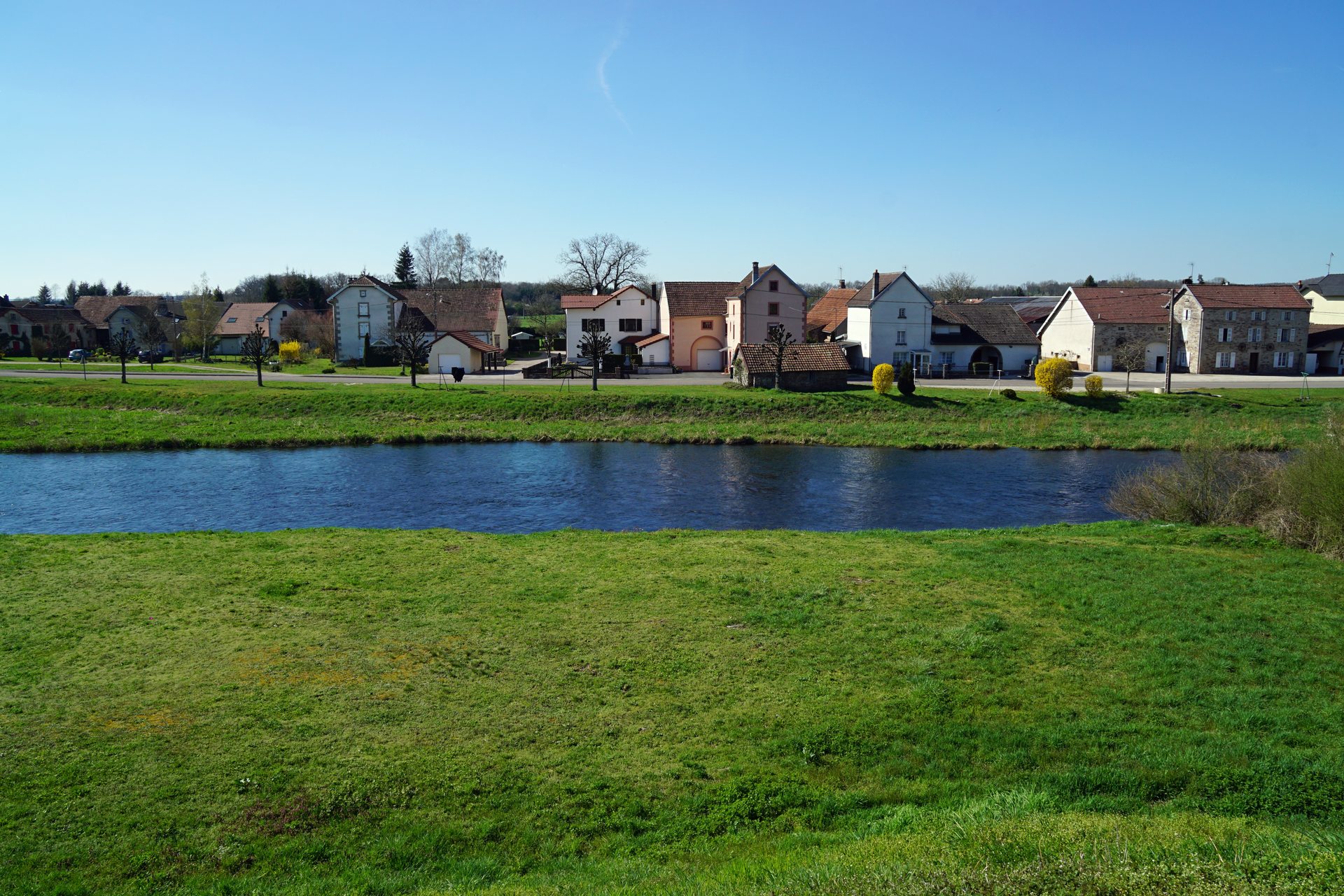
Pictured: houses along the Ognon river in La Neuvelle-lès-Lure, Haute-Saône — not the specific field or patrol route where the three gamekeepers observed the sighting, whose precise location within the surrounding countryside GEIPAN's published file does not disclose. No photograph, video, or other direct visual recording of the object itself is known to exist; the entire evidentiary record consists of the three witnesses' own testimony and GEIPAN's investigation. Photo by Wikimedia Commons contributor A.BourgeoisP (2016), released under CC BY-SA 4.0.
Theoretical Alignment
This case's weighting leans further toward Extraterrestrial framing than most of this site's single-instant French sightings, for reasons specific to its own structure. Three witnesses, all professionally engaged in an official night patrol rather than passive bystanders, independently described a genuinely multi-phase behavioral sequence — a sustained hover, a zigzagging vertical climb, a return to the same point, a color change, and a final multi-directional departure — that is considerably richer than the single-instant light phenomena more typical of this site's GEIPAN archive. The witnesses' own explicit, careful distinction between the silent phenomenon and a genuinely audible jet aircraft that passed minutes later is itself a meaningful anti-misidentification signal, the kind of specific negative detail this site's methodology treats as harder to produce by simple confusion than a vague, generic light report. Psycho-Social framing still carries real weight, rooted mainly in the sighting's age (1989) and the corresponding thinness of the surviving public documentation, which limits how much independent verification of witness demographics, training, or follow-up questioning this site's research was able to perform. Interdimensional framing draws the least support, as in nearly every case in this site's archive, resting on the total absence of any photographic or instrumented corroboration rather than anything distinctive about the witnesses' account itself.
Background
Three threads of context matter for this case: the small Haute-Saône farming commune where the sighting occurred, the NATO-era military airfield that turns out to sit substantially within that same commune, and the state of GEIPAN's predecessor agency at the specific moment, in mid-1989, this sighting was reported.
La Neuvelle-lès-Lure: From "Subtus Novam Villam" to a Rural Commuter Village
La Neuvelle-lès-Lure is a small commune of roughly 302 residents (2023) on the Haute-Saône plateau, within the sous-Vosgian depression of the Bourgogne-Franche-Comté region (Franche-Comté alone, prior to the 2016 regional merger), in the arrondissement of Lure, a few kilometers from that town. Its name is first documented in 1209 in the Latinized form Subtus novam villam ("below/near the new village"), later evolving into La Novale and eventually its modern form; an 1855 discovery of roughly 100 silver medals near a local Roman road hints at settlement activity considerably older than the medieval written record. The commune's land use today is roughly half agricultural (50.4%), a quarter industrial (26.2%, reflecting the former military airfield within its boundaries), and just over a sixth forested (17.4%), with the Ognon river running north to south through the territory and a stone bridge spanning it among the commune's few listed built landmarks, alongside a war memorial and traditional wayside calvaires. Unlike many communes in this site's published French archive, La Neuvelle-lès-Lure's population has been declining rather than growing in recent decades — from 487 residents in 1851 down to 302 by 2023, a 9.31% drop since 2017 alone, consistent with the broader rural depopulation pattern affecting much of inland Haute-Saône. The commune's subsoil holds one further, largely forgotten chapter: in June 1914, following the discovery of coal (houille) beneath the territory, it was formally integrated into the Saint-Germain coal concession — but the outbreak of the First World War only weeks later, followed by decades of broader economic uncertainty, meant that, per the commune's own recorded history, "aucun chantier d'exploitation n'a lieu" (no mining operation ever actually took place), leaving the concession a purely administrative footnote rather than an active industrial site.
Lure-Malbouhans: A NATO Airfield Inside the Commune Itself
This site's own research, conducted specifically to identify "the nearby air base" GEIPAN's published file references without naming, uncovered a genuinely significant geographic fact: the former Lure-Malbouhans aerodrome, designated Base Aérienne 184 (BA184) during its military era, sits partly within La Neuvelle-lès-Lure's own commune boundaries, alongside the neighboring communes of Malbouhans, Lure, Saint-Germain, Froideterre, and Roye. First developed as a grass airstrip in 1936, the field saw French Air Force reconnaissance use in 1939 (Groupe de Reconnaissance II/55) before German occupation forces expanded it for glider operations during the war. Designated BA184 in 1948, the site was substantially enlarged from 1951 onward to serve as a NATO Dispersed Operations Base, receiving a concrete NATO-standard runway in the 1950s. Throughout the Cold War, BA184 functioned as a dispersal and exercise field for aircraft based at BA116 Luxeuil-Saint-Sauveur, roughly 16 kilometers to the northeast — first North American F-100 Super Sabres, and later Dassault Mirage III interceptors, the same aircraft type BA116 itself flew until its own Mirage IIIE squadrons stood down in November 1988, only months before this sighting. BA184 remained formally active as a military airfield until its dissolution on January 5, 1998, meaning it was a genuinely live, operational NATO dispersal site on the night of this sighting in May 1989 — not a decommissioned ruin, as its present-day status (a proposed solar farm site as of the early 2020s) might otherwise suggest.
SEPRA, One Year Old: The State of French UAP Investigation in Mid-1989
GEIPAN's own published institutional history states that GEPAN, the agency's founding predecessor established under Claude Poher in 1977, was replaced by SEPRA (Service d'Expertise des Phénomènes de Rentrée Atmosphérique) in 1988 — meaning that at the time of this May 1989 sighting, France's national UAP investigation body had existed under its new SEPRA name and structure for barely a year. This site's own research was unable to determine from GEIPAN's published materials exactly how promptly SEPRA opened a formal investigation into this specific case, nor whether the file was actively worked in 1989 or catalogued and assessed only later as part of the unified digital case archive GEIPAN maintains today. What is independently verifiable is that the transparency-focused reforms accompanying SEPRA's 2005 reorganization into GEIPAN itself — explicitly intended, per the agency's own institutional history, "to inform the public in complete transparency" — postdate this sighting by sixteen years, a meaningful part of the explanation, in this site's assessment, for why this case's public file is considerably terser and less granular (a single combined document rather than the multiple separately itemized testimony sub-files and investigation reports typical of this site's more recent GEIPAN cases, such as its Étrelles High-Speed Object file) than newer cases benefiting from that later reform.
Complete Timeline
| Date | Event |
|---|---|
| 1209 | Earliest documented reference to La Neuvelle-lès-Lure, recorded in Latin as "Subtus novam villam." |
| 1855 | Roughly 100 silver medals are discovered near a Roman road within the commune, suggesting older settlement activity. |
| 1936 | The Lure-Malbouhans airfield, later BA184, is developed as a grass landing strip. |
| 1948 | The field is formally designated Base Aérienne 184 (BA184). |
| 1951–1955 | BA184 is substantially expanded and paved to NATO standards as a Dispersed Operations Base for aircraft from BA116 Luxeuil-Saint-Sauveur. |
| 1977 | GEPAN, GEIPAN's founding predecessor, is established at CNES under Claude Poher. |
| 1988 | GEPAN is replaced by SEPRA; separately, BA116's Mirage IIIE squadrons make their final flights that November. |
| May 30, 1989, approx. 23:15 | Sighting begins. Three gamekeepers on night patrol near La Neuvelle-lès-Lure see three lights emitting intense, closely spaced flashes. |
| Same night, +~20 seconds | The three lights, after holding still, climb vertically at very high speed in a zigzag pattern. |
| Same night, moments later | The lights return above the witnesses and hover again at the original point; a fourth, red light appears at their center. |
| Same night, immediately after | Final departure. The lights depart again, repeatedly changing direction, still in complete silence. |
| Same night, shortly after | A Dassault/SEPECAT Jaguar fighter aircraft passes nearby; the witnesses explicitly distinguish it from the phenomenon, noting the jet was audible and the PAN was not. |
| Date not published | Investigators contact the nearest active air base, seeking confirmation; the base cannot confirm the witnesses' account. |
| Date not published | Classification. The case is registered as GEIPAN file 1989-05-01176 and classified D: unidentified despite the evidence available. |
| January 5, 1998 | BA184 Lure-Malbouhans is formally withdrawn from military/aeronautical service. |
| 2005 | SEPRA is reorganized into GEIPAN, with an explicit new mandate for public transparency — sixteen years after this sighting. |
Detailed Narrative
Three Gamekeepers on Patrol
According to GEIPAN's own case synthesis, the sighting began around 23:15 on May 30, 1989, while three gardes-chasses (gamekeepers, professionally engaged in anti-poaching and wildlife-surveillance patrol duties) were conducting an official night surveillance round in the rural countryside near La Neuvelle-lès-Lure. GEIPAN's published file does not specify these witnesses' precise administrative affiliation (whether employed directly by a state wildlife agency, a hunting federation, or a private estate), a level of occupational detail this site's research was unable to independently confirm from the public record — itself a data gap this site's analysis attributes, as discussed above, to this case predating GEIPAN's 2005 transparency reform. What is clear from GEIPAN's own synthesis is that all three witnesses were on duty, actively patrolling as part of their professional responsibilities, rather than off-duty bystanders who happened to be outdoors at night.
Three Lights, Flashing "à Intervalles Très Rapprochés"
GEIPAN's own case synthesis describes the witnesses observing "3 projecteurs émettant des flashes très lumineux à intervalles très rapprochés" — three projector-like lights emitting very bright flashes at very closely spaced intervals. This site's analysis reads "projecteurs" here as a descriptive term for the lights' intense, directional brightness (comparable to a searchlight or floodlight in apparent brilliance) rather than as a claim that the witnesses saw literal film or theatrical projection equipment; French ufological usage of "projecteur" in this context consistently describes a bright, sharply defined point or beam of light rather than any specific mechanical device. The three lights held this rapid-flash pattern for approximately twenty seconds while remaining completely stationary in the sky — a detail this site's Five Observables analysis below treats as a genuinely significant anti-gravity-lift indicator, given how difficult sustained, motionless hovering is to reconcile with any conventional means of staying aloft absent forward airspeed or a powerful, audible vertical-lift mechanism.
The Zigzag Ascent
After this roughly twenty-second stationary phase, GEIPAN's own synthesis records that the three lights "partent à la verticale avec une très grande vitesse et en faisant des zigzags" — departed vertically at very high speed while making zigzag movements. This is a specific, structured maneuver description rather than a simple "flew away" account: a vertical climb combined with a zigzagging lateral component implies rapid, repeated changes in direction sustained across the climb itself, a flight profile this site's research found no close analogue for among conventional aircraft, munitions, or airborne flare/signal devices of the era, each of which follows a comparatively smooth, ballistic, or gradually curving trajectory rather than a sustained zigzag.
The Return, the Red Light, and the Final Departure
GEIPAN's own synthesis states that "après quelques secondes, le phénomène revient au-dessus des témoins pour s'immobiliser à son point de départ" — after a few seconds, the phenomenon returned above the witnesses to become motionless again at its original starting point, essentially repeating its earlier stationary-hover behavior at the same location. It was at this point that "une lumière rouge s'allume alors au milieu des trois phares" — a red light switched on in the middle of the three original lights — a specific color and positional change witnesses would have had no obvious reason to invent if simply improvising a generic description. The phenomenon then departed a final time, "en changeant plusieurs fois de direction" (changing direction several times), before disappearing from the witnesses' view. This site's analysis treats the overall structure — hover, climb, hover again, color change, multi-directional departure — as one of the more behaviorally complex sequences in this site's published GEIPAN archive, considerably more elaborate than the single-instant light phenomena that make up a large share of this site's other French case files.
Total Silence, From Start to Finish
Every phase of the sighting, per GEIPAN's own synthesis, unfolded without any sound: the phenomenon "s'est déplacé sans bruit" (moved without noise) throughout. This site's analysis flags this detail as particularly significant precisely because of what happened next: the witnesses' own subsequent encounter, minutes later, with a genuinely loud, audible aircraft gave them a direct, immediate point of acoustic comparison, rather than requiring them to imagine, in the abstract, what a "normal" aircraft sounds like.
The Jaguar That Passed — and Was Not Mistaken for Anything
GEIPAN's own case synthesis states plainly: "Un avion de chasse Jaguar est passé peu après, mais il ne pouvait être confondu avec le phénomène observé, qui est resté silencieux" — a Jaguar fighter aircraft passed shortly afterward, but it could not be confused with the observed phenomenon, which remained silent. This is a genuinely distinctive feature of this case within this site's published archive: rather than GEIPAN investigators independently confirming a nearby military exercise and then having to test whether it explained the sighting (as in this site's Villers-lès-Luxeuil Triangle file), here the witnesses themselves, at the time, actively and explicitly distinguished a real, audible aircraft from the silent phenomenon they had just watched — a spontaneous, real-time discrimination this site's analysis treats as meaningful evidence the witnesses were not simply primed to interpret any nearby aircraft activity as confirming or explaining what they had seen. The Dassault/SEPECAT Jaguar was a twin-engine, low-level strike/attack aircraft that entered French Air Force service in 1973 and remained in front-line use through the 1990s, flown at the time from wings based at BA113 Saint-Dizier and BA136 Toul-Rosières, both roughly 100 to 140 kilometers from La Neuvelle-lès-Lure — a distance well within normal range for a low-level training or navigation exercise transiting eastern France's Franche-Comté/Vosges corridor, rather than requiring the aircraft to be based locally.
An Air Base That Could Not Confirm
GEIPAN's own synthesis states that "les investigations menées auprès de la base aérienne proche n'ont pas permis de confirmer le témoignage des trois témoins" — investigations carried out with the nearby air base did not allow the three witnesses' testimony to be confirmed. GEIPAN's published file does not name this base directly, consistent with the agency's general anonymization practice; this site's own independent research, detailed in the Background and Environmental & Geospatial Context sections, identifies the former NATO dispersal field at Lure-Malbouhans (BA184) — sitting partly within La Neuvelle-lès-Lure's own commune boundaries — as the physically nearest candidate, though this site's analysis also notes that BA184 functioned purely as a dispersal and exercise site without its own independent permanent command structure, meaning any formal institutional inquiry GEIPAN or SEPRA's investigators made would most plausibly have been directed to BA116 Luxeuil-Saint-Sauveur's own command, roughly 16 kilometers away, which held administrative authority over the Malbouhans site. Either way, the inquiry's negative result is genuinely ambiguous rather than clearly exculpatory or clearly damning: it is consistent with no military aircraft or exercise from that specific base having caused the sighting, but it is equally consistent with the base's own records for that specific night and hour simply not being detailed enough, thirty-plus years on and in an era predating today's more granular digital flight-logging, to rule the possibility out with confidence.
Key Witnesses
T1 — Gamekeeper (identity withheld per GEIPAN's standard anonymization practice)
One of three gamekeepers conducting an official night patrol near La Neuvelle-lès-Lure on the night of May 30, 1989, when the group observed the three flashing lights and their subsequent maneuvers. GEIPAN's published file does not provide individualized detail distinguishing this witness's account from T2's or T3's, consistent with the case's older, pre-2005-reform documentation.
T2 — Gamekeeper (identity withheld per GEIPAN's standard anonymization practice)
The second of three gamekeepers on the same official patrol, present throughout the full sequence of the sighting — the initial flashing lights, the zigzag ascent, the return and color change, and the final multi-directional departure — and among those who subsequently observed the Jaguar aircraft pass nearby and explicitly distinguished it from the earlier phenomenon.
T3 — Gamekeeper (identity withheld per GEIPAN's standard anonymization practice)
The third of the three gamekeepers, whose combined testimony with T1 and T2 was recorded in a single official file (per GEIPAN's documentation, combining witness statements, a procès-verbal, and an investigation report) rather than broken out into the more granular per-witness sub-files typical of this site's more recently published GEIPAN cases.
The Five Observables Assessment
The Five Observables framework, developed by the Pentagon's Advanced Aerospace Threat Identification Program to describe performance characteristics beyond known conventional technology, is applied here for comparative consistency across this site's case files. This sighting's multi-phase structure — two separate hovering phases, a zigzagging vertical climb, and a repeatedly redirected departure, all in total silence and directly contrasted by the witnesses against a real, audible aircraft — gives it one of the richer behavioral profiles in this site's published GEIPAN archive.
Assessment: This case's Low Observability rating is, in this site's assessment, unusually well-supported for a 1989 file specifically because the witnesses did not merely assert silence in the abstract; they directly and explicitly contrasted the phenomenon's silence against a real aircraft's real noise, encountered within the same short observation window. That structure meaningfully reduces (though does not eliminate) the risk that "silent" simply reflects the witnesses being too far away, or too startled, to register sound that was genuinely present. Anti-Gravity Lift and Instant Acceleration are both rated Present on comparably strong grounds: a sustained, fully motionless hover, twice, bracketing a climb specifically described as both very fast and zigzagging rather than smoothly accelerating, is difficult to reconcile with any conventional aerodynamic explanation, which would generally require either forward airspeed to generate lift or a powerful, distinctly audible vertical-thrust mechanism, neither of which the witnesses report. Hypersonic remains Speculative rather than Present for the same reason it does across nearly every case in this site's archive lacking radar or other instrumented tracking: "very high speed," however vividly and specifically described, is not a substitute for a measured velocity.
Evidence Assessment
Supporting an Anomalous Origin
- Three professional witnesses, engaged in an official night surveillance patrol rather than passive nighttime observation, independently experienced a genuinely multi-phase behavioral sequence (hover, zigzag climb, return, color change, multi-directional departure)
- The witnesses spontaneously and explicitly distinguished the silent phenomenon from a real, audible Jaguar fighter aircraft encountered minutes later — a specific, real-time acoustic discrimination rather than a generic claim of silence
- The phenomenon's reported flight profile — sustained motionless hover, high-speed zigzag ascent, a second hover at the same point, and a multi-directional final departure — matches no conventional aircraft, flare, or signal-device behavior this site's research was able to identify
- Investigators contacted the nearest active military airfield seeking confirmation and received none, a genuine (if inconclusive) negative institutional result
- GEIPAN's own file states the phenomenon "n'a pu être identifié" (could not be identified) despite the investigation conducted
Supporting a Conventional/Mundane or Inconclusive Origin
- The case is classified only D, GEIPAN's baseline "unexplained" category, rather than the more strangeness/consistency-refined D1 or D2 tiers applied to several of this site's other, more recently investigated GEIPAN files
- The sighting is 36+ years old, and its public documentation, predating GEIPAN's 2005 transparency reform, is considerably thinner and less granular than this site's more recently published French cases, limiting independent verification of witness demographics, training, or follow-up detail
- No photograph, video, radar track, or other instrumented data of any kind exists; the entire evidentiary record rests on witness testimony and an official written report filed after the fact
- The negative result from the nearby air base is genuinely ambiguous rather than a clean exclusion, given the limits of 1989-era record-keeping for a specific night and hour more than three and a half decades ago
- All three witnesses were together on the same patrol at the same time, meaning their accounts, however individually credible, are not methodologically independent corroboration in the strictest sense
Why "Open"
This case is stamped Open on the strength of a combination this site's research finds genuinely compelling despite the file's age: three professional witnesses, engaged in official duty rather than passive nighttime observation, describing a richly structured, multi-phase behavioral sequence, and spontaneously, in real time, distinguishing that silent phenomenon from a genuinely audible aircraft encountered shortly afterward. That last detail in particular — witnesses actively discriminating between the anomaly and a real, confirmed aircraft, rather than simply reporting "something in the sky" — is a meaningfully different, and in this site's assessment stronger, form of evidence than an undifferentiated light report, and GEIPAN's own file preserves and credits that distinction directly rather than glossing over it.
At the same time, this site's own analysis is explicit that this case sits, on balance, in the middle rather than the upper tier of its published GEIPAN archive, for reasons distinct from (though related to) its evidentiary content. The case's own GEIPAN classification is the plain "D" category rather than the more granular D1 or D2 tiers this site's newer French cases more often carry, a distinction this site's research understands to at least partly reflect the sighting's 1989 vintage, investigated and classified well before the strangeness/consistency refinement (and the accompanying transparency reforms) that shaped GEIPAN's later methodology. No photograph, video, or physical trace corroborates the account at any point, the three witnesses were together for the entire sighting rather than independently positioned, and the negative result from the nearby air base, whichever specific installation actually fielded the inquiry, cannot be treated as a clean exclusion given the limits of record-keeping from that era. Weighed together — three credible, on-duty professional witnesses describing an unusually rich and internally consistent multi-phase sequence, with a genuine real-time aircraft-vs-phenomenon discrimination, against the case's age, its thin surviving documentation, its non-independent witnesses, and its lower "D" classification tier — this case scores in the middle of this site's published GEIPAN archive: a genuinely substantive account held back mainly by how much time has passed and how little has survived in the public record to independently test it further.
Sensor & Instrumentation Detection Profile
No photograph, video, radar track, or other live sensor recording of any kind captured this sighting, consistent with the general absence of instrumented documentation across most of GEIPAN's pre-2000s case files, an era before the agency's own later automated tools (such as the FRIPON fireball camera network, operational only from 2016) existed in any form. What this case does have is a specific, named institutional cross-check: investigators contacted the nearest active air base seeking confirmation of any military aircraft or exercise that might explain the sighting, and received a negative response. This is the same general investigative logic this site's research has documented in its other GEIPAN files involving a nearby air base — most directly the Villers-lès-Luxeuil Triangle, where GEIPAN specifically confirmed (rather than merely inquired about) a genuine four-aircraft Mirage 2000-5F exercise launched from BA116 the same evening, only to find its tracked timing, elevation, and apparent size did not match the witnesses' account. The Neuvelle-lès-Lure case's own institutional check produced a different kind of result: not a confirmed-but-mismatched aircraft, but a simple failure to confirm anything at all — a genuinely weaker, more ambiguous negative than Villers-lès-Luxeuil's specific, ruled-out candidate, though still a real, documented attempt at cross-verification rather than an unexamined assumption.
This site's own research, as detailed in the Background section above, independently identified the former NATO dispersal airfield at Lure-Malbouhans (BA184) — sitting partly within La Neuvelle-lès-Lure's own commune boundaries — as the physically nearest candidate for "the nearby air base" GEIPAN's file references without naming, while noting that any formal institutional inquiry would most plausibly have been routed through BA116 Luxeuil-Saint-Sauveur's own command structure, which held administrative authority over the Malbouhans dispersal site. This site's research was unable to determine which specific installation actually received GEIPAN or SEPRA's investigative inquiry, and treats this as an honest, disclosed gap rather than a resolved fact.
Environmental & Geospatial Context
Geographically, the sighting occurred in the rural countryside surrounding La Neuvelle-lès-Lure, on the Haute-Saône plateau within the sous-Vosgian depression, a landscape this site's research found to be roughly half agricultural land, a quarter industrial (including the former BA184 airfield site itself), and just over a sixth forest, crossed by the north-south-flowing Ognon river. The commune sits within a few kilometers of both Lure itself, the area's local commercial and administrative center, and the considerably larger and more strategically significant BA116 Luxeuil-Saint-Sauveur, a major French nuclear-capable strike base throughout the Cold War era and, as of this sighting, in the midst of a major transition — its long-serving Mirage IIIE squadrons had flown their final missions only six months earlier, in November 1988, with the base's subsequent Mirage 2000N nuclear-alert squadrons not fully stood up until July 1989, two months after this sighting. This site's analysis notes that sighting occurred, in other words, during a specific window of unusually reduced or transitional air activity at the region's primary air base, a detail worth flagging honestly even though this site's research found no way to determine what practical effect, if any, that transition period had on this specific night's air traffic.
Astronomically and meteorologically, GEIPAN's own published file for this case does not specify weather conditions, moon phase, or other environmental detail for the night of the sighting, a genuine documentation gap this site's research was unable to independently fill from public records more than three and a half decades after the fact. This stands in contrast to several of this site's more recently investigated GEIPAN cases (including its own Étrelles High-Speed Object file), where sky conditions, wind, and precipitation are all explicitly recorded — a difference this site's analysis attributes, once again, to this case's pre-2005-reform vintage rather than to any deliberate omission specific to this file.
Within this site's own published GEIPAN archive, the most directly relevant point of comparison for this sighting's real-jet-versus-PAN distinction is the Villers-lès-Luxeuil Triangle, itself investigated out of the same BA116 Luxeuil-Saint-Sauveur institutional orbit three decades later, discussed further in the Historical Precedents section below.
Observer Credibility & Occupational Profile
This case's strongest credibility factor is straightforward and specific: all three witnesses were professional gamekeepers, actively engaged in an official night surveillance patrol at the time of the sighting, a role that inherently involves training in careful nighttime observation of a rural landscape, familiarity with the normal sounds and sights of that landscape after dark, and (given the anti-poaching function such patrols typically serve) a professional expectation of being able to distinguish something genuinely unusual from routine nighttime wildlife, vehicle, or agricultural activity. GEIPAN's own file does not specify these witnesses' precise employer or formal credentials, a detail this site's research was unable to independently confirm from the surviving public record, but the underlying occupational context — three people professionally tasked with careful nighttime rural observation, on duty together at the moment of the sighting — is itself a meaningful credibility signal independent of any single witness's individual background.
This site's analysis credits, in particular, the witnesses' own real-time discrimination between the phenomenon and the subsequent Jaguar aircraft as the single strongest piece of behavioral evidence for their observational care: rather than reflexively attributing the earlier sighting to "probably a plane" once a real plane appeared minutes later — the easiest, most cognitively convenient resolution available to them — the witnesses instead maintained and articulated a specific distinction (silent versus audible) that required them to actively compare their memory of the earlier phenomenon against their immediate perception of the aircraft, rather than simply collapsing the two experiences together.
At the same time, this site's research is careful to state what this occupational strength does not resolve. Professional nighttime-observation experience does not, on its own, supply independent corroboration; all three witnesses were on the same patrol at the same time, and GEIPAN's own file does not indicate whether their accounts were recorded and cross-checked separately or compiled as a single joint statement — a methodological detail this case's older, pre-reform documentation does not clarify, unlike this site's Palau-del-Vidre Black Triangle and Étrelles High-Speed Object files, whose more recent public documentation explicitly addresses witness independence and interdependence as its own analytical question.
Physical & Material Assays
No physical trace evidence exists in this case, and GEIPAN's own published file gives no indication that any ground-level search for trace material was ever conducted. The phenomenon remained airborne throughout the entire observed sequence — hovering, climbing, returning, and departing, but never landing or otherwise contacting the ground — and no scorching, vegetation disturbance, or other ground-level physical effect was ever described by any of the three witnesses. Accordingly, this case has no soil, vegetation, or material sample of any kind associated with it, and no metallurgical, isotopic, or trace-chemical assay was performed or would have been applicable given the sighting as described, a limitation compounded, as with several other aspects of this case, by the more than three and a half decades since separating the sighting from any present-day attempt at renewed investigation. Even had a ground search been attempted at the time, the specific field or wooded parcel the three gamekeepers were patrolling that night is not identified in GEIPAN's published file with enough precision for this site's research to locate or meaningfully re-examine today.
Historical Precedents & Archive Matches
This case's most useful points of comparison within this site's own published GEIPAN archive fall into two categories: other cases sharing the same BA116 Luxeuil-Saint-Sauveur institutional orbit, and other cases where GEIPAN's investigators (or, as here, the witnesses themselves) directly weighed a real, confirmed nearby aircraft against the reported phenomenon.
Villers-lès-Luxeuil: The Same Air Base, Thirty Years Later
The Villers-lès-Luxeuil Triangle (Open, case #251) gives this site its closest institutional comparison, sharing the same BA116 Luxeuil-Saint-Sauveur orbit as this case, three decades on. There, GEIPAN's investigators specifically confirmed a real, four-aircraft Mirage 2000-5F exercise had launched from BA116 within the same general time window as the November 26, 2019 sighting, then tested that confirmed aircraft activity against the witnesses' reported size, elevation, and timing, finding each element conflicted with what was actually seen. This case's own institutional check inverts that structure: rather than GEIPAN confirming a specific aircraft and then testing whether it explained the sighting, the witnesses themselves independently encountered and explicitly ruled out a real aircraft (the Jaguar) as an explanation, in real time, before any formal GEIPAN investigation had even begun. Read together, both cases illustrate the same underlying base's long institutional relationship with this site's published GEIPAN archive — a NATO-era, nuclear-capable air base whose routine and exercise flight activity has been directly and specifically tested against, and found not to explain, two separate unexplained sightings separated by thirty years.
Douai and Crozon: Institutional Checks That Also Came Back Negative
The Douai Prison-Adjacent Sighting (Open, case #253) offers a further comparison in how GEIPAN handles a negative institutional result. There, investigators contacted local civilian drone hobbyists and a Marine Nationale drone instructor directly, none of whom could match the sighting's reported lighting configuration — a targeted, name-and-contact-based negative result broadly comparable in evidentiary weight to this case's own unconfirmed air-base inquiry, in that both represent a genuine, specific attempt at institutional cross-checking that came back empty rather than either confirming or definitively explaining the sighting. This site's research also notes the Crozon Peninsula naval air base check (from its Palau-del-Vidre Black Triangle file's own Historical Precedents discussion) as a further point of comparison, though that case's negative institutional result concerned drone operations specifically rather than a nearby fighter aircraft.
The Broader Haute-Saône GEIPAN Record
Set against this site's other Haute-Saône case, the Villers-lès-Luxeuil Triangle, this case's own plain-D classification (rather than D1 or D2) is, in this site's assessment, best read as substantially a function of the sighting's age and the correspondingly thinner surviving documentation, rather than as a straightforward signal that the underlying account itself is markedly weaker. Both cases share the same department, the same general BA116 institutional orbit, and a broadly similar evidentiary shape (multiple witnesses, no photo or video, a specific real-aircraft comparison point); the thirty-year gap between them, and the intervening 2005 transparency reform, is, in this site's analysis, the single largest difference in how each case's surviving public file actually reads today.
Material Analysis
As with the Physical & Material Assays section above, this case involves no physical or trace evidence of any kind. The phenomenon remained airborne throughout the entire observed sequence, and no landing, low-altitude ground approach, or other ground-level effect was ever reported that could have produced a testable trace.
Supporting Non-Terrestrial Origin
- No confirmed physical evidence exists to test in the first place, so no terrestrial material-composition finding contradicts an anomalous interpretation either
- Three professional, on-duty witnesses describing a specific, structured, multi-phase maneuver sequence, and explicitly distinguishing it in real time from a genuinely audible aircraft, remains unresolved by GEIPAN's own investigation, which states the phenomenon "could not be identified"
Supporting Terrestrial Origin
- The case's plain "D" classification, rather than the more granular D1/D2 tiers, reflects a lower-confidence assessment within GEIPAN's own methodology than several of this site's other, more recently investigated GEIPAN files
- The sighting's age (1989) and its correspondingly thin surviving public documentation foreclosed the kind of detailed follow-up investigation, witness cross-checking, and instrumented corroboration this site's newer GEIPAN files typically have available
The Conventional Explanation Candidate: Military Aircraft, Flares, and the Limits of a 1989 Investigation
GEIPAN's own published synthesis for this case addresses one specific candidate directly and reports a real, if incomplete, institutional check on it; this site's own research adds two further considerations it weighed and found insufficient to independently resolve the case.
The Jaguar Fighter Aircraft
GEIPAN's own file states plainly that a Dassault/SEPECAT Jaguar fighter aircraft passed nearby shortly after the sighting, but that it "ne pouvait être confondu avec le phénomène observé, qui est resté silencieux" — could not be confused with the observed phenomenon, which remained silent. This site's own analysis treats the Jaguar hypothesis as genuinely tested, in the most direct way possible: not by GEIPAN investigators reconstructing flight logs after the fact, but by the witnesses themselves, in real time, directly comparing the aircraft's actual sound to the phenomenon's total silence. A twin-engine Jaguar in level flight or during a low-level pass is a distinctly loud aircraft, and this site's research found no basis to question the witnesses' own confident, contemporaneous discrimination between the two.
Signal Flares, Military Pyrotechnics, or Ground-Based Lighting
GEIPAN's own published file does not name a flare, pyrotechnic, or ground-lighting hypothesis directly for this case, and this site's own research found this candidate a poor descriptive fit regardless: military signal flares and comparable pyrotechnic devices generally follow a ballistic arc (rising, decelerating, and falling under gravity, typically with a smoke trail) rather than the specific hover-zigzag-hover-departure sequence the three witnesses described, and none of the standard flare or signal-light colors and behaviors this site's research reviewed match the account's specific detail of three synchronized flashing lights followed by a separate, later-appearing fixed red light at their center.
Weather Balloon, Meteorological Sonde, or Airborne Debris
This site's own research also weighed, and found a poor fit for, a weather balloon, radiosonde, or similar lighter-than-air device, a hypothesis GEIPAN's own published file does not raise directly for this case. A drifting balloon or sonde is fundamentally at the mercy of ambient wind, producing a comparatively smooth, wind-driven drift rather than the specific, structured sequence described here — a sustained motionless hover, a fast vertical zigzag climb, a return to the exact same hovering point, and a final departure changing direction multiple times. Nothing in the standard behavior of a released balloon or sonde, this site's research found, accounts for a return to a precise prior position or for the kind of sharp, repeated directional changes both the ascent and the final departure are described as making.
The Limits of a Thirty-Six-Year-Old Investigation
This site's own research raises, independently of GEIPAN's published file, the general limitation that any investigation into a 1989 sighting conducted or reviewed today faces: the specific individuals who could have been asked follow-up questions, the specific flight logs and radar tapes for that exact night, and any contemporaneous local press coverage that might have existed are all, at this remove, either lost, inaccessible, or simply never generated in the first place, given the era's less comprehensive record-keeping standards. This is not a conventional explanation candidate in the same sense as an aircraft or a flare, but it is a genuine, structural reason this case's own classification and evidentiary base are narrower than a hypothetically identical sighting reported today, under GEIPAN's current, more thoroughly documented investigative standard, might produce.
This limitation cuts in both directions rather than simply weakening the case. On one hand, the absence of a detailed contemporaneous weather record, a confirmed civil or military radar log, or any surviving local newspaper coverage means several avenues of potential corroboration or refutation that might exist for a similarly reported sighting today are simply unavailable here, regardless of how the underlying event is ultimately interpreted. On the other hand, that same absence of detailed record-keeping means no specific, dated conventional candidate — a particular flight, a particular exercise, a particular weather event — has survived in the public record to positively explain the sighting either, unlike cases such as this site's own Villers-lès-Luxeuil Triangle, where a specific, named, and independently confirmed Mirage 2000-5F exercise could be checked against the witnesses' account only because a full thirty additional years of digital flight-logging and record retention separated that 2019 sighting from its investigation. This site's analysis treats the resulting evidentiary gap as symmetrical rather than one-sided: thirty-six years of record loss has not produced a hidden conventional explanation that this site's research simply failed to locate; it has instead left both the anomalous and conventional readings of this case equally under-evidenced by any standard more rigorous than the witnesses' own testimony and GEIPAN's own contemporaneous, if comparatively brief, investigation.
Jaguar Fighter Aircraft
ImplausibleDirectly and explicitly ruled out by the witnesses themselves, in real time, on the specific basis that the Jaguar was audible and the phenomenon was not; GEIPAN's own file preserves this distinction directly.
Signal Flares or Pyrotechnics
ImplausibleNot named in GEIPAN's own file; a poor fit given the reported hover-zigzag-hover-departure sequence, which bears no resemblance to a flare's characteristic ballistic rise-and-fall arc.
Weather Balloon or Sonde
ImplausibleNot named in GEIPAN's own file; a poor fit given the reported precise return to the original hovering point and the sharp, repeated directional changes on both the climb and final departure, neither typical of wind-driven balloon behavior.
Unconfirmed Military Exercise (Other Than the Observed Jaguar)
InconclusiveThe nearby air base could not confirm any matching activity, but this site's research treats that negative result as genuinely ambiguous given the limits of 1989-era record-keeping, rather than a clean exclusion.
Fabrication or Collective Misperception
InconclusiveWeighed against the witnesses' professional occupational context and their demonstrated real-time discrimination between the phenomenon and a real aircraft; this site's research found no specific basis in the record to suspect deliberate fabrication, though the case's age limits how thoroughly this can be independently tested today.
Related Cases
Confirmed Documents & Official Records
The official French government case summary: the three gamekeepers' testimony, the Jaguar distinction, the unconfirmed air-base inquiry, and the D classification.
GEIPAN's own published definitions, including the baseline D category (unexplained despite available evidence) applied to this case, distinct from the more granular D1/D2 tiers used on several of this site's more recently investigated files.
GEIPAN's own account of its institutional lineage, establishing that this case was investigated during SEPRA's first year of existence, sixteen years before the agency's 2005 transparency reform.
Official French national statistics for the commune, including its historical population series.
Further Reading — Recommended Literature
Passport to Magonia: On UFOs, Folklore, and Parallel Worlds
Vallée's foundational catalog of centuries of French and international sightings offers direct background for reading this case within a much longer national tradition of reported anomalous aerial phenomena.
UFOs and Government: A Historical Inquiry
Includes a dedicated chapter on French government UAP investigation, directly relevant to the GEPAN/SEPRA institutional framework that would have received this case in 1989.
CONFRONTATIONS: A Scientist's Search for Alien Contact
Vallée's personal investigation of forty international UFO cases, useful for its methodological attention to multi-witness accounts and to military-aircraft comparison points, both central to this case.
Identified Flying Objects: A Multidisciplinary Scientific Approach to the UFO Phenomenon
A methodologically-focused work useful for weighing occupational witness credibility and the evidentiary limits of an older, thinly-documented case, both directly relevant here.
UFOs: Generals, Pilots, and Government Officials Go on the Record
A collection built substantially around credentialed, professional witnesses across multiple countries, directly relevant to weighing this case's own three on-duty gamekeeper witnesses and their real-time military-aircraft comparison.
Essential Viewing
No Videos Available
Sources
- GEIPAN (CNES), "NEUVELLE-LES-LURE (LA) (70) 30.05.1989", Case 1989-05-01176 — official case summary
- GEIPAN (CNES), official case archive & public portal — geipan.fr
- GEIPAN (CNES), Glossaire du GEIPAN — official classification definitions, A/B/C/D/D1/D2
- GEIPAN (CNES), Son histoire — institutional history: GEPAN (1977), SEPRA (1988), GEIPAN (2005)
- Wikipedia (English), "La Neuvelle-lès-Lure" — population, coordinates, and administrative data
- Wikipédia (français), "La Neuvelle-lès-Lure" — village history, etymology, geography, and the former Lure-Malbouhans aerodrome
- Wikipédia (français), "Aérodrome de Lure – Malbouhans" — BA184 history, NATO dispersal role, and 1998 closure
- Anciens Aérodromes, "Lure – Malbouhans" — BA184 construction history and formal 1998 decommissioning
- Forgotten Airfields, "Malbouhans" — wartime and Cold War airfield history
- DGAC (Direction Générale de l'Aviation Civile), Atlas des aérodromes — Plate-forme de LURE-MALBOUHANS — official French civil aviation record for the site
- Wikipédia (français), "Base aérienne 116 Luxeuil-Saint Sauveur" — 1988 Mirage IIIE stand-down and 1989 Mirage 2000N alert transition timeline
- INSEE, Dossier complet — Commune de La Neuvelle-lès-Lure (70385) — official French national statistics for the commune
- Wikimedia Commons, File: 2016-04 - La Neuvelle-lès-Lure - 01.JPG, photo by A.BourgeoisP (2016), CC BY-SA 4.0 — licensing and attribution
- This site, case-files/villers-les-luxeuil-triangle.html — comparative GEIPAN case, the same BA116 institutional orbit thirty years later
- This site, case-files/douai-prison-adjacent-sighting.html — comparative GEIPAN case, a comparable negative institutional check
- This site, case-files/etrelles-high-speed-object.html — comparative GEIPAN case, a contrasting post-2005-reform file with denser public documentation
- This site, key-figures.html, entry on Claude Poher — GEPAN founding and early institutional history
- This site, locations/index.html, entry on BA116 Luxeuil-Saint-Sauveur — the air base holding administrative authority over the nearby Malbouhans dispersal site
See something inaccurate? Have additional information or sources?
Suggest an Edit →Last Updated: August 2026