
Norwood Searchlight Incident
On the evening of August 19, 1949, an Army-surplus searchlight operated by a University of Cincinnati ROTC sergeant swept across the sky above a church carnival in Norwood, Ohio and froze on a stationary, glowing disc. It was the first of ten reported sightings of the same phenomenon over the next seven months — witnessed by a parish priest, a Norwood police sergeant who filmed and photographed it, the city's mayor, a metropolitan newspaper's managing editor, and dozens of others — investigated at the time by Air Force intelligence at nearby Wright Field and, years later, by pioneering civilian ufologist Leonard H. Stringfield. Nearly all of the case's original photographic and film evidence has since vanished.
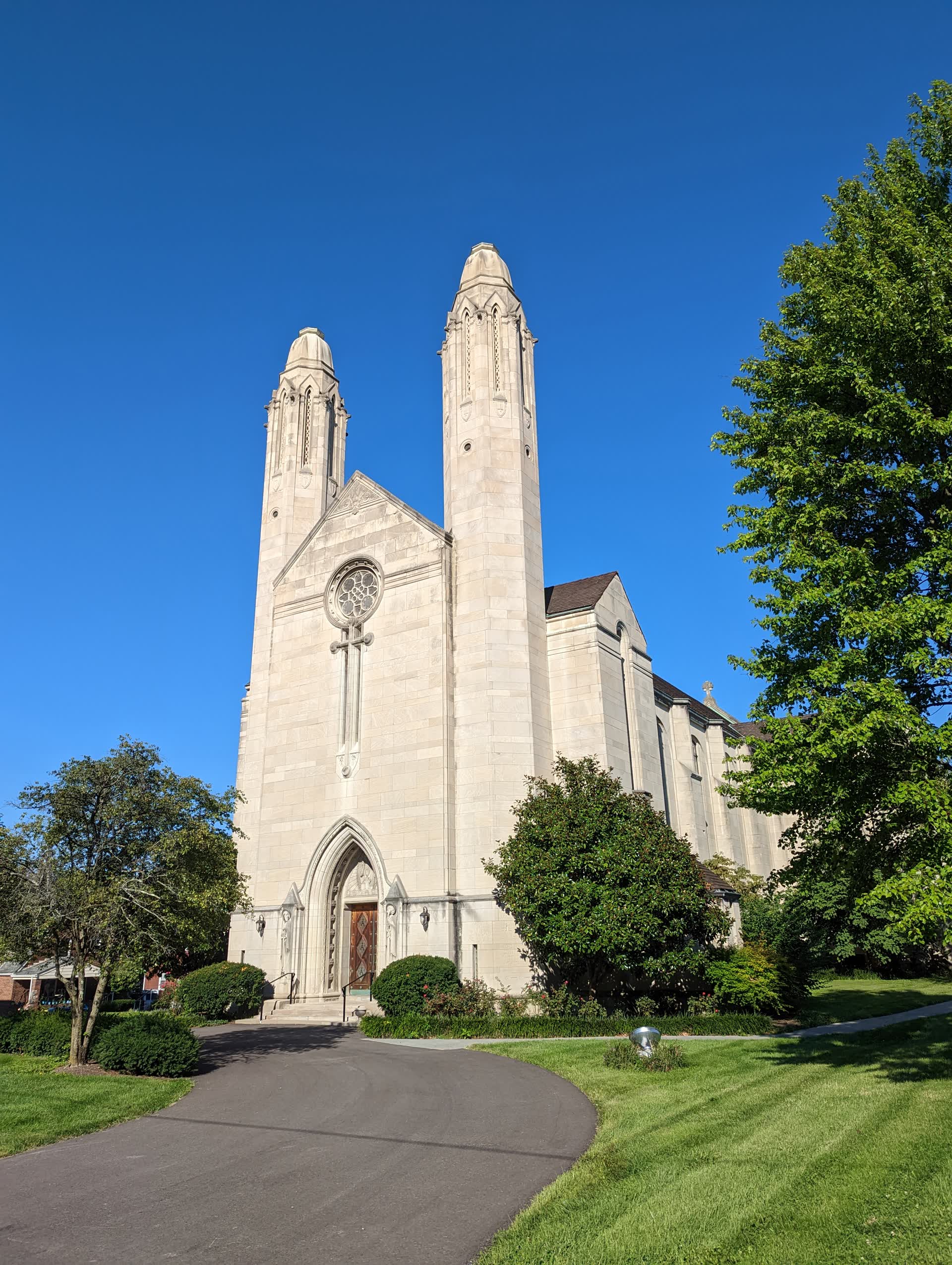
Pictured: Holy Trinity Church on Montgomery Road in Norwood, Ohio — the same building, dedicated in 1940 as Sts. Peter and Paul Church, where Rev. Gregory Miller served as pastor and where the August 19, 1949 Jitney Carnival and the pivotal October 23, 1949 sighting both took place (the 1994 Norwood parish merger kept the Sts. Peter and Paul building and renamed it Holy Trinity). This is not a photograph of the object, the searchlight, or the crowd itself — no rights-clear photograph of the 1949–1950 sightings is known to survive; the case's own photographs and film were lost or never returned, as this file details below. Photo by Andy Hemmer, September 2022, licensed CC BY-SA 4.0 via Wikimedia Commons.
Theoretical Alignment
Norwood aligns only weakly with the Extraterrestrial Hypothesis: nothing in any witness account describes a structured craft with visible surfaces beyond Mayor Tepe's single, uncorroborated mention of “ridges or ribbing,” and no occupant, landing, or physical trace evidence was ever reported. What keeps the ETH score from falling further is the object's reported self-sustained glow (independent of the searchlight beam) and the satellite triangular objects described on October 23 — details that, if accurately logged and observed rather than embellished in retelling, are difficult to fold into any single mundane stimulus. The Psycho-Social Hypothesis scores highest of the three: a searchlight deliberately pointed at the night sky, in front of an excited carnival crowd already primed by two years of national “flying saucer” headlines, is close to an ideal setup for collective misperception of an ordinary optical or atmospheric effect, and the case's very first newspaper coverage offered exactly that kind of mundane explanation before any of the case's stranger later embellishments had entered the record. The case has no plausible connection to any interdimensional framework.
Background
In the summer of 1949, Norwood, Ohio was an independent, densely populated industrial city of roughly 35,000 people almost entirely surrounded by Cincinnati, anchored economically by a large General Motors assembly plant and the U.S. Playing Card Company factory. It was, in miniature, exactly the kind of American community that found itself swept into the first great postwar “flying saucer” wave: Kenneth Arnold's June 1947 sighting near Mount Rainier had entered the national vocabulary two years earlier, the Air Force had stood up first Project Sign and then, in February 1949, Project Grudge at Wright-Patterson Air Force Base barely fifty miles north in Dayton, and Cincinnati-area newspapers had already run a steady trickle of “mystery light” stories throughout 1947 and 1948. What set Norwood apart was not the sighting itself, but the accident of equipment that produced it: a Catholic parish had, for entirely mundane fundraising reasons, acquired the one piece of hardware — a powerful military-surplus searchlight — capable of catching and holding an aerial light source in a fixed beam for the better part of an hour, in front of a crowd, repeatedly, for months.
The parish was Sts. Peter and Paul Church, one of three Catholic parishes then serving Norwood (alongside St. Elizabeth and St. Matthew, later consolidated with Sts. Peter and Paul in 1994 to form today's Holy Trinity Church at the same 2420 Drex Avenue address). Its pastor since 1938, Rev. Gregory Miller, organized an annual summer “Jitney Carnival” to raise money for the parish school and convent housing. For the August 1949 carnival, Miller purchased a war-surplus anti-aircraft searchlight rated at roughly eight million candlepower — the kind of light originally built to hold enemy bombers in a beam for anti-aircraft gunners, now repurposed to draw carnival-goers' eyes skyward and advertise the event for blocks around. To operate it, Miller enlisted Donald R. Berger, a sergeant in the University of Cincinnati's Army ROTC program, who had the training to run a heavy military light safely and effectively. Neither man could have anticipated that the light would end up illuminating something neither of them, nor the hundreds of other witnesses over the following seven months, could identify.
The city's own civic and scientific establishment became entangled in the story almost immediately. Norwood's sitting mayor, R. Ed Tepe, would personally witness one of the later sightings. Robert Linn, managing editor of the Cincinnati Post, became directly and repeatedly involved as both a witness and an intermediary to Air Force intelligence. Two University of Cincinnati science faculty — physicist Dr. Dare A. Wells and astronomer Paul Herget, director of the university's Cincinnati Observatory — offered competing conventional explanations within days of the first sighting, giving Norwood an unusually well-credentialed skeptical record for a small-city 1949 sighting. And a Norwood police sergeant, Leo Davidson, would eventually turn a personal camera and a borrowed 16mm movie camera on the phenomenon, producing the only photographic and film record of the case — nearly all of which has since been lost.
Norwood's involvement with the case did not end with the sightings themselves. In the decades since, a small but persistent line of regional researchers has kept the case from disappearing entirely from the historical record: Leonard Stringfield's own CRIFO organization, based in Cincinnati, treated Norwood as a flagship regional case throughout the 1950s; NICAP's national leadership selected it for inclusion in its 1964 congressional mailing precisely because it combined a broad, credentialed witness pool with genuine (if since-lost) photographic documentation; and, decades later, Cincinnati-based investigator Kenny Young picked up where Stringfield had left off, compiling additional interview leads and cross-referencing the case against other regional sightings before his death in 2005. That regional continuity — three generations of Cincinnati-area researchers returning to the same seven-month sighting series across more than fifty years — is itself an unusual feature for a case this obscure, and one of the reasons it remains catalogued in national reference works like NICAP's evidentiary compendium and Jerome Clark's UFO Encyclopedia rather than fading into purely local folklore.
Complete Timeline
| Date | Event |
|---|---|
| Aug. 19, 1949, ∼8:15 PM | During the Sts. Peter and Paul Jitney Carnival, Sgt. Donald Berger's sweeping searchlight beam catches and holds a stationary, glowing disc-shaped object in the sky above Norwood; hundreds of carnival-goers, including Rev. Gregory Miller and Robert Linn, watch it for roughly an hour. |
| Aug. 19–20, 1949, overnight | The object is reported intermittently visible from roughly 11:00 PM to 6:30 AM; switchboards at the Cincinnati Post, Cincinnati Enquirer, and Cincinnati Times-Star are flooded with calls describing “fireballs” and comet-like lights across the metropolitan area. |
| Aug. 20, 1949 | All three Cincinnati dailies run stories on the “strange lights,” with initial coverage attributing them to searchlight beams (Berger's and, some suggested, a second beam from a downtown theater) reflecting or refracting off a high cloud layer. |
| Sept. 11, 1949 | A second sighting is reported at St. Gertrude Church in nearby Madeira, Ohio, with witnesses describing a similar glowing object caught in a searchlight beam. |
| Sept. 17, 1949 | A third sighting is reported at Milford, Ohio, further east along the same general corridor. |
| Oct. 23, 1949, evening | The series' most heavily documented event: more than 50 witnesses at Sts. Peter and Paul watch the disc reappear in Berger's beam; Sgt. Leo Davidson shoots three 25-foot reels of 16mm black-and-white film and a series of still photographs as roughly ten small triangular objects, in two groups of five, appear to detach from the disc and maneuver along the beam for approximately 30 minutes before the display ends. |
| Late Oct. 1949 | Robert Linn and Rev. Gregory Miller, convinced Berger's light had found “some definite object,” personally deliver a report and photographic material to Air Force intelligence officers at Wright Field in Dayton. |
| Nov. 19, 1949 | A fifth sighting is recorded at Norwood. |
| Dec. 20, 1949 | A sixth sighting is witnessed by Mayor R. Ed Tepe, who describes visible “ridges or ribbing” on the object's surface. |
| Jan. 11, 1950 | A seventh sighting is recorded at Norwood. |
| Mar. 9–10, 1950 | The eighth and ninth (final recorded) sightings close out the seven-month series. |
| 1952 | Rev. Miller's surviving 16mm footage is broadcast once on WCPO-TV Channel 9, Cincinnati — the last confirmed sighting of the film by any researcher since. |
| 1954 | Miller, having appeared alongside civilian investigator Leonard Stringfield on a WCPO-TV program about the case, turns over Berger's original searchlight logs and his own surviving photographs and film to Stringfield for formal investigation. |
| Aug. 6, 1954 | Stringfield publishes his initial findings on the case in Orbit, the newsletter of his own investigative group, CRIFO (Civilian Research, Interplanetary Flying Objects). |
| 1957 | Stringfield includes the case, with one surviving (halftone-degraded) photograph, in his book Inside Saucer Post…3-0 Blue. |
| 1964 | NICAP's The UFO Evidence, edited by Richard Hall, catalogs the Norwood case on page 88 among its selected best-evidenced reports. |
| Dec. 1996 | Research psychologist Dr. Richard F. Haines conducts a formal digital analysis of the one surviving photograph. |
The August 19, 1949 Debut
The Jitney Carnival and the Searchlight
The Sts. Peter and Paul Jitney Carnival was, by every contemporary account, an entirely ordinary parish fundraiser — games, food, rides, and a searchlight sweeping the summer sky to draw attention from streets away, exactly as Rev. Miller intended when he bought it. Sometime around 8:15 PM, as Sgt. Donald Berger swept the beam across the sky, it settled on and held a circular, luminous object that did not move like an aircraft, a star, or a planet. Witnesses that night, drawn by the light's sudden fixation, estimated the object's apparent size using nothing more sophisticated than the naked eye and Berger's own rough dead-reckoning of the beam's likely range — producing wildly speculative figures (some secondary accounts cite an estimated diameter approaching 10,000 feet) that reflect the complete absence of any actual rangefinding equipment rather than a measured fact. What is better documented is the duration: multiple accounts describe the object remaining visible, on and off, for roughly an hour that first night, with Berger's own later-recovered logs recording one specific and much-repeated detail — that when he swung the beam away from the object entirely, it continued to glow on its own rather than going dark, the single most anomalous claim in the entire case and one resting almost entirely on Berger's uncorroborated personal notes.
Newspaper Coverage and the First Conventional Explanation
Word of the sighting spread through Norwood and greater Cincinnati within hours. Overnight into August 20, all three of the city's daily papers — the Cincinnati Post, the Cincinnati Enquirer, and the Cincinnati Times-Star — fielded a wave of calls describing “fireballs” and comet-like lights across the metropolitan area, and all three ran stories the next morning. Crucially, this first, most heavily reported wave of coverage did not treat the sighting as inexplicable: local editors and at least some witnesses suggested early on that Berger's searchlight beam, and possibly a second beam originating from a downtown theater marquee search-light, was reflecting or refracting off a layer of high cloud, producing an artificial glowing “halo” effect that no one on the ground could properly range or size. This conventional explanation, offered contemporaneously by the very newspapers that broke the story, is an important and often-omitted detail: Norwood's case did not begin as an unexplained mystery that later acquired a mundane explanation as a debunking afterthought; a mundane explanation was already in print within 24 hours, before the case's stranger later details — the triangular satellite objects, Tepe's “ribbing,” the object's self-sustained glow — had even occurred.
An Object That Returns: September–October 1949
Madeira and Milford
Rather than fading as a one-night carnival curiosity, the phenomenon recurred. On September 11, 1949, a similar object was reported at St. Gertrude Church in Madeira, Ohio, a few miles from Norwood, again apparently caught by a searchlight beam. A third sighting followed on September 17 at Milford, Ohio, further east along the same general Cincinnati-suburb corridor. Neither of these two intermediate sightings produced photographic evidence or the same volume of witnesses as the August 19 debut, but they matter for the case's overall pattern: whatever was being seen was not confined to one specific searchlight, one specific operator, or one specific parish carnival — it recurred across multiple towns and multiple weeks, a detail that argues against the simplest single-cause explanations (a specific balloon release, a specific aircraft) even as it remains fully consistent with a recurring atmospheric-optical effect tied to searchlight use in the region, or with a genuine recurring aerial phenomenon.
The October 23, 1949 Encounter
The case's best-documented single event took place back at Sts. Peter and Paul on the evening of October 23, 1949, when more than fifty witnesses gathered as Berger's beam again located the object. This time, according to multiple independent secondary compilations of the original reports, roughly ten small triangular-shaped objects — described by Rev. Miller's brother, Fr. Cletus Miller, dean of the Institutum Divi Thomae, as resembling “the apex of Indiana arrowheads” — appeared to detach from the main disc in two groups of five, maneuvering along and around the searchlight beam for approximately 30 minutes before the display ended and the disc itself faded from view. It was this sighting that Sgt. Leo Davidson of the Norwood Police Department captured on film and in still photographs — using, by several accounts, both his own Speed Graphic-style press camera with a long telephoto lens and a borrowed Hugo Meyer f/1.9 movie camera loaded with three 25-foot reels of 16mm black-and-white stock. It is also the sighting that convinced Robert Linn, the Cincinnati Post's managing editor, and Rev. Miller that they were looking at “some definite object” rather than an optical effect, prompting the two men to personally carry their report and photographic material to Air Force intelligence officers at Wright Field in Dayton — home at the time to Project Grudge, the Air Force's official UFO investigation office and the direct successor to Project Sign.
The Winter Sightings and the Series' End
The phenomenon continued to recur through the winter. A fifth sighting was recorded on November 19, 1949. A sixth followed on December 20, 1949, notable because it placed Norwood's own sitting mayor, R. Ed Tepe, among the direct witnesses; Tepe went on record describing visible “ridges or ribbing” on the object's surface, a level of structural detail beyond anything reported in August or October and one of the case's more specific — and least independently corroborated — claims. A seventh sighting followed on January 11, 1950. The series closed with an eighth and ninth sighting on March 9 and 10, 1950, seven months almost to the week after the original carnival debut, after which no further sightings at Norwood were recorded. (A separate, unrelated visual-and-radar sighting near Wright-Patterson AFB involving TWA airline pilots and interceptor aircraft occurred on March 8, 1950 — two days before Norwood's own final sighting and officially attributed by the Air Force to the planet Venus. The two cases are frequently conflated in secondary UFO literature because of their close proximity in date and geography, but they involve entirely separate witnesses, equipment, and circumstances, and this file treats them as distinct.)
The Vanished Evidence
The Time-Life Photographs
Of the photographic material Davidson and Miller produced, the strongest prints — by most accounts the sharpest and most detailed images from the October 23 session — were submitted to Harry Mayo, a correspondent for Time-Life, who was preparing a feature story on the case. That story never ran. The photographs were never returned despite repeated requests from Miller and, later, from Stringfield; when pressed years afterward, Time-Life reportedly had no record of ever having received them. Stringfield himself suspected, without ever proving, that the loss was connected to informal Air Force interest in the material rather than simple editorial misplacement — a suspicion this file cannot verify or refute from the available public record, but one worth stating plainly as an unresolved question rather than either endorsing or dismissing it. It is worth noting that lost or unreturned photographic evidence is a recurring, well-documented pattern across mid-century American UFO cases generally, not a detail unique to Norwood: contemporary researchers cataloguing this era have repeatedly found that photographs or film submitted to a major news organization, a government agency, or even a local newspaper's own photo desk for evaluation frequently failed to make it back to the original photographer, whether through simple bureaucratic loss, editorial disinterest once a story fell through, or, occasionally, deliberate confiscation. Norwood's version of that pattern is unusually well-documented precisely because Rev. Miller and Stringfield both kept dated correspondence describing the loss, rather than a case's evidence simply vanishing without any contemporaneous record of the attempt to preserve it.
The WCPO Film
Davidson's three reels of 16mm motion picture film survived considerably longer. Rev. Miller retained custody of the footage and had it broadcast once, on WCPO-TV Channel 9 in Cincinnati in 1952, in connection with local coverage of the case. No researcher has documented seeing the physical film reels, or any surviving broadcast tape of that 1952 program, since. When Miller turned his remaining material over to Leonard Stringfield in 1954, only still photographs and Berger's written logs are confirmed to have changed hands in a form later researchers could examine; the film itself appears to have already been effectively unrecoverable by that point. The result is a case whose central documentary claim — that a Norwood police officer filmed a genuine unexplained aerial phenomenon on ten separate occasions — can be traced through consistent secondhand description across half a dozen independent researchers and compilations, but cannot today be checked against the original film or against anything better than a single surviving photograph reproduced from a degraded newspaper or book halftone print.
Stringfield, CRIFO, and the NICAP Investigation
Leonard H. Stringfield, then a Cincinnati-based public relations executive and the founder of CRIFO (Civilian Research, Interplanetary Flying Objects), one of the largest civilian UFO research groups of the mid-1950s, became involved after appearing on the same WCPO-TV program as Rev. Miller. Recognizing the case's evidentiary potential despite its already-scattered documentation, Stringfield obtained Berger's original searchlight logs and Miller's surviving photographs directly from Miller in 1954 and published his initial findings in CRIFO's newsletter Orbit that August. Stringfield went on to include the Norwood case, together with one surviving photograph reproduced via a coarse halftone printing process that researcher Richard Haines later estimated had deleted as much as half of the original image's fine detail, in his 1957 book Inside Saucer Post…3-0 Blue — itself a chronicle of CRIFO's unusual, semi-formal working relationship with Air Defense Command intelligence officers in Columbus, Ohio between 1953 and 1957. The case was subsequently selected for inclusion, among a relatively small number of cases NICAP considered its strongest documented evidence, in Richard Hall's 1964 compendium The UFO Evidence — the volume NICAP mailed to every member of the U.S. Congress that year.
Later Analysis: Ray Stanford and Richard Haines
Two further researchers examined the case's surviving photographic material in later decades. Photo analyst Ray Stanford, working from a copy of the 16mm footage or its still frames, argued that the searchlight beam itself appeared to bend by roughly 26.5 degrees at the point where it intercepted the object — an observation Stanford treated as evidence of some optically or physically anomalous interaction, though it is at least as consistent with ordinary lens distortion, atmospheric refraction, or simple parallax in a hand-copied photograph as with any genuine beam-bending phenomenon. More rigorously, Dr. Richard F. Haines, the former NASA Ames research scientist and founder of NARCAP who has examined several other cases now cataloged on this site, conducted a formal digital analysis of the one surviving Norwood photograph in December 1996. Haines found that the object's upper-right sixth or so was either missing from the image or genuinely unilluminated, identified roughly three small distinct luminous sources near its perimeter consistent with (though not proof of) the reported triangular satellite objects, and concluded — based on Berger's own account and the object's reported multi-decade endurance in the record — that the simplest terrestrial explanations he considered, including a tethered balloon, were, in his words, “mostly ludicrous” given the object's reported size, duration, and lack of any daytime balloon-launch record from a facility capable of producing something that large. Haines's analysis remains the most technically rigorous treatment the case has received, but even he characterized his findings as inconclusive rather than confirmatory, given how much of the case rests on secondhand logs, lost film, and a single badly degraded photograph.
A Note on the Case's Popular Description
This case is frequently summarized in short form — including in this site's own prior placeholder listing — as involving a police chief as the key law-enforcement witness. That specific detail does not hold up against the primary and secondary record assembled for this file: every source located, from NICAP's own case files to Stringfield's original 1957 account to every subsequent researcher who has written about Norwood, identifies the police officer involved as Sgt. Leo Davidson, a Norwood Police Department sergeant who happened to bring his own camera and a borrowed movie camera to a sighting he witnessed, not Norwood's actual police chief. Norwood's chief of police in 1949 was Thomas C. Lydon, a 30-plus-year department veteran who had held the post since 1945 — but no source consulted for this file places Lydon at any Norwood sighting, in any capacity, at any point in the case's seven-month run. This file corrects the record to the documented facts: a police sergeant, not the police chief, photographed and filmed the object.
Key Researchers
- Leonard H. Stringfield (1920–1994) — Founder of CRIFO (Civilian Research, Interplanetary Flying Objects), one of the largest civilian UFO research groups of the mid-1950s, and later a public relations adviser to NICAP (1957–1970) and a board member of MUFON. Stringfield's unusual, semi-formal working arrangement with Air Defense Command intelligence officers in Columbus, Ohio between 1953 and 1957 — he was reportedly assigned his own code number for reporting sightings — makes him one of the few civilian UFO investigators of the era with any documented direct channel into active-duty Air Force intelligence, lending his 1954 acquisition of Berger's logs and Miller's photographs unusual institutional weight for a case that otherwise reached the Air Force only through an informal walk-in report.
- Richard F. Haines (1937–2020) — Former NASA Ames Research Center scientist and founder of NARCAP, whose December 1996 digital analysis of the one surviving Norwood photograph remains the case's only technically rigorous modern re-examination, even though it could work only from a badly degraded halftone reproduction rather than an original print or negative.
- Francis Ridge — Longtime NICAP webmaster who has maintained the organization's online Norwood case directory and cross-referenced it against Kenny Young's independent Cincinnati-area research, keeping the case's scattered primary documentation accessible to researchers decades after Stringfield's own death.
- Kenny Young (1966–2005) — A Cincinnati-based UFO researcher who studied directly under Stringfield in the early 1990s and spent years compiling additional research notes and interview leads on the Norwood case specifically, continuing the region's own investigative tradition until his death from leukemia at age 38; his research papers were later donated to Ohio State University.
Key Witnesses
Rev. Gregory Miller
Pastor of the parish since 1938, Miller purchased the Army-surplus searchlight for the August 1949 Jitney Carnival for entirely mundane fundraising reasons and ended up the case's central custodian: he witnessed the original sighting, retained Sgt. Berger's logs and his own photographs and film for years afterward, appeared on WCPO-TV to discuss the case, and personally turned his surviving material over to Leonard Stringfield in 1954. His brother, Fr. Cletus Miller, dean of the Institutum Divi Thomae, independently corroborated the October 23, 1949 sighting.
Sgt. Donald R. Berger
The University of Cincinnati Army ROTC sergeant recruited by Rev. Miller to operate the carnival's borrowed searchlight, Berger was the first person to locate the object on August 19, 1949 and went on to operate the light during several of the subsequent sightings. His own detailed logs — including the case's single most anomalous claim, that the object continued glowing even after the beam moved off it — became the documentary backbone Stringfield worked from after 1954, though the logs themselves are Berger's uncorroborated personal record rather than an independently witnessed instrument reading.
Sgt. Leo Davidson
A Norwood police sergeant present at the pivotal October 23, 1949 sighting, Davidson produced the case's entire surviving (and now largely lost) photographic and film record — still photographs and three 25-foot reels of 16mm motion picture film shot with a borrowed Hugo Meyer f/1.9 camera. His documented professional role as a working police officer gives his photographic testimony more institutional weight than an ordinary civilian's snapshot, even though none of his original negatives or film reels are known to survive today.
R. Ed Tepe
Norwood's sitting mayor personally witnessed the December 20, 1949 sighting and went on record describing visible “ridges or ribbing” on the object's surface — the case's most specific structural detail, and one that lends the sighting a degree of institutional credibility unusual for a small-city 1949 nocturnal-light report, even though his account of surface structure was never independently corroborated by any other named witness at that specific sighting.
Robert Linn
Linn witnessed the original August 19, 1949 sighting and, after the more detailed October 23 encounter, personally accompanied Rev. Miller to deliver a report and photographic material to Air Force intelligence officers at Wright Field in Dayton — a documented, deliberate act of institutional reporting by a senior newspaper editor, rather than an anonymous tip, that helped route the case into official Project Grudge channels regardless of what action, if any, the Air Force ultimately took on it.
Leonard H. Stringfield
Not an eyewitness to the sightings themselves, but the case's decisive early investigator: a Cincinnati-based public relations executive and founder of CRIFO, Stringfield obtained Berger's original logs and Miller's surviving photographs in 1954, published the first serious analytical account of the case, and preserved what would otherwise likely have been an entirely forgotten local curiosity within the formal UFO-research literature, from his own 1957 book through NICAP's 1964 The UFO Evidence.
The Five Observables Assessment
The Five Observables framework is applied to the performance characteristics reported in this case:
Assessment: Witnesses described a large object hanging motionless in the sky for up to an hour with no visible means of support, which is speculatively consistent with anti-gravity lift — but no altitude, size, or weight was ever independently measured, so the claim rests entirely on unverified visual estimation. The object and its satellite triangular lights were consistently described moving slowly, over roughly 30 minutes in the most detailed October 1949 account, with no report of the sudden, extreme accelerations or hypersonic speeds documented in cases like the Gorman Dogfight. The object's reported invisibility to the naked eye until intercepted by Berger's searchlight beam is marked speculative for low observability, since this is equally explainable by the simple limits of unaided night vision as by any active concealment capability. No transition between air, water, or any other medium was ever reported.
Evidence Assessment
Supporting Anomalous Origin
- A recurring pattern of sightings across seven months and three nearby towns, rather than a single isolated event.
- Corroboration from a professionally and civically diverse witness pool: a parish priest and his clergyman brother, a police sergeant, the sitting mayor, and a major metropolitan newspaper's managing editor.
- Genuine photographic and film documentation was produced at the time by a credentialed police officer, even though it has since been lost.
- Berger's specific, repeated log claim that the object continued glowing independent of the searchlight beam — difficult to reconcile with a purely reflective explanation if accurate.
- A documented, deliberate act of institutional reporting to Air Force intelligence at Wright Field within weeks of the most detailed sighting.
Supporting Conventional Explanation
- A specific, named conventional explanation (searchlight beams reflecting off cloud) was offered by local newspapers within 24 hours of the first sighting.
- No independently measured altitude, distance, or size was ever established; all size estimates rest on unaided visual guesswork.
- The case's central photographic and film evidence no longer survives in any examinable form, foreclosing independent modern re-analysis beyond a single degraded halftone image.
- Two credentialed University of Cincinnati scientists independently reached mundane explanations within days of the case's debut.
Why “Disputed”
Norwood earns a Disputed classification because it is a genuinely real, well-attested, and unusually well-corroborated event — not a fabrication, a hoax, or a case whose core facts collapse under scrutiny — that nonetheless never produced evidence capable of resolving what was actually seen. Its witness pool's breadth and civic standing (a priest, a police sergeant, a mayor, a newspaper managing editor) is genuinely unusual for an obscure small-city sighting and argues against simple collective fabrication. But the case's single most anomalous claim — the object's self-sustained glow independent of the searchlight beam — rests entirely on one operator's uncorroborated personal log, its strongest potential documentary evidence (Davidson's photographs and film) is entirely lost rather than merely unexamined, and a specific, credible conventional explanation was offered by the very newspapers that broke the story before the case had even finished unfolding. This is a case that deserves neither dismissal as an obvious searchlight illusion nor uncritical acceptance as an unexplained craft; it belongs, honestly, in the large and genuinely unresolved middle ground between those two poles.
Sensor & Instrumentation Detection Profile
Every sighting in the Norwood series was a naked-eye and searchlight-illuminated case; no radar, infrared, or any other instrumented sensor ever tracked the object. The one piece of genuine equipment involved — Berger's eight-million-candlepower Army-surplus searchlight — functioned as an illumination source, not a detection or ranging instrument, and no rangefinder, theodolite, or triangulating second observer ever established the object's actual altitude, distance, or true size; every size estimate in the record (including the frequently repeated but almost certainly wildly overstated “10,000 feet in diameter” figure) is a naked-eye guess based on an unmeasured, assumed range. The only physical recording devices used were Sgt. Davidson's still camera and a borrowed 16mm movie camera, both of which produced material that has since been lost, misplaced by Time-Life, or never recovered after its 1952 television broadcast. No audio recording, radiation detector, or magnetometer reading is associated with the case at any point.
Environmental & Geospatial Context
Norwood, Ohio sits within the dense, mixed industrial-residential fabric of inner-ring Cincinnati, roughly fifty miles south of Wright-Patterson Air Force Base in Dayton, at the time the Air Force's primary UFO-investigation and foreign-technology-evaluation center. Witness accounts describe clear night skies for the initial August 19, 1949 sighting, and the case's own weather-balloon rebuttal specifically cites 25–30 mph winds aloft that night as evidence against a free or tethered balloon remaining stationary for the better part of an hour — a detail that, notably, comes from witness testimony rather than an independently retrieved Weather Bureau observation, though a Weather Bureau official (identified in secondary sources only as “Mr. Stevens”) and a colleague were reportedly consulted informally during the investigation. Geospatially, the pattern of sightings — Norwood, then Madeira, then Milford, all within a roughly 15-mile radius east and northeast of downtown Cincinnati — traces a corridor rather than a single fixed point, consistent either with a genuinely mobile aerial phenomenon or with a shared regional atmospheric condition (a persistent temperature-inversion layer or a specific cloud base height common to the area's autumn and winter nights) capable of producing similar searchlight-halo effects at multiple nearby locations.
Observer Credibility & Occupational Profile
Norwood's witness pool is unusually well-credentialed for an obscure, small-city 1949 sighting. Rev. Gregory Miller was an established parish pastor with more than a decade of local standing; his brother, Fr. Cletus Miller, held an academic deanship at the Institutum Divi Thomae. Sgt. Donald Berger had formal military-adjacent training in ROTC, giving him more relevant experience operating heavy searchlight equipment than an untrained civilian, though no specific training in visual object identification or aerial rangefinding. Sgt. Leo Davidson was a working municipal police officer, adding institutional credibility to the photographic record even though his actual film and negatives no longer survive for independent examination. Mayor R. Ed Tepe and Cincinnati Post managing editor Robert Linn add senior civic and journalistic standing rarely found together in a single case. Working against this pool's strength is that none of these witnesses had any specialized training in aerial observation, several of the case's more specific claims (the object's self-sustained glow, Tepe's “ribbing”) rest on a single uncorroborated witness each, and the two University of Cincinnati scientists who examined the case — physicist Dr. Dare A. Wells and astronomer Paul Herget — both concluded, independently of each other and within days of the first sighting, that a mundane optical or atmospheric explanation was most likely.
Physical & Material Assays
No physical debris, trace material, landing mark, or recovered artifact connected to the object has ever been reported or claimed at any point in the case's seven-month run, and none has been claimed since. The case's entire evidentiary weight rests on eyewitness testimony and on photographic/film material that, while genuinely produced at the time by a credentialed police officer, no longer exists in any form better than a single surviving photograph reproduced through a coarse newspaper- or book-halftone printing process — itself estimated by later analysts to have discarded up to half of the original image's fine detail. No soil sample, radiation reading, or electromagnetic-interference report of any kind is associated with any of the ten sightings.
Historical Precedents & Archive Matches
Norwood sits within a well-documented pattern of late-1940s American nocturnal-light and searchlight-adjacent sightings that fed directly into the Air Force's escalating investigative response during exactly this period — the same eighteen-month window that produced the Kenneth Arnold sighting, Project Sign's transition into Project Grudge, and, a year after Norwood's final sighting, the Gorman Dogfight over Fargo, North Dakota — another case built on a single, unaided visual light source that provoked a strong but not fully conclusive conventional explanation. The case's most direct institutional archive connection is Wright-Patterson AFB/Wright Field itself, to which Linn and Miller personally delivered their October 1949 report; notably, no publicly released Project Grudge case file specifically matching the Norwood sightings has been identified by any researcher in the National Archives' declassified Blue Book/Grudge holdings, despite the documented, deliberate act of reporting it — a gap that is itself a recurring, unresolved feature of the case rather than evidence either for or against any particular explanation. The case's closest documentary sibling within Ohio ufology is the unrelated but chronologically adjacent March 8, 1950 Wright-Patterson radar-and-visual sighting, officially attributed to the planet Venus, which this file treats as a separate case per the "Winter Sightings" section above.
Material Analysis
Norwood produced no physical evidence of any kind — no debris, no landing trace, no soil or vegetation anomaly, and no recovered fragment ever claimed to originate from the object. Its only physical "material" in any sense is the photographic and film record itself, and that record's own physical chain of custody is the case's central evidentiary weakness: the sharpest prints were handed to a Time-Life correspondent and never returned; the 16mm film survived at least until a single 1952 television broadcast and has not been located since; and the single surviving image known to researchers today exists only as a halftone reproduction in Stringfield's 1957 book, a printing process that Richard Haines's 1996 digital analysis found had likely destroyed up to half of the original photograph's actual image information. No laboratory of any kind — metallurgical, isotopic, or otherwise — has ever examined any material connected to this case, because no such material has ever been available to examine.
Supporting Non-Terrestrial Origin
- Berger's log entry claiming the object continued glowing after the searchlight beam moved away, if accurately recorded, is difficult to explain via ordinary reflected or refracted light.
- The reported detachment and independent maneuvering of triangular satellite objects on October 23, 1949, described consistently by more than 50 witnesses.
Supporting Terrestrial Origin
- No physical trace, debris, or material of any kind was ever recovered or independently tested.
- The case's central photographic and film evidence no longer exists in any form better than a single degraded halftone reproduction, making independent re-examination impossible.
- Local newspapers offered a specific, named conventional explanation (crossed/reflected searchlight beams off cloud) within 24 hours of the first sighting, before the case's stranger later details had entered the record.
The Conventional Explanation Candidate: Crossed or Reflected Searchlight Beams
The explanation offered by Cincinnati's own newspapers within a day of the first sighting, and the one this file treats as the strongest single conventional candidate, holds that Berger's eight-million-candlepower beam — possibly interacting with a second searchlight beam from a downtown theater marquee — reflected or refracted off a layer of high cloud or ice-crystal haze, producing a bright, roughly circular glowing patch that untrained observers on the ground, with no way to judge true range or size, mistook for a solid object. This candidate deserves serious weight precisely because it was proposed immediately, by the same local press that broke the story, rather than introduced later as a retroactive debunking; it also naturally explains why the phenomenon recurred at other nearby towns (Madeira, Milford) that shared the same general atmospheric conditions and, presumably, similar carnival or civic searchlight use that autumn.
Where the Beam-Reflection Theory Falls Short
Its central weakness is Berger's own specific, repeated log claim that the object continued glowing after he swung the beam away from it entirely — a detail a pure beam-reflection or refraction effect cannot account for, since removing the illuminating beam from a purely reflective phenomenon should make it go dark immediately. This claim has never been independently corroborated by a second witness describing the same beam-off, object-still-glowing moment, and rests entirely on Berger's own uncorroborated notes, but if taken at face value it is the single strongest piece of evidence against the beam-reflection explanation as a complete account of the case.
Optical Illusion and Atmospheric Gas
University of Cincinnati physicist Dr. Dare A. Wells proposed a general “optical illusion” explanation, while the university's own astronomer, Paul Herget, director of the Cincinnati Observatory, suggested the illumination of atmospheric gas as a more specific mechanism. Both explanations carry the weight of relevant scientific credentials and were offered promptly, but neither Wells nor Herget appears to have visited a sighting in progress or examined Berger's or Davidson's photographic material directly before reaching their conclusions, making both candidates informed but essentially armchair judgments rather than field-investigated findings.
Misidentified Birds (Triangular Objects)
Cincinnati Post columnist Leo Hirt suggested that the small triangular objects reported detaching from the main disc on October 23, 1949 were simply a flock of geese or similar birds, illuminated from below by the searchlight beam and appearing triangular or arrowhead-shaped in silhouette during flight. This candidate plausibly explains the objects' described shape and loose formation-flying behavior, but struggles to account for more than fifty witnesses independently describing the objects as maneuvering in two distinct, symmetrical groups of five that appeared to originate directly from the central disc itself, rather than simply passing through the beam's cone of light as an unrelated flock would. Geese and other migratory waterfowl are common in the Cincinnati region during October, and their movement at night, illuminated from below by a bright searchlight beam against a dark sky, can genuinely produce a disorienting, seemingly structured formation effect for ground observers unfamiliar with the sight — but Hirt's own explanation was offered as a passing newspaper aside rather than a field-investigated finding, and no ornithologist or wildlife official appears to have been formally consulted on the specific October 23 sighting.
Crossed/Reflected Searchlight Beams
Plausible InconclusivePlausible as the origin of the August 19 debut and its recurrence at nearby towns; the contemporaneous local-press explanation. Inconclusive as a full account, given Berger's uncorroborated but specific "still glowing after the beam moved away" log claim.
Optical Illusion / Atmospheric Gas
InconclusiveOffered promptly by credentialed University of Cincinnati faculty, but neither scientist examined the case's photographic material or attended a live sighting, leaving both explanations informed judgments rather than field-verified findings.
Misidentified Birds (Geese)
ImplausiblePlausibly explains the triangular objects' silhouette, but struggles against more than fifty witnesses describing two symmetrical groups of five objects originating directly from the central disc rather than an unrelated flock passing through the beam.
Related Cases
Confirmed Documents & Official Records
National Archives finding aid for Project Sign, Project Grudge, and Project Blue Book case files (Record Group 341), the official Air Force channel to which Robert Linn and Rev. Gregory Miller reported the Norwood sightings in October 1949. No specific released case file matching Norwood has been identified within these holdings by any researcher consulted for this file.
UNCLASSIFIED (declassified)Broader NARA finding aid covering Air Force, FAA, and other federal record groups touching on UFO/UAP sightings and reporting procedures across multiple decades, useful for researchers attempting to locate any surviving Wright Field intelligence paperwork connected to the October 1949 Norwood report.
UNCLASSIFIED (declassified)Further Reading — Recommended Literature
Inside Saucer Post…3-0 Blue
Stringfield's own chronicle of CRIFO's investigation, including the Norwood case and its one surviving photograph — the single most important primary published source for this file.
The Report on Unidentified Flying Objects
Written by the officer who headed Project Grudge's successor, Project Blue Book, this remains the essential insider's account of exactly the Air Force investigative apparatus Robert Linn and Rev. Miller appealed to in 1949.
The UFO Encyclopedia, 4th Ed. (2-Volume Set)
The standard modern reference work covering thousands of cases, including obscure but well-documented ones like Norwood, with careful attention to original sourcing.
Project Blue Book Exposed
Examines gaps and omissions in the official Project Grudge/Blue Book case files — directly relevant to Norwood's own documented, unresolved absence from the released Wright Field archive despite a personal 1949 report.
Watch the Skies! A Chronicle of the Flying Saucer Myth
A skeptical aerospace historian's chronicle of the early flying-saucer era, offering useful context for evaluating Norwood's contemporaneous conventional explanations against the broader 1947–1950 wave.
Essential Viewing
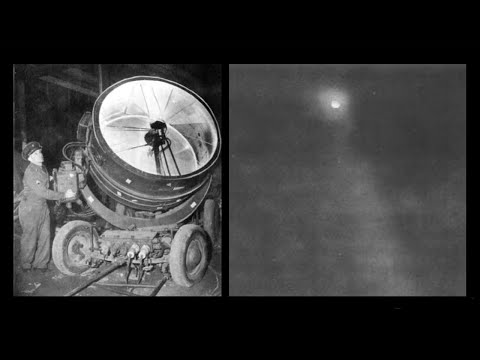
Sources
- NICAP. "UFO Report — Ohio Searchlight Incident, August 19, 1949." nicap.org
- NICAP. "Ohio Searchlight Case" (Stringfield analysis; Kenny Young & Richard Haines summary). nicap.org
- UFO Casebook. "1949, Norwood, Ohio Searchlight UFO Incident." ufocasebook.com
- Gross, Patrick. "UFOs at Close Sight: The Norwood Searchlight Incident, USA, 1949." ufologie.patrickgross.org
- The Black Vault. "Norwood, Ohio Searchlight UFO Incident — Case Files." theblackvault.com
- UFO Insight. "The Little-Known 1949 Norwood UFO Searchlight Encounters." ufoinsight.com
- Ripatrazone, Nick. "Close Encounters: A Priest and a Mysterious U.F.O. Sighting," America Magazine, July 27, 2018. americamagazine.org
- Hand, Greg. "Mysterious Sphere Floats Above 1949 Norwood," Cincinnati Curiosities. tumblr.com/handeaux
- RR0 (Réseau Réflexion OVNI). "Les observations de Norwood." rr0.org
- Norwood Historical Society. "This Day in Norwood History — June 2: Lydon Assumes Chief of Police Post." norwoodhistoricalsociety.org
- National Archives and Records Administration. "Project Blue Book Records Research Guide." archives.gov
- National Archives and Records Administration. "UAP Textual and Microfilm Records Research Guide." archives.gov
- Wikimedia Commons. "Holy Trinity Church in Norwood, OH" (photo by Andy Hemmer, CC BY-SA 4.0). commons.wikimedia.org
- gCatholic. "Norwood, Ohio, USA — Church of the Holy Trinity." gcatholic.org
- Stringfield, Leonard H. Inside Saucer Post…3-0 Blue: CRIFO Views the Status Quo — A Summary Report on UFOs. Cincinnati: CRIFO, 1957.
- Hall, Richard H., ed. The UFO Evidence. Washington, D.C.: NICAP, 1964, p. 88.
- UFOinfo. "Kenny Young Passes." ufoinfo.com
- Anomaly Response Network. Kenny Young UFO research archive. kenny.anomalyresponse.com
- Eyes On Cinema. "The 1949 Norwood, Ohio, Searchlight UFO Incident" (video). youtube.com
- National Archives and Records Administration. Records of Project Sign, Project Grudge, and Project Blue Book, Record Group 341. archives.gov
See something inaccurate? Have additional information or sources?
Suggest an Edit →Last Updated: August 2026