
Puerto Rico ASW Range Sonar Contact
Sometime in March 1963, according to a single published account, U.S. Navy sonar technicians conducting anti-submarine warfare exercises in the Atlantic waters off Puerto Rico tracked an unidentified object moving at speeds "over 150 knots" — roughly four to five times faster than any submarine of the era — to depths approaching 27,000 feet over a four-day pursuit involving thirteen ships and aircraft. The claim's earliest and, to date, only substantive source is naturalist Ivan T. Sanderson's 1970 book Invisible Residents, which names no ship, no sonar operator, and no officer, and in which Sanderson himself admits he was never able to independently confirm the story. The operational backdrop — a real U.S. Navy Fleet anti-submarine exercise off Puerto Rico that same month, with the carrier USS Wasp present — is independently documented in the Navy's own service history. The high-speed sonar chase itself is not.
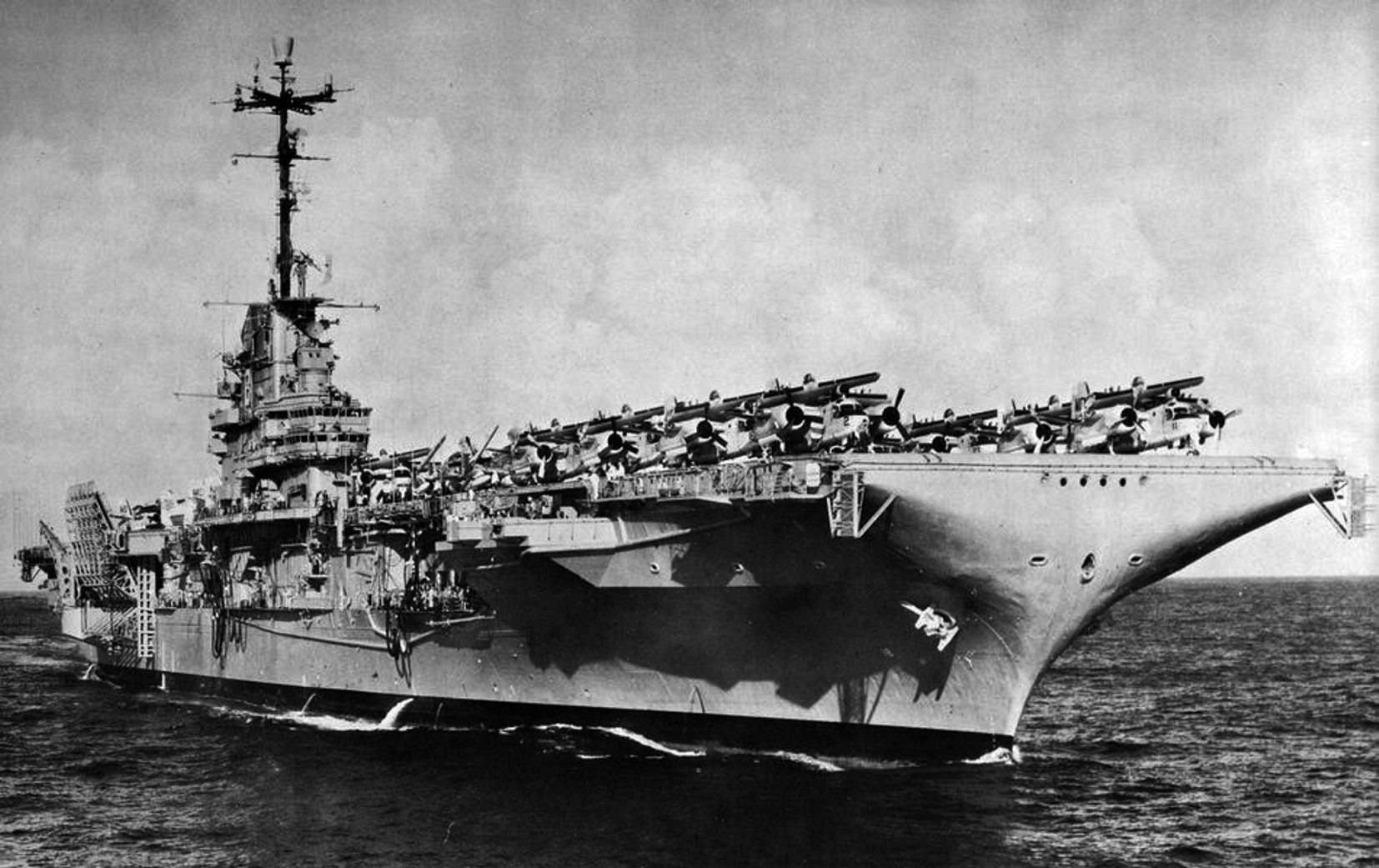
Pictured: USS Wasp (CVS-18), the Essex-class anti-submarine warfare support carrier, underway at sea in 1960 — three years before the March 1963 Puerto Rico exercises this case describes, but the same ship, in the same fleet role, that the Navy's own official service history confirms was conducting Fleet ASW exercises off Puerto Rico that month. No photograph, sonar trace, or any other visual or instrument record of the alleged high-speed contact itself is known to exist; the claim comes from a secondhand literary compilation published seven years after the fact, not from any surviving Navy document.
Theoretical Alignment
None of the three classic interpretive frameworks fit this case especially well, and that mismatch is itself informative. The Extraterrestrial Hypothesis draws only weak alignment from the raw magnitude of the claimed speed — a genuinely extraordinary figure if true — but with zero photographic, physical, or even a single named witness behind it, there is nothing here to actually evaluate against an ETH framework beyond the number itself. The Interdimensional Hypothesis finds almost no purchase at all; nothing in Sanderson's account describes a portal, a dimensional transition, or any of the phenomenology that hypothesis typically explains. The Psycho-Social Hypothesis scores modestly higher, but even that is an imperfect fit: PSH ordinarily explains how a real first-hand percept gets shaped by a witness's expectations and cultural context, and this case has no described witness psychology to examine at all — no one who saw or heard the contact left behind any personal account of what it felt like to experience it. What this case actually presents is a documentary and sourcing problem rather than an experiential one: a claim whose entire life exists inside one popular author's secondhand compilation and its later reprintings, disconnected from any traceable original observer. That is a different kind of anomaly than any of the three frameworks was built to assess, and this file treats it accordingly throughout.
Background
The term "USO" — Unidentified Submerged Object — entered popular use as a deliberate parallel to "UFO," describing reports of anomalous objects, lights, or sonar contacts encountered in or emerging from oceans, lakes, and rivers rather than the sky. The U.S. Navy itself has used a version of the term administratively, but in a far more mundane sense: internal Navy usage classifies "USOs" as whales, sharks, and other marine life that can interfere with ship maneuvering, towed sonar arrays, and oceanographic survey equipment — a routine operational hazard, not an unexplained phenomenon. Ufological usage of the same acronym is a later and much broader borrowing, encompassing everything from glowing underwater lights reported by mariners for centuries to claimed high-speed sonar contacts like the one this file examines.
The person most responsible for popularizing USOs as a distinct category within American ufology was Ivan T. Sanderson (1911–1973), a Scottish-born naturalist, professional zoologist, and prolific popular-science author. Sanderson had a genuinely credentialed scientific background — formal training in zoology, marine biology, and geology at Cambridge University, and fieldwork experience collecting animal specimens across West Africa, the Caribbean, and Central America for museums and for his own later television and writing career — which lent his subsequent forays into cryptozoology and Fortean phenomena a degree of institutional credibility that many of his contemporaries in the flying-saucer press lacked. In 1965 Sanderson published an influential article proposing "twelve devil's graveyards around the world," a global grid of ocean and sea regions — including the Bermuda Triangle and the so-called Devil's Sea off Japan — that he argued showed statistically elevated rates of unexplained ship and aircraft disappearances. In 1967 he founded the Society for the Investigation of the Unexplained (SITU) in Columbia, New Jersey, to collect and archive reports of anomalous phenomena of every kind, and in 1970 he published Invisible Residents: A Disquisition upon Certain Matters Maritime, and the Possibility of Intelligent Life under the Waters of This Earth — the book that, for the first time, gathered scattered maritime "USO" reports from around the world into a single sustained argument that an unknown, technologically advanced intelligence might inhabit Earth's oceans. It is inside that book, and nowhere else, that the Puerto Rico sonar-contact story this file investigates first appears in print.
The claimed event sits inside a specific and genuinely tense Cold War moment. The Cuban Missile Crisis had concluded barely four months earlier, in October 1962, after the tensest direct confrontation of the entire Cold War, and Soviet submarine activity in the Caribbean and Western Atlantic remained a first-order U.S. Navy preoccupation throughout 1963. Puerto Rico itself sat at the center of the Navy's Atlantic anti-submarine warfare infrastructure for exactly this reason. Naval Station Roosevelt Roads, on the island's eastern coast, served as the Atlantic Fleet's primary Caribbean logistical and training hub, and the Navy held large annual Fleet exercises — publicly known by the codename "Springboard" in multiple confirmed years of that era — in the waters around Puerto Rico, Cuba, and Panama each spring, explicitly built around sharpening ships' and aircraft crews' anti-submarine warfare, escort, and surveillance skills. Separately, and even more directly relevant to why the Navy chose Puerto Rico's waters specifically for sensitive underwater work, Naval Facility (NAVFAC) Ramey, on Puerto Rico's western coast, was commissioned in September 1954 as the very first operational station of the Sound Surveillance System (SOSUS) — the Navy's classified network of seafloor hydrophone arrays built to detect and track Soviet submarines across the Atlantic. By 1963 the surrounding Caribbean basin, and the deep water immediately north of Puerto Rico in particular, was accordingly one of the most acoustically instrumented and closely monitored patches of ocean in the world, precisely because its extreme depth and quiet bathymetry made it valuable for exactly the kind of long-range passive listening and active-sonar exercise work the Navy needed.
That depth is itself a genuine, independently verifiable extreme. The Puerto Rico Trench runs roughly 800 kilometers along a transform boundary where the Caribbean tectonic plate slides obliquely past the North American plate, and it contains the deepest point in the entire Atlantic Ocean: the Milwaukee Deep, most precisely measured at 8,376 meters (27,480 feet) by explorer Victor Vescovo's 2018 crewed descent, with earlier historical soundings ranging as high as roughly 28,700 feet depending on instrumentation and era. That verifiable figure — a real, documented, and famous oceanographic record — sits remarkably close to the "27,000 feet" depth Sanderson's account claims the pursued object reached, a correspondence this file treats as analytically significant and returns to directly in the Conventional Explanation Candidate section below.
The specific carrier named in period retellings of the story, USS Wasp (CVS-18), was a real and appropriately-cast vessel for this setting. An Essex-class carrier commissioned in 1943 and redesignated CVS-18 (Antisubmarine Warfare Support Aircraft Carrier) in 1956, Wasp's entire fleet mission by the early 1960s centered on hunting submarines using her embarked S-2 Tracker patrol aircraft and helicopter detachments working alongside an escort screen of destroyers and destroyer escorts equipped with hull-mounted and towed active sonar. According to the ship's own official U.S. Navy service history, the early part of 1963 saw Wasp conducting antisubmarine warfare exercises off the Virginia Capes, then steaming to the Caribbean coast of Costa Rica in support of President Kennedy's March 21, 1963 diplomatic visit to San José for a summit with six Central American heads of state, before the carrier took part in Fleet exercises off Puerto Rico and returned to Boston on April 4, 1963. That timeline independently places a real U.S. Navy anti-submarine carrier group in Puerto Rican waters in March 1963 — exactly the setting Sanderson's account describes — even though nothing in that same official service record mentions any high-speed sonar contact, unidentified object, or unusual incident of any kind during the deployment.
Complete Timeline
| Date | Event |
|---|---|
| October 1962 | The Cuban Missile Crisis brings the Cold War to its tensest point, sharply elevating U.S. Navy anti-submarine vigilance across the Caribbean and Western Atlantic for the following year. |
| Early 1963 | USS Wasp (CVS-18) conducts antisubmarine warfare exercises off the Virginia Capes, per the carrier's own official Navy service history. |
| March 21, 1963 | Wasp is operating off the Caribbean coast of Costa Rica in support of President Kennedy's summit with six Central American presidents in San José. |
| "Sometime in 1963" (Sanderson's own wording; no specific date given) | Per the only known account, U.S. Navy sonar technicians conducting ASW exercises off Puerto Rico, roughly 500 miles southeast of the continental United States, detect an unidentified object; a submarine breaks formation to pursue it. |
| (Same undated episode) | The object is tracked moving at "over 150 knots," prompting Navy personnel to wonder whether it was a planted decoy target rather than a genuine anomaly. |
| (Same undated episode) | "No less than thirteen craft," including anti-submarine patrol aircraft, are said to have tracked the object continuously for four days as it maneuvered to depths approaching 27,000 feet. |
| Late March/early April 1963 | Wasp takes part in Fleet exercises off Puerto Rico and returns to Boston on April 4, 1963, per the carrier's official service record — which makes no mention of any unusual sonar contact. |
| 1970 | Ivan T. Sanderson publishes Invisible Residents, the first and, to date, only substantive published account of the Puerto Rico sonar contact — in which Sanderson himself states he was unable to obtain any confirmation of the story. |
| 1970s–2000s | The story is repeated in secondary USO-themed literature and articles, generally citing Sanderson as the source, without any new corroborating document or named witness ever surfacing. |
| 2019 | Journalist Kyle Mizokami's Popular Mechanics article "The Weird History of Unidentified Submerged Objects" repeats the Sanderson account (mirrored the same year on ExoNews) as part of a broader survey of USO reports, again citing Sanderson as the sole source. |
| 2018–2021 | Independent of this case, explorer Victor Vescovo precisely measures the Puerto Rico Trench's Milwaukee Deep at 8,376 m (27,480 ft) — a verified real-world figure strikingly close to the "27,000 feet" Sanderson's decades-earlier account had already claimed. |
| 2020s | Numerous blog and video aggregators (Enigma Labs, Earth Mystery News, assorted YouTube "mystery" channels) further repeat the story, with some versions introducing specific unsourced embellishments — a named operation ("Springboard"), a named submarine (USS Skipjack), and a specific vessel count — that do not appear in Sanderson's original 1970 text. |
The Account As Sanderson Told It
Sanderson's version of the story, presented in Chapter 2 of Invisible Residents ("A Second Mystery — Oceanic UAOs"), is brief, general, and conspicuously light on the kind of specific, checkable detail that a firsthand or officially-sourced account would normally carry. In his own words, as closely as the surviving text can be reconstructed: sometime in 1963, the U.S. Navy conducted exercises to train personnel in detecting and tracking underwater craft, held off Puerto Rico roughly five hundred miles southeast of the continental United States. Five small naval vessels took part, with the carrier Wasp serving as command ship, while submarines engaged in silent-running drills as the exercise's simulated targets. During the exercise, a sonar operator aboard one of the vessels reported an object moving at "over 150 knots" — a speed Sanderson himself flags as nearly four times faster than any submarine speed record publicly known at the time. Uncertain whether the contact represented a planted decoy meant to test the exercise's own detection equipment, Navy personnel nevertheless kept tracking it: Sanderson states that "no less than thirteen craft," including anti-submarine patrol aircraft, logged the pursuit over a four-day span, during which the object maneuvered to depths approaching 27,000 feet.
What is just as notable as what Sanderson includes is what he does not. No ship is named beyond Wasp herself. No submarine, destroyer, or aircraft squadron is identified. No officer, sonar technician, or crew member is named or quoted directly. No specific date within March (or any other month) of 1963 is given. No document — deck log, after-action report, sonar tape, or press release — is cited as Sanderson's source. Most tellingly, Sanderson does not claim to have interviewed anyone involved; he presents the story as something relayed to him, at an unspecified remove, by unnamed intermediaries he describes only as "authors who originally wrote of them" and who had, in his telling, received "much help and advice from naval authorities." Immediately after presenting the story, Sanderson adds a rare and unusually candid admission for a book otherwise built on confident assertion: "As I have said, I have been unable to obtain any confirmation of them," calling the search for verification, in his own phrase, "a dead end," at least as of the time he was writing.
That admission matters enormously to how this file rates the case. Sanderson was not claiming firsthand knowledge, was not vouching for a named source he had personally vetted, and was explicit that his own attempts to confirm the story had failed. He nonetheless included it in his published book, presented with the specific numeric details (150 knots, thirteen craft, four days, 27,000 feet) that have made the story durable and vivid enough to be repeated, largely unchanged in substance, for more than five decades since. This is precisely the profile of a case that is real in the sense that matters for the site's Coming Soon Queue Verification Rule — a claim that genuinely exists in the published record, has been multiply repeated by independent secondary sources, and traces cleanly back toward an identifiable origin point — while remaining, on the evidence available, unconfirmed and very possibly unconfirmable at this historical distance.
How the Story Has Drifted in Later Retellings
A useful test for any claim this thinly sourced is whether the specific details attached to it stay stable across independent retellings, or whether they fracture and accumulate embellishment the further a version gets from the original text — a classic signature of an orally-transmitted or informally-copied story rather than one anchored to a single, checkable document. This case shows real evidence of the latter. Sanderson's 1970 original describes "five small naval vessels" with Wasp as command ship and unnamed submarines running silent as exercise targets; it does not name any specific submarine, does not use the phrase "Operation Springboard," and does not specify a number of submarines involved. Later web-era retellings — not this file's own research, but material surfaced during the research for this file — add exactly those missing specifics: some versions state that "at least four submarines" took part "including the SSN-585 Skipjack," and attach the operation to the name "Springboard." Those are real, verifiable objects: USS Skipjack (SSN-585) was indeed a fast, state-of-the-art nuclear attack submarine active in the Atlantic Fleet in 1963, and "Springboard" was indeed the real, recurring codename for the Navy's annual spring Fleet exercises in Puerto Rican and wider Caribbean waters in this general era. But neither detail appears anywhere in Sanderson's own original account, and no independent naval record confirming Skipjack's specific presence in this particular exercise, or definitively confirming "Springboard" as this specific March 1963 deployment's own codename, has surfaced during this file's research. The likeliest explanation is that later writers, aware of Springboard's real existence as the Navy's standing annual Caribbean exercise and aware of Skipjack's real reputation as the fastest U.S. submarine of the day, filled in plausible-sounding specifics that Sanderson himself had left blank — precisely the kind of incremental, unsourced elaboration that separates an urban legend's accumulated "common knowledge" from its actual, thinner documentary foundation. This file has deliberately declined to adopt those later, unsourced additions (Skipjack's name, the "Springboard" codename tied to this specific exercise) anywhere above, reporting only what Sanderson's own text and the independently-confirmed Wasp service record actually establish.
Key Witnesses
Ivan T. Sanderson
Sanderson is the case's sole named figure, and it is important to state plainly what role he actually occupies: he was not present for, and does not claim to have witnessed, any part of the alleged sonar contact. He is the compiler who first published the story, drawing it, in his own account, from unnamed secondary sources who claimed naval assistance he could not verify. His formal training in zoology and marine biology, and his standing as the founder of the Society for the Investigation of the Unexplained, lend the story a more credentialed presentation than it would carry from an anonymous tip, but they do not substitute for a named witness, an official document, or any form of independent corroboration — none of which Sanderson himself claimed to possess.
No sonar operator, ship's officer, pilot, or any other Navy or civilian individual has ever been named in connection with this case, in Sanderson's original text or in any of the secondary literature that has repeated it since 1970. This absence of even a single identified witness, more than five decades after the claimed event and well after most other 1963-era Navy participants would have been reachable for interview during the peak decades of ufological research into Cold War military cases, is one of the case's most significant evidentiary weaknesses, and this file treats it as such throughout.
The Five Observables Assessment
The Five Observables framework, drawn from the Pentagon's own Advanced Aerospace Threat Identification Program criteria for anomalous flight characteristics, is applied here to the performance characteristics described in Sanderson's account — with the important caveat that every rating below evaluates a claim with no instrument data, no visual observation, and no named observer behind it.
Assessment: The case is a near-total outlier on this framework in that only one of the five observables is even claimed, and that single claim (the 150-knot speed) is the entire substance of the account — there is no described anti-gravity lift, no low-observability/stealth characteristic (the object was, by the account's own logic, continuously and successfully tracked, the opposite of low observability), and no trans-medium transition of any kind, since the object is described as remaining fully submerged throughout. A case this narrow in its claimed anomalous characteristics, resting entirely on one secondhand numeric figure with no supporting sensor data, sits at the extreme thin end of what this framework is designed to evaluate.
Evidence Assessment
Supporting Anomalous Origin
- The claim has been continuously and consistently repeated in USO literature since 1970 without any published retraction, and independent later writers (Mizokami/Popular Mechanics, 2019) treat it as a genuine historical claim worth including in surveys of the broader USO phenomenon.
- The claimed tracking depth, "27,000 feet," is strikingly close to the Puerto Rico Trench's real, independently verified maximum depth — the Milwaukee Deep, precisely measured at 27,480 feet in 2018 — meaning the story's geography and depth figures are not simply invented from nowhere but track a genuine oceanographic extreme.
- The broader operational backdrop — a real U.S. Navy Fleet ASW exercise off Puerto Rico in March 1963, with the carrier Wasp present — is independently confirmed by the Navy's own official service history, meaning the story is not fabricated wholesale as to time and place.
- Cold War anti-submarine forces genuinely did encounter transient, hard-to-classify sonar returns as a routine operational reality, and internal Navy correspondence and oral histories from the era acknowledge that ambiguous contacts were common enough that crews sometimes debated whether a given return was a planted exercise target, a biological source, or something else entirely — the exact uncertainty Sanderson's account describes Navy personnel expressing in real time.
- No named Navy source has ever come forward specifically to deny that any unusual contact occurred during the March 1963 exercise, though this is a weak point in the case's favor given that no named Navy source has ever been identified to ask in the first place.
Supporting Conventional Explanation
- No named witness of any kind — no sonar operator, officer, pilot, or crew member — has ever been identified in over fifty years, despite the story's wide circulation within a research community that has successfully tracked down and interviewed named participants in far more sensitive Cold War-era incidents.
- Sanderson, the story's sole source, explicitly states in his own published text that he could not confirm the account and calls his search for corroboration "a dead end" — the case's only source affirmatively disclaims certainty about its own accuracy.
- No deck log, after-action report, sonar recording, incident report, or any other primary Navy document referencing an unidentified high-speed contact during this exercise has ever surfaced, despite decades of FOIA-driven UFO research specifically targeting Cold War-era military archives.
- A sustained 150-knot submerged speed exceeds the fastest confirmed speed of any submarine before or since — including the Soviet K-222's 44.7-knot 1969 trial and the Alfa-class's 40–45-knot short bursts, both of which remain the highest submerged speeds on the public record even decades later — by a factor of roughly three to four, a gap physics-based drag and cavitation limits make extraordinarily difficult to explain for any object obeying ordinary hydrodynamics.
- Later retellings of the story have introduced specific unsourced details (a named submarine, a named operation) absent from Sanderson's 1970 original, a documented pattern of incremental embellishment that is a recognized hallmark of an evolving secondhand claim rather than a stable, source-anchored account.
Why "Disputed"
This file rates the Puerto Rico ASW Range Sonar Contact case Disputed at 22/100 — near the low end of this catalogue's scoring range, and deliberately so. The rating is not a judgment that nothing unusual could have happened during a real, independently-documented March 1963 Navy exercise off Puerto Rico; a genuine sonar contact that puzzled crews in the moment is entirely plausible on general Cold War ASW grounds, and this file does not dismiss that possibility. What the rating reflects is the near-total absence of anything beyond a single secondhand account standing between "something happened" and the specific, dramatic claim actually made — 150 knots, thirteen craft, four days, 27,000 feet. Every one of those specific figures traces to one 1970 book, by an author who was not present, who names no one who was, who cites no document, and who states in his own words that he could not confirm the story. No subsequent researcher, in over fifty years of active USO and ufological research into Cold War naval incidents, has produced a named participant, a declassified document, or any independent corroboration of any kind. Set against that thinness are a few real, verifiable anchors this file does not want to understate: the operational setting is genuine and independently documented (Wasp's confirmed March 1963 Puerto Rico deployment), the claimed depth closely tracks a real oceanographic record (the Milwaukee Deep), and the story has been stable in its core substance, if not its embellished details, across more than five decades of retelling by independent secondary sources who were not simply inventing it from nothing. Those anchors keep this case in Disputed territory rather than Debunked — there is no positive proof the story is false, only an absence of proof it is true — but they fall far short of the multiply-witnessed, instrumentally corroborated, or officially documented standard this catalogue reserves for a Credible or Verified rating. A single unconfirmed compilation, admitted as such by its own author, is a real claim worth documenting honestly; it is not strong evidence of anything beyond its own existence as a claim.
Sensor & Instrumentation Detection Profile
No sonar recording, sonar tape transcript, radar log, or any other instrument record specific to this alleged contact has ever been published, cited, or made available for independent review. What can be established is the class of instrumentation genuinely in use in this specific ocean region at this specific time. By 1963, U.S. Navy anti-submarine forces in the Puerto Rico operating area had access to two broad categories of detection technology: shipborne and airborne active sonar, and fixed passive hydrophone surveillance. Active sonar aboard 1960s-era destroyers and destroyer escorts (variants in the AN/SQS series) worked by transmitting a directional acoustic "ping" and timing the echo, a method vulnerable to a range of known false-contact sources including thermal-layer refraction, biological targets, and multipath echoes off the seafloor or subsurface density layers. Airborne ASW assets — the S-2 Tracker patrol aircraft Wasp embarked, and Navy patrol squadrons operating from Roosevelt Roads — deployed sonobuoys, expendable passive listening devices dropped into the water and radio-linked back to the aircraft, to extend detection range beyond a single ship's own sonar. Separately, and independent of anything aboard the ships in the exercise itself, Naval Facility Ramey on Puerto Rico's western coast had operated as the first commissioned station of the classified SOSUS seafloor hydrophone network since September 1954, giving the wider Caribbean and Western Atlantic basin one of the most acoustically monitored underwater environments in the world by the early 1960s, even though SOSUS's own contact logs (assuming any exist for this specific date) remain classified or unreleased and were never cited by Sanderson or any subsequent researcher as a source for this case. In short: the technology existed, in this exact place and era, to generate a genuine transient high-speed sonar contact, whether from a real target, a decoy, or a sensor artifact — but no specific instrument record tying any of that real 1963 technology to this specific claimed event has ever been produced. It is worth stressing what none of this period sonar equipment could plausibly do: no active or passive system of the early 1960s, Soviet or American, was capable of reliably resolving a sustained target track at 150 knots against the ambient noise, reverberation, and Doppler-processing limits of the day, meaning even a genuinely instrumented reading at that speed would have strained the technology of the era to characterize accurately, quite apart from whether any solid object could physically achieve it.
Environmental & Geospatial Context
The Puerto Rico Trench lies along the boundary where the Caribbean tectonic plate slides obliquely eastward past the North American plate — a transform boundary with only a minor subduction component, distinct from the more dramatic subduction-driven trenches found elsewhere in the Caribbean arc. It runs roughly 800 kilometers parallel to and north of Puerto Rico and contains the deepest point in the entire Atlantic Ocean, the Milwaukee Deep, precisely measured at 8,376 meters (27,480 feet) by explorer Victor Vescovo's 2018 crewed descent, with earlier 20th-century soundings variously reporting figures as deep as roughly 28,700 feet depending on the sounding technology used. That extreme depth and the trench's generally steep, complex bathymetry make the surrounding water column oceanographically unusual in ways directly relevant to sonar performance: strong thermoclines, salinity gradients, and the ubiquitous deep scattering layer — a globally-present band of small mesopelagic fish and other organisms, concentrated at roughly 300–500 meters depth during daylight and migrating toward the surface at night, whose swim bladders reflect sonar pulses strongly enough that WWII-era sonar operators initially mistook the layer for a false seafloor, sometimes called the "phantom bottom." Any of these layers can refract, duct, or create multipath echoes of active sonar pulses in ways that produce apparent depth, range, or velocity readings that do not correspond to a genuine solid target's actual motion — a real, well-documented class of oceanographic sonar artifact directly relevant to evaluating a claimed 150-knot, multi-thousand-foot-deep contact. No meteorological, lunar-phase, or precise-date reconstruction is possible for this case, because Sanderson's account gives no specific day within March 1963 and no time of day, leaving any attempt at environmental reconstruction beyond the trench's own general, well-documented, and genuinely extreme oceanography necessarily speculative.
Observer Credibility & Occupational Profile
This case presents an unusual credibility problem: there is no primary observer to evaluate at all. The only named figure in the entire chain, Ivan T. Sanderson, was not present for and does not claim direct knowledge of the alleged event; his own occupational credibility — genuine, Cambridge-trained formal education in zoology and marine biology, a working career as a professional naturalist and museum-affiliated field collector, and founding leadership of the Society for the Investigation of the Unexplained — is real and relevant to how seriously his broader body of work should be taken, but it is credibility as a compiler and interpreter of secondhand reports, not as a witness to this specific event. Sanderson's own scientific training arguably cuts in both directions here: it explains why he was inclined to treat the story as worth including (he had a genuine intellectual framework, the "anomaly zones"/oceanic-intelligence thesis of Invisible Residents itself, into which a dramatic high-speed USO story fit neatly), while his explicit admission that he could not confirm it shows he was not willing to simply invent false certainty to strengthen his own book's argument — a point that, on balance, this file weighs as modestly in his favor as an honest, if credulous, compiler rather than a fabricator. Beyond Sanderson, the case has no occupational profile to assess at all: no sonar technician's rating or years of service, no officer's rank or specialty, no pilot's flight hours, because none of these people have ever been named. This total absence of any identifiable, credentialed primary witness is one of the single largest evidentiary gaps separating this case from the site's higher-rated Credible and Verified files, which typically rest on named, interviewable, and cross-checkable individuals.
Physical & Material Assays
No physical evidence of any kind is claimed to exist for this case, and none has ever been produced. There is no recovered fragment, no photograph, no sonar tape or its transcript, no deck log excerpt, and no laboratory test of any material — because the claimed event, as described, left behind nothing physical to test in the first place; it is, by its own nature, a purely acoustic/testimonial claim about a submerged object never seen, filmed, or touched by anyone. This file states that absence plainly, in keeping with the site's standing practice of treating a documented lack of physical evidence as itself an informative data point rather than an awkward gap to gloss over.
Historical Precedents & Archive Matches
The Puerto Rico region carries an unusually dense concentration of USO-adjacent reports independent of this specific 1963 claim. Journalist Kyle Mizokami's 2019 Popular Mechanics piece on the history of USOs — the same article that repeats Sanderson's 1963 account — separately relays a story told by retired Navy Commander David Fravor (the pilot at the center of the famous 2004 "Tic Tac" encounter off San Diego) about a fellow retired Navy helicopter pilot based at Naval Station Roosevelt Roads, Puerto Rico, who reported twice encountering unexplained underwater masses while recovering spent practice torpedoes from the water, including one incident in which a practice torpedo was allegedly pulled under and never recovered. That account, like Sanderson's 1963 story, rests on secondhand retelling (Fravor relaying another pilot's account on a podcast, rather than a primary source under his own name) and is not independently verified here, but it does establish that Puerto Rico's status as a recurring site of Navy-adjacent USO folklore did not begin or end with the 1963 claim. Within the broader catalogue of this site's own cases, this file's closest analogues are other Navy-instrumented, secondhand, or thinly-corroborated USO/UAP reports: the USS Omaha Underwater Object case (2019) similarly involves real Navy sensor data and a genuinely unresolved rival explanation; the Shag Harbour Incident (1967) shows what a well-corroborated USO case looks like by contrast, with dozens of named civilian and Coast Guard witnesses and an official search-and-rescue response, a evidentiary standard this Puerto Rico case falls far short of; and the Iarga Encounter (1967) represents the opposite extreme of a single, richly detailed, but entirely uncorroborated personal USO account. The U.S. Navy's own internal administrative use of "USO" for whale, shark, and marine-life sonar contacts, discussed in Background above, is itself a kind of institutional "precedent" worth noting: it demonstrates that ambiguous, ultimately mundane sonar returns were common enough in real Navy operations to warrant a standing internal classification term, independent of any ufological interpretation.
A far better-documented near-contemporary parallel comes not from the United States but from Argentina, and the contrast it offers is instructive. In May 1958, Argentine Navy cruisers General Belgrano, 9 de Julio, and La Argentina were conducting exercises in Golfo Nuevo, a gulf off Argentina's Patagonian coast, when the destroyer Buenos Aires obtained an unexpected sonar contact that officers classified as a submarine performing evasive maneuvers; crews reported sighting a periscope, an oil slick, and a schnorkel over roughly two weeks of pursuit before the contact reportedly departed the gulf at high speed on June 10, 1958. A second episode followed in October 1959, and a third began on January 31, 1960, when the torpedo boat Cervantes obtained a sonar contact moving slowly at 90 feet, again triggering a large-scale air-sea search involving more than thirty aircraft and a dozen warships. Unlike the Puerto Rico claim this file investigates, the Golfo Nuevo incidents were extensively covered by the contemporary press at the time they happened: TIME magazine's February 22, 1960 dispatch, "Argentina: The Ping in Golfo Nuevo," reported the story as international news within weeks of the event, named the ships involved, and struck an explicitly skeptical tone even at the time, noting that Argentine submarine scares had an inconvenient habit of surfacing just before congressional naval-appropriations votes, and that sonar "can confuse submarines with whales, old wrecks, even underseas prominences." That kind of contemporaneous, independently skeptical press scrutiny is precisely what the Puerto Rico case never received, because — unlike Golfo Nuevo — no press account, official Navy statement, or public acknowledgment of any kind exists from 1963 itself; the story entered the historical record only seven years later, filtered entirely through one author's secondhand retelling, with no contemporary reporter, editor, or fact-checker ever given the chance to ask a single question of anyone actually present. The comparison illustrates, in miniature, exactly what separates a real-time, press-covered military sonar mystery from a claim that surfaces only as an already-old, single-source literary account.
Material Analysis
No physical or material trace evidence survives from, or was ever claimed to exist for, this case — a fact worth stating directly because it is itself analytically informative rather than a simple absence to note in passing. Every other physical-trace case in this catalogue, from soil samples to metal fragments to biological specimens, offers at least some object that has been described, tested, or preserved (even if imperfectly) for independent examination. This case offers none: not a recovered instrument tape, not a written contemporaneous log excerpt, not so much as a hand-drawn sonar-scope sketch. The entire evidentiary record consists of prose description, filtered through one author's secondhand retelling, thirty-plus years removed from any possible original source and never at any point supported by a document anyone else has been able to independently examine.
Supporting Non-Terrestrial Origin
- The claimed depth figure (27,000 feet) is not an arbitrary invented number; it closely tracks the Puerto Rico Trench's own real, later-verified maximum depth record (the Milwaukee Deep, 27,480 feet), suggesting whoever originated the story, whatever its ultimate accuracy, had genuine, geographically-informed knowledge of the trench rather than fabricating details from nowhere.
- The specific claimed speed figure, while extraordinary, is presented with an internally consistent comparison (Sanderson's own "nearly four times" the era's known submarine speed record) rather than an arbitrary round number, a detail some researchers read as a mark of at least deliberate, considered reporting rather than casual invention.
Supporting Terrestrial Origin
- No original document, recording, or physical trace of any kind has ever been produced, published, or made available for outside testing — the entire "material record" is a single author's prose summary of an unnamed intermediary's unverified account.
- A close geographic/depth correspondence between a popular author's claimed figure and a famous oceanographic record is at least as consistent with a writer anchoring an unconfirmed story to a genuinely well-known regional superlative (the Atlantic's deepest point) as it is with the figure representing an actual, precisely-instrumented 1963 sonar reading.
- The claimed speed (over 150 knots, sustained, submerged) exceeds the real, publicly documented submerged speed record of any submarine before or after 1963 by a factor of roughly three to four, a gap that basic fluid-drag and cavitation physics make extraordinarily difficult to explain for any solid object obeying ordinary hydrodynamics in seawater.
The Conventional Explanation Candidate: An Unverifiable Secondhand Claim
Because this case rests on a single, admittedly unconfirmed compilation rather than on any primary testimony or instrument record, "conventional explanation" here means something slightly different than it does for a directly-witnessed sighting: the question is not only what mundane phenomenon might have generated a real sonar contact, but whether a real contact of any kind needs to be assumed to exist at all. This file evaluates four distinct candidates below, each addressing a different layer of that question.
Unverifiable Secondhand Compilation (No Confirmable Underlying Event)
PlausibleThe simplest explanation consistent with all available evidence is that Sanderson relayed a story from unnamed intermediaries that cannot now, and very possibly never could, be checked against any primary source — regardless of whether some real, more mundane sonar event originally inspired it. Sanderson's own admission that he could not confirm the account, the total absence of any named participant after more than fifty years, and the total absence of any surfaced Navy document together make this the best-supported single description of the case's actual evidentiary status: not proven false, but never rising above the level of an unconfirmable claim. This candidate does not require deciding whether anything unusual really happened during the March 1963 exercise; it simply states, accurately, that the published record cannot resolve that question either way.
Sonar Misidentification (Deep Scattering Layer / Thermocline Artifact)
InconclusiveIf a real, anomalous-seeming sonar return did occur during the exercise, the Puerto Rico Trench's genuinely unusual oceanography offers several well-documented, non-exotic mechanisms that could produce one: the globally-present deep scattering layer (a dense band of sonar-reflective marine life that WWII-era operators mistook for a false seafloor), thermocline-driven acoustic ducting, or multipath echoes off the trench's own complex, steeply-sloped bathymetry can all generate transient contacts that appear, briefly, to move at speed or depth values inconsistent with a genuine solid target. This candidate is rated Inconclusive rather than Plausible only because no original sonar recording survives to actually test it against — the mechanism is real and well-established in general, but nothing in the specific case record confirms or rules it out here.
Genuine But Exaggerated Submarine or Decoy Contact
InconclusiveSanderson's own account notes that Navy personnel in the moment debated whether the contact was a planted decoy target inserted into the exercise to test detection equipment — a mundane, entirely plausible possibility given that ASW exercises of this kind routinely used towed or self-propelled target decoys precisely to simulate hostile submarines. A real, unclassified friendly decoy, or even a genuine but ordinary submarine contact whose speed was misjudged, misreported, or exaggerated in the retelling chain between the exercise and Sanderson's unnamed intermediaries decades later, would fully account for a real underlying event without requiring any genuinely anomalous vehicle. This candidate cannot be confirmed without an original record identifying what, if anything, was intentionally placed in the water as an exercise target that week, but it aligns with the one piece of real-time human reasoning the account itself preserves.
Deliberate Fabrication by Sanderson
ImplausibleWhile Sanderson's overall thesis in Invisible Residents benefited from including a dramatic story like this one, nothing in his text suggests outright invention: he explicitly flags his own inability to confirm the account rather than asserting false certainty, a choice a deliberate fabricator manufacturing a more compelling book would have had every incentive not to make. Sanderson's broader career shows a pattern of credulously repeating claims from others rather than inventing them outright, which is a real and serious methodological weakness in his work but a different failure mode than fabrication. This file rates outright invention by Sanderson himself Implausible, while treating the deeper, unresolved question of what his own unnamed sources actually knew, and how accurately they represented it to him, as the case's genuinely open and probably permanently unanswerable core problem.
Leading Candidate: Unverifiable Secondhand Compilation remains the most accurate overall description of this case's evidentiary status, though this file stops short of asserting that no real event whatsoever underlies the story; the genuine, independently-confirmed Navy ASW exercise and the real Navy debate over decoy contacts described in Sanderson's own text are exactly the kind of true, mundane kernel that a later, more dramatic retelling can plausibly grow from.
Related Cases
Confirmed Documents & Official Records
No U.S. Navy deck log, after-action report, sonar recording, or any other document referencing an unidentified high-speed underwater contact during the March 1963 Puerto Rico exercise has ever surfaced or been cited by any researcher. The only independently confirmable official record connected to this case is USS Wasp's own routine 1963 deployment history, which places the carrier in Puerto Rican waters for Fleet ASW exercises that month but makes no mention of any unusual incident. The links below search the general holdings of the relevant U.S. archives directly for any tangential or cross-referenced material.
Search Government Archives Directly
Further Reading — Recommended Literature
Invisible Residents: The Reality of Underwater UFOs
The primary, and to date only substantive, source for this case. Sanderson's foundational USO text, including his own admission that he could never confirm the Puerto Rico story.
A History of USOs: Unidentified Submerged Objects, Vol. 1: From the Beginning to 1969
A more recent, wide-ranging catalogue of USO reports through 1969, situating this case within the broader documented history of the genre Sanderson founded.
Blind Man's Bluff: The Untold Story of American Submarine Espionage
The definitive popular history of Cold War U.S. submarine operations, useful for understanding the real operational world — and real culture of classification — this claim is set against.
The Silent War: The Cold War Battle Beneath the Sea
Written by the Navy's own former chief scientist for undersea programs during exactly this era, offering rare firsthand insight into how the real 1960s Navy actually approached, and classified, unusual underwater contacts.
The UFO Encyclopedia (3rd Edition)
A rigorously sourced, skeptically-minded reference standard for cross-checking claims like this one against the wider, better-documented history of the UFO/USO field.
Essential Viewing
No Videos Available
Sources
- Ivan T. Sanderson, Invisible Residents: A Disquisition upon Certain Matters Maritime, and the Possibility of Intelligent Life under the Waters of This Earth, World Publishing Co., 1970 — the original and sole substantive source for the Puerto Rico sonar-contact claim, Chapter 2. Full text via Internet Archive
- Ivan T. Sanderson, Invisible Residents (Google Books preview/overview). Google Books
- Kyle Mizokami, "The Weird History of Unidentified Submerged Objects," Popular Mechanics, October 9, 2019 (mirrored on ExoNews) — repeats and cites Sanderson's 1963 account, and separately relays Cdr. David Fravor's account of Roosevelt Roads, Puerto Rico USO reports. ExoNews mirror
- Naval History and Heritage Command, Dictionary of American Naval Fighting Ships (DANFS), "Wasp IX (CV-18)" entry — official U.S. Navy service history confirming USS Wasp's March 1963 Fleet exercises off Puerto Rico and April 4, 1963 return to Boston. Cited via its own Wikipedia mirror below; the primary NHHC domain was unreachable at time of research.
- "USS Wasp (CV-18)," Wikipedia, citing the official DANFS entry for the ship's 1963 deployment history. Wikipedia
- "Puerto Rico Trench," Wikipedia — depth, tectonic origin, and location data. Wikipedia
- "Milwaukee Deep," Wikipedia — precise 2018 depth measurement (8,376 m / 27,480 ft) by Victor Vescovo. Wikipedia
- "Deep Scattering Layer," Wikipedia — the WWII-discovered sonar phenomenon relevant to the sonar-misidentification CEC candidate. Wikipedia
- "Unidentified submerged object," Wikipedia — general USO definition, including the U.S. Navy's own administrative usage of the term for marine life. Wikipedia
- "Skipjack-class submarine," Wikipedia — confirms the class's 33-knot submerged speed record, the fastest publicly documented U.S. submarine speed of the early 1960s. Wikipedia
- "Underwater speed records," Wikipedia — confirms the Soviet K-222's 44.7-knot 1969 trial and the Alfa-class's 40–45-knot bursts as the highest submerged speeds ever publicly documented, for any submarine, before or since. Wikipedia
- "Sound Surveillance System," Wikipedia — confirms NAVFAC Ramey, Puerto Rico as the first commissioned SOSUS station worldwide (September 1954). Wikipedia
- Naval Submarine League, "Remembering: The Sound Surveillance System (SOSUS)," parts I–II, The Submarine Review, 2007 — further primary-adjacent detail on SOSUS's Caribbean stations. Naval Submarine League Archive
- "Roosevelt Roads Naval Station," Wikipedia — background on the Atlantic Fleet's Caribbean logistical/training hub and annual "Springboard" exercises. Wikipedia
- USNI News/U.S. Naval Institute, "Roosevelt Roads (Pictorial)," Proceedings, May 1964, Vol. 90/5/735 — contemporary period documentation of the Roosevelt Roads/Springboard exercise infrastructure. USNI
- "USS Skipjack (SSN-585)," Wikipedia — confirms the submarine's real 1962–63 Atlantic Fleet service and record-setting submerged transit, cited here only to evaluate (and ultimately decline to adopt) a later, unsourced retelling detail. Wikipedia
- "Cuban Missile Crisis," Wikipedia — background context for the heightened 1962–63 Caribbean anti-submarine posture. Wikipedia
- David Hatcher Childress, foreword to Ivan T. Sanderson's Invisible Residents (Adventures Unlimited Press reprint edition) — publication history of the book's most widely available modern edition.
- Amazon.com listing, Invisible Residents: The Reality of Underwater UFOs — verified current edition/ASIN. Amazon
- Amazon.com listing, A History of USOs: Unidentified Submerged Objects, Vol. 1, Richard M. Dolan & Allan Lavigne — verified current edition/ASIN. Amazon
- Amazon.com listing, Blind Man's Bluff: The Untold Story of American Submarine Espionage, Sherry Sontag & Christopher Drew — verified current edition/ASIN. Amazon
- Amazon.com listing, The Silent War: The Cold War Battle Beneath the Sea, John Pina Craven — verified current edition/ASIN. Amazon
- Amazon.com listing, The UFO Encyclopedia (3rd ed.), Jerome Clark — verified current edition/ASIN. Amazon
- National Archives and Records Administration, online catalog — general search resource for any tangential U.S. government holdings. NARA Catalog
- Naval History and Heritage Command — official U.S. Navy historical office responsible for the DANFS ship-history series cited above (institutional reference; primary domain unreachable at time of research).
See something inaccurate? Have additional information or sources?
Suggest an Edit →Last Updated: August 2026