
The Rixheim Course-Changing Light
On the night of July 26, 2009, a witness settled on his terrace in Rixheim, a commune of the Haut-Rhin department in Alsace, was watching the starry sky when a white point of light caught his attention, moving in a straight line from south to north at an elevation of 25 to 35 degrees — the ordinary, unremarkable profile of a satellite pass, and exactly what he assumed he was seeing. He looked away for one or two seconds. When he looked back, the point of light was gone from where it should have been — and in its place, he found a light executing a turn toward the west, in the general direction of Habsheim aerodrome, lasting two to three seconds, before it straightened onto a fast, linear trajectory that carried it directly over his head. No noise of any kind accompanied any part of the sequence. The dynamic portion of the sighting — the interrupted track, the turn, the acceleration, and the overhead pass — lasted only 10 to 12 seconds in total, embedded within a longer stargazing session that ran from around 10:20 PM to 11:48 PM. GEIPAN's own investigation tested three specific, real conventional explanations against actual data: regional air-traffic radar logs for the relevant time window, the true position of the planet Jupiter that night, and the real orbital pass of a Soviet-era rocket body, COSMOS 1151. All three were checked, and all three were eliminated on their own specific, calculated grounds. GEIPAN's own file, registered under case ID 2009-07-02361, closes the sighting Class D1: a phenomenon its own investigators describe as not very strange, yet still genuinely unexplained, justified by the uniqueness of the testimony and the impossibility of estimating the object's actual distance.
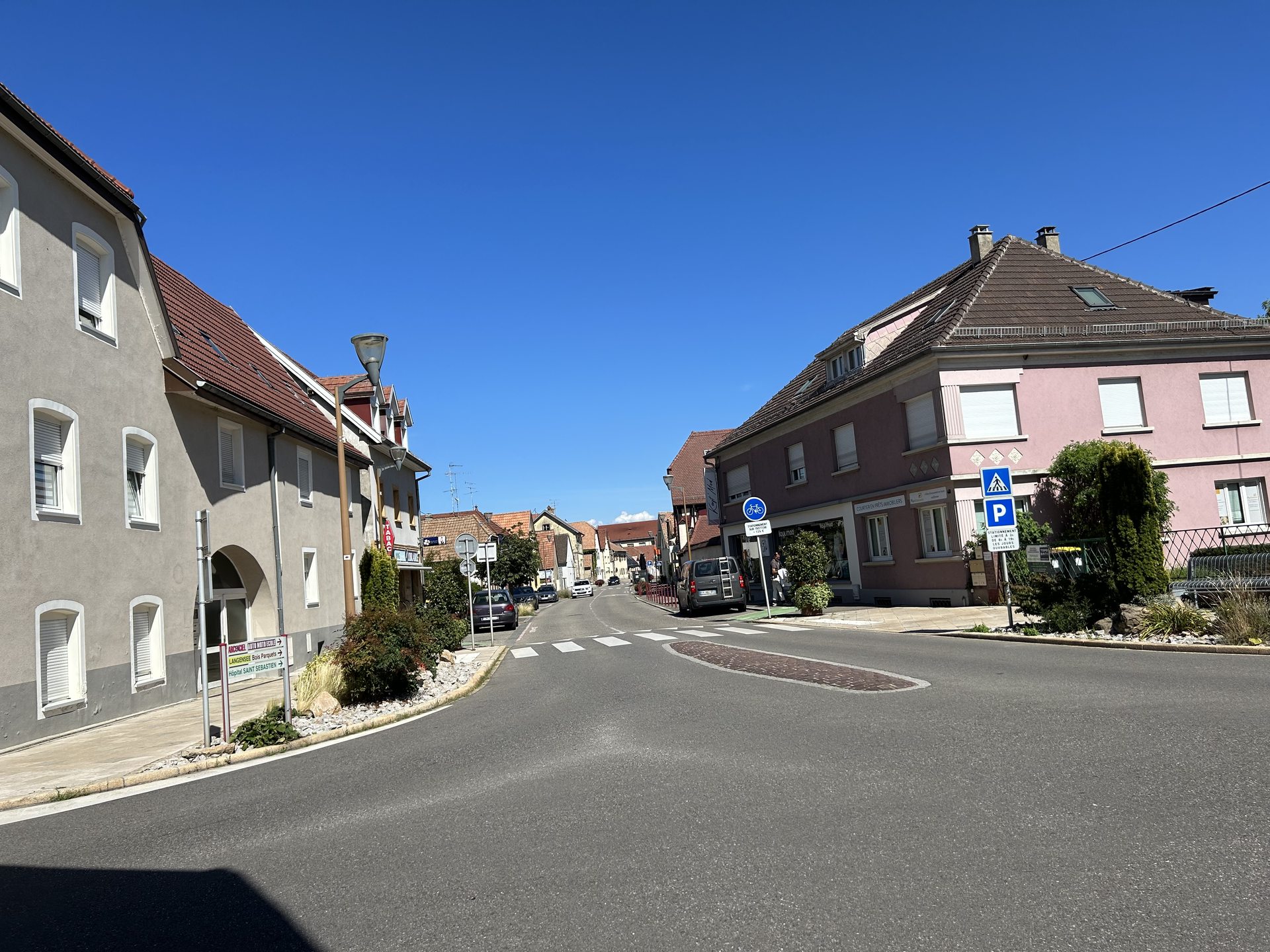
Pictured: the Grand Rue Pierre Braun, a main street in Rixheim, Haut-Rhin — not the witness's own terrace, whose precise location GEIPAN's published file does not disclose, and not Habsheim aerodrome itself, roughly 2.4 kilometers to the southwest. No photograph, video, or other direct visual recording of the phenomenon is known to exist; the entire evidentiary record consists of the witness's own testimony and GEIPAN's own radar, planetary, and orbital cross-checks. Photo by Wikimedia Commons contributor Yzergues (2023), released under CC BY-SA 4.0.
Theoretical Alignment
This is the most conservatively weighted case in this site's current published GEIPAN batch, and deliberately so: GEIPAN's own investigators describe the phenomenon itself, in their own words, as "peu étrange" — not very strange — even while classifying it as unexplained. Psycho-Social framing carries a clear majority of this case's alignment because nearly everything about the sighting's basic shape is consistent with an ordinary point-of-light misidentification: a single witness, already primed to interpret what he was seeing as a satellite, briefly loses visual contact with his target for one to two seconds in the dark, then reacquires what he assumes is the same light — a genuinely easy substitution to make unintentionally, particularly against a busy night sky with multiple faint moving and stationary points of light in view at once. Extraterrestrial framing retains real, if modest, weight specifically because of what GEIPAN's own investigation actually ruled out rather than what it merely doubted: a real regional radar log covering the relevant window showed no aircraft, the real position of Jupiter that night was calculated and found incompatible, and a real, dated satellite pass was calculated and found to not match on elevation. Three specific, checkable candidates were tested with genuine data and none fit — a stronger evidentiary position than a case resting on untested assumptions alone, even though the underlying sighting is admittedly thin. Interdimensional framing draws the least support of any case in this site's current GEIPAN batch, resting only on the generic absence of any instrumented trace rather than anything distinctive about what was actually reported.
Background
Two threads of context are essential to reading this sighting accurately: the town of Rixheim itself, whose own recorded population sits directly under Habsheim aerodrome's flight paths, and the aerodrome's own remarkable, century-long aviation history — including one of the most famous air disasters in modern French aviation, which occurred at the same airfield the witness watched his light turn toward.
Rixheim: An Alsatian Commune on Mulhouse's Eastern Edge
Rixheim is a commune of roughly 14,400 residents in the Haut-Rhin department of the Grand Est region (historically Alsace), sitting immediately east of Mulhouse within the Mulhouse Alsace Agglomération, across an area of roughly 19.5 square kilometers at a density of just over 700 residents per square kilometer — a genuinely urbanized commune rather than a small rural village, in clear contrast to this site's other, considerably smaller GEIPAN case locations such as Maffliers or Ruffec. The town is home to the Musée du Papier Peint (Wallpaper Museum), a nationally significant museum reflecting the region's historic textile-printing industry, and its built-up area extends close enough to the southwest that part of the shared Habsheim aerodrome itself sits on Rixheim's own communal territory, not merely nearby in a neighboring commune. That detail matters directly for this case: the witness's own terrace was, in a very literal sense, already within the operational neighborhood of an active general-aviation airfield, a fact that shapes several of the conventional hypotheses GEIPAN's own investigation went on to test. The commune's own elevation, per its official statistics, ranges from 232 to 366 meters above sea level, a modest range reflecting the gently rolling terrain typical of the Rhine plain's western edge as it begins to meet the foothills of the Vosges further west — terrain flat and open enough that a light tracking low across the horizon, whether an aircraft, a satellite, or something else, would have had an unobstructed sightline from a residential terrace for a considerable distance in every direction.
Habsheim Aerodrome: From a Prussian Cavalry Field to One of Europe's Aviation Cradles
What makes this sighting's own reported "turn toward the aerodrome" worth taking seriously as a genuine navigational reference point, rather than a coincidental detail, is just how significant an aviation site Habsheim actually is. The land was first used as a cavalry exercise field for Prussian forces garrisoned in Mulhouse between 1877 and 1906, during the period when Alsace was under German administration. Aviation use began in 1907, and by 1909 the aerodrome was hosting flight testing for the newly founded Aviatik company, whose aircraft would go on to serve in the German military's own fleet. In one of the more unlikely footnotes in aviation history, a young William Boeing — then simply a vacationing American, years before founding the company that bears his name — passed through Habsheim on an informal observation stint with Aviatik, learning to fly and drawing inspiration that would later feed into his own first aircraft designs. Habsheim's golden age arrived with the First World War, when it served as one of the most significant German air bases of the conflict, hosting pilots who would become among the most famous aces of the war: Ernst Udet, and a young Hermann Göring. Throughout the 1910s, the aerodrome was a genuine center of aviation innovation, the site of numerous world records for flight duration, speed, and passenger capacity. In the postwar decades, its role shifted decisively toward light and sports aviation, hosting a succession of local aéro-clubs, a role it retains today under the Ac3F (Aéroclub des 3 Frontières).
June 26, 1988: The Air France Flight 296 Disaster
Habsheim's modern reputation, however, rests most heavily on a single, tragic event that occurred there just over two decades before this sighting. On June 26, 1988, during the Habsheim air show, Air France Flight 296Q — a brand-new Airbus A320, on just its second day in passenger service — attempted a low-speed flyover intended to demonstrate the aircraft's handling at approximately 100 feet of altitude, landing gear down. Instead, the aircraft descended to roughly 30 feet, clipped the treetops of the forest bordering the runway's end, and crashed. Of the 136 people aboard, three died — a woman and two children, all killed by smoke inhalation after being unable to release their seatbelts in time — and around 50 more were injured. It was the first fatal crash involving an Airbus A320, and it became one of the most fiercely contested air-disaster investigations of its era: the pilot, Captain Michel Asseline, a highly experienced Air France veteran with over 10,000 flight hours, maintained his innocence throughout a legal battle that ultimately convicted him of involuntary manslaughter, serving roughly ten months in prison. Whether pilot error or a fly-by-wire system malfunction was primarily responsible for the aircraft's descent below its planned altitude remains disputed by aviation historians to this day, with Captain Asseline himself continuing to challenge the official verdict for years afterward, arguing that the A320's then-novel computerized flight-control system had overridden his own control inputs during the critical final seconds. This site's own research raises the point not because it bears directly on the 2009 sighting's own physical facts, but because it means Habsheim aerodrome was, by 2009, a site whose name carried real weight in French aviation memory — making a witness's spontaneous identification of a light's turn "toward Habsheim aerodrome" a specific, locally meaningful reference point rather than a vague gesture at open sky. It is also worth noting that the aerodrome's ordinary daily operations, more than two decades on from the 1988 disaster, had long since returned to routine light and sports aviation: touch-and-go training circuits, glider towing, and recreational flights conducted by the Ac3F's own membership, none of which GEIPAN's own checked radar log found any trace of during the specific window under investigation.
Complete Timeline
| Date | Event |
|---|---|
| 1877–1906 | The future Habsheim aerodrome site serves as a cavalry exercise field for Prussian forces garrisoned in Mulhouse. |
| 1907 | Aviation use begins at Habsheim. |
| 1909 | The Aviatik company conducts early flight testing at the aerodrome; a young William Boeing visits and learns to fly there. |
| 1914–1918 | Habsheim serves as a major German air base; pilots including Ernst Udet and Hermann Göring fly from the field. |
| 1910s | Numerous world aviation records for duration, speed, and passenger capacity are set at Habsheim. |
| June 26, 1988 | Air France Flight 296Q, an Airbus A320, crashes during a low-altitude flyover at the Habsheim air show; three passengers die, roughly 50 are injured. |
| July 26, 2009, approx. 10:20 PM | Stargazing session and sighting begin. A witness on his terrace in Rixheim tracks a white point of light moving south to north at 25–35° elevation, consistent with a satellite pass. |
| Moments later | The witness loses sight of the light for one to two seconds, then reacquires a light executing a westward turn (toward Habsheim aerodrome) lasting two to three seconds. |
| Immediately after | The light accelerates onto a fast, linear trajectory and passes directly overhead in total silence; the dynamic sequence totals 10–12 seconds. |
| July 26, 2009, 11:48 PM | The witness's overall observation session concludes. |
| Following days | The witness's report reaches GEIPAN; a technical questionnaire and formal testimony are recorded. |
| Investigation period | GEIPAN checks regional air-traffic radar logs for the window 11:30 PM–midnight (no aircraft trace found), Jupiter's true position (too low in elevation to match), and the orbital pass of the COSMOS 1151 rocket body (57° elevation, incompatible with the reported 25–35°). |
| Case status as maintained | Final classification. GEIPAN records the case as Class D1: an unidentified phenomenon, described by its own investigators as not very strange but genuinely unexplained, with a strangeness index of 0.62. |
Detailed Narrative
An Ordinary Satellite Watch, Then an Interruption
According to GEIPAN's own archived case synthesis, the witness was doing something entirely unremarkable that night: sitting on his own terrace, watching the stars, an activity that in itself implies at least a passing familiarity with the night sky's ordinary moving and stationary features. His attention settled on a white point of light tracing a straight line from south to north, at an elevation he placed between 25 and 35 degrees above the horizon — a profile entirely consistent with a satellite in low Earth orbit, and one he explicitly assumed was exactly that. He tracked this light for seven to eight seconds. Then, for a brief moment — one to two seconds, by his own estimate — he looked away.
The Reappearance, the Turn, and the Silent Overhead Pass
What happened next is the entire substance of this case. Looking back to where the light should have continued along its straight south-to-north track, the witness did not find it there. Instead, he located a light — whether the same one, or a different one entirely, is a question GEIPAN's own file is honest enough to leave explicitly open — in the middle of executing a turn toward the west, a maneuver he watched unfold over two to three seconds, in the general direction of Habsheim aerodrome. Coming out of that turn, the light straightened onto a new, linear trajectory and accelerated, passing directly over the witness's own position at what he judged to be considerable speed. At no point in this entire sequence — the initial linear track, the turn, or the fast overhead pass — did the witness report hearing any sound whatsoever. The dynamic portion of the encounter, start to finish, occupied only 10 to 12 seconds, embedded within a longer, otherwise unremarkable stargazing session that had begun around 10:20 PM and continued, per GEIPAN's own file, until 11:48 PM.
What GEIPAN's Own File Is Careful Not to Claim
This site's research treats one specific piece of intellectual honesty in GEIPAN's own published synthesis as worth naming directly, because it shapes how the entire case should be read: the agency's own file does not assert with confidence that the witness watched a single, continuous object throughout. The brief loss of visual contact means there is no way to rule out, on the testimony alone, that the witness watched an ordinary satellite pass to its natural conclusion, lost it as satellites naturally do when they dim near the edge of Earth's shadow or simply move out of a comfortable viewing angle, and then, moments later and completely independently, picked up an entirely separate light already executing an unrelated maneuver nearby. GEIPAN's own case synthesis states this limitation plainly: "rien ne permet d'affirmer avec certitude qu'il s'agit de la trajectoire d'un unique point lumineux" — nothing allows us to assert with certainty that this is the trajectory of a single point of light. That single sentence is, in this site's own assessment, the most important interpretive key to the entire case, and it is precisely why GEIPAN's own classification rationale cites "the impossibility of estimating the phenomenon's distance" as a specific justification for the case's D1 rating, rather than treating the object's reported course change and acceleration as settled, continuous facts about one physical thing.
Testing the Aircraft Hypothesis: A Clean Radar Log
Despite that honest uncertainty about continuity, GEIPAN's own investigators still worked through the most obvious conventional candidates as though the sighting described a single, real trajectory, and did so with real, checked data rather than assumption. The most immediately obvious candidate, given the witness's own explicit reference to Habsheim aerodrome, was a conventional aircraft — whether departing from, arriving at, or simply transiting near the active general-aviation field. GEIPAN's own file states plainly that a check of regional air-traffic radar logs for the window of 11:30 PM to midnight found no aircraft trace whatsoever in the Rixheim sector. This is a genuine, checked negative result from real instrumented data, not a bare assertion, and it is a meaningfully stronger form of evidence than this site's research has been able to establish for several of its other single-witness GEIPAN files.
Testing the Planetary Hypothesis: Jupiter, Ruled Out on Elevation
The second candidate GEIPAN's investigators tested was even more specific: could the witness have observed Jupiter, whose brightness at opposition can rival or exceed that of any star in the sky, and whose position, unlike a star's, does shift meaningfully over the course of a season? The agency's own calculation found Jupiter was sitting too low on the horizon that night to match the witness's reported observation — a clean, calculated elimination rather than a plausibility judgment.
Testing the Satellite Hypothesis: A Real Rocket Body, at the Wrong Elevation
The third and most specific candidate GEIPAN tested speaks directly to the witness's own initial assumption. Investigators identified a genuine, dated orbital pass that night: the spent rocket body cataloged as COSMOS 1151, a Soviet-era launch vehicle stage, passed over the region that same evening. But its calculated elevation for that pass was 57 degrees — substantially higher in the sky than the witness's own reported 25 to 35 degrees for the light's initial linear track. GEIPAN's own file treats this specific numerical mismatch as sufficient grounds to eliminate this particular satellite pass as the source, a genuinely rigorous piece of orbital-mechanics cross-checking for a single-witness file of this kind.
Key Witnesses
Rixheim Primary Witness (identity withheld per GEIPAN's standard anonymization practice)
Watching the night sky from his terrace in Rixheim on the night of July 26, 2009, this witness tracked a white point of light on a linear south-to-north path, lost sight of it briefly, then found a light turning west toward Habsheim aerodrome before it accelerated and passed silently overhead. GEIPAN's own investigation could not confirm whether this was one continuous object or two separate lights observed in close succession, a genuine uncertainty the agency's own file states directly. No other witness to this sighting was ever identified.
The Five Observables Assessment
The Five Observables framework, developed by the Pentagon's Advanced Aerospace Threat Identification Program to describe performance characteristics beyond known conventional technology, is applied here for comparative consistency across the site's case files. This is among the thinnest Five Observables profiles in this site's published GEIPAN archive, reflecting both the sighting's brevity and its status as an unresolved single point of light rather than a structured object.
Assessment: This case's Five Observables signature is genuinely modest, and this site's analysis treats that modesty as itself the most honest description of the file rather than something to explain away. A reported course change and acceleration are real, distinctive behavioral claims, but GEIPAN's own file is explicit that the sighting cannot even confirm it involved one continuous object rather than two separate lights observed moments apart — which means the "acceleration" and "turn" themselves rest on an unconfirmed assumption of continuity, not a settled fact the way Instant Acceleration is verified in some of this site's better-documented files. Total silence throughout, including during a pass reported directly overhead, remains the sighting's single most concrete and hardest-to-dismiss data point, regardless of how the continuity question resolves.
Evidence Assessment
Supporting an Anomalous Origin
- GEIPAN's own investigators checked a real regional air-traffic radar log for the relevant time window and found no aircraft trace in the Rixheim sector
- A specific, real planetary candidate (Jupiter) was calculated and found incompatible on elevation grounds
- A specific, real, dated satellite/rocket-body pass (COSMOS 1151) was calculated and found incompatible on elevation grounds (57° versus the reported 25–35°)
- No sound of any kind was reported at any point, including during a pass the witness judged to be directly overhead — a poor match for any conventional powered aircraft at a range close enough to be watched executing a turn
Supporting a Conventional/Mundane or Inconclusive Origin
- GEIPAN's own file explicitly states that nothing allows it to assert with certainty that a single, continuous object was observed throughout — the witness's one-to-two-second loss of visual contact leaves open the possibility of two unrelated lights, one an ordinary satellite pass and one something else entirely (or an equally ordinary aircraft/light source)
- This is a single, uncorroborated witness account with no photograph, video, or physical trace of any kind; the entire evidentiary record rests on one person's verbal description of a 10–12 second event
- GEIPAN's own investigators describe the phenomenon itself as "peu étrange" — not very strange — a direct, published acknowledgment that the sighting's underlying strangeness is genuinely low even though no specific conventional match was found
- The witness's own initial, confident assumption that he was watching a satellite indicates conditions that night were already conducive to seeing multiple ordinary moving lights in the sky, raising the baseline likelihood of an innocent misidentification or substitution
- No radar, planetary, or satellite candidate that GEIPAN tested was ever claimed to be exhaustive; the checked window (11:30 PM–midnight) begins roughly an hour after the sighting's own stated 10:20 PM start, leaving room for an untested earlier aircraft movement, though this site's research found no indication GEIPAN itself flagged this specific timing gap
Why "Open"
This case is stamped Open rather than Disputed or Debunked because GEIPAN's own investigation, working with real, checked data across three independent conventional candidates, could not identify what the witness actually saw — and because the agency's own file is unusually candid that even its own analysis of "the object's" course change rests on an unconfirmed assumption of continuity that the sighting's own brief interruption cannot fully support. That combination of genuine investigative effort and genuine, stated epistemic humility is itself worth crediting, even for a sighting this modest.
At the same time, this site's own scoring reflects, as honestly as it can, that this is among the weakest cases in its current published GEIPAN batch on strangeness grounds alone — a judgment GEIPAN's own investigators reach explicitly in their own published language, not one this site is imposing from outside. A single witness, a single point of light, a ten-to-twelve-second dynamic sequence, a directly acknowledged possibility that two separate ordinary lights were mistaken for one continuous object, and zero photographic, video, or physical evidence of any kind combine to place a hard ceiling on how anomalous this file can reasonably be scored, regardless of how rigorously its three tested conventional candidates were checked and eliminated. That rigor is real and worth crediting — a genuine radar log pulled and reviewed, a real planet's position calculated, a real satellite pass calculated to the degree — and it keeps this case meaningfully above a simple, untested "probably nothing" dismissal. But weighed against the sighting's own acknowledged thinness and GEIPAN's own explicit "not very strange" characterization, this case is scored at the low end of this site's published GEIPAN archive, honestly reflecting a file that is genuinely unresolved without being genuinely compelling.
Sensor & Instrumentation Detection Profile
No photograph, video, or live sensor recording of any kind captured this phenomenon. What this file does have, and what distinguishes it from several of this site's other single-witness GEIPAN cases, is a set of three genuinely checked, real-data cross-references: a regional air-traffic radar log reviewed for the window of 11:30 PM to midnight (comparable in kind, if not in outcome, to the confirmed radar check in this site's Fauville-Évreux Radar Sighting), a calculated planetary position for Jupiter, and a calculated orbital pass for a specific, real, dated rocket body, COSMOS 1151. That third check is the same basic investigative method this site's Ruffec Repeating Light Arc file documents in more recent form, where GEIPAN calculated exact satellite geometry (in that case, a Starlink flare) against a witness's reported observation and found a specific mismatch. Both files show GEIPAN applying real astronomical and orbital-mechanics calculation as a standard, non-negotiable step in evaluating a point-of-light report, rather than treating "might have been a satellite" as an unfalsifiable shrug.
This site's research also notes what this 2009 sighting predates on the instrumentation side. FRIPON, GEIPAN's automated fireball camera network, did not begin operating until May 2016, nearly seven years later, and in any case would have limited application here since the reported course change is inconsistent with a meteor's characteristic single-direction streak. IPACO, GEIPAN's photographic/video analysis toolkit, has no material to process in a case with no imagery. As with this site's other pre-2016 French files, this case's entire evidentiary weight rests on testimony cross-checked against real astronomical and radar data, not on any independent recording device.
Environmental & Geospatial Context
GEIPAN's own published file does not record specific weather conditions for the night of July 26, 2009, beyond what can be inferred from the sighting itself: conditions were clear enough for sustained naked-eye stargazing and for the witness to be confidently tracking a faint, star-like point of light against the night sky, consistent with a summer night with good visibility.
Geographically, the sighting occurred within the built-up eastern edge of Rixheim, a commune whose own territory partly overlaps with Habsheim aerodrome (LFGB), sited barely 2.4 kilometers to the southwest of the town center. This is a genuinely active general-aviation airfield, home to the Ac3F aéro-club, and the witness's own spontaneous identification of the light's turn as heading "toward Habsheim aerodrome" places the sighting squarely within the operational neighborhood of a real, historically significant airfield — not an arbitrary compass direction. The wider region also sits within reach of EuroAirport Basel–Mulhouse–Freiburg (LFSB), a major international civil airport roughly 15 to 20 kilometers to the south, whose own air-traffic-control radar coverage is the most likely source, though not explicitly named in GEIPAN's published file, for the regional radar log investigators checked and found clean for the relevant window.
The broader Haut-Rhin department, of which Rixheim forms a part, is a mixed industrial, commuter, and agricultural department in the Grand Est region, its skies subject to the ordinary civil and general aviation traffic typical of the Mulhouse metropolitan area, including regular activity associated with EuroAirport and several smaller regional and sport-aviation aerodromes, Habsheim foremost among them. None of that ordinary traffic pattern, per GEIPAN's own checked radar log, offers a documented explanation for this specific sighting.
It is worth adding, as further geospatial context this site's own research contributes independently of GEIPAN's published file, that the Mulhouse conurbation sits close to the point where the borders of France, Germany, and Switzerland converge — a fact reflected directly in the name of Habsheim's own resident flying club, the Aéroclub des 3 Frontières, "the flying club of the three borders." That tri-national proximity means the regional airspace above Rixheim is, in the ordinary course of civil aviation, considerably busier and more procedurally layered than a comparably sized town further from an international frontier would experience, with cross-border general aviation traffic, EuroAirport's own binational (French/Swiss) civil operations, and nearby German airfields all sharing overlapping airspace within a relatively compact geographic area. This site's research found no indication that GEIPAN's own investigation extended its radar check to German or Swiss air-traffic authorities, only to the regional French log; whether a cross-border light aircraft movement outside that specific check could account for the sighting is, on the published record, a genuinely open question rather than one GEIPAN's file states it exhaustively addressed.
Observer Credibility & Occupational Profile
The witness's occupation is not disclosed in GEIPAN's published case file, consistent with the agency's standard anonymization practice. What can be inferred from his own account is a baseline familiarity with the night sky: he was engaged in deliberate stargazing, correctly recognized the general profile of a satellite pass (a linear track at a plausible elevation, moving at a plausible angular speed) as his default, most likely interpretation before anything unusual occurred, and sustained his attention on the sky for well over an hour, from roughly 10:20 PM to 11:48 PM. That is a materially different starting position than a witness glancing up once, briefly, at an unfamiliar sky — and it lends his account a certain baseline credibility for the ordinary parts of what he reported.
At the same time, this site's own analysis treats the sighting's central interpretive problem — whether one continuous object or two separate lights were involved — as a genuine, unresolved limitation tied directly to ordinary human visual attention rather than to any question of the witness's honesty. A one-to-two-second break in visual contact, in the dark, while tracking a faint point of light against a busy field of similarly faint, similarly moving or stationary points (other satellites, aircraft, and stars all populate a clear night sky simultaneously), is exactly the kind of brief interruption in which an attentive, honest observer can unknowingly substitute one light for another without any way to detect the substitution himself. GEIPAN's own investigation, to its credit, states this limitation directly rather than glossing over it, and this site's own scoring treats that acknowledged uncertainty as a core reason this case cannot be scored higher, regardless of how genuinely careful and attentive the witness's overall stargazing session appears to have been.
This site's analysis also weighs one further, more speculative credibility factor that GEIPAN's own file does not itself discuss: the length of the witness's overall observation session, from roughly 10:20 PM to 11:48 PM, well over an hour, against the brevity of the specific anomalous sequence embedded within it, just 10 to 12 seconds. A witness who spends well over an hour deliberately watching the sky, rather than glancing up once and immediately reporting something extraordinary, is engaging in exactly the kind of patient, low-expectation observation that tends to produce more reliable testimony about the ordinary background of a night sky — and, by the same token, a witness that practiced at identifying satellites, aircraft, and stars is not an unsophisticated observer easily startled by the first unfamiliar thing he sees. That same extended session, however, also means the witness had a great deal of time and a great many individual lights passing through his field of view over which a single momentary lapse in attention, tracking one specific light among dozens of candidates, could occur — precisely the scenario GEIPAN's own file leaves open. Both readings are consistent with the same underlying facts, and this site's analysis does not attempt to resolve which one is correct.
Physical & Material Assays
No physical trace evidence exists in this case, and none was ever sought: the phenomenon remained airborne and in continuous motion throughout the entire reported observation, with no landing, low hover, or ground-level approach of any kind ever described. Accordingly, this case has no soil, vegetation, or material sample of any kind associated with it, and no metallurgical, isotopic, or trace-chemical assay was performed or would have been applicable given the nature of the sighting as reported.
Historical Precedents & Archive Matches
This case's most useful points of comparison on this site are other GEIPAN and non-GEIPAN files where a point of light's resemblance to a satellite, and the specific astronomical calculations used to test that resemblance, are central to the investigation.
Ruffec: The Same Investigative Method, a Different Outcome
The Ruffec Repeating Light Arc (Open, case #254) is this site's closest methodological parallel. There, GEIPAN calculated exact solar and satellite geometry to test, and ultimately rule out, a Starlink satellite flare as the source of a repeating light — the same fundamental method (calculate a real candidate's true position, then check it against the witness's reported geometry) used here to eliminate both Jupiter and the COSMOS 1151 rocket body. Ruffec's own case teaser notes that real air traffic came startlingly close to explaining that sighting; this Rixheim file's own radar check, by contrast, came back entirely clean, a genuinely different outcome from the same style of investigation.
Vancouver Starlink: What an Actual Satellite Train Looks Like
The Vancouver Starlink Satellite Train Sighting (Debunked, case #79) is worth naming as a useful contrast rather than a direct match: it documents hundreds of witnesses correctly, if initially confusedly, filming a real, dated, multi-satellite Starlink launch train — a slow, silent line of lights whose true identity was conclusively established after the fact. This Rixheim sighting describes something structurally different (a single, isolated point of light, not a train of dozens moving in tight formation) and, unlike the Vancouver case, was never matched to any specific, dated launch or pass that actually fit the reported geometry. Reading the two side by side underscores how differently "it looked like a satellite" cases can resolve: one to a confirmed, mundane, and spectacular real event, the other to a checked dead end.
Fauville-Évreux and Villers-lès-Luxeuil: Real Instrumented Cross-Checks, Different Results
The Fauville-Évreux Radar Sighting (Open, case #258) and the Villers-lès-Luxeuil Triangle (Open, case #252) both join this file in a small but genuine pattern within this site's GEIPAN archive: cases where investigators pursued a real, checkable instrumented or records-based cross-reference rather than relying on testimony alone. Fauville-Évreux's own base radar logged a faint, matching echo corroborating its witness's account — a positive result. Villers-lès-Luxeuil's cross-check against a real, confirmed Mirage 2000-5F training exercise ultimately did not match the witnesses' account — a negative result, like this Rixheim file's own three negative checks. Read together, these cases show GEIPAN applying the same standard of real evidentiary rigor regardless of whether the outcome favors or undercuts an anomalous reading.
A Weaker Strangeness Signature Than Almost Any Other File in This Site's Batch
It is worth stating directly, as a final point of comparison, just how unusual it is within this site's own published GEIPAN archive for the investigating agency itself to characterize a case in language as deflationary as "peu étrange." Most of the GEIPAN files this site has published to date, whatever their ultimate credibility score, describe a witness account with at least some element the agency's own investigators found visually or behaviorally distinctive — a structured shape, a color transformation, a hovering phase, a landing trace. This file's own strangeness index of 0.62 sits numerically close to Maffliers's own identical 0.62 rating, a coincidence this site's research flags honestly rather than reading any deeper significance into, given how differently GEIPAN's own investigators describe the two cases in their own qualitative language elsewhere in each file. What actually keeps Rixheim classified as unidentified rather than closed as solved is not a distinctive appearance, but a process of elimination: three specific, real candidates tested and rejected, leaving genuine uncertainty rather than a confirmed anomaly. That is a meaningfully different, and by GEIPAN's own admission less strange, category of "unexplained" than most of this site's other French files describe, and this site's own scoring for the case is calibrated specifically to reflect that distinction rather than treating every GEIPAN D1 classification as interchangeable regardless of the agency's own stated view of how anomalous each individual file actually is.
Material Analysis
As with the Physical & Material Assays section above, this case involves no physical or trace evidence of any kind. The phenomenon remained airborne and in motion throughout the entire observation, and no landing, hover, or ground-level approach was ever reported that could have produced a testable trace.
Supporting Non-Terrestrial Origin
- No confirmed physical evidence exists to test in the first place, so no terrestrial material-composition finding contradicts an anomalous interpretation either
- Three independent, real conventional candidates (aircraft via radar, Jupiter via calculated position, a specific satellite/rocket-body pass via calculated elevation) were each checked against real data and each eliminated on their own specific grounds
Supporting Terrestrial Origin
- GEIPAN's own investigators explicitly cannot confirm that a single, continuous object was observed at all, rather than two separate ordinary lights seen moments apart across a brief lapse in the witness's attention
- GEIPAN's own investigators independently describe the phenomenon as "peu étrange" (not very strange), a direct acknowledgment that its overall profile does not stand out sharply from ordinary night-sky observation even though no specific match was confirmed
The Conventional Explanation Candidate: Satellite Misidentification, Aircraft, and Residual Alternatives
GEIPAN's own published synthesis for this case tests three specific candidates directly, and this site's analysis follows that structure closely while adding several residual candidates the published file does not explicitly name.
An Ordinary Aircraft From or Near Habsheim Aerodrome
Given the witness's own explicit reference to a turn toward Habsheim aerodrome, a conventional light aircraft, whether departing, arriving, or simply transiting the area, was the most immediately obvious candidate. GEIPAN's own checked regional radar log for the relevant window found no aircraft trace in the Rixheim sector, a genuine negative result from real data. This site's analysis notes one honest caveat GEIPAN's own file does not itself flag: the checked window (11:30 PM to midnight) begins roughly an hour after the sighting's own stated 10:20 PM start time, which leaves the sighting's own earliest minutes formally outside the specific window investigators are recorded as having checked — though the case synthesis's own account of the dynamic sequence occurring within a compressed 10-to-12-second window makes it likely, though not explicitly confirmed in the published file, that investigators aligned their radar check to the sequence's actual, more precisely timed occurrence rather than the broader session's nominal start time.
The Planet Jupiter
Ruled out cleanly by GEIPAN's own calculation: Jupiter's actual elevation that night was too low to match the witness's reported observation. This site's analysis finds no basis to question this specific, calculated elimination.
A Satellite or Rocket-Body Pass
This is the candidate that speaks most directly to the witness's own stated assumption, and GEIPAN's own investigators gave it the most specific, individualized treatment: identifying a real, dated pass (the COSMOS 1151 rocket body) and calculating its actual elevation (57 degrees) against the witness's reported 25 to 35 degrees. The mismatch is substantial enough that this site's analysis treats the elimination as well-supported, while noting, as GEIPAN's own file does, that this check addresses only one specific catalogued object; it does not, and cannot, exhaustively rule out every satellite or piece of orbital debris that might have been in view that night, of which there are many thousands in low Earth orbit at any given time, the overwhelming majority too faint to be individually catalogued against a specific witness's casual report.
An Iridium-Type Satellite Flare
This is a candidate this site's own research raises independently; GEIPAN's published file does not address it as its own named hypothesis. In 2009, the Iridium satellite constellation was still fully operational and was, at the time, one of the most common sources of unexpectedly bright, brief flashes in the night sky — a well-documented phenomenon in which a satellite's flat, reflective antenna panels catch sunlight at just the right angle to produce a flare that can briefly rival Venus or even outshine it, then fade back to near-invisibility within seconds. This site's analysis rates this candidate as ultimately a poor fit, however, and is explicit about why: an Iridium flare is a brightness event happening to a satellite already on its own fixed, predictable orbital track, not a maneuver, and it does not produce a genuine change of direction or a sustained acceleration of the kind this witness described. A flare could plausibly explain a sudden, brief change in a light's apparent brightness, but not a turn followed by a fast, linear, and apparently accelerating pass — making it a weaker candidate than either the specific rocket-body pass GEIPAN itself tested and rejected, or the plain misidentification/discontinuity explanation the agency's own file favors implicitly.
An Early Civilian Drone or Radio-Controlled Model Aircraft
GEIPAN's own file raises no drone or model-aircraft hypothesis for this sighting, and this site's independent research finds strong contextual grounds to agree with that omission, stronger even than for this site's other, slightly later French GEIPAN files. This sighting predates France's first civil drone regulatory framework (April 2012) by nearly three years, and predates the Parrot AR.Drone — widely credited as the first mass-market, smartphone-controlled civilian quadcopter — by roughly six months; that device was not unveiled until January 2010 and did not reach retail shelves until September of that year. In July 2009, no consumer drone of the kind that might explain a fast, maneuvering, silent light existed anywhere in the world as a purchasable product. A radio-controlled fixed-wing hobbyist model, a genuinely pre-existing hobbyist category by 2009, remains a theoretical possibility in isolation, but such models are neither silent (their small internal-combustion or electric motors are audible at much greater range than this witness's reported overhead pass) nor plausible as an unattended, unlit night flight over a residential area near an active aerodrome; this site's analysis treats this candidate as implausible on both technological and practical grounds.
Conventional Aircraft (Habsheim or Regional)
ImplausibleDirectly tested against a real regional radar log for the relevant window; no aircraft trace was found in the Rixheim sector.
The Planet Jupiter
ImplausibleCalculated and ruled out cleanly by GEIPAN on elevation grounds; Jupiter was too low on the horizon that night.
COSMOS 1151 Rocket-Body Pass
ImplausibleA real, dated pass was identified and calculated; its 57° elevation did not match the witness's reported 25–35°.
Iridium-Type Satellite Flare
ImplausibleNot addressed by GEIPAN; a real, common 2009-era phenomenon, but a brightness flare does not itself produce a genuine turn or sustained acceleration.
Discontinuous Sighting (Two Separate Ordinary Lights)
InconclusiveGEIPAN's own file explicitly cannot rule this out; the witness's brief loss of visual contact leaves open a mundane substitution of one ordinary light for another.
Related Cases
Confirmed Documents & Official Records
The official French government case summary: the witness's account, the checked radar/Jupiter/satellite candidates, and the Class D1 determination.
GEIPAN's own published definitions, including the D1 category and strangeness-index methodology applied to reach this case's rating.
GEIPAN's own account of its institutional lineage, the same modern investigative framework applied to this 2009 case.
Background on Habsheim aerodrome's century-long aviation history, including the June 26, 1988 Air France Flight 296Q crash referenced in this file's own background section.
Further Reading — Recommended Literature
Passport to Magonia: On UFOs, Folklore, and Parallel Worlds
Vallée's foundational catalog of centuries of French and international sightings offers direct background for reading this case within a much longer national tradition of reported anomalous aerial phenomena.
Bad Astronomy: Misconceptions and Misuses Revealed, from Astrology to the Moon Landing "Hoax"
Includes a dedicated chapter, "Misidentified Flying Objects: UFOs and Illusions of the Mind and Eye," directly relevant to this case's central question of separating a real satellite pass from a genuinely unresolved point of light.
UFOs and Government: A Historical Inquiry
Includes a dedicated chapter on French government UAP investigation, directly relevant to the GEIPAN institutional framework that investigated this case.
Identified Flying Objects: A Multidisciplinary Scientific Approach to the UFO Phenomenon
A methodologically-focused work useful for weighing witness attention lapses, comparative-elevation estimation, and the limits of single-witness testimony, all directly relevant to how this case was actually investigated.
UFOs and the National Security State: Chronology of a Coverup, 1941–1973
A U.S.-focused history of military and national-security institutions handling UAP reports, a useful comparative lens for a case investigated near a genuinely significant regional aerodrome.
Essential Viewing
No Videos Available
Sources
- GEIPAN (CNES), "RIXHEIM (68) 26.07.2009", Case 2009-07-02361 — official case summary
- GEIPAN (CNES), official case archive & public portal — geipan.fr
- GEIPAN (CNES), Glossaire du GEIPAN — official classification definitions, A/B/C/D/D1/D2
- GEIPAN (CNES), Son histoire — institutional history: GEPAN (1977), SEPRA (1988), GEIPAN (2005)
- France 3 Régions / France Info, "Ovni : 72 témoignages de 'phénomènes étranges' inexpliqués en Alsace" — regional press coverage of unexplained GEIPAN files across Alsace, including this case's own south-to-north light track and westward turn toward Habsheim (title/content independently confirmed via search; direct fetch blocked by the outlet's own access controls)
- Wikipédia (français), "Aérodrome de Mulhouse-Habsheim" — full aerodrome history, from 1877 cavalry field to modern aéro-club
- Wikipedia (English), "Mulhouse–Habsheim Airfield" — aerodrome summary, ICAO code LFGB, and coordinates
- Wikipedia (English), "Air France Flight 296Q" — the June 26, 1988 Habsheim air show crash of a new Airbus A320
- France 3 Régions Grand Est, "L'aérodrome d'Habsheim, l'un des berceaux de l'aviation moderne" — regional feature on Habsheim's early aviation history, including Ernst Udet, Hermann Göring, and William Boeing's own visit (title/content independently confirmed via search)
- Wikipedia (English), "Rixheim" — commune geography, population, and administrative context
- Wikipedia (English), "Satellite flare" — general background on Iridium-type satellite flares, brightness, and duration
- Légifrance, Arrêté du 11 avril 2012 (drone design/use/operator regulation) — official text establishing France's first civil drone regulatory framework, nearly three years after this sighting
- Wikipedia (English), "Parrot AR.Drone" — January 2010 unveiling and September 2010 retail launch of the first mass-market civilian quadcopter, roughly six months after this sighting
- Wikimedia Commons, File: Rixheim - Grand Rue Pierre Braun.jpg, photo by Yzergues (2023), CC BY-SA 4.0 — licensing and attribution
- Wikimedia Commons, Category: Rixheim — image archive for the commune
- This site, case-files/ruffec-repeating-light-arc.html — comparative GEIPAN case, the same calculated-satellite-geometry investigative method
- This site, case-files/vancouver-starlink-satellite-train-sighting.html — comparative case, a real satellite train conclusively identified
- This site, case-files/fauville-evreux-radar-sighting.html — comparative GEIPAN case, a real radar cross-reference with a positive, corroborating result
- This site, case-files/villers-les-luxeuil-triangle.html — comparative GEIPAN case, a real military aircraft cross-reference with a negative result
- This site, key-figures.html, entry on Claude Poher — GEPAN founding and early institutional history
- This site, locations/index.html, entry on Toulouse — CNES/GEPAN/SEPRA/GEIPAN institutional headquarters
See something inaccurate? Have additional information or sources?
Suggest an Edit →Last Updated: August 2026