
Roerich Expedition Sighting
On the morning of August 5, 1927, painter, archaeologist, and mystic Nicholas Roerich and seven fellow members of his Central Asian Expedition watched a huge, shining oval body cross the sky over their camp in the Kukunor district near the Humboldt Mountains on the northeastern Tibetan Plateau. Roerich recorded the event in two of his own books, and the Buddhist lamas traveling with the expedition declared it "the Sign of Shambhala." A long-repeated "1926" date for the sighting is itself an error — Roerich's own diary dates it to 1927.
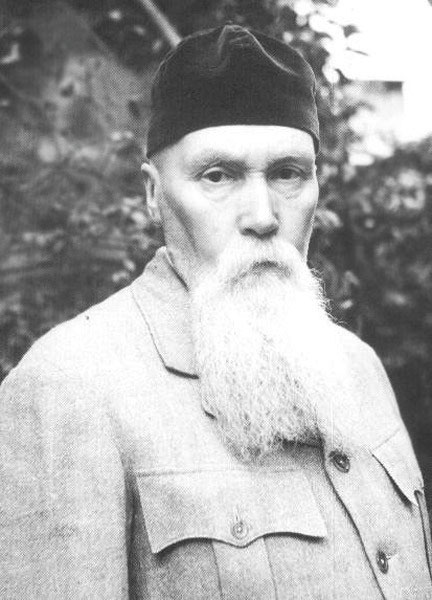
Pictured: Nicholas Roerich, circa the 1940s — not a photograph from the 1927 expedition itself, for which no photograph of the sighting, the camp, or the "Humboldt Chain" campsite is known to survive. This is a genuine portrait of the diarist whose two published first-person accounts, in Altai-Himalaya (1929) and Heart of Asia (1930), are this case's only surviving record. No image search for the sighting itself, the expedition's camp near Kukunor, or the specific stretch of the Humboldt Mountains it names turned up a rights-clear photograph from the expedition period; this portrait (public domain in India; tagged PD-old on Wikimedia Commons, and used as the infobox photograph on Roerich's own English Wikipedia article) was used instead of an unrelated stock image of the region.
Theoretical Alignment
The Psycho-Social Hypothesis scores highest here by a wide margin, not because Roerich invented anything, but because every element of the record — the immediate framing by the accompanying lamas as "the Sign of Shambhala," the expedition's own explicitly stated spiritual purpose, and Roerich's lifelong Theosophy-adjacent belief system — shaped how a genuinely ambiguous aerial object was interpreted the moment it appeared. The Extraterrestrial Hypothesis retains a modest, non-trivial alignment because the physical description Roerich gives (a large, metallic-looking, reflective oval executing a real directional change, tracked by seven independent observers through field glasses) is a genuinely craft-like profile that a purely psychological or folkloric account would not need to include. The Interdimensional Hypothesis finds almost no purchase: nothing in either of Roerich's own accounts describes a portal, a transitional geometry, or dimensional language, despite his own vocabulary being saturated with exactly the kind of mystical terminology ("Shambhala," "the Great Ones," "aerial vibrations") that would have made such a description natural had he intended one.
Background
Nicholas Konstantinovich Roerich (1874–1947) was already an internationally established figure by the time of the sighting at the center of this case file. Born in Saint Petersburg and trained at the Imperial Academy of Arts, he built his early reputation as a painter and stage designer, most famously creating the sets and costumes for Igor Stravinsky's The Rite of Spring for Sergei Diaghilev's Ballets Russes in Paris in 1913, alongside earlier design work for Alexander Borodin's opera Prince Igor. By the 1910s, Roerich and his wife, Helena Roerich (née Shaposhnikova, 1879–1955), had developed a deep interest in Theosophy and comparative Eastern religion. In March 1920, in London, the couple began developing what became known as Agni Yoga, or the "Teaching of Living Ethics" — a synthesis of Theosophical cosmology, Vedantic and Buddhist concepts, and the couple's own claimed communications with a hierarchy of spiritually advanced beings they called the Mahatmas or "Great Ones." Central to this system was the legend of Shambhala, a hidden, spiritually advanced kingdom described in Tibetan Buddhism's Kalachakra Tantra tradition as a refuge that will one day send forth an army under the future Buddha Maitreya to defeat the forces of ignorance. Where orthodox Tibetan Buddhism generally treats Shambhala as either a literal but inaccessible place or a symbolic inner state, Roerich's own writing treats it as an active, geographically real, and imminently significant force in world events — a belief that shaped not just his art but the itinerary and stated purpose of the expedition on which this case's sighting occurred.
That expedition, retrospectively known as the Roerich Central Asian Expedition (sometimes dated 1923–1928 depending on whether its preparatory Sikkim leg is included, more narrowly 1925–1928 for its main continental crossing), covered close to 10,000 kilometers on foot, horse, yak, and camel through Sikkim, Kashmir, Ladakh, Chinese/Soviet Turkestan (Xinjiang), the Altai region of Siberia, Mongolia, and Tibet, crossing dozens of mountain passes above 15,000 feet. It carried a genuine dual mandate: a scientific and artistic one, with Roerich producing roughly 500 paintings and collecting ethnographic, botanical, and archaeological material that would later seed the Urusvati Himalayan Research Institute the family founded in Naggar, India; and a spiritual one, explicitly framed by Roerich himself as a search for Shambhala and a mission connected to the "Great Ones" of Agni Yoga cosmology. Nicholas and Helena were accompanied throughout by their elder son, George (Yuri Nikolayevich) Roerich (1902–1960), a linguist trained at Harvard and the Sorbonne who had mastered Tibetan, Mongolian, and several regional dialects and served the expedition as its principal interpreter and de facto security officer; a rotating group of European associates, Mongol and Tibetan guides, and Buddhist lamas who joined the caravan for portions of the route; and, for part of the journey, the American flag was flown behind the caravan for diplomatic cover, since the expedition's early support had come partly through Roerich's contacts in New York, where he had founded a museum bearing his name in 1923.
Geopolitically, the expedition moved through a genuinely dangerous, contested landscape. Central Asia in the mid-1920s was a patchwork of warlord-controlled Chinese provinces, a newly Soviet-dominated Mongolia, and a Tibet wary of all foreign travelers after the 1904 British invasion. The expedition's own later ordeal makes this concrete: after departing the Kukunor region in the autumn of 1927 (following the August sighting), Roerich's caravan was stopped and effectively detained for roughly five months over the winter of 1927–1928 by Tibetan border authorities at an altitude exceeding 15,000 feet, without adequate shelter or fuel, an episode in which five expedition members died before the party was permitted to proceed to Lhasa's outskirts and eventually to Sikkim. It is against this backdrop of privation, danger, and constant low-grade contact with Buddhist religious authorities — not a controlled scientific field station, and not a credulous tourist party, but a genuinely mixed, multi-national, multi-faith caravan operating at the edge of political tolerance — that the August 1927 sighting needs to be read.
The expedition's meteorological neighbor deserves equal emphasis, since it becomes central to this case's leading conventional explanation. In 1927, Swedish geographer and explorer Sven Hedin (1865–1952), already famous for earlier Central Asian expeditions and his controversial later sympathies, launched the large international Sino-Swedish Expedition, a joint Chinese-Swedish scientific survey of Mongolia, the Gobi Desert, and Xinjiang that ran from 1927 to 1935 and included a dedicated meteorological program. That program's staff meteorologist, the German scientist Waldemar Haude, began releasing small hydrogen-filled pilot balloons to study upper-atmosphere winds, establishing weather stations at Tsondol (from September 1927) and later at several other points across the expedition's route. Hedin's expedition and Roerich's were, in the loosest sense, contemporaries working the same broad quadrant of Inner Asia in the same months of 1927 — a genuine coincidence this case file's Conventional Explanation Candidate section, below, examines in detail.
Complete Timeline
| Date | Event |
|---|---|
| March 1925 – 1927 | The Roerich Central Asian Expedition, led by Nicholas Roerich, crosses Sikkim, Kashmir, Ladakh, Xinjiang, the Altai region, and Mongolia en route toward Tibet. |
| Summer 1927 | The expedition constructs a Buddhist suburgan (reliquary monument) at Sharagol/Ulan Daban, near Tsaidam, using lime reportedly carried from the Humboldt Mountains, and camps in the Kukunor district awaiting permission to proceed toward Tibet. |
| August 5, 1927, c. 9:30 AM | Caravaneers in the expedition's camp notice a large black eagle (per Roerich's diary Altai-Himalaya) or dark vulture (per his book Heart of Asia) overhead; a member then spots "something far above the bird." |
| August 5, 1927, moments later | Seven expedition members and accompanying Mongols watch a large, shining, oval/spheroid object cross the sky from roughly north to south, retrieve field glasses, and confirm its "oval form with shiny surface." |
| August 5, 1927, continued | The object sharply changes direction from south to southwest and disappears behind the snow-capped Humboldt Chain; the accompanying Buddhist lamas whisper "The Sign of Shambhala." |
| August 7, 1927 | The expedition's suburgan is formally consecrated by the high priest of Tsaidam, an event Roerich's diary records immediately after the sighting entry. |
| September 1927 | Sven Hedin's Sino-Swedish Expedition meteorologist Waldemar Haude establishes a weather station at Tsondol and begins a sustained program of pilot-balloon launches across the same general region. |
| Autumn 1927 – March 1928 | Roerich's expedition is detained by Tibetan border authorities for roughly five months at high altitude; five members die before the party is allowed to proceed. |
| 1929 | Roerich publishes Altai-Himalaya: A Travel Diary, containing the day-dated diary entry describing the sighting. |
| 1930 | Roerich publishes Heart of Asia, containing a second, thematically framed account of the same event under the chapter "Shambhala," including the lamas' spoken line, "The Sign of Shambhala!" |
| 1935 | Russian-born author Andrew Tomas, who had attended a Roerich lecture in Shanghai, later becomes the case's primary conduit into ufological literature. |
| 1964 | NICAP's The UFO Evidence catalogs the sighting but misdates it to 1926, an error that would circulate in secondary UFO literature for decades, including on this site's own "Coming Soon" placeholder for this case. |
| 1970s | Researcher Leon Davidson cross-checks the NICAP summary against Roerich's own published diary, corrects the date to August 5, 1927, and first proposes a stray Sven Hedin expedition weather balloon as a possible explanation. |
| 1998 | Jerome Clark's The UFO Encyclopedia catalogs the corrected 1927 case as one of the earliest documented "pre-Arnold" sightings, predating Kenneth Arnold's 1947 Mount Rainier sighting by two decades. |
| 2010s | Writer Mark Pilkington revisits the case, weighing Davidson's weather-balloon hypothesis against researcher Brad Sparks's scale-and-distance objections to it. |
The Morning of August 5, 1927
The most detailed and most reliable account of the sighting is Roerich's own day-dated diary entry in Altai-Himalaya, written, by its own internal placement in the book's "Mongolia (1926–1927)" chapter, in the weeks before the expedition's autumn 1927 push into Tibet through the Tsaidam basin. In Roerich's own words:
"On August fifth—something remarkable! We were in our camp in the Kukunor district not far from the Humboldt Chain. In the morning about half-past nine some of our caravaneers noticed a remarkably big black eagle flying above us. Seven of us began to watch this unusual bird. At this same moment another of our caravaneers remarked, 'There is something far above the bird.' And he shouted in his astonishment. We all saw, in a direction from north to south, something big and shiny reflecting the sun, like a huge oval moving at great speed. Crossing our camp this thing changed in its direction from south to southwest. And we saw how it disappeared in the intense blue sky. We even had time to take our field glasses and saw quite distinctly an oval form with shiny surface, one side of which was brilliant from the sun."
Several details in this passage matter for evaluating the case. First, the sequence of attention: the party's eyes were drawn upward by an ordinary bird, and only then did a second observer notice "something far above" it — a detail that argues against simple pareidolia or expectation-driven misidentification of the eagle itself, since the object was explicitly described and tracked as distinct from, and much higher than, the bird that first drew everyone's gaze. Second, the object's motion was not a single instantaneous event: it was tracked long enough, in ordinary continuous viewing, for someone to fetch field glasses from inside a tent, implying a sustained sighting on the order of at least one to several minutes, not the second or two typical of a meteor or fireball. Third, Roerich records a specific, non-trivial course change — from a north-to-south heading to a south-to-southwest heading — occurring as the object crossed the camp, which he frames as an observed fact rather than an inference. Fourth, and often lost in later retellings, Roerich's own number of primary witnesses is precise: seven people, a first-person plural "we" throughout, not an ambiguous crowd.
A Second Account: "The Sign of Shambhala"
Roerich described the same event a second time, independently, in his 1930 book Heart of Asia, under a chapter simply titled "Shambhala." This version is not a diary entry with a date stamp but a more literary, thematically organized retelling, and it adds a detail absent from the Altai-Himalaya passage: the explicit reaction of the expedition's Buddhist lamas.
"A sunny, unclouded morning—the blue sky is brilliant. Over our camp flies a huge, dark vulture. Our Mongols and we watch it. Suddenly one of the Buriat lamas points into the blue sky: 'What is that? A white balloon? An aéroplane?' We notice something shiny, flying very high, from the northeast to the south. We bring three powerful field glasses from the tents and watch the huge spheroid body shining against the sun, clearly visible against the blue sky and moving very fast. Afterwards we see that it sharply changes its direction from south to southwest and disappears behind the snow-peaked Humboldt chain. The whole camp follows the unusual apparition and the lamas whisper: 'The Sign of Shambhala!'"
Read side by side, the two accounts corroborate each other on every major point — a bird sighted first, a shining, fast-moving oval/spheroid body noticed above it, an initial heading that bends sharply from south to southwest, and a disappearance behind the Humboldt Mountains — while differing in incidental detail exactly the way two honest retellings of the same memory, written years apart for different books with different purposes, typically do: an eagle versus a vulture, a north-to-south versus northeast-to-south initial heading, "field glasses" retrieved by an unnamed number of people versus "three powerful field glasses" specifically. Neither version is dated in a way that lets the two be checked against each other for exact timing; Altai-Himalaya supplies the calendar date (August fifth) that Heart of Asia omits, while Heart of Asia supplies the eyewitness dialogue (the Buriat lama's own spoken question, and the lamas' collective declaration) that Altai-Himalaya omits. Critically, the Heart of Asia version also preserves something the Altai-Himalaya version does not: a moment of genuine, mundane hypothesis-testing by the witnesses themselves. Before anyone invoked Shambhala, an unnamed Buriat lama's first instinct was to ask whether the object might be "a white balloon" or "an aéroplane" — ordinary, period-appropriate technological explanations, not a supernatural one. Only after the object's behavior (its speed, its sharp course change, its disappearance behind the mountains) failed to resolve into either did the party settle on a religious interpretation. That the witnesses' own first instinct was mundane, not mystical, is a real point in favor of the account's basic honesty, whatever one concludes about what the object actually was.
"The Sign of Shambhala": Why the Lamas Read It That Way
The lamas' declaration cannot be understood outside the specific religious expectation the expedition itself had spent months cultivating. Roerich's own diary, in the pages immediately surrounding the sighting, describes the camp constructing a Buddhist suburgan (a reliquary monument) at Sharagol, consecrated by "the high priest of Tsaidam," and records repeated, independent claims by visiting lamas that the region was suffused with "signs of Shambhala" — a fragrance with no visible source, a Kumbum monastery lama who "gave us the sign of Shambhala," and, shortly after the sighting itself, a lama's description of a geyser-formed salt deposit as "the sign of the third frontier of Shambhala." In other words, the aerial sighting was not a singular, isolated moment of mystical interpretation; it was one of several ordinary or semi-ordinary phenomena the party encountered in the same weeks that were folded into an already-active, expedition-wide framework primed to find religious significance in unusual events. This context matters directly for how much evidentiary weight the "Sign of Shambhala" label itself should carry: it documents how the witnesses felt about what they saw and what meaning they assigned to it, but it is not independent corroboration that the object itself was anomalous in a technical sense, since the same interpretive lens was already being applied to salt deposits and unexplained smells in the same stretch of desert.
At the same time, the episode is a genuine data point about Roerich's own belief system and its likely influence on both perception and memory. Roerich did not merely record the Shambhala myth as ethnographic material collected from his Buddhist guides; his own writing throughout Heart of Asia treats Shambhala as, in his words elsewhere in the book, a "reality... an unquestioned fact," a real force actively intervening in world affairs, including in his own expedition's fortunes. A worldview that already expects meaningful signs from an unseen, benevolent hierarchy is a worldview primed to notice, remember, and describe an ambiguous aerial phenomenon in maximally significant terms — large, shining, purposeful, sharply directional — rather than in the deflationary terms ("a distant bird," "a trick of haze") an equally honest but less primed observer might have reached for instead. This is precisely the mechanism the Psycho-Social Hypothesis describes, and it is the single largest reason this case's Theoretical Alignment score favors that framework over the Extraterrestrial Hypothesis, despite the object's own described physical behavior being genuinely craft-like.
From Diary to Ufology: How the Case Became Known
The sighting's path into UFO literature runs through a specific, traceable chain of individuals rather than emerging as instant, contemporaneous "flying saucer" news — unsurprising, since the term itself would not exist for another twenty years. Andrew Tomas (1906–2001), a Russian-born, multilingual writer who later settled in Australia, is understood to have attended one of Roerich's own public lectures in Shanghai in the 1930s and subsequently became the primary bridge carrying the account into the postwar "ancient mysteries" and ufological literature, most explicitly in his own 1977 book, Shambhala: Oasis of Light. From there the case entered more mainstream UFO cataloging: the National Investigations Committee on Aerial Phenomena's 1964 book The UFO Evidence listed it, but with the sighting's date incorrectly given as 1926 rather than 1927 — an error that, once printed in a widely circulated catalog, propagated through secondary sources for decades and is the same error this site's own "Coming Soon" placeholder for this case inherited before this file's research corrected it against Roerich's own published diary text.
Leon Davidson (1922–2007), a chemical engineer and early, determinedly skeptical UFO researcher best known for his 1960s theory that many "flying saucer" reports were misidentified U.S. government tests or deliberate disinformation, appears to be the first researcher to go back to Roerich's own book rather than relying on the secondhand NICAP summary. Cross-checking the diary text directly, Davidson corrected the year to 1927 and, separately, proposed that a stray weather balloon — possibly one launched by Sven Hedin's contemporaneous Sino-Swedish Expedition — could account for the sighting without requiring anything anomalous. Jerome Clark's authoritative The UFO Encyclopedia subsequently catalogued the corrected case as one of the earliest known "pre-Arnold" sightings, of interest to ufologists precisely because it predates Kenneth Arnold's 1947 Mount Rainier sighting, the event that popularized the term "flying saucer," by two full decades. More recently, writer and Fortean Times contributing editor Mark Pilkington revisited Davidson's weather-balloon hypothesis in his own research (discussed in detail in this file's Conventional Explanation Candidate section below), while researcher Brad Sparks raised specific, still-unresolved objections to it on grounds of balloon size and inter-expedition distance.
Key Witnesses
Nicholas Roerich
The expedition's leader and the sole author of both published accounts of the sighting. An internationally exhibited painter with formal academy training and a genuine record of serious archaeological and ethnographic fieldwork across Central Asia, Roerich's professional credibility as an observer is real but is inseparable from his own deeply held mystical worldview (Agni Yoga, the active reality of Shambhala) that demonstrably shaped how he and his party interpreted the object within moments of seeing it. He is this case's central witness and, because no other participant left an independent written account, also its only source.
Helena Roerich
Nicholas Roerich's wife and the co-author, with him, of the Agni Yoga teachings that shaped the expedition's spiritual framing. Present in the camp described in both accounts as part of the collective "we" who watched the object, though she left no separate published account of the sighting in her own voice.
George (Yuri) Roerich
The Roerichs' elder son, a Harvard- and Sorbonne-trained Orientalist fluent in Tibetan, Mongolian, and several regional dialects, who served as the expedition's interpreter and de facto security chief and later published the expedition's own scientific account, Trails to Inmost Asia (1931). As a member of the core traveling party in the summer of 1927, he is among the "seven of us" Roerich's diary describes watching the object, though, like his mother, he left no separate first-person account of the sighting itself.
Unnamed Buryat Lama(s)
Roerich's Heart of Asia account specifically attributes the object's initial, mundane hypothesis ("a white balloon? An aéroplane?") and its final religious framing ("The Sign of Shambhala!") to one or more unnamed Buryat lamas traveling with the caravan. Never identified by name in either published account, they represent a real, independent line of testimony — a non-Roerich party reaching, by Roerich's own report, broadly the same observations — but one that survives only through Roerich's own paraphrase and translation, with no way to interview or independently verify it.
The Five Observables Assessment
The Five Observables framework is applied to the performance characteristics reported in this case:
Assessment: No reported behavior in either of Roerich's accounts describes anti-gravity lift, hypersonic motion, or transmedium travel. The object was, by the witnesses' own repeated description, unusually observable — "big and shiny," "brilliant from the sun" — the opposite of low observability. The one genuinely ambiguous data point is the object's course change from south to southwest: Roerich's language ("changed in its direction," "sharply changes its direction") does not specify whether this was an instantaneous, angular turn or a gradual arc consistent with a free-floating object caught in shifting upper-level winds, which is exactly the distinction that separates a powered, maneuvering craft from a drifting balloon. Because the sustained, multi-minute duration of the sighting (long enough to fetch field glasses from a tent) argues against a meteor or bolide, and the described "great speed" was fast enough to draw astonished shouts but not so fast that seven observers lost track of it, this file rates Instant Acceleration speculative rather than present or absent, and every other observable absent.
Evidence Assessment
Supporting Anomalous Origin
- Seven named-collective witnesses (plus an unspecified number of Mongol caravaneers and Buddhist lamas) reported the same core observation independently of any post-event discussion documented in the record.
- The sighting is documented in two separate published books by the same author, written for different purposes years apart, whose independent descriptive details corroborate rather than contradict each other on every major point.
- The object's described directional change (south to southwest) and the sustained multi-minute duration of the sighting are inconsistent with the two most obvious "instant" natural explanations, a meteor or a lightning-related phenomenon.
- The witnesses' own recorded first instinct ("a white balloon? An aéroplane?") shows they attempted mundane identification before settling on a religious interpretation, arguing against simple credulous fabrication.
- The remote, high-altitude, largely unpopulated location makes a conventional aircraft of the period genuinely unlikely, since no scheduled or military aviation is documented operating over the Tibetan Plateau's Kukunor district in 1927.
Supporting Conventional Explanation
- The entire surviving record is testimony from a single expedition, filtered through one author (Roerich) whose own explicitly stated worldview predisposed him and his party to interpret ambiguous aerial phenomena as religiously significant.
- No photograph, sketch, instrument reading, or physical trace of any kind exists; the case rests entirely on prose description written for publication, not contemporaneous field notes available for independent inspection today.
- A real, documented, contemporaneous source of small hydrogen balloons — Sven Hedin's Sino-Swedish Expedition meteorological program — was operating in the same broad region in the same year, giving the sighting a genuine, non-exotic candidate explanation.
- None of the roughly century-old testimony can be cross-examined, re-interviewed, or checked against any surviving expedition log, weather record, or third-party observation from outside Roerich's own party.
Why "Disputed"
This case earns a Disputed stamp because its two real strengths and two real weaknesses are almost perfectly balanced, and neither side can be resolved with the evidence available. On the strength side: seven witnesses is a genuine corroboration signal, rare among century-old cases, and the account survives in two independently written, mutually consistent published sources from the same primary witness — a stronger paper trail than most pre-1947 sightings receive. The witnesses' own recorded impulse to test mundane explanations first, rather than leaping straight to the supernatural, is a small but real mark in favor of the account's basic honesty. On the weakness side: every one of those seven witnesses belonged to a single command structure led by a man whose worldview was already primed to find religious significance in ambiguous events, so "seven witnesses" here is not the same evidentiary unit as seven independent, unaffiliated observers with no shared motive to interpret events a particular way. There is no instrument data, no photograph, and, critically, a real and specific conventional candidate — Sven Hedin's contemporaneous balloon program — genuinely existed in the same broad region and year, even though (as the Conventional Explanation Candidate section below details) that specific candidate has its own serious, unresolved scale and distance problems that keep it from being a confident, closed explanation rather than merely a plausible one. A case with this profile — real multi-witness corroboration, but from a single non-independent party filtered through one spiritually motivated author, weighed against an imperfect but genuine conventional candidate, with no possibility of further investigation a century on — is exactly what this site's Disputed stamp is designed to capture: neither confidently explained nor confidently anomalous.
Sensor & Instrumentation Detection Profile
No sensor or instrument of any kind recorded this event. The expedition carried standard 1920s field equipment for a scientific-artistic caravan — cameras for landscape and ethnographic documentation, and at least three pairs of binoculars/field glasses, which the witnesses specifically retrieved and used to study the object at closer visual resolution. No photograph of the object itself is described in either of Roerich's accounts or claimed by any later researcher, which is itself notable: an expedition that produced hundreds of paintings and photographic plates over its multi-year course did not, by its own record, attempt or achieve a photograph of the one aerial anomaly it reported. There was no radio, radar, or any other electromagnetic-detection apparatus present; 1927 predates operational radar entirely, and the expedition's high-altitude, roadless route placed it far outside any government or military observation network's range even for entirely conventional aircraft movements.
Environmental & Geospatial Context
The Kukunor district takes its name from Kukunor (Kokonor), the Mongol/Tibetan name for Qinghai Lake, China's largest lake, which sits at roughly 3,200 meters (10,500 feet) elevation on the northeastern rim of the Tibetan Plateau. The Humboldt Mountains Roerich names were christened by Russian explorer Nikolai Przhevalsky during his own 19th-century Central Asian expeditions, honoring naturalist Alexander von Humboldt, and lie along the plateau's high desert-steppe frontier north of the lake. The climate at this elevation and latitude in early August is the region's driest, clearest season: a high-altitude continental steppe/desert climate with intense solar radiation, low humidity, and frequently cloudless skies, exactly the "brilliant," "unclouded," "intense blue sky" both of Roerich's accounts independently describe. This same clear-air, high-altitude environment is also the specific set of conditions under which small, distant objects — including a sunlit weather balloon at extreme range — are most visible and can appear deceptively large and close, a point directly relevant to the balloon hypothesis addressed below. No solar or geomagnetic anomaly is on record for the date, and none would be expected to produce a directional, sunlit oval visible for several minutes in daylight. No military installation, airbase, or radio transmission source of any kind existed within any plausible range of the Kukunor district in 1927; the nearest organized aviation or radio activity was Sven Hedin's own expedition infrastructure, established that same year across the same general region.
Observer Credibility & Occupational Profile
The primary witness, Nicholas Roerich, was not a naive or unschooled observer: he held formal training from the Imperial Academy of Arts and a law/history degree from Saint Petersburg University, had a genuine record of professional archaeological and ethnographic fieldwork recognized by institutions on multiple continents, and later authored the 1935 Roerich Pact, an internationally ratified treaty on cultural-property protection that still influences UNESCO heritage law today — not the résumé of a fabricator or an unserious witness. His son George Roerich brought comparable, arguably higher, formal credentials specific to the region itself: Harvard and Sorbonne training in Tibetology and Central Asian linguistics, later producing scholarly work still cited by specialists. Neither man, however, held any training in aviation, meteorology, optics, or astronomy that would qualify either as an expert witness for identifying an unfamiliar aerial object under ambiguous conditions — a meaningful contrast with cases in this catalogue involving trained pilots, radar operators, or professional astronomers as primary witnesses. The remaining witnesses — Helena Roerich, the Mongol caravaneers, and the unnamed Buryat lamas — left no independent written testimony at all; everything known about their observations passes through Nicholas Roerich's own paraphrase, translation, and editorial selection for two books explicitly built around demonstrating Shambhala's active reality. This is the single largest credibility limitation on the case: however genuinely and honestly Roerich reported what his party saw, the account cannot be checked against a version of events not shaped by his own hand.
Physical & Material Assays
No physical or trace evidence of any kind exists for this case, and none was ever claimed. Nothing fell, landed, or was recovered; no soil sample, metallic fragment, or burn mark is described in either of Roerich's accounts or in any subsequent research. This absence is itself an honest data point rather than a gap to explain away: an object described as remaining airborne throughout a sighting that ends only with it "disappearing" behind a mountain range would not be expected to leave any physical trace, and no researcher examining this case in the century since has claimed otherwise.
Historical Precedents & Archive Matches
This case's primary historical significance within ufology is chronological: catalogued by Jerome Clark's UFO Encyclopedia among a small handful of documented "pre-Arnold" sightings, it predates Kenneth Arnold's 1947 Mount Rainier sighting — the event that coined "flying saucer" and is conventionally treated as the start of the modern UFO era — by exactly twenty years. It belongs to a small, informally recognized set of daylight aerial-anomaly reports from the pre-1947 period that also includes the American "mystery airship" wave of 1896–1897 and assorted isolated 19th- and early 20th-century accounts, all of which share the same basic evidentiary shape this case does: vivid, often multi-witness testimony, recorded well after any possibility of physical follow-up investigation, from an era with no purpose-built reporting infrastructure (no Project Blue Book, no NICAP hotline, no standardized witness-interview protocol) to preserve or cross-check it. Within that thin pre-modern record, the Roerich case is unusual for having two independently published first-person accounts from the same primary witness rather than one secondhand retelling, which is precisely why it has remained a frequently cited reference point in surveys of the phenomenon's history despite resting on testimony alone.
The case also sits inside a specific and separately documented strand of Roerich's own cultural afterlife worth noting for completeness: his Himalayan paintings and the Roerich Museum's public profile in 1920s New York are understood by literary historians to have influenced American writer H.P. Lovecraft's depiction of an ancient, non-human city in his 1931 novella At the Mountains of Madness — a connection noted in genre scholarship rather than in ufological research specifically, but one that illustrates how thoroughly Roerich's particular blend of exotic Central Asian imagery and cosmic mystery had already permeated period popular culture, independent of and prior to this specific sighting's later adoption into UFO literature.
More broadly, the Roerich case belongs to a wider, loosely connected pattern of unexplained aerial reports scattered across the decades before Kenneth Arnold's 1947 sighting gave the phenomenon its modern name and its modern reporting infrastructure. The best-known American precedent is the 1896–1897 "mystery airship" wave, in which newspapers across the Midwest and California carried hundreds of reports of cigar-shaped, lighted craft, a period phenomenon later shown by historians to be a genuine mix of astronomical misidentification, outright hoax reporting by competing newspapers, and a smaller residue of accounts that have never been definitively resolved either way. What separates the Roerich sighting from that wave, and from most other pre-1947 reports, is precisely the absence of any newspaper-driven sensationalism or competitive hoaxing incentive: Roerich was not writing for a daily paper competing for circulation, had no financial incentive tied to the story's reception, and did not publish either account until years after the fact, inside serious travel-diary and philosophical books rather than as a standalone sensational claim. That context does not make the sighting itself any more or less anomalous, but it does mean the specific distortions that plague the 1896–1897 wave — deliberate newspaper hoaxing for circulation, syndicated copycat reporting inventing new details case to case — are not applicable criticisms of this particular record, whatever weight one gives to Roerich's own, different, religiously motivated distortion risk instead.
Material Analysis
Because no physical object, fragment, or trace evidence exists in this case, "material analysis" in the metallurgical or isotopic sense used elsewhere in this catalogue does not apply. What can be analyzed instead is the internal material consistency of the testimony itself as a documentary artifact: the physical descriptors Roerich uses across both books (oval or spheroid shape; a reflective, metallic-appearing surface bright on the sun-facing side; sustained, controlled-seeming directional flight) are specific and consistent rather than vague, and they match a coherent physical object rather than a shifting, dreamlike, or self-contradictory description of the kind more typical of purely psychological misperception reports. At the same time, "shiny, sunlit, oval, high-altitude, and far away" is also a physically accurate description of a reflective hydrogen balloon or a distant, sun-catching aircraft fuselage, which is exactly why this specific set of descriptors cannot, on its own, discriminate between an artificial craft of unknown origin and a conventional high-altitude object misjudged in scale and distance under clear, high-desert lighting conditions.
Supporting Non-Terrestrial Origin
- A consistent, non-contradictory physical description (oval/spheroid, reflective, sun-bright on one face) recurs across two independently written accounts.
- A real, observed course change from a south to a southwest heading is not the behavior expected of most natural airborne debris moving purely with prevailing wind.
Supporting Terrestrial Origin
- Every physical descriptor given (shiny, oval, high-altitude, sun-reflective) is equally consistent with a conventional hydrogen balloon or distant aircraft viewed under bright, clear, high-desert lighting.
- No fragment, residue, or instrument reading of any kind was recovered to test any hypothesis about composition, meaning the "material" record is entirely descriptive prose, not physical data.
The Conventional Explanation Candidate: The Sven Hedin Weather-Balloon Hypothesis
The leading conventional explanation, first proposed by Leon Davidson and most fully developed by Mark Pilkington, holds that the object Roerich's party saw was a stray meteorological pilot balloon released by Sven Hedin's Sino-Swedish Expedition, whose meteorologist Waldemar Haude began a sustained balloon-launching program from a base at Tsondol beginning in September 1927 — weeks after the August 5 sighting, though the expedition's broader Mongolia/Gobi operations, including preliminary meteorological work, were already underway earlier that year. The hypothesis deserves serious evaluation precisely because it is the only candidate grounded in a documented, dated, non-hypothetical source of exactly the right kind of object (a small, hydrogen-filled, silvery/reflective balloon) actually operating in the same broad region in the same year. Pilkington's own research notes that Haude's balloons came in two standard sizes, roughly two-and-a-half and four feet in diameter, ascending at several hundred feet per minute — objects that would appear as bright, shining points or small ovals at high altitude, catching direct sun exactly as Roerich describes, and drifting with upper-level winds in a way that could plausibly account for an apparent, gradual course change from south to southwest.
Researcher Brad Sparks has raised a specific, quantitative objection that Pilkington's own account acknowledges without fully resolving: a balloon only two-and-a-half to four feet across would need to be improbably close — by Sparks's estimate, no more than roughly a mile away — to be visible to the naked eye as the large, dominant object Roerich describes, let alone to be worth pausing an entire camp and fetching field glasses for. The two expeditions' documented routes in 1927, however, kept them separated by a much larger distance, on the order of several hundred miles, with no evidence either party was ever aware of the other's presence nearby. Pilkington, weighing this objection against the sheer number of balloons Haude's program eventually released over its multi-year run and the general plausibility of some balloon straying far off any expected trajectory on high-altitude winds, ultimately judges the balloon explanation more probable than an unexplained anomaly, while explicitly acknowledging that no specific, dated balloon launch has ever been tied to August 5, 1927, or placed within a corroborated distance of Roerich's camp. This is the same evidentiary structure this catalogue has flagged in other "documented program, undocumented specific link" cases: a real, dated activity exists in the right place and the right general period, but the exact causal thread connecting it to this specific sighting has never been produced.
The Meteor or Bolide Hypothesis
A bright daylight meteor or bolide is the standard default explanation for many historical "shining object in the sky" reports, and deserves consideration here on pure precedent. It fails, however, on the same duration evidence already discussed above: meteors and bolides are characteristically brief, typically visible for one to a few seconds before burning out, not for the extended, multi-minute period implied by Roerich's account of seeing the object, having time to remark on it, fetching field glasses from inside tents, and then studying its surface detail through them. A meteor also does not execute an observed course change from one compass heading to another partway through its visible path; it follows a single, essentially straight trajectory determined by its entry vector. Both accounts' description of a deliberate-seeming turn from south to southwest is difficult to reconcile with meteor physics under any reasonable reading.
Reflected Light or High-Altitude Optical Phenomenon
A genuine atmospheric-optics candidate exists in principle: sundogs, light pillars, and related ice-crystal or aerosol phenomena can produce bright, seemingly solid-looking luminous shapes in a clear sky, particularly at the high altitudes and low humidity of the Tibetan Plateau. This class of explanation, however, generally produces phenomena that are effectively stationary relative to the sun's position and the observer, rather than an object seen to travel a substantial arc across the sky and execute an independent directional change; it also would not typically first be mistaken for something distinct from, and higher than, a real bird already in flight. It remains a theoretically available but weakly supported candidate for this specific case.
Sven Hedin Weather Balloon
InconclusiveINCONCLUSIVE. The right kind of object existed in the right general region in the right year, and its physical description (small, shiny, wind-drifting) is broadly compatible with what was reported — but Brad Sparks's distance objection (roughly a mile of required proximity against several hundred miles of actual separation between the two expeditions) is real, quantitative, and never resolved by any documented specific balloon launch tied to this date or location.
Meteor / Bolide
ImplausibleIMPLAUSIBLE. The sighting's multi-minute duration (long enough to retrieve and use field glasses) and its observed mid-flight course change from south to southwest are both inconsistent with the brief, straight-line physics of a meteor or bolide.
Atmospheric Optical Phenomenon
InconclusiveINCONCLUSIVE. High-altitude ice-crystal or aerosol optical effects are a real, documented phenomenon under these exact climatic conditions, but typically remain fixed relative to the sun and observer rather than traversing an arc and independently changing direction, making this a theoretically available but weakly supported candidate.
Psycho-Social Embellishment of a Mundane Object
InconclusiveINCONCLUSIVE. Roerich's own Shambhala-centered worldview plausibly shaped the vividness and significance of the description after the fact, but the witnesses' own recorded first instinct to consider mundane explanations (a balloon, an aeroplane) before settling on a religious reading argues against outright fabrication or pure expectation-driven hallucination of the base event itself.
Related Cases
Confirmed Documents & Official Records
No U.S., Soviet, Chinese, Tibetan, or other government agency is known to have formally investigated the 1927 Roerich sighting — it is a civilian diary account from a private, non-military expedition, predating any government UFO-investigation program (Project Blue Book itself would not begin for another twenty years) by decades, with no defense-ministry or intelligence case file on record in any country. The closest genuinely relevant institutional record is the U.S. State Department's own historical file on the Roerich expedition's American backing and passports, held at the National Archives, which documents the expedition's logistics but does not address the sighting itself.
Search Government & Archival Records Directly
Further Reading — Recommended Literature
Altai-Himalaya: A Travel Diary
The primary source for this case: Roerich's own day-dated diary of the expedition, including the August 5, 1927 entry describing the sighting in his own words.
Shambhala: Oasis of Light
Written by the author most responsible for carrying Roerich's account into ufological literature; situates the sighting within the wider Shambhala myth Roerich believed he was investigating.
Nicholas and Helena Roerich: The Spiritual Journey of Two Great Artists and Peacemakers
A biographical account of the couple's lives, beliefs, and the Central Asian Expedition, providing the fullest context for the mindset both witnesses brought to the sighting.
The UFO Encyclopedia, 3rd Edition
The standard ufological reference that catalogues the corrected 1927 case and situates it among other pre-Arnold sightings.
Passport to Magonia: On UFOs, Folklore, and Parallel Worlds
A foundational study of how cultural and religious frameworks shape the interpretation of anomalous aerial phenomena across history, directly relevant to how this case's own witnesses processed what they saw.
Essential Viewing
No Videos Available
Sources
- Nicholas Roerich, Altai-Himalaya: A Travel Diary (New York: Frederick A. Stokes, 1929) — full scanned text: Internet Archive.
- Nicholas Roerich, Heart of Asia (New York: Roerich Museum Press, 1930) — full scanned text: Internet Archive.
- NICAP, "1927 Roerich Sighting Analysis," summarizing Leon Davidson's date correction: nicap.org.
- Mark Pilkington, "Nicholas Roerich's UFO," Mirage Men research blog: miragemen.wordpress.com.
- Jason Colavito, "Andrew Tomas, Nicolas Roerich, and the Flying Saucer Sighting of 1927": jasoncolavito.com.
- Michael M. Hughes, "Nicholas Roerich's 1927 UFO": michaelmhughes.com.
- Miskatonic Museum, "Chariots of the Elder Things? Nicholas Roerich's UFO": miskatonicmuseum.blogspot.com.
- Wikipedia, "Nicholas Roerich," consulted for biographical orientation: en.wikipedia.org.
- Wikipedia, "Shambhala," consulted for the traditional Tibetan Buddhist context of the myth: en.wikipedia.org.
- Wikipedia, "Sino-Swedish Expedition," consulted for Sven Hedin's 1927–1935 expedition timeline: en.wikipedia.org.
- International Centre of the Roerichs, "The Central Asian Expedition of Nicholas Roerich: Reality and Fiction" (E. Stetsenko): en.icr.su.
- Nicholas Roerich Museum, "Heart of Asia," official writings page: roerich.org.
- Nicholas Roerich Museum, "The Roerich Asian Expeditions," archive page: roerich.org.
- The Sven Hedin Foundation, "Fourth Expedition" (Sino-Swedish Expedition, 1927–1935): svenhedinfoundation.org.
- Russian Federation Commission for UNESCO, "Under the Banner of Peace: On the 150th Anniversary of the Birth of Nicholas Roerich": unesco.ru.
- Jerome Clark, The UFO Encyclopedia: The Phenomenon from the Beginning, 3rd ed. (Detroit: Omnigraphics, 2018), entry on the Roerich sighting.
- Gary Lachman, "Nicholas Roerich: Seeker of Shambhala," Fortean Times, issue 324 (February 2015).
See something inaccurate? Have additional information or sources?
Suggest an Edit →Last Updated: August 2026