
Solway Firth Spaceman Photograph
On the afternoon of May 23, 1964, Carlisle fireman and keen amateur photographer Jim Templeton took three color snapshots of his five-year-old daughter on Burgh Marsh, the tidal salt-marsh below the village of Burgh by Sands on the English shore of the Solway Firth. When the film came back from developing, the middle of the three frames appeared to show a bulky, faceless figure in white standing directly behind the child's head — a figure Templeton insisted was not there when he pressed the shutter, and that neither he nor, he said, anyone else present had noticed at the time. Kodak's own examiners and the Carlisle City Police forensic laboratory both inspected the negative and found no sign of tampering or double exposure. Decades later, folklorist and UFO historian David Clarke, working with fellow researcher Andy Roberts, concluded the figure was almost certainly Templeton's own wife, Annie, who had wandered into the frame unnoticed and been rendered pale, bulky, and featureless by strong backlighting. Templeton's family rejected that explanation for the rest of his life, and the case remains one of the most discussed and re-examined photographic anomalies in British ufology.
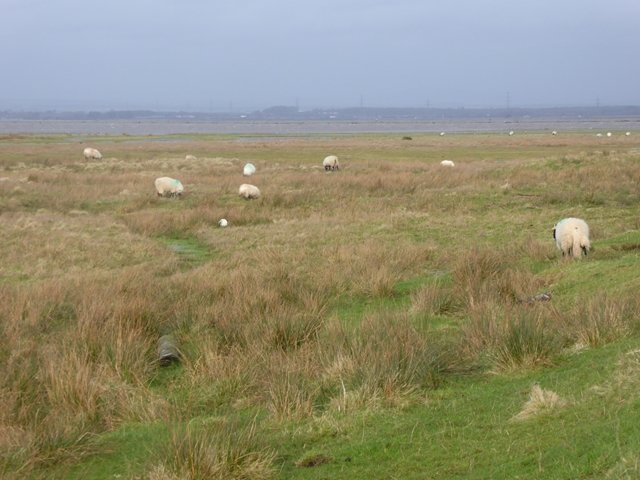
Pictured: Burgh Marsh and the Solway Firth, looking out from near Burgh by Sands, Cumbria — the tidal marshland where Jim Templeton photographed his daughter on May 23, 1964. This is not a reproduction of the disputed photograph itself, which remains held by the Templeton family and various press/ufological archives under unclear and contested reproduction rights; it is a general location photograph honestly presented as such. Photo by Oliver Dixon, via Geograph/Wikimedia Commons, licensed CC BY-SA 2.0.
Theoretical Alignment
This case aligns overwhelmingly with a Psycho-Social framing — not in the sense that Templeton misperceived a mundane object in the sky, since he never claimed to have seen anything unusual at the time, but in the sense that the entire phenomenon is a photographic and social one: an ordinary family snapshot, a genuinely puzzling background anomaly, a family's insistence on its reality, and forty-plus years of press embellishment (most notably the later "Men in Black" claims) layered on top of a single frame of film. Extraterrestrial framing scores low because nothing resembling a craft, light, or coordinated technological presence was ever reported; the "spaceman" is only ever a static, silent figure that nobody present consciously perceived. Interdimensional framing scores lower still, as nothing in the case's own details (no missing time, no electromagnetic effects, no altered perception) suggests anything beyond an ordinary photographic and human-memory puzzle.
Background
Understanding this case requires understanding three things: the man who took the photograph, the marshland where he took it, and the visual culture of 1964 — a year when the Space Race was in full swing and "spaceman" had just become a plausible word for a stranger in the news.
Jim Templeton
Jim Templeton (1920–2011) was a serving fireman with the Carlisle City Fire Brigade and a committed amateur photographer and local historian. By his own later account he had photographed the Solway coastline for years and knew Burgh Marsh well. On May 23, 1964, he drove his family out to the marsh for a day trip and took a short sequence of photographs of his younger daughter, Elizabeth, then five years old, posing among the wildflowers with the Solway Firth and the Scottish hills beyond visible in the background. He used a Contax-pattern 35mm single-lens-reflex camera loaded with Kodacolor-X negative film, a format that had only been introduced in 1963 and that, unlike the slide film more common at the time, produced color prints directly. When the roll was developed by a commercial photo lab and returned to him, Templeton has always said he was startled to find that the middle of his three frames of Elizabeth appeared to show a large, bulky, whitish figure standing immediately behind and slightly above her head — a figure with no visible face, features, or clear limbs, broadly resembling images of astronauts or spacesuited figures then filling newspapers and television during the early years of the American and Soviet crewed space programs.
Burgh Marsh and the Solway Firth
Burgh Marsh is a large expanse of tidal salt-marsh on the English side of the Solway Firth, the estuary separating Cumbria from Dumfries and Galloway in southwest Scotland. The marsh lies immediately north of the village of Burgh by Sands, itself built along the line of Hadrian's Wall and the site of a Roman fort, Aballava, whose stones were later reused in the village's parish church. The marsh is historically significant in its own right: King Edward I of England, "Hammer of the Scots," died at his military encampment on Burgh Marsh on July 7, 1307, while en route to campaign against Robert the Bruce, and a stone monument on the marsh still marks the traditional site. The marsh is flat, wide, exposed, and crossed by tidal channels; the Solway's tides are notoriously fast-moving and dangerous, and the area has long been used for grazing livestock rather than settlement, giving it the open, largely featureless character visible in Templeton's photographs. This kind of open, glare-heavy coastal terrain, with a bright sky and reflective wet sand or water often filling much of the frame, is directly relevant to the leading photographic explanation examined later in this file, since strong, low-angle backlighting from such an environment is exactly the condition photographic overexposure and "bloom" effects require.
1964: The Space Race in the Public Imagination
The word "spaceman," and the specific bulky, faceless, white-suited image the term evoked in 1964, did not exist in a vacuum. By May 1964 the United States and Soviet Union were roughly three years into the crewed spaceflight era: Yuri Gagarin and Alan Shepard had already flown, John Glenn had orbited the Earth, and NASA's Project Gemini was in active preparation, all extensively covered by newspapers and the still-young medium of television news, which by the early 1960s reached the great majority of British households. Bulky white pressure suits, rounded helmets, and a generally faceless, anonymous silhouette were, by 1964, a recognizable and recently-popularized visual shorthand in a way they simply had not been a decade earlier. This site's own analysis treats that cultural backdrop as directly relevant to how quickly and how specifically the "spaceman" interpretation was reached by the press, by Templeton, and by the public who saw the photograph reproduced in newspapers within weeks — not because it explains what appears in the photograph, but because it explains the specific vocabulary immediately reached for to describe an ambiguous white shape that could, under a different set of cultural referents, just as easily have been called a ghost, a monk, or simply "a person in white."
Publication and Early Reception
Templeton's local newspaper, The Cumberland News, was the first to publish the photograph and story, on June 12, 1964, under the headline "Solway 'spaceman' poses picture puzzle for police experts." The image was quickly picked up by national British papers, including the Daily Mail and Daily Express, and within weeks had been syndicated internationally. Templeton would later say that the resulting publicity, and specifically the "men in black" visit discussed below, made him regret ever having the photograph developed at a commercial lab rather than his own darkroom.
Complete Timeline
| Date | Event |
|---|---|
| 7 July 1307 | King Edward I dies at his encampment on Burgh Marsh; a monument later marks the traditional site. |
| 1920 | Jim Templeton is born in Carlisle, Cumberland. |
| 1961–1963 | Gagarin, Shepard, and Glenn's crewed spaceflights, and Project Gemini's build-up, saturate British press and television with images of bulky, faceless, white-suited spacemen. |
| 1963 | Kodacolor-X color negative film, the stock Templeton used, is introduced. |
| May 23, 1964 | Templeton photographs his daughter Elizabeth on Burgh Marsh. The 2nd of 3 frames later shows the "spaceman" figure; Templeton says he saw nothing unusual through the viewfinder. |
| Late May/early June 1964 | The film is developed at a commercial photo laboratory; Templeton notices the figure for the first time on the returned prints. |
| June 12, 1964 | The Cumberland News publishes the photograph and story under the headline "Solway 'spaceman' poses picture puzzle for police experts." |
| June 1964 | Carlisle City Police examine the negative and report finding nothing suspicious about it; Kodak separately examines it and finds no evidence of tampering or double exposure. |
| Summer 1964 | Templeton says two unnamed men, driving a black Jaguar and identifying themselves only as "Number 9" and "Number 11," question him at his fire station and later drive him out to Burgh Marsh before abandoning him to walk back. |
| September 1964 | Templeton tells The Cumberland News the "men in black" episode "looks like a leg-pull to me," adding he was sure the men were not genuine security agents; Detective Chief Inspector Stanley Armstrong tells the same paper he has "no knowledge whatsoever" of any such visit. |
| 1997 | Skeptical researcher Roger Green publishes a photographic re-analysis proposing the image shows evidence consistent with composite construction. |
| December 13, 2002 | Templeton writes to the Daily Mail reasserting the photograph is "certainly not a fake" and that he received no payment for it. |
| September 2013 | David Clarke and Andy Roberts publish "Solway Spaceman Solved?" in Fortean Times issue 305, proposing Templeton's wife Annie as the figure. |
| November 27, 2011 | Jim Templeton dies in Carlisle, having maintained the photograph was genuine and unexplained to the end of his life. |
| May 23, 2014 | On the photograph's 50th anniversary, David Clarke restates the "overexposed wife" explanation to the BBC. |
Detailed Narrative
Three Frames on Burgh Marsh
By Templeton's own consistent account across nearly five decades of interviews, he took three photographs of Elizabeth in quick succession on the marsh, intending simply to capture a pleasant record of the family's day out. He maintained that only his wife Annie, his elder daughter Frances (then nine), and two elderly women seated in a car some 300–400 yards away were anywhere in the vicinity; no other adult, and certainly no one dressed in anything resembling a spacesuit, was present. He looked through the viewfinder each time and saw nothing unusual behind Elizabeth. It was only the second of the three frames — not the first, and not the third — that showed the anomaly, a detail this site's own analysis treats as significant on multiple sides of the argument: it argues against a static, physically present figure that simply held still through all three shots (since it appears in only one), while also arguing against certain kinds of camera-fault explanations that would be expected to recur across a whole roll rather than a single frame.
The Figure Itself
What appears in the surviving frame is a tall, bulky, mostly white or pale figure standing close behind and slightly above Elizabeth, its "head" rounded and helmet-like, with no clearly resolved face, and no clearly resolved arms or hands, though some analyses have described a suggestion of one raised arm. The figure's lower body is obscured by the child in the foreground. Templeton and his family were adamant that nothing about its shape matched any person they recalled being present, and in particular that it did not match his wife's actual clothing that day, which Templeton insisted was a light or pale blue dress rather than anything white.
Kodak's Examination
Because the story quickly became a minor national sensation, both Carlisle City Police and Kodak's own technical staff examined the original negative directly, rather than relying on published prints. The Carlisle police forensic laboratory reported finding nothing to suggest the negative had been tampered with. Kodak's examiners reached a similar conclusion: no evidence of deliberate double exposure or darkroom manipulation was found, and by several later published accounts Kodak went so far as to offer a reward to anyone who could demonstrate how the image might have been faked, a challenge nobody is recorded as having successfully met. This site's own analysis treats this examination as the single strongest evidentiary pillar of the entire case: it does not prove the figure was an anomalous being, but it substantially narrows the space of possible explanations, ruling out the simplest and most common categories of photographic hoax (double-exposing the same frame twice, physically sandwiching two negatives, or scratching/painting the emulsion) without ruling out every possible explanation, photographic or otherwise.
The Missing First Frame
One persistently unresolved detail of the case, noted by researchers on both the proponent and skeptical sides, is that the first of Templeton's three frames — taken moments before the frame showing the anomaly — has never surfaced publicly. If a real, ordinary figure (a family member, a stranger, or Annie Templeton) walked into the shot only briefly, comparing the frame immediately before and after the anomalous one would be highly informative: their absence in both neighboring frames would weigh against a person simply standing still nearby, while their presence in either would support it. Without the first frame, and given uncertainty in some accounts over exactly what the third frame shows, this site's own research found this comparison could not be made with full confidence, leaving a genuine, acknowledged gap in the public record on both sides of the argument.
The "Men in Black" Episode
Templeton's story took on a second, separate layer of controversy later in the summer of 1964, when he began telling reporters that two men, whom he said identified themselves only by number ("Number 9" and "Number 11") rather than by name, had visited him at the Carlisle fire station, questioned him closely about the photograph, driven him out to Burgh Marsh, and specifically asked whether he had seen a "second spaceman" — before, in Templeton's account, growing angry when he insisted he had seen nothing at all, and abandoning him to walk roughly a mile back to the nearest garage. This story, an early and frequently-cited British example of the broader "Men in Black" motif in UFO folklore, is treated with particular skepticism by this site's own research for a reason that goes beyond its inherent strangeness: Detective Chief Inspector Stanley Armstrong of the Cumberland force told The Cumberland News at the time that he had "no knowledge whatsoever" of any such official visit, and Templeton himself, when asked about it directly in September 1964, told the same paper: "It all looks like a leg-pull to me. I'm sure the men were not security agents." This site's assessment treats Templeton's own contemporaneous dismissal of the story as the single most important fact bearing on the "men in black" claim specifically — a claim that later became a fixture of retellings of the case, often without noting that its own original subject dismissed it as a hoax within months. AGENTS.md's own editorial standard for this site requires treating disputed secondhand claims skeptically and attributing them clearly rather than repeating them as settled fact, and that standard is applied deliberately here: whatever happened to Templeton that summer, it is not treated by this file as a corroborated government cover-up, and the balance of the contemporary record suggests either an elaborate practical joke or, at minimum, an episode Templeton himself did not stand behind for long.
The Refused Camera
A further detail, drawn from David Clarke's research, adds useful context to how seriously any part of the UK government establishment actually engaged with the case: when the Ministry of Defence reportedly asked to examine Templeton's original film and camera directly, Templeton refused to hand them over. Combined with the Ministry's own later, separately reported statement that the photograph was "of no interest to them," this site's analysis reads the official record as one of mild, brief press-driven curiosity followed by rapid disengagement, not a sustained or high-level investigation — a pattern broadly consistent with how the Ministry of Defence is independently documented (see the Declassified Government Records section below) to have treated the large majority of civilian UFO reports throughout this period.
The Blue Streak Claim
In later interviews, including his 2002 letter to the Daily Mail, Templeton added a further, striking claim: that technicians at the Woomera rocket range in South Australia had aborted a countdown of the British Blue Streak missile within hours of his photograph being taken, after reportedly seeing two unidentified figures near the launch site matching his photograph's spaceman. This site's own research found no independent corroboration of this claim in any contemporary Australian press, official British or Australian rocket-program record, or independent ufological investigation; it appears to rest entirely on Templeton's own later, secondhand account of correspondence he said he received from Australia, and is treated here as an unverified addition to the case's folklore rather than as an established fact.
Roger Green's Composite Analysis
In 1997, researcher Roger Green published a skeptical photographic re-analysis of the image, proposing that its visual characteristics — the figure's awkward stance, its poor definition relative to the sharply-focused child in the foreground, and certain inconsistencies in apparent lighting direction — were consistent with the image being a composite of two separately-exposed elements rather than a single, straightforward exposure of a real scene. Green's analysis did not claim to identify or reproduce the specific technique used, and this site's own research found no follow-up publication in which the proposed composite method was actually demonstrated end-to-end on comparable equipment. This site's assessment treats Green's analysis as a genuine, serious contribution to the case's skeptical literature, but as one offering a general category of explanation (deliberate or accidental composite construction) rather than a fully reconstructed, tested mechanism, which is why it is treated in the Conventional Explanation Candidate section below as a distinct, still-live but comparatively weaker candidate next to the Clarke/Roberts "overexposed wife" identification.
David Clarke and Andy Roberts's Identification
David Clarke, a journalist and folklore academic at Sheffield Hallam University who has spent much of his career researching Ministry of Defence UFO files, and Andy Roberts, a British Fortean researcher, published their own detailed re-investigation of the case, first in the April 2012 issue of Fortean Times and then in a more pointed follow-up, "Solway Spaceman Solved?", in the magazine's September 2013 issue (issue 305). Their central conclusion, restated by Clarke directly to the BBC on the photograph's fiftieth anniversary in May 2014, is that the figure is Templeton's own wife, Annie, who they proposed had walked into the shot from behind, unnoticed by her husband, and had been rendered white, bulky, and largely featureless by strong backlighting overexposing her against the bright sky and marsh. Clarke specifically noted a technical limitation of the camera model Templeton used: "with that particular make of camera you could only see 70 percent of what was in the shot through the viewfinder," meaning a person standing at the frame's edge or slightly behind the primary subject could plausibly go unnoticed by the photographer even while appearing on the finished negative. Clarke and Roberts also pointed to digital contrast and levels adjustments of the published image, which they said increasingly suggested, once darkened and with the horizon corrected, "a regular person viewed from behind" rather than anything more exotic.
The Dress Color Dispute
The single most specific, falsifiable disagreement between the Clarke/Roberts explanation and the Templeton family's own account is the color of Annie Templeton's dress that day. Clarke and Roberts's published research states that Annie was wearing a pale or light blue dress, and that this specific shade of blue is a color known to overexpose toward white on Kodacolor-X stock under strong sunlight in a way that other colors do not as readily. Jim Templeton, for his part, consistently maintained across decades of interviews — including explicitly in his 2002 Daily Mail letter — that his wife's dress that day was a color that in no way resembled the bulky white shape in the photograph, and Templeton's family continued to reject the identification after his death. This site's own research was unable to independently verify either claim: no separate, contemporary 1964 photograph clearly documenting Annie Templeton's exact dress that specific day, distinct from the disputed frame itself, is known to survive in any published source this site could confirm. The dispute therefore rests on two competing forty-plus-year-old personal recollections of a single afternoon's wardrobe choice, a genuinely difficult category of claim to adjudicate either way, and this file treats it as exactly that rather than resolving it in either direction.
Key Witnesses
Jim Templeton (1920–2011)
Took the photograph and maintained for the rest of his life that the figure was not present when he pressed the shutter, that he saw nothing unusual through the viewfinder on any of his three exposures, and that no one matching the figure's appearance was anywhere on the marsh that day. He refused a Ministry of Defence request to hand over his original film and camera, dismissed the later "men in black" story himself as "a leg-pull" within months of it first appearing in print, and continued adding new details to the case (the Woomera Blue Streak claim, the dress-color dispute) in interviews over the following four decades. As the case's sole photographer and central witness, his credibility is the case's central variable: no allegation of financial motive, prior hoaxing history, or inconsistency in his core account (the figure's presence, the negative's authenticity) has been substantiated by any investigator on either side of the debate, even as some of his later embellishments have been treated skeptically by the same investigators.
Annie Templeton
Present on the marsh with the rest of the family that day. Neither Annie nor Jim Templeton is recorded as having given a detailed independent account, separate from Jim's own retelling, of exactly where she was standing or what she was doing at the specific moment each of the three photographs was taken. She is the central subject of this case's leading conventional explanation, identified by David Clarke and Andy Roberts as the "spaceman" figure itself, an identification the Templeton family disputed on the specific grounds of the dress-color discrepancy described above.
Detective Chief Inspector Stanley Armstrong
Told The Cumberland News in 1964 that he had "no knowledge whatsoever" of the "men in black" visit Templeton had described, a statement this site's research treats as the strongest single piece of contemporary evidence against that specific, separate strand of the story being a genuine official visit.
The Five Observables Assessment
The Five Observables framework, developed by the Pentagon's Advanced Aerospace Threat Identification Program to describe performance characteristics beyond known conventional technology, is applied here for comparative consistency across this site's case files, even though it fits this case unusually poorly: no craft, light, or object in motion was ever reported by any witness. The entire case concerns a single static figure in one photographic frame.
Assessment: This case is a poor structural fit for a framework built to describe the flight performance of an observed craft, and this file scores it accordingly: four of the five categories are simply not applicable to a static photographic anomaly with no witnessed motion. The one category that does register, Low Observability, does so for a genuinely unusual reason specific to this case: the figure was not undetectable to sensors while visible to the eye (the framework's normal sense), but rather the reverse — it was recorded clearly on film while apparently undetected by direct human perception, including by the photographer looking through the viewfinder at the precise moment of exposure. This inversion is exactly the detail the leading conventional explanation (a real, ordinary person briefly out of the photographer's narrow field of view) is built to explain, and this file's own assessment is that the Five Observables framework, designed for airborne performance anomalies, adds little independent analytical value to a case whose real substance is a question of photographic technique and eyewitness attention rather than of technology or flight physics.
Evidence Assessment
Supporting an Anomalous Origin
- Both Kodak's own examiners and the Carlisle City Police forensic laboratory independently examined the original negative and found no evidence of tampering or deliberate double exposure
- By several published accounts, Kodak went so far as to offer a reward for anyone who could demonstrate how the effect was faked, a challenge nobody is recorded as having met
- Templeton maintained a single, consistent core account — that he saw nothing unusual through the viewfinder and that no one matching the figure was present — across nearly five decades of repeated interviews, without ever wavering on that specific point even as other details (the "men in black," the Woomera claim) accumulated around it
- The figure appears in only the middle of three consecutive frames, arguing against certain kinds of persistent camera or lens faults that would be expected to recur across the whole roll
- No comparable, independently verified example of ordinary Kodacolor-X "blooming" or overexposure producing a similarly bulky, humanoid silhouette from a real backlit person has been located and published by researchers on either side of the debate, leaving the leading conventional explanation without a demonstrated real-world precedent even as it remains physically plausible in principle
Supporting a Conventional/Mundane Origin
- David Clarke and Andy Roberts's identification of the figure as Templeton's wife Annie, overexposed and viewed from behind, offers a specific, named, ordinary person who actually was present at the scene — a far simpler explanation than an unidentified craft-associated entity
- Clarke's account of the camera's viewfinder covering only around 70 percent of the actual frame provides a concrete mechanical reason a person at the image's edge could go unnoticed by the photographer
- Templeton's own contemporaneous, on-record dismissal of the "men in black" story as "a leg-pull," and Detective Chief Inspector Armstrong's denial of any official visit, substantially undercut the case's most dramatic secondary claim
- Roger Green's 1997 analysis independently proposed composite-construction indicators in the image, a second, distinct skeptical line of evidence alongside the Clarke/Roberts identification
- The Woomera Blue Streak claim, Templeton's most extraordinary secondary assertion, has never been independently corroborated in any Australian or British official or press record this site's research could locate
Why “Disputed”
This case is stamped Disputed and scored 33/100 because it combines a genuinely puzzling, professionally authenticated photograph with a specific, reasonably well-evidenced conventional explanation that has never been proven beyond the dispute of the one family with the strongest incentive and the most direct personal knowledge to contest it. Kodak's and the Carlisle police forensic laboratory's independent examinations are real, substantive positive evidence: they rule out the simplest, most common categories of photographic hoax, and no one has ever demonstrated, rather than merely proposed, exactly how the image could have been faked. That is a stronger evidentiary floor than several other photographic cases in this site's archive carry.
Working powerfully against a higher score is the existence of a named, present, physically real candidate explanation — Templeton's own wife — identified by two of British ufology's most methodical, MoD-file-literate researchers, who also offered a specific, concrete mechanical reason (the camera's limited viewfinder coverage) for how she could have gone unnoticed. This is a materially stronger conventional explanation than a vague appeal to "atmospheric effects" or "camera fault": it names a specific person who actually was at the scene and proposes a specific, physically ordinary mechanism. The explanation is weakened, but not disproven, by the unresolved dress-color dispute and by the absence of any independently verified real-world example of comparable Kodacolor-X overexposure producing a similarly bulky, faceless silhouette from an ordinary backlit adult. Roger Green's separate composite-analysis theory adds a second, independent skeptical line of argument, further reducing the odds that the image can only be explained anomalously. Set against this site's own calibration for comparable British and American photographic cases — McMinnville (Disputed, 55, multiple photographs of a genuinely undetermined object with no comparably specific named conventional candidate), Ilkley Moor (Disputed, 27, a single anonymous witness whose identity cannot even be checked), and Gulf Breeze (Debunked, 18, definitively matched to a physical foam model) — this case sits closer to the Gulf Breeze end of that range than to McMinnville's, precisely because it has a real, named, physically present alternative subject and a working technical mechanism proposed by credentialed investigators, even though, unlike Gulf Breeze, that explanation has never been proven with matching physical evidence and the Templeton family's specific, detailed rebuttal (the dress color) remains genuinely unresolved.
Sensor & Instrumentation Detection Profile
The sole instrumentation involved in this case is Templeton's own 35mm camera and the Kodacolor-X negative film it was loaded with — no radar, radio, or any other detection system of any kind was involved or has ever been claimed to have been involved. The negative itself functioned as the case's only physical evidentiary record, and was examined twice by independent technical parties: Kodak's own laboratory staff, who would have had direct institutional knowledge of their own film stock's behavior under various lighting and exposure conditions, and the Carlisle City Police forensic laboratory, a separate chain-of-custody examination. Neither found evidence of tampering. No spectrographic, densitometric, or other quantitative technical analysis of the original negative has been published in any source this site's research could locate; both known examinations (Kodak's and the police's) are reported only in summary form, without the underlying technical methodology or measurements being made public, a genuine limitation on how rigorously either the anomalous or the conventional case can be independently re-tested by outside researchers today, particularly since the original negative's current location and condition are not documented in any source this site could confirm.
Environmental & Geospatial Context
Burgh Marsh sits on the English shore of the Solway Firth, a broad tidal estuary with a strong reputation for fast-moving tides, treacherous sandbanks, and rapidly shifting light conditions off the water, all framed by the low hills of Dumfries and Galloway on the Scottish side. The marsh itself is flat, largely treeless grazing land, meaning a photograph taken there in bright weather would typically include a large proportion of open sky and, depending on the exact angle, reflective wet sand, mud, or water — conditions well understood in photography to increase the risk of localized overexposure ("blooming") on any brightly lit or pale-colored subject caught against that backdrop. Templeton's own account of a clear, sunny day, consistent with the negative's recorded f/16 aperture setting (a small aperture typically chosen specifically to compensate for strong ambient light), directly supports the physical plausibility, even if not the certainty, of the overexposure mechanism central to the Clarke/Roberts explanation.
Geopolitically and militarily, the Solway coast in 1964 held no major air base, radar installation, or nuclear or defense-research facility in its immediate vicinity that this site's research could confirm as directly relevant to the case; RAF Kirkbride, a former wartime airfield a short distance to the west, had by 1964 been substantially run down from its active wartime role, and this site's research found no indication any RAF or civil aviation activity from that station or any other nearby installation was proposed as relevant by any investigator, official or independent, at the time or since. This absence of any nearby military or industrial activity is itself a mild point of interest: unlike many British UFO cases of this era, no contemporaneous radar plot, nearby test-range activity (setting aside Templeton's own unverified, geographically distant Woomera claim), or aircraft movement has ever been proposed as a contributing factor to what appears in the photograph, reinforcing that this case's central puzzle is essentially photographic and perceptual rather than aeronautical.
Observer Credibility & Occupational Profile
Jim Templeton's occupation as a working fireman with the Carlisle City Fire Brigade, and his standing as a serious, longtime amateur photographer and local historian, are both treated by this site's own methodology as genuine, if moderate, positive credibility factors: a fireman's job did not require or reward public attention-seeking, and no investigator on either side of this case's long history has produced evidence of any financial motive, prior hoaxing history, or documented character issue bearing on Templeton's honesty. His decades-long, unwavering consistency on the single specific factual claim that matters most — that no one matching the figure was consciously visible to him at the moment of exposure — is a real, if limited, credibility signal, especially given that this is precisely the kind of claim a deliberate hoaxer would have the least incentive to maintain unembellished for nearly fifty years while other, more sensational details (the men in black, the Woomera missile) were added and, in the case of the men in black, later partly disowned by Templeton himself.
Working against a higher credibility rating is the specific, concrete, and unresolved factual dispute over his wife's dress color, a detail that, if the Clarke/Roberts identification is correct, Templeton either misremembered in good faith over a very long period or continued to dispute for reasons this site's research cannot independently adjudicate. It is also relevant that Templeton, by his own admission, refused the Ministry of Defence's request to examine his original camera and film directly — an action fully within his rights as a private citizen, but one that this site's methodology notes removed an opportunity for a more thorough contemporary technical examination beyond Kodak's and the police's. Annie Templeton, the case's second most important figure by the leading conventional explanation, left no independently documented, detailed account of her own movements and clothing that day distinct from her husband's; her credibility, and the credibility of the specific claim that identifies her as the figure, therefore rests substantially on secondhand family recollection on one side and circumstantial technical reasoning (dress color under Kodacolor-X, viewfinder coverage) on the other, rather than on any first-person testimony of her own that this site's research could locate.
Physical & Material Assays
No physical trace evidence of any kind exists in this case beyond the photographic negative itself, and none would be expected given the case's nature: nothing was reported to have landed, and no ground disturbance, residue, or debris was ever claimed by Templeton or documented by any investigator. The negative is the case's sole physical artifact, and its current custodianship and condition are not documented in any source this site's research could confirm; it is not known to this site's research whether the original negative survives today in a condition that would permit modern digital or chemical re-examination, a genuine and significant gap in the case's evidentiary record given how much modern forensic photographic analysis techniques have advanced since 1964.
Historical Precedents & Archive Matches
Within this site's own published archive, this case's closest structural comparisons are its fellow photographic-evidence files, each of which pairs a single striking image against a specific, named conventional explanation of varying strength.
Comparison to McMinnville
This site's McMinnville Trent Photos file (Disputed, 55/100) involves two photographs of an object that, unlike the Solway figure, was consciously seen and described in real time by both witnesses, and for which no comparably specific, named conventional identification has ever been proposed with the same degree of circumstantial detail Clarke and Roberts bring to this case. That structural difference — a witnessed object with no strong named alternative, versus an unwitnessed figure with a strong named alternative — is a central reason this site's own methodology scores Solway Firth notably lower than McMinnville despite both cases' negatives having passed contemporary technical examination without detected tampering.
Comparison to Ilkley Moor and Gulf Breeze
This site's Ilkley Moor Incident file (Disputed, 27/100) shares this case's basic shape — a single photograph of an ostensibly anomalous humanoid figure — but rests on a witness who has never been publicly identified, making independent character or motive assessment impossible in a way it is not for the named, long-interviewed Templeton. This site's Gulf Breeze UFO Sightings file (Debunked, 18/100) represents the clearest resolution in either direction available anywhere in this site's photographic-case archive: a matching physical foam model, bearing the photographer's own handwriting, was actually recovered, removing any real ambiguity. Solway Firth Spaceman sits meaningfully below McMinnville and above Ilkley Moor on this site's own scale specifically because its leading conventional explanation, while unproven, is more specific, more circumstantially detailed, and advanced by more methodologically rigorous named researchers than Ilkley Moor's can be, while still falling well short of Gulf Breeze's outright physical confirmation.
A Broader Pattern in 1960s "Spaceman" Photographs
This site's research also notes that the specific "spaceman" visual vocabulary Templeton and the contemporary press reached for was not unique to this case: several other photographic hoaxes and disputed images from the same general period, in Britain, the United States, and elsewhere, similarly describe bulky, faceless, white-suited humanoid figures, a pattern this site's own analysis reads as consistent with the wider cultural saturation of genuine spacesuit imagery during the early Space Race discussed in the Background section above, rather than as evidence of any coordinated or genuinely extraterrestrial phenomenon recurring across unrelated cases.
Material Analysis
As detailed in the Physical & Material Assays section above, this case involves no physical trace evidence beyond the photographic negative itself. There is no soil, biological, or metallurgical sample of any kind associated with this case.
Supporting Non-Terrestrial or Truly Unexplained Origin
- The negative passed two independent contemporary technical examinations (Kodak, Carlisle City Police) without any tampering being detected
- No one has ever demonstrated, rather than merely proposed, a working reconstruction of exactly how the image could have been deliberately faked
- No independently verified real-world comparison example of ordinary Kodacolor-X overexposure producing a similarly bulky, faceless silhouette from a real backlit person has been published by any investigator on either side of the debate
Supporting Terrestrial/Mundane Origin
- A specific, named, ordinary person — Templeton's own wife — was actually present at the scene and has been identified by name as a strong candidate for the figure by two credentialed researchers
- A concrete, camera-specific mechanical reason (limited viewfinder coverage) has been proposed for how she could have gone unnoticed by the photographer at the moment of exposure
- A separate, independent skeptical analysis (Roger Green, 1997) proposed composite-construction indicators in the image on entirely different technical grounds
- Templeton's own most dramatic secondary claim (the "men in black" visit) was dismissed by Templeton himself, on the record, within months of first being reported
The Conventional Explanation Candidate: An Overexposed Bystander, a Composite Image, or a Hoax
Three genuinely distinct conventional explanations have been seriously proposed for this case by independent researchers, each resting on different evidence and carrying different weight.
An Overexposed Bystander (Annie Templeton)
David Clarke and Andy Roberts's identification of the figure as Jim Templeton's wife, walking into the shot from outside the camera's limited viewfinder coverage and rendered white and featureless by strong backlighting, is this case's leading and most specific conventional candidate. It names a real, present, ordinary person; it proposes a concrete, camera-model-specific mechanism (roughly 70 percent viewfinder coverage) for why the photographer would not have noticed her; and it comes from two of British ufology's most methodical MoD-file researchers rather than from an anonymous or casual commentator. Its central weakness is the unresolved dress-color dispute and the absence of any independently verified comparison photograph demonstrating equivalent Kodacolor-X overexposure from a real backlit adult producing a similarly bulky, faceless silhouette.
A Composite or Manipulated Image
Roger Green's 1997 analysis proposed that specific visual characteristics of the image — inconsistent apparent lighting direction, the figure's comparatively poor definition against the sharply focused child, and its somewhat awkward stance — were more consistent with a composite of two exposures than with a single natural photograph. This candidate is strengthened by being an entirely independent line of skeptical reasoning from the Clarke/Roberts identification, arrived at through different technical means, but weakened by never having been demonstrated as a working, reproducible technique on comparable 1964-era equipment and film stock, and by sitting in some tension with Kodak's own and the Carlisle police's contemporary findings of no tampering, both of which pre-date Green's re-analysis by more than three decades of possible negative degradation or copy-generation loss that could itself introduce the kind of artifacts Green identified.
A Deliberate Hoax by Templeton
The simplest possible mundane explanation — that Templeton fabricated the image himself, whether for attention, money, or amusement — has been considered and given comparatively little weight by virtually every serious investigator on either side of this case's history, this site's own research included. No investigator has produced evidence of a financial motive (Templeton explicitly stated, and no one has disputed, that he received no payment for the original photograph), a prior hoaxing history, or any inconsistency in his core account across nearly fifty years of repeated interviews. Kodak's and the Carlisle police's independent examinations, while not conclusive against every conceivable hoaxing method, specifically ruled out the simplest and most common categories a self-hoaxing photographer would likely have used.
Overexposed Bystander (Annie Templeton)
PlausibleThe leading candidate: names a real person actually present, with a specific proposed mechanism, from credentialed researchers — weakened only by the unresolved dress-color dispute and the lack of a matching demonstration example.
Composite/Manipulated Image
InconclusiveAn independent, technically distinct skeptical line of reasoning, but never demonstrated as a reproducible technique and in some tension with the negative's two clean contemporary examinations.
Deliberate Hoax by Templeton
ImplausibleNo financial motive, prior hoaxing history, or account inconsistency has ever been substantiated, and two independent technical examinations ruled out the simplest hoaxing methods.
Related Cases
Official Records & Research Guides
The National Archives' own guide to locating Ministry of Defence UFO correspondence and sighting-report files (series DEFE, AIR, FCO and BJ), including the department's own note that UFO files were routinely destroyed at five-year intervals before 1967.
The Ministry of Defence's released DEFE 24 series of UFO sighting reports and correspondence; this site's research found no evidence this specific 1964 Solway Firth case is individually catalogued within it, consistent with the Ministry's own contemporaneous statement that the photograph was "of no interest to them."
Further Reading — Recommended Literature
Flying Saucerers: A Social History of Ufology
A social history of British ufology by the same two researchers who conducted the leading modern re-investigation of this case, essential for understanding the cultural moment that produced the "spaceman" interpretation.
Out of the Shadows: UFOs, the Establishment and the Official Cover-Up
Draws directly on declassified Ministry of Defence files to document how the British government establishment actually handled UFO reports of this era, directly relevant to assessing the Solway case's brief and dismissive official treatment.
The UFOs That Never Were
A case-by-case skeptical deconstruction of well-known British UFO incidents by the same investigative team, useful for calibrating how this site's leading conventional explanation compares to other resolved or partially resolved British cases.
UFOs Explained
A classic skeptical methodology text analyzing dozens of well-known UFO photographic and eyewitness cases, useful background for evaluating the general categories of conventional photographic explanation applied to this case.
How UFOs Conquered the World: The History of a Modern Myth
Clarke's own broader history of UFO belief situates this specific case within the wider cultural pattern of Space Race-era "spaceman" imagery discussed in this file's Background section.
Essential Viewing
No Videos Available
Sources
- David Clarke, drdavidclarke.co.uk, “The Solway Spaceman Photograph” — detailed case analysis and digital image re-examination
- James A. Conrad, jamesaconrad.com, “The 1964 Solway Spaceman Photograph: Case Report” — detailed technical case report, camera and film data, witness list
- The Times and Star (Cumbria), “The theory behind the 'Spaceman on the Solway Firth' photo mystery” — regional newspaper account and competing theories
- Wikipedia, “Solway Firth Spaceman” — overview, citations to primary press coverage
- The National Archives (UK), UFOs Research Guide — official guide to Ministry of Defence UFO files
- The National Archives (UK) Discovery catalogue, “UFO Reports” (DEFE 24 series) — catalogue entry
- Wikipedia, “Burgh by Sands” — village history, Hadrian's Wall, Edward I
- Wikimedia Commons, File: Burgh Marsh and the Solway Firth - geograph.org.uk - 4805422.jpg, photo by Oliver Dixon, CC BY-SA 2.0 — licensing and attribution
- Solway Coast National Landscape, “Burgh by Sands” — local geography and landscape designation
- David Clarke & Andy Roberts, “Solway Spaceman Solved?”, Fortean Times issue 305 (September 2013) — cited via Clarke's own case-file summary
- BBC News, coverage of the photograph's 50th anniversary (May 2014), David Clarke interview — cited via Wikipedia's sourced summary of the BBC interview
- Grunge, “The Unsolved Mystery Of The Solway Spaceman” — general-audience summary of the case's history and competing theories
- Curious Archive, “The Solway Spaceman, Men in Black, and the Blue Streak Missile” — discussion of the unverified Woomera/Blue Streak claim
- Wikipedia, “Solway Firth” — estuary geography, tidal characteristics
- Wikipedia, “Kodacolor (film)” — general background on the Kodacolor-X film stock used for the photograph
- This site, case-files/mcminnville-1950.html — comparative photographic UFO case
- This site, case-files/ilkley-moor-incident.html — comparative British single-photograph humanoid-figure case
- This site, case-files/gulf-breeze-ufo-sightings.html — comparative photographic case resolved with physical evidence
- This site, case-files/rex-heflin-ufo-photographs.html — comparative 1960s photographic case, occupationally credentialed witness
- This site, key-figures.html, entries on David Clarke and Andy Roberts — researcher backgrounds and other cases investigated
- This site, locations/index.html, entry on Burgh by Sands — village and marsh geography
See something inaccurate? Have additional information or sources?
Suggest an Edit →Last Updated: August 2026