
Rex Heflin UFO Photographs
Shortly after noon on August 3, 1965, Rex E. Heflin, a 38-year-old highway maintenance engineer for the Orange County Road Department, was parked in his work van near Myford Road outside Santa Ana, California, when a silvery, hat-shaped object crossed the road ahead of him. He fired off three Polaroid photographs of the object in flight and a fourth of the strange, solid-looking smoke ring it left behind. Six weeks later, two men claiming to represent NORAD talked their way into borrowing the first three originals — and never returned them. What followed was one of the longest-running photographic investigations in American ufology: a National Investigations Committee on Aerial Phenomena inquiry that lasted years, a U.S. Air Force verdict of hoax overruling its own investigator's contrary finding, a Condon Committee analysis that called the photos "of little probative value," a 1975 Ground Saucer Watch "string" claim that later proved to be an artifact of degraded copies, and finally, after the three missing originals mysteriously reappeared in Heflin's mailbox in 1993, a peer-reviewed 2000 computer-enhancement reanalysis that found no evidence of fraud and confirmed the photographs were "totally consistent" with Heflin's own account.
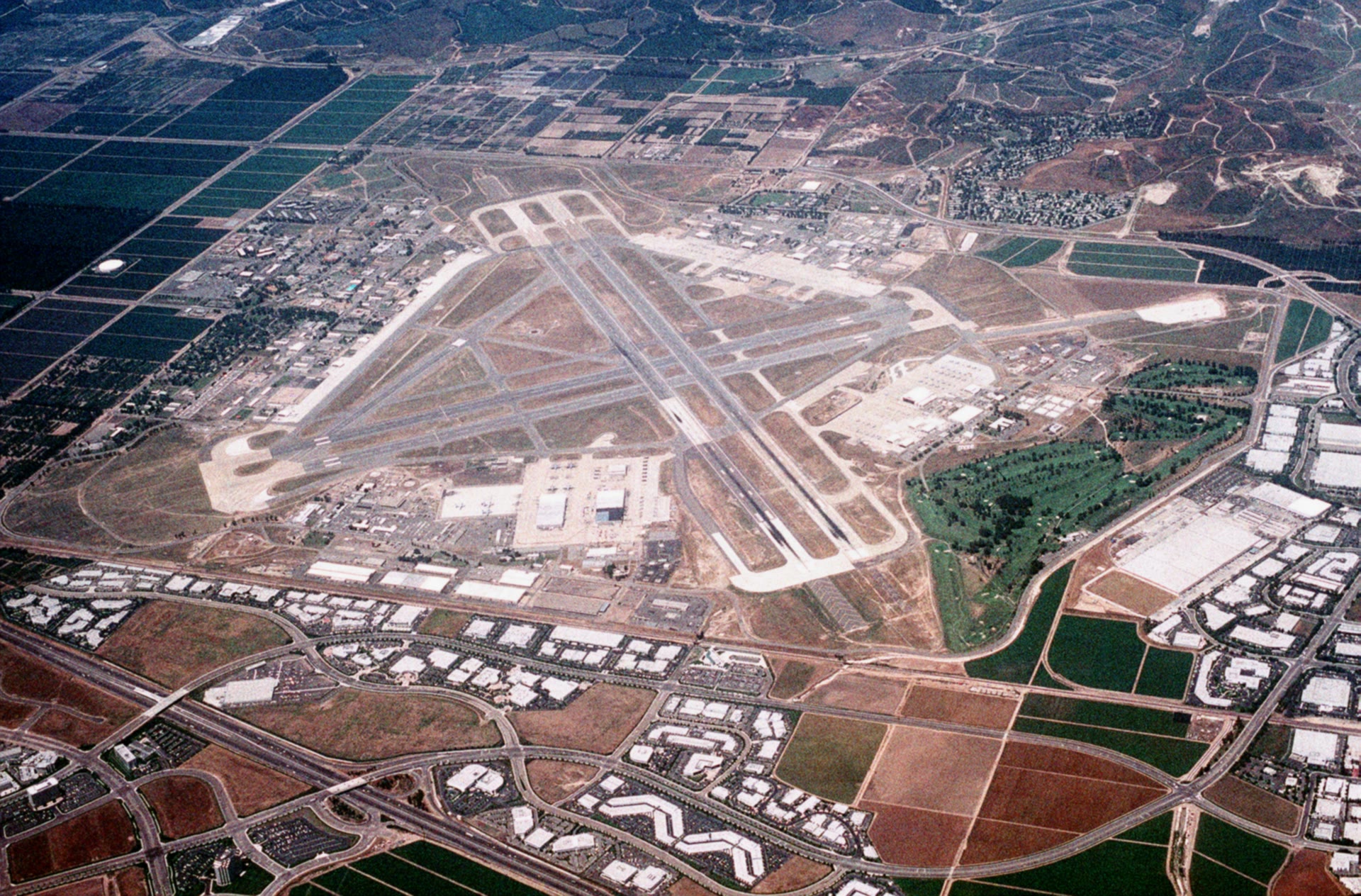
Pictured: a 1993 aerial view of the former Marine Corps Air Station El Toro (U.S. Navy photo by PH2 Bruce Trombecky, public domain) — the military base whose perimeter sat roughly half a mile from Heflin's sighting site, not the photographed object or the actual Polaroid images themselves, which remain the property of the Heflin estate and researcher Ann Druffel's SKYNET Library. No public-domain or rights-clear copy of Heflin's own four photographs is known to exist.
Theoretical Alignment
The Heflin case aligns most strongly with the Extraterrestrial Hypothesis among this site's three primary frameworks, though "aligns with ETH" here should be read narrowly: it means the physical evidence has consistently survived attempts to explain it away as a hoax or misidentification, not that an extraterrestrial origin has been proven. A single witness, however reliable, and four Polaroid photographs, however carefully reanalyzed, cannot on their own establish anomalous origin beyond doubt. The Psycho-Social framework finds only modest purchase here — there is no sustained community sighting wave, no self-reinforcing media-driven reporting culture of the kind this site documents at Bonnybridge or Warminster — because this is fundamentally a single-incident case with an unusually long and well-documented forensic tail, not a diffuse social phenomenon.
Background
Santa Ana, the seat of Orange County, California, sits at the heart of a rapidly suburbanizing Southern California landscape in the mid-1960s, adjoining what was then Marine Corps Air Station El Toro, a major West Coast Marine aviation base. Rex Heflin's sighting site on Myford Road lay roughly half a mile outside El Toro's perimeter, a detail that would drive much of the case's subsequent investigation, since it placed a witnessed and photographed unidentified object directly adjacent to active military airspace during the height of the Cold War.
1965 was, independent of the Heflin case specifically, an unusually active year for UFO reports across the United States, coming on the heels of a decade of Project Blue Book investigation and a growing, increasingly organized civilian UFO-research movement led by the National Investigations Committee on Aerial Phenomena (NICAP), founded in 1956 and by the mid-1960s the country's most prominent private UFO-research organization. NICAP's Los Angeles Subcommittee (LANS), a regional chapter with an unusually strong bench of professionally credentialed volunteer investigators, would go on to conduct the single most extensive contemporaneous investigation of Heflin's photographs of any organization, government or private, examined for this case file.
Heflin himself was, by every account gathered during a two-year LANS character investigation and a separate three-hour U.S. Air Force interview, an unremarkable and reliable witness by any conventional measure: a highway maintenance engineer with fifteen years of responsible service in the Orange County Road Department at the time of the sighting, a man his own supervisors and coworkers described as mature, alert, and trustworthy, and someone who had, by his own later account, been a mild skeptic about UFOs until his own photographs made him reconsider. This background matters directly to how this case file weighs the evidence: unlike a case built on a single, uncorroborated verbal account, Heflin's story is anchored by contemporaneous physical photographs, a documented radio malfunction independently confirmed by his own employer's equipment logs, and a personal reputation that multiple independent investigators, including a skeptical U.S. Air Force officer, explicitly found no reason to doubt.
Complete Timeline
| Date | Event |
|---|---|
| Aug. 3, 1965, ~12:30–12:37 p.m. | Rex Heflin photographs an unidentified object crossing Myford Road near Santa Ana, then photographs the smoke ring it leaves behind; his van's two-way radio fails during the sighting and resumes working immediately afterward. |
| First week of Aug. 1965 | A separate multiple-witness sighting of a large, glowing disc-shaped object occurs on the Santa Ana Freeway in Anaheim, roughly ten miles from Heflin's site, reported by motorist Ralph Joseph and his wife. |
| Aug. 3–Sept. 1965 | Heflin shows the photographs to coworkers and relatives; copies circulate informally through a chain of acquaintances, eventually reaching the Santa Ana Register. |
| Sept. 20, 1965 | The Santa Ana Register publishes the first three photographs, six weeks after the sighting. The same day, a man identifying himself as a NORAD colonel phones Heflin. |
| Sept. 22, 1965 | Two men in civilian clothes, claiming to represent NORAD, visit Heflin's home and borrow the three original photographs of the craft. They are never returned; NORAD later denies any knowledge of the incident. |
| Sept.–Oct. 1965 | U.S. Marine Corps Intelligence officers and USAF Captain Charles F. Reichmuth separately interview Heflin; Reichmuth's report finds no evidence of a hoax, but a separate Project Blue Book photo-comparison test leads the Air Force to officially classify the case as a hoax. |
| 1965–1968 | NICAP's Los Angeles Subcommittee (LANS), led by Idabel Epperson and investigator John Gray, conducts a multi-year character and photographic investigation. |
| 1966–1971 | Physicist James E. McDonald investigates the case independently, ultimately calling the photos "the outstanding photographic evidence yet submitted concerning UFOs," while raising unresolved doubts about the fourth "smoke ring" frame. |
| Jan. 1968 | McDonald and Condon Committee photo analyst William Hartmann travel to California, interview El Toro personnel, and attempt an on-site photographic recreation using a suspended lens cap. |
| 1969 | The Condon Report is published; Hartmann's write-up judges the photos "of little probative value," citing his own recreation as a close match to Heflin's second photograph. |
| 1971 | James E. McDonald dies; his unresolved doubts about the fourth photograph contribute to a decline in mainstream research attention to the case. |
| Mid-1970s | William Spaulding's Ground Saucer Watch (GSW) computer-enhances late-generation copies and publicly declares the photos a hoax, citing an alleged supporting "string." |
| 1993 | Heflin's three missing original photographs mysteriously reappear in his mailbox after an anonymous phone call; he entrusts all four originals to researcher Ann Druffel for scientific preservation and study. |
| 2000 | Druffel, Robert M. Wood, and Eric Kelson publish a peer-reviewed computer-enhancement reanalysis in the Journal of Scientific Exploration, finding no evidence of a string, model, or hoax, and reconfirming the photographic sequence's internal consistency. |
| Oct. 19, 2005 | Rex Heflin dies after a long illness. |
The Sighting
At approximately 12:30 p.m. PDT on August 3, 1965, Rex E. Heflin had stopped his Orange County Road Department work van near the intersection of Myford Road and Walnut Avenue, on the boundary of Orange County near Santa Ana, roughly half a mile outside the perimeter of Marine Corps Air Station El Toro. Some tree branches were obscuring a railroad-crossing sign, and as part of his ordinary duties keeping traffic signage visible, Heflin had stopped to photograph the obstruction with his Model 101 Polaroid work camera, loaded with high-speed ASA 3000 film. He first attempted to radio his supervisor to report the obscured sign, but his van's two-way radio had inexplicably gone dead.
Still inside the van, and about to photograph the sign itself, Heflin caught a flash of motion at the periphery of his vision and saw a silvery, hat-shaped object — a domed upper surface over a wider brim, by his own description — flying slowly from left to right across Myford Road at what he judged to be roughly 150 feet altitude, comparing its apparent size to the 20-foot-wide traffic lanes it crossed. Assuming at first that he was looking at an experimental aircraft from El Toro, Heflin raised his camera and took his first photograph through the windshield as the object crossed his line of sight. As it moved further east and tipped to reveal a darker underside, he photographed it a second time through the passenger window, and described watching "a rotating beam of light emitting from the center of the UFO on the bottom side" — a greenish-white beam he said rotated clockwise, completing a full rotation roughly every two seconds. He took a third photograph as the craft began a turning motion, its whole motion described as "similar to a gyroscope when losing its stability."
As the object continued moving east, it gained altitude and speed and departed rapidly, leaving behind what Heflin described as "a deposit of smokelike vapor" — a ring of bluish-black smoke that hung in the sky at roughly the same position the object had occupied moments before. Heflin drove a short distance north along Myford Road toward the ring, got out of his van, and photographed it a fourth time; he later told investigators he was struck by the ring's unusually "solid" appearance, since it did not dissipate the way ordinary smoke normally would. Returning to his work, he found that his two-way radio had resumed working normally. According to independent research, the time of the sighting was later fixed at approximately 12:37 p.m. PDT through analysis of shadow angles combined with astronomical data from Griffith Observatory.
From Curiosity to National News: The Santa Ana Register
Heflin was, by his own later account, unexcited by what he assumed were pictures of an experimental El Toro aircraft, and showed the photographs to a few coworkers that same afternoon; several were visibly unsettled by the fourth image of the smoke ring specifically, prompting Heflin to decide that "three pictures were enough for one day" and stop showing the fourth. He gave little further thought to the photographs until relatives and friends who saw them became intrigued and began asking to borrow the originals to make copies — a chain of informal lending that would prove consequential. Heflin's own coworkers, his sister, and a family friend who co-owned a Santa Ana drugstore each borrowed and copied the originals in turn, until a copy came to the attention of the co-owner of the Santa Ana Register, who requested them for possible publication.
The Register's own chief photographer tracked Heflin down at work and persuaded him, with some reluctance, to bring the true originals to the newspaper office to be professionally copied — Heflin, by his own account, sought neither publicity nor payment and still believed at the time that he had photographed an experimental aircraft. Six sets of negatives of the first three photographs were made, though cropped in a way that removed a foreground reference shadow later found useful in dating the sighting; a separate, uncropped set of copies was independently made around the same time by an amateur photographer through a different chain of informal lending, and it was this second, uncropped set that later proved essential in establishing the sighting's precise timing. The Register published the first three photographs on September 20, 1965 — six weeks after the sighting itself — without ever formally asking Heflin's permission, and without Heflin ever copyrighting the images or seeking payment for their use over the following three decades, even as they were reprinted in UFO research journals and popular magazines worldwide and appeared, within three years, in the 1968 Encyclopedia Britannica's "Spacecraft" entry.
The NORAD Confiscation
The Register's publication triggered the single most notorious episode of the entire case. On the very day the newspaper's story ran, September 20, 1965, a man identifying himself as a NORAD colonel telephoned Heflin, arranged to meet him two days later, and specifically warned him not to discuss the matter further with the press. On the evening of September 22, two men in civilian clothes came to Heflin's door claiming to represent the North American Aerospace Defense Command. One flashed an identification card — salmon-and-green in color, resembling cards Heflin recognized from his familiarity with El Toro Marine personnel, though he could not recall the name on it and specifically noted it carried no photograph; the second man said nothing throughout the exchange. Trusting the men in the same way he had cooperated with the U.S. Marine Corps and Air Force investigators who had already visited and returned his photographs unmarked, Heflin lent them the three original photographs of the craft, expecting them back.
They were never returned. Heflin, assisted by NICAP's Los Angeles Subcommittee, attempted for years afterward to track the two men down; NORAD itself disclaimed any knowledge of the photographs or the visit, and even a formal inquiry made on Heflin's behalf by his own congressman, Representative James Utt, produced assurances that NORAD's own offices had been searched top to bottom with no results. The identity of the men, and the reason two individuals falsely representing a real military command would specifically target three Polaroid photographs of an unidentified object, has never been established. The episode was not an isolated one: in October 1967, a man in a U.S. Air Force uniform, using a similarly photo-less salmon-and-green identification card and identifying himself as "Captain C. H. Edmonds," visited Heflin's home again, questioned him about his UFO-research affiliations, and left amid a strange purplish glow from a parked vehicle and unexplained interference on Heflin's home hi-fi system — a second, similarly unresolved encounter that led James E. McDonald to conclude the visitor's own identification could not have been genuine, since no legitimate investigating agency of the period issued photo-less ID cards in that color.
Early Investigations: The Air Force's Contradictory Verdicts
Heflin's case received an unusually thorough, multi-agency investigation within weeks of its public disclosure — and produced two directly contradictory official verdicts from the same government within a matter of months. U.S. Marine Corps Intelligence officers visited Heflin, interviewed him, and borrowed and returned copies of the first three photographs unmarked. Separately, USAF Captain Charles F. Reichmuth conducted a formal, more-than-three-hour interview with Heflin on behalf of Project Blue Book, independently verified his employment record and reputation with his supervisors, and filed a report to Blue Book's headquarters at Wright-Patterson Air Force Base concluding, in Reichmuth's own words, "From all appearances, he is not attempting to perpetrate a hoax."
Despite Reichmuth's own explicitly favorable assessment of Heflin's honesty, Project Blue Book's official case disposition classified the photographs as a hoax — a verdict based not on any finding about Heflin's character, but on a separate Air Force photo-comparison experiment in which officials photographed a nine-inch metal tray tossed into the air roughly fifteen to twenty feet from the camera and judged the resulting image comparable to Heflin's. This case file finds the discrepancy between Reichmuth's own field investigation and Blue Book's headquarters disposition to be one of the clearest documented examples, in any case on this site, of an official verdict diverging from its own investigating officer's contemporaneous, on-the-record findings.
The NICAP & LANS Investigation
The most sustained and methodologically rigorous contemporaneous investigation of the case came not from any government body but from NICAP's Los Angeles Subcommittee (LANS), led first by biophysicist Dr. Leslie K. Kaeburn and, after his 1968 death, by Idabel Epperson. LANS fielded an unusually well-credentialed bench of volunteer investigators for a private research group, including aviation engineers employed at North American Aviation and John Gray, an engineer who checked ground equipment for the Apollo program. Over roughly two years, LANS conducted a full character investigation of Heflin, cross-checking his employment record and reputation with supervisors and coworkers, and concluded he was a straightforward individual with fifteen years of responsible service who was "not the type to pull a hoax that could jeopardize his job."
Independent scientist Robert Nathan, working at a Southern California aerospace facility unrelated to his personal interest in the case, volunteered his own computer-enhancement expertise to the LANS investigation beginning in 1968. Nathan's analysis found no evidence of any supporting string or model around the object in any generation of copies then available, identified the dark band surrounding the craft as likely particulate matter — possibly atmospheric pollution the object had picked up while flying through smoggy Orange County air — and detected a faint wedge-shaped light feature on the object's underside in the second photograph, consistent with Heflin's own account of a rotating light beam. Nathan separately concluded there was no reason to doubt that the fourth "smoke ring" photograph was part of the same event as the first three, describing the ring itself as a "vortex ring" composed of the same kind of particulate matter that had surrounded the departing object.
James McDonald, William Hartmann, and the Fort Belvoir Puzzle
In the spring of 1966, physicist James E. McDonald, senior physicist at the University of Arizona's Institute of Atmospheric Physics, began an intensive independent investigation of the Heflin case, ultimately including it on his own list of the "100 best" UFO cases submitted to the newly funded Condon Committee. McDonald's own investigation of Heflin's reported radio malfunction is a rare example, in this site's case files, of a specific physical side-effect being independently checked against a third party's own contemporaneous records: he confirmed through Heflin's own employer that other Highway Department radio units in the area had also failed to receive any signal at the exact time Heflin's own radio went dead, and satisfied himself, in consultation with a University of Arizona radio engineer, that a strong electromagnetic field on the same frequency could plausibly saturate and silence the receiver in exactly the manner described.
McDonald's single largest unresolved doubt concerned the fourth photograph specifically: his own reading of the apparent sky conditions in his copy of the smoke-ring image suggested thicker clouds than should have been meteorologically possible at the sighting's claimed time and location, leading him to suspect Heflin might have photographed the ring at a different time or place and represented it as part of the same sequence. LANS investigators, working from differently processed and exposed copies showing a less dramatic sky, and backed by U.S. Weather Bureau data indicating overcast conditions genuinely could appear "flat" in photographs taken at a low angle from inside an enclosed vehicle, disputed McDonald's reading throughout a lengthy, occasionally tense multi-year correspondence.
In November 1967, McDonald arranged to investigate the case on-site together with William Hartmann, the University of Arizona-based photo-case analyst for the newly formed Condon Committee. The two traveled to California in January 1968, interviewed El Toro personnel and radar technicians (who reported no unusual returns logged at the time of the sighting), and attempted an on-site photographic recreation using both a small model on a string and a Leica lens cap suspended by a thread — producing photographs Hartmann considered a close visual match to Heflin's own second image, despite the test setup's supporting thread being clearly visible in the recreation itself, a detail this case file finds significant given that no such thread or string has ever been detected in any of Heflin's actual photographs by any analyst. Seeking a comparative case to help resolve the fourth photograph's smoke-ring puzzle, McDonald separately investigated a visually similar 1957 incident at Fort Belvoir, Virginia, in which soldiers photographed a solid-looking black smoke ring later attributed, without conclusive documentation, to a military "demonstration device" — a comparison that, by McDonald's own later assessment, raised as many new questions as it resolved.
The Condon Report's Verdict
When the Condon Committee's final report was published in 1969, Hartmann's write-up of the Heflin case — formally covered as one of the report's roughly ninety detailed case studies, discussed further in this site's own dedicated Condon Report case file — judged the photographs "of little probative value," citing his own lens-cap recreation as a good match for Heflin's second photograph. This case file finds Hartmann's conclusion difficult to reconcile with the fuller investigative record available even in 1968: Robert Nathan had already demonstrated, using confirmed first-generation copies, that no string or supporting mechanism was visible in Heflin's actual photographs; Heflin's own camera had already been shown by LANS photo expert Zan Overall to focus sharply at distances as close as three feet, meaning close-range test shots were not informative about whether the real photographs depicted a nearby small object or a genuinely distant large one; and Hartmann's own recreation reproduced neither the wedge-shaped light Nathan had detected on the object's underside nor the black particulate band surrounding it. Dr. James McDonald himself, writing to Heflin in December 1967, had independently assessed that "your 1965 photos remain the outstanding photographic evidence yet submitted concerning UFOs" — a verdict from the same physicist working the case alongside Hartmann that the Condon Report's own published conclusion did not reflect.
Ground Saucer Watch's Hoax Declaration
James McDonald's death in June 1971, and his own unresolved doubts about the fourth photograph specifically, contributed to a broader decline in sustained scientific attention to the case through the first half of the 1970s. Into that vacuum stepped William Spaulding, a lay UFO researcher who headed a group called Ground Saucer Watch (GSW) in Arizona. In the mid-1970s, GSW obtained what were likely fourth-generation or later copies of the Heflin photographs from an unspecified source and had them computer-enhanced by the group's photographic consultant. In a 1975 GSW News Bulletin, Spaulding publicly listed the Heflin photographs among a group of images he characterized as representing "crude and grandiose hoaxs [sic] or photographic anomalies," basing the Heflin verdict specifically on what he described as a supporting "string" visible in his enhanced copies, which he claimed appeared in four separate sets of the photographs he examined.
LANS researchers, including Idabel Epperson and photo expert David Branch, challenged Spaulding's finding directly, noting that every photo expert who had worked from confirmed first-generation copies — made directly from the original photographs before they disappeared — had found no evidence of any string. Under pressure, Spaulding eventually conceded there was a "slim chance" that all four of his own examined copy sets shared the same questionable source, and allowed that the linear feature he had identified might be a scratch rather than an actual string, but never formally withdrew GSW's overall hoax verdict. The dispute went unresolved for a quarter-century, since the disappearance of Heflin's own three original craft photographs in 1965 meant no analyst after Spaulding could work from anything better than second- or third-generation copies of uncertain provenance — until, entirely unexpectedly, that changed.
The Original Photos Reemerge
Heflin continued working for the Orange County Road Department for fifteen years after the sighting before retiring; decades of outdoor work in heavy highway traffic eventually left him with a serious, difficult-to-treat bone-marrow condition linked to lead exposure, and around 1985 he relocated to a small town in northern California for cleaner air and access to experimental treatment. In 1993, sitting in his northern California home, Heflin received a phone call from an unidentified woman asking simply, "Have you checked your mailbox lately?" before abruptly hanging up. His mailbox was empty; a second identical call followed roughly thirty minutes later, and this time Heflin found an unmarked manila envelope with no postage inside it — containing what proved, on close examination, to be the three original photographs missing since the 1965 NORAD visit, their size and texture matching his own retained fourth original precisely, and bearing his own original numbering in blue ink alongside additional handwritten notations he had never made himself, apparently left by whoever had held the photographs for the intervening twenty-eight years.
Facing mounting medical bills his fixed retirement income and a bankrupt Orange County pension fund could not fully cover, and increasingly convinced the four originals represented what he and many researchers considered the finest photographic UFO evidence in existence, Heflin agreed to entrust all four photographs to Ann Druffel, a veteran NICAP researcher who had personally participated in the original 1960s LANS investigation, in exchange for financial assistance with his medical treatment — an arrangement both parties later described as an act of friendship rather than a formal commercial sale. The photographs subsequently became part of Druffel's own SKYNET research library, finally placing the case's core physical evidence in the hands of researchers equipped to apply photogrammetric technology that had not existed at the time of the original 1960s investigation.
The 2000 Scientific Reanalysis
Druffel, joined by aerospace physicist Robert M. Wood (who had separately conducted his own independent analysis of the case using Marine Corps-supplied copies back in the 1960s) and computer-imaging specialist Eric Kelson, undertook a full digital reanalysis of the recovered original photographs, publishing their findings in the peer-reviewed Journal of Scientific Exploration in 2000. Working from professionally prepared high-resolution scans of the true originals — the first time since 1965 that any analyst had access to anything other than second- or later-generation copies of the first three photographs — the team applied nonlinear scale-stretch computer enhancement to recover detail in both the object itself and the surrounding sky.
The reanalysis's central findings directly addressed every major outstanding objection raised against the case since 1965. The team found no trace whatsoever of any supporting string, wire, or model in the enhanced backgrounds of any of the three craft photographs, concluding that William Spaulding's mid-1970s "string" finding had almost certainly resulted from image degradation across multiple generations of copying — or possibly outright tampering by unknown parties — rather than from any feature present in the genuine originals. Enhancement of the third photograph's background sky revealed a previously unreported, faint smoke trail streaming behind the departing object, visually and compositionally consistent with the particulate matter that formed the black band around the craft in the first three photographs and the disputed smoke ring in the fourth — directly resolving James McDonald's decades-old doubt about whether the fourth photograph belonged to the same event, by establishing physical continuity between all four images. Contrast analysis of the sky backgrounds across all four photographs also found consistent, genuinely overcast conditions throughout, addressing McDonald's other major objection about apparently mismatched cloud cover.
The team's overall conclusion, published under the peer review of the Society for Scientific Exploration, was unambiguous: "Our reanalysis of the August 3, 1965, Heflin photos confirms that Heflin's account of the sighting is entirely consistent with his pictures and reconfirms that the witness/photographer was not involved in a hoax." The paper further concluded that Hartmann's own 1968 photographic "replication" for the Condon Report was "unacceptable" given the new evidence, since it reproduced neither the particulate band nor the wedge-shaped light feature present in the genuine originals.
Key Witnesses
Rex E. Heflin
The sole direct witness, whose fifteen-year employment record, cooperative demeanor with military and civilian investigators alike, and consistent account across four decades led every investigator who conducted a formal character assessment — including a skeptical U.S. Air Force officer — to conclude he was not perpetrating a hoax.
Ralph Joseph
Driving with his wife roughly ten miles from Heflin's sighting site during the same week, Joseph reported a large, silent, glowing disc-shaped object resting on high-voltage transmission lines above the Santa Ana Freeway, corroborated by numerous other stopped motorists, though never covered by contemporary media.
The Five Observables Assessment
The Five Observables framework, designed to assess a single craft's performance envelope, is applied here to Heflin's own directly witnessed and photographed sequence:
Assessment: Heflin's own account describes a relatively low-performance flight profile by the standards of this framework: slow, level, "wobbling" flight at low altitude, not the abrupt, physics-defying maneuvers documented in some other case files on this site. Its most genuinely anomalous feature is the object's behavior at departure — a rapid increase in speed and altitude accompanied by a stable, "solid"-appearing smoke or vortex ring — and even this was never captured by any instrument beyond Heflin's own camera. The El Toro radar log itself recorded no unusual return at the time of the sighting, though this is not dispositive, since ground radar of the era was neither optimized nor necessarily tasked to track a slow, low-altitude object of this kind.
Evidence Assessment
Supporting Anomalous Origin
- Four Polaroid photographs, professionally analyzed by at least six independent photographic experts or teams across four decades, none of whom found conclusive evidence of fabrication in confirmed first-generation material
- A two-year NICAP/LANS character investigation and a separate three-hour USAF interview both independently concluded Heflin showed no signs of attempting a hoax
- Independently corroborated, contemporaneous physical evidence: a two-way radio malfunction confirmed by Heflin's own employer's equipment logs at the exact time of the sighting
- A peer-reviewed 2000 computer-enhancement reanalysis of the recovered original photographs found no trace of any supporting string, wire, or model, directly refuting the case's most widely cited hoax claim
- The bizarre, unresolved 1965 confiscation of three original photographs by men falsely claiming NORAD affiliation, and a similarly unresolved 1967 follow-up visit by a man using an apparently fraudulent Air Force ID, indicate some party took Heflin's photographs seriously enough to actively suppress them by deception
- A separate, multiple-witness sighting of a similar disc-shaped object roughly ten miles away during the same week, independently investigated and found credible by NICAP and James McDonald
Supporting Conventional Explanation
- Project Blue Book's official case disposition classified the photographs as a hoax, based on an Air Force photo-comparison test, despite its own field investigator's contrary finding
- The Condon Committee's own photo-case analyst, William Hartmann, judged the photographs "of little probative value" and produced a recreation he considered visually comparable
- Ground Saucer Watch publicly declared the photographs a hoax in 1975 based on an alleged supporting string, a claim not formally retracted even after being challenged
- Only a single direct witness exists for the core sighting; the case rests heavily on the integrity of one man and the physical evidence he produced, rather than multiple independent, simultaneous observers of the same event
- The three original craft photographs were out of researchers' hands entirely between 1965 and 1993, during which time only progressively degraded copies were available for analysis, complicating the chain of custody
Why "Credible"
This case receives a CREDIBLE classification and a moderately high confidence score because it combines a consistently reliable single witness, contemporaneous physical evidence beyond the photographs themselves (the corroborated radio malfunction), and an unusually long, multiply independent chain of professional photographic analysis that has, on balance, favored authenticity over hoax at nearly every properly conducted stage. The case's central weakness — a single uncorroborated witness to the core sighting — is real and this case file does not minimize it; unlike multiply-witnessed cases such as the Coyne Helicopter Incident, Heflin's account depends entirely on the honesty and accuracy of one man, however consistently that honesty was independently verified by investigators with every institutional incentive to find otherwise.
What elevates this case above a simple "credible witness, no proof" verdict is the unusual amount of scrutiny its physical evidence survived intact. Two separate hoax claims — Project Blue Book's 1965 photo-comparison test and Ground Saucer Watch's 1975 "string" finding — were each raised, examined, and ultimately undermined by more rigorous analysis working from better source material: LANS's contemporary first-generation copies contradicted Blue Book's methodology at the time, and the 2000 peer-reviewed reanalysis of the actual recovered originals directly refuted GSW's claim decades later. A case whose evidence gets stronger, not weaker, the more rigorously and recently it is examined is a genuinely unusual pattern in ufology, where the opposite — an impressive case eroding under closer scrutiny — is far more common. That said, "Credible" here reflects confidence in Heflin's own honesty and the photographs' technical authenticity, not a scientific conclusion about what the photographed object actually was.
Sensor & Instrumentation Detection Profile
No radar detection of the object has been documented. El Toro's own Marine Corps Air Station radar log and the Radar Air Traffic Control Center, a joint FAA–USMC facility that James McDonald and William Hartmann visited in person during their January 1968 investigation, both reported no unusual return logged at the time of Heflin's sighting. This absence is not dispositive: the object as described was small, slow, and flying at a low altitude directly over a road rather than through controlled airspace, and 1965-era ground radar was neither universally tasked nor necessarily sensitive enough to reliably distinguish such a target from ground clutter. The one confirmed instrumented effect associated with the case — Heflin's two-way radio malfunction — was independently corroborated through the Orange County Road Department's own equipment logs, which showed other radio units on the same frequency also failed to receive signal at the precise time of the sighting, a detail investigated in person by McDonald and consistent with a strong, transient electromagnetic field on Heflin's operating frequency.
Environmental & Geospatial Context
Heflin's sighting site on Myford Road sat within a still-largely agricultural stretch of Orange County in 1965, roughly half a mile outside the perimeter of Marine Corps Air Station El Toro, one of the busiest Marine Corps aviation facilities on the West Coast, with the Santa Ana Freeway visible in the distance in Heflin's own photographs. The mid-day sky conditions were widely disputed among investigators specifically because of how they appeared differently across different photographic copies: Heflin himself described genuinely overcast conditions, while some analysts working from certain generations of copies perceived an apparently clearer sky, a discrepancy the 2000 reanalysis ultimately attributed to differences in exposure and copying rather than to any inconsistency in the underlying event. Light winds of roughly four knots from the southwest were independently confirmed by both NICAP and McDonald's own research, though a separate contemporaneous reading from the joint FAA–USMC radar facility reported conflicting wind data from the north-northwest — a discrepancy investigators were unable to resolve and that McDonald privately speculated might reflect deliberately inaccurate information supplied to throw his own investigation off track.
Observer Credibility & Occupational Profile
Rex Heflin's occupational and personal credibility received an unusually thorough vetting by the standards of any case on this site, examined independently by at least four separate parties with no coordination between them: the U.S. Marine Corps, the U.S. Air Force, NICAP's Los Angeles Subcommittee, and physicist James E. McDonald. Each concluded, independently, that Heflin was a reliable, non-attention-seeking witness. His fifteen years of employment with the Orange County Road Department at the time of the sighting, his continued employment there for fifteen further years afterward, his explicit reluctance to have his photographs published at all, and his refusal to copyright or seek payment for images that circulated globally for three decades, together paint a portrait of a witness with essentially no financial or reputational motive to fabricate his account — a profile this site's Credibility Stamp assessment weighs heavily.
This strength, however, comes with a corresponding structural limitation: Heflin was the only direct witness to the core sighting, meaning the case's evidentiary strength rests almost entirely on assessments of one man's character rather than on independent corroboration from multiple simultaneous observers. The August 1965 Anaheim sighting reported by Ralph Joseph and his wife, roughly ten miles away during the same week and separately found credible by NICAP and McDonald, offers a degree of contextual corroboration that a similar disc-shaped object was being reported in the general area at the time, but it does not corroborate Heflin's own specific encounter, which remains, in the strictest sense, a single-witness case.
Physical & Material Assays
The Heflin case's physical evidence is unusual among this site's case files for consisting entirely of photographic material rather than any collected physical trace, sample, or fragment — there was no landing, no debris, and no site to sample beyond the empty road and sky. The four Polaroid photographs themselves are the case's sole physical artifacts, and their own physical chain of custody is itself a documented part of the case: the three craft photographs left Heflin's possession in September 1965, were unaccounted for across twenty-eight years, and were returned anonymously in 1993 bearing markings Heflin had never made himself, before finally being subjected, alongside the fourth photograph Heflin had retained throughout, to full modern digital analysis in the 2000 reanalysis. See Material Analysis below for a detailed discussion of what that analysis found.
Historical Precedents & Archive Matches
Heflin's case sits within a small group of American UFO photograph cases that received sustained, multi-decade scientific reanalysis rather than a single contemporaneous verdict. The 1950 McMinnville Trent Photographs, also formally reviewed by the Condon Committee's William Hartmann, similarly produced a cautious, unresolved verdict rather than a confident debunking, and Hartmann's involvement in both cases invites direct comparison of his own analytical methodology across two of his highest-profile photo-case assignments. The 2000 Lake Cote UFO Photograph case from Costa Rica offers a striking direct link: Ground Saucer Watch's William Spaulding, the same researcher who declared Heflin's photographs a hoax based on a since-discredited "string" finding, separately "authenticated" the Lake Cote photograph in 1979 using the same organization's early computer-enhancement methods — a track record this site's Lake Cote case file itself explicitly cites as a caution against treating any single GSW verdict, in either direction, as decisive. This site's dedicated Condon Report case file documents the broader institutional pattern Hartmann's Heflin write-up exemplifies: a project whose internal case-by-case findings were frequently more cautious and equivocal than its own published summary conclusions suggested.
Material Analysis
Unlike many of this site's strongest physical-evidence cases, Heflin's produced no soil sample, metallic fragment, or biological trace — its entire physical evidentiary record consists of four photographic images and their own decades-long chain of custody. This case file treats the photographs themselves as the relevant "material" for analysis, since their authenticity as unaltered, untampered photographic documents is the central forensic question the case has generated across six decades of investigation.
The String and Scratch Controversy
The most consequential physical-evidence dispute in the case's history concerns William Spaulding's 1975 claim that a supporting string was visible in Ground Saucer Watch's computer-enhanced copies of the Heflin photographs. This case file's own review of the documented record finds this claim did not survive scrutiny: NICAP–LANS analysts working from confirmed first-generation copies never detected any such feature, Spaulding himself later conceded the linear artifact might be a mere scratch, and the 2000 peer-reviewed reanalysis — working directly from the recovered original photographs, the best possible source material available to any analyst in the case's history — found no trace whatsoever of a string, wire, scratch, or any other supporting mechanism in the enhanced backgrounds surrounding the object.
The Particulate Band and the Vortex Ring
Independent computer-enhancement analysis conducted decades apart — Robert Nathan's in 1968 and the Druffel-Wood-Kelson team's in 2000 — converged on the same physical characterization of the dark band surrounding the photographed object: not a solid structural feature of the craft itself, but a cloud of particulate matter, possibly atmospheric pollution the object picked up while in flight through smoggy mid-1960s Orange County air. The 2000 team's enhancement additionally detected a previously unreported smoke trail streaming behind the object in the third photograph, compositionally and visually continuous with both the particulate band in the earlier frames and the disputed "vortex ring" in the fourth photograph — physical evidence directly linking all four images into a single continuous event, resolving the specific discontinuity James McDonald had puzzled over for the better part of five years without ever fully resolving it himself.
Supporting Non-Terrestrial or Unexplained Origin
- No supporting string, wire, or model has ever been detected in any confirmed first-generation copy or in the recovered original photographs, despite two separate, decades-apart hoax claims specifically alleging one
- Independent enhancement analyses conducted 32 years apart, using entirely different technology, reached the same physical conclusions about the particulate band and light-beam feature, a level of independent replication rare in UFO photo-analysis history
- The photographs' own chain of custody — genuine originals stolen by impersonators, then anonymously returned decades later bearing third-party handling marks — is itself difficult to reconcile with a simple hoax perpetrated by Heflin alone
Supporting Terrestrial or Mundane Origin
- A Project Blue Book photo-comparison test using a tossed tray, and a Condon Committee recreation using a suspended lens cap, both produced images officials considered visually comparable to Heflin's own, even though neither recreation reproduced the particulate band or light-beam feature found in the genuine photographs
- The object's own described performance — slow, level, wobbling flight — is consistent with a small, close object photographed from a moving vantage point, though LANS's own tests found Heflin's camera focused sharply even at very close range, making distance and scale difficult to establish definitively from the photographs alone
- No independent instrument (radar, a second camera, a second direct witness) ever captured the object itself, leaving photographic and testimonial evidence from a single source as the entirety of the case's positive evidence
The Conventional Explanation Candidate
Two directly opposed conventional explanations, one official and one from an independent research organization, have been raised against the Heflin photographs since 1965, alongside a broader consideration of the case's own best-supported non-hoax reading.
Project Blue Book / Condon Committee: Suspended Model Hoax
The U.S. Air Force's official Project Blue Book disposition, and later the Condon Committee's own published verdict, held that Heflin's photographs depicted a small suspended model, photographed at close range and represented as a distant flying object. Both official assessments rested on recreation experiments — a tossed metal tray for Blue Book, a suspended lens cap on a thread for the Condon Committee — that investigators judged visually comparable to Heflin's own images. This case file finds the hypothesis directly undermined by the specific physical evidence both recreations failed to reproduce: neither test setup generated the particulate band Robert Nathan detected around the object in 1968, the wedge-shaped underside light feature independently confirmed by two separate analyses 32 years apart, or the physical continuity between the object's particulate trail and the smoke ring established by the 2000 reanalysis. Most tellingly, the Condon Committee's own recreation required a visibly present supporting thread that no analyst, working from any generation of copy across six decades, has ever detected in any of Heflin's actual photographs.
Ground Saucer Watch: Supporting String
William Spaulding's Ground Saucer Watch offered a related but independently sourced hoax claim in 1975, alleging a supporting string was directly visible in the group's own computer-enhanced copies. This case file finds this specific claim decisively refuted by the best available evidence: the 2000 peer-reviewed reanalysis, working from the actual recovered original photographs rather than the late-generation copies GSW had access to, found no trace of any string, wire, or scratch in the enhanced sky backgrounds surrounding the object in any of the three craft photographs.
Genuine Unidentified Aerial Object
The reading favored by NICAP's original 1960s investigators, by James McDonald's own considered 1967 assessment, and by the peer-reviewed 2000 reanalysis team holds that Heflin genuinely photographed an unidentified, physically real object whose precise nature remains unknown. This case file finds this the best-supported reading of the actual physical evidence as it stands today: it accounts for the particulate band, the light-beam feature, and the smoke trail/ring continuity that both major hoax theories failed to explain, it is consistent with Heflin's own unwavering account across four decades and multiple independent character investigations, and it does not require attributing either fabrication or fraud to a witness whom every party that formally investigated his character concluded was honest.
Suspended Model Hoax (Blue Book / Condon)
ImplausibleIMPLAUSIBLE. Both official recreations failed to reproduce the particulate band, light-beam feature, and photographic continuity later confirmed in the genuine originals, and required a visible supporting thread absent from every actual Heflin photograph ever examined.
Supporting String (Ground Saucer Watch)
ImplausibleIMPLAUSIBLE. Decisively refuted by the 2000 peer-reviewed reanalysis of the recovered original photographs, which found no trace of any string, wire, or scratch; Spaulding's own claim was based on late-generation copies of disputed provenance.
Genuine Unidentified Aerial Object
Highly PlausibleHIGHLY PLAUSIBLE as the best current reading of the physical evidence, consistently favored by the investigators with the most direct access to the best-quality source material across six decades, though it does not by itself establish extraterrestrial or any other specific origin.
Related Cases
Confirmed Documents & Official Records
The declassified Project Blue Book case files, including Captain Reichmuth's investigating-officer report and the Air Force's own photo-comparison "Photo Analysis Report," are held in the National Archives' digitized Project Blue Book collection.
Search Government Archives Directly
Further Reading — Recommended Literature
Firestorm: Dr. James E. McDonald's Fight for UFO Science
The authorized biography of the physicist whose multi-year investigation of the Heflin case, and whose own unresolved doubts about it, shaped the case's evidentiary reputation for a generation, written by the researcher who later personally preserved the recovered original photographs.
The UFO Evidence: A Thirty-Year Report, Volume 2
NICAP's own multi-decade compilation of its most evidentially significant investigated cases, including the organization's Los Angeles Subcommittee's extensive work on the Heflin photographs.
Scientific Study of Unidentified Flying Objects
The official Condon Report, containing William Hartmann's original case write-up and photo-comparison recreation that judged the Heflin photographs "of little probative value."
UFO's: A Scientific Debate
Proceedings of the 1969 AAAS symposium at which James McDonald, J. Allen Hynek, and skeptical scientists debated the Condon Report's methodology and conclusions in the same period the Heflin case was under review.
UFOs Explained
A leading skeptical researcher's era-appropriate case-by-case treatment of UFO photographic evidence, providing the strongest available skeptical counterpoint to this case file's own findings.
Essential Viewing
Rex Heflin Talks About His Famous 1965 UFO Photos and How They Got Confiscated
A firsthand account from Heflin himself, describing the sighting and the NORAD confiscation in his own words.
Famous 1965 UFO Photos by Rex Heflin Were Confiscated by NORAD and Brought Back 28 Years Later
A detailed summary of the case's central mystery: the 1965 confiscation and the photographs' unexplained 1993 reappearance.
Sources
- Druffel, Ann, Robert M. Wood, and Eric Kelson. "Reanalysis of the 1965 Heflin UFO Photos." Journal of Scientific Exploration 14, no. 4 (2000): 583–622. tustinhistory.com
- "UFOs at Close Sight: The Rex Heflin Photographs Case, Santa Ana, Ca., USA, 1965." Patrick Gross UFO Research. ufologie.patrickgross.org
- "Rex Heflin UFO Photographs — Santa Ana, California, United States — August 3, 1965." UFO Evidence. ufoevidence.org
- "Rex Heflin's 1965 UFO Photos Not a Hoax." The Black Crow. theblackcrow.substack.com
- Druffel, Ann. "Goodbye, Rex Heflin." MUFON UFO Journal, 2006 (memorial article following Heflin's October 2005 death). nicap.org
- "UFOs Like the Quality of Life in Tustin." Tustin Historical Society. tustinhistory.com
- "Marine Corps Air Station El Toro." Wikipedia. en.wikipedia.org
- "Condon Report." Wikipedia. en.wikipedia.org
- File: MCAS El Toro Aerial View 1993. Photograph by PH2 Bruce Trombecky, U.S. Navy (public domain), via Wikimedia Commons. commons.wikimedia.org
- "Lake Cote UFO Photograph," The Omni Ledger case file — comparative photo-analysis case discussing Ground Saucer Watch's Heflin "string" claim. Internal reference
- "The McMinnville UFO Photographs," The Omni Ledger case file — comparative American UFO photo case, also reviewed by William Hartmann for the Condon Committee. Internal reference
- "The Condon Report," The Omni Ledger case file — the official 1969 government study that formally reviewed the Heflin photographs as one of its detailed case studies. Internal reference
- Condon, Edward U., ed. Scientific Study of Unidentified Flying Objects. Bantam Books, 1969.
- Hall, Richard H. The UFO Evidence: A Thirty-Year Report, Volume 2. Scarecrow Press, 2000.
- Klass, Philip J. UFOs Explained. Random House, 1974.
- Sagan, Carl, and Thornton Page, eds. UFO's: A Scientific Debate. Cornell University Press, 1972.
- National Investigations Committee on Aerial Phenomena (NICAP). Los Angeles Subcommittee (LANS) case files on the Rex Heflin photographs, 1965–1968.
- McDonald, James E. Personal and case correspondence files on the Rex Heflin case, 1966–1971, University of Arizona Library archives.
See something inaccurate? Have additional information or sources?
Suggest an Edit →Last Updated: August 2026