
The Warminster Thing
Beginning on Christmas Day 1964, residents of the small Wiltshire market town of Warminster began reporting an unearthly crackling, whining sound with no visible source. Local Warminster Journal features writer Arthur Shuttlewood started collecting the reports, and by mid-1965 the phenomenon — nicknamed "the Thing" — had grown to include daylight sightings of silent, light-covered aerial objects, culminating in factory worker Gordon Faulkner's September 1965 photograph, published nationally in the Daily Mirror. Thousands of sky-watchers descended on Cradle Hill and Cley Hill over the following decade, making Warminster Britain's best-known UFO hotspot of the era. What the record actually supports, six decades later, is a genuinely large and well-documented volume of testimony, one seriously disputed photograph, a Ministry of Defence that logged but never formally investigated the reports, and no confirmed radar, physical-trace, or scientifically authenticated photographic evidence — a gap this case file treats as the central, unresolved fact of the entire wave.
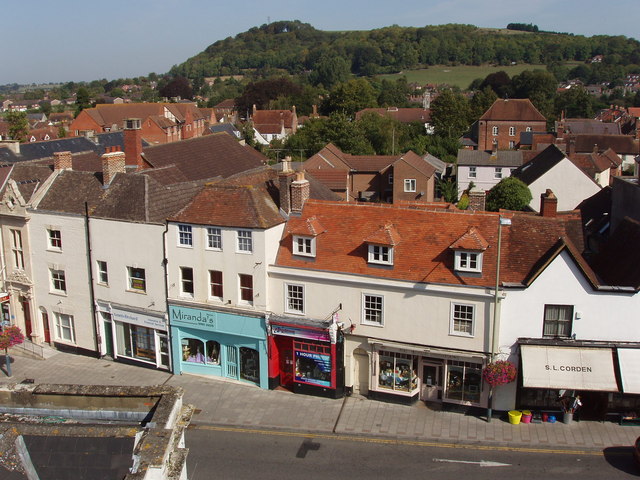
Pictured: shops on the High Street in Warminster, Wiltshire (David Hawgood / Geograph, CC BY-SA 2.0) — the town itself, not a photograph of any reported sound or object. Gordon Faulkner's disputed September 1965 photograph remains the property of his estate and the newspapers that first published it; no independently rights-clear copy of it, or of any other Warminster-area sighting photograph, was located for use here.
Theoretical Alignment
The Warminster wave aligns most strongly with a Psycho-Social reading of the evidence. Nearly every structural feature of the phenomenon — a single vivid originating account, a local journalist who actively solicited and published further reports, national tabloid amplification of one disputed photograph, organized sky-watch gatherings that both attracted new observers and shaped how ambiguous stimuli were interpreted, and a self-sustaining decade-long identity as Britain's UFO capital that persisted long after the original sounds had tapered off — matches the same social-amplification pattern this site has documented in other sustained sighting waves. This case file finds real, if modest, residual alignment with the Extraterrestrial Hypothesis, reflecting the genuine fact that the underlying sounds were never conclusively matched to any single named, dated conventional source, and that Gordon Faulkner's photograph, while never scientifically authenticated, was also never conclusively debunked by the newspaper editors and researchers who examined it.
Background
Warminster is a market town of roughly 18,000 people on the western edge of Salisbury Plain in southwest Wiltshire, England, sitting within a few miles of the Army's Battlesbury Barracks infantry base and the wider Salisbury Plain Training Area, a large Ministry of Defence live-firing and exercise zone. The town lies roughly fifteen miles from Stonehenge and close to several prehistoric hillforts, including Battlesbury Hill and Cley Hill, both of which would later become informal sky-watching sites during the events described in this case file. Nothing about Warminster marked it out nationally before the winter of 1964; its subsequent decade as "the UFO capital of Britain" is a phenomenon that grew almost entirely out of local press coverage of a specific, dateable sequence of events rather than any pre-existing reputation.
Britain in the mid-1960s was, like much of the rest of the world, in a period of significant public interest in UFO reports, fed by Cold War-era anxieties, an active domestic UFO-research culture, and near-continuous American and European press coverage of the subject. That domestic research culture had itself only just consolidated into a single national body: the London UFO Research Organisation (LUFORO), founded in 1959, merged with seven other regional British UFO groups in 1962 to form the British UFO Association, which was in turn formally reconstituted as the British UFO Research Association (BUFORA) in 1964 — the same year Marjorie Bye's first report reached Arthur Shuttlewood. Warminster's own proximity to Salisbury Plain's dense concentration of British Army training activity, and to RAF Boscombe Down's experimental flight-test airfield roughly nine miles to the southeast, gave the area a genuinely unusual volume of low-flying and sometimes classified aircraft activity, a fact that would recur throughout the conventional-explanation debate discussed later in this case file. Boscombe Down, home to the Air Ministry's Aeroplane and Armament Experimental Establishment (A&AEE), had spent the preceding decade testing some of Britain's most advanced and secretive supersonic military aircraft, giving the wider region a long-standing, genuinely well-documented history of unusual and classified aerial activity that long predated the Warminster wave itself.
The wave's own origin story is unusually well anchored to a single named witness and a single dateable event, in a way many long-running sighting waves are not. Marjorie Bye, a Warminster housewife, was walking toward church in the pre-dawn hours of Christmas Day 1964 when she heard an unearthly crackling and whining sound she later described as being "like branches being pulled over gravel." Her account reached Arthur Shuttlewood, a features writer at the Warminster Journal who had previously served in the Grenadier Guards and the Air Ministry Constabulary, and who began actively soliciting further reports from readers from January 1965 onward — the specific organizational step, exactly analogous to Councillor Billy Buchanan's role a generation later at Bonnybridge, that turned one woman's pre-dawn encounter into a sustained, town-wide, and eventually national phenomenon.
Complete Timeline
| Date | Event |
|---|---|
| Dec. 25, 1964 | Marjorie Bye hears an unexplained crackling, whining sound near Bell Hill while walking to church — the report generally credited with opening the wave. |
| Jan. 1965 | Arthur Shuttlewood publishes his first Warminster Journal article on the sounds and begins actively collecting further witness reports. |
| Spring 1965 | Reports of crackling, hissing, whining, and detonation-like booms multiply across the town; residents describe stalled car engines and disturbed animals during the loudest episodes. |
| June 3, 1965 | A silent, cigar-shaped object covered in winking lights is reported hovering over nearby Heytesbury — the wave's first widely reported daylight visual sighting, distinct from the earlier sound reports. |
| June 1965 | A similar silent object is reported hovering over Warminster itself for roughly thirty minutes. |
| Aug. 17, 1965 | A loud detonation-like boom is reported over the Boreham Fields housing estate, accompanied by an orange flame and crackling, hissing sounds. |
| Aug. 27, 1965 | A public meeting is called at Warminster Town Hall after residents demand an official explanation for the ongoing explosions and sounds. |
| Sept. 9, 1965 | Factory worker Gordon Faulkner, 23, photographs a fast-moving object over south Warminster while travelling to his mother's home. |
| Sept. 10, 1965 | Faulkner's photograph is published in the Warminster Journal's letters column and, the same day, in the Daily Mirror after Shuttlewood forwards it — bringing national press attention to the town for the first time. |
| Autumn 1965 | Thousands of visitors converge on Warminster; organized sky-watch gatherings begin at Cradle Hill, Cley Hill, and Star Hill. |
| Dec. 1965 | Renewed sightings are reported around Christmas 1965; Shuttlewood reports his own close sighting of an object from his own window. |
| 1967 | Shuttlewood publishes The Warminster Mystery, his first and best-known book-length account. |
| 1968–1981 | Shuttlewood publishes six further books on the phenomenon, including Warnings from Flying Friends (1968), The Flying Saucerers (1976), and More UFOs Over Warminster (1979). |
| By 1976 | The intensity of the original sound reports and sky-watches has substantially declined, though sporadic reports and Shuttlewood's own investigations continue. |
| 1996 | Arthur Shuttlewood dies in Warminster, aged 76. |
| 2006 | Steve Dewey and John Ries publish In Alien Heat: The Warminster Mystery Revisited, reframing the wave primarily as a social and folkloric phenomenon. |
| 2009 | Dewey and Kevin Goodman publish History of a Mystery: Fifty Years of the Warminster Thing. |
| Aug. 24, 2025 | A 60th Anniversary Conference is held at Warminster's Athenaeum, drawing researchers and residents to revisit the case; former MoD investigator Nick Pope publicly states "we still don't know what really happened." |
The Sounds Begin: Christmas 1964 to Spring 1965
The phenomenon that would become known as "the Thing" began, by every account traced for this case file, not with a light in the sky but with a sound. Marjorie Bye's pre-dawn Christmas 1964 experience near Bell Hill set the template for dozens of subsequent reports across the following months: an unearthly crackling or whining noise, with no visible source, that residents struggled to describe in conventional terms. Secondary accounts of the following weeks describe the sound variously as "like branches being pulled over gravel," a droning or pulsating hum, and on the loudest occasions a detonation-like boom accompanied by a visible orange flame, as in the widely reported August 17, 1965 incident at the Boreham Fields housing estate.
Arthur Shuttlewood's role in this early period is central and well documented: as a working local journalist already embedded in the town's own news-gathering apparatus, he was positioned to receive, collate, and publish an unusually large volume of individual reports far more efficiently than an outside UFO-research organization could have managed from a standing start. By his own later account, he began the investigation as a skeptic, and only grew convinced of the phenomenon's genuineness after accumulating multiple independent witness statements and, later in 1965, after reporting a personal sighting of his own from his own window. That personal conversion narrative — a skeptical local reporter won over by his own accumulating evidence — became one of the case's most frequently repeated framing devices in subsequent press coverage, and deserves the same scrutiny this site applies to any single-source conversion story: it is Shuttlewood's own account of his own change of mind, not independently verified by a third party, and it sits at the exact center of a phenomenon he was simultaneously the primary chronicler of and, by mid-1965, a direct participant in.
Reports through the spring of 1965 broadened beyond simple crackling sounds to include claims of stalled car engines, agitated pets and livestock, and on at least one occasion a genuinely alarmed public meeting. On August 27, 1965, residents packed Warminster Town Hall specifically to demand an official explanation for the ongoing explosions and sounds — a real, dateable civic event that establishes beyond reasonable dispute that a large number of Warminster residents were, by that date, genuinely disturbed by something they could not explain, whatever its ultimate cause. The Ministry of Defence's later public response, discussed in full in the Conventional Explanation Candidate section below, offered "marsh gas ignited by atmospheric electricity" as one possible mundane mechanism for the sounds — an explanation this case file finds thinly evidenced and which many contemporary sky-watchers rejected outright.
Visual Sightings Begin: June 1965 Onward
The wave's character shifted decisively in June 1965, when the reports moved from purely acoustic phenomena to daylight visual sightings of an actual object. On June 3, 1965, witnesses near Heytesbury, a village a few miles from Warminster, reported a silent, cigar-shaped object covered in winking lights hovering in daylight; a broadly similar silent object was reported hovering directly over Warminster itself later the same month for approximately thirty minutes. These June 1965 reports are significant for this case file's own evidentiary assessment because they represent the first sustained visual (rather than purely acoustic) claims associated with the phenomenon, and because a silent, slow-moving, light-covered cigar shape observed continuously for half an hour by multiple witnesses is, if accurately described, a considerably more specific and falsifiable claim than an unexplained noise heard in darkness — and correspondingly harder to explain away with a single mundane mechanism such as marsh gas or settling ground.
No source consulted for this case file was able to identify a single named, individually interviewed witness to either the June 3 Heytesbury sighting or the Warminster hovering-object report with the same level of documentary specificity available for Bye's Christmas 1964 account or Gordon Faulkner's September 1965 photograph. This is a genuine gap in the public record rather than an oversight in this case file's research: by mid-1965, reports were arriving at the Warminster Journal in volume, and Shuttlewood's own later books, while extensively narrating the general character of the June sightings, do not appear from the secondary accounts of them consulted here to preserve the same individually attributable witness statements and signed accounts that exist for the case's best-documented earlier and later moments.
Gordon Faulkner's Photograph and the Daily Mirror
The single most consequential event in the entire Warminster wave, in terms of its transformation from a local Wiltshire news story into a national sensation, was a photograph taken almost by accident. On September 9, 1965, Gordon Faulkner, a 23-year-old factory worker, was traveling to his mother's home in Warminster when he became aware of an unusually shaped object flying low and fast over the south of the town. By his own account, the object was moving so quickly that it was "virtually impossible" to get properly framed in his camera's viewfinder; he focused ahead of the object's apparent path and fired the shutter regardless, producing a single grainy frame showing an indistinct, elongated shape against the sky.
Faulkner sent the photograph to Arthur Shuttlewood at the Warminster Journal with the instruction to "do as he seemed fit with it" — a detail worth pausing on, since it establishes that Faulkner himself made no attempt to control, monetize, or sensationalize the image's distribution; that decision was Shuttlewood's alone. Shuttlewood published it in the Journal's letters-to-the-editor column on Friday, September 10, 1965, and, in parallel, forwarded a copy to the Daily Mirror, which ran it the same day. The Mirror's own science and aeronautical editors were reportedly skeptical of the image's authenticity but were unable to conclusively identify or debunk it outright — an ambiguous, unresolved verdict from a national newspaper's own technical staff that this case file treats as an honest reflection of the photograph's genuinely poor evidentiary quality: a single blurred, off-center frame of a fast-moving object, captured without the photographer having time to properly compose or focus the shot, is intrinsically difficult to either authenticate or debunk with confidence.
The photograph's cultural impact vastly outran its evidentiary strength. Within weeks of the Mirror's publication, thousands of visitors began converging on Warminster specifically to see the "Thing" for themselves, transforming a local sound-and-sighting story into what several later retrospectives describe as one of the largest UFO sensations Britain had yet seen. No first-generation print or negative of Faulkner's photograph, to this case file's knowledge, has ever been subjected to the kind of rigorous, multi-decade photogrammetric reanalysis this site has documented for comparable American photo cases such as the Rex Heflin UFO Photographs or the McMinnville Trent Photographs — a genuine asymmetry in the scientific record between British and American ufology of the same era that this case file was unable to resolve, and that leaves Faulkner's image in a permanent evidentiary limbo: neither authenticated nor debunked, simply unresolved.
Cradle Hill and the Sky-Watch Culture
The single most visible and best-documented consequence of the Daily Mirror's coverage was the emergence of organized public sky-watching as a Warminster institution in its own right. Shuttlewood began organizing regular gatherings at Cradle Hill, a low rise on the edge of town, and at nearby Cley Hill and Star Hill, drawing local residents, out-of-town enthusiasts, and eventually international visitors to watch the night sky together in the hope of witnessing the Thing for themselves. This social practice, sustained for the better part of a decade, is one of the case's most sociologically significant and least disputed features: whatever one concludes about the underlying phenomenon's cause, Warminster's sky-watch culture is a genuine, extensively documented piece of 1960s and 1970s British popular culture, discussed in academic treatments of UFO belief as a paradigmatic case study of how a place can become collectively defined by a shared reporting and viewing practice.
Cley Hill in particular carried pre-existing local folklore associations as a site of unusual phenomena, a detail some retrospectives on the case connect to the wave's rapid uptake by Warminster's own residents, on the theory that a location already locally understood as unusual or liminal is more readily incorporated into a new unexplained-phenomenon narrative than a location with no such prior association. This case file treats that connection as a plausible contributing factor to the wave's local reception rather than a confirmed causal mechanism, since no source consulted quantifies how much, if any, of the eventual sighting volume can be attributed to pre-existing local folklore as opposed to the national press coverage discussed above.
The Limits of the Secondary Record: Unverifiable Claims
A responsible account of the Warminster wave has to reckon honestly with the fact that, as the phenomenon's fame grew, so did the range and extremity of claims attributed to it in secondary retellings — not all of which this case file was able to verify to a standard it considers reliable. Several popular summaries of the case attribute a body of considerably more sensational claims, including rodents found with unexplained puncture wounds and flocks of pigeons killed in mid-air, to a local figure sometimes identified only as "David Halton," whom at least one secondary source explicitly characterizes as having had an unreliable, "crank" reputation even among contemporary Warminster-watchers. No source consulted for this case file was able to independently corroborate either the specific animal-death claims or Halton's own precise role and credibility with anything approaching the documentary rigor available for Bye's, Faulkner's, or Shuttlewood's own accounts.
Rather than either uncritically repeating these more sensational claims or pretending they were never made, this case file flags them explicitly as an unresolved and likely unreliable secondary layer of the Warminster story — precisely the kind of exaggerated, poorly sourced accretion that the Two-Pass Research protocol behind this site's case files is designed to catch. This pattern is not unique to Warminster: this site's own Bonnybridge UFO Wave case file documents an analogous unverifiable "60,000 believers" statistic that circulated widely without any underlying survey or methodology ever being produced. A genuinely well-documented core phenomenon (in Warminster's case, Bye's original account, the town hall meeting, and Faulkner's photograph) can and evidently does accumulate a penumbra of considerably less reliable claims as its fame spreads — a distinction popular retellings of both cases very rarely draw explicitly.
The Modern Reassessment: In Alien Heat and the Sociological Turn
The most substantial scholarly re-examination of the Warminster wave did not arrive until four decades after the events themselves. In 2006, Steve Dewey and John Ries, both raised in Warminster, published In Alien Heat: The Warminster Mystery Revisited, explicitly declining to frame the case as a binary choice between genuine extraterrestrial visitation and deliberate hoax. Instead, drawing on their own nights spent sky-watching alongside surviving witnesses and researchers at Cradle Hill, the authors treat the entire decade-long wave primarily as a social and cultural phenomenon — a specific, historically dateable example of modern folklore formation, sustained by press amplification, communal sky-watching ritual, and Shuttlewood's own prolific and commercially successful writing career, rather than as a claim to be adjudicated purely on its physical evidence. A subsequent review in the Journal of the Society for Psychical Research credited the book with a "well-researched" critical analysis that "resurrected the case" for a new generation of readers.
Dewey returned to the subject in 2009 with Kevin Goodman for History of a Mystery: Fifty Years of the Warminster Thing, marking the wave's own fiftieth anniversary and extending the same social-historical treatment. This case file's own Theoretical Alignment assessment above draws directly on this sociological framing: the Psychosocial UFO Hypothesis, as documented in the broader academic literature on British UFO belief, treats collective sighting waves of exactly this shape — a single vivid originating account, a sympathetic local media figure, and a self-sustaining viewing culture — as classic instances of socially amplified misperception and rumor propagation rather than as evidence the underlying stimulus was necessarily anomalous. Warminster is cited in exactly this context in general treatments of the psychosocial hypothesis, precisely because its own documentary record is unusually complete and well-preserved by the standards of a decade-old rumor-driven phenomenon.
Sixty Years On
The Warminster Thing has never entirely left British popular consciousness. A 50th-anniversary conference and commemorative activity took place around 2015, and a formal 60th Anniversary Conference was held at Warminster's Athenaeum on August 24, 2025, running from morning until early evening and featuring expert talks, historical accounts of the original sightings, and open discussion of the wider mysteries connected to the case, drawing researchers, longtime residents, and members of the public to revisit the case in depth. A new commemorative mural referencing the phenomenon was also unveiled in the town around the same anniversary, a visible sign that six decades on, Warminster's own civic identity remains genuinely, publicly entangled with the wave rather than having quietly moved past it. Asked for his own verdict at that anniversary event, former Ministry of Defence UFO-desk investigator Nick Pope, who worked the MoD's dedicated UFO desk from 1991 to 1994 and is separately profiled on this site in connection with the Calvine UFO Incident and the Bonnybridge UFO Wave, drew a specific distinction between Warminster and most individual UFO reports: "With most UFO sightings, we think of them as one-off events … But with the Warminster Thing, you have an entire community where dozens if not hundreds of people are experiencing things." Pope offered military low-flying exercises involving flare drops, and meteorological phenomena, as his own leading candidate explanations, while explicitly declining to declare the matter resolved: "we still don't know what really happened, it's not case closed."
That verdict, from a career UK government UFO investigator with direct institutional knowledge of how the Ministry of Defence actually handled reports of this kind rather than an outside commentator speculating from the secondary literature alone, is a genuinely useful anchor for this case file's own final assessment. Sixty years on, Warminster remains simultaneously one of the best-documented sustained UFO sighting waves in British history and one of the least evidentially resolved: a genuine, large, and well-attested social phenomenon whose underlying physical cause — whether wholly mundane, wholly anomalous, or some combination distributed unevenly across hundreds of individual reports — was never definitively established at the time and cannot be definitively established from the surviving record today.
Key Witnesses
Marjorie Bye
The Warminster resident whose pre-dawn Christmas 1964 report of an unearthly crackling, whining sound near Bell Hill is generally credited with opening the wave. Her account reached journalist Arthur Shuttlewood directly and set the template for dozens of subsequent sound reports through the following spring.
Arthur Shuttlewood
The case's central chronicler and, by his own account, an eventual direct witness himself. Began soliciting reports from readers in January 1965, forwarded Gordon Faulkner's photograph to the Daily Mirror, organized the Cradle Hill sky-watches, and wrote seven books on the phenomenon between 1967 and 1981.
Gordon Faulkner
Photographed a fast, low-flying object over south Warminster without properly framing the shot, producing the case's single most reproduced — and most evidentially disputed — image, published in the Daily Mirror the following day.
The Five Observables Assessment
The Five Observables framework, designed to assess a single craft's performance envelope, is applied here across the wave's most consistently repeated report types rather than to any one incident:
Assessment: The June 1965 reports of a silent object hovering motionless for up to thirty minutes, and Faulkner's account of an object moving too fast to properly photograph, would together suggest genuinely anomalous performance — near-total stillness followed by rapid motion — if independently confirmed. None of this was ever captured on radar or any other instrument, so every rating here remains speculative rather than confirmed. No report reviewed for this case file described any interaction with water, and no measured speed data exists for any sighting.
Evidence Assessment
Supporting Anomalous Origin
- An unusually large, sustained volume of independent testimony from named and unnamed residents over more than a decade, beginning with a specific, dateable originating account
- A public town hall meeting convened specifically to demand an official explanation — establishing that a substantial number of residents were genuinely, contemporaneously alarmed rather than simply entertained by a media story
- One disputed but never conclusively debunked daylight photograph, examined at the time by a national newspaper's own science and aeronautical staff, who could not identify it
- A shift from purely acoustic to sustained daylight visual reports (June 1965) that is harder to attribe to a single simple mundane mechanism than the sound reports alone
- The Ministry of Defence's own suggested "marsh gas" explanation for the sounds was widely rejected by contemporary witnesses and has never been rigorously matched to a specific dated report
Supporting Conventional Explanation
- No radar, film, or physical-trace evidence has ever been independently authenticated for any specific, dated Warminster sighting across more than a decade
- Faulkner's photograph is a single, blurred, off-center frame of a fast-moving object captured without proper framing — a quality profile consistent with simple misidentification of a conventional object
- The area's genuine proximity to Salisbury Plain's military training activity and RAF Boscombe Down's experimental flight-test airfield provides a real, if never case-by-case verified, source of unusual sounds and low-flying aircraft
- National tabloid coverage (the September 1965 Daily Mirror photograph) demonstrably transformed a local story into a national sensation, plausibly inflating subsequent reporting independent of any new aerial activity
- A body of more sensational secondary claims (animal deaths, puncture wounds) traces to a figure explicitly described in at least one source as having an unreliable reputation, and could not be independently verified
- The case's own central chronicler, Arthur Shuttlewood, was simultaneously its primary journalist, its sky-watch organizer, and eventually a direct participant-witness — a convergence of roles that plausibly shaped, rather than simply recorded, the phenomenon's growth
Why "Disputed"
This case receives a DISPUTED classification with a low-to-moderate confidence score because it combines an unusually well-documented, decade-long social phenomenon with an unusually thin body of physically or scientifically confirmed evidence. There is no serious dispute that Warminster residents reported a large and sustained volume of unexplained sounds and sightings from December 1964 onward, that a public meeting was convened specifically over the issue, or that the phenomenon drew genuine national press attention and thousands of visitors. None of that establishes anomalous origin for any specific incident: Faulkner's photograph was never scientifically authenticated by the standard this site applies to comparable American photo cases, the sound reports were never conclusively matched to either a specific mundane source or a specific anomalous one, and a meaningful portion of the wave's more extreme secondary claims cannot be traced to a reliable original source.
Compare this case to the site's other major sustained British sighting wave, the Bonnybridge UFO Wave: both share the same structural profile of a real, socially significant, heavily publicized volume of reports anchored by one dedicated local chronicler, weak individual-case documentation, and a body of exaggerated secondary claims layered atop a genuinely stranger core. Warminster arguably has a marginally stronger evidentiary basis than Bonnybridge on two specific points — a real, if unauthenticated, daylight photograph, and June 1965 visual sightings with a specific described duration (thirty minutes) that go beyond a simple ambiguous light in the distance — which is reflected in this case file's own score sitting modestly above Bonnybridge's. Both remain, on the public record available today, substantially better evidenced as social phenomena than as anomalous aerial ones.
Sensor & Instrumentation Detection Profile
No radar track, instrumented reading, or independently authenticated photographic record has ever been publicly released for any specific, dated Warminster-area sighting. RAF Boscombe Down, roughly nine miles from Warminster, and the wider Salisbury Plain Training Area's own air-traffic and range-safety monitoring would in principle have retained contemporaneous radar and flight-activity data capable of confirming or ruling out conventional military aircraft for any specific, precisely timed report, but no evidence was found in this research that Shuttlewood or any other Warminster investigator ever formally requested or obtained such data for cross-referencing against a specific sighting. The Ministry of Defence's own UFO desk, established decades earlier at the government's own initiative and eventually running for over sixty years, logged public reports during the relevant period as a matter of routine practice, but its surviving public statements on Warminster address only the general "marsh gas" explanation for the sounds rather than a case-by-case sensor-data review.
Environmental & Geospatial Context
Warminster sits on the western edge of Salisbury Plain, adjoining the British Army's Battlesbury Barracks infantry base and the broader Salisbury Plain Training Area, one of the largest military training grounds in Western Europe, used for live artillery fire, low-flying helicopter exercises, and flare deployment. RAF Boscombe Down, home to the Air Ministry's Aeroplane and Armament Experimental Establishment, lies roughly nine miles to the southeast, meaning the wider Warminster area has genuinely hosted an unusually high volume of both conventional and experimental military air activity throughout the period in question. Boscombe Down's main runway, at over 3,200 meters the longest military runway in the UK, was already by the mid-1960s hosting genuinely unusual, low-flying experimental flight-test work — including a heavily modified Fairey Delta 2 research aircraft used through the decade to develop the drooped-nose, ogee-wing configuration later adopted for the supersonic Concorde airliner — giving the area a real, independently documented history of exactly the kind of unconventional-looking low-altitude aircraft activity that could plausibly generate unfamiliar sounds and silhouettes among residents unfamiliar with the test program. The surrounding chalk downland terrain, including Battlesbury Hill and Cley Hill, both prehistoric hillforts, produces acoustic conditions in which sounds can carry and echo unpredictably across the open, largely treeless landscape — a real, if never individually verified, contributing factor to how a distant conventional sound source might be misheard as originating from directly overhead or from an unidentifiable direction.
Observer Credibility & Occupational Profile
No systematic occupational or credibility audit of the many dozens of named and unnamed individuals who reported sounds and sightings to Arthur Shuttlewood across more than a decade exists in the public record; reports came from ordinary Warminster residents across the full range of local occupations, with no disproportionate representation by pilots, radar operators, or other professionally trained aerial observers documented in any source consulted for this case file. Among the case's named figures, Marjorie Bye and Gordon Faulkner were both ordinary local residents with no evident stake in publicizing their reports beyond what their accounts genuinely describe, while Shuttlewood himself brings the case a working journalist's documentary instincts but also, as discussed above, an unusually entangled dual role as both chronicler and eventual direct participant in the phenomenon he was reporting on.
This absence of a formal credibility framework cuts in both directions when weighing the case, in the same way this site's Bonnybridge UFO Wave case file found for its own decade-spanning volume of reports. On one hand, Warminster lacks the kind of high-value corroborating witness — a trained pilot, a police officer on duty, a military radar operator — whose professional training and stake in their own credibility have proven decisive in elevating other case files on this site, such as the trained USAF security personnel at the center of the Rendlesham Forest Incident. On the other hand, no systematic effort has ever been made to filter, weight, or rank the wave's many logged reports by witness reliability, leaving open the possibility that a genuinely striking, highly credible individual account exists somewhere within the wider body of testimony without ever having been isolated and investigated to the depth its details might deserve.
Physical & Material Assays
No soil sample, metallic fragment, burn mark, or other physical trace from any Warminster-area sighting has ever been collected, tested, or published in the sources consulted for this case file, despite the sheer volume and decade-long duration of the reports. See Material Analysis below for a full discussion of why this absence matters and what it does and does not imply.
Historical Precedents & Archive Matches
Warminster sits within a broader pattern of notable, sustained British sighting waves that this site has separately investigated in detail. The 1992–present Bonnybridge UFO Wave in central Scotland shares an almost identical structural profile: a single originating account, a dedicated local chronicler who actively solicited further reports, national tabloid amplification, and an organized public viewing culture, separated from Warminster by roughly three decades and several hundred miles yet arriving at a remarkably similar shape. The 1980 Rendlesham Forest Incident, by contrast, demonstrates what a single, tightly bounded, multiply-corroborated British military encounter with trained witnesses looks like when it does not diffuse into a multi-year public sighting wave — a useful evidentiary contrast to Warminster's own diffuse, decade-long pattern. Internationally, the American Great Airship Wave of 1896–1897 offers the closest nineteenth-century analogue: a geographically dispersed, press-amplified wave of aerial sightings with weak individual-case documentation but genuine, well-attested social significance, receiving a similarly cautious evidentiary rating from this site for the same underlying reason.
It is worth being precise about what this comparative pattern does and does not establish. Rendlesham's own evidentiary strength comes specifically from its bounded, multiply-corroborated, single-incident structure — exactly what Warminster, as a diffuse multi-year wave, structurally cannot offer. That Britain's UFO record includes both types of case (a tightly bounded, strongly evidenced military encounter, and a diffuse, socially significant but weakly evidenced public wave) is itself informative: it demonstrates that the country's overall UAP reporting culture is capable of producing strong individual cases when the underlying circumstances allow for it, which makes Warminster's own comparatively thin case-by-case documentation a more meaningful gap than it would be if no strongly evidenced British case existed for comparison at all.
Material Analysis
Warminster is one of this site's most thinly evidenced cases on the physical-trace front, despite its enormous volume of testimony. No sample, fragment, or instrumented reading from any specific sighting across the wave's entire decade-plus history has been collected, tested, and published to a standard this case file could independently verify. This is worth analyzing directly, because the absence itself is informative about the nature of the phenomenon, and it stands in sharp contrast to how physical evidence has been handled in this site's more strongly evidenced single-incident case files.
Why No Physical Trace Exists
Unlike a single-incident case such as the Rendlesham Forest Incident, where a specific, dateable site could be identified, cordoned, and revisited by trained personnel with instruments within hours or days of the encounter, Warminster's reports are diffuse in both time and space: hundreds of individual sound and sighting reports, made by ordinary residents with no dedicated field-investigation apparatus arriving in time to secure a scene, spread across more than a decade and an entire town and surrounding countryside. Even the most dramatic claimed episodes, such as the August 17, 1965 Boreham Fields detonation with its reported orange flame, were followed up only by a local journalist rather than a trained forensic investigator, with no evidence any site was ever cordoned or sampled before any trace that might have existed had dissipated or been disturbed.
The Photograph as the Case's Only Physical Artifact
Faulkner's September 1965 photograph is, in a real sense, the entire physical evidentiary record of the Warminster wave — the single tangible artifact, as opposed to testimony, that survives from the entire decade-long phenomenon. That a case of this scale and duration produced exactly one disputed photograph and no other physical evidence of any kind is itself a meaningful data point: it suggests either that the underlying phenomenon (whatever it was) was genuinely difficult to capture on camera under 1960s photographic conditions, or that the great majority of individual reports were of a nature — distant lights, ambiguous sounds — that ordinary residents were simply never well positioned to photograph in the first place, independent of any question about the phenomenon's ultimate cause.
Supporting Non-Terrestrial or Unexplained Origin
- The sheer persistence and volume of reports over more than a decade is not, by itself, explained away simply because no physical sample happens to exist
- Neither Shuttlewood, Bye, nor Faulkner has ever been credibly accused of fabricating their own original accounts, whatever one concludes about the wave's ultimate cause
Supporting Terrestrial or Mundane Origin
- Zero physical trace evidence exists after more than a decade and hundreds of claimed sound and sighting reports
- A genuinely dense, geographically proximate source of conventional aircraft and ordnance activity (Salisbury Plain Training Area, RAF Boscombe Down) is fully capable of producing misidentifiable sounds and low-flying lights, even though no one performed the case-by-case matching needed to confirm this for any specific report
- The wave's single surviving physical artifact — Faulkner's photograph — has never been subjected to the scientific photogrammetric reanalysis that has resolved comparable American photo cases
The Conventional Explanation Candidate
Four broad conventional explanations, none mutually exclusive, have been raised against the Warminster wave since the mid-1960s. Because the case is a diffuse, decade-long wave combining distinct acoustic and visual report types rather than a single incident, each candidate should be read as addressing a portion of the reported phenomenon rather than the whole of it.
Military Aircraft & Ordnance Activity
The single most frequently cited general explanation is misidentification of, or genuine acoustic/visual disturbance from, conventional and experimental military activity on and around Salisbury Plain. RAF Boscombe Down, roughly nine miles from Warminster, conducted classified and experimental flight-test operations throughout the relevant period capable of producing unusual sounds, and the Salisbury Plain Training Area's live artillery fire, low-flying helicopter exercises, and flare deployments provide a genuinely dense, geographically proximate source of both sound and light phenomena. This candidate is highly plausible in aggregate given the area's real, well-documented military density, but, as with the material-evidence gap discussed above, it has never been matched case-by-case against a specific dated Warminster report by any party with access to contemporary range-activity or flight-test logs.
Marsh Gas Ignited by Atmospheric Electricity
The Ministry of Defence's own publicly stated explanation for the sound phenomenon specifically, this candidate proposes that naturally occurring marsh or bog gas, ignited by atmospheric static electricity, could produce the crackling and detonation-like sounds residents described. This case file finds the explanation thinly evidenced: no source consulted identifies a specific marshland site near any specific reported sound incident, the mechanism itself is not extensively documented as a recurring, well-characterized natural phenomenon elsewhere in the scientific literature, and many contemporary witnesses and researchers rejected it outright as inadequate to the sounds they described.
Misidentification of the Faulkner Photograph Specifically
Independent of the broader sound-and-sighting wave, Gordon Faulkner's September 1965 photograph itself invites a narrower explanation: a fast-moving, poorly framed daylight photograph of an ordinary object — a bird, a light civil aircraft, or a distant vehicle reflection — captured without the photographer having time to properly compose the shot. Faulkner's own account of being unable to get the object "in his viewfinder" is, on its face, consistent with almost any fast-moving conventional object photographed in haste. The Daily Mirror's own science and aeronautical editors' inability to conclusively identify the object, despite their evident skepticism, argues against a trivially obvious misidentification, but does not rule one out.
Media & Social Amplification
Beyond any single physical stimulus, this case file's own research points to a real, documented amplification mechanism: national press coverage — most concretely the September 1965 Daily Mirror publication of Faulkner's photograph — publicized the phenomenon far beyond its original local scope, plausibly increasing both the number of residents and visitors primed to interpret ambiguous stimuli through an established "the Thing is here" frame, and the sheer volume of subsequent reports independent of any actual change in the underlying rate of unusual sounds or sightings. A decade of sustained organized sky-watching at Cradle Hill and Cley Hill provided an ongoing structural mechanism for the wave's continuation that operated independently of the truth or falsity of any individual report.
Military Aircraft & Ordnance Activity
PlausiblePLAUSIBLE for a substantial share of individual sound and low-light reports, given genuine proximity to a major training area and an experimental flight-test airfield, though never formally matched case-by-case against range or flight logs.
Marsh Gas Ignited by Atmospheric Electricity
InconclusiveINCONCLUSIVE. The Ministry of Defence's own official explanation for the sounds, but thinly evidenced — no specific marshland site or dated incident has ever been matched to the claim, and it was rejected by many contemporary witnesses.
Misidentification of a Conventional Object (Faulkner Photograph)
InconclusiveINCONCLUSIVE. Consistent with the photograph's own poor quality and hurried framing, but never conclusively confirmed — even the Daily Mirror's own skeptical science staff could not identify the object with confidence.
Media & Social Amplification
PlausiblePLAUSIBLE and well-documented as a real contributing factor to the wave's scale, geographic reach, and decade-long persistence, independent of and in addition to whatever conventional or anomalous stimuli originally triggered it.
Related Cases
Confirmed Documents & Official Records
The National Archives' collection page for the Ministry of Defence's declassified UFO desk files, covering the decades during which the Warminster reports were logged; no single, dedicated MoD case file specific to Warminster by name was identified as separately released.
Search Government Archives Directly
Further Reading — Recommended Literature
The Warminster Mystery
The case's original and best-known first-hand account, written by the Warminster Journal reporter whose own investigation and sky-watches defined the phenomenon for the wider public.
In Alien Heat: The Warminster Mystery Revisited
The most substantial modern scholarly reassessment, treating the wave as a social and folkloric phenomenon based on the authors' own research and sky-watching at Cradle Hill.
History of a Mystery: Fifty Years of the Warminster Thing
A fiftieth-anniversary retrospective extending Dewey's earlier sociological analysis with additional historical documentation.
Out of the Shadows: UFOs, the Establishment and the Official Cover-Up
Essential institutional context for how the Ministry of Defence's UFO desk actually handled public sighting reports during the exact decades Warminster's wave unfolded.
The UFO Encyclopedia (3rd Edition)
A comprehensive general reference placing the Warminster wave in the wider context of major twentieth-century UFO sighting waves worldwide.
Essential Viewing
The Warminster Thing (1990) — Full Documentary
A period British television documentary revisiting the wave roughly twenty-five years after it began, featuring contemporary witnesses and researchers.
What Was The Warminster Thing? | Unsolved Mysteries
A segment on the case drawing on the Unsolved Mysteries documentary format's own archival coverage of the wave.
![The Warminster Thing - Britain's Strangest UFO Mystery [Eerie's Vault Episode #9]](/images/thumbs/aAXrEUcpt4A.jpg)
The Warminster Thing — Britain's Strangest UFO Mystery [Eerie's Vault Episode #9]
A modern retrospective episode summarizing the wave's origins, key events, and lasting cultural legacy.
Sources
- "The Warminster Thing, UFO Over Wiltshire." Spooky Isles. spookyisles.com
- "Arthur Shuttlewood." Wikipedia. en.wikipedia.org
- "UFO Expert Gives Verdict on Warminster Thing 60 Years On." Warminster Journal, 2025. warminsterjournal.co.uk
- "Revisiting the Warminster UFO 'Thing'." Higgypop Paranormal. higgypop.com
- "The Warminster Thing." Unresolved. unresolved.me
- "The Warminster UFO Mystery — 'The Warminster Thing'." StrangeOutdoors.com. strangeoutdoors.com
- "Psychosocial Hypothesis." Wikipedia. en.wikipedia.org
- The Warminster Thing 60th Anniversary Conference, Warminster Athenaeum, August 24, 2025. warminsterthing60th.co.uk
- "Warminster to Host 60th Anniversary Conference Marking the Mysterious 'Thing'." Higgypop Paranormal. higgypop.com
- "60 Years of Mystery: Warminster Thing Celebrated with Anniversary Conference." Warminster Journal, 2025. warminsterjournal.co.uk
- The National Archives (UK). "UFO Reports." nationalarchives.gov.uk
- "Wiltshire's Most Notorious UFO Sightings from the 1960s to the Present Day." Wiltshire Live. wiltshirelive.co.uk
- "Warminster." Wikipedia. en.wikipedia.org
- File: Shops in High Street, Warminster. Photograph by David Hawgood, Geograph Britain and Ireland (CC BY-SA 2.0), via Wikimedia Commons. commons.wikimedia.org
- Shuttlewood, Arthur. The Warminster Mystery. Neville Spearman, 1967.
- Dewey, Steve, and John Ries. In Alien Heat: The Warminster Mystery Revisited. Anomalist Books, 2006.
- Dewey, Steve, and Kevin Goodman. History of a Mystery: Fifty Years of the Warminster Thing. 2009.
- Clarke, David, and Andy Roberts. Out of the Shadows: UFOs, the Establishment and the Official Cover-Up. Piatkus, 2002.
- "Bonnybridge UFO Wave," The Omni Ledger case file — comparative British sighting-wave case, 1992–present. Internal reference
- "Rendlesham Forest Incident," The Omni Ledger case file — comparative single-incident British military UAP encounter, December 1980. Internal reference
See something inaccurate? Have additional information or sources?
Suggest an Edit →Last Updated: August 2026