
Bonnybridge UFO Wave
In January 1992, a Bonnybridge-area businessman named James Walker reported an object hovering over the Falkirk Road as he drove home. Within the year, local councillor Billy Buchanan had logged more than 200 further reports from residents of this small central-Scotland town — and the reports never really stopped. Three decades later, Bonnybridge and the surrounding "Falkirk Triangle" are still cited as one of the most UFO-saturated places on Earth, drawing international press, a National Enquirer front page, tourist proposals, and a 2024 on-camera apology from a former Ministry of Defence UFO investigator. What the wave has never produced is a single piece of radar-confirmed, photographically verified, or physically tested evidence — a gap this case file treats as the central, unresolved fact of the entire phenomenon.
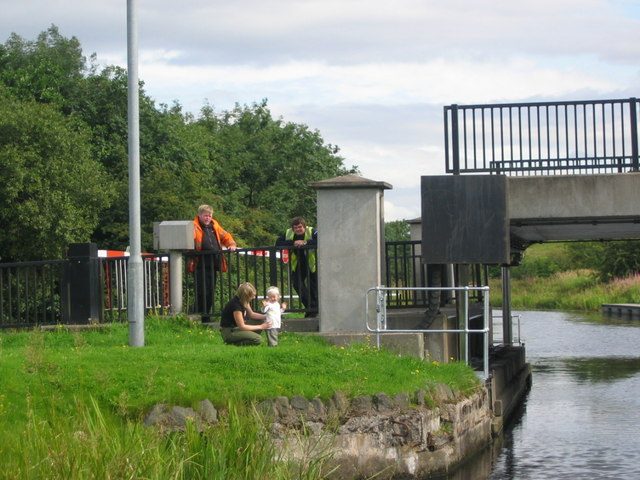
Pictured: the hydraulic lifting bridge over the Forth & Clyde Canal approaching Bonnybridge, Scotland (Renata Edge / Geograph, CC BY-SA 2.0) — the town itself, not a photograph of any reported object. No photograph or film of any Bonnybridge-area sighting has ever been independently authenticated to this site's satisfaction; every reported image search consulted during this research turned up either unrelated stock photography or unverifiable social-media stills with no chain of custody.
Theoretical Alignment
The Bonnybridge wave aligns overwhelmingly with a Psycho-Social reading. Nearly every documented structural feature of the phenomenon — a single vivid originating account, a local advocate who actively solicited further reports from residents, national tabloid coverage that inflated and publicized the sighting count, genuine nearby sources of misidentifiable light (an oil refinery's flare stacks, two international airports' approach corridors), and a self-sustaining thirty-year identity as "the UFO capital of Scotland" that both attracts new observers and shapes how ambiguous stimuli get interpreted — is a textbook profile for a socially amplified sighting wave rather than a case built around one strong anomalous data point. This case file finds real, if modest, residual alignment with the Extraterrestrial Hypothesis, reflecting the honest fact that no conventional explanation has ever been rigorously matched to any single named, dated Bonnybridge sighting the way the Grangemouth-flare or aircraft explanations have been matched to specific cases elsewhere on this site — the wave remains formally unresolved even as it reads, in aggregate, as substantially explicable.
Background
Bonnybridge is a small town of roughly 6,000 people in the Falkirk council area of central Scotland, about four miles west of Falkirk itself and roughly midway between Glasgow (some 25 miles to the west) and Edinburgh (roughly 25 miles to the east). The town sits at the rough center of what has become known, by explicit analogy to the Bermuda Triangle, as the "Falkirk Triangle" — an informally bounded area loosely described by researchers as running between Stirling, Cumbernauld, and Falkirk, covering roughly twenty square miles and a regional population of around 165,000 people. The area is a working industrial and post-industrial landscape rather than a remote wilderness: it sits astride the historic Forth & Clyde Canal, within a few miles of the large Grangemouth petrochemical complex on the Firth of Forth, and along road and rail corridors linking Scotland's two largest cities.
Nothing about Bonnybridge marked it out nationally before 1992. The town's modern notoriety began abruptly with a single reported sighting and grew, over the following three decades, into one of the most cited "UFO hotspot" claims anywhere in the world — a reputation now actively promoted in some local tourism material even as it remains scientifically unresolved. Understanding how that reputation formed, who built and sustained it, and what has and has not actually been documented along the way is the subject of this case file.
Central Scotland in the early 1990s was, like much of the rest of the UK, in a period of real public interest in UFO phenomena, driven in part by the tail end of the Cold War's own UFO culture and by a wave of British sighting reports through the late 1980s and early 1990s that included, elsewhere in Scotland, the 1990 Calvine UFO Incident in Perthshire. The UK Ministry of Defence maintained a small dedicated desk (the "UFO desk," part of the Directorate of Defence Security within the MoD's Secretariat) tasked with logging and briefly assessing public sighting reports for any genuine defense-security implication, though not with actively investigating individual cases for their own sake — a distinction that would become central to the friction between the MoD and Bonnybridge's own advocates in the years that followed.
Bonnybridge's case is also unusual in having drawn sustained attention from outside the UFO-research community entirely. UFOs.ac.uk, an academic research project examining UFO belief and reporting as a social and cultural practice rather than attempting to adjudicate the underlying phenomenon, treats Bonnybridge as one of its central British case studies precisely because the wave offers such a clear, long-running example of how a place can become locally and internationally defined by a reporting pattern — complete with its own folklore, tourism economy, local celebrity investigators, and multi-decade political advocacy campaign — regardless of whether any individual sighting within it is ever confirmed as anomalous. This case file draws on that same distinction throughout: sociological and evidentiary questions about Bonnybridge are related but genuinely separate, and conflating "this is a real, well-documented social phenomenon" with "this is a real, well-documented anomalous phenomenon" is one of the most common analytical errors made in popular coverage of the case.
Complete Timeline
| Date | Event |
|---|---|
| Jan. 1992 | Businessman James Walker reports an object hovering over the Falkirk Road near Droves Loan while driving — the sighting generally credited as opening the modern Bonnybridge wave. |
| 1992 | Councillor Billy Buchanan begins formally logging UFO reports from Bonnybridge-area constituents; by year's end he has recorded more than 200 separate incidents. |
| 1992–1995 | Local and then national press coverage builds, drawing researchers including Malcolm Robinson of Strange Phenomena Investigations (SPI, founded 1979) and journalist/author Ron Halliday to the area. |
| June 6, 1995 | The U.S. edition of the National Enquirer runs the front-page headline "Town in Panic Over 2,000 UFO Sightings," bringing international attention to Bonnybridge for the first time. |
| Late 1990s | Robinson and Halliday publish early book-length treatments of the phenomenon, including Halliday's UFO Scotland (1998) and Beyond the Falkirk Triangle (1998). |
| Nov. 25, 2001 | Scotland's Sunday Post publishes a satirical cartoon imagining an alien theme park in Bonnybridge, reflecting the phenomenon's growing status as a piece of Scottish popular culture as much as a live investigative question. |
| 2000s–2010s | Buchanan continues petitioning successive UK Prime Ministers (John Major, Tony Blair, David Cameron) for a formal government investigation; none results. Local hotels and guesthouses begin offering UFO-themed packages, and proposals circulate for a dedicated UFO tourist centre. |
| Jan. 2023 | The short documentary The Bonnybridge Files: The Town With The Most UFO Sightings In The World, featuring Buchanan, is released and draws over 60,000 YouTube views. |
| 2024–2025 | A TalkTV documentary features former MoD UFO-desk officer Nick Pope personally apologizing to Buchanan and Bonnybridge residents for the Ministry's historical dismissal of their reports; Buchanan publicly rejects the apology. |
| 2025 | Malcolm Robinson and Ron Halliday co-publish The Bonnybridge UFO Enigma (A Modern Day Mystery), their joint retrospective account of the case. |
James Walker's Originating Sighting
The event generally credited with opening the modern Bonnybridge wave took place in January 1992, when local businessman James Walker was driving on the Falkirk Road toward Droves Loan. Exactly what Walker says he saw is where the case's first genuine documentation problem appears: secondary sources describing the same originating sighting diverge in ways too substantial to be simple paraphrase. One widely circulated account describes "a shiny star-shaped object hovering above the road" that blocked Walker's path before departing at high speed; another, similarly widely circulated, describes "a large triangular-shaped craft low down in the sky, which had small lights on its underside," explicitly noted as "not a conventional aircraft." A star-shaped hovering light and a large low-flying triangle with underside lights are not simply two ways of describing the same object — they are meaningfully different observations, and no primary, dated, first-person written account from Walker himself was located during this research to resolve which (if either) is more accurate.
This case file treats that discrepancy as an important, honest data point about the case's entire subsequent thirty-year retelling, not a minor footnote to skip past. An originating story this central to the town's identity has plainly been retold, summarized, and re-summarized by dozens of secondary sources over three decades, and at least one of those retellings has drifted materially from whatever Walker originally described — a pattern this site has documented on other well-known cases (see, for instance, the similarly divergent shape descriptions given by different named witnesses at the 1954 Florence Stadium Sighting). Whatever its exact original content, Walker's report was significant enough, once publicized locally, to prompt councillor Billy Buchanan to begin actively soliciting and logging further reports from other Bonnybridge residents later that same year — the specific organizational step that turned one man's roadside encounter into an ongoing, town-wide phenomenon.
Billy Buchanan's Campaign
Billy Buchanan, a local councillor for the Bonnybridge/Larbert ward (today serving with the title of Baillie, an Independent), began collecting sighting reports from constituents on his own initiative in 1992, ultimately logging more than 200 separate incidents by the end of that first year. Buchanan has maintained, consistently across three decades of press interviews, that the true annual rate has settled at roughly 300 reported sightings a year in and around Bonnybridge since 1992 — a figure that, if taken at face value across more than thirty years, implies a cumulative total in the thousands, though this case file was unable to locate any independently audited, methodologically documented total; the 300-per-year figure originates from Buchanan's own informal record-keeping and has been repeated, largely unquestioned, across dozens of subsequent press accounts rather than independently re-verified by any outside body.
Buchanan has been explicit and consistent that his primary goal has never been to prove an extraterrestrial explanation, but to secure a formal government investigation into what residents are reporting. By his own account, he has traveled to London to personally petition every UK Prime Minister in office since 1992 — naming John Major, Tony Blair, and David Cameron specifically in interviews — asking each in turn to order an inquiry into "the Bonnybridge phenomena." None of these approaches has ever produced a formal investigation, and Buchanan has said plainly that "no politician or political party or government or prime minister" has taken the matter further. This three-decade pattern of persistent, unsuccessful advocacy is itself one of the case's most well-documented and least disputed elements — whatever one concludes about the underlying sightings, Buchanan's campaign to get them formally investigated is a real, extensively reported, and so far entirely unsuccessful effort.
Buchanan's own political career has run in parallel with, rather than been built on top of, his UFO advocacy: he has served as an elected councillor for the Bonnybridge/Larbert ward for well over two decades, sitting on Falkirk Council's Executive and Planning committees among other civic responsibilities entirely unrelated to the sightings campaign, and today holds the traditional Scottish civic title of Baillie. This matters for how his advocacy should be read: he is not a UFO researcher or investigator who happened to also hold local office, but a working local politician whose UFO campaign has been one strand, however persistent and internationally noticed, of a broader multi-decade career in ordinary municipal governance. That context is largely absent from the international tabloid coverage the case has attracted, which tends to present Buchanan primarily or exclusively through the lens of his UFO advocacy.
Malcolm Robinson, Ron Halliday, and the Research Record
Malcolm Robinson, founder of Strange Phenomena Investigations (SPI) in 1979 and already Scotland's most established UFO researcher by the time the Bonnybridge wave began, became one of the phenomenon's primary chroniclers almost from the outset. Robinson has characterized Bonnybridge as probably the UK's single most significant UFO "window" — a term researchers in this tradition use for a location that appears to generate a persistently higher concentration of reports than the surrounding region, without claiming to explain why. He has also been notably careful, in a way that distinguishes his public statements from some of the wave's more sensational tabloid coverage, to stress a basic definitional point: "the term UFO means Unidentified Flying Object. It does not describe alien ships" — an explicit reminder that an unidentified light is, by definition, exactly that and nothing more, until and unless it is actually identified.
Journalist and author Ron Halliday was an early and equally persistent chronicler, publishing two book-length treatments in 1998 alone — UFO Scotland: The Secret History of Scotland's UFO Phenomenon and Beyond the Falkirk Triangle — making him, alongside Robinson, one of the two researchers most associated with the case's written record from its earliest years through to their joint 2025 retrospective, The Bonnybridge UFO Enigma (A Modern Day Mystery). Both men's decades of engagement give the case an unusually long, continuous research paper trail by the standards of most modern sighting waves, even though neither researcher has ever produced instrumented, physically confirmed evidence for any specific incident.
Media Amplification and the National Enquirer Headline
The wave's transformation from a local Falkirk-area story into an internationally cited phenomenon has a specific, dateable inflection point: the U.S. edition of the National Enquirer ran a front-page headline on June 6, 1995 reading "Town in Panic Over 2,000 UFO Sightings." This is worth examining directly rather than simply citing as background color, because the headline's core claim — "2,000 sightings" and a town "in panic" — does not obviously match the more measured, decades-long figures Buchanan himself has given in his own, far more numerous interviews (roughly 200 in the first year, and a claimed ongoing rate of around 300 per year thereafter). A supermarket tabloid compressing several years of Buchanan's cumulative log into a single dramatic "2,000" figure, and characterizing a town whose most prominent public voice was calmly and repeatedly asking for a government inquiry as being "in panic," is a specific, documented example of exactly the kind of media amplification that sociologists of these phenomena point to as a driver of sighting waves in their own right — coverage that plausibly increased both the volume of subsequent reports (by publicizing the phenomenon internationally and inviting more local residents to interpret ambiguous stimuli through a newly reinforced "our town has UFOs" frame) and the perceived scale of the underlying claim, independent of anything new actually appearing in the sky over Bonnybridge that particular year.
The wave's continued life as a piece of popular culture, rather than purely as an open investigative question, is well documented in its own right: a satirical Sunday Post cartoon imagining an alien theme park (November 2001), UFO-themed lodging packages offered by local hotels and guesthouses, serious local proposals for a dedicated UFO tourist centre, and multiple television documentary treatments — including the 2023 short film The Bonnybridge Files: The Town With The Most UFO Sightings In The World and the 2024–2025 TalkTV documentary featuring Nick Pope's on-camera apology — all point to a phenomenon that has become genuinely economically and culturally embedded in the town's identity, which this case file treats as a real sociological fact about Bonnybridge regardless of what one concludes about any individual sighting's origin.
Bonnybridge has also featured as a recurring subject for paranormal- and mystery-format television programming beyond the two documentaries discussed above, including segments built specifically around the "Falkirk Triangle" branding. This case file treats that broader television-format coverage as a further data point about the wave's cultural durability rather than as investigative evidence in its own right — these are, almost without exception, entertainment-format productions built to dramatize an existing story rather than to conduct new, rigorous fieldwork, and none reviewed for this case file has been credited with producing new photographic, radar, or physical evidence beyond what Buchanan, Robinson, and Halliday had already compiled through their own decades of direct, on-the-ground work. The distinction matters for readers trying to weigh how much any given piece of Bonnybridge media coverage actually adds to the case's evidentiary record, as opposed to simply repackaging the same underlying testimony and statistics for a new audience.
The "60,000 Believers" Claim, Examined
Among the statistics that circulate about Bonnybridge, one deserves particular scrutiny precisely because of how casually it gets repeated: a claim, reported by at least one listicle-format outlet, that "more than 60,000 residents claim to have witnessed a sighting or strongly believe in them" across the wider Falkirk Triangle region. This case file was unable to locate any underlying survey, poll, or methodology behind that figure in any source consulted — no polling organization, academic study, or named research body is credited with having actually asked 60,000 or more individuals whether they had personally witnessed a sighting or simply held a belief that sightings occur, and the figure notably conflates two very different things (personal eyewitness testimony versus general belief) into a single number. Given that the wider region's total population is itself cited as roughly 165,000, a genuine, verified 60,000-person figure would represent more than a third of every single resident of the entire Falkirk Triangle having either witnessed something directly or professing belief in the phenomenon — an extraordinary claim that would, if true, be among the most significant sociological facts about the case, and that this case file cannot verify and therefore does not treat as established. This is exactly the kind of unaudited, uncritically repeated statistic the Two-Pass Research protocol behind this site is built to catch and flag rather than pass along uncritically, and it stands as a useful cautionary example for how even a genuinely well-documented phenomenon can accumulate exaggerated secondary claims that outrun anything in the primary record.
The Nick Pope Apology
Nick Pope, who worked the UK Ministry of Defence's UFO desk from 1991 to 1994 — almost exactly the years the Bonnybridge wave began — and who is separately profiled on this site in connection with the Rendlesham Forest Incident and the Calvine UFO Incident, appeared in a 2024–2025 TalkTV documentary about Bonnybridge's reputation and, speaking as an individual rather than in any official capacity, personally apologized to Buchanan and to "the people of Bonnybridge" for what he characterized as the Ministry's historical dismissal of their reports, suggesting the British public as a whole might deserve a broader, corporate-level apology on similar grounds.
Buchanan's response is itself a genuinely important, and under-reported, part of this story: rather than accepting the apology as vindication, he publicly rejected it, describing Pope as an "agent provocateur" whom he characterized as still effectively working for the government. This is a striking reaction for a campaigner who has spent three decades seeking exactly this kind of official acknowledgment, and it reflects a deep, persistent distrust between Bonnybridge's own advocates and the UK's official UFO-investigation apparatus that runs in both directions: the MoD's consistent public position, repeated across three decades of parliamentary questions and press inquiries, has been that it is "satisfied that there is no evidence that the United Kingdom's airspace might have been compromised by hostile or unauthorised foreign military activity" — a genuine, if narrow, national-security-focused finding that neither confirms nor investigates the specific content of any individual Bonnybridge report.
Key Witnesses
James Walker
The Bonnybridge-area businessman whose January 1992 roadside sighting is generally credited with opening the modern wave. Secondary sources give materially different descriptions of what he actually reported — a hovering star-shaped light versus a low-flying, lit-underside triangle — a discrepancy this case file was unable to resolve and treats as a genuine, unresolved gap in the record rather than a minor detail.
Billy Buchanan
Not a witness to any single sighting himself, but the case's central chronicler and advocate: the local politician who began formally logging resident reports in 1992, has maintained an informal running count ever since, and has spent three decades unsuccessfully petitioning successive Prime Ministers for a formal government investigation.
Malcolm Robinson
Scotland's most established UFO researcher and one of the wave's earliest and most persistent outside investigators, who characterizes Bonnybridge as likely the UK's most significant UFO "window" while explicitly cautioning that the term UFO itself only means unidentified, not extraterrestrial.
The Five Observables Assessment
The Five Observables framework, designed to assess a single craft's performance envelope, is applied here across the wave's most consistently repeated report types rather than to any one incident:
Assessment: Individual Bonnybridge reports have, over three decades, included claims of hovering lights that reportedly changed formation from a cross to a triangle, objects that "buzzed" moving vehicles, and lights that departed at high speed — each of which would, if independently confirmed, suggest genuinely anomalous performance. None of this has ever been captured on radar, film, or any other instrument, however, so every rating here is speculative rather than confirmed. No report reviewed for this case file described any interaction with water or any hypersonic transition with an actual measured speed, and the overall profile is one of anecdotal claims of unusual motion rather than documented anomalous performance.
Evidence Assessment
Supporting Anomalous Origin
- An unusually large, sustained volume of independent reports from a single small town over more than three decades, by Buchanan's own long-running informal count
- A genuinely long, continuous research record from established, named investigators (Malcolm Robinson, Ron Halliday) spanning the wave's entire history, rather than a single retrospective account written decades later
- A local advocate (Billy Buchanan) whose consistent, decades-long public request has been for formal government investigation, not personal publicity or financial gain
- A former MoD UFO-desk officer (Nick Pope) has publicly acknowledged, on camera, that the Ministry's historical treatment of the reports fell short of a proper response
- The MoD's own official position addresses only national-security airspace compromise, not the underlying content of any specific sighting — the individual reports themselves remain, formally, unaddressed rather than affirmatively debunked
Supporting Conventional Explanation
- No radar, photographic, film, or physical-trace evidence has ever been independently authenticated for any specific, dated Bonnybridge sighting across more than thirty years
- The originating 1992 sighting itself is described inconsistently across secondary sources, undermining confidence in exactly what was first reported
- The self-reported "~300 sightings a year" figure comes entirely from Buchanan's own informal record-keeping and has never been independently audited or cross-verified
- The town sits within a genuinely dense field of conventional light sources: the Grangemouth petrochemical complex's flare stacks roughly seven miles away (visible from Edinburgh, 25 miles distant), and flight paths serving both Edinburgh and Glasgow airports
- National tabloid coverage (the 1995 National Enquirer headline) demonstrably inflated and publicized the phenomenon in a way that plausibly increased subsequent reporting independent of any new aerial activity
- Three decades of sustained local tourism and media interest around the "UFO capital of Scotland" identity creates an ongoing incentive structure that can itself sustain a reporting wave regardless of the underlying stimulus
Why "Disputed"
This case receives a DISPUTED classification with a low confidence score because it is, at its core, an extraordinarily well-documented sociological phenomenon built on an extraordinarily thin evidentiary base. There is no serious dispute that Bonnybridge residents have reported an unusual volume of unexplained aerial sightings since 1992, that Billy Buchanan has spent three decades trying to get that pattern formally investigated, or that respected researchers have taken the phenomenon seriously enough to write multiple books about it. None of that, however, amounts to confirmed evidence of anomalous origin for any specific incident: no photograph, radar track, or physical trace from any individual Bonnybridge sighting has ever been independently authenticated, the wave's own founding story is inconsistently described across the secondary record, and the town sits inside a genuinely plausible cluster of conventional light sources (refinery flaring, two major airports' approach corridors) that has never been systematically ruled out on a case-by-case basis.
Compare this to the site's other major "wave" case, the Great Airship Wave of 1896–1897: both share the pattern of a real, socially significant, heavily publicized volume of reports with weak individual-case documentation, and both receive a similarly cautious rating for the same underlying reason — genuine social phenomena are not automatically genuine anomalous phenomena, and this site's stamp reflects the strength of the evidence for the latter, not a judgment about whether something real and worth investigating happened in the former sense. Bonnybridge remains a legitimate, ongoing, and formally unaddressed matter of local and national concern; it is simply not, on the public record available today, a strongly evidenced case of anomalous aerial activity.
A fair reading of this case has to hold two things simultaneously that popular coverage usually collapses into one: it is entirely possible, and in this case file's own assessment likely, that the large majority of the several thousand reports logged since 1992 have entirely mundane explanations, while also being true that "most reports in a large sample are explicable" does not logically require "every report in the sample is explicable," and no systematic effort has ever been made to identify which, if any, of Bonnybridge's thousands of individual reports might be the rare genuine outlier a mundane-explanation-dominant model would still predict should exist somewhere in a dataset this size. That unresolved possibility, however statistically modest, is precisely why this case remains Disputed rather than Debunked.
Sensor & Instrumentation Detection Profile
No radar track, photographic record, or instrumented reading has ever been independently authenticated and publicly released for any specific, dated Bonnybridge-area sighting. The UK Ministry of Defence's UFO desk logged public reports during the relevant period but is not documented to have conducted, or released the results of, any dedicated radar or sensor review specific to Bonnybridge; its public statements address only the broader question of whether UK airspace has been compromised by hostile or unauthorized activity, a national-security framing rather than a case-by-case investigative one. Civil air-traffic radar coverage of central Scotland, run separately by NATS (National Air Traffic Services) for Edinburgh and Glasgow airport approaches, would in principle retain historical track data capable of confirming or ruling out a conventional aircraft explanation for any specific, precisely timed report, but no evidence was found in this research that Buchanan, Robinson, Halliday, or any other Bonnybridge investigator has ever formally requested or obtained such data for cross-referencing against a specific sighting.
Environmental & Geospatial Context
Bonnybridge sits in the Forth Valley of central Scotland, within the informally bounded "Falkirk Triangle" running roughly between Stirling, Cumbernauld, and Falkirk. The area combines several genuinely relevant environmental features: the Grangemouth petrochemical refining complex, with flare stacks over 100 meters tall reportedly visible from Edinburgh some 25 miles away (placing Bonnybridge, roughly seven miles closer, well within easy visual range), sits a short distance to the northeast on the Firth of Forth; the town also lies along regional approach and departure corridors serving both Edinburgh Airport (roughly 25 miles east) and Glasgow Airport (roughly 25 miles west); and the area's damp, often overcast central-Scotland climate produces frequent low cloud and haze that can distort the apparent size, distance, and behavior of distant lights.
Observer Credibility & Occupational Profile
No systematic occupational or credibility audit of the hundreds of individuals who have reported sightings to Billy Buchanan over three decades exists in the public record; reports have come from ordinary residents across the full range of local occupations, with no disproportionate representation by pilots, radar operators, or other professionally trained aerial observers documented in any source consulted for this case file. Among the case's named figures, Buchanan himself brings three decades of consistent, non-financially-motivated public advocacy rather than technical observational credentials, while researchers Malcolm Robinson and Ron Halliday bring genuine long-term investigative experience but are, by their own account, compilers and analysts of others' reports rather than primary witnesses to any specific incident themselves.
This absence of a formal credibility framework cuts both ways when weighing the case. On one hand, it means Bonnybridge lacks the kind of high-value corroborating witness — a commercial pilot, a police officer on duty, a military radar operator — whose professional training and stake in their own credibility have proven decisive in elevating other case files on this site, such as the trained USAF security personnel at the center of the Rendlesham Forest Incident. On the other hand, it also means no systematic effort has ever been made to filter, weight, or rank Buchanan's several thousand logged reports by witness reliability, which leaves open the possibility that a genuinely striking, highly credible individual account exists somewhere within the wider body of reports without ever having been isolated and investigated to the depth its details might deserve. Neither Robinson nor Halliday's published work, by this case file's own review of the secondary literature describing it, appears to organize the wave's reports into a formally ranked or scored credibility index; both researchers' books are instead organized primarily around narrative case description and personal investigative reflection.
Physical & Material Assays
No soil sample, metallic fragment, burn mark, or other physical trace from any Bonnybridge-area sighting has ever been collected, tested, or published in the sources consulted for this case file, despite claims across the wave's history of objects landing in fields or "buzzing" vehicles at close range. See Material Analysis below for a full discussion of why this absence matters and what it does and does not imply.
Historical Precedents & Archive Matches
Bonnybridge sits within a broader pattern of notable Scottish UAP cases that predate and postdate the wave's 1992 origin, several of which this site has separately investigated in detail. The 1957 West Freugh UFO Sighting, in Dumfries and Galloway, is among the earliest well-documented Scottish radar-visual cases. The 1979 Livingston UFO Encounter, roughly 25 miles east of Bonnybridge in West Lothian, produced physical ground traces and was investigated in detail by Malcolm Robinson himself, giving Robinson a rare direct research link between two of Scotland's most significant cases. The 1990 Calvine UFO Incident in Perthshire produced the country's most-discussed UFO photograph and drew the same Nick Pope who would later apologize to Bonnybridge's own advocates. Taken together, these cases establish that Scotland has a genuine, independently documented history of significant UAP reports beyond Bonnybridge alone — context that neither strengthens nor weakens the Bonnybridge wave's own specific evidentiary claims, but does push back against any suggestion that the country's broader UAP profile is solely a product of Bonnybridge's own tabloid-driven fame. It is worth being precise about what this pattern does and does not establish: Livingston, Calvine, and West Freugh are each single, dateable incidents with a specific evidentiary record (ground traces at Livingston, a photograph at Calvine, radar and visual corroboration at West Freugh) that can be individually assessed on their own merits, in exactly the way this case file has argued the Bonnybridge wave, as a diffuse thirty-year phenomenon rather than one incident, cannot be. Scotland's genuine track record of well-documented single-incident cases is, if anything, an argument for treating Bonnybridge's own lack of any comparably well-evidenced individual incident as more notable, not less — the country plainly can and does produce cases with real physical or instrumented corroboration when they occur, which makes their absence across hundreds of Bonnybridge-area reports a more meaningful gap than it would be if Scotland had no strong UAP case files to compare against at all.
Material Analysis
Bonnybridge is one of this site's genuinely thinly-evidenced cases on the physical-trace front: no sample, fragment, or instrumented reading from any specific sighting across the wave's entire thirty-plus-year history has been collected, tested, and published to a standard this case file could independently verify. This is worth analyzing directly rather than passing over, because the absence itself is informative about the nature of the phenomenon, and it stands in sharp contrast to how physical evidence has been handled in this site's more strongly evidenced case files, where a specific site could be secured, sampled at the time, and later independently re-examined by outside parties years or decades afterward.
Why No Physical Trace Exists
Unlike a single-incident case such as the Rendlesham Forest Incident, where a specific, dateable landing site could be identified, cordoned, and revisited by trained personnel with instruments, Bonnybridge's reports are diffuse in both time and space: hundreds of individual sightings, reported by ordinary residents with no dedicated field-investigation apparatus arriving in time to secure a scene, spread across three decades and an entire twenty-square-mile region. Even the claimed instances of objects "landing in fields" were, by all accounts reviewed, followed up only informally if at all, with no evidence any site was ever cordoned, sampled, or tested by an investigator with relevant scientific training before whatever trace might have existed degraded or was disturbed.
The Conventional Material Signature, By Comparison
Where this case file can offer a genuine material comparison is against the leading conventional candidates. Grangemouth's flare stacks burn waste hydrocarbon gas, producing a bright, often orange-tinged flame at a fixed, well-documented location roughly seven miles from Bonnybridge — a physically unremarkable and entirely explicable light source when correctly identified, but one capable of appearing, to an observer unfamiliar with the exact bearing and distance of the refinery, as an unexplained glow low on the horizon, particularly under the low cloud and haze common to the region's climate. Commercial aircraft on approach to Edinburgh or Glasgow airports carry standard anti-collision strobes and landing lights whose blinking, banking flight paths have been misidentified as unconventional aerial objects in documented cases worldwide. Neither of these conventional sources has ever been formally, case-by-case matched against a specific dated Bonnybridge report in the way this site's Conventional Explanation Candidate sections normally attempt — a real limitation of the public record this case file was unable to overcome, since no systematic log of individual report bearings, times, and durations appears to have ever been compiled and cross-checked against refinery operations logs or air-traffic records by any party. Establishing that link properly would require exactly the kind of dedicated, well-resourced research effort — requesting historical flare-operation logs from INEOS, historical radar tracks from NATS, and precise report timestamps from Buchanan's own archive, then cross-referencing all three — that no UFO-research body, academic project, or government agency appears to have ever actually undertaken for this specific case, despite more than three decades in which to do so.
Supporting Non-Terrestrial or Unexplained Origin
- The sheer persistence and volume of reports over three decades is not, by itself, explained away simply because no physical sample happens to exist
- Neither Buchanan nor the wave's principal researchers has ever been credibly accused of fabricating the underlying volume of resident reports, whatever one concludes about their ultimate cause
Supporting Terrestrial or Mundane Origin
- Zero physical trace evidence exists after more than thirty years and hundreds of claimed sightings, including multiple claimed close-range and landing events — a striking absence for a phenomenon of this claimed scale and duration
- Two well-documented, geographically proximate conventional light sources (Grangemouth flaring, airport approach traffic) are fully capable of producing misidentifiable lights of the general kind described, even though no one has performed the case-by-case matching needed to confirm this for any specific report
- No investigator, including the wave's own most sympathetic long-term researchers, has ever produced a tested physical specimen from any Bonnybridge incident
The Conventional Explanation Candidate
Four broad conventional explanations, none mutually exclusive, have been raised against the Bonnybridge wave since the mid-1990s. Because the case is a diffuse, multi-decade wave rather than a single incident, each candidate should be read as addressing a portion of the reported phenomenon rather than the whole of it.
Aircraft, Satellites, and Astronomical Misidentification
The most frequently cited general explanation, offered by numerous commentators covering the case, is simple misidentification of conventional aerial and astronomical objects: aircraft on approach to Edinburgh or Glasgow airports, satellites (including, in more recent years, Starlink trains — a genuinely modern addition to the misidentification landscape that this site has documented driving confirmed sighting spikes elsewhere), weather balloons, and bright planets such as Venus, all of which are well-documented sources of UFO reports elsewhere in the world and none of which require any special local explanation. This candidate is highly plausible in aggregate given the town's genuine proximity to two major airport corridors, but, as with the material-evidence gap discussed above, it has never been matched case-by-case against a specific dated Bonnybridge report by any party with access to flight-tracking or astronomical ephemeris data.
The specific difficulty in applying this candidate rigorously to Bonnybridge is one of record-keeping rather than principle: matching an individual report to a specific aircraft, satellite pass, or planetary position requires knowing the precise date, time, compass bearing, and elevation angle a witness observed, cross-referenced against flight-tracking data, satellite ephemeris tables, or astronomical almanacs for that exact moment. Buchanan's own decades of logging appear, from every secondary description of his archive reviewed for this case file, to have prioritized capturing the raw fact and general character of a sighting over this level of technical precision — an entirely understandable choice for a single local advocate working without institutional research funding, but one that leaves the case's entire logged archive largely unsuited to this kind of rigorous, after-the-fact conventional-source matching, even decades later.
Grangemouth Refinery Flaring
The Grangemouth petrochemical complex, roughly seven miles from Bonnybridge on the Firth of Forth, operates flare stacks over 100 meters tall that burn off waste hydrocarbon gas, producing flames documented as visible from as far away as central Edinburgh, some 25 miles distant. Given that Bonnybridge sits substantially closer than Edinburgh, a distant, occasionally intense flare visible above the treeline or a ridge, especially under the low cloud and haze common to the region, is a specific, geographically well-grounded candidate for at least some of the reported glowing-light sightings, particularly those described as stationary or slow-moving low on the horizon. It does not obviously account for reports describing structured shapes (triangles, crosses) or close-range "buzzing" encounters, which would require a different explanation.
Media and Social Amplification
Beyond any single physical light source, this case file's own research points to a real, documented amplification mechanism: national and international press coverage — most concretely the 1995 National Enquirer "2,000 sightings" headline — publicized the phenomenon far beyond its original local scope, plausibly increasing both the number of residents primed to interpret ambiguous nighttime lights through an established "our town has UFOs" frame and the perceived scale of the underlying claim independent of any actual change in what was appearing in the sky. Three decades of sustained local tourism promotion around the same identity provides an ongoing structural incentive for the wave's continuation that has nothing to do with the truth or falsity of any individual report.
Genuine Unexplained Aerial Activity ("Window Area")
Held seriously by the wave's own primary researchers, particularly Malcolm Robinson, is the hypothesis that Bonnybridge sits within a genuine geographic "window" that generates a real, elevated rate of anomalous aerial activity for reasons not yet understood — a framework applied to other persistent hotspot locations elsewhere in UFO research. This case file treats the hypothesis as a serious, honestly-held position rather than a fringe claim, while noting that it remains, by its own proponents' description, a pattern observation rather than a confirmed mechanism, and that no instrumented data has ever been produced to distinguish a genuine geographic window from the combined effect of the three conventional candidates above operating on an unusually receptive and well-publicized local population.
Aircraft, Satellites & Astronomical Misidentification
PlausiblePLAUSIBLE for a substantial share of individual reports, given genuine proximity to two major airport corridors, though never formally matched case-by-case against flight or ephemeris data for any specific dated sighting.
Grangemouth Refinery Flaring
PlausiblePLAUSIBLE for stationary or slow-moving low-horizon glow reports specifically, given a real, geographically well-documented flare source roughly seven miles away, though it does not address structured-shape or close-range encounter claims.
Media & Social Amplification
PlausiblePLAUSIBLE and well-documented as a real contributing factor to the wave's scale and persistence, independent of and in addition to whatever conventional or anomalous stimuli originally triggered it.
Genuine Unexplained Aerial Activity ("Window Area")
InconclusiveINCONCLUSIVE. A seriously held position among the wave's own longtime researchers, but unsupported by any instrumented data distinguishing it from the combined effect of the conventional candidates above.
Related Cases
Confirmed Documents & Official Records
Official UK government data on military low-flying activity across Great Britain, relevant background for assessing whether routine military air traffic could account for any individual low-altitude Bonnybridge-area report; no source consulted for this case file documents a specific MoD case file dedicated to Bonnybridge by name.
No single, dedicated Ministry of Defence case file specific to the Bonnybridge wave as a whole has been identified as publicly released; MoD public statements on the matter have consistently addressed only the general question of UK airspace security rather than releasing findings on individual reports.
Search Government Archives Directly
Further Reading — Recommended Literature
The Bonnybridge UFO Enigma (A Modern Day Mystery)
The two researchers most closely associated with the case, in their own joint retrospective account of more than three decades of Bonnybridge-area reports.
UFO Scotland: The Secret History of Scotland's UFO Phenomenon
Halliday's early, foundational book-length treatment of Scottish UFO cases, written while the Bonnybridge wave was still in its first decade.
Beyond the Falkirk Triangle
Halliday's dedicated treatment of the Falkirk Triangle specifically, among the earliest book-length examinations of the phenomenon by name.
Open Skies, Closed Minds
Pope's own account of his years running the UK Ministry of Defence's UFO desk during the exact 1991–1994 window the Bonnybridge wave began, useful for understanding the official British investigative culture he would later apologize for on Buchanan's behalf.
The UFO Files: The Inside Story of Real-Life Sightings
An official National Archives history of British UFO reports drawn from declassified Ministry of Defence files, providing essential institutional context for how the MoD handled public sighting reports during the Bonnybridge wave's key years.
Essential Viewing
"The Government Silenced Us" — The Tiny Town With The Most UFO Sightings In The World
TalkTV's documentary segment on Bonnybridge, featuring Billy Buchanan and Nick Pope's on-camera apology to the town.
Mysteries and Monsters: Episode 343 — The Bonnybridge UFO Enigma with Malcolm Robinson
A long-form interview with researcher Malcolm Robinson discussing his decades of Bonnybridge investigation ahead of his co-authored book's publication.
Sources
- "When Scotland Was the World's UFO Hotspot." BBC News, 2025. bbc.com
- "The Bonnybridge (or Falkirk) Triangle — UFO Practice in Scotland." UFOs.ac.uk (academic research project). ufos.ac.uk
- "Bonnybridge Councillor Shines a Light on Local UFO Sightings in New Documentary." Falkirk Herald. falkirkherald.co.uk
- "Apology to UFO Councillor and People of Bonnybridge from Former MOD Officer Who Once Dismissed Sighting Claims." Falkirk Herald. falkirkherald.co.uk
- "The Small Village in Scotland That Is the UK's UFO Capital, With Hundreds of Sightings." Yahoo News UK. uk.news.yahoo.com
- "UK Town With the Most UFO Sightings in the World." LADbible. ladbible.com
- "Mystery of Scottish UFO Hotspot Bonnybridge Continues to Endure." Unexplained Mysteries. unexplained-mysteries.com
- "Baillie William Buchanan." Falkirk Council official councillor profile. council.falkirk.gov.uk
- "Bonnybridge." Wikipedia. en.wikipedia.org
- "Falkirk." Wikipedia. en.wikipedia.org
- UK Government. "Military Low Flying: Air Weapons Ranges Activity." gov.uk
- "'Extreme' Flaring Seen for Miles From Ineos Grangemouth as Firm Deals With 'Process Upset.'" Energy Voice. energyvoice.com
- INEOS Grangemouth. "About Grangemouth." ineos.com
- "Grangemouth Refinery." Wikipedia. en.wikipedia.org
- File: Bonnybridge Lifting Bridge, Forth and Clyde Canal. Photograph by Renata Edge, Geograph Britain and Ireland (CC BY-SA 2.0), via Wikimedia Commons. commons.wikimedia.org
- "Livingston UFO Encounter," The Omni Ledger case file — comparative Scottish physical-trace case, November 1979. Internal reference
- "The Calvine UFO Incident," The Omni Ledger case file — comparative Scottish case connected to Nick Pope, August 1990. Internal reference
- "West Freugh UFO Sighting," The Omni Ledger case file — comparative Scottish radar-visual case, April 1957. Internal reference
- Mysteries and Monsters. "Episode 343: The Bonnybridge UFO Enigma with Malcolm Robinson." Podcast/YouTube interview. mysteriesandmonsters.com
- Robinson, Malcolm, and Ron Halliday. The Bonnybridge UFO Enigma (A Modern Day Mystery). 2025.
- Halliday, Ron. UFO Scotland: The Secret History of Scotland's UFO Phenomenon. B&W Publishing, 1998.
See something inaccurate? Have additional information or sources?
Suggest an Edit →Last Updated: August 2026