
Talavera la Real Air Base Sighting
In the early hours of November 12, 1976, two conscript sentries guarding the fuel-storage perimeter of Talavera la Real Air Base near Badajoz, Spain, reported a piercing radio-like whistle, a partial power failure, and then a luminous, three-meter humanoid figure standing motionless at close range, its long arms held in a cross. José Manuel Trejo and Juan Carrizosa Luján, joined moments later by dog handler José Hidalgo, opened fire with their service submachine guns — between forty and fifty rounds by most accounts — before the figure vanished in a flash, "like an old television turning off." A fifty-man daylight search the next morning found no shell casings, no bullet marks in the wall behind where the figure had stood, and no trace of anything at all. The Spanish Air Force opened a file, closed it citing insufficient information, and it remained inside the Ejército del Aire's own archives until Spain's 1990s military UFO declassification program brought it into public view — where it sits today as one of the shortest, least conclusive, and most disputed entries in that entire release. Journalist J.J. Benítez investigated it for Flying Saucer Review within two years of the event; researcher Vicente-Juan Ballester Olmos, the same investigator whose advocacy later forced open the Manises file, has proposed that what the sentries actually experienced was a hallucinatory episode in one soldier, amplified into shared conviction by fear, isolation, and contagious hysteria — an explanation the case's own missing physical evidence neither confirms nor fully closes off.
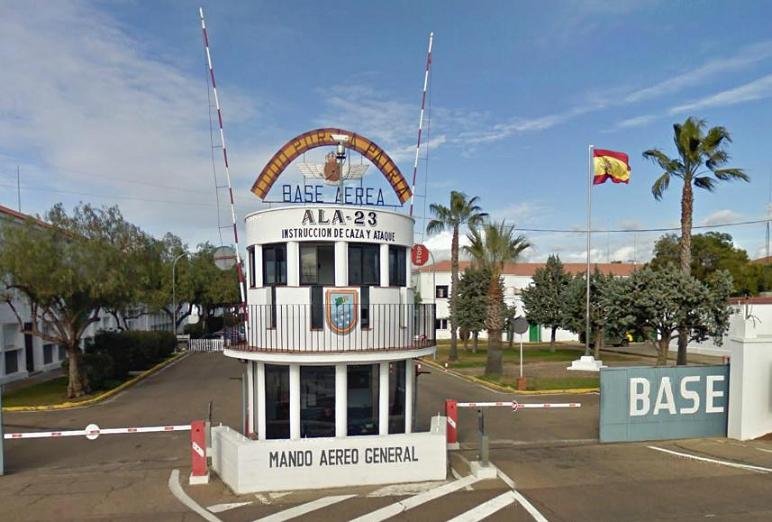
Pictured: the entrance to Talavera la Real Air Base, Badajoz, via the N-V highway, photographed in 2012 — not the fuel-storage perimeter zone where the encounter itself occurred, which sits deeper inside the restricted installation and has never been publicly photographed. No photograph of the 1976 incident, its witnesses, or the interior encounter site is known to exist in the public record; this is the closest rights-clear, case-relevant image available under this site's Hero Image Sourcing Protocol.
Theoretical Alignment
Talavera la Real scores near the low end of this catalogue's Extraterrestrial Hypothesis range, considerably below even a contested case like Mantell, because it lacks every category of corroboration this framework rewards: no craft was ever described, no instrument or radar system was involved at any stage, and the entire evidentiary record consists of three young conscripts' testimony about a single, brief, close-range nighttime encounter inside their own guard post. The Psycho-Social score is comparatively high — higher than any other case in this catalogue’s current Spanish cluster — because a specific, named, credentialed investigator (Ballester Olmos) has proposed a detailed psychological mechanism grounded in exactly the conditions present that night: an isolating overnight post, live weapons, a genuinely startling precursor phenomenon (the whistle and power disruption), and a small, tightly bonded unit primed for shared conviction once one member's initial fright took hold. It is not scored higher still only because that mechanism does not obviously explain the missing shell casings, nor the military dog's independent distress, two details this file was unable to fully resolve in either direction.
Background
November 1976 found Spain barely a year removed from the death of Francisco Franco and still deep in the uncertain, improvised early phase of its transition to democracy — the country's first democratic constitution would not be ratified until December 1978, and the military remained, in this period, one of the institutions least touched by political liberalization. Talavera la Real Air Base had been operational since 1953, originally established as the Escuela de Reactores (Jet School) and, from 1954, home to Spain's first Lockheed T-33A jet trainers; by 1976 the installation trained fighter and attack pilots as what would later be formally redesignated Ala 23 de Instrucción de Caza y Ataque, and it remains an active Spanish Air and Space Force base today. Mandatory military conscription (the mili) meant that a large share of the young men stationed at bases like Talavera la Real, including sentries assigned to routine perimeter duty, were serving out compulsory terms rather than pursuing military careers — a detail directly relevant to how this file weighs witness credibility elsewhere. The installation's flying unit would later be formally redesignated Ala 23 de Instrucción de Caza y Ataque in March 1987, organized into the 231 and 232 Squadrons and known within the Ejército del Aire by the nickname "Patas Negras" (Black Feet); it continues to serve as a jet flight-instruction base today, having flown Northrop F-5 Freedom Fighters for training in the decades after the sighting.
José Manuel Trejo and Juan Carrizosa Luján were both conscripts assigned to sentry duty in the base's fuel-storage zone on the night of November 11–12, 1976, posted in separate guard huts roughly 60 meters apart. Neither soldier has been documented in the available record as having any prior interest in UFOs, paranormal phenomena, or ufology before that night, a detail researchers on both sides of the case's later interpretation have generally treated as working against a simple hoax-for-attention explanation. Nothing in the hours before their shift suggested it would become one of the more unusual entries in Spain's eventual military UFO archive.
Complete Timeline
| Date | Event |
|---|---|
| 1953–1954 | Talavera la Real Air Base is established as the Escuela de Reactores, receiving Spain's first Lockheed T-33A jet trainers. |
| 1967 (undated) | Pilots flying near Montánchez, en route to the base, reportedly encounter an unusual, shape-changing aerial object — a secondary account this file could not independently verify beyond secondary retellings. |
| Early 1975 | Base control-tower personnel reportedly log unexplained radar anomalies, archived by the Ministry without further investigation. |
| October 20, 1976 | A senior Spanish Air Force general hands twelve UFO case files directly to journalist J.J. Benítez — Spain's first act of UFO-file disclosure, predating the Talavera la Real sighting itself and the later 1990s program by more than a decade. |
| November 11–12, 1976, ~01:45 | Sentries José Manuel Trejo and Juan Carrizosa Luján, on duty in separate posts in the fuel-storage zone, hear radio-like interference that develops into a sharp, penetrating whistle lasting roughly five minutes. |
| ~01:45–01:50 | After a brief silence, a bright light "like a flare" appears in the sky for 15–20 seconds, illuminating the surrounding area; the whistling sound resumes for another five minutes. The base experiences a partial power and telephone disruption in the area. |
| ~01:50 | Duty NCO Cabo Pavón is alerted and orders a perimeter inspection; Trejo, Carrizosa Luján, and dog handler José Hidalgo advance roughly 300 meters into the eucalyptus grove bordering the fuel depot. |
| ~01:50–01:55 | Hidalgo's German shepherd, released ahead of the group, returns agitated, staggering, and disoriented. A branch cracks nearby. |
| ~01:55 | At a reported distance of roughly 15 meters, the three soldiers see a greenish, luminous, roughly three-meter-tall humanoid figure with a small helmeted head, a thick torso, and long arms held in a cross position; hands and feet are not clearly visible. |
| Moments later | Trejo, attempting to raise his weapon, reports sudden physical paralysis, chest pain, and collapse. Carrizosa Luján and Hidalgo open fire, discharging an estimated 40–50 rounds from their Z-62 submachine guns. |
| Immediately after | The figure vanishes in a bright flash "like an old television turning off"; the piercing whistle resumes briefly before stopping entirely. |
| Later that night | Trejo is evacuated for medical attention after reporting temporary vision loss; the base is placed on alert. |
| November 12, 1976 (daylight) | Approximately fifty base personnel search the fuel-storage perimeter. No shell casings, bullet fragments, or impact marks are found; military investigators separately confirm the weapons had in fact been fired. |
| Following days | Trejo undergoes repeated interrogation (by his own later account, more than sixty separate interviews) and is hospitalized in Badajoz after recurring episodes of temporary blindness. |
| November 30, 1976 | Trejo is transferred to the Hospital del Aire in Madrid for further evaluation, remaining roughly a month; examinations find no organic cause and record a diagnosis in the range of "nervous disturbance." |
| February 1978 | J.J. Benítez publishes "Encounter at Talavera" in Flying Saucer Review, Vol. 23, No. 5 — among the earliest detailed investigative write-ups of the case. |
| 1996 | The Ejército del Aire's Jefatura del Estado Mayor del Aire (JEMA) formally declassifies the file (reference "JEMA 6200," dated November 26, 1996), closing it on record for insufficient information. |
| October 26, 2016 | Spain's Ministry of Defense makes roughly 80 declassified UFO files, including the 28-page Talavera la Real file, publicly searchable online for the first time via the Biblioteca Virtual de Defensa. |
| February 23, 2026 | On the case's approaching 50th anniversary, Cadena COPE publishes a retrospective interview confirming Trejo remains alive and has never altered his core account. |
The Whistle, the Light, and the Blackout
By every account that has reached print, the night began as an entirely ordinary overnight sentry rotation. José Manuel Trejo and Juan Carrizosa Luján were posted in separate guard huts roughly sixty meters apart in the fuel-storage zone of Talavera la Real Air Base, a routine assignment neither soldier had any reason to expect would be memorable. Sometime around 01:45, both men independently began hearing a sound neither could initially place: something resembling radio-frequency interference, a crackling, static-like disturbance that within moments began transforming into a sharp, high-pitched whistle, described in multiple retellings as painful enough to make the sentries fear for their hearing. The sound persisted for roughly five minutes before stopping. In the silence that followed, a bright light appeared in the sky — described by witnesses as resembling an illumination flare, lighting the surrounding terrain for some fifteen to twenty seconds before fading. The piercing whistle then resumed for a further five minutes. Separately, and in the same general window, the fuel-storage zone experienced a partial disruption to its electrical power and telephone lines — a detail that appears consistently across the case's secondary literature, though this file was unable to locate a precise technical account of its extent or duration within the declassified material available for public review. Whatever combination of phenomena produced this sequence, its most significant evidentiary feature is that it was reported by two men in separate locations before either had any visual contact with what came next, making it, at minimum, the one part of the story not dependent on a single observer's perception alone.
The Encounter in the Fuel Depot
Alerted by the noise and the light, duty NCO Cabo Pavón ordered a perimeter inspection. Trejo and Carrizosa Luján were joined by José Hidalgo, handler of one of the base's German shepherd patrol dogs, and the three advanced roughly 300 meters into the eucalyptus grove bordering the depot. As they neared the tree line, a branch cracked nearby; Hidalgo released the dog to investigate, and the animal returned almost immediately in a state multiple accounts describe as agitated, staggering, and disoriented — "as if it were dizzy," in one witness's later phrasing — rather than displaying the alert, purposeful behavior a trained security dog would normally show when tracking a genuine intruder.
At a reported distance of roughly fifteen meters, the three soldiers say they then saw it: a humanoid figure, standing motionless, composed of what witnesses described as a faint, greenish, almost phosphorescent light — "like the glow of phosphorus at night," in one account — standing roughly three meters tall. Descriptions across the case's various retellings agree closely on the figure's basic morphology: a comparatively small head topped by something resembling a smooth, helmet-like or crystalline dome; a thick, bulky torso; and unusually long arms held out from the body in a fixed cross position, with neither hands nor feet clearly resolved in the dim light. No craft, landed object, or any other physical structure was reported alongside the figure — only the entity itself, standing at the tree line as though it had simply always been there.
The Shooting and the Vanishing
What happened in the next several seconds is, by every source's account, the case's most consequential and most argued-over moment. Trejo has stated that as he tried to raise his weapon toward the figure, he was struck by a sudden, overwhelming physical sensation — a piercing pain across his chest that he has since described as feeling "like incandescent iron," followed by an inability to move and a collapse to the ground, weapon un-fired. In some retellings he has framed this moment as the figure protecting him, reasoning decades later that he had been standing directly in his companions' likely line of fire. Carrizosa Luján and Hidalgo, for their part, did not hesitate: both opened fire with their 9mm Star Z-62 submachine guns, discharging what most sources place at somewhere between forty and fifty rounds in the direction of the figure and the wall or terrain behind it. The figure did not fall, cry out, or show any visible reaction to being struck. Instead, by witness account, it brightened suddenly — "like a camera flash," in one description — and disappeared, with more than one retelling using the specific image of an old cathode-ray-tube television screen switching off, the light collapsing inward rather than simply fading. The sharp whistling sound returned once more, briefly, before the fuel depot fell silent.
Immediate Aftermath and the Missing Evidence
The base was placed on alert in the encounter's immediate aftermath, and Trejo was evacuated for medical attention after reporting temporary vision loss — the first of what would become a recurring, and eventually much more serious, medical complication discussed in full below. The following morning, in daylight, a search party of roughly fifty base personnel combed the fuel-storage perimeter and the surrounding grove for physical evidence: any trace of the figure itself, and, just as importantly to investigators at the time, confirmation of exactly what forty to fifty rounds of submachine-gun fire had actually struck. They found nothing. No spent cartridge casings were recovered from the ground where two men had unloaded multiple magazines. No bullet impact marks, chips, or scarring were found on the wall or terrain behind where the figure had stood, despite direct testimony that both shooters had fired at it from close range. Separately, military investigators were able to confirm through more conventional means — almost certainly ammunition and magazine accounting — that the weapons had genuinely been discharged that night; the shooting itself is not in dispute. What is unresolved is where the physical byproducts of that shooting went. This file has not been able to identify a fully satisfying account of that absence from any source, proponent or skeptic, and treats it as the case's single most important open evidentiary question — discussed further in the Material Analysis and Conventional Explanation Candidate sections below.
José Manuel Trejo's Medical Ordeal
Of the three primary witnesses, Trejo experienced by far the most severe and best-documented physical aftermath, and it is this thread of the case — rather than any surviving physical trace — that produced most of what today functions as institutional documentation of the event. In the days following the encounter, Trejo suffered recurring episodes of temporary blindness, on more than one occasion collapsing unconscious, including once in the base cafeteria. He was hospitalized in Badajoz for roughly a week, undergoing what multiple sources describe as extensive medical testing that failed to identify any organic cause for his symptoms. On November 30, 1976, he was transferred to the Hospital del Aire (Air Force Hospital) in Madrid, where he remained under observation for approximately a month, into late December. According to Trejo's own later accounts, he was subjected to more than sixty separate interviews and interrogations during this period — by medical personnel, military investigators, and, by his account, individuals he came to believe were assessing him for possible drug use or fabrication, an accusation he has consistently and specifically denied. The eventual medical finding, as best this file can reconstruct it from secondary accounts of records that remain within military medical archives rather than the publicly declassified UFO file itself, fell in the general category of "trastornos nerviosos" — nervous or neurological disturbance — without a documented physical injury mechanism (radiation burn, blunt trauma, or similar) that could tie his symptoms to a specific external energetic cause. By his own account, his episodes of temporary blindness ceased entirely by January 1977 and did not recur. Among the accusations Trejo says he faced during this extended period of questioning was a specific suggestion that he had been under the influence of narcotics on the night of the sighting — a claim he has consistently and specifically denied across every subsequent retelling, and one this file notes as a serious allegation that, if it had been substantiated at the time, would presumably have appeared in his surviving medical or disciplinary record rather than persisting only as an unresolved verbal accusation he continued to deny decades later. In later interviews, Trejo has additionally described lasting, non-medical effects he attributes to the encounter, including a newly discovered facility for drawing and what he has characterized as an expanded spiritual awareness — claims this file cannot independently verify but records as part of the witness's own account of how the experience affected him.
The File, the Declassification, and Benítez's Early Investigation
Two distinct institutional threads eventually brought this case into the public record, on two very different timelines. The first began almost immediately: journalist and ufologist J.J. Benítez, who only weeks before the Talavera la Real sighting had received Spain's first-ever set of released military UFO files directly from a senior Air Force general, investigated the sentries' account independently and published a detailed write-up, "Encounter at Talavera," in the British journal Flying Saucer Review in February 1978 — a genuinely early, contemporary piece of documentation by the standards of most cases in this catalogue, appearing barely fifteen months after the event itself and nearly two decades before any government file on it became public.
The second thread is the official one, and it moved far more slowly and far less dramatically than Benítez's early write-up might suggest. The Ejército del Aire's Jefatura del Estado Mayor del Aire (Air Staff Headquarters) formally declassified its file on the case — a 28-page document titled "Avistamiento de fenómenos extraños en la base aérea de Talavera (Badajoz): 12 de Noviembre de 1976," compiled largely from correspondence spanning 1982 to 1994 responding to public information requests rather than a contemporary 1976 investigative report — under reference "JEMA 6200" on November 26, 1996. For two decades after that, the file remained accessible only by in-person consultation at the Air and Space Force's Central Library. It was not until October 26, 2016, when Spain's Ministry of Defense digitized and published roughly eighty declassified UFO case files through the Biblioteca Virtual de Defensa, that the Talavera la Real file became searchable and viewable online by the general public for the first time. According to Ballester Olmos, the researcher most closely associated with reviewing this entire body of material, the base's own command never treated the November 1976 episode as a UFO-type event at the time; the file exists at all chiefly because members of the public, aware of the story through Benítez's earlier reporting and its subsequent circulation, wrote to the Ministry over the following years asking what the Air Force actually knew.
Key Witnesses
José Manuel Trejo
The case's central and most consequential witness, on sentry duty in the fuel-storage zone when the encounter began. Reported sudden paralysis and chest pain as he tried to raise his weapon, and suffered the case's only serious documented medical aftermath — weeks of recurring temporary blindness, hospitalization in Badajoz and then Madrid, and more than sixty subsequent interrogations. Still living as of this case file's most recent research, he has maintained a materially consistent account for nearly fifty years, including in an on-record interview marking the 50th anniversary of the case.
Juan Carrizosa Luján
Posted in a separate guard hut roughly sixty meters from Trejo, Carrizosa Luján independently reported the same precursor whistling and interference before either soldier had visual contact with the figure. One of the two soldiers who opened fire on the entity, discharging an estimated twenty to twenty-five rounds. Now deceased.
José Hidalgo
Joined Trejo and Carrizosa Luján during the perimeter inspection with his German shepherd patrol dog, whose agitated, disoriented reaction near the encounter site is one of the case's few non-human behavioral data points. Also fired on the figure alongside Carrizosa Luján. Now deceased.
Cabo Pavón
The duty non-commissioned officer who, alerted by the reported noise and light, ordered the perimeter inspection that led directly to the encounter. No further biographical detail about Pavón has surfaced in the case's available secondary literature.
The Five Observables Assessment
The Five Observables framework, developed by former AATIP director Luis Elizondo, is applied across this catalogue to classify UAP encounters by performance characteristics exceeding known technology of their era. Because Talavera la Real involves no craft of any kind — only a stationary humanoid figure that appeared, stood still, and disappeared — this framework returns one of the lowest overall profiles in this catalogue, a result this file considers genuinely informative rather than a weakness of the framework itself:
Assessment: Anti-Gravity Lift, Instant Acceleration, and Hypersonic Velocity are all rated absent, simply because no craft, flight, or propulsion of any kind was reported by any witness — the figure stood motionless throughout the entire encounter. Low Observability is rated speculative rather than present or absent: the figure's disappearance without leaving any of the physical evidence a solid, struck body should produce (blood, tissue, a corpse, or at minimum bullet-damaged terrain) is a genuinely unusual absence, but this file cannot responsibly credit it as a demonstrated exotic capability rather than a search-and-recovery failure, given the search was conducted in daylight the next morning rather than immediately, in wooded terrain, by personnel who were not specifically trained forensic investigators. Trans-Medium travel is rated absent; nothing in this case describes any transition between air, water, or any other medium.
Evidence Assessment
Supporting Anomalous Origin
- Three witnesses gave closely consistent accounts of an unusual, specific morphology (three-meter height, cross-armed posture, small helmeted head) in the brief window available for the encounter itself, rather than a vague or shifting description.
- Two independent sentries in separate guard posts reported the same precursor whistling and interference phenomenon before either had visual contact with the figure, a detail not dependent on a single observer's perception.
- A systematic fifty-person daylight search failed to recover any of the shell casings or bullet-impact evidence that forty to fifty rounds of confirmed submachine-gun fire should have produced — a genuine forensic anomaly this file could not fully resolve.
- José Manuel Trejo has maintained a materially consistent account for nearly five decades, including in an on-record 2026 interview, without the escalating embellishment pattern that typically erodes long-running witness credibility.
- A trained military patrol dog reportedly reacted with acute agitation and disorientation at the same location and moment as the human witnesses — a non-human behavioral data point not obviously explained by shared human suggestion.
- The case was investigated and documented within roughly fifteen months of the event by a contemporary journalist working independently of any later declassification effort, reducing (though not eliminating) the risk of decades-later reconstruction or embellishment.
Supporting Conventional Explanation
- The Spanish Air Force's own file never endorsed any anomalous conclusion and was explicitly closed for insufficient information; per researcher Ballester Olmos, base command itself never treated the episode as a UFO-type event at the time.
- All three primary witnesses belonged to the same small unit, stood an isolating overnight post together, and were young conscripts under genuine physical danger (live weapons, a startling precursor phenomenon) — textbook preconditions for shared perceptual distortion rather than fully independent observation.
- No instrumented, photographic, radar, or laboratory-testable evidence of any kind exists in this case; the entire record rests on witness memory and testimony, much of it recorded well after 1976.
- A specific, named psychological mechanism — hallucinatory delirium in one soldier, amplified by contagious hysteria, fear, and confusion in his companions — has been proposed by the researcher most familiar with the declassified file, and has never been systematically rebutted point-by-point in the public record.
- Trejo's own subsequent medical evaluations identified a nervous/psychological finding rather than any documented physical-injury mechanism tied to an external energetic event.
Why "Disputed"
This file rates the Talavera la Real case DISPUTED rather than "Credible" or "Debunked" because neither pole is honestly supportable from the available record, and because the case's own institutional history reflects exactly that same unresolved middle ground. On the side of genuine mystery: two sentries in separate posts independently reported the same unusual precursor phenomenon before either saw anything; three witnesses gave closely matching descriptions of a specific, unusual humanoid morphology under brief, high-stress conditions; a trained patrol dog reacted with acute distress at the same location and moment; and a systematic daylight search failed to recover not just evidence of an anomalous entity but evidence of the mundane, already-confirmed gunfire itself — a genuinely puzzling gap this file could not close in either direction. José Manuel Trejo's nearly fifty years of consistent testimony, without escalating embellishment, is a real point in the case's favor as a matter of witness reliability, whatever ultimately caused his experience. On the side of a mundane resolution: the Spanish Air Force's own file never adopted any anomalous conclusion and was formally closed for insufficient information; researcher Ballester Olmos, working from direct access to the full declassified material, has proposed a specific, named psychological mechanism — hallucinatory delirium compounded by contagious hysteria under isolating, high-tension conditions — that has never been systematically rebutted point-by-point in the public record; and every witness belonged to the same tiny, single-unit pool, with zero independent outside corroboration and zero instrumentation of any kind. What keeps this file from moving further toward "Debunked" is that the psychological explanation, however well-credentialed, does not on its own account for the missing shell casings and bullet marks, nor for the dog's independent reaction — real, specific gaps rather than generic residual mystery. What keeps it equally far from "Credible" is the near-total absence of the kinds of corroboration (multiple independent witness pools, any instrumented data, any recovered physical evidence in either direction) that anchor this catalogue's stronger cases, including Spain's own considerably more thoroughly documented Manises file. A single-location, single-unit encounter, closed by its own government's investigators for lack of information rather than any substantive finding, and carrying a real, unrebutted psychological explanation alongside a real, unexplained physical anomaly, is precisely the kind of case this site's "Disputed" rating exists to describe honestly.
Sensor & Instrumentation Detection Profile
No radar, camera, or recording instrument of any kind was involved in this case at any point — a meaningful structural difference from this catalogue's other major Spanish file, Manises, which produced cockpit weather-radar returns, ground radar logs, and a fighter pilot's own threat-sensor telemetry. Talavera la Real is a pure testimony case: everything known about the sighting itself rests on what José Manuel Trejo, Juan Carrizosa Luján, and José Hidalgo personally heard and saw, and on the post-incident search that a wider group of base personnel conducted the following day. The closest thing to an instrumented record is negative rather than positive: the declassified Ejército del Aire file itself, and the military weapons the sentries carried, whose confirmed discharge (reconstructed from ammunition counts) is the one piece of the story every source, skeptical or otherwise, treats as an established fact. What those weapons did not produce — recoverable brass, or bullet scarring on the wall behind the figure — functions in this case less as evidence of the anomaly and more as the central unresolved puzzle any explanation, mundane or otherwise, has to account for.
Environmental & Geospatial Context
Talavera la Real Air Base sits roughly 15 kilometers east of the city of Badajoz, near Spain's border with Portugal, in the Extremadura region — a sparsely populated agricultural area of cork oak and eucalyptus groves. The encounter occurred in the base's fuel-storage zone, a restricted perimeter area bordered by eucalyptus trees roughly 300 meters from the sentries' guard posts, on a clear night with the moon in a waning gibbous phase (roughly 68% illuminated) well after midnight. This is a genuinely dark, isolated stretch of a military installation — not an open field or populated area, and not a location with any documented history of civil aviation confusion, industrial lighting, or a nearby population center whose activity could plausibly account for a bright, close-range, humanoid-shaped light source by simple misidentification of a distant object. Extremadura as a whole, and Badajoz province specifically, has an outsized footprint in Spain's declassified UFO record: researchers reviewing the province's case density have noted that Badajoz alone accounted for roughly 35 percent of Spain's reported UFO cases in the 1974–1980 window, a concentration this file cannot fully explain but flags as relevant regional context rather than coincidence. No nuclear facility, major airspace corridor, or high-voltage transmission infrastructure of note lies near the encounter site beyond the base's own fuel-storage electrical and telephone lines — whose reported partial disruption that night is itself one of the case's more interesting, and least explained, environmental data points.
Observer Credibility & Occupational Profile
This file's witness pool is both a strength and a real limitation, and this catalogue treats it honestly as both. All three primary witnesses were young men performing Spain's then-mandatory military service — conscripts, not career military professionals, credentialed pilots, or trained investigators — assigned to an overnight sentry post armed with 9mm Star Z-62/Z-70 submachine guns standard to Spanish Army and Air Force security details of the era. That is a materially different credibility profile from this catalogue's stronger instrumented cases: these were not, for instance, the credentialed airline captains and NATO interceptor pilot whose corroborating testimony anchors the Manises file elsewhere in this catalogue's Spanish coverage. At the same time, conscript sentries assigned to guard a fuel depot are not untrained or careless observers within their own competency: they carry live weapons specifically because they are expected to identify and respond to genuine threats, and both Trejo and Carrizosa Luján independently reported the same precursor interference and whistling sound before either had visual contact with the figure, a detail suggesting the auditory phenomenon, whatever its cause, was not simply invented after the fact by one witness and adopted by the other. Trejo in particular has maintained a materially consistent account for very nearly fifty years, including in an on-record 2026 interview marking the case's half-century anniversary, without the kind of escalating, increasingly elaborate embellishment that erodes credibility in many long-running witness accounts. Both Carrizosa Luján and Hidalgo are now deceased, meaning independent re-interview of the full original witness pool is no longer possible — a limitation this file notes rather than papers over.
Physical & Material Assays
No physical fragment, debris, footprint, scorch mark, or any other trace evidence connected to the entity itself was ever recovered, despite a systematic daylight search involving roughly fifty base personnel the following morning. The case's one genuine physical-evidence puzzle runs in the opposite direction from most UAP material-evidence claims: rather than an unexplained object showing up where nothing should be, expected mundane evidence — spent cartridge casings from as many as fifty rounds fired from two submachine guns, and bullet impact scarring on the wall or terrain behind where the figure stood — failed to show up at all. Multiple independent retellings across nearly five decades consistently report this same negative finding, which argues against it being a detail invented or exaggerated by a single late source. Trejo's own subsequent medical examinations, discussed in full in the Observer Credibility and later Material Analysis sections below, produced findings of "nervous disturbance" rather than any documented radiological, thermal, or other physical-injury marker connectable to an external energetic source. In short: this is a case with essentially no positive physical evidence in either direction, and one piece of negative physical evidence — the missing casings and bullet marks — whose explanation remains genuinely open.
Historical Precedents & Archive Matches
Talavera la Real was not the only unusual aerial report connected to this specific installation. Earlier retrospectives on the case describe a 1975 control-tower incident at the same base, in which duty controllers logged unexplained radar anomalies that were reportedly archived by the Ministry without further investigation, and a separate account — attributed to pilots flying the route near Montánchez, north of the base — describing an unusual, shape-changing object encountered en route to Talavera la Real at some point in 1967. Neither of these earlier reports was declassified or documented with anything close to the level of detail applied to the November 1976 sentry encounter, and this file cannot independently verify either beyond the secondary accounts describing them, but their existence is consistent with a base and region that generated more than an isolated single incident. More significant is the case's place within Spain's broader military UFO declassification history. Unusually for a country's very first officially released UFO material, Spain's opening act came not from the 1990s program most associated with Ballester Olmos and the Manises file, but from October 1976 — weeks before the Talavera la Real sighting itself — when a senior Spanish Air Force general handed a set of twelve case files directly to journalist J.J. Benítez, who published them in the newspaper La Gaceta del Norte that December and, in March 1977, in book form as Ovnis: Documentos Oficiales del Gobierno Español. Talavera la Real itself was not among that first batch (it postdates it), but it entered the historical record through the same investigator only slightly later, when Benítez wrote up the sentries' account for the British journal Flying Saucer Review in February 1978 under the title "Encounter at Talavera" — making this one of relatively few Spanish military UFO cases with a documented contemporary investigation trail predating the country's later, more systematic 1990s file release by well over a decade.
Material Analysis
Talavera la Real is, in the most literal sense, a case defined by an absence of material evidence — but an unusually specific and double-sided one. Nothing connected to the entity itself was ever recovered: no fragment, residue, footprint, or trace of any kind survived the encounter, despite a systematic fifty-person search conducted in daylight the following morning. What makes this case's evidentiary gap distinctive within this catalogue is that the missing material isn't limited to evidence of the anomalous object; it extends to evidence of an entirely mundane, already-confirmed event — the discharge of two submachine guns at close range. Cartridge casings from an automatic or semi-automatic weapon eject and land on the ground as a simple matter of firearms mechanics; bullets striking a wall, tree, or packed earth leave physical marks that do not require sophisticated forensic technique to find in daylight. Neither turned up. This file has reviewed every available secondary account of the search and can identify only two categories of explanation genuinely on offer: either the physical evidence existed and was simply missed by an imperfect, non-forensically-trained search party working in wooded terrain roughly twelve hours after the fact, or the evidence was never there to find because the shots, fired by frightened men in near-total darkness at a target none of them could clearly resolve, did not actually strike anything solid at the reported location — wide of a genuine object, or of no fixed object at all. This file cannot resolve which is correct, and treats that inability honestly as the case's central open question rather than resolving it by assumption in either direction.
Supporting a Genuinely Unusual Physical Event
- The precursor radio-like interference and partial power/telephone disruption in the fuel-storage zone are, at minimum, evidence of some real, non-purely-perceptual electromagnetic disturbance that night, independent of what the entity itself may or may not have been.
- A trained military patrol dog's acute, disoriented reaction at the precise location and moment of the sighting is not straightforwardly explained by shared suggestion among the human witnesses.
Supporting a Mundane Origin
- No physical specimen, fragment, or independently testable material connected to the entity was ever recovered, in either direction.
- The absence of even the mundane, already-confirmed physical evidence (shell casings, bullet impacts) that the shooting itself should have left behind indicates the search, the shooting circumstances, or both were less reliable than a clean forensic record would require — a limitation that also weakens confidence in the visual sighting reported under the same chaotic, frightened conditions.
- Trejo's subsequent medical workup, while genuinely serious, produced a psychological/nervous finding rather than a documented physical mechanism (burns, radiation exposure, blunt trauma) linking his symptoms to contact with an external energetic source.
The Conventional Explanation Candidate: Hallucinatory Delirium and Contagious Hysteria (Ballester Olmos)
The most detailed and most frequently cited conventional explanation for the Talavera la Real sighting comes from Vicente-Juan Ballester Olmos, the Spanish researcher whose broader review of the country's declassified military UFO files is the single most authoritative critical treatment this body of material has received. Ballester Olmos has proposed that the case originated in a hallucinatory episode experienced by one soldier — a description some secondary accounts specifically link to a documented psychiatric history — that then propagated into shared conviction among his companions through what Ballester Olmos has described as histeria contagiada: contagious hysteria, compounded by genuine fear and confusion in the isolating, high-tension circumstances of an overnight armed sentry post. This candidate deserves serious evaluation on its own terms: nighttime sentry duty in isolated, tense conditions is a well-documented real-world setting for exactly this kind of shared perceptual distortion, independent of UFO cases specifically, and Ballester Olmos's position carries the authority of the researcher most directly responsible for Spain's entire declassified UFO archive being reviewable at all.
Where the Contagion Explanation Falls Short
Its most significant unaddressed weakness is precisely the physical evidence problem discussed above: a purely psychological explanation accounts naturally for a shared visual misperception, but it does not, on its own, explain why forty to fifty rounds of confirmed submachine-gun fire left no recoverable trace whatsoever, nor why a trained patrol dog reacted with acute distress at the same specific location and moment. A hallucination, however vivid or contagious, does not typically also disable a search party's ability to find its own spent brass the next morning. Ballester Olmos's own characterization — per multiple secondary accounts of his position — that base command never treated the episode as a UFO-type event, and that the surviving file exists chiefly because of later public information requests rather than a contemporary investigation, is itself double-edged: it is consistent with an institution that saw nothing worth investigating, but it is equally consistent with an institution that, in 1976 Spain, had every institutional incentive to close an embarrassing incident quickly and quietly regardless of what its own sentries actually encountered.
Electromagnetic or Atmospheric Phenomenon
A second candidate, developed independently by this file rather than attributed to any specific named researcher, proposes that the precursor radio-interference-like whistle, the brief aerial light, and the partial power/telephone disruption in the fuel-storage zone reflect a genuine, if unusual, atmospheric electrical phenomenon — a corona-discharge or ball-lightning-type event occurring near the depot's electrical infrastructure. This candidate deserves consideration because it would explain, without invoking any psychological mechanism, several of the case's stranger sensory details that a pure hallucination theory addresses only awkwardly: an auditory phenomenon independently reported by two separated witnesses before any visual contact, and a documented (if unquantified) electrical disruption in the same area at the same time. It struggles badly, however, as an explanation for the humanoid figure itself: no documented form of ball lightning or corona discharge naturally organizes into a stable, three-meter, cross-armed anthropomorphic shape with a distinct head, torso, and limb structure sustained long enough for three witnesses to describe consistent detail. This candidate is therefore best treated as a plausible partial explanation for the case's electromagnetic precursor phenomena, and a poor one for the entity sighting that followed it.
Prank or Fellow-Soldier Hoax
A third candidate worth testing directly, in the absence of any specific mundane object or animal having been proposed by any researcher on either side of this case, is that a fellow serviceman staged the encounter as a prank — deliberately provoking the whistling sound and appearing at the tree line in some improvised luminous costume. This candidate is consistent with the era's documented conscript barracks culture, in which elaborate pranks between servicemen were not unknown, and would require no anomalous phenomenon of any kind. It fails, however, on the same evidence the hallucination theory struggles with, and adds a new problem of its own: staging this stunt at night, at close range, in front of two armed and visibly frightened sentries who then opened fire with automatic weapons is an extraordinarily dangerous prank to attempt, and no perpetrator, accomplice, confession, or physical prop (a costume, a light source, a hiding place) has ever surfaced in nearly fifty years of subsequent interest in the case. The absence of any blood, injury, or hospitalized "victim" among base personnel in the encounter's aftermath argues against a real person having actually been struck by gunfire that night, but that same absence is equally consistent with the shots having missed a genuine unknown target as with there having been no solid target there to hit at all.
Hallucinatory Delirium & Contagious Hysteria (Ballester Olmos)
InconclusiveA real, specific, credentialed explanation grounded in documented psychological phenomena, with a serious unaddressed gap around the missing physical evidence.
Electromagnetic / Atmospheric Phenomenon
Plausible ImplausiblePLAUSIBLE for the precursor whistle, light, and power disruption. IMPLAUSIBLE as an explanation for the structured humanoid figure itself.
Prank or Fellow-Soldier Hoax
ImplausibleConsistent with conscript barracks culture in the abstract, but no perpetrator, prop, or confession has ever surfaced, and the risk of staging it under armed fire is extreme.
Related Cases
Confirmed Documents & Official Records
The Spanish Air Force's official catalog record for the declassified case file, held by the Biblioteca Virtual de Defensa (reference BMDB20160069099, JEMA 6200). The file comprises correspondence and administrative records largely spanning 1982–1994, compiled in response to public information requests rather than a contemporary 1976 field investigation.
DECLASSIFIED (1996)Search Government Archives Directly
Further Reading — Recommended Literature
The UFO Encyclopedia, 4th Edition
The definitive English-language UFO reference work, useful for situating Talavera la Real's humanoid morphology and Spain's broader 1970s wave within the international record.
Above Top Secret: The Worldwide UFO Cover-Up
A global survey of military and government UFO files, including Spanish cases, drawing on the same era of FOIA-style disclosure that eventually produced the Talavera la Real declassification.
Están aquí: ¿Qué ocultan los militares sobre los ovnis?
A career-spanning compilation of Spanish and international military UFO cases by the same journalist who investigated Talavera la Real for Flying Saucer Review in 1978, drawing on decades of witness interviews.
Humanoid Encounters 1975–1979: The Others amongst Us
A worldwide catalog of humanoid-encounter cases covering exactly the years of the Talavera la Real sighting, situating the "green man" morphology within a much larger global pattern of similar reports.
Passport to Magonia: On UFOs, Folklore, and Parallel Worlds
A foundational cross-cultural study of humanoid and "entity" encounters, useful context for evaluating both the psychological-contagion and folkloric-pattern angles raised by this case's skeptical treatment.
Essential Viewing
Sources
- Ministerio de Defensa, España. Biblioteca Virtual de Defensa — "Avistamiento de fenómenos extraños en la base aérea de Talavera (Badajoz): 12 de Noviembre de 1976," declassified file (JEMA 6200, 1996). bibliotecavirtual.defensa.gob.es
- Extremadura7dias.com. "Defensa publica los expedientes OVNI de la Base Aérea de Talavera (Badajoz)." extremadura7dias.com
- Cadena COPE (Extremadura). "El misterio del 'hombre verde' de Talavera la Real, medio siglo después: ¿contra qué o quién dispararon los soldados aquella noche?" February 23, 2026. cope.es
- Planvex.es. "José Manuel Trejo, principal testigo del caso OVNI de Talavera la Real," August 2017. planvex.es
- Extremadura Misteriosa. "El hombre Verde de Talavera la Real." extremaduramisteriosa.com
- El Pensante. "Expedientes X. El hombre Verde de Talavera la Real." elpensante.com
- Misterio Paranormal. "Talavera la real, el caso OVNI de Badajoz," September 30, 2013. misterioparanormal.wordpress.com
- Prensa Mercosur. "El expediente OVNI de Talavera la Real que todavía desconcierta al Ejército del Aire español," May 25, 2026. prensamercosur.org
- Prensa Mercosur. "El 'Hombre Verde' de Talavera la Real: el expediente OVNI que todavía desconcierta al Ejército del Aire español," June 29, 2026. prensamercosur.org
- UFO Insight. "The Talavera Le Real Air Force Alien Incident — One of Many 1970s Spanish UFO Encounters." ufoinsight.com
- Benítez, Juan José. "Encounter at Talavera," Flying Saucer Review, Vol. 23, No. 5, February 1978.
- PlanetaBenitez.com. "Primera desclasificación ovni en España" (on J.J. Benítez's October 1976 receipt of Spain's first released military UFO files). planetabenitez.com
- Canal Extremadura. "Fenómeno ovni en la base de Talavera la Real," Tras el Mito. canalextremadura.es
- Wikimedia Commons. "File:Base Aerea - Talavera la Real.JPG," photographed by Franky sp, November 28, 2012 (CC BY-SA 3.0). commons.wikimedia.org
- Wikipedia en español. "Base Aérea de Talavera" (unit history, Ala 23 de Instrucción de Caza y Ataque). es.wikipedia.org
- Wikipedia. "UFO sightings in Spain." en.wikipedia.org
- TheSkyLive.com. "Moon Phase on November 12, 1976: Waning Gibbous." theskylive.com
- YouTube / Milenio sin Misterio. "Ovni y Humanoide en la Base Aérea militar de Talavera la Real." youtube.com
See something inaccurate? Have additional information or sources?
Suggest an Edit →Last Updated: August 2026