
The Cussac Close Encounter
Shortly after 10:30 AM on August 29, 1967, thirteen-year-old François Delpeuch and his nine-year-old sister Anne-Marie Delpeuch were minding the family's cattle on a remote pasture called Les Tuiles, about 800 meters outside the tiny hamlet of Cussac, in France's mountainous Cantal department, when their dog began barking furiously at something in a nearby hedge. What the children said they saw next — four small, entirely black humanoid figures moving around a brilliant, perfectly smooth metallic sphere hovering just above the grass, which the beings boarded one by one before the object climbed away in a widening spiral — became, within days, a national news story and, within a decade, one of the most exhaustively re-investigated close encounters in French ufology. What sets Cussac apart from most single-report humanoid cases is not the story itself but its afterlife: gendarmes reached the isolated site within hours and documented a strong sulfur odor and a patch of abnormally discolored grass; a private research group's methodical 1968 field investigation became a landmark of early French case documentation; and, in April 1978, Claude Poher, the CNES engineer who had just founded France's new government UFO-study unit GEPAN, personally led a four-person team back to the plateau to retest the decade-old testimony with a theodolite and a magistrate's eye for inconsistency. Their unpublished finding — that nothing in the children's account, or in the corroborating adult testimony gathered around it, "permitted doubting the sincerity" of the witnesses — would surface only decades later, first in the unofficial 1999 COMETA defense report and then in CNES's own 2007 mass declassification of its UFO archive. It remains disputed today largely because of what investigation could never settle: whether two farm children, in a plateau region used periodically for military maneuvers, had genuinely witnessed something outside known technology, or had instead glimpsed and elaborated upon an ordinary low-flying helicopter — a debate French skeptics and GEPAN's own founder continued arguing in print for more than three decades after the sighting itself.
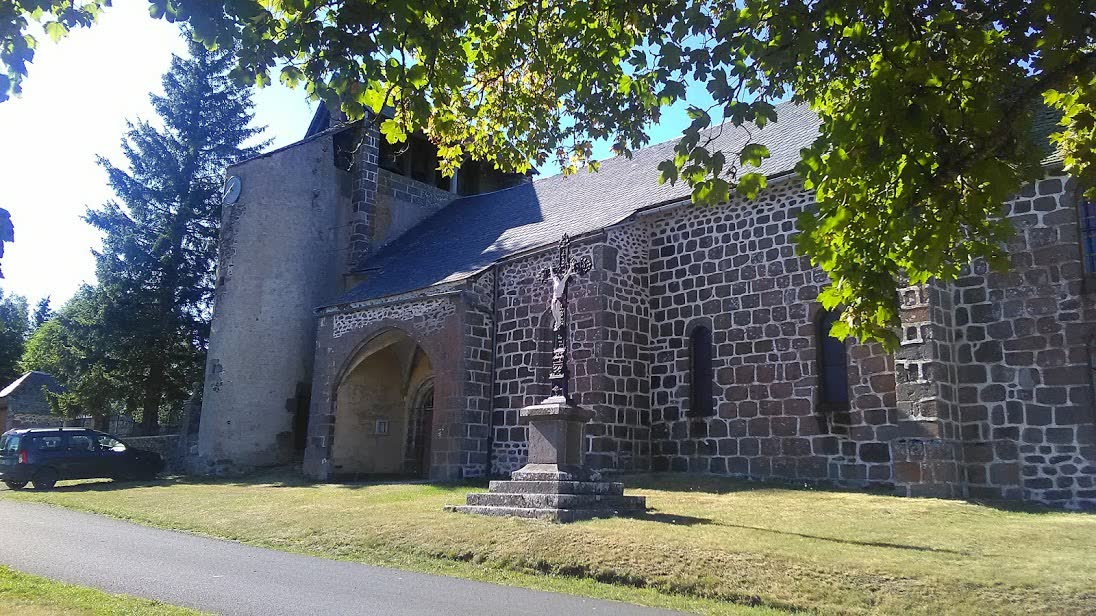
Pictured: Église Saint-Amand, the parish church of Cussac, Cantal — the commune where the Delpeuch family lived, not the isolated Les Tuiles pasture roughly 800 meters outside the village where the sighting itself occurred. No public-domain or rights-clear photograph of the actual pasture, the 1967 ground trace, or the witnesses is known to exist; GEPAN's own 1978 site photography remains held within CNES/GEIPAN's archival case file rather than freely licensed. Photograph by Sancta floris, licensed CC BY-SA 4.0 via Wikimedia Commons.
Theoretical Alignment
Cussac sits in an unusually well-documented but evidentially modest position among humanoid-occupant cases. Its Extraterrestrial Hypothesis alignment is capped at a middling 25% because, unlike physical-trace landmark cases such as Trans-en-Provence, no laboratory ever tested the Cussac ground trace; the case's evidentiary weight rests almost entirely on two child witnesses' consistent, decades-stable testimony and a handful of adults' secondhand sensory corroboration (odor, sound, and animal distress) rather than on measured physical or chemical data. What keeps the ETH alignment from falling lower still is precisely that consistency: François Delpeuch never altered his account across three separate formal interviews spanning more than a decade (1967–68, 1977, and 1978), and the investigating magistrate on Claude Poher's 1978 GEPAN team explicitly found no basis to suspect invention, hoax, or hallucination. The Interdimensional Hypothesis offers essentially nothing distinctive here — a landed metallic craft and physically embodied, if biologically unusual, occupants is a poor fit for a framework built around trans-dimensional rather than trans-medium travel, earning only a residual score. The Psycho-Social Hypothesis scores comparatively higher than in most cases in this catalogue, not because the children were lying, but because the single most substantial documented external contamination pathway in the entire case — the nearly simultaneous, heavily-publicized Arc-sous-Cicon sighting roughly six weeks earlier and 340 kilometers away, involving strikingly similar small black humanoid figures and a similarly discolored, oddly scented patch of grass — gives skeptical researchers a genuinely plausible, non-fabrication explanation for why two rural children might describe an ordinary aerial vehicle using exactly the vocabulary regional newspapers had already put into wide circulation that summer.
Background
In the late summer of 1967, Cussac was, and remains, one of the smallest and most remote communes in the Cantal department: a scattering of stone farmhouses on a high volcanic plateau in France's Massif Central, its economy built entirely around dairy and beef cattle grazed on the thin mountain pasture that surrounds it on every side. François Delpeuch, thirteen and a half years old, and his younger sister Anne-Marie, nine, were the children of the commune's mayor, a local lawyer who would go on decades later to serve as mayor of the larger nearby town of Saint-Flour. Watching the family's cattle on the plateau was an entirely ordinary chore for children in a farming commune this size, one they had almost certainly performed dozens of times before without incident; nothing in either child's background, or their father's, suggested any prior interest in UFOs, unusual religious belief, or any motive to fabricate an elaborate hoax that would draw unwanted national press attention to a mayor's own household. France in 1967 had no government body dedicated to investigating UFO reports — GEPAN would not be founded within the national space agency CNES for another decade — but the country already possessed an active, organized private ufology community, anchored by groups like GEPA (Groupe d'Étude des Phénomènes Aériens) and the long-running bulletin Lumières Dans La Nuit (LDLN), whose members would descend on Cussac within months of the sighting to conduct the kind of methodical, comparative witness interviews that gave the case its unusually well-documented early record. It was into this pre-GEPAN landscape — serious volunteer investigators, an engaged regional and national press, but no standing government scientific unit — that the Delpeuch children's morning on the plateau abruptly, and permanently, dropped.
Complete Timeline
| Date | Event |
|---|---|
| August 29, 1967, ~10:30 AM | François Delpeuch (13) and his sister Anne-Marie Delpeuch (9), watching cattle at the Les Tuiles pasture outside Cussac, Cantal, see their dog Médor barking at a hedge and discover four small black humanoid figures near a brilliant, hovering metallic sphere roughly 80 meters away. |
| Same morning | The beings appear to notice the children watching; one returns briefly for a small reflective object before all four dive headfirst into the sphere, which ascends in an expanding, rotating spiral accompanied by a rising whistling sound and a strong sulfur odor, then departs rapidly to the northwest. |
| Same morning | The children run home with the cattle, visibly frightened; their father, the mayor of Cussac, contacts the gendarmerie brigade at Saint-Flour, roughly 15 km away. |
| August 29, 1967, afternoon | Gendarmes visit Les Tuiles, interview both children, and personally detect a strong sulfur odor and a patch of abnormally yellowed grass at the site the children identify as the sphere's hovering point. |
| August 30, 1967 | Radio Luxembourg broadcasts an early report on the sighting. |
| September 1, 1967 | Regional newspaper La Montagne publishes "Les martiens ont-ils atterri?" ("Have the Martians landed?"), the case's first major press coverage. |
| September 2–3, 1967 | National tabloid Paris Jour runs the story nationally; a quote later shown to be journalistic invention, attributed to the beings asking the children to "come play with us," begins circulating in press accounts. |
| Within days after the sighting | Both children are examined by the family physician, who documents eye irritation persisting for several days. |
| Late 1967 – early 1968 | GEPA investigators Joël Mesnard and Claude Pavy conduct a methodical field investigation, separately interviewing each child, checking their accounts against the parents' and gendarmerie's records, and testing for contradictions. |
| June 1968 | Mesnard and Pavy publish their findings in Phénomènes Spatiaux no. 16, pp. 27–31 — the case's first detailed formal writeup. |
| October 12, 1968 | A parallel investigation by Claude de Saint-Étienne for LDLN is published in the Toulouse edition of Hebdo. |
| September 1968 | An English translation of the GEPA findings appears in Flying Saucer Review, Vol. 14, No. 5, introducing the case to English-language researchers. |
| 1969–1977 | The case is discussed in a lengthening series of French UFO books and journals, including works by Jacques Vallée (1972), Fernand Lagarde (1973), Jean-Claude Bourret (1974), and Coral and Jim Lorenzen's English-language Encounters with UFO Occupants (1976), cementing its status as a landmark French humanoid case even as no further fieldwork occurs. |
| 1977 | LDLN investigator Luc Bourdin re-interviews François, by then a university student, a decade after the sighting; he confirms the "come play with us" quote was a journalistic fabrication and documents that François, unlike his sister, never saw support legs beneath the sphere. |
| 1977 | CNES engineer Claude Poher founds GEPAN (Groupe d'Études des Phénomènes Aérospatiaux Non-identifiés) within France's national space agency in Toulouse, the world's first standing government UFO-study unit. |
| April 1978 | Poher personally leads a four-person GEPAN team — including an optical-engineering specialist and an investigating magistrate with no prior UFO background — back to Les Tuiles for a theodolite-based site reconstruction and formal witness re-assessment, eleven years after the sighting. |
| June 1978 | GEPAN's internal findings, filed within its Report to the Scientific Council, vol. 4, conclude that nothing in the case's corroborating elements permits doubting the witnesses' sincerity or suspecting hoax, invention, or hallucination — while reaching no conclusion about the object's actual nature. The report is not published. |
| 1996–1999 | Éric Maillot, of the skeptical Cercle Zététique, re-opens the case using GEPA's original material and GEPAN's then-unpublished 1978 dossier, proposing that the object was most likely a military helicopter misidentified with the aid of media contamination from the recent Arc-sous-Cicon case, published as "Les ufologues et l'ovni de Cussac – 30 ans dans un cul-de-sac!" |
| 1999 | The unofficial COMETA report, compiled by retired French general officers and defense specialists, cites Cussac among its supporting case studies and reproduces the 1978 magistrate's sincerity finding; Jean-Jacques Velasco, a COMETA contributor and GEPAN's later director, personally delivers the finished report to Prime Minister Lionel Jospin's office. |
| December 2003 | Researcher Alain Delmon publishes a rebuttal arguing the helicopter hypothesis is operationally implausible given the roughly 160 km distance to the nearest capable air base. |
| June 2004 | Claude Poher publishes "Retour sur le cas de Cussac," arguing the reported spiral ascent, odor, and brightness are difficult to reconcile with an ordinary helicopter. |
| August 29, 2004 | Éric Maillot revisits the site on the sighting's 37th anniversary for a photographic sightline reconstruction; researcher Grégory Gutierez separately publishes a helicopter-hypothesis visualization. |
| March 2, 2005 | Gutierez publishes an account describing GEPAN's internal 1978 dossier as having become available for the first time to researchers outside the agency. |
| March 2007 | CNES/GEPAN publicly releases its full historical case archive online, including the Cussac file, in a mass declassification so heavily trafficked the agency's site reportedly crashed on its first day. |
| 2007 | David Rossoni, Éric Maillot, and Éric Déguillaume publish a dedicated Cussac chapter in Les OVNI du CNES: 30 ans d'études officielles (1977–2007), the fullest published statement of the helicopter hypothesis. |
| January/February 2009 | Rossoni, Maillot, and Déguillaume summarize the case and the broader helicopter debate for an English-language audience in Skeptical Inquirer, Vol. 33, No. 1. |
Ten-Thirty on the Plateau: The Sighting at Les Tuiles
By the Delpeuch children's own account, the morning of August 29, 1967 began exactly like any other. François and Anne-Marie had led the family's small herd of cattle out to graze at Les Tuiles, a pasture roughly 800 meters from the village center, and had settled in, by at least one retelling, to pass the time playing cards while the animals grazed nearby. What broke the routine was their dog, Médor, who began barking with unusual agitation at a thorn hedge bordering the field. When François went to investigate — in some tellings prompted by a cow that had wandered off, giving him a reason to walk toward the hedge — he saw, at a distance both children later estimated at roughly 80 meters, a scene neither of them had any frame of reference for: an intensely bright, perfectly smooth sphere, silver in color and by their initial estimate roughly two meters in diameter, hovering just above the grass, with four small figures moving around its base. His first impression, by his own later account, was that he might be looking at other children he didn't recognize — an ordinary, almost reassuring assumption that lasted only until a closer look made clear these were not children at all.
The four figures stood no taller than about 1.2 meters, and both witnesses independently described them as uniformly, completely black, with a smooth, faintly shiny texture François specifically compared to silk — smooth enough that investigators who interviewed him afterward could never establish whether he was describing skin or a seamless protective suit, since no seam, fastener, or join of any kind was ever reported. The beings had disproportionately long, thin arms and short, thin legs; their heads were described as bare, with a pointed cranium, a sharp nose, and a distinctly marked chin, and no visible eyes, ears, or mouth that either child could describe with confidence. One figure appeared to be crouched over, doing something at ground level; a second held a small, flat, reflective object the children compared to a hand mirror. Anne-Marie, but not François, described three or four thin, straight legs beneath the sphere ending in small round pads about ten centimeters across — landing supports that, if present, had apparently already retracted by the time François had his own clear look, or that he simply never noticed from his own vantage point. Both children agreed that at some point the beings appeared to become aware they were being watched, and began, one after another, diving or leaning headfirst into the sphere through an opening neither child could describe in any structural detail; the last being broke away briefly to retrieve the reflective object it had apparently set down, then followed the others inside.
What happened next was, by both children's account, the most physically striking part of the encounter. The sphere began to climb, not straight up, but in a widening, rotating spiral — several full clockwise rotations, its radius expanding outward from perhaps ten meters to fifty or a hundred, at a rate the children later estimated at roughly one rotation per second, growing brighter as it rose — before shooting away rapidly toward the northwest and vanishing. The ascent was accompanied by a soft, high-pitched whistling sound layered with something more like a rush of expelled breath, and, distinctly, a strong smell of sulfur that lingered at the site well after the object was gone. The family's cattle, which had been calmly grazing throughout, began bellowing and clustering together in evident agitation as the sphere climbed; Médor barked and gave chase toward the departing object. The entire episode, from the children's first clear sighting of the beings to the sphere's final departure, lasted only around thirty seconds — long enough, and close enough, to leave both children badly frightened, but far too brief for either of them to have formed anything like a complete, systematic inventory of what they were looking at.
Sulfur in the Grass: The Gendarmerie's First Response
The children's fear was, by every account, immediately obvious to the adults around them. They ran back to the village with the cattle still in tow, visibly shaken, and their father — Cussac's mayor at the time, and a lawyer by training — made the decision that would give the case its unusually strong early documentation: rather than dismiss the story or simply comfort his children and move on, he contacted the gendarmerie brigade at Saint-Flour, roughly 15 kilometers away, officers he knew personally through the ordinary business of local governance, from traffic accidents to the everyday problems of a small rural commune. Gendarmes reached Les Tuiles that same day and did something no later investigator could ever replicate: they examined the physical scene while whatever had happened there was still fresh. They interviewed both children separately at the site, and, walking to the specific spot the children identified as where the sphere had hovered, personally detected a strong, distinctive odor of sulfur still lingering in the air, along with a patch of grass there that had turned an abnormal yellow color, sharply distinct from the healthy green grass immediately surrounding it.
This gendarmerie visit matters disproportionately to the case's overall credibility, because it means the odor and the discolored grass are not solely the children's own claims, filtered through memory and repeated retelling, but observations independently made by law-enforcement officers with no connection to ufology, no motive to inflate the story's importance, and every institutional incentive to write a brief, unremarkable report and move on to other business. In the days that followed, the Delpeuch family's own physician examined both children and documented genuine eye irritation persisting for several days — a further physiological data point independent of the children's narrative, though one just as consistent with irritation from an ordinary unfamiliar chemical odor as with anything exotic. None of this amounted to a scientific investigation in the sense GEPAN would later bring to cases like Trans-en-Provence: no soil sample was collected, no photograph of the trace was taken, and the yellowed grass patch was left simply to fade back toward normal over the following weeks, unmeasured and unphotographed. But it did establish, within hours of the sighting and well before any newspaper had run a single word about it, that something real, physical, and sensorially verifiable by uninvolved adults had happened at that specific spot on the plateau — a foundation the case's later investigators, on both the credulous and skeptical sides, would spend decades building on.
The Press Descends, and a Quote Is Invented
News of the sighting escaped Cussac almost immediately. Radio Luxembourg carried an early report the very next day, August 30; the regional newspaper La Montagne ran the story on September 1 under the breathless headline "Les martiens ont-ils atterri?" ("Have the Martians landed?"); and by September 2–3, the Paris-based national tabloid Paris Jour had picked it up for a nationwide audience. It was somewhere in this rapid escalation from local curiosity to national tabloid story that a specific, vivid quote entered the record and stayed there for a decade: the claim that one of the beings, or the children themselves, had said "voulez-vous venir jouer avec nous?" — "would you like to come play with us?" — a phrase that, if genuine, would have implied some form of attempted verbal contact rather than the silent, uncommunicative encounter both children actually described. The quote appeared in enough retellings over the following years that it became, for a time, one of the case's best-known details.
It was also, as later investigation established beyond reasonable doubt, entirely invented by a journalist rather than spoken by anyone involved. When LDLN investigator Luc Bourdin re-interviewed François in 1977, by then a university student a decade removed from the sighting, one of his specific findings was that neither child had ever reported any such exchange; both, from the very beginning, had described a starkly wordless encounter in which the beings gave no sign of language or intentional communication at all, and François in particular emphasized that the moment he realized the small figures near the hedge were not other children playing nearby was precisely the moment it became clear they were not behaving like children, or communicating like people, at all. This is, in its own small way, one of the more instructive threads in the case's history: it demonstrates concretely how quickly and thoroughly press coverage of a UFO report can add invented, dramatic detail that then circulates for years as though it were part of the original testimony — and it is exactly the kind of embellishment that later, careful re-investigation exists to catch and correct, rather than something this catalogue treats as evidence the entire account is unreliable.
GEPA's 1968 Field Investigation
The first genuinely methodical investigation of the Cussac case came not from any government body — none yet existed — but from GEPA (Groupe d'Étude des Phénomènes Aériens), one of the more serious private French ufology research organizations of the period. Investigators Joël Mesnard and Claude Pavy traveled to Cussac within the months following the sighting and conducted what remains, for its era, an unusually disciplined field inquiry: they interviewed François and Anne-Marie separately rather than together, to avoid one child's account shaping the other's in real time; they returned repeatedly to the same key points across the interview, deliberately reformulating their questions each time to test whether the children's answers stayed internally consistent or shifted under different phrasing; and they cross-checked what the children told them against the parents' own recollection of that morning and against whatever the gendarmerie had already recorded. They also, notably, brought the children back to the actual site at Les Tuiles and observed them there directly, watching for any hesitation, contradiction, or tell that might distinguish a rehearsed story from a genuine memory.
Mesnard and Pavy's conclusion, published in the June 1968 issue of Phénomènes Spatiaux (no. 16, pp. 27–31), was that the children's testimony held together under this kind of sustained, adversarial-style questioning without producing the contradictions a fabricated story usually reveals under pressure. François himself was notably candid about the limits of his own certainty even as he held to his central account: when asked directly about the support legs his sister described beneath the sphere, he told the investigators plainly, "from day one, Anne-Marie said she saw legs… but I did not see them" — the kind of small, honestly-reported discrepancy between two witnesses that investigators in this catalogue generally treat as a credibility strength rather than a weakness, since a coached or jointly rehearsed account would be far more likely to eliminate exactly this sort of inconsistency rather than preserve it. The GEPA report was translated into English for Flying Saucer Review that September and into German for UFO-Nachrichten in 1972, giving the case an international audience within French ufology's still-developing network of exchange years before any government scientist would look at it at all.
A Decade of Silence, and Luc Bourdin's 1977 Re-Interview
For nearly a decade after GEPA's 1968 report, Cussac's investigative record went quiet even as its reputation grew. The case was cited and re-summarized across a steady stream of French UFO books through the early-to-mid 1970s — by Jacques Vallée in 1972, by Fernand Lagarde's edited volume in 1973, by Jean-Claude Bourret in 1974, and by several others — establishing it as one of the handful of "classic" French humanoid cases discussed in survey after survey, but without a single new interview, site visit, or piece of physical documentation being added to the record in all that time. That changed in 1977, when LDLN investigator Luc Bourdin undertook a deliberate counter-investigation: he sought out François, no longer a thirteen-year-old farm boy but a university student, specifically to test whether a decade of retelling, aging, and exposure to the case's own growing mythology had altered his account.
It largely had not, on the substance that mattered most. François's core narrative — the four black figures, the smooth silver sphere, the spiraling ascent, the sulfur smell — remained essentially unchanged from what he had told Mesnard and Pavy nine years earlier. But Bourdin's re-interview did something equally valuable: it identified exactly where the case's record had drifted from what the children had actually said. The "come play with us" quote, by then a decade into wide circulation, was traced conclusively to journalistic invention rather than to either child's own words. And François again confirmed, unprompted, that he had never personally seen the landing-leg structure his sister described — the same specific discrepancy he had volunteered in 1968, held stable and unresolved across nine years and two independent investigators. Bourdin's willingness to report both the confirmation and the correction, rather than simply re-asserting the case's most dramatic version, is a large part of why Cussac's early documentary record is regarded, even by researchers who ultimately doubt the case's exotic interpretation, as unusually careful for a UFO report of its era.
Claude Poher and GEPAN's 1978 Reconstruction
The case's most consequential investigation came from an entirely new direction. In 1977, CNES engineer Claude Poher established GEPAN (Groupe d'Études des Phénomènes Aérospatiaux Non-identifiés) inside France's national space agency in Toulouse — the world's first standing government unit dedicated to the scientific investigation of UFO reports, built to receive cases referred through the national gendarmerie rather than relying on volunteer civilian investigators. Unlike Trans-en-Provence four years later, where GEPAN's scientists reached a fresh scene within a day of the report, Cussac presented Poher's brand-new agency with something different: a decade-old case, already extensively documented by private investigators, that had become one of French ufology's most frequently cited humanoid encounters purely on the strength of its early testimony. In April 1978, Poher personally led a four-person team back to Les Tuiles — including an optical-engineering specialist who would go on to work on France's SPOT Earth-observation satellite program, and, critically, an investigating magistrate with no prior background in ufology, brought in specifically to apply an outside professional's standard for assessing witness credibility rather than an already-convinced ufologist's.
The team's methodology mirrored, in miniature, what GEPAN would later bring to fresher cases: they used a surveyor's theodolite to re-measure the sightline geometry with both witnesses present at the actual site, recording slightly different but broadly consistent distances from each — about 30 meters to the roadside per François, 33 meters per Anne-Marie — and they separately interviewed each witness again, without disclosing what hypothesis, if any, the team was testing. They also gathered testimony from the adults around the original sighting: the father who had watched his children return from the plateau visibly terrified, and other locals who could independently confirm the sulfur odor, the whistling sound, and the cattle's agitation without having seen the object themselves. The investigating magistrate's eventual written assessment, later reproduced in the unofficial 1999 COMETA defense report, held that there was "no flaw or inconsistency in these various elements" sufficient to doubt the witnesses' sincerity or to reasonably suspect invention, hoax, or hallucination — a conclusion GEPAN filed within its June 1978 Report to the Scientific Council (vol. 4) without ever identifying, or claiming to identify, what the object actually was. Because GEPAN did not exist in 1967, this was necessarily a retrospective credibility assessment of an eleven-year-old memory rather than a contemporaneous scene investigation, an honest distinction this catalogue draws explicitly rather than allowing Cussac's GEPAN involvement to imply the same kind of same-week government fieldwork Trans-en-Provence received. GEPAN's dossier itself was not published at the time, and would remain effectively confidential for more than two decades — entering wider ufological discussion only through a researcher's 2005 account of having obtained it, and reaching full public visibility only with CNES's 2007 mass archive declassification.
The Helicopter Hypothesis: Éric Maillot and the Cercle Zététique
The case's most substantial and longest-running skeptical challenge began in 1996, when Éric Maillot, a schoolteacher and collaborator with the University of Nice-Sophia Antipolis's Laboratoire de Zététique, reopened the file for the skeptical Cercle Zététique. Working from GEPA's original 1967–68 material and, eventually, GEPAN's own then-unpublished 1978 dossier, Maillot published "Les ufologues et l'ovni de Cussac – 30 ans dans un cul-de-sac!" ("Ufologists and the Cussac UFO – 30 years in a dead end!"), arguing that French ufology had spent three decades treating an almost certainly conventional sighting as one of its landmark cases. Maillot's central thesis was not that the Delpeuch children lied; he explicitly accepted that they had genuinely seen and been frightened by something real. His argument was that the object was most likely a military helicopter — he specifically raised, without being able to confirm through any accessible flight log, the possibility of an Alouette II operating out of a base near Bordeaux — misidentified at a distance and elaborated, consciously or not, with details borrowed from recent, heavily-publicized press coverage of the similar Arc-sous-Cicon sighting six weeks earlier. He grounded the hypothesis geographically in the plateau's documented use as a military maneuver and training area for roughly three years around the period of the sighting, arguing this made the presence of a low-flying military aircraft in the area, on an ordinary Tuesday morning, considerably more plausible than ufologists writing about the case had generally acknowledged.
Maillot's argument carries real force specifically because he does not simply assert the helicopter theory and move on: he engages directly with the details that make it difficult to accept without qualification — the sulfur odor, the spiral ascent, the absence of any reported rotor noise — treating each as a problem to be addressed rather than a detail to be ignored. His strongest single piece of circumstantial support remains the Arc-sous-Cicon parallel: two nearly identical humanoid-and-trace reports, from unconnected children in unconnected regions, appearing within six weeks of each other during a summer of unusually intense regional press coverage of exactly this kind of story, is precisely the pattern a genuine media-contamination effect would be expected to produce, and it is a comparison this catalogue's own Historical Precedents section above treats as a legitimate, serious point rather than dismissing it. What the helicopter hypothesis has never produced, in nearly three decades of argument, is a specific, dated flight record placing any helicopter over Cussac that morning — a gap its own proponents have consistently acknowledged rather than papered over.
Rebuttal and Counter-Rebuttal: Delmon, Poher, and the Unresolved Geometry
The helicopter hypothesis did not go unanswered. In December 2003, researcher Alain Delmon published a detailed operational critique arguing that the theory's central weakness was logistical: the nearest air base capable of housing and operating an Alouette II lay roughly 160 kilometers from Cussac, and a round trip of that distance, with a four-person crew, using the fuel and flight-endurance characteristics typical of a 1967-era light helicopter, was difficult to reconcile with the reported timeline of a brief, unscheduled morning appearance over an isolated plateau with no evident tactical purpose. Claude Poher himself, by then GEPAN's founder and long past his own agency's active involvement in the case, entered the debate directly in June 2004 with "Retour sur le cas de Cussac," arguing that three specific reported details remained genuinely hard to reconcile with an ordinary helicopter regardless of the base-distance question: the object's helical, expanding-radius ascent pattern, difficult to produce with a conventional rotary-wing aircraft's normal climb profile; the specific sulfur-like odor, distinct from aviation fuel exhaust and not an obvious byproduct of any 1960s-era helicopter; and the object's extreme reported brightness, described by the children as comparable to looking at the midday sun, which Poher argued two children accustomed to the ordinary sound and appearance of military aircraft overflying the region would have been unlikely to simply fail to recognize as an aircraft if that was genuinely all it was.
The debate continued to sharpen rather than resolve through the following years. Éric Maillot revisited the site in person on August 29, 2004, the sighting's 37th anniversary, attempting a photographic reconstruction of the witnesses' original sightlines to test whether the reported distances and positions were geometrically consistent with his hypothesis; researcher Grégory Gutierez separately produced his own helicopter-hypothesis visualization that same year. Even within the skeptical camp, the exact geometry of the case remained genuinely contested down to the meter: David Rossoni, one of Maillot's own later co-authors, publicly disputed aspects of Maillot's 2004 distance reconstruction in 2008, arguing Maillot had at points conflated GEPAN's original hedge-to-witness measurement with a separate object-to-witness distance, a technical disagreement that undercuts neither side's broader case but is a useful reminder that this debate has never been a simple two-sided argument between "believers" and "skeptics" so much as an unusually granular, decades-long argument over specific meters and minutes that neither side has ever fully settled.
The 2007 Declassification and Cussac's Place in COMETA
Two developments in the late 1990s and 2000s brought Cussac's long-buried government paper trail into full public view for the first time. In 1999, the unofficial COMETA report — a 90-plus-page study compiled by a private, non-profit association of retired French Air Force general officers, defense specialists, and scientists associated with the Institut des Hautes Études de Défense Nationale, and delivered informally to then–Prime Minister Lionel Jospin's office — cited Cussac among its supporting case studies, explicitly describing it as a case that "occupied a special place" precisely because of the 1978 GEPAN counter-investigation, and reproducing the investigating magistrate's sincerity finding for a policy-and-defense audience that had never seen it. One of COMETA's contributing authors was Jean-Jacques Velasco, by then GEPAN's successor-agency director, who personally carried the finished report to Jospin's office — a direct institutional thread connecting Cussac's decade-old dossier to the same government UFO-research lineage that would later produce Trans-en-Provence's far more famous physical-trace investigation.
Then, in March 2007, CNES took the far more consequential step of releasing its entire historical GEPAN/SEPRA/GEIPAN case archive to the public online for the first time — a mass declassification covering well over a thousand case files spanning half a century, so heavily trafficked in its first days that the agency's own website reportedly crashed under the load, as The Washington Post's Molly Moore reported at the time. The Cussac file was among the cases the release brought into full public view, allowing researchers on every side of the case's central debate to examine GEPAN's actual 1978 findings directly rather than relying on secondhand summaries. Unlike Trans-en-Provence, which carries a clearly published GEIPAN Category D classification in the agency's current online case-search database, Cussac — as a pre-1977 case that GEPAN examined only retrospectively rather than processing through its post-founding case-intake system — does not appear to carry a formal A-through-D classification in GEIPAN's modern public catalogue; this catalogue states that gap honestly rather than assigning the case a classification GEIPAN itself has not published. What the 2007 release did accomplish was placing every primary document in the case — the original gendarmerie report, GEPA's 1968 findings, and GEPAN's own 1978 reconstruction — into a form any researcher, skeptical or otherwise, could examine directly for the first time in the case's forty-year history.
Circumstantial Evidence
- Gendarmes reached the isolated sighting site within hours and personally detected a strong sulfur odor and an abnormally yellowed patch of grass at the specific spot the children identified, independent of the children's own account.
- The family physician documented genuine eye irritation in both children persisting for several days — a physiological finding independent of their narrative.
- A field hand elsewhere on the plateau independently corroborated hearing the whistling/hissing sound the children described.
- François Delpeuch's account remained substantively unchanged across three separate formal interviews spanning more than a decade (1967–68, 1977, 1978), given to different investigators with no coordination between them.
- François consistently and voluntarily reported a discrepancy with his sister's account (the landing legs), the kind of detail a rehearsed or coordinated false story would more likely have eliminated than preserved.
- The investigating magistrate on Claude Poher's 1978 GEPAN team — a professional with no prior ufology background — found no basis in the corroborating elements to suspect invention, hoax, or hallucination.
- The "come play with us" quote once widely attributed to the beings was traced by LDLN's 1977 re-investigation to journalistic invention, demonstrating the case's record has been actively and successfully corrected of embellishment rather than allowed to accumulate it unchecked.
- No dated military flight log placing a helicopter over Cussac that morning has ever surfaced, despite nearly three decades of dedicated skeptical research specifically seeking one.
Key Witnesses
François Delpeuch
The son of Cussac's mayor, François was watching the family's cattle at the Les Tuiles pasture when he first noticed the four humanoid figures near the hovering sphere, initially mistaking them for children he didn't recognize. He gave formal accounts to investigators three times across more than a decade — to GEPA in 1967–68, to LDLN's Luc Bourdin in 1977 as a university student, and to Claude Poher's GEPAN team in 1978 — and his core account never changed. He consistently and voluntarily told each investigator that, unlike his sister, he never personally saw support legs beneath the sphere, an honestly preserved discrepancy investigators have generally read as a credibility strength rather than a weakness.
Anne-Marie Delpeuch
François's younger sister, watching the cattle alongside him, Anne-Marie independently corroborated the core sighting — the sphere, the four black figures, the spiral ascent, the sulfur smell — while also describing details her brother did not, most notably three or four thin support legs beneath the sphere ending in small round pads. Investigators noted no evidence her account was coached or synchronized with her brother's; the two children's testimony was gathered separately from the outset.
Claude Poher
The CNES engineer who founded GEPAN in 1977, Poher personally led the four-person team that returned to Les Tuiles in April 1978 to re-measure the site with a theodolite and formally reassess the Delpeuch children's credibility, eleven years after the sighting. He remained engaged with the case for decades afterward, publishing a direct rebuttal of the helicopter-misidentification hypothesis in 2004 that emphasized the reported spiral ascent, distinctive odor, and extreme brightness as details he considered difficult to reconcile with an ordinary aircraft.
The Five Observables Assessment
The Five Observables framework, developed by former AATIP director Luis Elizondo, is designed to classify witnessed UAP flight performance against the limits of known technology. Cussac, like other brief, close-range humanoid-occupant cases in this catalogue, is a difficult structural fit for that framework: it is a thirty-second visual sighting by two children at a distance of roughly 80 meters, not an instrumented flight-dynamics event with tracked speed, altitude, or maneuvering data. The assessment below reflects what the witnesses impressionistically described rather than anything independently measured, and says so plainly.
Assessment: Anti-Gravity Lift is rated speculative because the children described the sphere hovering just above the grass with no reported downwash, wheels, skids, or (per François's own account) any visible support structure at all — consistent with an unconventional lift mechanism, but resting entirely on two children's brief visual impression rather than any measurement. Instant Acceleration is similarly speculative: the object's departure was rapid, but neither witness offered anything like a timed estimate of its actual speed. Hypersonic Velocity is rated absent, since neither child described anything approaching extreme velocity, only a fast climb-away after the spiral ascent. Low Observability is rated present on a narrower basis than in most cases in this catalogue: the object produced no reported engine roar and left the scene without being independently seen departing by anyone beyond the two witnesses, though this is arguably as consistent with the encounter's brief duration and remote location as with any genuinely unusual acoustic signature — a distinction the helicopter hypothesis's proponents would frame very differently than this catalogue's default reading. Trans-Medium travel does not meaningfully apply to a hovering, near-ground encounter with no medium transition of any kind. As with several other humanoid-occupant cases in this catalogue, Cussac's evidentiary weight rests almost entirely on witness testimony and its surrounding corroboration, not on any instrumented flight-performance characteristic.
Evidence Assessment
Supporting Anomalous Origin
- Gendarmes independently corroborated a strong sulfur odor and an abnormally discolored grass patch within hours of the sighting, without having witnessed the object themselves.
- The family physician documented genuine eye irritation in both children persisting several days, a physiological finding independent of their narrative.
- François Delpeuch's account remained substantively consistent across three separate formal interviews given to different, uncoordinated investigators over more than a decade.
- The investigating magistrate on Claude Poher's 1978 GEPAN team, a professional with no prior ufology background, found no basis to suspect invention, hoax, or hallucination.
- A field hand elsewhere on the plateau independently corroborated the whistling/hissing sound described by the children.
- The case's record demonstrably self-corrected a journalistic fabrication (the "come play with us" quote) rather than allowing embellishment to accumulate unchecked.
Supporting Conventional Explanation
- The only direct witnesses to the object and its occupants were two children, ages 9 and 13½, an unavoidable limitation on the account's evidentiary weight.
- No soil, plant, or trace sample was ever collected for laboratory analysis; the ground trace itself was never systematically measured or photographed.
- The plateau's documented use as a military maneuver area around 1967 gives the helicopter-misidentification hypothesis a genuine geographic foundation.
- The near-simultaneous, heavily-publicized Arc-sous-Cicon case six weeks earlier offers a specific, plausible media-contamination pathway for the children's descriptive vocabulary.
- Eleven years elapsed before any government-level investigation occurred, long after contemporaneous physical evidence could have been more rigorously documented.
Why "Disputed"
The Cussac Close Encounter earns a DISPUTED classification because it combines a genuinely unusual depth of corroboration and decades-long testimonial consistency with the same fundamental limitation that constrains every UFO case resting primarily on child witnesses: however carefully documented, it is still, at its evidentiary core, the memory of two children describing thirty seconds at eighty meters. On the strength side, this catalogue takes seriously what is genuinely rare about Cussac's record: gendarmes reached the site within hours and personally corroborated a sulfur odor and an abnormal ground trace independent of the children's own account; the family physician documented real physiological eye irritation independent of the narrative; a private research group's 1968 field investigation applied genuinely disciplined, adversarial-style questioning rather than credulous note-taking; a decade-later re-interview caught and corrected a fabricated quote rather than letting it stand; and, most unusually, the founder of France's own government UFO-study unit personally revisited the case eleven years on with a magistrate specifically tasked with finding reasons to doubt it, and came away unable to do so. On the other side of the ledger: no physical sample was ever tested in any laboratory, unlike the site's later French counterparts; the primary witnesses were nine and thirteen years old, an unavoidable reason for caution regardless of how consistent their testimony has remained; the case's only government-level examination occurred more than a decade after the fact, long after any contemporaneous physical evidence could have been more rigorously preserved; and a serious, still-argued conventional alternative — a military helicopter, misidentified with the possible aid of media contamination from an almost identical case six weeks earlier — has never been definitively confirmed or eliminated, more than three decades into a genuinely careful, good-faith argument between France's own skeptical researchers and GEPAN's founder himself. That is precisely the profile of a case that deserves neither uncritical acceptance nor dismissal: a real, physically corroborated event happened at Les Tuiles that August morning, and what it actually was remains exactly as unresolved today as it was when Claude Poher's magistrate first declined to call it a hoax in 1978.
Sensor & Instrumentation Detection Profile
No radar station, aircraft, or automated sensor of any kind recorded the Cussac object; the entire encounter took place over roughly thirty seconds in an isolated agricultural pasture with no aviation facility, military radar coverage, or observatory anywhere nearby positioned to detect it independently. The only instrumentation ever applied to this case was retrospective and geometric rather than observational: when Claude Poher's GEPAN team visited the site in April 1978, eleven years after the sighting, they used a surveyor's theodolite to precisely re-measure the sightline distances the two witnesses separately reported — approximately 30 meters to the roadside edge according to François, 33 meters according to Anne-Marie — and to re-plot the beings' and the sphere's remembered positions against the hedge and the road. This was a methodology for testing the internal geometric consistency of a decade-old memory, not a measurement of the object itself, and GEPAN's team was careful to frame it that way. No period photograph, film, or audio recording of the encounter exists; the gendarmes who responded arrived after the object had already departed, and their contribution to the record is sensory corroboration — smell and sound — rather than instrumented data. Cussac is accordingly, in the vocabulary this catalogue uses elsewhere, a pure testimony-and-aftermath case: whatever evidentiary weight it carries comes from cross-checked human testimony gathered close in time to the event, not from any device that recorded the phenomenon directly.
Environmental & Geospatial Context
Cussac is a tiny commune in France's Cantal department, part of the volcanic Massif Central in the Auvergne region, sitting at an average elevation of roughly 1,070 meters on the high, windswept Saint-Flour plateau, about 15 kilometers southwest of the market town of Saint-Flour. In 1967 the commune's population was already in steady decline from its mid-century peak (236 residents the year before the sighting, dropping toward the roughly 117 recorded today) — the kind of sparsely populated, cattle-farming high country where a rural family's herd grazing on an unremarkable Tuesday morning would ordinarily go entirely unremarked. Witnesses and investigators agreed the weather that morning was unremarkable in every way that might explain an optical misperception: clear skies, a light westerly breeze, temperatures in the 12–16°C range typical of a late-August Auvergne morning, with morning ground fog reported only in distant lower valleys, not on the plateau itself. The pasture called Les Tuiles, where the herd grazed, sat roughly 800 meters from the village center near the departmental road, isolated enough that the children's only other company was their dog and, at a greater remove, a farm hand elsewhere on the plateau who later told investigators he heard the same sound the children described. The region's geospatial context carries real weight in the case's central controversy: French skeptical researchers have specifically noted the plateau had served, for roughly three years around the period of the sighting, as an army maneuver and training area — the geographic basis for the helicopter-misidentification hypothesis discussed later in this file, and a genuinely different environmental profile from isolated rural sightings with no known military activity nearby.
Observer Credibility & Occupational Profile
Cussac's central credibility problem, honestly stated, is that its only direct witnesses to the object and its occupants were two children — François Delpeuch, thirteen and a half years old and nearsighted enough to wear glasses, and his sister Anne-Marie Delpeuch, nine, without glasses — performing the ordinary daily chore of watching the family's cattle. Neither had any documented prior interest in UFOs, and their father, the mayor of Cussac at the time, was a local official with every reason to prefer his children's dramatic story simply go away rather than draw national press attention to his commune; instead, he personally contacted the gendarmerie brigade at Saint-Flour, whom he knew through his official duties, rather than any newspaper. What elevates the case above an ordinary uncorroborated childhood account is the density of independent adult corroboration gathered around, rather than of, the sighting itself: a field hand elsewhere on the plateau reported hearing the same hissing or whistling sound the children described; the responding gendarme personally detected the strong sulfur odor at the scene and observed the discolored grass patch the children pointed him to; and, perhaps most significantly, the family physician who examined both children in the days that followed documented genuine eye irritation lasting several days — a physiological finding independent of the children's own narrative. When Claude Poher's GEPAN team formally re-examined the case eleven years later, the investigating magistrate on that team — a professional with no prior UFO background, brought in specifically to apply ordinary standards of witness assessment — concluded that nothing in the various corroborating elements permitted doubting the sincerity of the witnesses or reasonably suspecting invention, hoax, or hallucination. Working against a fully frictionless assessment: François and Anne-Marie's accounts were not perfectly identical even on points investigators specifically probed (Anne-Marie described support legs beneath the sphere that François, when re-interviewed a decade later, explicitly said he never saw), a genuine internal inconsistency no investigator in the case's history has tried to paper over, and their ages mean the case ultimately asks readers to weight two children's memory, however consistently held, against a serious and never fully dismissed conventional alternative.
Physical & Material Assays
Unlike Trans-en-Provence or the Delphos ring, no soil sample, plant sample, or trace material from Cussac was ever submitted to a laboratory for physical or chemical analysis — a real and honest limitation of this case's evidentiary record that later investigators, including GEPAN's own team, never disputed. What exists instead is contemporaneous sensory documentation, gathered by adults with no stake in the case's outcome, close in time to the event itself. The responding gendarme, reaching the pasture at Les Tuiles within hours of the report, personally detected what multiple accounts describe as a strong, distinctive sulfur odor lingering at the spot the children identified as where the sphere had hovered, and observed a patch of grass there that had turned an abnormal yellow color, distinct from the healthy green grass surrounding it, which investigators later noted appeared to fade back toward normal over the following days and weeks — a transient trace, observed and described, but never systematically measured, photographed in controlled conditions, or subjected to soil chemistry. The single piece of quasi-medical physical evidence in the case is more concrete: the Delpeuch family's own physician examined both children in the days after the sighting and documented genuine eye irritation persisting for several days, a physiological finding independent of anything the children said about the object itself, though one that is equally consistent with irritation from an unfamiliar chemical odor of entirely mundane origin as with anything exotic. No metallurgical, isotopic, or radiological assay of any kind was ever performed, because no physical fragment, residue, or sample was ever collected for that purpose — a gap this catalogue states plainly rather than working around, since it directly limits how much weight Cussac's physical evidence, as opposed to its witness testimony, can bear compared to the site's laboratory-analyzed French counterparts a decade and more later.
Historical Precedents & Archive Matches
Cussac belongs to a small, internationally recognized cluster of Close Encounters of the Third Kind — using astronomer J. Allen Hynek's classification for sightings in which occupants, not just a craft, are directly observed — that includes France's own Valensole incident two years earlier, in which farmer Maurice Masse reported a landed egg-shaped craft and two small humanoid occupants in a lavender field roughly 300 kilometers south. Far more directly relevant, and far more consequential to how skeptical researchers have approached Cussac specifically, is the Arc-sous-Cicon case in the Doubs department, roughly 340 kilometers to the north: on July 17, 1967, just six weeks before the Delpeuch children's sighting, local children there reported several small, black, form-fitting-suited humanoid figures near a patch of ground that investigators found burned or abnormally yellowed and emitting an unusual odor — a startlingly similar physical-trace signature that received heavy regional and national press coverage that same summer. French skeptics, most systematically Cercle Zététique researcher Éric Maillot, have argued this near-simultaneous, widely publicized precedent is the single strongest piece of circumstantial evidence for media contamination in the entire case: two rural children, primed by weeks of newspaper coverage describing almost exactly this kind of encounter, would have had both the vocabulary and the expectation already available when they genuinely did see something startling and unfamiliar at close range. Within the broader institutional history of French government UFO research, Cussac also occupies a specific, well-documented niche: it is one of the relatively few pre-1977 cases GEPAN's own founder personally chose to revisit once his agency existed, and it appears, alongside better-known cases like Trans-en-Provence, among the supporting case studies cited in the unofficial 1999 COMETA defense report — whose authors included Jean-Jacques Velasco, GEPAN's later director, who personally delivered the finished report to Prime Minister Lionel Jospin's office.
Material Analysis
Cussac's material record is genuinely modest compared to France's later, laboratory-scrutinized trace cases, and this catalogue states that plainly rather than inflating it. What physical evidence exists is entirely sensory and observational rather than measured: a strong sulfur odor and a patch of grass turned an abnormal yellow color, both personally documented by gendarmes who reached the scene within hours of the sighting, at the precise spot the children identified as where the sphere had hovered. Neither the odor nor the discolored grass was ever sampled, photographed under controlled conditions, or subjected to any soil or plant chemistry — the patch was simply observed to fade back toward its normal green color over the following days and weeks, unmeasured. The case's one piece of quasi-medical evidence is more concrete: the Delpeuch family's own physician examined both children in the days after the sighting and documented genuine eye irritation persisting for several days, an independent physiological finding, though one equally consistent with irritation from an unfamiliar mundane chemical odor as with anything exotic. No metallurgical, isotopic, or radiological assay was ever performed on any sample, because no physical fragment or residue was ever collected for that purpose.
Supporting a Genuine Anomaly
- The sulfur odor and grass discoloration were personally observed by gendarmes, not solely reported by the children.
- The physician's documentation of eye irritation is an independent physiological data point, not derived from the children's own account.
- No conventional agricultural, mechanical, or chemical source for either the odor or the trace was ever identified at the site.
Supporting a Natural or Mundane Origin
- Neither the odor nor the trace was ever laboratory-tested, sampled, or photographed under controlled conditions, leaving no way to rule out a mundane chemical or agricultural cause after the fact.
- Eye irritation is a common, non-specific physiological response to a wide range of ordinary chemical odors, not a signature unique to an exotic origin.
- The trace's transient nature (fading within days to weeks) is consistent with either an unexplained event or an ordinary, if unidentified, mundane contaminant.
Conventional Explanation Candidate: Military Helicopter Misidentification
Three distinct terrestrial explanations have been proposed for Cussac across more than five decades of investigation and critique, and each deserves individual evaluation.
Military Helicopter Misidentification
InconclusiveÉric Maillot's Cercle Zététique hypothesis holds that the object was a low-flying or briefly-landed military helicopter, possibly an Alouette II, misidentified at a distance of roughly 80 meters and elaborated with details drawn from recent, near-identical press coverage of the Arc-sous-Cicon case. The plateau's documented use as a military maneuver area around 1967 gives this a real geographic foundation. It falls short of confirmation because no dated flight log has ever placed a helicopter over Cussac that morning, and Alain Delmon's 2003 critique of the roughly 160 km round-trip distance from the nearest capable air base, together with Claude Poher's 2004 objections regarding the reported spiral ascent, distinctive odor, and extreme brightness, have never been fully answered by proponents of the theory.
Media-Contaminated Genuine Misperception
InconclusiveA variant of the helicopter theory holds that the children saw something genuinely unfamiliar and startling — potentially an ordinary aircraft, weather phenomenon, or other mundane light source — and unconsciously described it using vocabulary and imagery borrowed from the heavily-publicized Arc-sous-Cicon sighting six weeks earlier. This candidate deserves serious consideration because the timing and similarity of the two cases is a genuinely striking coincidence. It falls short of confirmation because no specific mundane light source or object has ever been identified as the actual stimulus, leaving the theory a plausible mechanism without a proposed cause.
Hoax or Deliberate Fabrication
ImplausibleThe least-favored explanation holds that the Delpeuch children invented the story, whether independently or with adult encouragement. This candidate deserves consideration because deliberate fabrication is among the most common explanations proposed for isolated child-witness cases generally. It falls short badly: the investigating magistrate on GEPAN's own 1978 team found no basis to suspect invention; the children's account survived deliberately adversarial, separately-conducted re-interviews by three different investigators across more than a decade; their father, as the sitting mayor, had every institutional incentive to discourage rather than encourage a story that brought national tabloid attention to his own household; and gendarmes independently corroborated physical sensory evidence (the odor and grass discoloration) that two children would have had no obvious means to fabricate convincingly enough to fool law-enforcement officers examining the scene within hours.
The helicopter-misidentification hypothesis and its media-contamination variant both offer genuinely plausible mechanisms grounded in real, verifiable circumstances (the plateau's military use, the Arc-sous-Cicon precedent), but neither has ever been confirmed with a specific dated flight record or identified stimulus, while the hoax hypothesis has been directly and repeatedly undermined by independent adult corroboration and three decades of consistent, separately-tested witness testimony.
Related Cases
Confirmed Documents & Official Records
France's national space agency's public case-search database, part of the 2007 mass declassification of GEPAN/SEPRA/GEIPAN's historical UFO archive that first made the Cussac dossier broadly accessible outside the agency's own staff.
UNCLASSIFIED / PUBLIC ARCHIVEGEIPAN's own published institutional history, covering Claude Poher's 1977 founding of GEPAN, the agency's early investigations including its 1978 Cussac reconstruction, and the 2005–2007 transparency reforms that led to public archive release.
UNCLASSIFIED / PUBLIC ARCHIVEThe unofficial 1999 report by retired French general officers and defense specialists that cited Cussac among its supporting case studies, reproducing the 1978 GEPAN magistrate's sincerity finding for a national-security policy audience.
UNOFFICIAL / NON-GOVERNMENTALSearch Government Archives Directly
Further Reading — Recommended Literature
Chronique des apparitions extra-terrestres
One of the earliest book-length treatments to discuss Cussac directly, from the French-American astronomer and computer scientist whose broader work situates the case among ufology's classic humanoid-occupant reports.
Encounters with UFO Occupants
The APRO founders' English-language survey of humanoid-occupant reports, including an early detailed summary of Cussac for readers outside France's own ufological press.
Les OVNI du CNES : 30 ans d'études officielles (1977–2007)
The fullest published statement of the helicopter-misidentification hypothesis, with a dedicated chapter reconstructing the case's geometry and critiquing GEPAN's institutional handling of it.
The UFO Experience: A Scientific Inquiry
The astronomer's foundational work defining the Close Encounter classification system, including the CE3 "occupant" category Cussac is universally cited under.
The UFO Encyclopedia, 4th Edition
The definitive UFO reference work, situating Cussac among the small number of internationally significant French humanoid-occupant cases with a genuine, decades-long government investigative record.
Essential Viewing

Cas OVNI 04 – Le Cas de Cussac (1967)
A French-language dedicated case rundown covering the Delpeuch children's sighting, the gendarmerie and GEPA investigations, and the case's place in French ufology.
OVNI : Militaires ou Autre Chose ? Cussac, le Mystère Français Jamais Résolu
A French-language analysis weighing the military-helicopter hypothesis against the case's unresolved status, examining why the debate has never been definitively settled.
Sources
- "Rencontre de Cussac," Wikipédia (French). fr.wikipedia.org
- "Close encounter of Cussac," Wikipedia. en.wikipedia.org
- "Cussac, Cantal," Wikipedia (commune). en.wikipedia.org
- Patrick Gross. "UFOs at Close Sight: Cussac, France, 1967." ufologie.patrickgross.org
- Patrick Gross. "Cussac: Question de mesures" (distance-reconstruction analysis). ufologie.patrickgross.org
- Mesnard, Joël, and Claude Pavy. "Cussac, France, 1967 – the GEPA Report" (English summary of Phénomènes Spatiaux no. 16, June 1968). ufologie.patrickgross.org
- Gutierez, Grégory. "L'observation de Cussac en 1967 : historique des débats." gregorygutierez.com
- Maillot, Éric. "Les ufologues et l'ovni de Cussac – 30 ans dans un cul-de-sac!" Cercle Zététique, 1996. zetetique.ldh.org
- Rossoni, David, Éric Maillot & Éric Déguillaume. "Chapitre 10 – Cussac (1967)," from Les OVNI du CNES. Observatoire Zététique. zetetique.fr
- Observatoire Zététique. "Les OVNI du CNES, trente ans d'études officielles (1977–2007)." zetetique.fr
- Rossoni, David, Éric Maillot, and Éric Déguillaume. "UFOs: An Assessment of Thirty Years of Official Studies in France," Skeptical Inquirer, Vol. 33, No. 1 (Jan/Feb 2009). skepticalinquirer.org
- COMETA. Les OVNI et la Défense: À quoi doit-on se préparer? (1999), English translation "UFOs and Defense: What Should We Prepare For?" — Cussac case summary. archive.org
- "COMETA report," Wikipedia. en.wikipedia.org
- GEIPAN / CNES. "Its history" (GEPAN/SEPRA/GEIPAN institutional history since 1977). cnes-geipan.fr
- GEIPAN / CNES. Official Case Search database. cnes-geipan.fr
- CNES. "GEIPAN" project overview. cnes.fr
- Moore, Molly. "French Get a Look at Nation's UFO Files," The Washington Post, March 23, 2007. washingtonpost.com
- "GEIPAN," Wikipedia. en.wikipedia.org
- Vallée, Jacques. Chronique des apparitions extra-terrestres, Denoël, 1972 (Cussac discussion, p. 420).
- Amazon.com. "Chronique des apparitions extra-terrestres," Jacques Vallée. amazon.com
- Amazon.com. "Encounters with UFO Occupants," Coral E. & Jim Lorenzen. amazon.com
- Amazon.com. "Les OVNI du CNES," David Rossoni, Éric Maillot & Éric Déguillaume. amazon.com
- Wikimedia Commons. "File: Église de Cussac (Cantal).jpg" (CC BY-SA 4.0, hero image source). commons.wikimedia.org
- Clark, Jerome. The UFO Encyclopedia, 4th Edition, Visible Ink Press, 2023 (entry on the Cussac case).
- Hynek, J. Allen. The UFO Experience: A Scientific Inquiry, Henry Regnery Company, 1972 (CE3/occupant classification framework).
See something inaccurate? Have additional information or sources?
Suggest an Edit →Last Updated: August 2026