
The Vranov nad Dyjí Helicopter Incident
Shortly after noon on July 12, 1987, Czechoslovak air-defense radar controllers vectored a Mil Mi-24 Hind gunship of the Czechoslovak People's Army's 51st Helicopter Regiment onto an unidentified contact approaching from Austrian airspace over the Vranov Reservoir, a popular swimming destination crowded with summer visitors. The three-man crew — Captain Čestmír Tesařík, Ivan Pospíchal, and Milan Šero — closed on a dark, wingless, cigar-shaped object that repeatedly slipped their gunsight the instant it swung toward them, then, near the encounter's climax, turned and flew directly at the helicopter, forcing a violent evasive bank that dropped the Mi-24 several dozen meters near its service ceiling. Ground command's order to open fire was never carried out: with hundreds of swimmers in the water below, the crew held their guns. The object then reportedly streaked away at a calculated speed approaching Mach 2.2, passing near two nuclear power stations before vanishing from radar close to the Slovak border. No official report survived; by every account collected for this file, the crew was ordered to erase their own radio tapes and flight-parameter recordings on landing, and the story remained essentially unknown outside the regiment for eleven years, until fellow pilot Jaroslav Špaček included it in his own history of the unit.
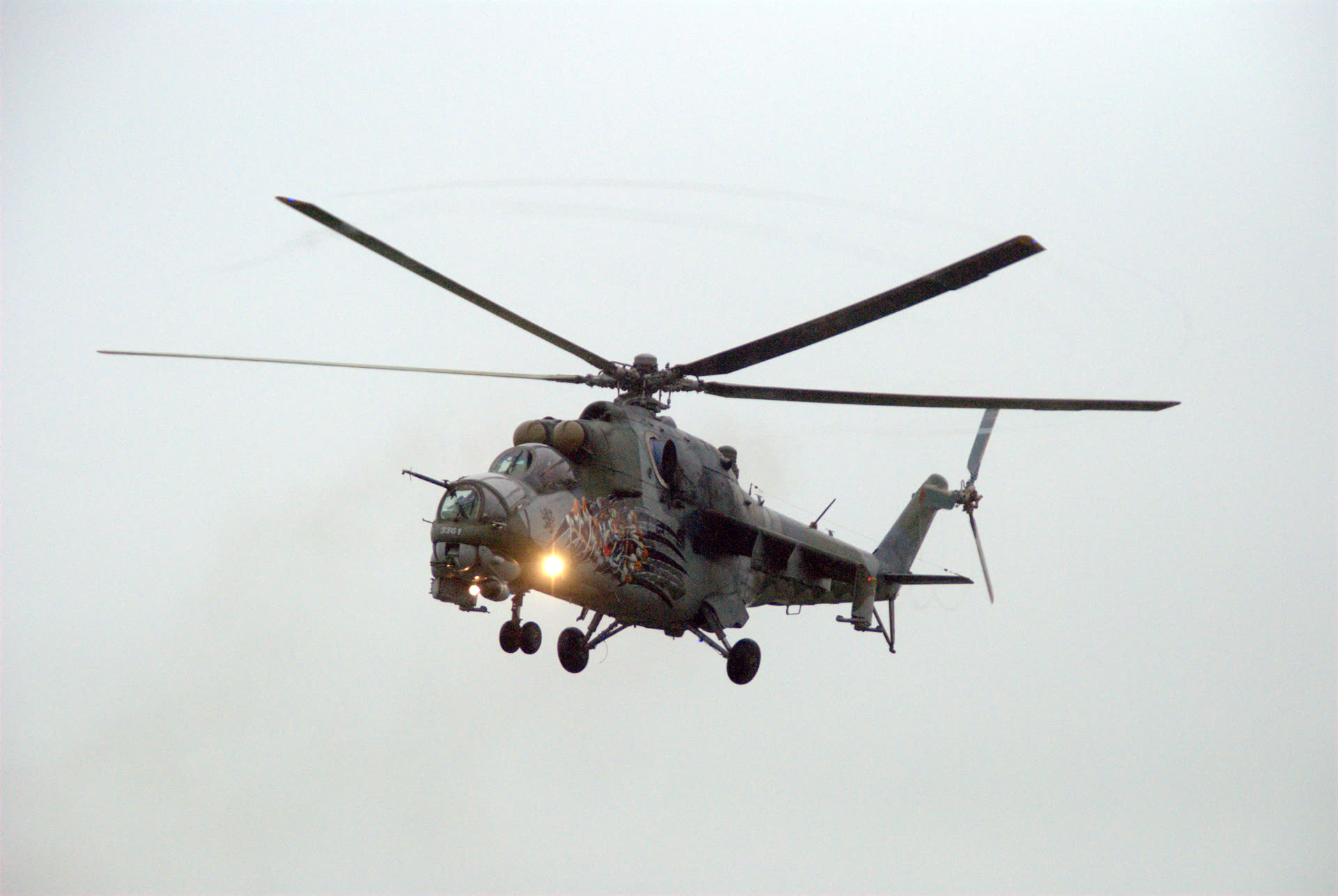
Pictured: a Mil Mi-24 Hind attack helicopter of the Czech Air Force, the same type — a Mi-24D gunship — flown by the 51st Helicopter Regiment at the time of the 1987 encounter, photographed in 2013. This is not a photograph of the specific aircraft or crew involved on July 12, 1987, or of the object itself — no photograph of either is known to exist in any archive or publication consulted for this case file. Photo by Cato Edvardsen, licensed CC BY-SA 3.0.
Theoretical Alignment
This case leans toward the Psycho-Social/Mundane reading, though not overwhelmingly. The Extraterrestrial Hypothesis draws its support from a specific, dramatic performance envelope — a body reportedly capable of holding a near-hover around 60 km/h and then bursting to a calculated 2,700 km/h, anticipating a trained gunship crew's targeting attempts, and using the sun's position as a deliberate evasive tool — behavior that, if accepted at face value, sits well outside any known 1987 aircraft's flight envelope. The Psycho-Social/Mundane reading draws its weight from the case's evidentiary chain rather than from the reported behavior alone: this is a story that reached the public only eleven years after the fact, through a single author's regimental history rather than a contemporaneous report, filtered through a tight-knit military unit's internal retelling during exactly the kind of gap in which a genuinely startling but more mundane radar-and-visual intercept can plausibly accrete embellishment. The Interdimensional Hypothesis finds essentially no support: every description is of a discrete, physically opaque, radar-trackable object with specific (if extreme) aerodynamic behavior, not of a phenomenon suggestive of another plane of existence.
Background
The 51st Helicopter Regiment (51. vrtulníkový pluk) of the Czechoslovak People's Army (Československá lidová armáda) was formally established on September 1, 1974, garrisoned at the airfield in Prostějov, a garrison town in the Olomouc Region roughly 230 km northeast of the Austrian border. Over its two decades of existence the regiment flew a succession of Soviet-built rotary types — Mil Mi-1 (1974–1981), Mi-4 (1974–1985), Mi-8 transport helicopters (1974–1992), Mi-24D gunships (1978–1994), and later Mi-17s (from 1988) — and it would not receive its honorary title, "Vrtulníkový pluk Dr. Edvarda Beneše" (named for the Czechoslovak president who served both before and after the Second World War), until May 9, 1990, nearly three years after the events described in this file; at the time of the 1987 encounter it was simply the 51st Helicopter Regiment, commanded by Colonel Jaroslav Skácel, who led the unit from 1983 to 1990.
Part of the regiment's peacetime mission was border-security patrol along the heavily fortified, closely monitored frontier the Cold War's Iron Curtain drew between Czechoslovakia and neutral Austria — among the most sensitive stretches of airspace in the Warsaw Pact, doubly so in the Znojmo District, whose western edge the border followed closely. Rather than fly every border sortie the roughly 230 km from Prostějov, the regiment maintained forward detachments closer to the frontier: an area near Moravské Budějovice through the mid-1980s, and, from November 1985 onward, the small airfield at Božice, a village a short distance north of Znojmo and only a few kilometers from the Vranov reservoir itself (the regiment would shift this forward border-patrol role again, to Malacky in Slovakia, in the fall of 1987 — a change that fell just months after the July encounter this file documents, and that several secondary accounts of the case describe loosely as "Prostějov" without registering that the crew's actual launch point that day was the Božice detachment, not the regiment's home garrison). It was from Božice, according to every detailed account located for this case file, that the Mi-24 crew launched on July 12, 1987.
Vranov nad Dyjí itself is a small market town on the Dyje river, dominated by a large medieval-and-baroque castle overlooking the Vranovská přehrada, a reservoir completed in 1934 by damming the Dyje that has long served as one of South Moravia's most popular inland recreation destinations — exactly the kind of crowded civilian tourist site that, as this case file discusses at length below, became directly relevant to why the intercepting crew ultimately withheld fire. The reservoir sits within a landscape thick with Cold War infrastructure of a very different kind: the Dukovany Nuclear Power Plant, whose first reactor had been connected to the Czechoslovak grid only two years earlier, in 1985, lies roughly 20 km to the northeast, and the Jaslovské Bohunice nuclear site in neighboring Slovakia — already notorious within the Eastern Bloc for a serious 1977 accident at its A1 reactor — sat along the flight path multiple accounts describe the object taking as it left the area.
The case's ultimate source is Jaroslav Špaček, a nadporučík (senior lieutenant) who served as a pilot within the same 51st Helicopter Regiment. Eleven years after the event, Špaček compiled a regimental history titled Jedenapadesátý aneb historie 51. vrtulníkového pluku vesele i vážně ("The Fifty-First, or a History of the 51st Helicopter Regiment, in Jest and in Earnest"), portions of which were first serialized in the June 1998 issue of L+K (Letectví + Kosmonautika), Czechoslovakia's and then the Czech Republic's long-running aviation magazine, before the full book followed later that year (a second edition appeared subsequently). Every detailed secondary account of this case traces back, directly or through a small number of later interviews, to Špaček's account of what Tesařík's crew told him — a limitation this case file discloses openly, in keeping with this site's standard practice for cases resting on a single ultimate narrator, rather than presenting a book-length reconstruction as equivalent to a contemporaneous, independently corroborated record.
Complete Timeline
| Date | Event |
|---|---|
| Sept. 1, 1974 | The 51st Helicopter Regiment is established at Prostějov airfield. |
| 1978 | The regiment begins flying the Mil Mi-24D gunship, the type involved in the 1987 encounter. |
| Nov. 1985 | The regiment's forward Austrian-border patrol detachment relocates to the airfield at Božice, near Znojmo — the launch point for the July 1987 sortie. |
| 1985 | The Dukovany Nuclear Power Plant's first reactor is connected to the Czechoslovak grid, roughly 20 km from Vranov nad Dyjí. |
| July 12, 1987, ~12:00 | Ground air-defense radar detects an unidentified contact approaching Czechoslovak airspace from over Austria, in the vicinity of the Vranov reservoir. |
| July 12, 1987, shortly after | A Božice-based Mi-24 crewed by Captain Čestmír Tesařík, Ivan Pospíchal, and Milan Šero is scrambled and vectored onto the contact by ground controllers reading off closing distances. |
| July 12, 1987 | The crew achieves visual contact with a dark, wingless, cigar-shaped object over the crowded reservoir; every attempt to bring it into a stable gunsight solution fails as the object changes direction the instant it is targeted. |
| July 12, 1987 | Ground command orders the object shot down; the crew withholds fire, citing the swimmers and sunbathers directly below. |
| July 12, 1987 | The object turns and flies directly at the helicopter; Tesařík executes a hard evasive bank, dropping the Mi-24 several dozen meters near its service ceiling to avoid a collision. |
| July 12, 1987 | The object accelerates away, its speed calculated by the crew as reaching approximately 2,700 km/h, passing near Brno and the Dukovany and Jaslovské Bohunice nuclear plants before disappearing from radar toward Bratislava. |
| July 12, 1987, on landing | According to every account collected for this file, the crew is ordered to erase the flight's radio-communication recordings and flight-parameter data; no official report is known to have survived. |
| Fall 1987 | The 51st Helicopter Regiment's forward Austrian-border patrol role shifts from Božice to Malacky, Slovakia — a change that post-dates the encounter by only a few months. |
| 1999 | Čestmír Tesařík gives an on-camera account of the encounter for the Czech Television program Fakta ČT-1, one of the earliest public airings of the story. |
| 1998 | Jaroslav Špaček's regimental history, serialized that June in L+K magazine and published as a book the same year, becomes the account nearly every later retelling of the case traces back to. |
| May 9, 1990 | The 51st Helicopter Regiment receives its honorary title, "Vrtulníkový pluk Dr. Edvarda Beneše" — a designation that did not yet exist at the time of the 1987 encounter. |
| 2018 | Former Czechoslovak border guard Eduard Nový comes forward publicly with a secondhand account of unusual lights observed from his post near the Austrian border around the same period. |
| 2024 | The case draws a fresh wave of Czech press coverage on its anniversary and inspires Franta mimozemšťan ("Frank the Alien"), a comedic feature film loosely based on the incident. |
| 2026 | This case file is published, replacing the "Coming Soon" queue's placeholder entry. |
The Scramble: A Contact from Austrian Airspace
Every detailed account of this case places its start around midday on July 12, 1987, a summer Sunday when the Vranovská přehrada would have been at its most crowded with domestic tourists escaping the South Moravian heat. Czechoslovak air-defense ground radar registered an unidentified contact approaching from the direction of Austria — itself a serious matter in the militarized calculus of the Iron Curtain border, where any unauthorized incursion from a NATO-adjacent neutral state carried live-fire rules of engagement rather than the benefit of the doubt. The Mi-24 crew on standby at the regiment's forward Božice detachment, Captain Čestmír Tesařík in command with Ivan Pospíchal and Milan Šero aboard, was scrambled and vectored onto the contact by ground controllers, who called off the closing distance in the standard cadence of a ground-controlled intercept: twenty kilometers, fifteen, ten, continuing down through single digits to a few hundred meters before the crew themselves could confirm anything visually.
What resolved out of the haze over the reservoir, in every account, was not an aircraft in any conventional sense: a dark-colored (some retellings say silver or reflective) body, cigar- or torpedo-shaped, estimated at somewhere between 10 and 15 meters in length, with no wings, no cockpit or canopy, no visible intake or exhaust, and — as best the crew could tell over their own rotor noise — no sound of its own. It held roughly level with the helicopter, according to Tesařík's later account, moving at what the crew eventually calculated as a mere 60 km/h, well below anything capable of sustained, controlled flight for a winged aircraft of that era, and a description considerably closer to a hover than to forward flight.
The Gunsight That Would Not Hold
Ground command's response to a confirmed, unidentified, non-Warsaw-Pact-pattern contact violating Czechoslovak airspace was, in the political and military context of 1987, unambiguous: destroy it. The Mi-24D's ASP-17V gyro-stabilized optical gunsight, designed to track a maneuvering target and compute a lead solution for its 12.7–30mm cannon and rocket armament, is the "gunsight" this case's central, most-repeated detail concerns. Every time Tesařík or Pospíchal brought the object into the sight's field of view and began to establish a firing solution, the object changed direction — not randomly, in the crew's account, but as if directly responding to the specific moment targeting began, breaking the lock before a shot could be loosed. At other points in the pursuit the object was reported turning deliberately toward the sun, using the glare to degrade the crew's own optical tracking, a maneuver Tesařík's account treats as evidence of some kind of active, purposeful evasion rather than the incidental drift of an inert or automated object.
This is the detail on which this case's evidentiary weight most depends, and also the detail hardest to independently verify: a gunsight failing to hold lock on a maneuvering target is, mechanically, a mundane and frequent occurrence for any gunship crew, whether the target is evading deliberately, moving unpredictably for entirely ordinary reasons, or simply difficult to track against a bright sky; what makes the Vranov account unusual is the specific, repeated, almost personal quality the crew attributed to the object's response — changing direction at the exact instant a shot became possible, again and again, rather than merely being a fast or erratic target. No source consulted for this case file provides a specific number of distinct targeting attempts, nor any surviving gunsight footage or telemetry; the entire account rests on the crew's own recollection, filtered through Špaček's book eleven years later.
Fire Withheld Over the Reservoir
According to Tesařík's own later, frequently quoted words from his 1999 Fakta ČT-1 television appearance: "When you get an order to fire and realize there are many people below you, especially on a reservoir, then you start thinking a bit differently." Ground command's order to open fire and destroy the object went unexecuted, by every account, specifically because the Mi-24 and its target were operating directly over a reservoir crowded with civilian swimmers and sunbathers on a summer weekend — a scenario in which a 30mm cannon burst or unguided rocket, whether or not it struck its intended target, risked civilian casualties on the ground or in the water below. This detail carries real independent weight regardless of how the object itself is ultimately explained: a trained military crew choosing, in the moment, to defy or quietly decline a direct engagement order on their own safety-of-civilians judgment is a concrete, plausible, and consequential command decision, not an embellishment likely to have been invented for dramatic effect after the fact — if anything, admitting to having declined a direct order was the more professionally and politically risky detail for Tesařík to have volunteered publicly in 1999, only two years after Czechoslovakia had ceased to exist as a state and the old military hierarchy's tolerance for such admissions was untested.
The Near-Collision and the Supersonic Departure
The encounter's most physically dramatic moment came, by every account, when the object reversed its behavior from evasive to what the crew read as directly threatening: rather than continuing to evade, it turned and flew straight at the helicopter. Tesařík's response, described in some detail in secondary accounts of his own retelling, was a hard turn — a bank of roughly 40 degrees to the left with left rudder pressed down — executed at an altitude close to the Mi-24's service ceiling, where the aircraft's performance margin for such a maneuver was already thin; the maneuver caused the helicopter to lose several dozen meters of altitude even as it succeeded in avoiding what the crew believed was an imminent collision. Whatever its ultimate cause, this is described consistently across every account as a genuine, high-stakes flying decision made in real time by a crew who believed they were seconds from a mid-air collision with an object they could not identify, at an altitude where a mishandled recovery carried its own separate risk.
Following the near-collision, the object is described breaking away and accelerating, its speed reconstructed after the fact by Tesařík and Pospíchal from the closing and separation rates ground radar had been calling out; their calculation put the top figure at approximately 2,700 km/h — on the order of Mach 2.2, and well beyond the performance envelope of the Mi-24 itself, whose own maximum speed sits closer to 300–335 km/h, ruling out any possibility of continued visual pursuit. Ground radar reportedly continued tracking the departing contact as it moved northeast toward Brno and then south toward the Bratislava area, its flight path passing close to both the Dukovany and Jaslovské Bohunice nuclear plants, before the contact was lost near the Slovak border; at least one secondary account extends the object's final untracked heading toward Hungary rather than stopping the story at Bratislava, a discrepancy this case file was unable to resolve from the sources available.
Debrief and the Order to Erase
What allegedly happened immediately after the Mi-24 landed is, in a real sense, as consequential to this case's evidentiary status as anything observed in the air. By every secondary account located for this file, the crew was ordered — whether by their immediate command at Božice or a level above it, sources do not agree on specifics — to destroy the recordings of their own radio communications with ground control and the helicopter's flight-parameter data from the sortie. One frequently repeated characterization of the underlying institutional logic, rendered in Czech secondary sources as something close to "what we don't understand doesn't exist," casts the destruction order less as an active cover-up of a specific finding than as a bureaucratic reflex against filing an incident report the chain of command had no template or appetite for handling. No primary Czechoslovak military document related to this sortie — no radar log, no incident report, no debrief transcript — was located by this case file's own research in any published or online archive, Czech or otherwise, and at least one secondary source states explicitly that a search of the Central Military Archive in Prague turned up nothing.
This case file treats the records-destruction claim honestly as exactly what it is: a real, specific, and plausible feature of Cold War Czechoslovak military bureaucracy under a regime with every institutional incentive to avoid documenting an unexplained failure to identify or destroy an airspace violator, but also a claim that is, by its nature, almost impossible to independently verify or falsify decades later. A destroyed record and a record that was never especially detailed to begin with would look identical from the outside; this case's total absence of primary documentation is consistent with either.
From Cockpit to Print: How the Story Reached the Public
What sets this case apart from a great many unpublicized military encounters is not that it eventually became a matter of record, but how long that took and through what specific channel. For eleven years, by every account, the July 1987 sortie existed only as an internal story within the 51st Helicopter Regiment — the kind of dramatic, unresolved tale that circulates informally among a unit's own personnel but never reaches a journalist, a formal archive, or the public. That changed only because Jaroslav Špaček, a fellow pilot within the same regiment, undertook to write its history, gathered Tesařík's crew's account as part of that larger project, and included it — first in a serialized excerpt carried by L+K (Letectví + Kosmonautika) magazine in June 1998, then in the full book, Jedenapadesátý aneb historie 51. vrtulníkového pluku vesele i vážně, published later that same year. Every detailed Czech-language account of this case that this research located — across Czech Wikipedia, Aktuálně.cz, e15.cz, Deník.cz's regional network, Reflex.cz, Seznam Médium, Dotyk.cz, and the ufology research site Projekt Záře — traces back, directly or through a short chain of interviews, to Špaček's book as the case's ultimate primary source.
Tesařík himself gave a further, independent public account the following year, in 1999, on the Czech Television program Fakta ČT-1, a segment that appears to be the earliest instance of a direct participant discussing the case on camera rather than through Špaček's written narration, and the source of the "many people below you" quotation used throughout later retellings. In 2018, the story gained a further, independent thread when a former Czechoslovak border guard, Eduard Nový, came forward publicly to describe having separately observed unusual aerial activity from his own post along the Austrian frontier during roughly the same period — a secondhand, unverified-in-detail account this case file discloses honestly as suggestive corroboration rather than confirmed independent evidence, since this research could not examine Nový's specific claim in the detail available for the crew's own testimony. The case has continued to draw renewed mainstream Czech press interest into the 2020s, including a coordinated 2024 anniversary feature carried across Deník.cz's regional network of South Moravian and Vysočina papers, and it inspired Franta mimozemšťan ("Frank the Alien"), a 2024 comedic feature film loosely based on the incident — itself a further sign of how firmly the story has entered Czech popular culture, independent of whatever the object itself ultimately was.
A Story Told Eleven Years Later: Disclosed Inconsistencies
Because this case's entire evidentiary record passes through a single narrator writing more than a decade after the fact, this case file's own research surfaced a number of real, unresolved inconsistencies across the secondary accounts that cite Špaček's book — disclosed here directly rather than silently smoothed over into one artificially clean narrative. The exact ranks given for Pospíchal and Šero vary meaningfully across sources, from "flying officer" to "senior sergeant" to "senior lieutenant," which this case file could not resolve to a single authoritative figure without access to Špaček's book itself. The total pursuit duration is given as anywhere from roughly 90 minutes to approximately 2.5 hours depending on the retelling, a range wide enough that it likely reflects different authors measuring different phases of the encounter (radar contact to radar loss, versus active visual engagement only) rather than a single consistent figure. The object's color is described as both "dark/black" and "silver/reflective" across different accounts — not necessarily a true contradiction, since a dark body catching direct sunlight at certain angles could plausibly read as either, but not a discrepancy this research was able to resolve definitively either way. And Špaček's own precise role is the least consistent detail of all: most detailed accounts describe him strictly as the regiment's later chronicler, gathering Tesařík's crew's testimony after the fact, while at least one source places him aboard the helicopter itself as a second pilot. This case file's own best reading, given the balance of sources, treats Špaček primarily as the account's author and preserver rather than a direct participant in the July 12 sortie itself, while disclosing that the sources do not speak with one voice on this point.
Key Witnesses
Captain Čestmír Tesařík
The crew's aircraft commander and the pilot who executed the evasive maneuver at the encounter's climax, and later the crew member most frequently quoted directly, including in his own 1999 Fakta ČT-1 television appearance. His account is the anchor for this case's most consequential detail — the decision to withhold weapons fire over the crowded reservoir — and for the after-the-fact speed calculation that gives the case its most extreme performance claim.
Ivan Pospíchal
The second named crew member, credited alongside Tesařík with reconstructing the object's calculated speed from the encounter's closing and separation rates. His exact rank is given inconsistently across secondary sources, a discrepancy this case file discloses above rather than silently resolving.
Milan Šero
The third named crew member aboard the helicopter. As with Pospíchal, no source consulted for this case file provides independent, separately published testimony from Šero in his own words; his corroboration reaches the modern record through Tesařík's and Špaček's accounts of the crew's shared experience.
Jaroslav Špaček
Not, on this case file's own best reading of the available sources, a direct participant in the July 12, 1987 sortie, but the single individual most responsible for this case existing as a documented, publicly known story at all: eleven years after the fact, he gathered Tesařík's crew's account into his own history of the 51st Helicopter Regiment, first serialized in L+K magazine in June 1998, and every detailed secondary account of this case traces back to that work.
Eduard Nový
Came forward publicly in 2018 with a secondhand account of unusual aerial activity observed from his own post along the Austrian border during roughly the same period as the helicopter encounter. This case file treats his account as suggestive, independently sourced ground corroboration rather than confirmed, itemized evidence, since it could not examine the specific content and dating of his claim in the same detail available for the aircrew's own testimony.
The Five Observables Assessment
Assessment: Anti-Gravity Lift is rated Speculative rather than Present: the object was reported holding a near-stationary position at roughly 60 km/h, which is suggestive of hovering flight but was never explicitly described as lift generated without rotors, wings, or any visible means of propulsion in the specific terms this framework's category requires; no witness account consulted describes the mechanism of the object's apparent hover, only its outcome. Instant Acceleration and Hypersonic Velocity are both rated Present as claimed, on the strength of the crew's own after-the-fact calculation of a jump from roughly 60 km/h to approximately 2,700 km/h — but this case file flags plainly that "claimed" is the operative qualifier: no radar tape, gunsight footage, or independent instrumented record of this calculation survives for this research to examine directly, and the figure rests entirely on two crew members' own reconstruction, filtered through a chronicler's book written eleven years after the fact. Low Observability is rated Absent specifically because ground radar is described as tracking the object continuously, from initial detection through to its disappearance near the Slovak border — a stealth-defeating radar signature is not consistent with the case's own account of continuous ground-radar contact, whatever else the object might have been. Trans-Medium Travel is rated Absent as inapplicable; nothing in this case involves a body of water or any other transition between physical media in the sense this category tracks.
Evidence Assessment
Supporting Anomalous Origin
- A three-man military gunship crew, not a single unsupported witness, and guided throughout by independent ground radar controllers who were themselves tracking the same contact
- The crew's decision to withhold weapons fire over a crowded civilian reservoir, in apparent defiance of a direct order, is a specific, high-stakes, and plausible real-world command decision rather than an embellishment likely invented after the fact
- The near-collision and the resulting hard evasive maneuver at an altitude close to the Mi-24's service ceiling reflects a genuine, safety-driven, real-time flying decision by a trained military pilot, not idle wonder at an unusual light
- A repeated, specific pattern of evading targeting at the exact moment a firing solution became achievable, rather than merely erratic or fast movement, is the case's most distinctive reported behavior
- The case has drawn sustained, independent interest from multiple mainstream Czech news organizations across nearly three decades, rather than circulating solely within a single fringe ufological network
Supporting Conventional Explanation
- No radar tape, gunsight footage, photograph, or any other instrumented or physical record of the encounter has been located in any archive or publication consulted for this case file; the entire account rests on witness recollection
- The story reached the public only eleven years after the event, through a single author's regimental history rather than a contemporaneous report — exactly the kind of gap in which a genuinely dramatic but more mundane encounter can plausibly accrete embellishment through internal retelling within a tight-knit military unit
- Secondary accounts of the case disagree with each other on multiple specific points — crew ranks, pursuit duration, the object's exact color, and even Jaroslav Špaček's own role as participant versus chronicler — a pattern more consistent with a story that has drifted across nearly three decades of retelling than with one anchored to a single, stable, contemporaneous record
- The claimed destruction of official records, while a plausible feature of Cold War Czechoslovak military bureaucracy, is also a claim that is inherently unfalsifiable and convenient for a story that might otherwise be expected to have left some documentary trace
- The case's single most extreme performance claim — a jump from a near-hover to roughly Mach 2.2 — rests entirely on two crew members' own after-the-fact mental reconstruction of closing rates called out by ground radar, not on any surviving instrumented measurement
Why "Disputed"
This case earns a DISPUTED classification with a credibility score of 43/100, placing it in the lower-middle portion of this catalogue's Disputed range — above single-witness, purely visual cases with no independent radar corroboration such as Thomas Mantell (Disputed, 38), but below cases with either stronger contemporaneous documentation, such as the multiply-corroborated same-night account in The Ota Air Base Encounter (Disputed, 59), or genuine instrumented physical corroboration, such as the altimeter anomaly in the Coyne Helicopter case (Credible, 81). What keeps this case meaningfully above the bottom of the Disputed range is real: a three-man military aircrew rather than a single observer, independent ground-radar tracking of the same contact throughout the encounter, and a specific, high-stakes, plausible command decision — withholding fire over civilians — that reads as a genuine real-world judgment call rather than embellishment.
What holds this case down in the lower-middle of that range, rather than pushing it toward Ota's or Oscoda's tier, is this case's single defining structural weakness: unlike Ota, where all four pilots gave a same-night signed declaration and press interview, this case's entire public record begins eleven years after the fact, through one author's regimental history rather than a contemporaneous report from any of the three crew members themselves. That gap is long enough, and the resulting secondary accounts inconsistent enough with each other on basic details — ranks, duration, the object's color, even the chronicler's own role — to leave real, disclosed uncertainty about how much of the story as it exists today reflects the original 1987 encounter cleanly versus nearly three decades of retelling within a small, close social network of military aviators and the journalists who later interviewed them. No radar tape, gunsight footage, or other instrumented record survives for independent examination, and the claimed destruction of official documentation, while plausible, cannot be verified. This case file's own judgment is that the underlying event was very likely real and very likely a genuinely difficult intercept that ended without resolution — but that the specific, extreme performance figures attached to it (the near-hover, the Mach 2.2 dash, the object's apparently deliberate targeting evasion) carry meaningfully less evidentiary weight than a case with a same-day report or any surviving instrumented data would.
Sensor & Instrumentation Detection Profile
Ground air-defense radar is described in every detailed account as having detected, tracked, and guided the intercepting helicopter onto the object continuously from initial contact near the Austrian border through to its disappearance near the Slovak border — making this, unusually among this catalogue's older military cases, an encounter with a documented (if not surviving) radar component rather than a purely visual sighting. The Mi-24D's ASP-17V optical gunsight is the only other instrument this case's record specifically involves, and its repeated failure to hold a stable lock on the object is the case's single most-repeated behavioral detail. No source consulted for this case file states that any gunsight footage, radar tape, or flight-data recording survives; by every account, exactly these records are what the crew was ordered to destroy upon landing. This case file's own research located no independent radar log, from any allied or neutral source on the Austrian side of the border, that might corroborate or contradict the Czechoslovak military's own tracking.
Environmental & Geospatial Context
The encounter took place over one of Cold War Czechoslovakia's most sensitive and most heavily surveilled stretches of airspace: the Iron Curtain frontier with neutral Austria, in the Znojmo District of South Moravia, an area whose proximity to a non-Warsaw-Pact state made any unauthorized aerial incursion a matter of immediate air-defense concern rather than routine air-traffic administration. The specific location — directly over the Vranovská přehrada, a reservoir crowded with civilian swimmers and sunbathers on a summer weekend — is itself an important environmental fact rather than incidental scene-setting, since it was precisely that civilian presence that led the intercepting crew to withhold weapons fire despite a direct order. The broader area's other defining environmental feature is its proximity to nuclear infrastructure: the Dukovany Nuclear Power Plant, its first reactor connected to the grid only two years before the encounter, sits roughly 20 km to the northeast, and the object's reported departure path carried it near Dukovany and then near the Jaslovské Bohunice nuclear site in Slovakia before radar contact was lost — a routing this catalogue's broader pattern of UAP-near-nuclear-facility reports (explored further on this site's dedicated UFOs and Nukes theory page) treats as a recurring, if unproven, area of interest rather than as confirmation of any specific surveillance motive. No specific meteorological record for July 12, 1987 was located in any source consulted; the reservoir's description as crowded with sunbathers, and the object's reported use of the sun's glare as a tactical evasion, together imply clear or largely clear midsummer daytime conditions, though this case file's research could not confirm cloud cover, visibility, or wind data for the specific date and hour.
Observer Credibility & Occupational Profile
The three named crew members were, at the time of the sighting, serving military gunship aviators — a Mi-24D attack helicopter crew trained specifically for weapons-delivery precision, ground-controlled intercept procedures, and the kind of disciplined, high-stakes real-time decision-making a hard evasive bank at near-ceiling altitude, and a decision to withhold ordered weapons fire, both reflect. Tesařík in particular, as aircraft commander, carried direct responsibility both for the tactical decisions made in the cockpit and, ultimately, for his own willingness to discuss the encounter publicly on Czech television in 1999 — a decision that, like Lemos Ferreira's in this catalogue's separate Ota Air Base case, carried no obvious professional upside and some risk of ridicule, yet which he made anyway.
This case's observer-credibility profile has a real limitation this case file discloses directly: unlike cases with independently published testimony from each individual witness, Pospíchal's and Šero's corroboration reaches the modern record almost entirely through Tesařík's and Špaček's retellings of the crew's shared experience, not through separately documented accounts in their own words. Neither their subsequent careers nor any independent interview with either man was located in any source consulted for this case file. Ground radar controllers, whose independent tracking is repeatedly cited as corroborating the crew's own account, are never named in any source this research examined, making their contribution to the case's credibility a matter of secondhand characterization (that radar detected and guided the intercept) rather than of any controller's own on-record testimony.
Physical & Material Assays
No physical trace evidence of any kind exists for this case. The object was never reported to land or deposit any debris, and no sample, impression, or recovered material is claimed to exist in any source consulted for this case file. The case's entire evidentiary record is testimonial and documentary rather than physical: crew recollection, a single author's regimental history, and a handful of later broadcast and print interviews. See Material Analysis below for a fuller discussion of what survives of that documentary record and what does not.
Historical Precedents & Archive Matches
Within this catalogue, the Vranov nad Dyjí Helicopter Incident belongs to a specific and recurring category: a multi-crew military-aircraft encounter, corroborated by independent ground tracking, in which the story's public disclosure was significantly delayed relative to the event itself. Its closest structural echo is this site's own Coyne Helicopter Incident (October 1973), which likewise involves a multi-person military helicopter crew and a reported near-collision with an unidentified object, though Coyne's case includes a same-encounter instrumented altimeter anomaly this case lacks. Within this catalogue's own recent additions documenting Cold War-era military pursuits, this case is most directly comparable, in evidentiary shape rather than geography, to The Ota Air Base Encounter (September 1957) — another military-aircrew sighting whose full public record depends heavily on a single lead narrator's own retellings, though Ota's narrator gave a same-night signed declaration, a stronger contemporaneous anchor than this case possesses. Geographically and politically, this case also belongs alongside the Finnish Air Force "Seven Balloons of Pori" case (April 1969) as an example of a Cold War-era military sighting occurring directly astride the frontier between the Warsaw Pact and a neutral or Western-aligned state, a category of case in which the political stakes of any unauthorized airspace incursion shaped the military response as much as the object's own reported behavior did. No specific prior or subsequent UFO report at Vranov nad Dyjí itself, distinct from this 1987 encounter, was located in any source consulted for this case file.
Material Analysis
There is no physical object, debris, or trace sample connected to this case; "material" here refers instead to the case's actual surviving evidentiary substrate — Jaroslav Špaček's 1998 book and its June 1998 L+K magazine serialization, Čestmír Tesařík's 1999 Fakta ČT-1 television appearance, and roughly three decades of subsequent Czech press retellings — since that documentary and testimonial record is the only tangible thing this case file's research was able to assess directly.
The Surviving Documentary Record
The core of this case's paper trail, as reconstructed from secondary Czech-language sources, consists of Špaček's Jedenapadesátý aneb historie 51. vrtulníkového pluku vesele i vážně (1998, with a later second edition), the June 1998 L+K serialization that first brought portions of the account into print, and Tesařík's 1999 Fakta ČT-1 interview. Czech Wikipedia's own detailed "UFO nad Vranovem" entry synthesizes these and later press accounts and is itself sourced substantially to the same chain. Separately, the specialized Czech aviation-history site vrtulnik.cz and the military-history reference valka.cz independently confirm the regiment's founding date, home base, aircraft types, forward Božice detachment, and command structure — genuine, if narrowly technical, corroboration of the unit-history context surrounding the encounter, even though neither source addresses the UFO incident itself.
What Does Not Survive
No radar tape, gunsight footage, flight-data recording, incident report, or debrief transcript from the July 12, 1987 sortie was located in any archive, publication, or online source this case file's research was able to access directly; at least one secondary source states plainly that a search of the Central Military Archive in Prague turned up nothing on the incident. This case file's own research was also unable to directly examine Špaček's original book text, relying instead on secondary Czech press accounts that quote and paraphrase it; every specific quotation attributed to Tesařík in this case file traces back to secondary reporting on his 1999 television appearance rather than to this case file's own examination of the broadcast itself. This is a materially thinner and more indirect documentary record than exists for some of this catalogue's better-preserved military cases, and this case file discloses that limitation directly rather than presenting secondary synthesis as equivalent to primary-source verification.
Supporting Non-Terrestrial or Unexplained Origin
- A three-man military aircrew and independent ground radar controllers, not a single uncorroborated observer, are described as tracking the same contact throughout the encounter
- The specific, high-stakes command decision to withhold ordered weapons fire over a crowded civilian reservoir is a concrete, plausible real-world judgment call that reads as authentic rather than embellished
- The case has drawn independent, sustained interest from multiple mainstream Czech news organizations across nearly three decades, a pattern more consistent with a story journalists kept finding worth re-examining than with a single fabricated anecdote
Supporting Terrestrial or Mundane Origin
- This case file's research could not directly examine Špaček's original 1998 book, the original L+K serialization, or the original 1999 Fakta ČT-1 broadcast, relying instead on secondary press synthesis of all three
- No radar tape, photograph, or any other instrumented or physical record of the object survives in any archive consulted
- The eleven-year gap between the event and its first publication, combined with real, disclosed inconsistencies across later retellings (crew ranks, pursuit duration, the object's color, Špaček's own role), is a pattern consistent with embellishment accreting through internal retelling within a small, tight-knit military and journalistic social network
- The claimed destruction of official records is a convenient, unfalsifiable claim that this case file could not independently verify
The Conventional Explanation Candidate (CEC): Legend Growth Across an Eleven-Year Publication Gap
The single most structurally distinctive conventional candidate for this case — and the one this case file's own research treats as carrying the most weight — is not a specific misidentified object at all, but a process: a genuinely unusual, difficult, and unresolved radar-and-visual intercept, real in its broad outline, whose most extreme specific details (the object's precise behavior, its calculated top speed, the exact sequence of the gunsight evasions) were shaped, sharpened, or exaggerated across eleven years of internal retelling within a small, closed military unit before ever reaching print, and then further across nearly three decades of subsequent press retelling. This candidate does not require assuming anyone lied; it only requires the well-documented, ordinary tendency of a dramatic story to sharpen and simplify with each retelling, especially one first written down more than a decade after the fact by someone who was not himself necessarily present. The real, disclosed inconsistencies this case file found across secondary sources — on crew ranks, pursuit duration, the object's color, and Špaček's own role — are the specific evidence supporting this candidate, rather than a generic assumption of unreliability.
Western Fighter Jet Misidentification
A recurring skeptical suggestion found across secondary sources proposes that the object was a Western military aircraft — specifically the F-104 Starfighter or F-111 Aardvark have been named — that strayed across or was deliberately probing the border. This case file assesses this candidate as a poor fit and notes that the crew themselves are consistently described as having rejected it on much the same grounds this file does: no aircraft of that era, Western or Soviet, could sustain a controlled near-hover around 60 km/h, then accelerate to a claimed Mach 2.2, nor remain airborne for a reported 90 minutes to 2.5 hours without any indication of aerial refueling.
Soviet or Allied Secret Prototype Aircraft
Given the case's Iron Curtain border setting and its proximity in time to genuinely classified Cold War aviation testing programs on both sides of that border, an undisclosed prototype aircraft is a candidate this case file cannot rule out, but it remains entirely speculative: no specific program, airframe, or corroborating record of any nation testing an aircraft with this performance envelope near the Austrian-Czechoslovak border in 1987 was located in any source consulted.
Weather or Reconnaissance Balloon
A balloon drifting near the border is a candidate that fits poorly with this case's most dramatic reported behaviors — a directed evasion of gunsight lock, a deliberate turn toward the sun, and a supersonic departure — none of which have any obvious balloon-based analogue, even accounting for the possibility of an inflated account.
Genuine Unidentified Craft
This reading remains open given the case's combination of a multi-person military aircrew, independent ground-radar corroboration, and a specific command decision (withholding fire over civilians) that reads as authentic. It is tempered heavily by the eleven-year gap before publication, the total absence of any surviving instrumented record, and the real inconsistencies across the secondary accounts that reconstruct this case's most extreme performance claims.
Legend Growth Across the Publication Gap
PlausiblePLAUSIBLE as a partial explanation for the case's most extreme specific details. A genuinely unusual, unresolved intercept is entirely consistent with the crew's core account; the specific performance figures and behavioral details most likely to have sharpened across eleven years of internal retelling before publication are exactly the ones this case file treats with the most caution.
Western Fighter Jet Misidentification
ImplausibleIMPLAUSIBLE. No Western or Soviet aircraft of the era could combine a controlled near-hover with a claimed Mach 2.2 dash and a multi-hour endurance without refueling.
Secret Prototype Aircraft
InconclusiveINCONCLUSIVE. Plausible in principle given the sensitive Iron Curtain border setting, but entirely speculative; no specific program or corroborating record was located.
Weather or Reconnaissance Balloon
ImplausibleIMPLAUSIBLE. The reported directed gunsight evasion, deliberate sun-glare maneuver, and supersonic departure have no obvious balloon-based analogue.
Genuine Unidentified Craft
InconclusiveINCONCLUSIVE. Supported by a multi-person military crew and independent radar corroboration, but limited by the eleven-year publication gap and the total absence of surviving instrumented data.
Related Cases
Search Czech Government & Military Archives Directly
No specific declassified Czechoslovak military file, radar log, or incident report for this July 12, 1987 sortie could be located and verified in this case file's own research; at least one secondary source states a search of the Central Military Archive in Prague itself found nothing on the incident, consistent with the records-destruction claim discussed above. The search portals below are provided for readers who wish to pursue primary verification directly.
Further Reading — Recommended Literature
The Soviet UFO Files: Paranormal Encounters Behind the Iron Curtain
The standard English-language survey of Eastern Bloc UFO cases, including military encounters and the specific institutional habit — visible in this case's own records-destruction claim — of Warsaw Pact militaries treating unexplained aerial contacts as bureaucratic non-events rather than filed incidents.
A History of Military Encounters with UFOs: Explanations and Combat Strategies
A cross-national survey of military dogfights and near-collisions with unidentified aircraft, useful context for situating this case's gunsight-evasion and near-collision details within a broader pattern of aircrew encounters worldwide.
UFOs and the National Security State: Chronology of a Coverup, 1941–1973
A scholarly chronology of government secrecy practices around UFO reports; relevant background for assessing how plausible this case's own claimed order to destroy radio and flight-data recordings is against a wider pattern of military information control.
The UFO Encyclopedia, 4th Edition (2-Volume Set)
A broad, cross-referenced reference work covering military-witness UFO cases worldwide, useful for situating this Czechoslovak encounter within the wider tradition of Cold War-era pilot and aircrew sightings.
Above Top Secret: The Worldwide UFO Cover-Up
A wide-ranging survey of international government UFO files, published the same year as this case's own encounter, offering useful global context for how Warsaw Pact military secrecy compared with contemporaneous Western practice.
Essential Viewing
Záhady TV Prima — UFO Tracked by the Czechoslovak Army Over the Vranov Reservoir
A Czech television mystery-program segment (broadcast on TV Prima, uploaded by the Czech UFO research club KPUFOeu) devoted specifically to the Vranov reservoir intercept, covering the crew's account and the case's evidentiary gaps.
Armádní souboj s UFO: Nový svědek a další incident
A Badatelé (Czech investigative/paranormal-research) production covering the Vranov case directly, including the 2018 emergence of former border guard Eduard Nový's corroborating account.

UFO nad Vranovem
A dedicated Czech-language walkthrough of the case's timeline and sourcing, from the July 1987 sortie through Špaček's 1998 book to the case's continued place in Czech popular culture.
Sources
- Wikipedie (Czech). "UFO nad Vranovem." cs.wikipedia.org
- Aktuálně.cz (Magazín). "UFO nad Vranovem 1987: Když československá armáda bojovala s neznámým objektem." magazin.aktualne.cz
- e15.cz. "Záznamy o UFO museli piloti smazat, prozrazuje pilot Špaček v knize." e15.cz
- Dotyk.cz. "V roce 1987 se armáda nad Vranovskou přehradou setkala s UFO. Pilot stíhal podivný doutníkový objekt." dotyk.cz
- Dotyk.cz. "V roce 1987 se armáda nad Vranovem setkala s UFO. Vysvětlení dodnes neexistuje." dotyk.cz
- Dotyk.cz. "Nad Vranovem se střetlo UFO s vojenským vrtulníkem. Armáda doteď nemá vysvětlení." dotyk.cz
- ARMYWEB.cz. "V roce 1987 se český armádní vrtulník střetl s pravděpodobným UFO." armyweb.cz
- G.cz. "UFO nad Vranovem: Nikdy nevysvětlená záhada, která překvapila i Československou armádu." g.cz
- Reflex.cz. "UFO v Česku: Miličínské koule a střelba na záhadný doutník nad Vranovskou přehradou." reflex.cz
- Seznam Zprávy (Komentáře). "V roce 1987 se armáda nad Vranovem setkala s UFO. Vysvětlení dodnes neexistuje." seznam.cz
- Médium (Seznam.cz). "Naháněli 15metrový objekt letící rychleji než zvuk nad Dukovany. Režim pak vymazal všechny záznamy." medium.seznam.cz
- Deník.cz (regional network). "Hon na UFO nad Třebíčskem/Vysočinou/jižní Moravou. Armádní vrtulník se zapojil do bizarní akce." denik.cz
- Znojemský deník. "UFO nad Vranovem ožívá ve filmu Franta mimozemšťan." znojemsky.denik.cz
- PraguePig.com. "The Vranov nad Dyjí UFO Case." praguepig.com
- Valka.cz (military history reference). "51. vrtulníkový pluk [1974–1992]." valka.cz
- English Wikipedia. "List of UFO sightings in the Czech Republic." en.wikipedia.org
- English Wikipedia. "Vranov nad Dyjí." (Geography, population, and location background for the town and reservoir.) en.wikipedia.org
- Wikimedia Commons. "Czech Air Force Mil Mi-24 Hind reg. 3361 at Orland Main Air Station.jpg" (Cato Edvardsen, CC BY-SA 3.0), source of this case file's hero image. commons.wikimedia.org
- YouTube (oEmbed-verified). "Záhady TV Prima — případ sledování UFO čs. armádou nad Vranovskou přehradou" (KPUFOeu). youtube.com
- YouTube (oEmbed-verified). "Armádní souboj s UFO: Nový svědek a další incident" (Badatelé). youtube.com
See something inaccurate? Have additional information or sources?
Suggest an Edit →Last Updated: August 2026