
The Ota Air Base Encounter
At 19:21 on September 4, 1957, four Ota Air Base pilots of the Portuguese Air Force's 20th Squadron — Captain José Lemos Ferreira leading three sergeants in a flight of F-84G Thunderjets — took off on a routine night navigation exercise toward Spain. Somewhere over the Córdoba–Cáceres corridor, all four watched a brilliant, color-shifting sphere hang above the horizon, swell and contract repeatedly for the better part of 35 minutes, then shed three or four smaller lights that accelerated toward the formation and scattered it. The case became known in Portugal as the "Caso Lemos Ferreira" — not primarily because of what was seen, but because of who saw it: the same Captain Ferreira rose over the following two decades to four-star general, serving as Chief of Staff of the Portuguese Air Force from 1977 to 1984 and of the Armed Forces from 1984 to 1989, and while still holding that first post he personally authorized a civilian scientific commission's access to Air Force files and to Ota itself — an institutional decision this file argues counts as a genuine, if informal, reopening of official interest in his own encounter. This file is deliberately distinct from, and should not be confused with, an unrelated November 2, 1982 sighting also associated with the Ota area, involving different witnesses and a structured metallic disc rather than a luminous sphere; the distinction is addressed explicitly below.
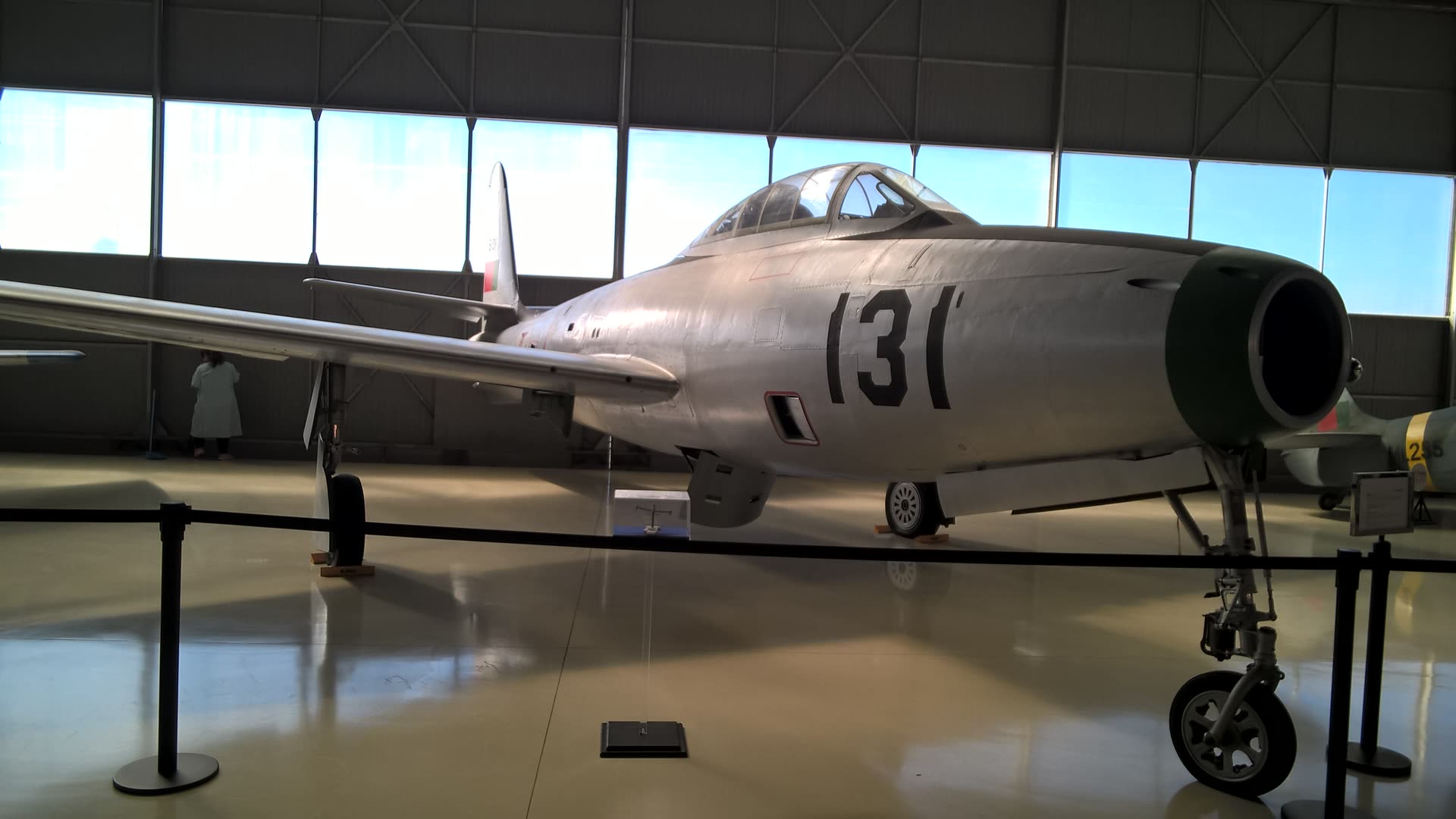
Pictured: a Republic F-84G Thunderjet, the exact type flown by Lemos Ferreira and his three sergeant pilots on the night of the encounter, preserved today at Portugal's Museu do Ar (Air Museum) in Sintra. This is not a photograph of one of the four specific aircraft involved on September 4, 1957, or of the object itself — no photograph of the object exists in any archive consulted for this case file, and no photograph of the specific airframes flown that night could be located and rights-cleared. Photo by GualdimG, licensed CC BY-SA 4.0.
Theoretical Alignment
This case splits almost evenly between the Extraterrestrial and Psycho-Social/Mundane readings, and that near-even split is itself the most honest single summary of its evidentiary character. The Extraterrestrial Hypothesis draws real support from behavior that a simple misidentified light struggles to explain on its own: a single luminous source that repeatedly changed color through a specific sequence, expanded and contracted several times over minutes rather than seconds, and eventually appeared to release three or four smaller lights that moved toward the formation with enough apparent speed and purpose that four trained pilots broke formation to avoid a possible collision. The Psycho-Social/Mundane reading draws equally real support from the case's total absence of any instrumented corroboration — no radar, no photograph, nothing recovered — and from the well-documented tendency of a genuinely unusual, sustained point of light near the horizon, observed at night from a moving aircraft with no fixed reference points, to appear to pilots to change size, shape, and color as their own eyes and expectations struggle to parse it, especially once one pilot's initial excited description begins to shape what the others expect to see. The Interdimensional Hypothesis finds little purchase here: every description is of a discrete, visually opaque light source with specific, repeatable behavior, not a phenomenon suggestive of another plane of existence.
Background
Base Aérea Nº 2 (BA2), universally known simply as Ota after the Alenquer-municipality parish where it sits roughly 40 kilometers north of Lisbon, had been a Portuguese Air Force installation since 1940. On May 15, 1953, it became home to Esquadra 20 (20th Squadron), the first jet-equipped combat unit in Portuguese Air Force history, when the first 25 of an eventual 125 Republic F-84G Thunderjets arrived straight from the factory. A second unit, Esquadra 21, followed in 1954 as further airframes arrived from allied surplus stocks, and the two squadrons together formed Grupo Operacional 201, tasked with air defense and, increasingly, ground-attack training. Esquadra 20 adopted red as its squadron color and a black F-84G intertwined with the number 20 as its emblem; in 1956, pilots drawn from the squadron formed the Dragões (Dragons), an aerobatic display team that flew F-84Gs out of Ota until 1958, when the squadrons re-equipped with F-86 Sabres and the display role passed to a new team at Monte Real Air Base.
José Lemos Ferreira was born on June 23, 1929. He entered the Air Force's aeronautics course on November 13, 1948, earned his pilot's brevet on March 31, 1951, and completed a further course of training in the United States the following year. Promoted through Alferes (September 1952), Tenente (December 1954), and Capitão (December 1956), he assumed command of Esquadra 20 at Ota on March 11, 1957 — not yet 28 years old, and less than six months before the encounter that would make him nationally known for reasons that had nothing to do with his flying skill. By September 1957, then, Ferreira was not merely one pilot among four; he was the squadron's actual commanding officer, leading a routine night navigation exercise of the kind Esquadra 20 flew regularly to keep its jet pilots current in instrument and cross-border flying between Portugal and Spain, two nominally allied Iberian air forces that cooperated on training airspace under bilateral arrangements of the period.
The three sergeant pilots who flew as his wingmen that night — Alberto Gomes Covas, Salvador Alberto Oliveira, and Manuel Neves Marcelino — are, like the great majority of enlisted and non-commissioned aircrew across this catalogue's older cases, far less documented in the public record than their commanding officer. No source consulted for this case file provides birthdates, subsequent careers, or personal photographs for any of the three; what survives is that all three flew that night, all three gave consistent accounts afterward, and all three signed the same declaration Ferreira signed upon landing. This case file treats that asymmetry of documentation honestly: Ferreira's later fame as a general is precisely why his own account survives in such detail across six decades of retrospective interviews, while his three sergeants' accounts survive largely as supporting, corroborating detail folded into Ferreira's own retellings rather than as independently sourced testimony in their own right.
Complete Timeline
| Date | Event |
|---|---|
| May 15, 1953 | Esquadra 20 is inaugurated at Ota Air Base (BA2) with the first Republic F-84G Thunderjets delivered to the Portuguese Air Force — the country's first operational jet squadron. |
| March 11, 1957 | Captain José Lemos Ferreira assumes command of Esquadra 20 at Ota. |
| Sept. 4, 1957, 19:21 | Ferreira leads a flight of four F-84G Thunderjets off from Ota on a scheduled night navigation exercise across the Portugal–Spain border, with Sergeants Alberto Gomes Covas, Salvador Alberto Oliveira, and Manuel Neves Marcelino as his wingmen. |
| Sept. 4, 1957, ~20:00–20:30 | Somewhere along the Córdoba–Cáceres leg of the route, at an altitude reported variously as approximately 25,000 feet or approximately 9,000 meters (~29,500 feet), Ferreira notices an unfamiliar light above the horizon and watches it for three to four minutes before alerting the other three pilots over the formation's interphone. |
| Sept. 4, 1957, following ~35 minutes | All four pilots track the object as it changes color through a green–blue–yellow–red sequence and repeatedly expands to several times its initial apparent size before contracting again. |
| Sept. 4, 1957, near the end of the encounter | Near Coruche, on the return leg into Portuguese airspace, a small yellow circle of light detaches from the main object, followed by two or three more; the smaller lights, and possibly the primary object itself, appear to accelerate toward the formation, and the four aircraft scatter to avoid a possible collision. |
| Sept. 4, 1957, on landing at Ota | All four pilots agree, independently and immediately, that nothing about the encounter matched any conventional explanation. Ferreira gives a same-night interview to the Lisbon correspondent of Flying Saucer Review and signs a formal declaration; all four pose for photographs. |
| 1957 (exact date not established in sources consulted) | According to Ferreira's own later account, a joint report on the incident was prepared and, he believed, forwarded through NATO channels; secondary Portuguese ufological literature separately states the case was later included among cases reviewed under the U.S. Air Force's Project Blue Book. This case file could not independently verify either claim against a primary NATO or Blue Book document. |
| 1973 | CEAFI (Centro de Estudos Astronômicos e de Fenómenos Insólitos) is founded in Portugal, led by historian Joaquim Fernandes, beginning what Portuguese ufological literature calls the "golden age" of organized UFO research in the country. |
| 1982–1984 | CEAFI is restructured into CNIFO (Comissão Nacional de Investigação do Fenómeno OVNI), still under Fernandes; as Chief of Staff of the Air Force, General Lemos Ferreira authorizes the commission's access to Air Force data and to Ota Air Base itself for a multidisciplinary investigation into Portuguese military UFO cases, a decision multiple secondary sources tie explicitly to his own 1957 experience. |
| 1983–1984 | CNIFO's investigation, drawing on roughly thirty consulting scientists and specialists across physics, meteorology, psychology, and engineering, produces a report exceeding 170 pages; its most detailed case-specific findings concern the November 2, 1982 Ota-area sighting (see the separate-incident discussion below), but Fernandes's own later writing repeatedly frames the 1957 Lemos Ferreira case alongside it as the other flagship military-pilot encounter in the Portuguese record. |
| Jan. 10, 1977 – March 1, 1984 | Lemos Ferreira serves as Chefe do Estado-Maior da Força Aérea (Chief of Staff of the Portuguese Air Force). |
| March 1, 1984 – March 8, 1989 | Lemos Ferreira serves as Chefe do Estado-Maior-General das Forças Armadas (Chief of Staff of the Portuguese Armed Forces). |
| 2007 | On the 50th anniversary of the sighting, LUSA news agency publishes a new interview with the retired general, carried by RTP and other Portuguese outlets, in which he restates the account largely unchanged from 1957. |
| Mid-1990s | CNIFO dissolves; its archive of roughly 600–800 documented Portuguese cases (sources give slightly different totals) passes to CTEC (Centro Transdisciplinar de Estudos da Consciência) at Universidade Fernando Pessoa, where Fernandes continued his academic career. |
| Jan. 23, 2020 | José Lemos Ferreira dies at age 90; Portuguese obituaries in Correio da Manhã, SÁBADO, and elsewhere identify him simultaneously as a decorated military reformer and as "the general who swore he saw a UFO." |
| 2026 | This case file is published, replacing the "Coming Soon" queue's placeholder entry and explicitly distinguishing this 1957 encounter from the separate, unrelated November 2, 1982 Ota-area sighting. |
Inside the Formation: What Four Pilots Say They Saw
Every detailed account of this case traces back, directly or through a small number of interviews conducted decades apart, to Lemos Ferreira's own retelling — a limitation this case file discloses openly rather than obscures, since it means the record's real independent corroboration comes from the fact that three other pilots reportedly signed the same same-night declaration and gave consistent accounts, not from three separately published, fully independent narratives. According to Ferreira, the flight had been proceeding as an unremarkable instrument and cross-border navigation exercise when, somewhere along the leg between Córdoba and Cáceres in Spanish airspace, he noticed something above the horizon that did not fit any of the categories a night-flying pilot routinely rules in or out. His own later description, given consistently across interviews spanning fifty years: "not a star, an astro (celestial body), or a comet, but a kind of yellowish sphere." He watched it alone for three or four minutes — long enough, by his own account, to become confident it was not simply Venus or a bright star behaving as bright stars and planets often seem to at night, shimmering and appearing to move as a pilot's own aircraft banks and yaws — before alerting his three wingmen over the formation's interphone.
What followed, according to the consistent core of every account, was a slow, dramatic transformation sustained over roughly 35 minutes: the sphere shifted color through a repeating sequence — described variously across interviews as green to blue to yellow to red, or green-dark to blue and then "all yellowish and reddish colors" — while its apparent size swelled to what witnesses estimated as five or six times its original diameter before contracting again, a cycle that repeated several times. Different interviews given by Ferreira across the decades use different similes for the object's changing outline at its largest: "like an enormous marble," "a large colored ball," and, in at least one account, something with "a kind of teeth on the edges" or resembling "a bitten sausage" around its periphery. This case file treats the variation in exact wording across interviews given fifty years apart as expected and unremarkable — precise language for describing an unfamiliar light's changing outline is inherently difficult, and some drift in simile is a normal feature of long-term recall, not evidence of fabrication — while still disclosing it plainly rather than presenting a single, artificially harmonized quotation as if it were the only version Ferreira ever gave.
The Smaller Lights and the Scatter
The encounter's most consequential moment, from the pilots' own point of view, came near its end. As the formation continued toward Portuguese airspace near Coruche, a small yellow circle of light was seen to detach from the main object, followed shortly by two or three more — accounts vary on the exact final count, giving either three or four smaller lights in total. The primary object, by some accounts roughly ten to fifteen times the size of the smaller lights, appeared to lead or direct their movement. At least one of the four pilots had the distinct impression that the lights were closing on the formation at very high speed, enough that all four aircraft broke formation and dispersed to avoid what they perceived as a genuine risk of collision. This is the detail on which this case's overall shape most depends: everything before it is consistent with (if not conclusively explained by) an unusual, sustained bright light misidentified by pilots without a fixed reference frame; the scatter maneuver describes trained military aviators making a real-time, safety-driven flying decision in direct response to what they perceived as an approaching hazard, not idle wonder at a pretty light in the sky.
No source consulted for this case file provides a specific estimated closing speed for the smaller lights, in contrast to the more precise numerical estimates preserved for the unrelated 1982 Ota-area case discussed later in this file. This is a genuine, disclosed gap: the 1957 record's strength lies in the consistency and rank of its witnesses, not in quantified performance data of the kind more instrumented cases elsewhere in this catalogue can offer.
Landing, the Signed Declaration, and the Press
What the four pilots did immediately after landing is itself part of the case's evidentiary record. According to every account located for this file, all four agreed on the ground, before any opportunity to compare notes with outside parties, that nothing about the encounter matched a rational, conventional explanation. Ferreira's own words, quoted consistently across Portuguese-language retrospectives: "after this, don't come to me anymore with that story of Venus, balloons, airplanes, or similar things, which have been given as general explanations for almost all UFO cases" — a line notable less for its content (skepticism toward the standard explanatory candidates is common among UFO witnesses generally) than for who said it and when: a career military jet pilot, the day of the sighting, before his own later career gave that skepticism any institutional weight it would not otherwise have carried.
Still at Ota that same night, Ferreira gave an interview to the Lisbon correspondent of Flying Saucer Review, the long-running British ufological magazine that in 1957 was in just its third year of publication. He signed a formal declaration confirming the facts as he understood them, and all four pilots posed for photographs together. This immediacy is a genuine evidentiary strength largely independent of how the sighting itself is ultimately explained: a same-night signed statement and press interview, given before any extended public discussion could shape a shared narrative, is a materially different category of evidence from a recollection reconstructed for a journalist years afterward, even though this case file's own research could not locate a surviving copy of the original 1957 declaration or the original Flying Saucer Review article itself, relying instead on later Portuguese-language secondary accounts that describe their existence and content.
The Unverified Corroborating Claims: Coruche's Hunters and the Coimbra Magnetometer
Two further claims recur across secondary accounts of this case, and this file discloses both honestly as lower-confidence, secondhand additions rather than treating them as verified corroboration. First, hunters reportedly in the vicinity of Coruche around the same time separately described what one retrospective account calls "a dance of lights" in the sky. Second, and more strikingly, Ferreira has stated in later interviews that the Coimbra Geophysical Institute recorded "significant variations in the Earth's magnetic field" at a time coinciding with the sighting — a claim he attributes, according to at least one detailed retrospective, to an officer who had been stationed at Ota and had himself studied in Coimbra, rather than to Ferreira's own direct knowledge of the Institute's records. Ferreira himself, notably, has been reported as declining to speculate further on any connection between the two claims when directly asked.
This case file's own research could not locate a primary Coimbra Geophysical Institute record, contemporaneous or retrospective, confirming a magnetic disturbance on the evening of September 4, 1957, nor could it independently confirm the Coruche hunters' account beyond its appearance in secondary Portuguese-language ufological writing. Both claims are presented here exactly as what they are: real, repeatedly cited pieces of the case's popular telling, resting on secondhand or unverified sourcing rather than on a document this case file's own research was able to examine directly. Readers should weigh them accordingly — as suggestive color on the edges of the case, not as independently confirmed instrumented corroboration of the pilots' own account.
From Witness to Chief of Staff: How This Case Was Institutionally Reopened
The detail that gives this case its unusual long-term significance is not contained in the sighting itself, but in what happened to its lead witness over the following quarter-century. Lemos Ferreira's post-1957 career was, by any measure, a successful and conventional one for a Portuguese Air Force officer of his generation: promotion to Major in 1961, Lieutenant Colonel in 1966, Colonel in 1972, Brigadier in 1974 (the year of Portugal's Carnation Revolution), full General in September 1976, and four-star General in January 1977, when he also took up the post of Chefe do Estado-Maior da Força Aérea — Chief of Staff of the Air Force, the service's most senior uniformed position — which he held until March 1984, when he moved up again to become Chief of Staff of the Armed Forces overall until 1989. He was additionally, in the 1950s, a member of the Dragões aerobatic display team flying the same F-84G Thunderjets involved in his own 1957 sighting, and President Marcelo Rebelo de Sousa's tribute upon his death in January 2020 credited him with having "shaped the Air Force of the 21st century" through reforms undertaken during his command tenure.
It was specifically while serving as Air Force Chief of Staff — the very institution whose files and whose Ota base held whatever residual record of his own 1957 encounter still existed — that Ferreira made the decision most directly relevant to this case's evidentiary weight: he authorized CEAFI's successor organization, the civilian Comissão Nacional de Investigação do Fenómeno OVNI (CNIFO), founded and directed by historian Joaquim Fernandes, to access Air Force data and to conduct fieldwork at Ota itself as part of a formal, multidisciplinary investigation into Portuguese military UFO cases. Multiple secondary sources describing this decision tie it explicitly to Ferreira's own credibility as a 1957 witness: a serving four-star general with firsthand experience of an unexplained aerial encounter was, in this reading, uniquely positioned to treat a civilian researcher's request for access as a legitimate aviation-safety and institutional-history matter rather than a fringe inquiry to be deflected. This case file characterizes that decision as the closest real-world equivalent to a formal reopening that a 1957 military sighting with no surviving physical case file could plausibly receive: not a re-investigation that overturned or confirmed any specific finding about the object itself, but a concrete, documented act of institutional access-granting by the very witness whose own credibility had been publicly staked on the case for over two decades by that point.
It is worth being precise about what this reopening did and did not produce. CNIFO's resulting 1983–1984 investigation, involving roughly thirty consulting scientists and specialists across physics, meteorology, psychology, and engineering and producing a report exceeding 170 pages, is most concretely and specifically documented in connection with a different, later sighting — the November 2, 1982 encounter discussed in detail below — rather than as a fresh, independent forensic re-examination of the 1957 encounter's own physical evidence, which by the 1980s consisted of nothing more than witness memory and whatever remained of the original 1957 paperwork. Fernandes's own writing repeatedly presents the two cases side by side as the two most significant military-pilot UFO encounters in the Portuguese record, and Ferreira's authorization of CNIFO's access is consistently described as informed by, and inseparable from, his own 1957 experience — but this case file does not overstate the claim into something CNIFO's own documented work does not support: there is no evidence CNIFO produced a dedicated, stand-alone 170-page (or any other specific length) forensic report re-litigating the 1957 sighting on its own terms.
A Note on the Separate, Unrelated 1982 Ota-Area Incident
Because both cases share the Ota area, the Portuguese Air Force, and even a loose institutional thread running through Lemos Ferreira, it is essential to state clearly what this case file is not about. On November 2, 1982, near the Serra de Montejunto between Torres Vedras and Ota, Portuguese Air Force flight instructor Captain Júlio Miguel Guerra, then flying solo in a DHC-1 Chipmunk trainer, reported a structured metallic disc — described as two halves fitted together "like two tight-fitting skullcaps," with a banded, lit central section — that climbed rapidly to his altitude, stabilized, and then flew a large, repeating elliptical orbit for roughly 25 minutes total, with two additional pilots, Carlos Garcês and António Gomes, arriving partway through in a second Chipmunk to independently observe the same object. That 1982 case is the subject of a dedicated CNIFO investigation producing detailed reconstructed flight-dynamics estimates (a vertical climb rate exceeding 300 mph and a horizontal speed approaching 1,550 mph), and it is the case most directly and specifically served by the 1983–1984 CNIFO fieldwork described above.
The two cases are related only in the loosest sense: both occurred in the general Ota area of Portugal and both involved Portuguese Air Force pilots, and Lemos Ferreira's decision as Chief of Staff to grant CNIFO institutional access is repeatedly described in secondary sources as informed by his own 1957 experience even though the fieldwork that access enabled centered on Guerra's 1982 sighting. Beyond that administrative link, the two encounters share no witnesses, no comparable object description (a color-changing luminous sphere that released smaller lights, versus a solid, banded metallic disc), and markedly different durations (roughly 35 minutes versus roughly 25). This case file is exclusively about the 1957 Lemos Ferreira encounter; readers seeking the 1982 Guerra/Garcês/Gomes case should treat it as a separate, related-but-distinct entry in the Portuguese military UFO record, not as an alternate description of the same event.
Key Witnesses
Captain José Lemos Ferreira
The formation leader and primary witness, and the case's central evidentiary asset: a career military pilot whose own account of an unexplained aerial encounter, given the same night it occurred, remained a matter of public record throughout a subsequent thirty-year rise to the most senior uniformed positions in the Portuguese military — a career trajectory in which walking back or downplaying the sighting would arguably have been the institutionally safer choice, yet he never did so, restating it largely unchanged in interviews as late as 2007 and in obituary retrospectives after his death in 2020.
Sergeant Alberto Gomes Covas
One of Ferreira's three wingmen, alerted over the formation interphone and an independent observer of the encounter's full duration. No source consulted for this case file provides biographical detail on Covas beyond his participation in the flight and his signature on the same-night declaration.
Sergeant Salvador Alberto Oliveira
A second of Ferreira's three wingmen, similarly alerted and similarly a full-duration independent observer. As with Covas, no source consulted preserves further biographical detail beyond his role in the flight and the declaration.
Sergeant Manuel Neves Marcelino
The third of Ferreira's wingmen. Together, Covas, Oliveira, and Marcelino provide this case's core corroboration: three additional trained military pilots, independently alerted rather than told what to expect in advance, observing the same object over the same extended window and reaching the same conclusion on landing.
Joaquim Fernandes
Not a witness to the 1957 encounter itself, but the researcher whose decades of organized Portuguese ufology — from CEAFI's founding in 1973 through CNIFO's 1980s investigations to the CTEC archive at Universidade Fernando Pessoa — made the case's later institutional history possible, and whose own writing is the primary secondary-source link between Lemos Ferreira's 1957 sighting and the separate 1982 Ota-area case CNIFO's fieldwork most directly investigated.
The Five Observables Assessment
Assessment: Anti-Gravity Lift is rated Absent: the primary object is consistently described as remaining above the horizon, expanding and contracting in place, rather than hovering, climbing, or otherwise demonstrating lift against gravity in the way this framework's category is meant to capture. Instant Acceleration and Hypersonic Velocity are both rated Speculative rather than Present or Absent, on a deliberately narrow basis: the smaller lights that detached near the end of the encounter were perceived by at least one pilot as closing on the formation at very high speed, prompting an evasive scatter, but no source consulted provides a specific quantified speed estimate for this case, in contrast to the detailed reconstructed climb-rate and speed figures available for the separate 1982 Ota-area case discussed above. Low Observability is rated Absent specifically because no radar of any kind was tracking this flight in a position to register the object one way or the other — a genuine absence of data, not a confirmed absence of any exotic radar-evading property. Trans-Medium Travel is rated Absent as inapplicable; nothing in this case involves water or a transition between physical media. Overall, this case's profile is unusual within this framework: it scores low across the board not because witnesses failed to report exotic behavior, but because the specific behaviors this framework tracks (hovering, quantified acceleration, quantified hypersonic speed, radar-detected low observability, trans-medium transition) were simply not the axis along which four pilots without instrumentation were equipped to measure what they were watching.
Evidence Assessment
Supporting Anomalous Origin
- Four trained military jet pilots, not one, independently observed the same object over a sustained roughly 35-minute period, reaching the same conclusion on landing before any outside discussion could shape a shared narrative
- The lead witness gave a same-night signed declaration and press interview, and restated the account largely unchanged across public interviews spanning more than five decades, including as a retired four-star general with no remaining career incentive to sustain a claim he did not believe
- That same witness's subsequent rise to Chief of Staff of the Air Force, and then of the Armed Forces, gave the case an unusual degree of institutional credibility rarely available for a 1950s military sighting, culminating in his own decision to grant a civilian research commission access to Air Force files and to Ota itself
- The reported behavior — sustained, cyclical color and size changes over many minutes, followed by the apparent release of multiple smaller light sources — is a more elaborate and sustained sequence than a single, brief misidentification would typically produce
- The pilots' own decisive evasive maneuver at the encounter's climax reflects a real-time safety judgment made by trained aviators in the moment, not an embellishment added after the fact
Supporting Conventional Explanation
- No radar, photographic, or physical trace evidence of any kind exists; the entire case rests on witness testimony, chiefly Ferreira's own repeated retellings
- No independently sourced, fully separate account from any of the three sergeant pilots survives in the public record; their corroboration is documented mainly through Ferreira's own descriptions of their shared reaction and signatures, not through independently published interviews of their own
- A sustained, color-changing, size-changing point of light near the horizon, observed at night by pilots without a fixed visual reference frame, is a documented pattern consistent with misidentification of a bright star or planet combined with atmospheric scintillation and the autokinetic effect, exactly the explanatory category Ferreira himself pre-emptively rejected on the ground that night
- The claimed Coimbra Geophysical Institute magnetic-disturbance corroboration and the Coruche hunters' account both rest on secondhand or unverified sourcing rather than a primary record this case file's own research could examine
- No specific, quantified performance data (closing speed, precise altitude, precise duration) survives for this case, limiting how rigorously its central "smaller lights approaching at speed" claim can be independently assessed
Why "Disputed"
This case earns a DISPUTED classification with a credibility score of 59/100, placing it well above the single-witness, visual-only Thomas Mantell case (Disputed, 38) and the ambiguous Woomera Rocket Range sighting (Disputed, 52), in the same general tier as the multi-witness Gorman Dogfight (Disputed, 58) and the radar-corroborated West London/Heathrow sighting (Disputed, 56), while sitting below stronger military-corroborated cases such as Oscoda AFB (Disputed, 70) and well below the instrument-documented Coyne Helicopter case (Credible, 81). What earns this case its position at the upper end of the Disputed range, rather than down alongside single-witness cases like Mantell, is a genuinely unusual combination: four trained military pilots rather than one or two, a same-night signed declaration and press interview rather than a memory reconstructed later, and — unique within this catalogue — a lead witness whose subsequent thirty-year rise to the very top of his nation's military hierarchy gave the case a form of institutional credibility most 1950s sightings never receive, culminating in his own documented decision, as a sitting four-star Chief of Staff, to open Air Force files to outside civilian investigation on the strength of his own experience.
What keeps this case in the middle of the Disputed range rather than pushing it toward Oscoda's or Coyne's tier is equally real. Unlike Coyne's instrument-corroborated altimeter anomaly or Heathrow's confirmed radar contact, this case has no instrumented corroboration whatsoever — nothing was tracked, photographed, or recovered. The three sergeant pilots' corroboration, while real, is documented almost entirely through Ferreira's own accounts of their shared reaction rather than through independently published testimony in their own words. Two of the case's most dramatic supporting details — the Coimbra magnetic-disturbance claim and the Coruche hunters' account — rest on secondhand sourcing this case file could not independently verify. And the object's core described behavior, a sustained, color-and-size-changing light near the horizon, sits squarely within a well-documented pattern of astronomical and atmospheric misidentification that four pilots without a fixed visual reference, flying at night, would have been poorly positioned to rule out on the strength of visual observation alone — exactly the possibility Ferreira's own on-the-ground rejection of "Venus, balloons, airplanes" acknowledges as the standard skeptical response, even as he rejected it.
Sensor & Instrumentation Detection Profile
No sensor or instrumentation system of any kind is documented as having captured this event. The flight was a routine training navigation exercise, not a monitored intercept, and no source consulted for this case file places any Spanish, Portuguese, or allied ground or airborne radar in a position to have tracked the object independently of the pilots' own visual observation. The only instrumented claim associated with the case — the Coimbra Geophysical Institute's reported detection of a simultaneous magnetic field disturbance — is a secondhand claim relayed by Ferreira decades later, attributed to an unnamed officer's account rather than to a primary Institute record this case file's own research could examine, and is treated throughout this file as unverified rather than as confirmed instrumented corroboration.
Environmental & Geospatial Context
The encounter took place over the Extremadura region of southwestern Spain, in the general vicinity of Córdoba and Cáceres — a sparsely populated, largely agricultural and pastoral landscape well removed from major population centers, on a flight path that would have taken the formation over open countryside for most of the exercise before crossing back into Portugal near Coruche, itself a rural market town on the Sorraia river plain. No specific meteorological record for the evening of September 4, 1957 was located in any source consulted for this case file; the sustained nature of the sighting — 35 minutes of continuous visual contact with a light near the horizon — implies clear or largely clear night conditions, since low cloud or haze would have made such extended observation difficult, though this case file's research could not confirm cloud cover, visibility, or wind data for the specific evening or altitude. The region's status as a joint Portuguese-Spanish training corridor, used regularly for cross-border navigation exercises of exactly this kind, is relevant background: this was a well-worn route for Esquadra 20's pilots, not an unfamiliar area where basic navigational confusion might independently explain an unfamiliar light.
Observer Credibility & Occupational Profile
This case's central evidentiary asset is occupational credibility compounded over time. At the moment of the sighting, all four witnesses were serving military jet pilots, trained specifically in night flying, instrument navigation, and the kind of disciplined aerial hazard-recognition that a scatter maneuver in response to a perceived collision risk reflects. Ferreira, the formation leader, had already completed advanced training in the United States and would go on to command Esquadra 20 for the balance of that assignment before an unusually successful thirty-year career culminating in the two most senior uniformed posts in the Portuguese military. That trajectory matters directly to how this case should be weighed: a pilot whose career depended on being taken seriously by his superiors, and who continued climbing that career ladder for decades after publicly signing a "flying saucer" declaration, had every institutional incentive to let the story quietly fade and no obvious incentive to keep restating it — yet every source consulted for this case file describes him doing exactly that, unprompted, as late as his 2007 fiftieth-anniversary interview and in his own on-the-record comments referenced in obituaries after his 2020 death.
The three sergeant pilots' occupational profile is necessarily thinner in the public record; no source consulted provides their subsequent career paths, and this case file does not claim otherwise. What can be said is that all three held the qualifications to fly a Portuguese Air Force jet fighter on a live navigation exercise at night in 1957, a nontrivial credential in its own right, and that all three are described consistently, across every source, as independently corroborating Ferreira's account rather than as passive followers of his lead. This case file discloses, rather than obscures, that their corroboration reaches the modern reader filtered through Ferreira's own narration in every source consulted, rather than through separately published testimony in their own words — a real, if unavoidable, limitation given how thinly documented enlisted and non-commissioned aircrew of this era typically are relative to the officers who commanded them.
Physical & Material Assays
No physical trace evidence of any kind exists for this case. The object was never reported to land, and no debris, sample, or landing-site impression was recovered or is claimed to exist in any source consulted for this case file. The case's entire physical evidentiary record consists of a signed 1957 declaration (whose original this case file's research could not locate) and contemporaneous photographs of the four pilots taken after landing (also not located in any archive consulted). See Material Analysis below for a fuller discussion of what does and does not survive of the case's documentary record.
Historical Precedents & Archive Matches
Within this catalogue, the Ota Air Base Encounter belongs to a specific and recurring category: a multi-witness military-pilot sighting reported the same night through formal channels, later revisited by an organized research effort. The multi-witness military structure most directly echoes this site's own Gorman Dogfight (October 1948), though Gorman's case involved a single airborne pilot corroborated by ground-based tower observers rather than four pilots airborne together, and Oscoda AFB, whose own military-corroborated profile this file's calibration places above the present case specifically because Oscoda's record includes stronger physical or instrumented elements. Within Portugal's own domestic UFO record, this case is most directly paired — institutionally, if not evidentially — with the separate November 2, 1982 Ota-area sighting involving Captain Júlio Guerra and two fellow pilots, discussed at length above; Portuguese ufological literature additionally documents a third, distinct local case, a 1960 sighting at Montejunto in which a radar operator named Heitor Morais reported an object tracked simultaneously on radar traveling at an estimated 4,800 km/h, a genuinely instrumented case this file's own research could not verify in further detail but flags here as a further, separate precedent from the same general region and period, not to be confused with either the 1957 or 1982 incidents.
Material Analysis
There is no physical object, debris, or trace sample connected to this case; "material" here refers instead to the case's actual surviving evidentiary substrate — the signed 1957 declaration, the contemporaneous Flying Saucer Review interview, and six decades of retrospective press interviews with Lemos Ferreira — since that documentary and testimonial record is the only tangible thing this case file's research was able to assess.
The Surviving Documentary Record
The core of this case's paper trail, as reconstructed from secondary Portuguese-language sources, consists of the same-night 1957 declaration signed by all four pilots, the Flying Saucer Review Lisbon correspondent's contemporaneous interview and accompanying photographs, and a chain of later press interviews with Ferreira himself — most substantially the 2007 fiftieth-anniversary LUSA interview carried by RTP, and further retrospective coverage in Correio da Manhã, Diário de Notícias, and SÁBADO across the following decade and at the time of his 2020 death. Portuguese Wikipedia's own detailed entry for the "Caso Lemos Ferreira" synthesizes these accounts and is itself sourced to several of the same outlets. Separately, CNIFO's 1983–1984 institutional history establishes that Ferreira, as Air Force Chief of Staff, personally authorized the commission's access to Air Force data and to Ota Air Base, a decision consistently described in secondary sources as directly informed by his own 1957 experience.
What Does Not Survive
No copy of the original 1957 signed declaration, no print of the original Flying Saucer Review article or its accompanying photographs, and no dedicated CNIFO report specifically re-examining the 1957 sighting on its own forensic terms were located in any archive or publication this case file's research was able to access directly. Every specific quotation attributed to Ferreira in this case file traces back to secondary Portuguese-language press retrospectives rather than to this case file's own examination of a 1957 primary document, and the claimed Coimbra Geophysical Institute magnetic-disturbance record and the Coruche hunters' account are, as discussed above, secondhand claims this research could not independently verify. This is a materially thinner documentary record than exists for some of this catalogue's better-preserved military cases, and this case file discloses that limitation directly rather than presenting secondary synthesis as equivalent to primary-document verification.
Supporting Non-Terrestrial or Unexplained Origin
- A same-night signed declaration and press interview anchor the case's core timeline, rather than a report reconstructed from memory years later
- Four independent trained witnesses, not one, reportedly reached the same conclusion on landing, before any external discussion could shape a shared narrative
- The case's broad outline has remained materially consistent across interviews given by the same lead witness at intervals spanning more than fifty years, including well after any conceivable career incentive to sustain or embellish the claim had disappeared
Supporting Terrestrial or Mundane Origin
- This case file's research could not directly examine the original 1957 declaration, the original Flying Saucer Review article, or any primary CNIFO document specifically addressing the 1957 sighting, relying instead on secondary press synthesis
- No photograph or physical trace of the object itself survives in any archive consulted, only photographs of the pilots taken after landing
- The three sergeant pilots' corroboration reaches the modern record almost entirely through Ferreira's own narration rather than through independently published accounts in their own words
- The reported behavior of a sustained, color-and-size-changing light near the horizon is a well-documented signature of misidentified astronomical or atmospheric phenomena under exactly the conditions (night flight, no fixed reference frame) these four pilots were operating under
The Conventional Explanation Candidate (CEC): Bright Planet or Star Misidentification
The single most natural conventional candidate for this case — and the specific one Ferreira himself pre-emptively rejected on the ground the night of the sighting — is a bright planet or star near the horizon, its apparent color and size distorted by atmospheric scintillation and the autokinetic effect (the well-documented tendency of a stationary point of light against a featureless dark background to appear to move, pulse, or change when stared at for an extended period, especially from a moving platform with no fixed reference frame). Venus, in particular, is a recurring explanatory candidate across this catalogue's older nocturnal-light cases precisely because it is bright enough to be mistaken for something extraordinary and can appear to flicker through colors near the horizon under certain atmospheric conditions. This case file's own research could not confirm Venus's specific position in the sky on the evening of September 4, 1957 from any source consulted, and so cannot state with confidence whether Venus specifically was even above the horizon at the relevant time and azimuth; this is disclosed as a genuine, unresolved gap rather than either confirming or ruling out the candidate.
Weather or Research Balloon
A high-altitude balloon, illuminated by residual sunset light and rotating or oscillating as it drifted, is a second recurring conventional candidate for sustained, color-shifting aerial lights, and is the second specific candidate Ferreira named and rejected on landing. A balloon's slow, wind-driven drift is a reasonably good fit for an object that appeared to remain roughly stationary near the horizon for an extended period, though it is a poorer fit for the specific, repeated expansion-and-contraction cycle described, and a considerably poorer fit for the reported detachment of multiple smaller light sources near the end of the encounter, which has no obvious balloon-based analogue.
Aircraft with Landing or Formation Lights
A distant conventional aircraft, its navigation or landing lights distorted by distance, haze, and the same autokinetic effect, is a third named-and-rejected candidate. This case file's own assessment treats this as a comparatively poor fit specifically because of the sustained 35-minute duration and dramatic color-and-size cycling reported; a conventional aircraft transiting the area, even one flying a holding pattern, would be expected to show more conventional, directional running-light behavior than the cyclical, quasi-stationary transformation four trained pilots described.
Genuine Unidentified Object
This reading remains open given the case's combination of four independent, credentialed military witnesses, a same-night signed declaration, and a specific, repeatedly described behavior (multiple smaller lights detaching and approaching the formation) that none of the three named conventional candidates above explain particularly well on their own. It is tempered by the total absence of instrumented corroboration, the secondhand-only sourcing for the case's most dramatic supporting claims, and the inherent difficulty of ruling out astronomical or atmospheric misidentification for a sustained nocturnal point-light sighting made without any fixed visual reference frame.
Bright Planet or Star Misidentification
InconclusiveINCONCLUSIVE. A well-documented pattern for sustained nocturnal point-light sightings, and the candidate Ferreira himself named and rejected, but this case file could not confirm Venus's or any bright star's specific position for the exact date and azimuth from sources consulted.
Weather or Research Balloon
InconclusiveINCONCLUSIVE. A reasonable fit for the object's roughly stationary, sunset-lit appearance, but a poor fit for the reported release of multiple smaller light sources, which has no obvious balloon-based analogue.
Distant Aircraft Lights
ImplausibleIMPLAUSIBLE. The sustained 35-minute cyclical color-and-size transformation described is a poor match for conventional, directional aircraft running-light behavior.
Genuine Unidentified Object
InconclusiveINCONCLUSIVE. Supported by four independent credentialed witnesses and a same-night declaration, but limited by zero instrumented corroboration and the inherent difficulty of ruling out astronomical or atmospheric misidentification without a fixed reference frame.
Related Cases
Search Portuguese & Allied Government Archives Directly
No specific declassified Portuguese Air Force file or U.S. Project Blue Book case card for this 1957 sighting could be located and verified in this case file's own research. Secondary Portuguese ufological literature states the case was reported through Air Force channels and, according to Ferreira's own account, forwarded via NATO, and separately claims inclusion among cases reviewed under the U.S. Air Force's Project Blue Book — neither claim could be confirmed against a primary document this case file could directly examine. The search portals below are provided for readers who wish to pursue primary verification directly.
Further Reading — Recommended Literature
Fatima Revisited: The Apparition Phenomenon in Ufology, Psychology, and Science
Co-authored by the historian who founded and directed the CEAFI/CNIFO commissions at the center of this case's 1980s institutional history. Not about the Ota encounter itself, but the standard English-language introduction to Joaquim Fernandes's broader body of Portuguese ufological research and methodology.
Above Top Secret: The Worldwide UFO Cover-Up
A wide-ranging survey of international government UFO files and military-witness cases, useful context for how a case like Ferreira's fits into the broader pattern of Cold War-era air force encounters worldwide.
UFOs and Government: A Historical Inquiry
A scholarly, multi-national survey of official government engagement with UFO reports, relevant to assessing the credibility of Ferreira's own claim that his sighting was forwarded through NATO channels.
The Encyclopedia of UFOs
A broad, cross-referenced survey of pilot-witness UFO cases worldwide, useful for situating Ferreira's account within the wider tradition of credentialed military-aviator sightings.
UFOs Explained
A leading skeptical treatment of pilot-witness UFO reports from the same broad Cold War period, including detailed argument for astronomical and atmospheric misidentification as an explanation for sustained, color-shifting nocturnal light sightings of exactly this kind.
Essential Viewing
No Videos Available
A reasonable search effort located no video dedicated primarily and specifically to the 1957 Lemos Ferreira encounter that met this site's sourcing and verification standards; most video results returned instead cover the separate, unrelated November 2, 1982 Ota-area case, or are general Portuguese UFO-history compilations that are not primarily about this specific 1957 sighting. Rather than recycle off-topic or unverifiable video content, this section is left honestly empty pending a future round of research.
Sources
- Wikipédia (Portuguese). "Caso Lemos Ferreira." pt.wikipedia.org
- Wikipédia (Portuguese). "José Lemos Ferreira." pt.wikipedia.org
- RTP Notícias (LUSA). "General Lemos Ferreira recorda encontro nos céus 50 anos depois." rtp.pt
- Ufo Portugal Network (blog). "Portugal: General Lemos Ferreira recorda encontro com OVNI." ufoportugal.blogspot.com
- Correio da Manhã. "Morreu José Lemos Ferreira, o acrobata que mudou a aviação." cmjornal.pt
- Correio da Manhã (Domingo). "Os caçadores de OVNIs." cmjornal.pt
- Correio da Manhã. "Ovnis: As novas descobertas sobre um velho tema." cmjornal.pt
- SÁBADO. "Morreu José Lemos Ferreira, o general que jurou ter visto um OVNI." sabado.pt
- Diário de Notícias. "Eles andam aí." dn.pt
- Blogota (blogs.sapo.pt). "OVNIs vistos por pilotos da BA2 de Ota." blogota.blogs.sapo.pt
- Wikipedia (English). "Dragões (Portuguese Air Force)." en.wikipedia.org
- Wikipédia (Portuguese). "Republic F-84 Thunderjet" (Portuguese Air Force service history, Esquadra 20/21, Ota Air Base). pt.wikipedia.org
- UAP Globe. "The Ota Air Base Encounter: A Portuguese Air Force Pilot Circled by a Disc (1982)" — cited only to document and distinguish the separate, unrelated November 2, 1982 incident referenced in this file. uapglobe.com
- UFO Insight. "The Extraordinary 1982 Ota Air Base UFO Incident" — cited only to document and distinguish the separate, unrelated November 2, 1982 incident referenced in this file. ufoinsight.com
- Wikimedia Commons. "F-84 no Museu do Ar.jpg" (GualdimG, CC BY-SA 4.0), source of this case file's hero image. commons.wikimedia.org
- Ordens Honoríficas Portuguesas (Presidência da República). Official searchable registry of national honors and decorations, including Lemos Ferreira's own military decorations. ordens.presidencia.pt
- 24notícias (SAPO). "Morreu o general José Lemos Ferreira." 24noticias.sapo.pt
See something inaccurate? Have additional information or sources?
Suggest an Edit →Last Updated: August 2026