
The Zonza Corsica Sighting
At 5:00 AM on August 28, 2014, a single witness near Zonza, a mountain village in Corsica's Alta Rocca region, watched for roughly ten minutes the silent displacement of a dark circular mass with a light glowing at its center, preceded and followed by several rows of groups of smaller dark masses, moving between two groves. The witness filed a formal statement with the local gendarmerie, and GEIPAN's own field investigation subsequently confirmed the account. Investigators concluded the observation did not correspond to the most frequent misidentifications — aircraft, satellites, clouds, or light animations — even though certain aspects of the testimony might suggest them, and the case's own file explicitly notes that the movements observed did not have an intentional character. GEIPAN classifies the case a genuinely strange one of good consistency — unexplained despite a real field investigation, and, so far as this site's research can determine, the only entry in its own published GEIPAN archive originating from the island of Corsica.
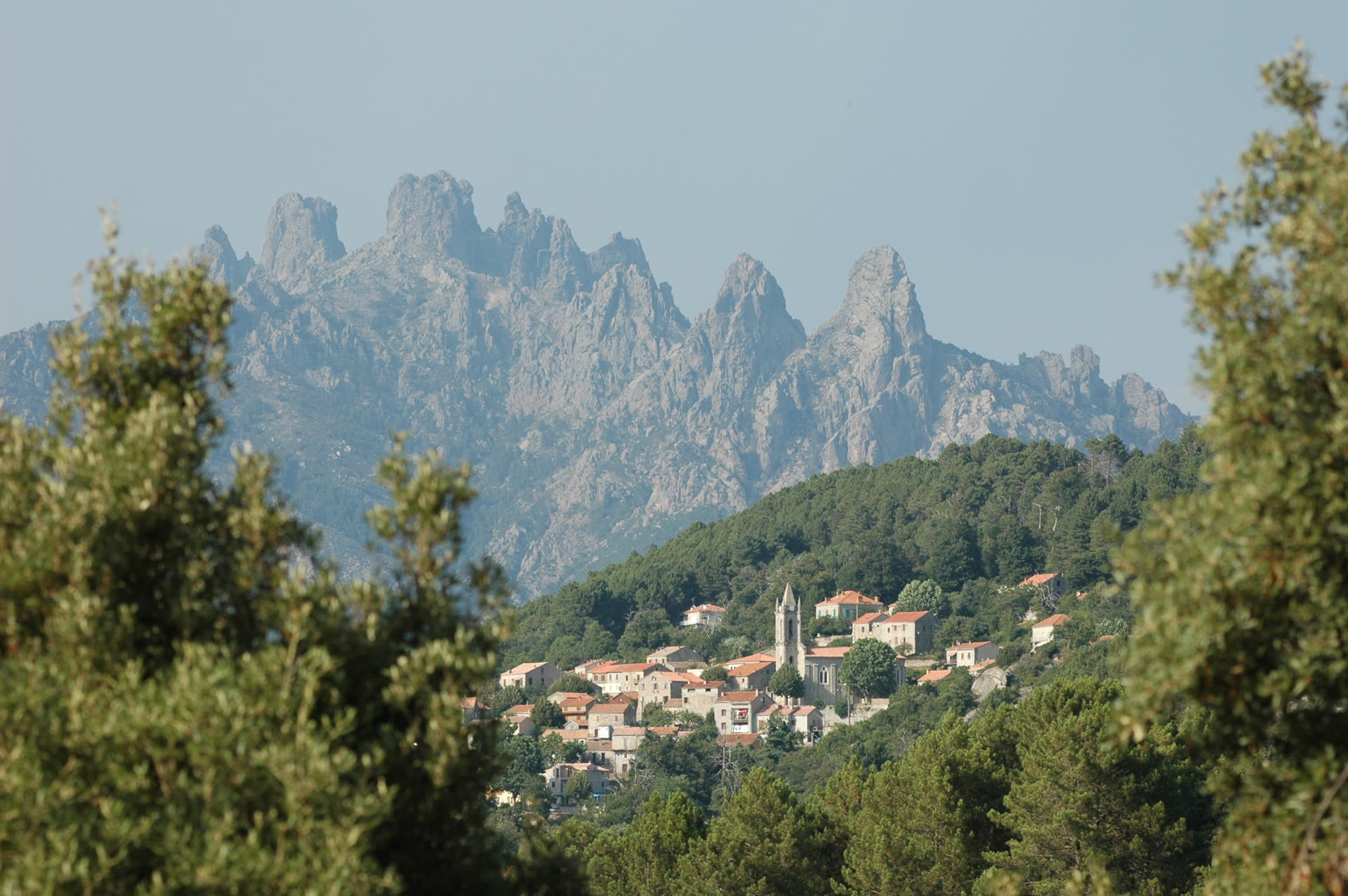
Pictured: the village of Zonza, Corse-du-Sud, with the granite spires of the Aiguilles de Bavella rising behind it, photographed in July 2006 — not the sighting itself, which occurred before dawn between two groves somewhere in the surrounding Alta Rocca countryside, and not at night. No photograph, film, or other visual record of the 2014 event is known to exist; the entire evidentiary record consists of the witness's own testimony and GEIPAN's field-investigation report. Photo by Philippe Dollé, via Wikimedia Commons, licensed CC BY-SA 3.0 / CC BY 2.5.
Theoretical Alignment
This case's weighting is unusual within this site's published GEIPAN archive for a specific reason: GEIPAN's own file explicitly states that the movements observed “n'ont pas de caractère intentionnel” — did not have an intentional character. A classic Extraterrestrial framing generally implies a controlled, purposeful craft; a phenomenon GEIPAN's own investigators describe as lacking intentionality sits awkwardly against that framing, which is reflected in this case's comparatively modest ETH alignment relative to several of this site's other GEIPAN files. That same detail nudges this case's Interdimensional weighting slightly higher than usual for this site's archive — not because anything in the testimony points toward another dimension specifically, but because a genuinely strange, sustained, structured-but-non-intentional visual phenomenon is a harder fit for either a simple technological craft or a simple misperception, leaving more analytical room for framings that don't require a controlled pilot at all. Psycho-Social framing remains this case's highest-weighted category, reflecting the single-witness nature of the account and the total absence of any second observer, photograph, or instrumented corroboration — even though GEIPAN's own field investigation rated the witness's consistency good rather than poor.
Background
This is the first sighting in this site's published GEIPAN archive to originate from the island of Corsica rather than mainland France or a French overseas department — a genuinely distinct French region, both geographically and administratively, that is worth understanding on its own terms before turning to the sighting itself.
Zonza and the Alta Rocca
Zonza is a mountain commune in Corse-du-Sud, built at roughly 900 meters elevation at the foot of the Aiguilles de Bavella, a dramatic range of granite spires that has made the village one of the most photographed in Corsica. The commune itself is vast and topographically extreme for its category, spanning from sea level up to 1,480 meters across roughly 134 square kilometers, and sits within the Alta Rocca micro-region — a cluster of villages including Zonza, Lévie, Quenza, and Sainte-Lucie-de-Tallano — entirely inside the Parc naturel régional de Corse. The area's human history runs far deeper than its 17th-century village core, formally built up under the name Zonza di Carbini: the nearby Cucuruzzu site, a Bronze Age fortified settlement, and associated standing stones dating to roughly the third millennium BCE place the Alta Rocca among Corsica's richest prehistoric landscapes. Zonza's population has grown substantially on paper in recent decades — from roughly 1,800 to over 2,200 residents between the 1999 and 2008 censuses alone, and to nearly 3,000 by 2023 — but this site's own research treats that figure with real caution as a measure of the village's actual settled character: the same sources describing that growth also note that the historic village center itself holds fewer than 200 people through the winter months, with the broader commune's population swelling primarily through second homes, tourism accommodation, and outlying hamlets rather than year-round residency in the village proper.
Corsica: A Distinct French Region
Corsica's relationship to the French state is genuinely different from that of an ordinary mainland département, and this site's own research treats that difference as directly relevant background for a case originating there. The island was sold by the Republic of Genoa to France under the 1768 Treaty of Versailles, but Corsican nationalists under Pasquale Paoli, who had already declared an independent Corsican Republic in 1755 and drafted one of the era's first Enlightenment-influenced constitutions, resisted French annexation until their defeat at the Battle of Ponte Novu in 1769 — the same year Napoleon Bonaparte was born in Ajaccio, on Corsica's western coast, into a France that had controlled the island for barely a matter of months. Administratively, Corsica today holds a special status distinct from ordinary French departments: since January 1, 2018, a single unified “Collectivité de Corse” has merged the separate departmental councils of Corse-du-Sud (2A, the department containing Zonza) and Haute-Corse (2B) into one territorial authority under Article 72 of the French Constitution, even though the historic 2A/2B department codes remain in ordinary administrative and postal use. The island also maintains its own distinct Corsican language, Corsu, a Romance language closely related to Tuscan Italian rather than to French, still spoken by a meaningful share of the population and taught in island schools alongside French, feeding a cultural identity meaningfully separate from either mainland France or peninsular Italy despite historical ties to both. That linguistic and cultural distance is directly relevant to how this site's own research approached this case: GEIPAN's published file, like its published files for mainland French cases, is written in standard French, and this site's own independent search for corroborating regional coverage of this sighting was necessarily conducted in French rather than in Corsu, a genuine limitation given that some informal, oral, or dialect-language local discussion of the event could plausibly exist without ever appearing in a French-language, standard-orthography source this site's research could locate.
A First for This Site's GEIPAN Archive
So far as this site's own research can establish, no other case in its published GEIPAN coverage originates from Corsica; every other GEIPAN file this site has published to date traces back to mainland France, a French overseas department or territory, or, in one singular case, the New Hebrides Condominium (see this site's Port Vila Fishermen's Sighting file). This does not mean Corsica lacks a broader UFO-reporting history of its own: independent Corsican-language and French-language regional press, including the online outlet Corse Net Infos, has covered aerial-phenomena reports on the island for years, and the island has its own dedicated body of published ufological research — most notably Christophe Canioni's Ovnis dans le ciel corse (2011), the first book-length treatment of the UFO phenomenon specifically in Corsica, built from testimonies the author gathered across the island over roughly two years of fieldwork. This site's own research found no indication that Canioni's own published work specifically documents this particular 2014 Zonza case, but it stands as useful evidence that Corsica has a real, independently-documented regional tradition of aerial-phenomena reporting distinct from, though occasionally overlapping with, GEIPAN's own official case archive.
A Gateway to the GR20
Beyond its own resident population, Zonza's real seasonal identity is closely tied to hiking and mountain tourism, a detail directly relevant to weighing why so thinly-populated a village might still generate a formally-filed anomalous sighting report at all. The village sits close to the Col de Bavella, widely considered one of the most scenic mountain passes on the island and a celebrated waypoint on the GR20, the roughly 180-kilometer long-distance trail that traverses Corsica's granite spine from Calenzana in the north to Conca in the south and is routinely described as among the most physically demanding hiking routes in Europe. Zonza itself functions as a practical gateway and resupply point for hikers tackling the GR20's southern stages and for day visitors driving the Bavella pass road, one of the island's most popular scenic drives. This site's own research treats this tourism-driven seasonal population — swelling the area with visitors far more numerous than its roughly 200 year-round village residents, especially across the summer hiking season that includes late August — as a genuinely relevant contextual detail: it broadens, at least in principle, the pool of people who might plausibly have been up and moving through the Alta Rocca's mountain terrain in the pre-dawn hours of August 28, 2014, whether the witness in this specific case was a local resident, a seasonal worker, or a visiting hiker, none of which GEIPAN's published file specifies.
What a GEIPAN Field Investigation Involves
This case's own file specifically credits a “enquête de terrain” — a field investigation — with confirming the witness's testimony, a detail this site's research treats as meaningfully different from a case resolved purely through a desk review of a written statement. A GEIPAN field investigation of this kind typically involves an investigator physically visiting the reported location to verify sightlines, terrain features, and the general plausibility of the witness's described vantage point and distances, and checking for readily available conventional explanations specific to that exact site — nearby roads, structures, agricultural or recreational lighting, or known local aircraft and drone activity. That this case's own file specifically foregrounds a field visit, rather than resting solely on the witness's written account, is treated in this site's own methodology as a real, if modest, positive weight in favor of the testimony's underlying consistency, independent of whatever the phenomenon itself actually was.
Complete Timeline
| Date | Event |
|---|---|
| c. 3rd millennium BCE | The Alta Rocca's prehistoric standing stones and the Cucuruzzu fortified site are established, among Corsica's richest Bronze Age landscapes. |
| 1755 | Pasquale Paoli proclaims the Corsican Republic and drafts an early Enlightenment-era constitution. |
| 1768 | The Republic of Genoa sells Corsica to France under the Treaty of Versailles. |
| 1769 | French forces defeat Corsican nationalists at Ponte Novu; Napoleon Bonaparte is born in Ajaccio the same year. |
| 17th century | The modern village of Zonza, historically Zonza di Carbini, is built at the foot of the Aiguilles de Bavella. |
| 1977 | Claude Poher founds GEPAN, GEIPAN's founding predecessor agency, at CNES in Toulouse. |
| 2011 | Christophe Canioni publishes Ovnis dans le ciel corse, the first book-length study of UFO reports specifically in Corsica. |
| Aug. 28, 2014, 5:00 AM | Sighting begins. A single witness near Zonza observes a dark circular mass with a light at its center, flanked by rows of smaller dark masses, moving silently between two groves. |
| Same morning, +~10 minutes | Sighting ends. The phenomenon's displacement concludes after roughly ten minutes of continuous observation. |
| 2014 (date not published) | The witness files a formal statement with the gendarmerie (PV n°1426, ref. 2014311439). |
| 2014/2015 (date not published) | GEIPAN conducts a field investigation at the reported site, confirming the witness's testimony. |
| 2018 | The unified “Collectivité de Corse” replaces the separate Corse-du-Sud and Haute-Corse departmental councils. |
| 2014 (classification date not published) | GEIPAN classifies the case D1: unexplained, good consistency, medium-to-high strangeness (score 0.62). |
| June 16, 2026 | GEIPAN's published online case file for 2014-08-08968 is last updated. |
Detailed Narrative
Before Dawn, Between Two Groves
GEIPAN's own case synthesis places its single witness observing, beginning at 5:00 AM on August 28, 2014, “entre deux bosquets” — between two groves — near Zonza. Late August at Corsica's latitude places sunrise at roughly 6:50 to 7:00 AM local time, meaning this sighting unfolded well before dawn, in conditions of full or near-full darkness rather than any twilight transition. This site's own analysis treats the specific “between two groves” framing as a genuinely useful detail for weighing the sighting's plausibility: it implies the witness had a partially bounded, tree-framed field of view rather than an unobstructed full-sky vantage, a detail relevant both to how GEIPAN's own field investigators would have verified the account (by checking whether that specific sightline and those specific groves actually exist at the reported location, which they evidently did) and to how much of the surrounding sky the witness could plausibly have scanned for comparison objects.
A Dark Mass, a Light at Its Center
What the witness reported, in GEIPAN's own summary, was “le déplacement silencieux d'une masse circulaire sombre avec de la lumière en son centre” — the silent displacement of a dark circular mass with light at its center. This site's own analysis flags this specific morphology as genuinely unusual within its published archive: rather than a discrete point of light, or a solid shape without any internal light source, this is a single large dark object with an internal or central light, a combination this site's research could not straightforwardly match to any single common object type. A dark circular mass large enough to be its own primary subject of observation, rather than simply outshone by its own light source the way a lit aircraft or drone typically would be, is itself an unusual reported detail worth taking at face value rather than assuming it must be a simple misdescription of something more ordinary.
Rows of Smaller Masses, Front and Back
GEIPAN's file adds a second layer of complexity: the central mass was “précédée et suivie de plusieurs rangées de groupes de masses sombres plus petites” — preceded and followed by several rows of groups of smaller dark masses. This site's own analysis treats this compound structure — a large central object, itself internally lit, escorted front and back by multiple organized rows of smaller dark shapes — as the single most distinctive and hardest-to-classify detail in this entire case file. It does not straightforwardly resemble a single aircraft, a simple formation of aircraft, a hot-air balloon, a satellite, a meteor, or a cloud on its own terms; it more closely resembles some kind of compound, multi-part structure or coordinated grouping, a description this site's Conventional Explanation Candidate section below examines directly against the most plausible natural and technological analogues this site's research could identify.
Ten Minutes, and “No Intentional Character”
The witness observed this configuration moving for roughly ten minutes — a genuinely long sustained observation window relative to most single-witness anomalous sightings, giving considerable opportunity to register detail. GEIPAN's own concluding analysis includes one specific, carefully-worded observation this site's research treats as the case's single most important interpretive detail: “le cas s'avère d'une étrangeté certaine, mais les déplacements constatés n'ont pas de caractère intentionnel” — the case proves to be one of definite strangeness, but the movements observed did not have an intentional character. This site's own analysis reads this phrasing carefully rather than glossing over it: GEIPAN is not stating that nothing unusual happened, nor that the phenomenon was simply misidentified — it is specifically distinguishing the phenomenon's visual strangeness from any implication of controlled, purposeful flight behavior, of the kind a piloted or remotely-operated craft would typically be expected to display (a directed course change, an apparent response to the witness's own presence, a stop-and-hover reaction). Movement that is strange in appearance but not intentional in character is a genuinely distinctive combination, one this file's Five Observables and Conventional Explanation Candidate sections below both treat as directly relevant to how the case should be interpreted, rather than an incidental detail to skip past.
Ruling Out the Common Explanations
GEIPAN's own file states its investigative conclusion in direct terms: “cette observation ne correspond pas aux méprises les plus fréquentes (avions, satellites, nuages, animations lumineuses), bien que certains aspects du témoignage puissent y faire penser” — this observation does not correspond to the most frequent misidentifications (aircraft, satellites, clouds, light animations), even though certain aspects of the testimony might suggest them. This site's own analysis treats this sentence's second half as a rare and valuable piece of institutional candor: GEIPAN is explicitly acknowledging that parts of the witness's own account are individually consistent with one or more of those four ordinary explanations, while stating that the full, compound description — the dark circular mass, the central light, the escorting rows of smaller masses, the ten-minute duration, and the specifically non-intentional movement — does not, taken as a whole, resolve to any of them. This site's Conventional Explanation Candidate section below examines each of GEIPAN's four named candidates individually on these same terms, and adds one further candidate GEIPAN's own file does not explicitly name.
A Witness Believed, a Case Left Open
GEIPAN's own consistency assessment for this case is unusually direct in the witness's favor: “la consistance du témoignage est bonne : le témoin a déposé son témoignage en gendarmerie, et une enquête de terrain a confirmé son témoignage” — the testimony's consistency is good: the witness filed a statement with the gendarmerie, and a field investigation confirmed the testimony. GEIPAN's final classification follows directly: “Le GEIPAN classe ce cas en catégorie D1, inexpliqué, de bonne consistance, et d'étrangeté moyenne à élevée” — GEIPAN classifies this case in category D1, unexplained, of good consistency, and of medium-to-high strangeness. This site's own analysis treats the combination of an explicit consistency endorsement and a field-confirmed account, set against the case's single-witness limitation, as this file's central evidentiary tension — one this file's Why-Open and Observer Credibility sections below examine directly.
Key Witnesses
T1 — Sole Witness, near Zonza (identity withheld per GEIPAN's standard anonymization practice)
The only witness to this sighting, observing for roughly ten minutes shortly before dawn on August 28, 2014, and the entire evidentiary basis of this case. GEIPAN's own file does not specify this witness's occupation, age, or gender, but does specifically credit the account with “good consistency,” a rating this site's research treats as significant precisely because GEIPAN applies it unevenly across its published archive rather than as a routine courtesy. The witness's own decision to file a formal gendarmerie statement, in a rural mountain commune where doing so for an aerial sighting is a genuinely unusual step, is itself treated in this site's analysis as a modest additional credibility factor.
The Five Observables Assessment
The Five Observables framework, developed by the Pentagon's Advanced Aerospace Threat Identification Program to describe performance characteristics beyond known conventional technology, is applied here for comparative consistency across this site's case files. This sighting's defining performance characteristic is its unusual compound morphology — a large, internally-lit dark mass escorted by rows of smaller dark masses — combined with GEIPAN's own explicit finding that its movement lacked intentional character.
Assessment: This case's Five Observables profile is the most restrained in this site's published GEIPAN archive: four of the five categories rate Absent or Not Reported, and even Trans-Medium earns only a Speculative rating on the thin technical grounds that GEIPAN's file never specifies an altitude. This is a direct, structural consequence of GEIPAN's own most important finding in this case: a phenomenon that displayed no hover, no abrupt acceleration, no extreme speed, and, per GEIPAN's explicit language, no intentional directed behavior at all does not map onto a framework built specifically to describe extreme performance characteristics. This site's own analysis treats that mismatch as informative rather than as evidence the case is unremarkable: this sighting's genuine strangeness, as GEIPAN's own file states directly, lies almost entirely in its unusual compound morphology — the dark mass, the central light, the escorting rows of smaller masses — not in any kinematic extreme the Five Observables framework was built to capture.
Evidence Assessment
Supporting an Anomalous Origin
- GEIPAN's own file explicitly rates the witness's testimony as having “good consistency,” a rating this site's research has found GEIPAN apply unevenly rather than automatically across its published archive
- A genuine field investigation, not merely a desk review of the written statement, confirmed the witness's account — a real, if modest, independent check on the testimony's underlying plausibility
- GEIPAN's own investigation directly and specifically tested the observation against the four most common misidentification categories — aircraft, satellites, clouds, and light animations — and found the full, compound description did not correspond to any of them, despite openly acknowledging that some individual aspects of the testimony might suggest one or another
- The reported morphology — a large, internally-lit dark mass escorted by organized rows of smaller dark masses — is a genuinely unusual combination this site's research could not straightforwardly match to any single common object or natural phenomenon
- The sighting's roughly ten-minute duration gave the witness an unusually long, sustained observation window compared to most single-witness anomalous sightings in this site's archive, reducing (without eliminating) the likelihood of a brief, easily-misjudged glimpse
Supporting a Conventional/Mundane or Inconclusive Origin
- Only one witness exists, with no second observer, photograph, video, or instrumented corroboration of any kind to independently cross-check the account
- GEIPAN's own file explicitly acknowledges that certain aspects of the testimony individually resemble common misidentifications, even while concluding the full account does not resolve cleanly to any single one of them
- GEIPAN's own explicit finding that the observed movements “did not have an intentional character” is, on its own terms, a point against interpreting this as a controlled, piloted craft specifically, even though it does not resolve the sighting to any named conventional cause either
- The sighting occurred in full pre-dawn darkness, a condition under which visual estimation of scale, distance, and precise shape is generally understood to be considerably less reliable than in daylight
- No altitude, precise size, or distance estimate survives in GEIPAN's published file, limiting how rigorously this site's own research could test any specific conventional candidate against the reported details
Why “Open”
This case is stamped Open because it combines a genuinely credible, field-confirmed single witness with a distinctly unusual, hard-to-classify morphology, weighed against the inescapable limitations of resting on one uncorroborated observer and no instrumented data of any kind. GEIPAN's own explicit “good consistency” rating, paired with an actual field investigation rather than a desk-only review, gives this case a stronger evidentiary floor than a comparable single-witness account lacking either would carry. The compound morphology — a large, internally-lit dark mass escorted by rows of smaller dark masses, sustained for roughly ten minutes — is also a genuinely distinctive detail this site's research could not cleanly resolve to any single conventional candidate, even after GEIPAN's own investigators tested it against the four most likely misidentification categories.
Working against a higher score are factors specific to this case's single-witness structure. With no second observer, this case cannot benefit from the kind of even modest multi-witness corroboration this site's research has credited in other GEIPAN files, even accounts resting on witnesses who shared one vantage point (compare this site's Étrelles and Palau-del-Vidre files, each with at least two co-located observers). The pre-dawn darkness in which the sighting occurred further limits how much confidence this site's research can place in fine visual details like exact shape, scale, and distance, areas where even careful, honest witnesses are known to be more prone to error in low light. GEIPAN's own explicit finding that the movement lacked intentional character, while analytically valuable, also removes one of the strongest kinds of evidence available in other cases — a directed, apparently deliberate response to the witness's own presence — that could have pushed this case's weighting higher. Weighed together — a field-confirmed, good-consistency witness describing a genuinely distinctive morphology, against a single uncorroborated observer, full pre-dawn darkness, and an explicit absence of directed, intentional movement — this case sits in the middle of this site's published GEIPAN Open archive: above a thinly-described, uncorroborated account with no distinguishing structural detail, but below cases carrying either multiple witnesses or any surviving instrumented data.
Sensor & Instrumentation Detection Profile
No photograph, video, radar track, or other instrumented recording of any kind exists for this sighting. This site's own research found no indication that any civil or military radar record, satellite-tracking database, or air-traffic-control log was checked against the reported time, location, and duration, though GEIPAN's own file does confirm that investigators actively considered and tested a satellite-related explanation as one of the four named candidates it ruled out, implying at least some comparison against known satellite pass data for the relevant morning, even though the file does not describe that comparison's specific methodology.
What this case's investigative record does include, in place of remote-sensor data, is the field investigation itself: an on-site visit specifically credited with confirming the witness's account, functionally serving as this case's primary verification instrument in the complete absence of any photographic or electronic recording. This site's own research treats a genuine field visit, focused on verifying sightlines, terrain, and locally-available conventional explanations, as a real, if modest, substitute form of investigative rigor — structurally comparable in spirit, though methodologically quite different, to the radar and flight-log cross-checks this site's research has documented on some of GEIPAN's more recent, better-instrumented mainland case files.
Environmental & Geospatial Context
Geographically, the sighting occurred in the mountainous interior of Corse-du-Sud, near Zonza, a village built at roughly 900 meters elevation at the foot of the Aiguilles de Bavella within the Parc naturel régional de Corse. The surrounding Alta Rocca terrain is characterized by granite peaks, larch and pine forest, and the kind of open highland pasture and grove-dotted countryside GEIPAN's own “between two groves” description implies. Astronomically, late August at Corsica's latitude (roughly 41.75°N) places sunrise at approximately 6:50 to 7:00 AM local time; a sighting beginning at 5:00 AM and lasting roughly ten minutes therefore unfolded entirely in full pre-dawn darkness, well before any twilight transition, meaning the witness had no ambient daylight assistance in resolving fine detail.
Regionally, Corsica's mountainous, sparsely-populated interior carries comparatively limited civil radar and air-traffic infrastructure relative to mainland France's own major population centers, a factor this site's research treats as relevant to why no instrumented cross-check of this sighting appears to have been attempted or, if attempted, was not documented in GEIPAN's published file. The island's own satellite-visibility conditions, by contrast, are generally excellent given its low light pollution and high average cloud-free nights, a detail directly relevant to GEIPAN's own consideration and rejection of a satellite-based explanation for this specific sighting. Zonza's own mountain setting, roughly 900 meters up in a natural park with no significant nearby urban center, would have offered the witness a genuinely dark sky background for the observation, distinct from the ambient light pollution that complicates many mainland French sightings occurring near cities or major roadways; this site's research treats a darker-than-average sky as cutting in two directions for this specific case, sharpening the visibility and apparent contrast of the reported dark mass and its central light against the night sky, while also removing any nearby artificial light source (streetlights, illuminated signage, vehicle headlights) that might otherwise have offered a ready, mundane point of comparison or a more straightforward misidentification candidate.
Within this site's own published GEIPAN archive, this sighting's closest points of comparison are not regional but structural: this site's Étrelles High-Speed Object and Palau-del-Vidre Black Triangle files both similarly involve a compact, sustained visual observation in low-light conditions, though both benefit from at least two co-located witnesses where this case rests on one alone.
Observer Credibility & Occupational Profile
This case's sole witness carries no stated occupational credential in GEIPAN's published file — no profession, military or aviation background, or other specialized frame of reference is recorded, a real contrast with this site's Circourt Air Force Officer Sighting file, where the primary witness's military aviation background is the single strongest credibility factor in that case. What this witness's account does carry is GEIPAN's own explicit “good consistency” rating and the fact of a formal gendarmerie statement, filed and followed up on by an actual field investigation rather than left as an unverified written account. This site's own analysis treats those two institutional endorsements as a real, if different, category of credibility signal than professional occupation: rather than crediting the witness's own background, it credits GEIPAN's own investigators' assessment of the testimony's internal coherence and its correspondence to the physical site, evaluated after the fact by a trained third party rather than assumed from the witness's own resume.
Working against this case's credibility is the simple fact of a single, uncorroborated observer: with no second witness of any kind, this case cannot benefit from even the limited additional weight this site's methodology assigns to co-located but non-independent multiple witnesses elsewhere in its GEIPAN archive. The pre-dawn darkness in which the sighting occurred further limits how much this site's research can credit fine claimed details of shape, scale, and internal structure, since low-light conditions are well understood to degrade the reliability of exactly those kinds of visual judgments, independent of any question about the witness's own honesty or general reliability. This is a general, well-established feature of human night vision rather than a criticism specific to this witness: scotopic (rod-dominated) vision, active in the near-total darkness GEIPAN's file implies, provides far poorer color discrimination, edge sharpness, and depth perception than daylight or even twilight cone-dominated vision, which is consistent with the witness reporting an overall dark mass with a single internal light rather than any finer surface detail, coloration, or texture on the object itself. This site's own methodology treats that consistency as a mildly positive credibility signal in its own right, in a specific, narrow sense: a witness whose reported level of visual detail matches what human night vision would actually be expected to resolve under the stated conditions is, on balance, more credible than one reporting a degree of fine detail implausible for the lighting conditions described, even though it cannot by itself resolve what the underlying object actually was.
Physical & Material Assays
No physical trace evidence exists in this case, and none would be expected given its circumstances: the phenomenon was observed entirely in the air, moving between two groves rather than landing, and no ground-level contact, debris, or residue of any kind was ever reported by the witness or referenced in GEIPAN's field-investigation findings. Accordingly, this case has no soil, vegetation, or material sample associated with it, and no metallurgical, isotopic, or trace-chemical assay was performed or would have been applicable given the sighting as described.
Historical Precedents & Archive Matches
This case's most useful points of comparison within this site's own published archive span both its single-witness evidentiary structure and, as the final entry in this site's current GEIPAN series, the broader range of cases that series has covered.
A Genuinely Unique Morphology
This site's research found no other case in its own published GEIPAN archive describing a comparable compound structure — a large, internally-lit dark mass escorted by organized rows of smaller dark masses. The closest analogue in general shape, though not in the specific details, is this site's Port Vila Fishermen's Sighting file, in which a craft described with colored flame emission likewise resisted straightforward classification into a single familiar object type; but Port Vila's object was a single coherent craft, not an escorted, multi-part configuration, leaving this case without a genuinely close morphological match anywhere else in this site's coverage. This site's own analysis treats that absence of precedent as itself worth stating plainly rather than passing over: a case whose closest available comparison, even loosely construed, sits at arm's length from its own actual reported details is a case this site's broader correlation methodology cannot yet triangulate against a wider pattern, leaving Zonza's own morphology to stand or fall largely on GEIPAN's own field-confirmed assessment of it, rather than on any reinforcing cross-case signal this site's archive can currently offer.
Single-Witness Evidentiary Weight, Compared
Set against this site's other single- or shared-vantage-point GEIPAN files — Étrelles and Palau-del-Vidre (both two co-located witnesses) and the Circourt Air Force Officer Sighting (also two co-located witnesses, one occupationally credentialed) — this case's single, uncorroborated witness sits at the thinner end of this site's own witness-count spectrum. What partially offsets that thinness, in this site's own assessment, is GEIPAN's unusually explicit “good consistency” endorsement and its confirming field investigation, two forms of institutional corroboration several of this site's multi-witness files do not carry to the same degree.
Closing This Site's Current GEIPAN Series
As the final case in this site's current run of published GEIPAN files, this sighting sits, in this site's own assessment, neither among the strongest nor the weakest of that full batch. It lacks the multi-witness corroboration of Port Vila's three fishermen or the occupational credentialing of Circourt's Air Force officer, but it also carries a genuinely distinctive, hard-to-classify morphology and an explicit, field-confirmed consistency rating that several thinner single-witness files elsewhere in GEIPAN's broader archive do not share. Set against GEIPAN's own published statistics — roughly 3.1% of its full case archive of over 3,300 investigated sightings classified Type D, unidentified despite the evidence in GEIPAN's possession — this case's combination of institutional consistency endorsement, a genuine field investigation, and a morphology this site's research could not match to any existing case elsewhere in its own coverage makes it a fitting, if modestly-scored, final entry to this particular series. Read together, this site's current GEIPAN batch spans a genuinely wide evidentiary range: from a three-witness maritime sighting occurring outside mainland French territory altogether, through two-witness accounts sharing a single vantage point (one of them carrying real occupational credentials), down to this case's single, uncorroborated but institutionally well-regarded witness. No single case in that batch resolves cleanly to either a confirmed anomaly or a confirmed conventional explanation, which this site's own methodology treats as an accurate reflection of GEIPAN's own Type D category as a whole, rather than as a shortcoming specific to any one file. What varies case to case is not whether the phenomenon was ultimately explained — by definition, none of GEIPAN's Type D cases were — but how much corroborating weight, institutional scrutiny, and structural detail surrounds each individual account, and this case's own combination of those three factors places it credibly, if unspectacularly, within the middle of that range.
Material Analysis
As detailed in the Physical & Material Assays section above, this case involves no physical or trace evidence of any kind. The phenomenon was observed entirely in the air between two groves the witness did not approach, and no landing, debris field, or other ground-level effect was ever reported.
Supporting Non-Terrestrial Origin
- No confirmed physical evidence exists to test in the first place, so no terrestrial material-composition finding contradicts an anomalous interpretation either
- GEIPAN's own field-confirmed, “good consistency” witness describes a compound morphology — a large, internally-lit dark mass escorted by rows of smaller dark masses — this site's research could not match to any conventional object or to any other case in its own published archive
Supporting Terrestrial Origin
- No photograph, video, radar track, or physical trace of any kind exists; the entire evidentiary record rests on one witness's testimony and GEIPAN's own field-investigation summary
- GEIPAN's own file explicitly notes the observed movements lacked intentional character and that some individual aspects of the testimony resemble common misidentifications, even while concluding the full account did not resolve cleanly to any one of them
The Conventional Explanation Candidate: Aircraft, Satellites, Clouds, and a Bird Flock
GEIPAN's own published file names four specific misidentification categories it directly tested and ruled out; this site's own research adds one further candidate, prompted directly by GEIPAN's own "no intentional character" finding, that GEIPAN's file does not explicitly name.
Aircraft
GEIPAN's investigation directly tested and rejected a conventional aircraft explanation. This site's own analysis finds this exclusion well-supported by the reported morphology: no conventional aircraft, whether civilian or military, single or in formation, presents as a large dark circular mass escorted by multiple organized rows of smaller dark masses, and the sighting's complete silence over a ten-minute observation window is a poor match for any powered aircraft operating low enough to be resolved in this much visual detail.
Satellites
GEIPAN's investigation also tested and rejected a satellite-pass explanation. This site's analysis finds this exclusion straightforward on kinematic and visual grounds: a satellite pass presents as a single, steadily-moving point of light crossing the sky in a fixed, predictable arc, not a large dark mass with internal light and an escort of smaller masses, and Corsica's genuinely excellent night-sky visibility conditions would have made a real satellite pass comparatively easy for GEIPAN's investigators to check against known orbital pass data for the relevant morning.
Clouds
GEIPAN's investigation tested and rejected a cloud-based explanation, plausibly the misidentification category GEIPAN's own file most directly has in mind when noting that some aspects of the testimony might suggest a common misidentification: a dark cloud formation, especially one briefly illuminated from within or behind by moonlight or a distant ground light, could superficially resemble a dark mass with an internal glow. This site's own analysis finds this candidate weakened specifically by the reported rows of smaller, similarly dark masses preceding and following the central one, a level of organized, repeated structure that would be a genuinely unusual coincidence for ordinary cloud formations to produce, and by the sustained ten-minute directional displacement GEIPAN's file describes, atypical for a stationary or slowly-drifting cloud bank observed from a fixed vantage point.
Light Animations
GEIPAN's investigation tested and rejected “animations lumineuses” — light animations or displays, a category this site's research reads as most plausibly covering drone light shows, coordinated ground-based lighting displays, or similar organized artificial-light performances. This site's own analysis finds this candidate weakened by both the timing (5:00 AM, an unusual hour for any organized public lighting event) and the specific reported morphology, which centers on a single lit point within a larger dark mass rather than the coordinated arrays of individually bright, moving lights characteristic of an actual drone light show.
A Bird Flock: This Site's Own Additional Candidate
GEIPAN's own explicit finding that the observed movements “did not have an intentional character” prompted this site's research to consider one further candidate GEIPAN's file does not name directly: a large flock of birds, of the kind capable of producing the dense, coordinated murmuration displays associated with species like starlings. Murmuration behavior, as this site's research confirms independently of this specific case, arises from a small number of simple, local rules each bird follows relative to its immediate neighbors — broadly, matching the neighbors' direction of travel, avoiding collisions with them, and staying loosely grouped with them — propagated bird to bird through the flock in a chain reaction, with no leader, no central coordination, and no genuinely intentional group-level plan directing the display's overall shape at any given moment. That is a real natural phenomenon capable of producing large-scale, visually organized aerial displacement that is, in a precise technical sense, non-intentional at the group level even while looking, from a distance, remarkably purposeful — closely echoing GEIPAN's own specific language for this case. Murmurations are also generally understood to function primarily as a defensive response to aerial predators such as falcons and hawks, gathering the flock into a dense, harder-to-target mass rather than pursuing any independent navigational goal, a description broadly consistent with organized-but-purposeless collective movement.
This site's own analysis nonetheless rates this candidate as, at best, a partial and imperfect fit for the specific details GEIPAN's file records. Murmurations are overwhelmingly a daylight or civil-twilight phenomenon, typically observed at dawn or dusk roosting gatherings, and are associated with a continuously reshaping "sheet"- or cloud-like collective silhouette rather than a single large solid mass with one static internal light escorted by discrete, countable rows of smaller masses. A pre-dawn murmuration in complete darkness, with no ambient light to silhouette the birds against the sky and no plausible internal light source any flock could itself produce, would be a highly atypical occurrence this site's research could not find any comparable documented precedent for anywhere in the ornithological or ufological literature it consulted. The candidate is included here specifically because it is the single closest natural match this site's research could identify to GEIPAN's own distinctive "non-intentional" finding, not because its other visual details fit the case comfortably.
Aircraft
ImplausibleDirectly tested and eliminated by GEIPAN's own investigation; a poor match for the reported compound morphology and total silence.
Satellites
ImplausibleDirectly tested and eliminated by GEIPAN's own investigation; a poor kinematic and visual match for a single steady point of light.
Clouds
InconclusiveTested and eliminated by GEIPAN's own investigation, but the candidate GEIPAN's own file seems most directly to have in mind as superficially suggestive; weakened by the reported organized rows of smaller masses and the sustained directional displacement.
Light Animations
ImplausibleDirectly tested and eliminated by GEIPAN's own investigation; a poor fit for the 5:00 AM timing and the single-internal-light morphology.
Bird Flock / Murmuration
InconclusiveThis site's own additional candidate, prompted by GEIPAN's "non-intentional" finding; genuinely echoes that specific behavioral detail, but a poor fit for the reported solid mass, single internal light, and total pre-dawn darkness.
Related Cases
Confirmed Documents & Official Records
The official French government case summary: the witness's testimony, the gendarmerie statement (PV n°1426), the confirming field investigation, and the case's D1 classification.
GEIPAN's own published definitions, including the Class D1 sub-tier (unexplained, good consistency, moderate strangeness) applied to this case.
GEIPAN's own account of its founding in 1977 and later reorganizations into SEPRA (1988) and GEIPAN (2005).
GEIPAN's own live statistics dashboard: roughly 3.1% of its full case archive is classified Type D, the same broad category applied to this case.
Further Reading — Recommended Literature
Ovnis dans le ciel corse
The first book-length study of the UFO phenomenon specifically in Corsica, built from testimonies the author gathered across the island — the single most directly relevant background source for this site's first GEIPAN case originating from Corsica.
Granite Island: A Portrait of Corsica
A classic, deeply-researched portrait of Corsican history, landscape, and culture, directly relevant to understanding the Alta Rocca region and the island's distinct identity within France.
Passport to Magonia: On UFOs, Folklore, and Parallel Worlds
Vallée's foundational, internationally-scoped catalog of anomalous aerial phenomena reports provides useful comparative grounding for a sighting with a morphology this site's own research could not match to any other case in its archive.
UFOs and Government: A Historical Inquiry
Includes a chapter on France's own government UAP-investigation framework, directly relevant to understanding the GEIPAN field-investigation process this case's own file specifically credits.
Vesper Flights
A naturalist's essay collection that includes a close account of starling murmurations, directly relevant to this site's own consideration of a bird-flock candidate for this case's specifically "non-intentional" reported movement.
Essential Viewing
No Videos Available
Sources
- GEIPAN (CNES), “ZONZA (2A) 28.08.2014”, Case 2014-08-08968 — official case summary
- GEIPAN (CNES), official case archive & public portal — geipan.fr
- GEIPAN (CNES), Glossaire du GEIPAN — official classification definitions, A/B/C/D and D1/D2
- GEIPAN (CNES), Son histoire — institutional history: GEPAN (1977), SEPRA (1988), GEIPAN (2005)
- GEIPAN (CNES), Statistiques — official classification statistics (Types A/B/C/D) across GEIPAN's full case archive
- Wikipedia (English), “Zonza” — geography, population, and history
- Wikipedia (English), “Corse-du-Sud” — departmental geography and administration
- Wikipedia (English), “Aiguilles de Bavella” — the granite spires overlooking Zonza
- Wikipedia (English), “Pasquale Paoli” — the Corsican Republic and its 18th-century constitution
- Wikipedia (English), “Corsica” — broader island geography, history, and administrative status
- Corse Net Infos, “OVNI” tag archive — regional Corsican press coverage of aerial-phenomena reports
- Babelio, “OVNIS dans le ciel corse” by Christophe Canioni — book description and publication background
- Wikimedia Commons, File: Zonza - Aiguilles Bavella.jpg, photo by Philippe Dollé, CC BY-SA 3.0 / CC BY 2.5 — licensing and attribution
- Wikimedia Commons, Category: Zonza — image archive for the village
- This site, case-files/port-vila-fishermens-sighting.html — comparative GEIPAN case from outside mainland France
- This site, case-files/circourt-air-force-officer-sighting.html — comparative GEIPAN case, this site's other closing entry in its current series
- This site, case-files/etrelles-high-speed-object.html — comparative GEIPAN case on witness-count evidentiary weighting
- This site, key-figures.html, entry on Claude Poher — GEPAN founding and early institutional history
- This site, locations/index.html, entry on Toulouse — CNES/GEPAN/SEPRA/GEIPAN institutional headquarters
See something inaccurate? Have additional information or sources?
Suggest an Edit →Last Updated: August 2026