
Breakaway Civilization
Investigating the theory that a highly compartmented segment of human society has secretly developed technologies decades ahead of public science.
Contested TheoryCore Thesis
Due to classified defense spending, military compartmentation, and private aerospace reverse-engineering efforts initiated during World War II and the Cold War, a highly organized group within the military-industrial complex has split off scientifically and technologically from mainstream society, forming a "breakaway civilization."
While the popular debate surrounding UAPs assumes that advanced technology must be extraterrestrial, the Breakaway Civilization Hypothesis presents a terrestrial alternative. Formulated primarily by UAP historian Richard Dolan, the hypothesis suggests that the technological disparity between public science and classified, black-budget programs is so vast that the defense establishment has effectively branched into a separate culture.
This model argues that the craft witnessed in our skies are not piloted by interstellar travelers, but are the result of highly compartmented black programs funded by trillions of dollars in unaccounted government funding, operating entirely outside democratic oversight and congressional audit. The technology developed by these programs—particularly in propulsion and materials science—is so far advanced that it represents a technological leap unprecedented in human history.
Origins and Development
The roots of the breakaway civilization model lie in the extreme mobilization of scientific resources during World War II and the Cold War. Under operations like Project Paperclip, the United States imported hundreds of Nazi aerospace engineers and scientists. It is theorized that early research into gravity-defying concepts (such as "electro-gravitics" or rotating plasma engines) was moved into deep military classification by the late 1940s.
With the signing of the National Security Act of 1947 and the establishment of the CIA, the institutional framework was built to shield these programs. Over the next seven decades, defense contractors conducted research at remote testing sites (such as Area 51 (Groom Lake)) completely isolated from academic peer-review. The physical transfer of materials from sites like Wright-Patterson AFB further cemented the isolation of these reverse-engineering efforts.
A key whistleblower in this narrative is Bob Lazar, who in 1989 claimed to have worked at S-4 (Papoose Lake), a highly classified facility near Area 51. Lazar testified that he was hired to reverse-engineer the propulsion systems of recovered non-human discs. His account described a compartmented program operating under extreme security controls—the exact institutional blueprint of a breakaway organization.
Key Pillars of the Theory
The Breakaway Civilization theory relies on several documented realities within the defense establishment:
- The Black Budget: The Pentagon routinely fails its financial audits, with trillions of dollars in assets unaccounted for. Proponents suggest this capital is diverted to fund Special Access Programs (SAPs) and Unacknowledged Special Access Programs (USAPs) that develop UAP-like capabilities.
- Technological Asymmetry: Historically, classified military aviation runs 10 to 30 years ahead of public technology. The theory proposes that in the realm of field propulsion or zero-point energy, the gap is closer to 100 years.
- Private Aerospace Monopoly: By shifting recovered materials and reverse-engineering tasks to private defense contractors, the government avoids FOIA requests, as private companies are exempt from disclosure laws. This dynamic was corroborated during the 2023 US Capitol Hearing Rooms testimonies by whistleblower David Grusch, who stated under oath that private contractors held recovered craft and operated outside congressional oversight, a claim supported by retired Army Colonel Karl Nell.
Skeptical Critiques & Limitations
While the breakaway civilization model explains how such craft could be human-built, skeptics point out several structural flaws in the theory:
- Information Containment: Keeping a technological breakthrough of this scale—involving thousands of engineers, scientists, test pilots, and security personnel—completely secret for 70+ years is practically impossible. Human error, whistleblowers, and foreign espionage would inevitably lead to leaks.
- Lack of Commercial Offshoots: In human history, military breakthroughs eventually filter down to the civilian economy to generate profits (e.g., GPS, radar, the internet). If a breakaway group possessed anti-gravity or infinite energy, the economic pressure to commercialize it would be overwhelming. Keeping it locked in vaults for 70 years defies economic logic.
- Intrusion Incidents: If UAPs are human-built military craft, their intrusion into nuclear facilities and the shutting down of active ICBMs (as documented by whistleblowers like Robert Salas) would represent acts of treason or electronic warfare between different branches of the US government, which is highly implausible.
Summary Assessment
The Breakaway Civilization Hypothesis remains a critical framework, especially for explaining mid-range military sightings and the intense secrecy surrounding UAP crash recovery operations. It is likely that the truth is a hybrid: if a breakaway group exists, its primary goal is the reverse-engineering of technologies that are truly non-human in origin, as whistleblowers like Lue Elizondo have suggested.
Theory Development Timeline
| Date | Development |
|---|---|
| 1942–1946 | The Manhattan Project conceals a multi-billion-dollar bomb-building effort involving over 130,000 personnel from Congress and even Vice President Harry Truman, establishing the wartime template for large-scale technological compartmentation that breakaway theorists later cite as historical proof of concept. |
| 1945–1959 | Operation Paperclip quietly relocates hundreds of German aerospace and rocketry specialists into U.S. military-industrial research, seeding the classified aerospace base the theory says eventually split off from public science. |
| 1947 | The National Security Act creates the CIA and the modern classification system, providing the legal and institutional scaffolding for the compartmented Special Access Programs (SAPs) central to the theory. |
| 1955–1960 | Lockheed's Skunk Works develops the U-2 spy plane in near-total secrecy at a remote Nevada site; the program becomes public only after pilot Francis Gary Powers is shot down over the USSR on May 1, 1960. |
| 1959–1972 | The CORONA reconnaissance satellite program launches over 100 missions under the public cover story of the "Discoverer" scientific series; it remains classified until 1995. |
| 1976–1988 | The Have Blue/F-117A Nighthawk stealth fighter is developed and first flown at Groom Lake in June 1981; the U.S. Air Force does not publicly confirm its existence until November 1988, seven years later. |
| 1989 | Bob Lazar states publicly that he worked at S-4 reverse-engineering non-human spacecraft, later cited by Dolan as a firsthand account of a compartmented "breakaway" workforce. |
| 2004 | Physicist and alternative-history author Joseph P. Farrell publishes Reich of the Black Sun, arguing that surviving Nazi-era weapons research fed postwar black programs — a parallel "hidden advanced technology" thread that fed into the breakaway framework. |
| 2009 | Richard Dolan publishes UFOs and the National Security State, Vol. 2: The Cover-Up Exposed, 1973–1991, in which he formalizes "breakaway civilization" as a distinct interpretive framework. |
| 2016 | Dolan devotes a standalone title, The Secret Space Program and Breakaway Civilization, to the hypothesis, cementing the term in mainstream UAP research discourse. |
| 2023 | David Grusch testifies before Congress that the U.S. holds recovered craft and biological material under programs walled off from oversight, shifting the debate from anecdote toward sworn testimony. |
Theoretical Alignment
The Breakaway Civilization Hypothesis occupies an unusual position among UAP frameworks: rather than proposing new physics, it argues that high-performance UAP characteristics — rapid acceleration, sustained high-speed flight, and apparent stealth from radar — are the product of engineering that remains, in principle, humanly comprehensible, just decades or generations ahead of publicly disclosed aerospace science. This sets it apart from the Extraterrestrial Hypothesis and the Ultraterrestrial/Interdimensional frameworks, which posit exotic non-human intelligences or physics operating outside conventional causality. The theory aligns comfortably with cases showing extreme but still aerodynamically plausible behavior — sharp-edged maneuvering, radar-trackable flight paths, craft that appear to obey inertia even while defying it at the margins — but strains badly against cases involving apparent instantaneous directional reversals at extreme velocity or interaction with sensors and consciousness in ways no known engineering, however advanced, could plausibly produce. In that sense the hypothesis functions less as a complete explanation for the UAP phenomenon than as a partial one: a mechanism that could plausibly account for a subset of military-adjacent sightings, particularly the triangular and cylindrical craft reported near restricted airspace, while leaving the higher end of the observed performance envelope — such as the 2004 USS Nimitz encounter's Tic Tac maneuvers — unexplained by terrestrial engineering alone.
Sensor & Instrumentation Detection Profile
Theoretical predictions for sensor signatures that would support or refute this hypothesis.
Environmental & Geospatial Context
Breakaway-civilization claims cluster tightly around a handful of specific, named U.S. defense installations rather than distributing across arbitrary geography — itself part of the theory's argument, since a real classified program would be expected to leave an institutional footprint rather than an even scattering of anecdotes. Bob Lazar's claimed reverse-engineering site, S-4, is described as a satellite facility roughly ten miles south of the well-documented Groom Lake test range (Area 51) in the high desert of Lincoln County, Nevada — remote, restricted airspace with minimal population and long unobstructed sightlines, environmental conditions that make it easier to control what outside observers can verify either way. The historical precedents this theory leans on (Groom Lake's Have Blue/F-117 program, the U-2's Nevada test site) sit in the same high-desert secrecy corridor, reinforcing the pattern. David Grusch's 2023 testimony, by contrast, is not tied to a single site at all — it describes a distributed, multi-decade program spanning defense contractor facilities nationwide, a structurally different geographic claim (institutional dispersion rather than a single hidden location) that is harder to independently examine precisely because it has no one place a researcher could travel to and inspect.
Observer Credibility & Occupational Profile
The theory's two principal architects bring markedly different, non-overlapping credentials. Richard Dolan holds a B.A. in English and history from Alfred University and an M.A. in history from the University of Rochester, where his graduate research focused on U.S. Cold War strategy and diplomacy — training that shapes his approach to the subject as an exercise in intelligence and institutional history rather than physics or engineering; he holds no formal scientific credentials, a point critics raise when his claims touch on propulsion physics. Joseph P. Farrell, a secondary but frequently cited voice, holds a Ph.D. in Patristics (early Christian theology) from Pembroke College, Oxford (1987) and writes as an independent researcher rather than an aerospace or physics specialist; his contribution is historical-speculative — tracing an alleged continuity of Nazi-era secret-weapons research into postwar black programs — rather than technical. Supporting testimony comes from a different occupational category: Bob Lazar, a self-described physicist whose claimed graduate degrees from MIT and Caltech have never been verified in institutional enrollment records, and David Grusch, a decorated former officer of the National Geospatial-Intelligence Agency and National Reconnaissance Office who held Top Secret/Sensitive Compartmented Information clearance and served as the NGA's UAP co-lead before becoming an Intelligence Community whistleblower — occupational access, rather than scientific training, being the basis for his credibility. The result is a theory whose intellectual scaffolding rests primarily on historians and self-described insiders, not on engineers or physicists positioned to independently evaluate the propulsion claims at its center.
Historical Precedents & Archive Matches
The mechanism the Breakaway Civilization Hypothesis depends on — that a government can sustain a technologically transformative secret for years or decades — is not speculative; it is documented, recurring practice in 20th-century U.S. defense history. The Manhattan Project (1942–1946) hid a bomb-building effort involving over 130,000 personnel from Congress and the press, and from Vice President Harry Truman himself, who learned of the program only after becoming President in April 1945. The CORONA reconnaissance satellite program ran from 1959 to 1972, launching more than 100 classified missions under the public cover story of the "Discoverer" research series, and was not declassified until 1995 — 23 years after its final flight. Lockheed's U-2 spy plane was designed and flown from a fenced-off Nevada site beginning in 1955 with no public acknowledgment until Francis Gary Powers was shot down over Soviet airspace on May 1, 1960. The SR-71 Blackbird, developed by the same Skunk Works division, cruised at Mach 3+ — performance the public aviation world would not approach for decades — and remained substantially classified through most of its operational life. The Have Blue/F-117A Nighthawk stealth fighter first flew in June 1981 out of Groom Lake and operated for seven years before the Air Force publicly confirmed its existence in November 1988. Each case demonstrates the specific claim breakaway theorists make: that classified defense programs can operate one or more technological generations ahead of published science, invisible to oversight, for periods measured in years to decades. None of these documented precedents, however, involved anti-gravity or exotic propulsion — they establish that the secrecy mechanism is real, not that the specific technology alleged to be hidden by it exists.
Material Analysis
Because the theory locates the technology in human hands rather than non-human ones, its material-evidence claims center on chain-of-custody for alleged recovered hardware and reverse-engineering testimony rather than on exotic alloys or anomalous isotope ratios. The strongest cited material claims remain testimonial: Bob Lazar's description of a stable, gravity-wave-generating fuel source at S-4 that he labeled "Element 115" (a designation later associated, coincidentally, with the real superheavy element moscovium, synthesized by scientists in 2003), and David Grusch's 2023 sworn testimony that the U.S. possesses "intact and partially intact" non-human craft under multi-decade compartmented control, corroborated in general terms by retired Army Colonel Karl Nell. Physical evidence proper — a sample, component, or artifact released for independent, peer-reviewed scientific analysis — has never accompanied either claim. That absence is the central weakness of the material record: the theory predicts recovered hardware should exist somewhere within a defense contractor's classified holdings, but three decades of FOIA requests, congressional hearings, and Pentagon audits (the Department of Defense has failed every comprehensive financial audit it has undergone since 2018) have produced testimony and unexplained budgetary gaps, not artifacts.
The Conventional Explanation Candidate
Mainstream scientific and skeptical interpretations that offer alternative explanations for the phenomena this hypothesis attempts to address.
Supporting This Hypothesis
- Bob Lazar's 1989 S-4 testimony describing a compartmented reverse-engineering program tied to recovered non-human craft
- David Grusch's 2023 sworn congressional testimony alleging a multi-decade "UFO retrieval program" outside oversight, rated "credible and urgent" by the Intelligence Community Inspector General
- Documented historical precedent for multi-decade classified technology concealment (Manhattan Project, U-2, CORONA, F-117)
- The Pentagon's unbroken run of failed comprehensive financial audits since 2018, cited by theorists as evidence that black-budget diversion at the scale the theory requires is at least structurally possible
Against This Hypothesis
- No physical sample, artifact, or component from an alleged reverse-engineering program has ever been released for independent scientific testing
- Lazar's claimed academic credentials from MIT and Caltech have never been verified in institutional enrollment records
- No commercial or scientific spin-off technology consistent with anti-gravity or exotic propulsion has surfaced in the 35+ years since Lazar's claims, despite the strong historical pattern of military technology eventually diffusing into civilian markets
- Grusch's testimony, while sworn, is secondhand — he has stated he did not personally witness a craft, but relied on interviews with other officials
Theoretical Assessment Profile
Six-domain evaluation of this hypothesis
Key Proponents
Richard Dolan
Historian and author holding an M.A. in history from the University of Rochester, where his graduate work focused on Cold War strategy and diplomacy. Author of the two-volume UFOs and the National Security State and the 2016 title The Secret Space Program and Breakaway Civilization, which formalized and popularized the theory's name.
Joseph P. Farrell
Independent researcher holding a Ph.D. in Patristics from Pembroke College, Oxford (1987). Author of Reich of the Black Sun (2004) and other works arguing that classified postwar research built on suppressed Nazi-era secret-weapons programs — a parallel strand of "hidden advanced technology" scholarship often cited alongside Dolan's framework.
Related Cases
Further Reading & Recommended Literature
UFOs and the National Security State (Vol 1)
The definitive historical audit of UAP intelligence reports, detailing the birth of the national security state and the compartmentation protocols established in the 1940s and 50s.
The Hunt for Zero Point: Inside the World of Antigravity
Jane's Defence Weekly aviation editor Nick Cook investigates the classified military programs pursuing gravity-modification, electro-gravitics, and zero-point physics.
Corporate America & UFOs: The Corporate Takeover
An analysis of how aerospace behemoths monopolized the reverse-engineering of anomalous UAP debris, creating a firewall against FOIA requests and congressional oversight.
Covert Wars and Breakaway Civilizations: The Secret Space Program, Celestial Psyops and Hidden Conflicts
Oxford-trained historian Joseph P. Farrell's own book-length treatment of the breakaway civilization concept, tracing his argument that suppressed wartime research fed postwar black programs — the parallel thread to Dolan's framework discussed in this page's Key Proponents section.
Operation Paperclip: The Secret Intelligence Program that Brought Nazi Scientists to America
A Pulitzer-finalist investigative history of the program that seeded the postwar U.S. aerospace-classification base this theory identifies as the historical origin point for a compartmented "breakaway" research culture.
Essential Viewing
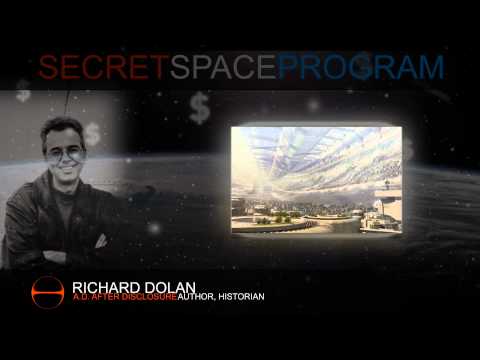
Richard Dolan: A Breakaway Civilization, the Secret Space Program
Dolan, the theory's principal author, lays out the case for a breakaway civilization directly on his own channel — black-budget compartmentation, reverse-engineering claims, and why he argues public aerospace science has fallen decades behind classified programs.
Richard Dolan — The Case for a Breakaway Civilization (Pt. 1 of 2)
A long-form interview in which Dolan walks through the historical precedents (Manhattan Project, U-2, stealth aircraft) he cites as proof that multi-decade technological secrecy is achievable.

Catherine Austin Fitts: Missing $21 Trillion, Corruption & Breakaway Civilization
Former Assistant HUD Secretary Catherine Austin Fitts details the unaccounted defense and federal spending she and economist Mark Skidmore traced, and argues it points toward a parallel, breakaway financial and technological system.
Sources Cited
- Dolan, R. M. (2002). UFOs and the National Security State: Chronology of a Coverup, 1941-1973. Keyhole Publishing.
- Cook, N. (2001). The Hunt for Zero Point: Inside the Classified World of Antigravity Technology. New York: Broadway Books.
- Dolan, R. M. (2020). UFOs and the Military-Industrial Complex: The Corporate Takeover. Richard Dolan Press.
- U.S. House of Representatives. (2023). Unidentified Aerial Phenomena: Implications on National Security, Public Safety, and Government Transparency. Hearing before the Subcommittee on National Security, the Border, and Foreign Affairs. July 26, 2023.
- Good, T. (2007). Need to Know: UFOs, the Military, and Intelligence. New York: Pegasus Books.
- Kean, L. (2010). UFOs: Generals, Pilots, and Government Officials Go on the Record. New York: Crown Publishing.
- Jacobsen, A. (2014). Operation Paperclip: The Secret Intelligence Program that Brought Nazi Scientists to America. New York: Little, Brown and Company.
- Farrell, J. P. (2012). Covert Wars and Breakaway Civilizations: The Secret Space Program, Celestial Psyops and Hidden Conflicts. Port Townsend, WA: Feral House.
- U.S. House of Representatives, Office of the Historian. "The National Security Act of 1947." Historical Highlights. history.house.gov
- Central Intelligence Agency. (1992/declassified 2013). The Central Intelligence Agency and Overhead Reconnaissance: The U-2 and OXCART Programs, 1954–1974. Cited in: Devereaux, R. (2013, August 16). "Area 51's Existence Acknowledged by CIA in Declassified Documents." CBS News
- Knapp, G. "UFOs: The Best Evidence," investigative series, KLAS-TV, Las Vegas, November 1989. Retrospective coverage: Knapp, G. (2019). "Mystery Wire Launches 30 Years After 'UFOs: The Best Evidence'." 8newsnow.com (KLAS)
- Copp, T. (2023, November 15). "Pentagon Again Fails Annual Audit of $3.8 Trillion in Military Assets." Stars and Stripes
- Executive Order 12951, "Release of Imagery Acquired by Space-Based National Intelligence Reconnaissance Systems," 60 Fed. Reg. 10789 (February 22, 1995). clintonwhitehouse6.archives.gov
- McMillan, T. (2023, June 5). "Intelligence Officials Say U.S. Has Retrieved Craft of Non-Human Origin." The Debrief
- von Rennenkampff, M. (2023, July 27). "Claims That UFO Information Was Inappropriately Withheld From Congress Deemed 'Credible,' 'Urgent'." The Hill
Have corrections, additional research, or peer-reviewed sources? Help improve this entry.
Suggest an Edit