
Carl Higdon / Rawlins Encounter
On the afternoon of October 25, 1974, oil-rig foreman Carl Higdon was elk hunting in the Medicine Bow National Forest south of Rawlins, Wyoming when, he said, his rifle shot stalled in mid-air and dropped a mangled bullet roughly 50–60 feet away — moments before a six-foot humanoid calling itself "Ausso One" appeared and invited him aboard a transparent, cube-shaped craft. Higdon was found disoriented in his truck nearly eight hours later, three miles from where he had parked, with no memory of how he got there. Investigated at length by University of Wyoming psychologist Dr. Leo Sprinkle for APRO and MUFON, and later scrutinized by researchers who traced striking parallels between Higdon's hypnotically-recovered account and a specific 1911 French science-fiction novel, the case remains one of the most closely examined — and most contested — single-witness abduction narratives of the 1970s.
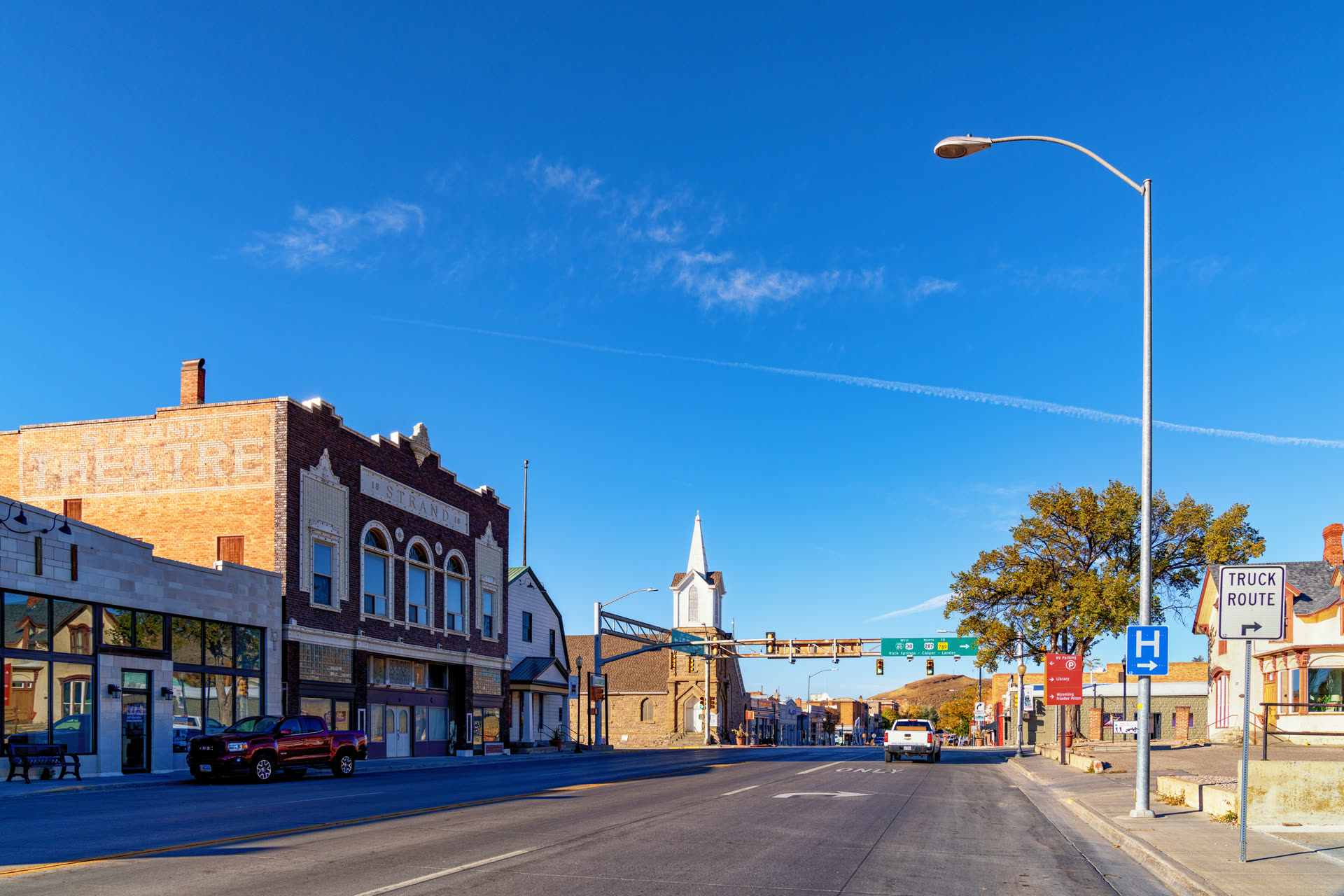
Pictured: downtown Rawlins, Wyoming, the Carbon County oil-patch and Union Pacific railroad town Higdon left on the afternoon of October 25, 1974 — not the actual encounter site, McCarty Canyon, roughly 40 miles south in the Medicine Bow National Forest, which sits on undeveloped public land with no known photograph tied to the incident itself. No photograph of Higdon, the entity, or the craft he described is known to exist; his own drawings and the composite sketch produced with investigators are the only visual record.
Theoretical Alignment
The Psycho-Social Hypothesis scores highest here by a wide margin, reflecting a case built entirely on one man's hypnotically-recovered testimony that researchers have since matched, scene-for-scene, against a specific, obscure 1911 French science-fiction novel that had a documented American distribution pathway decades before 1974 (see Historical Precedents and the Conventional Explanation Candidate, below). The Extraterrestrial Hypothesis retains a modest, non-zero alignment because the deformed rifle bullet is a genuine physical object two independent examiners could not immediately explain, and because Higdon's own account, whatever its origin, is internally consistent across more than three decades of retelling. The Interdimensional Hypothesis finds almost no purchase in an account that describes ordinary spatial travel to a physical planet, not a portal, veil, or dimensional transition.
Background
By the mid-1970s, the University of Wyoming's Dr. R. Leo Sprinkle had already spent more than a decade as one of the small handful of credentialed psychologists willing to publicly investigate UFO contact claims. A counseling psychologist who had served as a psychological consultant to the Condon Committee and personally hypnotized Nebraska patrolman Herbert Schirmer in 1968, Sprinkle described his own trajectory from "scoffer" to committed believer in the reality of UFO contact experiences dating back to the early 1950s. By 1974 he was also a sitting member of a UFO research body assembled by a very different kind of institution: the National Enquirer's "Blue Ribbon Panel," a group of five credentialed PhDs J. Allen Hynek helped organize in 1972 at the tabloid's request, tasked with evaluating whether any submitted UFO case met the bar for a standing $50,000 reward the paper had offered for scientific proof of extraterrestrial visitation, with a separate $5,000 prize earmarked for whichever single case the panel judged most scientifically valuable in a given year. The panel's existence gave Sprinkle, and by extension any witness he investigated, a direct institutional and financial channel to national publicity and potential compensation — a structural feature of several of the decade's best-known abduction cases; the panel awarded its $5,000 prize to logger Travis Walton's case the very next year, 1975, establishing a concrete precedent for exactly the kind of payout a witness or investigator working with the panel might reasonably anticipate. The Enquirer itself never abandoned the $50,000 reward or disbanded the panel until roughly 1980–1981, meaning it remained a live institutional backdrop throughout the entire span of Higdon's hypnosis sessions and follow-up testing.
Carl Higdon was, by every account, an unlikely figure to become a national UFO case. A U.S. Air Force veteran of the Korean War, he had spent 15 years working as an oil-well driller and foreman "in the patch" around Rawlins, Wyoming, a Union Pacific railroad and oil-industry town in the state's high desert, at the time employed by AM Well Service. He was married to Margery Higdon and, by later accounts, the father of a large family. Those who knew him in Rawlins, including his employer Roy Fleming, described him as an ordinary, hard-working, unremarkable man with no known prior interest in UFOs, no history of psychiatric illness, and no obvious motive to fabricate an elaborate hoax — a profile investigators and skeptics alike have both cited, for opposite reasons, in evaluating what happened next. Rawlins itself, seat of Carbon County, had grown up around the Union Pacific railroad and later the region's oil and coal industries, and by the mid-1970s remained a small, close-knit working town of only a few thousand residents, the kind of place where an oil-rig foreman's sudden disappearance and equally sudden, disoriented reappearance would have been genuinely difficult to keep quiet, let alone stage-manage without word spreading almost immediately.
Complete Timeline
| Date | Event |
|---|---|
| Oct. 25, 1974, ~4:00 p.m. | Carl Higdon drives south from Rawlins into the Medicine Bow National Forest, parks near a logging road in McCarty Canyon, and sets out on foot to hunt elk with a new 7mm Remington Magnum rifle. |
| ~4:50 p.m. | Higdon reports sighting a herd of five elk in a clearing, firing at a large bull, and watching the bullet visibly slow and drop to the ground roughly 50–60 feet away, undamaged by impact yet already deformed. |
| Immediately after | A roughly six-foot humanoid entity, later giving the name "Ausso One," appears near the elk; Higdon says the being offers him food and then gestures him toward a small floating box before he loses consciousness. |
| ~6:30 p.m. | According to a hypnotically-recovered detail, Higdon briefly contacts his employer, Roy Fleming, by CB radio during the missing-time period, though he has no memory of the call or what was said. |
| ~11:40 p.m. | A search party led by Carbon County Sheriff Charles Ogburn and Deputy Ed Tierney, alerted after Higdon failed to return, locates his pickup truck roughly three miles from where he had parked, mired in a muddy ravine with no tire tracks leading to it. |
| ~11:40 p.m. | Searchers find Higdon inside the truck, cold, disoriented, and unable to explain how the vehicle got there; several report a red-green-white flashing light moving across the area during the search, separately corroborated by Margery Higdon and family friends Don and Marilyn James. |
| Oct. 26, 1974, ~2:00 a.m. | Higdon is examined at Carbon County Memorial Hospital by Dr. R. C. Tongco, who notes bloodshot, watery eyes, disorientation, and, on reviewing his prior medical records, the apparent absence of tuberculosis scarring and kidney stones previously documented in his chart. |
| Oct. 28, 1974 | Higdon is released from the hospital. |
| Oct. 29, 1974 | Rawlins Daily Times reporter Sue Taylor publishes the first newspaper account of the incident. |
| Early Nov. 1974 | Higdon passes a polygraph examination arranged by the National Enquirer. |
| Nov. 2, 1974 | Dr. Leo Sprinkle, notified by local MUFON investigator Rick Kenyon, conducts the first of several hypnotic regression sessions with Higdon at the University of Wyoming. |
| Nov. 17, 1974 | Sprinkle conducts a second hypnosis session; additional sessions follow into 1976, with Higdon's account of the entity's planet and purpose growing more detailed across sessions. |
| 1975 | Sprinkle publishes "A Preliminary Report on the Investigation" in Flying Saucer Review, and freelance writer Frank Bourke publishes an account in the tabloid National Star. |
| Sept. 1978 | Higdon undergoes a further round of hypnotic regression and a Psychological Stress Evaluator (voice-stress) test, administered separately by an LAPD scientific consultant and an FDA consultant, both of whom conclude his distress responses appear genuine. |
| 1979 | Sprinkle publishes a fuller case analysis as a chapter in the academic anthology UFO Phenomena and the Behavioral Scientist. |
| 1989 | Folklorist Thomas E. Bullard analyzes the case's narrative structure in the Journal of American Folklore, situating it within the broader abduction-narrative genre. |
| 1997 | Higdon retires from oilfield work and relocates to Texas, where he was born. |
| 2017 | Margery Higdon publishes Alien Abduction of the Wyoming Hunter, a first-person family account of the case. |
| Jan. 26, 2022 | Carl Higdon dies in Temple, Texas, of COVID-19 pneumonia, having maintained the same core account for nearly half a century. |
The Shot That Wouldn't Fly
Higdon's account begins in the most mundane way possible: a day off from the oil patch, a new rifle, and an elk tag he hoped to fill before the season closed. He drove south out of Rawlins into the Medicine Bow National Forest, parked near a logging road in a drainage locally known as McCarty Canyon, and set out alone on foot in the mid-afternoon light, having briefly crossed paths with a couple of other local hunters and a game warden on his way in — ordinary, unremarkable contacts that nonetheless establish he was alone by the time the encounter itself began. According to Higdon, he came across a small herd of five elk in a clearing and, sighting a large bull through his new 7mm Remington Magnum, fired a single shot.
What happened next is the detail that put this case on the map among UFO investigators, and it is worth stating precisely because so many retellings compress or exaggerate it: Higdon said the bullet did not simply miss. It appeared, in his account, to slow down in flight as though passing through some kind of resistant medium, arcing gently to the ground roughly 50 to 60 feet from where he stood — far short of the elk, and far too short a distance to be consistent with a normal ballistic trajectory for a 7mm Magnum round, which at that range should still have been traveling at several thousand feet per second. When Higdon retrieved the spent round, he found it visibly deformed: the lead core was missing entirely, leaving only the copper jacket, which was itself misshapen in a way a local police examiner who later looked at it described, according to multiple secondhand accounts, as looking as though it had been "turned inside out." Neither the officer nor a metallurgy consultant retained afterward by Coral Lorenzen's Aerial Phenomena Research Organization (APRO), Dr. Walter Walker, could identify an ordinary mechanical or chemical process that produced exactly this result.
Almost immediately after recovering the bullet, Higdon said he became aware of a "sort of man" standing near the elk — a humanoid figure he estimated at six feet tall and 180 pounds, with yellowish skin, no visible ears, small deep-set eyes, a lipless mouth showing three blocky teeth, coarse straw-like hair, and what looked like two short antennae on its forehead. The being wore a black jumpsuit marked with a six-pointed star and yellow insignia, and in place of a right hand had what Higdon described as a rigid, drill-like appendage. It introduced itself, in Higdon's account, as "Ausso One," and communicated with him telepathically rather than aloud.
Aboard the Craft
What Higdon reported next comes almost entirely from the hypnotic regression sessions conducted by Dr. Leo Sprinkle beginning eight days after the encounter, since Higdon had no conscious memory of most of the intervening period. Under hypnosis, he described Ausso One offering him small food pills from a box that floated unsupported in the air, and after accepting one, finding himself abruptly transported — by a gesture from the being rather than any visible mechanism — into a transparent, cube-shaped enclosure roughly five feet on a side that also contained the same five elk he had been hunting, along with two additional humanoid occupants. He said the craft's interior seemed disproportionately larger than its exterior dimensions should have allowed.
Higdon recalled Ausso One explaining, again telepathically, that his people periodically visited Earth to collect animals — and, it was implied, sometimes people — as a food or breeding resource, and that the craft was taking him to their home planet. He was told the distance was "163,000 light-miles," an figure that struck even Higdon himself as strange enough that he specifically raised it with investigating officers afterward; when he questioned whether the being meant light-years, he recalled being told that "the passage of time is different" for Ausso One's people. Once "there," in his account, he was shown a landscape dominated by a tall, tapering structure he compared to Seattle's Space Needle, then brought before a group of other beings who examined him on a platform, ultimately deciding — because he had undergone a vasectomy years earlier — that he was unsuitable for whatever reproductive purpose they had in mind, and that he would be returned. He recalled feeling his memory of the experience beginning to slip away even as it was happening, a detail Sprinkle and later researchers have both treated as significant, for very different reasons discussed in the Conventional Explanation Candidate section below.
Higdon's conscious memory resumes only with the search party finding him at approximately 11:40 p.m., nearly eight hours after he had left his truck, sitting inside the vehicle in a state of considerable disorientation. The truck itself had been relocated roughly three miles from where he had parked it, deposited in a muddy ravine that required searchers to lay down wooden planks to extract it, with no tire tracks connecting the two locations despite the soft ground — a detail Higdon could not explain and that has never been resolved by any conventional account of the case. During the search, Margery Higdon and family friends Don and Marilyn James separately reported a red-green-white flashing light moving back and forth over the search area for more than twenty minutes, a sighting independent of, and never directly tied to, Higdon's own account of the entity encounter.
Medical Examination and Immediate Aftermath
At Carbon County Memorial Hospital in the early hours of October 26, examining physician Dr. R. C. Tongco documented bloodshot, watery, light-sensitive eyes and general disorientation consistent with exposure to intense light or significant physiological stress. The case's most dramatic secondary claim emerged from this examination: Tongco, reviewing Higdon's existing medical chart, reported that scarring on his lungs previously attributed to tuberculosis, and kidney stones documented in earlier records, both appeared to be absent. Higdon's blood was also described as showing an unusually rich supply of vitamins and nutrients. No pre-encounter imaging or lab work from this specific period was preserved or independently re-examined in any source available for this case file, meaning the "healing" claim rests entirely on Tongco's own comparison to Higdon's prior chart rather than on any contemporaneous before-and-after test that has itself survived for outside review.
Toxicology found no evidence of drugs or alcohol. Sprinkle and other early investigators who interviewed Higdon's employer, neighbors, and fellow oil-patch workers described him as consistently regarded as honest, sober, and hard-working, with no history of mental illness — an assessment Sprinkle's own psychological evaluation, conducted independently of the hypnosis sessions, supported. Sprinkle's own written conclusion, drawn from his combined clinical and hypnotic sessions, stated plainly: "I find…no evidence of hoax. No evidence of psychotic reaction…I'm left with the mysterious…feeling that the cases are happening as the individuals describe."
The case did not end with the 1974 sessions. In September 1978, nearly four years later, Higdon underwent a further, independent round of testing: renewed hypnotic regression alongside a Psychological Stress Evaluator (PSE) examination, a voice-stress analysis technique distinct from a standard polygraph, administered separately by a scientific consultant to the Los Angeles Police Department (identified in sources as Dr. Greenberg) and a consultant to the U.S. Food and Drug Administration (Dr. Sidney Walter). Both concluded Higdon's responses under questioning appeared sincere; the PSE examiner's own written verdict was unusually direct for a technical report: "I am forced to admit that something utterly fantastic did happen in this man's life: the test proves it beyond doubt." Higdon's hypnotic response specifically to recalling the intense light he described aboard the craft was interpreted by the examiners as physiologically consistent with genuine prior exposure to harsh light, though this interpretation, like the rest of the 1978 round, still measured only Higdon's own stress response to his own testimony, not any external or independently verifiable signal.
Key Witnesses
Carl Higdon
The case's only witness to the humanoid entity, the bullet's mid-air deformation, and the journey aboard the craft. A 41-year-old Air Force veteran with 15 years' oilfield experience and, by every account gathered, no prior UFO interest or history of psychiatric illness, Higdon maintained a consistent core narrative for the rest of his life, across a 1974 polygraph, a 1978 voice-stress test, and decades of retellings to journalists and researchers, without any of the financial windfall or media career some critics of the era's abduction cases have pointed to as a motive elsewhere. His account is nonetheless entirely uncorroborated at its center: no other person witnessed the entity, the craft, or the abduction itself.
Margery Higdon
Present during the search for her husband on the night of October 25–26, 1974, Margery Higdon reported, together with family friends Don and Marilyn James, a red-green-white flashing light moving over the search area — the case's only second-party observation of anything unusual that night, though it corroborates an unexplained light in the general vicinity, not the entity encounter Carl Higdon separately described under hypnosis. She later authored a first-person account of the case and its decades-long aftermath on the family.
Dr. R. Leo Sprinkle
Not a witness to the encounter itself, but the case's central investigator, Sprinkle conducted the hypnotic regression sessions that produced nearly all of the case's narrative detail beyond the initial rifle-and-bullet incident, administered psychological evaluations that found no evidence of hoax or psychosis, and later published the case's principal academic analyses. A self-described former "scoffer" who had become a committed believer in the reality of UFO contact experiences by the early 1950s, and a sitting member of the National Enquirer's Blue Ribbon UFO Panel at the time of the investigation, his own prior convictions and institutional position are cited by later researchers as a plausible source of confirmation bias in how the sessions were conducted and interpreted.
Rick Kenyon
A local art teacher and Mutual UFO Network investigator who was among the first outside Higdon's immediate circle to interview him, Kenyon notified Sprinkle and helped initiate the formal investigation, and produced a composite sketch of "Ausso One" from Higdon's description. Researcher analysis of the hypnosis-session transcripts has specifically flagged Kenyon's own active presence and prompting during at least one session — introducing terms like "time lapse" that Higdon then adopted — as a plausible channel through which specific narrative details could have been suggested rather than spontaneously recalled.
Dr. Walter Walker
Retained by APRO to examine the deformed 7mm bullet, Walker, like the local police examiner who looked at it independently, could not identify a straightforward mechanical or chemical explanation for its missing lead core and inverted copper jacket. His examination remains the closest thing this case has to independent physical-evidence analysis, though it was never followed by modern instrumental re-testing, and the bullet's present location is not documented in any source consulted for this case file.
The Five Observables Assessment
The Five Observables framework is applied to the performance characteristics reported in this case:
Assessment: Every performance claim in this case comes from Higdon's own hypnotically-recovered testimony about a craft no one else ever saw operate, take off, or land. He described covering an impossible interstellar distance "in less than a minute," which would necessarily imply extreme instantaneous acceleration and effectively unbounded velocity — but there is no instrumented data of any kind, no radar return, and no second witness to weigh against the account. Low Observability is rated not applicable rather than speculative for the same reason Anti-Gravity Lift is rated absent: with no external observer present at any point during the claimed flight, there was nothing for the craft to successfully evade detection by, which makes the entire observables framework fundamentally untestable for this case rather than merely unconfirmed.
Evidence Assessment
Supporting Anomalous Origin
- A physical object — the deformed 7mm bullet — exists independent of Higdon's testimony, and two separate examiners (a local police official and an APRO-retained metallurgist) could not identify an ordinary process producing its missing lead core and inverted jacket
- Higdon passed a 1974 polygraph examination and a 1978 Psychological Stress Evaluator test administered by independent consultants, both of whom concluded his distress responses appeared genuine
- Dr. Leo Sprinkle's independent psychological evaluation found no evidence of psychosis, hoax, or a motive to fabricate
- Higdon maintained a consistent core account for nearly 48 years, across a polygraph, a voice-stress test, and dozens of interviews, without the financial payoff several other 1970s abduction claimants received
- His truck's relocation three miles from where he parked it, with no tire tracks on soft, muddy ground, has never been given a conventional mechanical explanation
- A second party (his wife and two family friends) independently reported an unexplained flashing light over the search area the same night, though this does not corroborate the entity encounter itself
Supporting Conventional Explanation
- The encounter's entire narrative content beyond the initial rifle shot exists only because of hypnotic regression, a technique with well-documented risk of confabulation and source-monitoring confusion between real memory and absorbed fiction
- Researcher analysis has identified more than a dozen specific structural and descriptive parallels between Higdon's account and Maurice Renard's 1911 French novel Le Péril Bleu, which had a documented English-language American magazine printing decades before 1974
- The bullet was never subjected to modern instrumental or isotopic re-testing, and its present whereabouts are not documented in any source reviewed for this case file — there is no ongoing chain of custody to examine
- The claimed distance to Ausso One's planet, "163,000 light-miles," is not a coherent unit of astronomical measurement, and the account's own explanation for the discrepancy ("the passage of time is different") does not resolve it
- Investigator Rick Kenyon is on record introducing specific narrative terminology during at least one hypnosis session that Higdon then adopted, a textbook mechanism for unintentional suggestion
- Principal investigator Dr. Leo Sprinkle held a prior, longstanding personal belief in the reality of UFO contact and sat on a body (the National Enquirer's Blue Ribbon Panel) with a direct institutional incentive to validate exactly this kind of claim
- The dramatic medical claims (resolved tuberculosis scarring, disappeared kidney stones) rest entirely on one physician's after-the-fact comparison to Higdon's existing chart, with no preserved contemporaneous imaging available for independent re-examination
Why "Disputed"
This case receives a DISPUTED classification rather than a stronger or weaker one because its central physical claim and its central narrative claim deserve, and receive, genuinely different confidence levels. The physical evidence — a rifle bullet two independent examiners could not immediately explain — is real in the narrow sense that a deformed piece of metal existed and was looked at by more than one person, but it was never modern-tested, was never isotopically analyzed, and is not known to survive in any documented location today; "unexplained by a 1974 examiner" is a real but modest evidentiary bar, not proof of anomalous origin. The narrative — the entity, the craft, the planet, the breeding-rejection motive — is far more elaborate, and it emerged almost entirely through repeated hypnotic regression sessions, a method with a well-established capacity to elaborate, confabulate, and absorb culturally available material as if it were genuine memory. That risk is not abstract here: independent literary research has traced Higdon's account point-for-point against a specific, obscure but documented 1911 French science-fiction novel with a demonstrable pre-1974 American publication history, and has identified the case's own lead investigator introducing specific terminology during a session that Higdon then incorporated. Higdon himself, by every account, appears to have been a sincere, consistent, and non-litigious witness rather than a knowing hoaxer — but sincerity does not resolve the question of where the story's specific content actually came from. A genuine, unresolved physical anomaly combined with a narrative that has a specific, well-matched non-anomalous origin candidate is exactly the profile of a Disputed case: too consistently told across decades to dismiss as a simple fabrication, too dependent on hypnotically-recovered detail and too well-matched to a pre-existing fictional source to rate as strong evidence of an actual extraterrestrial encounter.
Sensor & Instrumentation Detection Profile
No radar, photographic, film, or FLIR record of any kind exists for this case. The only instrumented data connected to it are the two post-hoc psychophysiological examinations of Higdon himself — the November 1974 polygraph arranged by the National Enquirer, and the September 1978 Psychological Stress Evaluator (voice-stress) test administered by an LAPD scientific consultant and an FDA consultant — both of which measured Higdon's own physiological responses while retelling the story, not any external signal from a craft or entity. No sensor of any kind was ever trained on the alleged encounter site itself, either at the time or afterward.
Environmental & Geospatial Context
McCarty Canyon sits in the southern reaches of the Medicine Bow National Forest, roughly 40 miles south of Rawlins in Carbon County, Wyoming — a high-desert and forested foothill terrain at elevation above 7,000 feet, within the Sierra Madre/Encampment Ranger District rather than the better-known alpine Snowy Range unit of the same national forest. Late October in this part of south-central Wyoming brings clear, cold afternoons giving way to near-freezing overnight temperatures, consistent with the search party's description of a cold, disoriented Higdon when they found him. No unusual solar, geomagnetic, or meteorological activity for October 25–26, 1974 is noted in any source reviewed for this case file. The area is remote hunting ground with no significant military installation, airfield, or population center nearby; Rawlins itself is an oil-patch and Union Pacific railroad town with no defense-related industry that would independently explain unusual aerial activity in the area that week.
Observer Credibility & Occupational Profile
Unlike many of the era's most-cited abduction cases, this one does not rest on a credentialed professional observer describing a brief sighting; it rests on a single blue-collar witness's detailed, multi-hour account of sustained contact, recovered mostly under hypnosis. Higdon's specific occupational profile — a Korean War-era Air Force veteran with 15 years of oilfield foreman experience, described consistently by neighbors and coworkers as sober, honest, and hard-working, with no prior interest in UFOs — supports the argument that he was not a habitual fantasist or a publicity-seeker; it does nothing, however, to establish reliability under hypnosis, a technique that credentialed and honest witnesses are just as susceptible to as anyone else. The investigation's credentialed figure, Dr. Leo Sprinkle, brought real academic standing (a doctorate in counseling psychology, a Condon Committee consultancy, and hundreds of subsequent hypnotic regressions of contactees) but also a documented, self-acknowledged prior conviction that UFO contact experiences were genuine, and a seat on an institution (the National Enquirer's Blue Ribbon Panel) with a direct financial stake in exactly this kind of finding — a combination that supports treating his conclusions as informed but not disinterested.
Physical & Material Assays
The only physical evidence in this case is the deformed 7mm Remington Magnum bullet Higdon recovered at the scene. Both a local police examiner and APRO metallurgy consultant Dr. Walter Walker reported that its lead core was entirely missing and its copper jacket was deformed in a manner neither could readily attribute to an ordinary firing malfunction, corrosion, or mishandling. Crucially, this assessment has never been updated with modern analytical techniques — no scanning electron microscopy, no isotopic mass spectrometry, no fractographic analysis of the copper jacket has ever been performed or published, and no source consulted for this case file documents where the bullet is held today or whether it still exists. This is a real, if modest, physical-evidence claim that has never been given the kind of rigorous modern re-examination several other cataloged cases on this site (see the Florence Stadium Sighting's chemically analyzed "angel hair," for comparison) have received.
Historical Precedents & Archive Matches
The case sits in the first wave of American abduction narratives that followed Betty and Barney Hill's 1961 account and preceded Travis Walton's the following year, sharing with both a missing-time structure, a hypnotic-regression investigation, and eventual involvement with the National Enquirer's Blue Ribbon Panel. It is also, per folklorist Thomas E. Bullard's 1989 Journal of American Folklore analysis, a clear example of the genre's recurring narrative "grammar" — capture, examination, communication of purpose, rejection, and return — that recurs across geographically and culturally unconnected reports. More specifically and more consequentially, independent literary research published since has matched Higdon's account point-for-point against Maurice Renard's 1911 French science-fiction novel Le Péril Bleu ("Up Above" in its 1912 English serialization) and several derivative 1930s–1940s American pulp stories, identifying at least a dozen specific shared plot beats — an out-of-place vehicle left in inaccessible terrain, a transparent holding cell, a view of Earth through a transparent floor, eye pain from unfamiliar light, a mid-flight sound described as an electric-razor buzz, and being "dropped" back to Earth like cargo — discussed in full in the Conventional Explanation Candidate section below. The University of Wyoming's American Heritage Center, which holds Dr. Sprinkle's full 1961–2020 professional archive (94 boxes), specifically catalogs a dedicated "Carl Higdon Chapter" folder and a set of case sketches, making this one of relatively few 1970s abduction cases whose original investigative paper trail survives intact in a public research archive.
Within Sprinkle's own body of investigative work, the case also invites direct comparison to his 1968 hypnosis of Herbert Schirmer, conducted for the Condon Committee six years earlier: both involve a single male witness in a rural setting, a period of missing time discovered only afterward, a hypnotically-recovered abduction narrative that grew more detailed across multiple sessions, and a polygraph the witness passed. The Condon Committee's own published verdict on Schirmer — that it had "no confidence" his experience was physically real, despite Sprinkle's parallel finding that Schirmer sincerely believed what he described — is frequently cited by this site and by outside researchers as the closest institutional analogue to how the Higdon case is best read: a witness very plausibly convinced of the truth of an account whose specific content did not originate the way he believed it did. The case's core narrative elements — alien beings, an examination motif, and communication of a specific extraterrestrial purpose — also echo Betty Hill's 1961 star map, later analyzed by schoolteacher Marjorie Fish as depicting the Zeta Reticuli system, underscoring how consistently this genre's specific narrative furniture recurs across otherwise unconnected witnesses and decades.
Material Analysis
The deformed 7mm rifle bullet is this case's only surviving physical exhibit, and it deserves closer treatment on its own terms. Higdon fired a factory 7mm Remington Magnum round, a caliber whose muzzle velocity at the time was typically in excess of 3,100 feet per second, and at the modest range he described (well under 100 yards) it should have retained the overwhelming majority of that velocity. A soft-point or jacketed hunting bullet that strikes an elk, brush, rock, or the ground at that speed typically shows either a mushroomed, expanded nose (if it struck a soft target and held together) or a badly fragmented, torn jacket with visible impact scoring (if it struck a hard surface at speed) — but in either case, some remnant of the lead core is normally still present, fused or partially melted into the copper jacket rather than absent altogether. A near-total absence of the lead core, without heavy external impact scoring, is not the profile investigators or a firearms examiner would expect from an ordinary miss, ricochet, or manufacturing defect, which is the specific basis for both the police examiner's and Dr. Walker's inability to offer a routine explanation.
What Cannot Be Ruled Out
At the same time, several mundane possibilities were never definitively excluded because the bullet was never subjected to rigorous modern testing. A rare manufacturing defect in the lead-core seating process, a prior handling or reloading irregularity not disclosed by Higdon, or a chemical reaction from prolonged exposure to moisture and soil after landing could each, in principle, produce an unusual-looking deformed round without requiring any anomalous cause — none of these has been affirmatively demonstrated for this specific bullet, but none has been affirmatively ruled out either, because no isotopic, electron-microscopy, or metallurgical re-analysis was ever performed. The absence of the bullet from any documented modern collection or laboratory record means this question is now very likely unresolvable.
Supporting Non-Terrestrial Origin
- Two independent examiners in 1974, working from direct physical inspection rather than secondhand description, both reported being unable to identify an ordinary process producing the bullet's specific deformation
- The described behavior (a mid-air slowing rather than a normal ballistic arc) and the physical result (missing lead core, inverted jacket, no impact scoring) are not the standard signature of a miss, ricochet, or manufacturing flaw a firearms examiner would expect to see
Supporting Terrestrial Origin
- The bullet was never subjected to modern instrumental testing (SEM, isotopic mass spectrometry, fractographic analysis) that could either confirm or rule out a mundane manufacturing or handling defect
- Its current location and chain of custody after the original 1974 examination are undocumented in any source reviewed for this case file, meaning no follow-up verification is now possible
- The claim rests entirely on the secondhand characterization ("turned inside out") of an unnamed police official, filtered through decades of retelling, rather than a preserved, published laboratory report
The Conventional Explanation Candidate: Cultural Contamination via Hypnotic Confabulation
The strongest, most specific conventional explanation for this case does not attempt to explain away the rifle bullet as a simple ballistics error, nor does it accuse Higdon of deliberate fraud. Instead, independent literary-historical research — most fully developed by UK-based UFO historian Gideon Reid — argues that the elaborate narrative content Higdon produced under hypnosis, from the transparent holding cell to the breeding-rejection motive to the specific sound and lighting details of the "craft," derives from cultural material already circulating in American popular fiction decades before 1974, surfaced through hypnosis rather than genuinely remembered.
The argument traces back to Maurice Renard's 1911 French novella Le Péril Bleu, which depicts superior, largely unseen alien beings capturing humans in invisible aerial craft and holding them in transparent cells for examination — published in an English-language adaptation, translated by John N. Raphael, in the British and American magazine Pearson's Magazine in 1912, and again as "Up Above." Reid catalogs a specific chain of American pulp science-fiction stories through the 1920s–1940s that reworked and elaborated these same motifs, culminating in at least a dozen specific, point-for-point matches to details Higdon described only after multiple hypnosis sessions, not in his initial, far sparser conscious account: an out-of-place vehicle left in inaccessible terrain (Renard's fictional hay-cart stranded on an inn roof; Higdon's truck relocated three miles with no tire tracks); an eerie sense of absolute stillness or silence; a transparent enclosure holding both the human captive and animal specimens together; a view of the outside world through a transparent floor or wall; a firearm discharged inside the enclosure producing an abnormally deformed projectile; eye pain and vision impairment attributed to unfamiliar light; a solid but effectively invisible or intangible craft; an invisible platform or shelf described in strikingly similar language across sources; other human and animal "specimens" held in the same space; rough, undignified handling on return, described as being "dropped" like cargo; a distinctive buzzing or humming sound compared to an electric razor; and a pronounced disorientation about the passage of time. Hypnosis is well documented in the cognitive-science literature to increase confidence in recalled material without increasing its accuracy, and to create genuine "source-monitoring" confusion between material a person actually experienced and material they were merely exposed to at some point, including in fiction absorbed and forgotten years earlier. Reid further proposes a plausible transmission pathway for exactly this kind of decades-old, obscure material reaching a Wyoming oil worker: Pearson's Magazine's serialized "Up Above" adaptation circulated in both the UK and the United States, and its core imagery was subsequently recycled, sometimes nearly verbatim, across a run of widely distributed American pulp titles through the 1940s — the same low-cost, high-circulation magazines that supplied casual reading material to rural and working-class American men of Higdon's generation.
Investigator Suggestion and Confirmation Bias
A second, related strand of the same explanation focuses on the investigation itself rather than on Higdon's own prior reading. Dr. Leo Sprinkle was, by his own account, already a committed believer in the reality of UFO contact experiences well before 1974, and sat on the National Enquirer's Blue Ribbon Panel, an institution with a direct financial and publicity interest in validating exactly this kind of claim. Separately, MUFON investigator Rick Kenyon is on record introducing specific terminology — including the phrase "time lapse" — during at least one hypnosis session, terminology Higdon subsequently adopted into his own account. Neither fact proves the case was consciously manufactured by its investigators, but together they describe an investigative environment with a real, documented capacity to shape, rather than merely record, an already-malleable hypnotic narrative.
Psychogenic Fugue and Dissociative Episode
A more conventional psychiatric candidate holds that Higdon experienced a genuine dissociative or fugue-like episode — possibly triggered by carbon monoxide exposure from his idling truck, mild hypoxia at altitude, dehydration, or acute psychological stress — that produced the missing-time period and the disorientation documented at the hospital, with the specific abduction narrative constructed afterward, consciously or not, to explain a gap his mind could not otherwise account for. This candidate fits the missing time, disorientation, and light sensitivity reasonably well, but it does not, by itself, explain either the specific literary parallels in the narrative content or the deformed bullet, which by all accounts existed before any hypnosis session took place.
Deliberate Hoax
The least well-supported candidate, deliberate fabrication, is undermined by the consistent, decades-long assessment of Higdon's character by neighbors, coworkers, and every investigator who interviewed him, by his passing both a 1974 polygraph and a 1978 voice-stress test, and by the absence of any significant financial gain he pursued from the story. A hoax explanation would also require Higdon to have independently sourced and internalized a genuinely obscure 1911 French novella and its pulp-fiction derivatives well enough to reproduce a dozen specific plot beats under pressure — a more demanding standard than the confabulation hypothesis, which only requires that this material have been absorbed passively, at some point, the way ambient pop-cultural material commonly is.
Cultural Contamination / Hypnotic Confabulation
PlausiblePLAUSIBLE. The specific, multi-point match between Higdon's hypnotically-elaborated narrative and a documented, pre-1974 American-circulated science-fiction source is unusually strong for this genre of case, and is consistent with well-established, non-exotic mechanisms (source-monitoring confusion under hypnosis) rather than requiring any unverified psychological phenomenon.
Investigator Suggestion / Confirmation Bias
PlausiblePLAUSIBLE as a contributing factor rather than a complete account on its own. Documented terminology introduction by an investigator during a session, combined with the principal investigator's prior belief and institutional financial interest, is a real and specific mechanism, though it does not by itself explain every detail in the account.
Psychogenic Fugue / Dissociative Episode
InconclusiveINCONCLUSIVE. Fits the missing time and disorientation reasonably well, but no contemporaneous toxicological or neurological workup exists to confirm or rule out a specific trigger, and it does not independently explain either the bullet or the narrative's literary parallels.
Deliberate Hoax
ImplausibleIMPLAUSIBLE. Contradicted by Higdon's consistent character assessment, his passing two independent stress-detection examinations, his absence of financial motive, and the greater complexity a conscious hoax would require compared to passive absorption of pre-existing fictional material.
Related Cases
Confirmed Documents & Official Records
The 94-box public archive of Dr. Sprinkle's full professional papers, held at the University of Wyoming, specifically catalogs a dedicated "Carl Higdon Chapter" folder (Box 51) and case sketches (Box 52) — the closest thing this case has to a surviving original investigative paper trail, though access to some materials is restricted by a research-use agreement protecting named individuals' privacy.
This is not a federal case: Project Blue Book had already closed in December 1969, nearly five years before the encounter, so no U.S. Air Force or other federal agency ever opened an official file on the Higdon case. No FBI, CIA, or military record referencing this incident is known to exist.
Search Government & Archival Records Directly
Further Reading — Recommended Literature
Alien Abduction of the Wyoming Hunter
A first-person family account of the case and its decades-long aftermath, written by Carl Higdon's own wife — the closest thing available to a primary-source retrospective from inside the family.
Passport to Magonia: From Folklore to Flying Saucers
Vallée's foundational argument that abduction and contact narratives echo far older folkloric abduction motifs — directly relevant to this case's own literary-lineage explanation.
Abducted!: Confrontations with Beings from Outer Space
APRO's own contemporaneous compilation of abduction cases, published while the Higdon investigation was still fresh, from the organization that retained the metallurgist who examined his rifle bullet.
The Myth and Mystery of UFOs
A scholarly synthesis by the folklorist who first placed Higdon's account within the broader structural "grammar" of the abduction narrative genre in his 1989 journal analysis.
UFO Healings: True Accounts of People Healed by Extraterrestrials
The first book-length survey of contactee "healing" claims, the same category as Higdon's reported resolution of tuberculosis scarring and kidney stones, useful for placing that specific claim in its wider evidentiary context.
Essential Viewing

Carl & Margery Higdon | The Carl Higdon Alien Abduction Story
Carl and Margery Higdon discuss the case directly, including the physical evidence Carl retained, in this Inception Radio Network interview.
Then and Now: Carl Higdon Talks About His Alien Abduction
Eyes On Cinema's retrospective interview footage of Higdon revisiting the details of his 1974 encounter.
Carl Higdon Abduction, 1974
Think Anomalous's detailed case-file summary, drawing on the same primary sources (Sprinkle's reports, Bourke's 1975 article) used in this investigation.
Sources
- Nichols, Jake. "Alien Abductions Of 2 Wyoming Men In The 1970s Remain Unexplainable." Cowboy State Daily, Sept. 30, 2023. cowboystatedaily.com
- "Carl Higdon Abduction, 1974." Think Anomalous. thinkanomalous.com
- Lowth, Marcus. "The Bizarre Humanoid Encounter Of Carl Higdon." UFO Insight. ufoinsight.com
- Gross, Patrick. "The Carl Higdon Close Encounter of the 3rd Kind, 1974." Ufologie. ufologie.patrickgross.org
- "Carl Higdon's Humanoid/UFO Encounter — Medicine Bow National Forest, Wyoming, October 25, 1974." UFO Evidence, Case 308. ufoevidence.org
- Reid, Gideon. "Science Fiction and the Carl Higdon Alien Encounter Story." Gideon Reid. gideonreid.co.uk
- Reid, Gideon. "Carl Higdon's Trip Up Above." Gideon Reid. gideonreid.co.uk
- "R. Leo Sprinkle Papers, 1961–2020." Finding Aid, American Heritage Center, University of Wyoming. Archives West. archiveswest.orbiscascade.org
- "R. Leo Sprinkle." American Heritage Center, University of Wyoming. ahcwyo.org
- "Archives on the Air 73: UFO Psychology — Leo Sprinkle Papers." Wyoming Public Media, Oct. 24, 2018. wyomingpublicmedia.org
- "The Alien Abduction of Carl Higdon." My Dark Path, Episode 77. mydarkpath.com
- "The Blue Ribbon UFO Panel of the National Enquirer." The Saucers That Time Forgot, Sept. 2019. thesaucersthattimeforgot.blogspot.com
- "Carl Higdon." Wikidata, entry Q132191658. wikidata.org
- "Medicine Bow–Routt National Forest." Wikipedia, used only for light geographic/administrative orientation. en.wikipedia.org
- Sprinkle, R. Leo. "A Preliminary Report on the Investigation of the Alleged UFO Experience of Carl Higdon." Flying Saucer Review 21, no. 3 (1975).
- Sprinkle, R. Leo. "Investigation of the Alleged UFO Experience of Carl Higdon," in UFO Phenomena and the Behavioral Scientist, ed. Richard Haines (1979).
- Bullard, Thomas E. "UFO Abduction Reports: The Supernatural Kidnap Narrative Returns in Technological Guise." Journal of American Folklore 102, no. 404 (1989).
- Bourke, Frank. "I Was Kidnapped by a UFO Bubble." National Star, March 22, 1975.
- Taylor, Sue. Original report. Rawlins Daily Times, Oct. 29, 1974.
- Higdon, Margery A. Alien Abduction of the Wyoming Hunter. Self-published, 2017.
- Lorenzen, Coral E. & Jim Lorenzen. Abducted!: Confrontations with Beings from Outer Space. Berkley Medallion, 1977.
- Vallée, Jacques. Passport to Magonia: From Folklore to Flying Saucers. 1969; Anomalist Books reprint.
- "Carl & Margery Higdon | The Carl Higdon Alien Abduction Story." Inception Radio Network, YouTube, 2017.
- Renard, Maurice. Le Péril Bleu [Up Above]. Eugène Fasquelle, 1911; English serialization by John N. Raphael, Pearson's Magazine, 1912 — the literary source Gideon Reid's research connects to Higdon's hypnotically-recovered narrative.
See something inaccurate? Have additional information or sources?
Suggest an Edit →Last Updated: August 2026