
Island of Trindade Sighting
At 12:15 p.m. on January 16, 1958, the Brazilian Navy oceanographic vessel Almirante Saldanha lay off Trindade Island, a volcanic outcrop 1,140 kilometers into the South Atlantic, when a gray, metallic, ring-encircled object — described by witnesses as resembling a flattened planet Saturn — approached from the sea, banked around the island's central peak, and departed at high speed. Of roughly 300 people aboard, some 47 to 48 crew members and civilian scientists on deck reported watching it; professional underwater photographer Almiro Barauna captured four exposures on Rolleiflex film before it vanished over the horizon. The Navy developed the film under armed supervision, subjected the negatives to two independent photographic analyses, and ultimately let President Juscelino Kubitschek release the images to the press — only for the case to be thrown back into dispute decades later by the Navy's own declassified internal doubts, a primary witness's disavowal of the case's signature statistic, and two mutually contradictory hoax "confessions" from the photographer's own family.
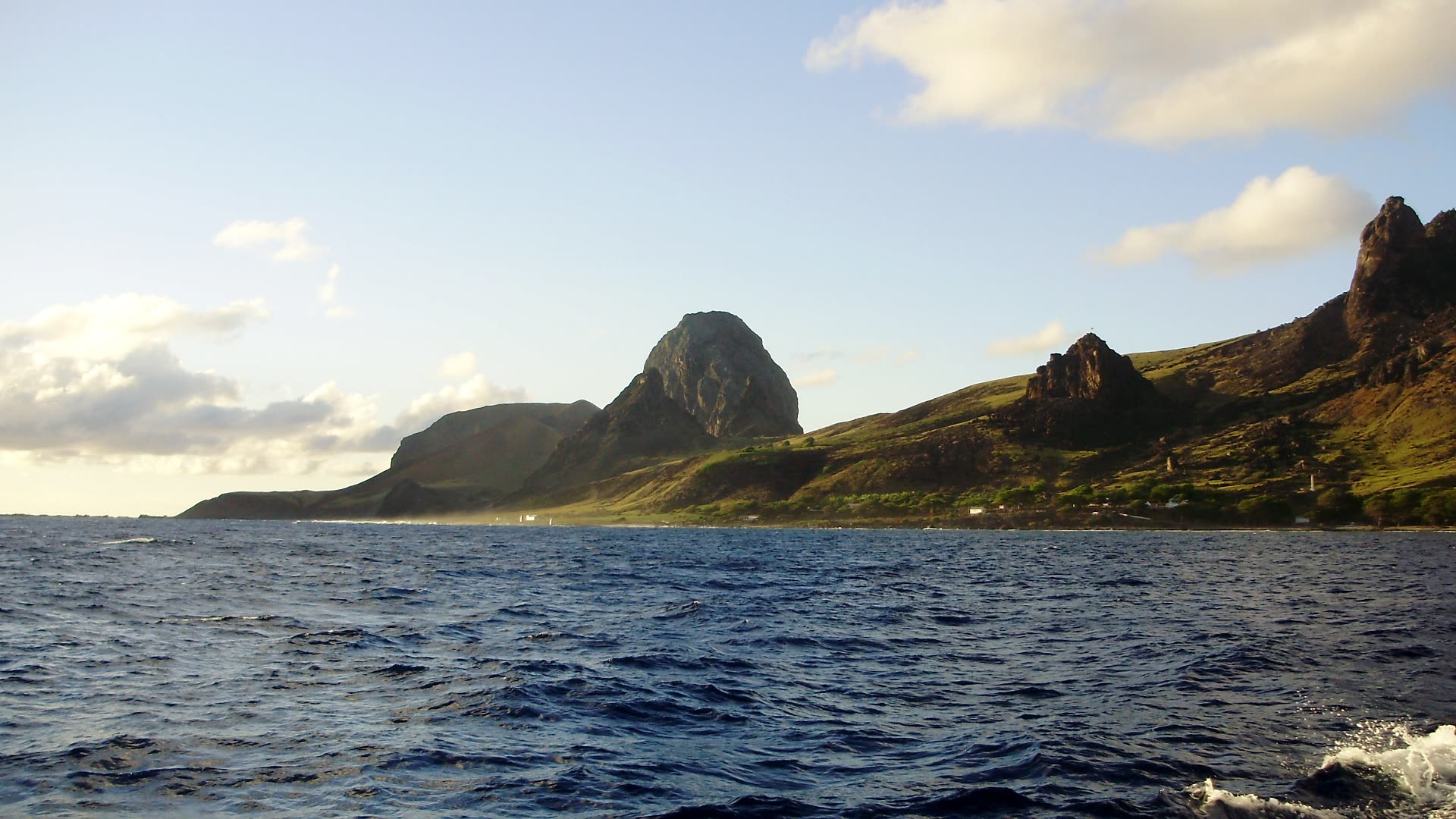
Pictured: Trindade Island itself, photographed by the Brazilian Navy in 2012 — not the alleged object. The four original Barauna negatives remain the property of his estate and are not confirmed to be in the public domain, so no direct case photograph is used here; his widow has also declined researchers' requests to release the negatives for independent modern analysis. (Photo: Marinha do Brasil / Flickr, CC BY-SA 2.0.)
Theoretical Alignment
If genuine, the photographed object's solid, structured, metallic appearance and controlled flight aligns most naturally with the Extraterrestrial Hypothesis. The case sits awkwardly under the Psycho-Social Hypothesis, however, because the leading skeptical explanation is not honest misperception of a mundane stimulus but deliberate photographic fabrication — a different category of explanation the standard PSH framework was not built to describe. No element of the case (missing time, physiological aftereffects, portal-like phenomena) supports an interdimensional reading.
Background
In October 1957, a Brazilian Navy task force under Captain-of-Corvette Carlos Alberto Bacellar arrived at Trindade Island to establish an oceanographic and meteorological research post as Brazil's contribution to the International Geophysical Year (IGY), the eighteen-month global science initiative running from July 1957 through December 1958 that also produced the first satellite launches and a wave of new Antarctic and oceanic research stations worldwide. Trindade — the most remote point in Brazilian territory, roughly 1,140 kilometers off the coast of Rio de Janeiro's home state region of Espírito Santo — had been intermittently occupied by Brazil since the eighteenth century (and briefly by Britain in 1895, an episode that produced a real diplomatic dispute) but had no permanent population; establishing a functioning IGY post there required the Navy's full logistical support.
The ship assigned to resupply and support the Trindade post was the NE Almirante Saldanha, a training and school ship built by Vickers-Armstrong in England and delivered to Brazil in June 1934, named for nineteenth-century Rear-Admiral Luiz Philippe Saldanha da Gama. In February 1957 the Brazilian Navy's Directorate of Hydrography and Navigation formally reassigned the ship to oceanographic duty, installing a laboratory and a 5,000-meter sounding machine while it retained its historic role training midshipmen. Through 1957–58 it became the principal Brazilian vessel of the International Geophysical Year, running 162 separate oceanographic stations and resuming Brazil's occupation of Trindade.
Aboard for the January 1958 resupply voyage was a civilian sport-diving club, the "submarine hunting" group captained by lawyer and bank executive Amilcar Vieira Filho, invited to explore the waters around the island. Among the club's guests was Almiro Barauna, a 41-year-old professional underwater photographer and former newspaperman from Rio de Janeiro's neighboring city of Niterói. Barauna was not a naive first-time observer of the UFO phenomenon: in the early 1950s, working as a photojournalist, he had exposed an earlier "flying disc" photograph taken near Rio's Barra da Tijuca beach as a manufactured hoax, publishing his own reconstruction to demonstrate exactly how the fake had been produced. That prior episode — establishing Barauna as someone with genuine, publicly demonstrated expertise in constructing convincing UFO photo fakes — would become the single most cited fact on the skeptical side of the Trindade case for the next seven decades.
Also aboard was retired Brazilian Air Force Captain José Teobaldo Viegas, a geologist identified in period accounts only as "Professor Fernando" with two research assistants, a reporter from the Jornal do Brasil, and the ship's dentist, Lieutenant-Commander Homero Ribeiro. The Almirante Saldanha had departed Rio de Janeiro on January 8, 1958, reached Trindade, and by midday on January 16 was completing its resupply call and preparing to get underway — a routine departure that was, according to the eventual published account, interrupted by an object approaching from over the sea.
Complete Timeline
| Date | Event |
|---|---|
| October 1957 | A Brazilian Navy task force under Captain-of-Corvette Carlos Alberto Bacellar reoccupies Trindade Island to build an IGY oceanographic and meteorological post. |
| January 8, 1958 | The NE Almirante Saldanha departs Rio de Janeiro for Trindade, carrying resupplies, IGY scientific personnel, and a civilian sport-diving club captained by Amilcar Vieira Filho. |
| January 15, 1958 | The ship's radar reportedly tracks an unidentified target at supersonic speed — a separate, uncorroborated contact the night before the photographed sighting. |
| January 16, 1958, ~2:30 A.M. | Hundreds of kilometers away on the Brazilian mainland, Rio surgeon Dr. Ézio Azevedo Fundão and family members report a separate Saturn-shaped object over the coast in the direction of Trindade — an independent account surfacing less than ten hours before the Barauna photographs. |
| January 16, 1958, ~12:15 P.M. | As the Almirante Saldanha prepares to depart Trindade, Captain Viegas and Vieira Filho spot an object approaching from the sea and summon Almiro Barauna to the deck. |
| January 16, 1958, ~12:15–12:20 P.M. | Barauna exposes six frames on his Rolleiflex over roughly 84 seconds (about 14 seconds apart); four frames (1, 2, 3, and 6) capture the object as it approaches, passes behind Pico do Desejado, reappears, and departs out to sea. All electrical power aboard the ship reportedly fails during the sighting, stalling a boat-launching winch mid-operation. |
| January 16, 1958 (afternoon) | Commander Bacellar orders the film developed immediately in a converted onboard washroom under armed supervision; Barauna is required to strip to swimming trunks before entering, to rule out a switched roll. Bacellar's own report describes seeing a "strange stain" (estranha mancha) on three of the four negatives. |
| Late January 1958 | The ship calls at Vitória, Espírito Santo; Bacellar permits Barauna to disembark there with the negatives still in his personal possession, ending direct Navy custody of the physical film. |
| Early February 1958 | Back in Rio, Bacellar visits Barauna's home requesting enlargements; the Navy separately summons Barauna to its intelligence offices, where negatives are sent to the Cruzeiro do Sul Aerophotogrammetric Service for four days of analysis and Kodak is asked to run chemical tests on the film stock. |
| February 15, 1958 | Commander Bacellar verbally authorizes publication of the photographs. |
| February 21–22, 1958 | Correio da Manhã and O Jornal publish the photographs in Rio de Janeiro; Diário de São Paulo quotes a Navy commandant stating the object was "not a balloon, and not a teleguided thing." |
| February 24–25, 1958 | The Brazilian Navy Ministry issues a public statement declining to suppress the photographs while stopping short of formally identifying the object; Navy Minister Admiral Antônio Alves Câmara personally vouches for the photographs' authenticity after briefing President Juscelino Kubitschek, who releases prints to the press himself. |
| February 26, 1958 | The Los Angeles Times runs international coverage under the headline "Brazil Has a Secret; Can't Explain It." |
| March 8, 1958 | Journalist João Martins publishes an extensive first-person interview with Barauna in O Cruzeiro magazine, the case's most detailed contemporaneous account. |
| March 11, 1958 | The U.S. Naval Attaché in Rio files a report on the case to Washington, later criticized by researchers for "inaccuracies and obvious bias" and closing with a dismissive aside about Martians being "extremely comfort loving creatures." |
| 1958 | Federal Deputy Sérgio Magalhães files a formal Congressional information request (RIC 2957/1958) on the case; the Navy's classified reply is never made public. |
| April 16, 1958 | Correio da Manhã reports that a Navy inquérito (formal inquiry) "confirms the existence" of the object over Trindade, without further technical elaboration. |
| 1964 | An anonymous Brazilian Navy officer leaks internal case documents to the American research group APRO, the first substantial release of the Navy's internal file outside official channels. |
| 1978 | An independent laboratory runs digital/computer photo analysis on surviving print generations and reports no clear evidence of double exposure or tampering. |
| 1983 | Barauna gives a 25th-anniversary interview to the International UFO Reporter, recalling different camera settings than his 1958 account and revising his estimate of the object's size upward. |
| 2000 | Almiro Barauna dies in Niterói on July 29, having never publicly recanted the photographs during his lifetime. |
| 2003 | Surviving witness Amilcar Vieira Filho tells an interviewer he does not know where the case's famous "48 witnesses" figure came from and has no crew roster to support it. |
| August 15, 2010 | Brazilian television program Fantástico (Rede Globo) broadcasts an interview with family friend Emília Bittencourt, who claims Barauna privately confessed the photographs were staged with two joined kitchen spoons against a refrigerator backdrop. |
| 2010 | Skeptical researcher Kentaro Mori, cross-publishing with American researcher Tim Printy's SUNlite bulletin, releases computer-enhanced cloud-pattern analysis arguing photographs 1 and 6 show sky conditions inconsistent with a 14-second interval; Mori and researcher Rodrigo Moura Visoni separately interview retired crewman Edson Jansen Ferreira, who does not corroborate the sighting. |
| 2011 | Barauna's nephew, photographer Marcelo Ribeiro, offers a second, contradictory account, claiming the object was actually built from old tram tokens on wire and dismissing the spoons story as an unrelated joke; the same year, researcher Alexandre de Carvalho Borges recovers previously classified 1958 Navy correspondence, including Bacellar's "strange stain" report and the Navy's own final assessment that the photographic evidence "loses its convincing quality due to the impossibility of proving prior photomontage." |
The Sighting
According to the case's earliest and most detailed published account — João Martins's March 1958 O Cruzeiro interview with Barauna — the Almirante Saldanha was nearly ready to weigh anchor off Trindade at midday on January 16 when Captain José Teobaldo Viegas, standing on deck with several officers and crew, noticed a bright object over the sea to the east. Viegas later gave the case's canonical description: "The first view was that of a disc shining with a phosphorescent glow, which — even in daylight — appeared brighter than the moon. As it followed its path across the sky, changing to a tilted position, its real shape was clearly outlined against the sky: that of a flattened sphere encircled, at the equator, by a large ring or platform." Amilcar Vieira Filho and Viegas together summoned Barauna, who was elsewhere on the ship, to bring his camera.
Barauna's own account describes roughly thirty seconds spent locating the object after being alerted, catching sight of it by "the flash of light it emitted." He described the object as dark, ash-gray, and metallic, wrapped in a "condensation of a greenish, phosphorescent vapor" most visible at its leading edge, moving with an "undulatory movement... like the flight of a bat" and changing speed abruptly, "with no transition, in a jump." He and other witnesses reported no audible sound, though the commotion on deck made this impossible to confirm with certainty. The object appeared roughly the apparent size of the full moon. As it crossed the sky it approached the island, passed behind the 620-meter Pico do Desejado and briefly vanished from view, then reappeared moving in the opposite direction — larger, lower, and faster than before — before pausing momentarily in mid-air over the sea and accelerating away until it shrank from sight on the horizon. The Brazilian Navy's own later calculations, based on the island's known geometry and timed observation, estimated the object at roughly 120 feet in diameter and 24 feet in height, traveling at 900–1,000 km/h at a closest approach of roughly 14 kilometers; Barauna's own 1983 recollection, using a different remembered exposure setting, implied a considerably larger object, closer to 350 feet across.
Witnesses also later noted that all electrical power aboard the Almirante Saldanha failed at the moment of the sighting, stalling a boat-launching winch mid-operation. Barauna maintained he was certain of the power failure; a contemporary journalist called the coincidence "remarkable" without further elaborating on any physical mechanism that might connect it to the object, and no instrumented measurement of the outage's cause survives in the published record. Barauna's own summary of his impression, given to Martins weeks later, was unambiguous: "I am absolutely sure it was a controlled object — either directly or by remote control — but very well operated, in any case. The general impression of people aboard the ship was the same: It had come to make a close observation of the ship."
The Barauna photographs were not presented, even at the time, as an isolated event. Martins's interview also recorded that at least four other sightings had occurred around Trindade in the thirty days before January 16, including one in which a Navy sergeant reportedly photographed an object — a picture that, per Barauna's account, "was obviously not released and probably never will be." Separately, in the pre-dawn hours of the same day as the Barauna sighting, a Rio de Janeiro surgeon, Dr. Ézio Azevedo Fundão, and members of his family reported a Saturn-shaped object off the Brazilian coast in the general direction of Trindade — an account that surfaced independently and was not connected to Barauna's photographs until afterward.
The Photographs
Barauna shot with a Rolleiflex 2.8 Model E twin-lens reflex camera, recording (per his original 1958 account) an exposure of f/8 at 1/125 second — a setting analyst John T. Hopf of the American research group APRO later judged sufficient to "stop" an object moving at the estimated speed and distance, though it produced slight overexposure of the bright sky background. Barauna fired six frames at roughly 14-second intervals across about 84 seconds. Two frames captured only sea and rocky coastline, missed in the confusion of a crowded, pitching deck as other crew members jostled for a view; the remaining four — numbered 1, 2, 3, and 6 in the sequence that circulated internationally — captured the object at different points in its reported flight path: approaching the island, at its closest and slowest point, reappearing from behind Pico do Desejado moving the opposite direction, and finally receding far out to sea.
Hopf's contemporaneous technical assessment, published in the APRO Bulletin, was strikingly positive: he called the images "without a doubt the finest record of a UAO to come into my hands," noting that the density and contrast of the negatives were consistent with photographing "a solid object at considerable distance" under overcast conditions rather than a luminous source or a nearby model, and that comparison with test photographs of distant aircraft under similar lighting supported an object roughly the size the Navy had calculated. He also complimented Barauna's "alertness and self-control" given the chaotic circumstances aboard ship. The Brazilian Navy's own Photo Reconnaissance Laboratory and a separate civilian firm, the Cruzeiro do Sul Aerophotogrammetric Service, examined the negatives directly and reported, in the phrasing later quoted in Navy correspondence, that "no photographic tricks are involved. The negatives are normal." The American research group NICAP's own 1964 published assessment reached a similarly confident conclusion: "Weighing all the facts, we conclude that the pictures appear to be authentic. They definitely are one of the potentially most significant series of UFO photographs on record."
That confident technical picture, however, sits alongside a considerably more equivocal account from inside the Navy's own contemporaneous paperwork, only made public decades later (see "The Modern Skeptical Case," below) — and alongside a persistent set of purely visual anomalies flagged by researchers working from later print generations, most significantly the apparent mismatch in cloud cover between the first and last frames of the sequence, discussed in detail below.
Chain of Custody and the Naval Investigation
The Navy's initial handling of the film was, on paper, rigorous. Commander Carlos Alberto Bacellar ordered the roll developed immediately, in a washroom improvised into a darkroom aboard ship, and required Barauna to strip to swimming trunks before entering it — an explicit security measure meant to rule out a pre-exposed roll being smuggled in and substituted. Development was supervised by several officers, and the resulting negatives were examined by much of the crew before any prints could be made (no photographic paper was available aboard). Barauna, notably, retained physical custody of the negatives himself throughout this process; by his own account, the Navy exerted no pressure to confiscate them outright.
The chain of custody weakened considerably after that point. When the ship called at Vitória, Espírito Santo on its way back to Rio, Bacellar permitted Barauna to disembark there with the negatives still in his own possession — ending the Navy's direct physical control of the only original photographic evidence in the case. Only after the ship's return to Rio did Bacellar visit Barauna's home to request enlargements, which the Navy returned two days later with congratulations; Barauna was separately summoned twice to the Navy Ministry, where the negatives were sent out to the Cruzeiro do Sul Aerophotogrammetric Service for four days of analysis and the Navy commissioned chemical tests from Kodak, the results of which it kept classified. A second interrogation involved Navy officers with chronometers attempting to time-replicate Barauna's photographic sequence. Barauna produced 38 enlargements for the Navy in total; proofs were sent up the chain to the armed forces leadership and, eventually, to President Kubitschek himself.
Declassified decades later, Bacellar's own written report on developing the film describes something more equivocal than the confident public account the Navy ultimately allowed into print. Examining the negatives immediately after development, he recorded: "I took the film, examined it better and, in three negatives and in different positions, noted the presence of a strange stain [estranha mancha] that was later perfectly identified." Different researchers have read this phrase in opposite directions — as either a routine, slightly informal description of an object a trained observer went on to positively confirm, or as a telling sign that even the officer overseeing the case's chain of custody initially saw nothing more than an ambiguous mark on the film. The Navy's own final internal assessment, part of the same 2011 document recovery, is considerably less confident than the case's popular reputation: it concludes that "the most valuable evidence presented, the photographic, somehow loses its convincing quality due to the impossibility of proving prior photomontage" — an internal acknowledgment that the Navy could not actually rule out that the images had been staged before the sighting was ever reported, sitting in stark tension with the "no photographic tricks are involved" line more commonly quoted from the same period.
Publication and the Government's Response
Commander Bacellar verbally authorized release of the photographs on February 15, 1958; Correio da Manhã and O Jornal published them in Rio de Janeiro on February 21 and 22, running under headlines describing the Navy as having photographed a "flying disc." A Navy commandant, Paulo Moreira da Silva, was quoted in Diário de São Paulo stating flatly that the object was "not a balloon, and not a teleguided thing." The Navy Ministry's own formal statement, issued February 24, 1958, is a careful piece of institutional hedging that is frequently quoted only in part: it denied any effort to suppress the photographs and confirmed Barauna had been the Navy's own invited guest, but explicitly declined to characterize the object itself, stating that "the photographs do not constitute sufficient proof for such purpose." The following day, Navy Minister Admiral Antônio Alves Câmara personally vouched for the images' authenticity in public remarks after briefing President Juscelino Kubitschek, who then released prints to the press in person — the moment most often cited as the Brazilian government's endorsement of the case, even though the Navy's own written position stopped considerably short of that.
International coverage followed quickly, including a February 26 Los Angeles Times piece titled "Brazil Has a Secret; Can't Explain It." The U.S. Naval Attaché in Rio filed his own report to Washington on March 11, 1958 — a document later criticized by researchers for "inaccuracies and obvious bias," and one whose closing line has become a minor case footnote in its own right: dismissing the odds of a genuine sighting at "the very barren island of Trindade, as everyone knows Martians are extremely comfort loving creatures." Separately, and largely absent from the case's popular retellings, Federal Deputy Sérgio Magalhães filed a formal Congressional information request on the case in 1958; the Navy's classified reply to that request was never made public, and researchers who later located the request itself have argued its existence is difficult to reconcile with the Navy's other, later claims to possess no UFO-related documents at all.
The Hoax Allegations (2010–2011)
The case's authenticity, treated as more or less settled by mainstream ufology for half a century, was reopened by two separate, mutually incompatible claims from Barauna's own family a decade after his death. On August 15, 2010, the Brazilian television program Fantástico (Rede Globo) broadcast an interview with Emília Bittencourt, described as a family friend and publicist, who stated that she had heard directly from Barauna that the photographs were "a montage" — that "he got two [kitchen] spoons, joined them and improvised a spaceship, using as background his home fridge." As researchers including Kevin Randle quickly pointed out, the claim contains an immediate internal problem: Barauna was aboard a Navy ship in the South Atlantic on the day of the sighting, not at home with access to his own refrigerator, and the account was, by Bittencourt's own description, secondhand testimony relayed 34 years after the fact rather than a direct, contemporaneous confession.
In 2011, a second and different account emerged from Barauna's nephew, professional photographer Marcelo Ribeiro, who described himself as the last living person who knew "the truth" about the case. Ribeiro's version contradicted Bittencourt's on the central physical detail: rather than spoons, he claimed his uncle had actually built the model from old tram tokens suspended on wire, and characterized the spoons account as an unrelated joke Barauna had once made when pestered about his methods. Ribeiro summarized his uncle's motive plainly: "Tudo foi uma grande brincadeira, uma gozação de Baraúna" — "It was all a big joke, a prank by Barauna." He pointed to his uncle's demonstrated skill and history in trick photography, and noted that Barauna's widow, Soraia, had declined to release the family's surviving negatives and files for independent scientific analysis, a refusal that has itself become a point of contention on both sides of the debate. The tram-token detail is not invented out of nowhere: it echoes the identical technique — a joined pair of streetcar tokens, double-exposed against a landscape — that Barauna himself had publicly demonstrated in print in 1954, explicitly to debunk an entirely different, earlier Brazilian "flying disc" photograph, the Barra da Tijuca Sighting. Whether that overlap reflects Ribeiro's account drawing on a real, consistent Barauna trademark or simply the most famous trick in the era's shared repertoire of saucer-photo fakery is itself unresolved.
Kevin Randle's widely cited response to the 2010 broadcast argued for caution on evidentiary grounds rather than dismissing the hoax claim outright: the person making the accusation was, in his words, "not a relative, or a witness for that matter, but a neighbor [family friend]," offering no documentary evidence, and the family member who reportedly possessed Barauna's private files declined to produce them for verification. Randle also raised a question skeptics have not fully resolved: if the sighting was purely Barauna's private hoax, why would dozens of Navy officers and crew members maintain, decades later and with nothing obviously to gain, that they too had seen something unusual that day? The honest answer, given the 2011 archival findings discussed below, is that the number of people who can actually be shown to have made that claim in 1958 — rather than in later ufological retellings — is considerably smaller and more contested than either the pro- or anti-authenticity camps have generally acknowledged.
The Modern Skeptical Case
The most substantive challenge to the case's authenticity has come not from the family confessions, which remain uncorroborated hearsay pointing in two different directions, but from a convergence of independent technical and archival findings made from roughly 2003 onward. Brazilian skeptical researcher Kentaro Mori, publishing through his site Ceticismo Aberto and cross-published in American researcher Tim Printy's SUNlite bulletin, applied computer-based contrast enhancement to available print generations of photographs 1 and 6 — the first and last frames in Barauna's sequence — and reported that the cloud formations visible in the sky background of the two images appear substantially different. If accurate, that finding is difficult to reconcile with Barauna's own account of a roughly 84-second sequence, since cloud formations do not typically change so visibly in under a minute and a half; Printy summarized the implication bluntly: "The sky conditions seem completely different!" Working from independent wave-pattern analysis of the photographed object's apparent wake/edge features, researchers Brad Sparks and Martin Shough separately calculated a total sequence duration closer to two minutes — directly at odds with the Brazilian Navy's own contemporaneous account of an encounter lasting under thirty seconds. Printy has additionally argued that a period-appropriate darkroom technique — inserting a second, pre-exposed negative strip between the film and the shutter, sometimes called an "internal mask" — could reproduce the specific density readings researchers have measured on the negatives without leaving detectable evidence of tampering under 1958-era or even 1978-era analysis methods.
Working with fellow researcher Rodrigo Moura Visoni, Mori also tracked down and interviewed retired Navy petty officer Edson Jansen Ferreira, one of the few ordinary crew members from that voyage still findable decades later. Unlike the case's officer- and civilian-witness testimony, which has dominated every published account since 1958, Ferreira did not corroborate the sighting: he told his interviewers he did not know what had made everyone say they had seen something, that no one on deck could actually point to where the object supposedly was, and that the incident barely came up in conversation among the crew afterward — a striking contrast to the image of a ship full of excited eyewitnesses that later accounts, including Barauna's own, would present.
That contrast sharpened further with the 2011 recovery, by independent researcher Alexandre de Carvalho Borges, of previously classified Brazilian Navy correspondence on the case, held at the Navy's Documentation Service on Cobra Island and only losing its "confidential" classification after roughly a decade under Brazilian declassification rules. Beyond Commander Bacellar's "strange stain" report and the Navy's own hedged final conclusion on the photographic evidence (both discussed above), the same documents show that the case's signature statistic — 47 or 48 corroborating witnesses on deck — has no support in the 1958 paper trail at all. Navy Captain Paulo de Castro Moreira da Silva, quoted in O Globo at the time, put the real number of people who reported seeing anything unusual at roughly eight, with only Lieutenant-Commander Homero Ribeiro corroborating among the officers present; Barauna's own contemporaneous claim was closer to fifty, a figure he revised downward to 48 only two years later — the number ufology has repeated ever since. Most tellingly, primary witness Amilcar Vieira Filho himself, asked directly about the number in a 2003 interview, said he did not know where the 48-witness figure had come from and did not even have a crew roster to support it.
None of this constitutes definitive proof of a hoax. The 1978 independent laboratory analysis found no direct evidence of double exposure in the print generations it examined; the "internal mask" technique Printy describes is a plausible method rather than a demonstrated one for this specific case; and the 1958 congressional inquiry into the case, with its still-unreleased classified Navy reply, remains a genuine, unresolved loose end that is difficult to square with a simple, contained practical joke. What the modern archival and technical work does establish, however, is that the popular version of Trindade — forty-eight corroborating witnesses, an unambiguous Navy endorsement, and technically unimpeachable photographs — is considerably cleaner than the documented 1958 record actually supports.
Almiro Barauna: A Photographer's Documented History
Any honest assessment of the Trindade case has to reckon directly with who took the photographs. Almiro Barauna was, by 1958, an experienced professional photojournalist with specific, publicly demonstrated expertise in both underwater photography and the mechanics of faking UFO images. His early-1950s exposure of the earlier Barra da Tijuca "flying disc" hoax cuts both ways in the literature: to Donald Menzel, the Harvard astronomer who was the case's most prominent early skeptic, it was direct evidence that Barauna had the specific technical toolkit — and, having once shown how it was done, the motive to demonstrate it again more convincingly — to construct his own convincing fake. To Trindade's defenders, including ufologist Kevin Randle and encyclopedist Jerome Clark, the same episode shows the opposite: a photographer whose established reputation was for exposing hoaxes, not perpetrating them, making a second, undetected fabrication years later a considerably harder case to make than Menzel's framing implies. Menzel's original 1963 case for a hoax, laid out in his book The World of Flying Saucers, proposed that Barauna photographed a small model at home and combined it with separate sky photographs through double exposure — essentially the same mechanism, decades before the fact, that Emília Bittencourt's 2010 account and Tim Printy's technical "internal mask" theory would each independently arrive at from completely different directions.
Barauna died in Niterói on July 29, 2000, at age 84, having spent more than forty years publicly standing behind the authenticity of his four Trindade photographs without ever offering a direct, first-person recantation. Whether that consistency reflects an honest account maintained under decades of scrutiny, or simply a hoax its author never had reason to voluntarily undo, is precisely the question the case has never definitively answered — and precisely why, taken together with the family's own contradictory posthumous claims and the Navy's own hedged internal paperwork, "Disputed" is the only honest classification this file can carry.
Key Witnesses
Almiro Barauna
A 41-year-old freelance photojournalist from Niterói with prior, publicly demonstrated expertise in exposing fabricated UFO photographs, Barauna captured the case's four defining images on his personal Rolleiflex 2.8 and maintained their authenticity for the rest of his life. See his full profile for his documented photographic history and the posthumous, mutually contradictory hoax claims made by his own family.
Captain José Teobaldo Viegas
A retired Air Force officer traveling as a civilian guest aboard the Almirante Saldanha, Viegas was among the first to spot the object and gave the case's canonical formal description — "a disc shining with a phosphorescent glow... a flattened sphere encircled, at the equator, by a large ring or platform." His military background lent the sighting institutional credibility from the outset. See his full profile.
Amilcar Vieira Filho
Co-alerted Barauna to the object alongside Captain Viegas and was, for decades, cited as the source anchoring the case's famous "48 witnesses" figure — a number he himself disavowed in a 2003 interview, saying he did not know where it came from and had no crew roster to support it. See his full profile.
Capitão-de-Corveta Carlos Alberto Bacellar
Ordered the film developed under armed guard within hours of the sighting and later authorized the photographs' release — yet his own declassified report describes seeing only a "strange stain" on three of the four negatives immediately after development, and he later let Barauna leave the ship with the negatives in his own possession. See his full profile.
Petty Officer Edson Jansen Ferreira
One of the only rank-and-file crew members located and interviewed decades later, Ferreira did not corroborate the sighting, telling researchers he did not know what made everyone say they had seen something and that the incident barely came up in conversation among the crew afterward. See his full profile.
Dr. Ézio Azevedo Fundão
Together with family members, reported an independent sighting of a Saturn-shaped object off the Brazilian coast toward Trindade at roughly 2:30 A.M. on January 16, 1958 — less than ten hours before the Barauna photographs and unconnected to them at the time of the report.
The Five Observables Assessment
The Five Observables framework is applied below to the object as described by witnesses and shown in the photographs, on the assumption the account is accurate — a significant assumption given the case's disputed authenticity.
Assessment: The object's brief mid-air pause and abrupt, "jump"-like changes of speed described by witnesses are consistent with anti-gravity lift and instant acceleration, but neither is confirmed by any instrument — both remain purely testimonial and are marked speculative. At an estimated 900–1,000 km/h, the described speed is fast but firmly subsonic to low-transonic, not hypersonic. The object was reportedly visible in clear daylight to dozens of observers and deliberately photographed across nearly a minute and a half, making low observability inapplicable, and no account places it entering water or any medium other than air.
Evidence Assessment
Supporting Anomalous Origin
- Two independent 1958 photographic laboratories (Navy Photo Reconnaissance Laboratory and Cruzeiro do Sul Aerophotogrammetric Service) reported the negatives showed no evidence of tricks or tampering
- APRO analyst John T. Hopf's technical review found the density and contrast profile consistent with a genuine distant solid object rather than a nearby model
- A 1978 independent laboratory examination of surviving print generations found no clear evidence of double exposure
- Multiple credentialed witnesses — a retired Air Force captain, a bank executive, and the ship's dentist — independently described a consistent object shape and behavior
- A separate, independent sighting of a Saturn-shaped object was reported off the Brazilian coast by an uninvolved physician's family less than ten hours before the Barauna photographs
- A 1958 Congressional information request and the Navy's still-unreleased classified reply to it suggest a genuine institutional response disproportionate to a routine hoax
Supporting Conventional Explanation
- Photographer Barauna had specific, publicly demonstrated expertise in constructing and exposing fabricated UFO photographs before 1958
- The Brazilian Navy's own declassified final assessment concluded the photographic evidence "loses its convincing quality due to the impossibility of proving prior photomontage"
- Commander Bacellar's contemporaneous report describes an ambiguous "strange stain" on the negatives rather than a confidently identified craft
- Computer-enhanced cloud-pattern analysis of the first and last frames appears inconsistent with the ~84-second sequence Barauna described
- Independent wave-pattern timing analysis suggests a total duration nearly four times longer than the Navy's contemporaneous account
- The case's signature "47–48 witnesses" figure has no support in the 1958 documentary record and was directly disavowed by one of its two founding civilian witnesses in 2003
- A rank-and-file crew member located decades later did not corroborate the sighting at all
- Two mutually contradictory hoax claims (spoons vs. tram tokens) surfaced from within Barauna's own family after his death, and his widow has declined to release the family's negatives for independent analysis
Why "Disputed"
The Island of Trindade Sighting is classified DISPUTED because the case's two evidentiary traditions — the confident, government-endorsed photographic record most familiar from decades of English-language ufology, and the considerably more equivocal documentary record recovered from the Brazilian Navy's own declassified files since 2011 — are difficult to fully reconcile, and neither on its own resolves the question of what, if anything, was photographed over Trindade on January 16, 1958.
What is not disputed: something was reported by multiple people aboard the Almirante Saldanha that day; the Navy did develop and analyze the film under its own procedures; two 1958-era photographic laboratories did report finding no evidence of tampering in the negatives available to them; and the Brazilian government, at the level of its Navy Minister and President, did publicly treat the photographs as worth taking seriously rather than suppressing. What is genuinely contested is almost everything else that gives the case its popular reputation: the confident "48 witnesses" figure traces to the photographer's own account rather than a Navy roster and was disavowed by a founding witness; the officer who supervised the film's development described an ambiguous "stain" rather than a clearly identified object; the Navy's own final internal report explicitly could not rule out staged photography; and modern computer analysis of the surviving prints has identified a specific, testable inconsistency — mismatched cloud cover between the first and last frames — that a genuine 84-second sequence would not be expected to show. Layered on top of all of this is a photographer with a documented, public history of both exposing and (per his own family's later, contradictory accounts) constructing UFO photo fakes, who never personally recanted the case before his death. No single one of these facts proves a hoax; together, they make the "authentic Navy-verified photographs" version of Trindade considerably harder to defend than its enduring reputation suggests, without ever quite closing the case on the other side either.
Sensor & Instrumentation Detection Profile
The only instrumentation involved was photographer Almiro Barauna's personal Rolleiflex 2.8 Model E camera; no radar, film, or other independent sensor recorded the object described in the photographs. The Almirante Saldanha's own radar reportedly logged an unidentified supersonic contact the previous day, January 15 — a separate, uncorroborated detection that cannot be tied to the object in Barauna's photographs.
Environmental & Geospatial Context
Trindade Island is Brazil's most isolated territory: a 10.4 km² volcanic outcrop roughly 1,140 kilometers east of the Espírito Santo coast, dominated by the 620-meter Pico do Desejado. The sighting occurred in clear tropical daylight around noon with some cloud cover, over open ocean and rugged volcanic terrain with no nearby air traffic corridors, radar installations, or industrial activity of any kind — a setting later cited on both sides of the debate, by proponents as ruling out mundane aircraft and by skeptics as offering an isolated stage with minimal opportunity for independent corroboration or immediate follow-up investigation.
Observer Credibility & Occupational Profile
The case's core witnesses carried unusually strong credentials for a 1950s UFO sighting: a retired Brazilian Air Force captain (José Teobaldo Viegas), a lawyer and bank executive (Amilcar Vieira Filho), the ship's dentist, a geologist, and a professional photojournalist with an established byline. Yet this same credential-heavy roster is also where the case's deepest documented weakness lies: the Navy officer who commanded the ship's own developing lab, Carlos Alberto Bacellar, left a declassified written account considerably more equivocal than the confident public story, and one of the two founding civilian witnesses, Vieira Filho, later disavowed the case's own headline witness count.
Physical & Material Assays
No physical trace evidence of any kind exists for this case — no debris, no ground trace, no radiological or biological effect. The entire evidentiary record consists of four photographic exposures on 120-format Rolleiflex film, their surviving reproductions, and the paper trail generated by the Brazilian Navy's contemporaneous review of them. The original negatives have not been made available to independent researchers since the 1950s-era analyses; Barauna's widow has declined to release them.
Historical Precedents & Archive Matches
Trindade sits at the head of a specific sub-genre of UFO evidence — the single-witness photographic disc case — alongside McMinnville (1950) and, decades later, the Gulf Breeze photographs, all cases whose authenticity debates turn less on the object's described behavior than on the photographer's personal history and the technical properties of the film itself. It is also Brazil's founding national UFO case, predating the country's other major photographic and physical-trace incidents at Ubatuba (1957) and Colares (1977) and setting the template — official government engagement followed by long-delayed, incomplete declassification — that would recur in Brazil's UFO record for the rest of the twentieth century.
Material Analysis
Unlike crash-retrieval or trace-evidence cases, Trindade left no physical residue of any kind — no debris, no ground scoring, no radiological or biological effect on witnesses. The entire physical evidentiary record consists exclusively of the photographic negatives themselves and their derivative print generations. This narrows "material analysis" for this case specifically to the film: its density and contrast profile, its grain structure, and whether its exposures are consistent with a single unbroken 84-second sequence or show signs of composite construction.
The two competing period analyses reached opposite emphases from broadly similar raw material. APRO's John T. Hopf, working from Barauna's own supplied prints, found the negatives' density and contrast consistent with a genuine distant solid object under overcast lighting. The Brazilian Navy's Photo Reconnaissance Laboratory and the civilian Cruzeiro do Sul Aerophotogrammetric Service each separately reported finding "no photographic tricks." Yet the Navy's own final internal report on the same evidence — not surfaced publicly until researcher Alexandre de Carvalho Borges recovered it in 2011 — concluded the photographic evidence could not be fully trusted precisely because prior photomontage could not be excluded, a materially different and more cautious verdict than "no tricks are involved." No public accounting exists of precisely how the two 1958 conclusions were reconciled internally, if they were reconciled at all. Modern computer-based analysis, working necessarily from later-generation prints rather than the original negatives (which have not been available to independent researchers since the 1950s), has additionally identified an apparent cloud-pattern mismatch between the sequence's first and last frames that several researchers argue is difficult to square with the short elapsed time Barauna described.
Supporting Non-Terrestrial Origin
- Contemporaneous photographic-lab analysis (Navy Photo Reconnaissance Laboratory, Cruzeiro do Sul Aerophotogrammetric Service) reported no detectable tricks in the negatives examined
- 1978 independent digital/computer analysis of surviving prints found no clear evidence of double exposure
Supporting Terrestrial Origin (Fabrication)
- The Navy's own final internal report could not rule out prior photomontage, directly undercutting the "no tricks" verdict more commonly quoted
- Modern computer cloud-pattern analysis of the first and last frames shows apparent inconsistencies with the claimed exposure interval
- Wave-pattern timing analysis implies a sequence duration roughly four times longer than the Navy's contemporaneous account, undermining the internal consistency of the record
- No independent researcher has examined the original negatives since the 1950s; only later-generation copies have been analyzed since, limiting the certainty of any modern conclusion in either direction
The Conventional Explanation Candidate: Deliberate Photographic Fabrication
The leading conventional explanation for the Trindade photographs is that they were staged — most plausibly through a double exposure or an "internal mask" darkroom technique combining a photographed model with genuine sky/coastline background frames, consistent with both Emília Bittencourt's and Marcelo Ribeiro's independent (if mutually contradictory) family accounts and with Tim Printy's technical reconstruction. It deserves serious weight because it is the only candidate explanation directly supported by the photographer's own documented prior expertise, by the Brazilian Navy's own declassified final assessment questioning whether photomontage could be excluded, and by specific, testable visual evidence — the cloud-pattern mismatch between frames 1 and 6 — rather than by supposition alone.
Optical or Atmospheric Misidentification
A genuine but conventional atmospheric phenomenon — a lenticular cloud formation over Pico do Desejado, a mirage or superior-refraction effect, or a rare parhelion/subsun optical artifact — could in principle explain a disc-like daylight apparition near a coastal peak. This candidate struggles, however, to account for the object's photographed structural definition (a clearly bounded, ring-encircled solid form rather than a diffuse optical effect) and its reported behavior — directional flight, a pause in mid-air, and a sharp turn behind the peak — none of which is typical of lenticular clouds or refraction mirages, which are static or slow-moving relative to the observer.
Misidentified Aircraft or Experimental Balloon
No known aircraft type or high-altitude balloon program of the era is documented operating near Trindade Island in January 1958, and the extreme remoteness of the location — over 1,100 kilometers from the mainland with no nearby airbase or research-balloon launch site — makes an accidental military or scientific overflight considerably less plausible here than in mainland cases like Roswell's Project Mogul. No specific candidate aircraft, balloon flight, or test program has ever been proposed for this case by either researchers or the Brazilian military.
Deliberate Photographic Fabrication
PlausiblePLAUSIBLE. The only candidate explanation directly supported by documented photographer expertise, the Navy's own declassified doubts, and specific testable photographic anomalies — though it remains unproven, since no original negative has been independently re-examined since the 1950s and the family's own hoax accounts contradict each other on method.
Optical / Atmospheric Misidentification
InconclusiveINCONCLUSIVE. Plausible in principle given the coastal, mountainous setting, but the object's sharply defined structure and directional flight behavior are a poor fit for known lenticular-cloud or mirage phenomena.
Misidentified Aircraft or Balloon
ImplausibleIMPLAUSIBLE. No known aircraft or balloon program has ever been documented operating near this remote South Atlantic location in January 1958, and no researcher on either side of the case has proposed one.
Related Cases
Confirmed Documents & Official Records
The declassified Project Blue Book case file on the Trindade sighting, digitized and hosted by The Black Vault FOIA archive; original Blue Book records are held by the National Archives (NARA).
UNCLASSIFIED (declassified)The National Archives' official Project Blue Book landing page, covering the full 1947–1969 case file collection, including foreign and international sighting reports referred to the U.S. Air Force.
UNCLASSIFIED (declassified)Previously classified Navy correspondence, including Commander Bacellar's "strange stain" report on the negatives and the Navy's own final assessment questioning the photographs' "convincing quality." Held at the Navy's Documentation Service (Cobra Island); not yet digitized for public online access.
DECLASSIFIED (2011, per Brazilian records law)Search Government Archives Directly
Further Reading — Recommended Literature
The UFO Encyclopedia: The Phenomenon from the Beginning (2-Volume Set)
The standard reference-work entry on Trindade, running several pages and laying out both the case's photographic-analysis history and Clark's own argument against the hoax explanation in detail.
Above Top Secret: The Worldwide U.F.O. Cover-Up
Situates Trindade within Good's broader survey of internationally significant, government-adjacent UFO cases and the patterns of official secrecy surrounding them.
The Encyclopedia of UFOs
An early, influential reference work with a dedicated Trindade entry reflecting how the case was assessed by researchers roughly two decades after the sighting, before the 2010–2011 hoax allegations and archival discoveries.
UFO Sightings: The Evidence
A skeptical, case-by-case evidentiary review; useful for the analytical framework Sheaffer applies to photographic UFO evidence generally, of direct relevance to weighing the Trindade photographs.
UFO Contacts in Brazil
A dedicated survey of Brazil's major UFO cases — including Trindade alongside Ubatuba, Operation Prato/Colares, and others — written from within Brazil's own domestic ufological research tradition.
Essential Viewing
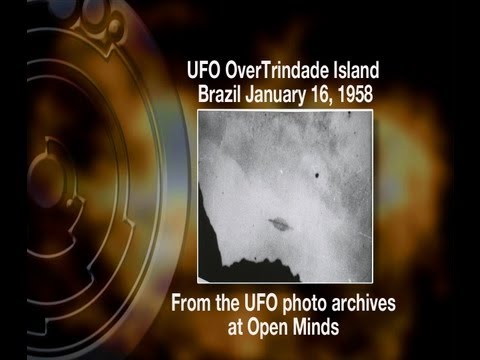
Sources
- Gross, Patrick. "The Trindade Island Visual and Photographic Case of 1958." UFOs at Close Sight, compiled from period APRO/NICAP documentation, official Brazilian Navy correspondence, and the 1983 IUR interview. ufologie.patrickgross.org
- Printy, Tim. "UFO over Trindade Island." SUNlite / Astronomy-UFO analysis, technical critique including internal-mask double-exposure theory and cloud-pattern comparison. astronomyufo.com
- NICAP. "Item 39: Trindade Isle, Brazil." The UFO Evidence, 1964. nicap.org
- Randle, Kevin. "Trindade Island UFO Revisited." A Different Perspective, August 2010. kevinrandle.blogspot.com
- Open Minds. "Rare Document on the Trindade UFO Case." OpenMinds.tv, on the 1958 Congressional information request. openminds.tv
- Portal Vigília. "Caso Ilha de Trindade: De Prova Incontestável a Fraude Disputada." Overview of the case's evidentiary reversal, including the Emília Bittencourt and Marcelo Ribeiro accounts and Edson Jansen Ferreira interview. vigilia.com.br
- UFO Magazine (Brazil). "Caso Trindade: Sobrinho de Almiro Baraúna Afirma que as Fotos São um Truque (Parte 1)." Interview with nephew Marcelo Ribeiro. ufo.com.br
- Além da Ciência. "Caso Ilha da Trindade: Documentos Sigilosos São Revelados (Parte 1)." Coverage of Alexandre de Carvalho Borges's 2011 declassified Navy document recovery, including Bacellar's "strange stain" report and the witness-count discrepancy. alemdaciencia.com
- UFO Magazine (Brazil). "Caso Trindade: CBU Recupera Documento Oficial de 1958." On the recovered 1958 Congressional information request (RIC 2957/1958). ufo.com.br
- Wikipedia contributors. "UFO Sightings in Brazil." Cites Correio da Manhã, April 16, 1958, "Inquérito da Marinha confirma existência do disco voador sobre a Ilha da Trindade." en.wikipedia.org
- Wikipedia contributors (Portuguese). "Caso da Ilha da Trindade." Summarizes the 2011 declassified documents, the witness-count discrepancy, and period newspaper citations (O Globo, Feb. 26, 1958; Folha da Manhã, Mar. 1–2, 1958; O Cruzeiro, May 1958). pt.wikipedia.org
- U.S. Air Force / Project Blue Book. Trindade Island case desk file, January 16, 1958. Digitized via The Black Vault FOIA archive. documents.theblackvault.com
- National Archives and Records Administration. "Project BLUE BOOK: Unidentified Flying Objects." archives.gov
- Marinha do Brasil (Brazilian Navy). "Almirante Saldanha: Navio-Escola / Navio Oceanográfico, 1934–1990." Official Navy history of the vessel's construction, 1957 oceanographic conversion, and IGY service. marinha.mil.br
- Martins, João. Interview with Almiro Barauna. O Cruzeiro, March 8, 1958. The case's most detailed contemporaneous first-person account, reproduced in Gross (2015) and NICAP archival translations.
- Menzel, Donald H. The World of Flying Saucers: A Scientific Examination of a Major Myth of the Space Age. Doubleday, 1963. Original published hoax argument.
- Clark, Jerome. "Trindade Island Photographs." The UFO Encyclopedia: The Phenomenon from the Beginning, 2nd ed., Vol. 2, pp. 898–903. Omnigraphics, 1998.
- Story, Ronald D., ed. The Encyclopedia of UFOs. Doubleday, 1980.
- APRO Bulletin. Hopf, John T. Photographic analysis of the Trindade negatives. March 1958; January, March, May 1960; January 1965 issues.
- Office of Naval Intelligence. "Information Report 39-58," M. Sunderland, Capt. USN, on the Trindade sighting. Cited in Condon Committee papers, American Philosophical Society archives.
- Los Angeles Times. "Brazil Has a Secret; Can't Explain It." February 26, 1958.
- Wikimedia Commons. "090-ilha-da-trindade P1210010 (32594401762).jpg." Marinha do Brasil, 2012, CC BY-SA 2.0 — hero image source. commons.wikimedia.org
See something inaccurate? Have additional information or sources?
Suggest an Edit →Last Updated: August 2026