
The St. Clair County Triangle Sightings
Beginning shortly before 4:00 a.m. on January 5, 2000, a 66-year-old miniature-golf-course owner in Highland, Illinois reported a massive, silent, brightly lit object drifting low over his business. Over the next roughly three hours, five on-duty police officers in five separate southwestern Illinois jurisdictions — Lebanon, Shiloh, Millstadt, Dupo, and O'Fallon, all within a few miles of Scott Air Force Base — independently reported tracking what each described, with real variation in detail, as an enormous triangular or arrowhead-shaped craft carrying three or four intensely bright lights, relaying their observations to one another over live St. Clair County dispatch radio as the object appeared to move between their jurisdictions. Robert Bigelow's National Institute for Discovery Science (NIDS) dispatched investigators the same day and spent over two years examining the case without reaching a firm conclusion. Scott Air Force Base gave police dispatchers and the press flatly contradictory statements about whether its radar was even operating that night. A specific, serious advertising-blimp explanation fits several core details well but has never been confirmed by an actual flight record, and cannot easily account for the most extreme maneuvers the two nearest officers described. This site classifies the case Credible, 66/100: a genuinely strong multi-witness professional corroboration, offset by real internal inconsistencies among the officers' own accounts and the absence of any radar or other instrumented confirmation.

Pictured: the former main gate at Scott Air Force Base, Illinois — the installation whose airspace and radar coverage sit at the center of this case's central factual dispute, not a photograph of the object or any specific sighting location. The single Polaroid photograph taken during the event itself shows only ambiguous, unresolved points of light and has never been published in a form clear enough to reproduce meaningfully; no photograph of Officer Craig Stevens's actual Polaroid, or of the golf course, roads, or fields where the officers were positioned that night, is known to be rights-clear and publicly available. U.S. Air Force photo, public domain, via Wikimedia Commons.
Theoretical Alignment
This case does not sort neatly into any one framework. The sheer weight of independent, real-time, radio-corroborated testimony from five credentialed on-duty officers across five separate jurisdictions argues against a pure Psycho-Social reading (contagious misperception spreading through a single social group), which is why PSH is capped well below where this site rates confessed or single-source hoaxes; but the absence of any radar, photographic, or physical confirmation, combined with a serious, if never flight-record-confirmed, conventional advertising-blimp candidate that fits much of the reported lighting and motion, keeps the Extraterrestrial Hypothesis allocation from scoring meaningfully higher. Robert Bigelow's own National Institute for Discovery Science, which investigated the case directly, never endorsed an extraterrestrial reading at any point — its own working hypothesis, discussed in full below, was a classified terrestrial aircraft, not an alien one. The Interdimensional Hypothesis finds essentially no purchase here: nothing in any officer's or civilian's account involves missing time, unexplained memory effects, or any of the paranormal-adjacent elements IDH is typically invoked to explain.
Background
Understanding why five separate police departments' radio traffic about one object became one of the more closely studied multi-witness police sightings in American UFO history requires understanding the specific corridor of southwestern Illinois where it happened, the nearby military installation whose radar became central to the case, and the private research organization that investigated it.
St. Clair County and the Metro-East Corridor
St. Clair County and neighboring Madison County sit directly across the Mississippi River from St. Louis, Missouri, forming what the region calls the "Metro-East" — a corridor of small and mid-sized towns (Belleville, O'Fallon, Shiloh, Lebanon, Millstadt, Dupo, Summerfield, and Highland among them) strung along Interstate 64, U.S. Route 50, and Illinois Route 4 through flat farmland and the Mississippi River's American Bottom floodplain. In January 2000 these were quiet, low-density municipalities with their own small police departments, each typically staffing only one or two patrol officers on an overnight shift — a detail directly relevant to how the case unfolded, since it meant the officers who responded were often the only law-enforcement presence in their entire town that night, radioing directly to a shared St. Clair County dispatch center (CENCOM) rather than up any large departmental chain of command.
Scott Air Force Base
Scott Air Force Base, straddling Belleville, O'Fallon, Mascoutah, and Shiloh in the heart of this same corridor, has been a major U.S. military installation since 1917 and by 2000 was headquarters of Air Mobility Command and the newly established U.S. Transportation Command, hosting a heavy schedule of KC-135 Stratotanker and other transport aircraft traffic. Every town involved in this case sits within a few miles of Scott's boundary or approach/departure corridors, and several of the officers reported the object moving in the base's general direction at points during the sighting — a proximity that made Scott AFB's own account of what its radar and personnel observed (or didn't) that night one of the case's most consequential, and most disputed, pieces of evidence.
NIDS and the Broader "Black Triangle" Wave
The National Institute for Discovery Science was a privately financed research organization founded in 1995 by aerospace and real-estate billionaire Robert Bigelow, headquartered in Las Vegas and staffed with a scientific advisory board that at various points included physicist Jacques Vallée and engineer Hal Puthoff, with Colm Kelleher serving as deputy administrator. By January 2000, NIDS had already spent several years compiling reports of large, silent, triangular or deltoid-shaped craft from across the United States, Canada, and Europe — a recognized, recurring sighting category researchers and the press had taken to calling the "black triangle" phenomenon, distinct from classic flying-saucer reports. The St. Clair County case arrived as, by NIDS's own account, one of the best-witnessed examples of this category the organization had yet documented, which is why it dispatched investigators the same day the initial report came in.
Complete Timeline
| Time (Jan. 5, 2000) | Event |
|---|---|
| ~4:00 a.m. | Melvern Noll, 66, owner of the "Fun Land" miniature golf course in Highland, Illinois, sees a large, brightly lit object he later describes as looking like "a flying house with windows on the top and bottom." He calls St. Clair County dispatch (CENCOM). |
| 4:10–4:15 a.m. | Lebanon Police Officer Ed Barton, dispatched to investigate near Summerfield, reports two brilliant white lights merging into one and then resolving into a large triangular object; he describes a flat, non-banking pivot, sudden acceleration to an estimated 80–100 mph, and an apparent relocation of several miles toward Shiloh within seconds. |
| 4:23:57 a.m. | Shiloh Police Officer David Martin independently reports an "extra-wide triangle or arrowhead" with three brilliant white lights and an irregular, blocky underside he compares to ship's plumbing or naval superstructure, moving, in his words, "in the snap of a finger, the wink of an eye." |
| 4:28–4:39 a.m. | Millstadt Police Officer Craig Stevens, parked in an open field near Liederkranz Park, observes a triangular/arrowhead object at an estimated 500–1,000 ft altitude with a concave rear edge, three lights to the rear and two more to the sides, and a low-frequency buzzing sound "like the hum of a power transformer." He takes a single Polaroid photograph. |
| ~4:33–5:03 a.m. | Dupo Police Officer Matt Jany, viewing through binoculars, reports lights at an altitude he estimates at 20,000–30,000 feet — commercial-airliner altitude, sharply contradicting the low-altitude estimates given by Barton, Martin, and Stevens. |
| Same window | O'Fallon Police Detective Mark Lopinot, driving east on U.S. 50 near its interchange with I-64, reports an arrangement of amber lights in two fixed rows (three top, two bottom), covering an area he judges larger than the wingspan of a C-5 or 747, at an estimated 200–300 ft, which does not change its apparent bearing relative to him as it moves — becoming, per investigator Darryl Barker's own case file, the fifth on-duty officer to report the object. |
| Later that morning | A police officer contacts the National Institute for Discovery Science's 24-hour research hotline; NIDS begins making phone inquiries the same day and dispatches two investigators to conduct face-to-face interviews. |
| ~6:45–6:50 a.m. | Centreville schoolteacher Steven Wonnacott, commuting near Frank Holton State Park, reports a stationary arrowhead-shaped object with bright white lights — the last reported sighting of the morning. |
| February 2000 | Independent investigator/filmmaker Darryl Barker obtains the CENCOM dispatch tape and timecode log via a Freedom of Information Act request. |
| April 5, 2000 | Riverfront Times reporter William Stage publishes "Space Case," reporting that the FAA had attributed the object to an advertising blimp — a claim that, per this site's research, has never been corroborated by an actual dated flight record from any blimp operator. |
| Nov. 30 & Dec. 2, 2000 | The Discovery Channel airs a special segment on the case featuring NIDS's own laser-based, survey-grade 3D reconstruction of the officers' sightlines and the object's inferred flight path. |
| 2001 | Darryl Barker Productions releases the independent documentary The Edge of Reality: Illinois UFO, Jan. 5, 2000. |
| July 2002 | NIDS publishes a paper presenting, as a speculative outside essay rather than an institutional conclusion, the hypothesis that the object was a classified Department of Defense lighter-than-air/electrokinetic craft ("Big Black Delta"); the paper explicitly states NIDS itself "did not come to a definite conclusion regarding the origin of the object." |
| 2004 | NIDS reassesses its own 2002 hypothesis, noting in an internal review that the behavior of large triangular sightings in its broader database "does not conform to previous patterns of covert deployment of unacknowledged aircraft"; NIDS itself disbands later that year. |
| 2005 | Musician Sufjan Stevens releases "Concerning the UFO Sighting Near Highland, Illinois" on his album Illinois, cementing the case's place in regional popular culture. |
Detailed Narrative
Melvern Noll and the First Report
Shortly before 4:00 a.m., Melvern Noll, the 66-year-old owner of the Fun Land miniature golf course on the edge of Highland, Illinois, pulled into his own parking lot to check that the business's pipes hadn't frozen in the January cold. He later told Riverfront Times reporter William Stage that he saw a large, brightly lit shape hovering low over the property, which he described in various retellings as looking like "a big house floating in the air" or "a flying house with windows on the top and bottom." Noll called St. Clair County dispatch, and a dispatcher began working through the list of on-duty officers in the surrounding towns to see whether anyone else could confirm what he had reported — the call that started the chain of independent sightings that followed.
Officer Ed Barton's Pursuit Near Summerfield
Lebanon Police Officer Ed Barton took the dispatcher's call around 4:11 a.m. and drove out toward Summerfield to investigate, initially skeptical that there was anything to find. Within minutes he reported seeing two brilliant white lights, close enough together that they appeared briefly to merge into one, before they resolved into what he described as a massive triangular object, longer than it was wide, that he estimated at 65 to 75 feet in length at an altitude of roughly 1,000 to 1,500 feet. Barton's account is the most dramatic of the morning: he reported the object executing a flat, level pivot with no banking whatsoever, then accelerating almost instantly to what he judged as 80 to 100 miles per hour and appearing to relocate several miles toward Shiloh within a span of only a few seconds — a claimed rate of travel that, taken completely literally, would require speeds far beyond anything in Barton's own stated mph estimate, and which this site's research treats as very likely either an exaggerated impression formed under the stress and darkness of the moment, a garbled element of later retellings, or an accurate description of a genuinely extraordinary maneuver; the raw CENCOM tape does not preserve enough precise timing detail to resolve which. What is not in dispute is that Barton went from open skepticism to reporting a massive, fast-moving, silent object over live police radio within the span of a single patrol stop.
Officer David Martin's Independent Sighting in Shiloh
At 4:23:57 a.m. — a timestamp preserved on the CENCOM dispatch log Darryl Barker later obtained under the Freedom of Information Act — Shiloh Police Officer David Martin radioed that he, too, had something in sight: an "extra-wide triangle or arrowhead" carrying three brilliant white lights, with an irregular, blocky underside he likened to ship's plumbing or naval superstructure rather than a smooth aircraft fuselage. Martin's account of the object's motion was, if anything, even more extreme than Barton's: he described it moving "in the snap of a finger, the wink of an eye," language this site's research reads as an impressionistic description of an abrupt, near-instantaneous shift in position rather than a precise velocity claim. Martin had not yet heard Barton's own report in detail when he began his own; the two officers' independently generated, closely timed descriptions of a similar object moving in a similar direction is one of the case's stronger internal corroborations.
Officer Craig Stevens, the Polaroid, and the Buzzing Sound
Millstadt Police Officer Craig Stevens picked up the object next, parking in an open field near Liederkranz Park to get an unobstructed view. Between roughly 4:28 and 4:39 a.m. he described an arrowhead-shaped object with a concave rather than pointed rear edge, three lights toward the back and two more to either side, at an altitude he placed between 500 and 1,000 feet (with some retellings citing figures as high as 2,000 feet). Stevens is also the only witness of the night to report an audible sound — a faint, low-frequency buzzing he compared to the hum of an electrical power transformer — and the only one to produce a physical artifact: a single Polaroid photograph, taken in the dark, that shows, in the assessment of every source this site located that has actually described it, only ambiguous, blurred points of light against a black background, with no clearly resolved shape.
Officer Matt Jany's Contradictory High-Altitude Report
Dupo Police Officer Matt Jany's contribution to the case is, for this site's own clear-eyed assessment, the single most important complicating detail in the entire record. Observing through binoculars in roughly the same general time window as Stevens, Jany reported lights at an altitude he estimated at 20,000 to 30,000 feet — squarely within the range where commercial airliners fly, and utterly incompatible with Barton's, Martin's, and Stevens's shared low-altitude, treetop-level estimates for what all three otherwise describe as recognizably the same general triangular shape and light pattern. This site's research treats Jany's account honestly rather than quietly setting it aside: either Jany was looking at a genuinely different object (a real possibility, given how many aircraft cross this specific stretch of sky nightly and how easy misidentification through binoculars in darkness can be), or one or more of the altitude estimates from the night are simply wrong, which is itself an important data point about how much weight this case's specific numerical details can bear. Multi-witness corroboration on shape and general direction of travel is a real strength of this case; multi-witness agreement on altitude is not.
Detective Mark Lopinot, "the Fifth Officer"
O'Fallon Police Detective Mark Lopinot, driving east on U.S. Route 50 near its interchange with Interstate 64 roughly two hours before the end of his shift, reported an arrangement of bright, occasionally twinkling amber lights arranged in two fixed rows — three on top, two below — covering an area he judged larger than the wingspan of a C-5 Galaxy or a Boeing 747, at an estimated altitude of 200 to 300 feet. Lopinot specifically noted that as the lights moved south and away from him, they never changed their apparent relationship to one another as seen from his position, a detail he found personally more unsettling than any single light or shape description — the kind of observation a trained investigator used to assessing scenes for what does and doesn't add up would be expected to notice. Independent researcher and filmmaker Darryl Barker, who conducted his own detailed investigation of the case beginning shortly after it occurred, titled his profile of Lopinot's account simply "The 5th Officer," reflecting Lopinot's position as the fifth and final on-duty police officer NIDS and subsequent investigators identified as having independently reported the object that morning.
The CENCOM Dispatch Tape
The single most valuable piece of documentary evidence in this case is not any officer's individual account but the St. Clair County CENCOM dispatch tape itself — the actual, contemporaneous recording of the radio traffic between the dispatcher and the responding officers as the night unfolded, which Darryl Barker obtained under a Freedom of Information Act request in February 2000. The tape preserves real-time cross-talk in which officers in different towns can be heard questioning whether the dispatcher was joking, describing what they were looking at to each other, disagreeing about altitude in essentially real time, and, in one now-often-cited moment, an officer audibly humming the theme from The Twilight Zone over the air — a small, human detail that this site's research treats as evidence against, not for, any coordinated hoax: genuine confusion, nervous humor, and unresolved disagreement among the officers themselves is a very different texture of evidence than a rehearsed or collaboratively invented story would likely produce.
Scott Air Force Base's Contradictory Statements
Scott Air Force Base's own account of the night is the case's most direct and most troubling factual dispute. According to multiple secondary sources that have reviewed the original police and press record, Scott AFB personnel told St. Clair County police dispatchers directly that night that "they could see nothing on the radar" — a statement that only makes sense if the base's radar was in fact operating and being monitored. Yet when a local paper, the Lebanon Advertiser, later asked the base for an official statement, Scott AFB's public response was that it "no longer has radar on the field and that control tower personnel were not on duty at that hour." These two statements cannot both be true: a base cannot simultaneously report seeing nothing on radar that was not there to look at, and every account this site located that examines Scott's public statements on the case treats this contradiction as, at minimum, evidence of institutional carelessness in handling the inquiry, and at most, evidence that the base's initial "nothing on radar" response was untrue on its face. Complicating the picture further, officers from nearby departments separately told investigator Darryl Barker that Scott's radar coverage, as they understood it from routine professional contact with the base, "almost never stops rotating" — directly contradicting the base's later claim that no radar was even present. The Federal Aviation Administration separately stated that its own regional radar showed nothing unusual in the area that night, a claim this site's research was not able to independently verify against any published raw radar log, and which in any case would not necessarily be inconsistent with a low, slow-moving target of the kind several officers described, since ground-clutter and beam-geometry limitations routinely cause civilian ATC radar to miss low-altitude targets entirely.
The National Institute for Discovery Science Investigation
NIDS's involvement began the same day, when, per the organization's own published case abstract, a police officer called the NIDS research hotline to report "a very large, silent, brightly lit object in western Illinois." NIDS made a series of follow-up telephone calls and then dispatched two investigators to the region to conduct face-to-face interviews, ultimately compiling accounts from eight named witnesses. Later that year, NIDS commissioned a survey-grade physical reconstruction of the case: technicians used a 40-watt argon laser with steering optics to precisely map each officer's actual physical position and sightline, then built a 3D computer-animated model of the inferred flight path, verified against each witness's own account of what they had seen from where they were standing. This reconstruction — a genuinely unusual level of methodological rigor for a private UFO-research organization, closer to a forensic accident-reconstruction technique than to typical witness-interview ufology — aired as part of a Discovery Channel special on November 30 and December 2, 2000. Despite this investment, NIDS never reached a firm conclusion about the object's origin. Its most substantive public output on the case, a July 2002 paper, presented as an outside essay from an unnamed aircraft designer, not as NIDS's own institutional finding, the hypothesis that the object was a classified U.S. military lighter-than-air craft using an experimental "electrokinetic" propulsion system — a large, black, delta-shaped airship the paper's author nicknamed a "Big Black Delta," or BBD. The paper is explicit that "NIDS did not come to a definite conclusion regarding the origin of the object sighted in Illinois in January 2000," and by 2004, in an internal reassessment of its broader database of more than 150 large-triangle sightings collected in the two years since the Illinois case, NIDS itself walked the hypothesis back, noting that "the behavior of these Triangular aircraft does not conform to previous patterns of covert deployment of unacknowledged aircraft" — a rare example of a UFO-research organization publicly reversing its own working hypothesis rather than quietly abandoning it. NIDS disbanded later that same year, its functions and remaining resources folded into Bigelow Aerospace Advanced Space Studies (BAASS), the contractor organization that would later run the Defense Intelligence Agency's Advanced Aerospace Weapon System Applications Program (AAWSAP) — the same BAASS discussed at length in this site's AATIP case file.
The Advertising Blimp Hypothesis
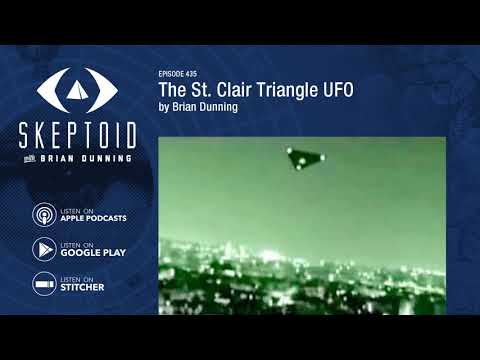
Three months after the sighting, Riverfront Times reporter William Stage published "Space Case," reporting that the Federal Aviation Administration had privately identified the object as an advertising blimp operated by the American Blimp Company. Science writer Brian Dunning later developed this explanation at length for his Skeptoid podcast, noting that Van Wagner, a major regional airship operator, corroborated that "everyone in the airship industry" would have recognized the description, and that advertising blimps of the period typically cruised around 1,000 feet at 35 to 45 miles per hour, carrying landing lights, red and green navigation lights, and illuminated advertising panels that could plausibly account for the varied lighting descriptions different officers gave. The roughly 55-kilometer distance between Highland, where the sighting began, and Dupo, where Jany's report came in, would take an airship cruising at that speed almost exactly the hour or so the full event spanned. This is, on its own terms, a serious and specific explanation, not a hand-wave — and this site's research gives it real weight for exactly that reason. It is also, on the same terms, unconfirmed: this site's research, like every other independent investigation it reviewed, found no dated flight record from the American Blimp Company, its later successor Van Wagner, or any other identifiable operator confirming that a specific airship was actually in transit over St. Clair County that specific morning. Brian Dunning's own account concedes as much, noting that "nobody at Van Wagner knew of any records showing the details of times and dates of blimps in transit from one event to another back in 2000." A blimp explanation also strains badly against the two nearest and most detailed officer accounts: no lighter-than-air craft can execute Barton's reported flat, non-banking pivot and near-instant acceleration, or Martin's "snap of a finger" relocation, and it does nothing to resolve Jany's incompatible high-altitude sighting.
Other Proposed Explanations and Their Weaknesses
Longtime UFO skeptic Philip Klass publicly called the case "bogus" without, by his own account, having interviewed any of the officers directly, and later proposed the planet Venus as an explanation — a claim this site's research finds does not survive contact with the actual record, since Venus cannot execute a flat pivot, cannot relocate across the sky, and would not explain three separately positioned officers reporting a single object moving between their respective jurisdictions in a manner consistent with continuous tracking. Astronomer James McGaha and a biology professor cited in contemporary coverage each separately dismissed the officers' credibility as untrained sky-observers in general terms, without engaging the specific radio-corroborated, cross-jurisdictional structure of the sightings that sets this case apart from a single uncorroborated report. This site's research treats these particular dismissals as weaker, not stronger, than the blimp hypothesis: they reject the case's credibility in the abstract rather than engaging its most distinctive actual feature, which is that five separately positioned, on-duty professional observers were describing a broadly consistent object to each other in real time as it appeared to move.
Cultural Legacy
The case has left an unusually durable mark on the region for a UFO sighting that produced no crash, no abduction claim, and no lasting physical evidence. A roadside historical marker outside a business in Shiloh, Illinois — a genuine rarity for any UFO case in the United States — commemorates the sighting directly, reading in part: "On January 5th, 2000 at 4:23 a.m. Shiloh Police Officer David Martin reported a floating object with 3 bright lights in the sky above Shiloh. Other witnesses said the UFO floated slowly and had no engine noise. Lebanon, Shiloh, Millstadt and Dupo Police Officers all reported witnessing this UFO that morning." Indie musician Sufjan Stevens, a Michigan native with no personal connection to the case, included a song titled "Concerning the UFO Sighting Near Highland, Illinois" on his critically acclaimed 2005 concept album Illinois, introducing the case to a national audience with no particular interest in ufology. The case has also drawn sustained attention from MUFON Illinois State Director and author David Marler, whose 2013 book Triangular UFOs: An Estimate of the Situation treats it as one of the best-documented American examples of the broader black-triangle sighting category, drawing directly on the CENCOM audio and contemporary press coverage Darryl Barker and William Stage had assembled years earlier.
Key Witnesses
Officer Ed Barton
The first officer to respond to dispatch, initially skeptical, who reported the most dramatic single account of the night: a massive triangular object executing a flat, non-banking pivot and an apparent near-instant multi-mile relocation toward Shiloh. His report near Summerfield around 4:10–4:15 a.m. set the rest of the night's chain of sightings in motion.
Officer David Martin
Independently reported an "extra-wide triangle or arrowhead" with an irregular, blocky underside at 4:23:57 a.m., a timestamp preserved on the FOIA'd CENCOM dispatch log. His description of the object moving "in the snap of a finger" closely echoes the extreme motion Barton had reported minutes earlier from a different location, one of the case's stronger points of independent corroboration. The Shiloh historical marker commemorating this case is built directly around his report.
Officer Craig Stevens
Observed the object from an open field near Liederkranz Park between roughly 4:28 and 4:39 a.m., reporting a concave-rear arrowhead shape, a low-frequency buzzing sound, and taking the case's only photograph — a single ambiguous Polaroid showing blurred points of light rather than a resolved shape.
Officer Matt Jany
Observed lights through binoculars at an estimated 20,000–30,000 feet — commercial-airliner altitude — directly contradicting the low-altitude estimates given by Barton, Martin, and Stevens. This site's research treats Jany's account as the case's single most important complicating detail rather than setting it quietly aside.
Detective Mark Lopinot
The fifth and final on-duty officer identified as an independent witness, per investigator Darryl Barker's own case files. Reported amber lights in two fixed rows, larger than a C-5 or 747's wingspan, that never changed their relative position to him as they receded — an observation from a trained detective that he found more unsettling than any single light or shape detail.
Melvern Noll
The night's first witness, whose roughly 4:00 a.m. report to St. Clair County dispatch of a large, brightly lit object resembling "a flying house" set the entire chain of subsequent officer sightings in motion. NIDS's own investigation ultimately identified more than a dozen total witnesses beyond the five officers, including Noll, schoolteacher Steven Wonnacott, and a Centreville resident named Johnny Doss.
The Five Observables Assessment
The Five Observables framework describes flight-performance characteristics associated with reported anomalous craft. This case scores unusually high on the framework for a case with no instrumented confirmation, precisely because several officers described extreme performance characteristics directly to each other over live radio, in real time, before any of them could have coordinated a story.
Assessment: Two observables (Instant Acceleration, Low Observability) are rated Present on the strength of specific, named officers' own direct radio-corroborated testimony rather than post-hoc reconstruction, which is unusually strong sourcing for this framework. Hypersonic and Anti-Gravity Lift are rated Speculative because the underlying claims exist but rest on imprecise verbal estimates (Barton's and Martin's) or an outside researcher's unendorsed hypothesis (NIDS's 2002 "Big Black Delta" essay) rather than measured data. This is a genuinely unusual profile: most cases in this framework either have strong instrumented data supporting several observables or weak testimonial support for all of them; this case has strong testimonial support for some, and none at all for others.
Evidence Assessment
Supporting a Genuine Anomalous Event
- Five on-duty, credentialed police officers across five separate jurisdictions independently reported a broadly consistent object over live radio, in real time, before any coordination between them was possible
- The CENCOM dispatch tape, obtained via FOIA, preserves genuine, unrehearsed confusion and disagreement among the officers rather than a polished or coordinated account
- Officer Martin's timestamped 4:23:57 a.m. report of extreme, near-instantaneous motion closely echoes Officer Barton's independently generated account from minutes earlier and a different location
- Scott Air Force Base's own statements about its radar coverage that night are directly self-contradictory, undermining the base's own implicit "nothing to see" position
- NIDS's laser-based survey reconstruction of the officers' actual sightlines found their accounts geometrically consistent with tracking a single object moving through the described corridor
Supporting a Conventional Explanation
- Officer Jany's 20,000–30,000-foot altitude estimate is flatly incompatible with the low-altitude estimates given by the other three officers who described the object in detail
- A specific, serious advertising-blimp candidate fits the lighting pattern, cruise altitude/speed, and roughly hour-long transit time reasonably well
- No flight record from any blimp operator has ever been produced confirming or ruling out that candidate either way
- The single photograph taken that night (Officer Stevens's Polaroid) shows only ambiguous, unresolved points of light, providing no independent visual confirmation of shape
- No radar system — military or civilian — is confirmed to have tracked the object, and Scott AFB's own contradictory statements leave real doubt about whether its radar was even being monitored that night
Why “Credible”
This case is stamped Credible and scored 66 out of 100, placing it below this site's Coyne Helicopter Incident file (Credible, 81/100) but well above a purely testimonial single-witness account. The comparison to Coyne is instructive on both counts. Like Coyne, this case rests on multiple independent, credentialed professional observers describing a genuinely anomalous encounter in terms that are difficult to fully explain away — and this case has more independent observers across more separate jurisdictions than Coyne's single helicopter crew, corroborating each other over live, contemporaneously recorded radio traffic rather than in after-the-fact interviews. But Coyne's crew experienced a directly instrumented anomaly (an inexplicable altimeter climb, corroborated by multiple crew members watching their own instruments in real time), where this case has no equivalent instrumented data at all: no radar lock, no confirmed altimeter or sensor reading, nothing beyond human testimony and one ambiguous photograph. This case's officers also disagree with each other on a basic, checkable detail — altitude, by a factor of roughly twenty to one between Jany and the others — in a way Coyne's crew did not. And where Coyne's best conventional explanation (a meteor, per some skeptics) never gained wide acceptance among investigators of any persuasion, this case's leading conventional candidate, the advertising blimp, is specific, plausible on its own physical merits, and unconfirmed rather than disproven, which this site's own stated methodology treats as a real, if not decisive, downward pressure on the score. The combination of unusually strong multi-witness professional corroboration with a genuinely live, unresolved, specific conventional alternative is exactly the profile of a Credible rating: this is a real, well-documented event that multiple trained observers experienced and could not adequately explain, but it is not a case with the kind of instrumented confirmation or resolved conventional-explanation contest that would justify a Verified rating or the low score of a case where the mundane explanation is essentially proven.
Sensor & Instrumentation Detection Profile
This case's instrumentation record is almost entirely testimonial, with two partial exceptions. The CENCOM dispatch tape itself, while not a sensor recording of the object, is a genuine, contemporaneous instrumented record of the officers' own real-time verbal reports, preserving exact timestamps (Officer Martin's report at 4:23:57 a.m. is on the record to the second) that allow at least a partial reconstruction of the sequence of sightings. Officer Stevens's single Polaroid photograph is the case's only visual capture device, and by every account this site located that describes its actual content, it shows nothing more resolvable than ambiguous points of light. No radar system is confirmed to have tracked the object: the FAA stated its regional radar showed nothing unusual, a claim this site could not independently verify against a published raw log, and Scott Air Force Base gave directly contradictory statements — telling police dispatchers it could see "nothing on the radar" while telling the press days or weeks later that it had no operating radar at all that night. NIDS's own most significant technical contribution was not sensor data captured during the event but a post-hoc, survey-grade laser reconstruction of each officer's physical position and sightline, built and verified after the fact specifically to test whether the separate accounts were geometrically consistent with a single moving object — a methodological tool for evaluating testimony, not an independent instrumented detection of the object itself.
Environmental & Geospatial Context
The sighting corridor runs through flat, low-relief farmland and small-town development along the U.S. 50/I-64 corridor in St. Clair and Madison Counties, roughly 20 to 30 miles east of downtown St. Louis across the Mississippi River's American Bottom floodplain. Every location involved — Highland, Summerfield, Lebanon, Shiloh, Millstadt, Dupo, and O'Fallon — sits within a roughly 15-mile radius of Scott Air Force Base, a major Air Mobility Command and (as of 1992) U.S. Transportation Command installation with a heavy, round-the-clock schedule of KC-135 tanker and cargo-aircraft traffic. This proximity cuts both ways for this site's assessment: it makes a coincidental misidentification of ordinary military air traffic a real possibility for at least some of the individual sightings (particularly Jany's high-altitude report), while also making Scott's own contradictory account of its radar coverage that specific night a more consequential gap in the record than it would be for a sighting far from any radar-equipped facility. The region in January experiences long, dark, rural night skies away from the immediate town centers, and every account located by this site describes clear, cold, calm conditions with no fog, precipitation, or unusual atmospheric effect reported by any witness — ruling out weather-related visual distortion as a contributing factor, in contrast to cases where fog, temperature inversion, or precipitation plausibly explain some reported effects.
Observer Credibility & Occupational Profile
This is, on its witness roster alone, one of the stronger multi-observer cases this site has documented. Five separate, on-duty, credentialed police officers — Ed Barton, David Martin, Craig Stevens, Matt Jany, and Mark Lopinot — each independently reported the object from a different physical location within roughly the same hour, relaying their observations to a shared county dispatcher who was actively working to confirm or disconfirm what the first caller, a civilian, had reported. None of the five had any documented pre-existing interest in UFOs, financial motive, or history of similar claims; several, including Barton, are reported to have responded with initial skepticism rather than any eagerness to report something unusual. Their occupational training matters directly here: police officers are professionally trained to give specific, time-stamped, radio-relayed situational reports under real operational pressure, which is precisely the discipline the CENCOM tape captures them doing. That same training, however, does not make them trained aerial observers in the way a military pilot or air-traffic controller is, and the wide disagreement on altitude between Jany and the other three officers is a genuine, unresolved limitation of what police-officer testimony alone can establish. Civilian witnesses Melvern Noll, Steven Wonnacott (a schoolteacher), and Johnny Doss add corroborating detail but carry less individual evidentiary weight than the officers' own radio-relayed, time-stamped accounts. On the investigative side, NIDS's own personnel — a private but genuinely credentialed team that included scientific advisory board members with backgrounds in physics and engineering — brought real methodological rigor to the case's after-the-fact reconstruction, even though the organization itself never reached a conclusion about what the officers had actually seen.
Physical & Material Assays
This case has essentially no physical evidence in the sense of trace material, ground disturbance, or recovered hardware — unsurprising, since no witness reported a landing, and the object was described throughout as remaining airborne. The only tangible artifact produced during the event itself is Officer Craig Stevens's single Polaroid photograph, which this site's research could not locate any published, high-resolution reproduction of; every secondary source that describes its actual visible content agrees it shows only blurred, ambiguous points of light rather than a resolved shape, and this site found no record of the photograph ever being subjected to a published, independent forensic or photographic-analysis review. The CENCOM dispatch tape, while not physical evidence of the object itself, is a genuine, FOIA-obtained physical (audio) record of the event's human testimony as it happened, and functions in this case's evidentiary structure closer to how a black-box recording functions in an aviation incident than how witness testimony typically functions in ufology.
Historical Precedents & Archive Matches
Comparison to the Coyne Helicopter Incident
This site's own Coyne Helicopter Incident file (Credible, 81/100) remains the strongest point of comparison and contrast for this case, discussed in full in the Why "Credible" section above: both rest on multiple credentialed professional witnesses experiencing a close, sustained encounter with an unexplained object, but Coyne's crew had a genuine instrumented anomaly corroborating their testimony where this case has none.
Comparison to the Gorman Dogfight
This site's Gorman Dogfight file (Disputed, 58/100) offers a useful contrast from the other direction: a single credentialed military pilot's visual-only encounter with ground-radar corroboration that itself remains contested, versus this case's five independent civilian-agency officers with no radar corroboration at all but considerably broader witness distribution. Neither case achieves the combination of multi-witness breadth and instrumented confirmation that would justify a Verified rating; this site's research treats St. Clair County as the stronger of the two specifically because of how many independently positioned professional observers it involves.
Comparison to the Belgian UFO Wave
This site's Belgian UFO Wave file (Verified) documents a structurally similar triangle-shaped-craft phenomenon — large, silent, dark aerial triangles reported across an entire region over an extended period — that achieved a materially stronger evidentiary record, including an actual military radar lock and F-16 scramble with gun-camera-adjacent tracking data. The contrast is instructive for calibrating this case's own score: St. Clair County shares the same basic "black triangle" morphology and the same real strength of geographically distributed witness corroboration, but never achieved the instrumented military confirmation that helped push the Belgian case to this site's highest evidentiary tier.
Comparison to the Hudson Valley UFO Wave
This site's Hudson Valley UFO Wave file (Disputed) documents a cautionary parallel from the American "black triangle" tradition specifically: a large, multi-witness wave of triangular-light sightings in New York State that later investigation partially traced to civilian small-aircraft formation flights conducted for recreational purposes. This site's research treats the Hudson Valley case as a genuine reminder that even large, sincere, multi-witness "triangle" reports can resolve to mundane aviation once the right specific candidate is identified and confirmed — precisely the open question this case's own advertising-blimp hypothesis has never definitively answered one way or the other.
The Broader Black Triangle Sighting Category
NIDS's own database, by 2002, had already logged more than 150 separate large-triangle sightings across North America and Europe, and MUFON Illinois State Director David Marler's 2013 book Triangular UFOs: An Estimate of the Situation treats this case as one of the best individually documented examples within that broader recognized category, specifically because of its radio-corroborated, multi-jurisdiction structure. This site's research treats that categorization as accurate: whatever this specific case's ultimate origin, it is a genuinely well-preserved example of a sighting type reported with real consistency across many independent locations and decades, not an isolated anomaly.
Material Analysis
The only material artifact this case produced is Officer Craig Stevens's Polaroid photograph, and the CENCOM dispatch audio tape functions as this case's closest equivalent to a physical documentary record. Neither has been subjected to the kind of independent forensic material analysis (photographic authentication, audio waveform analysis for splicing or tampering, etc.) that would allow this site to draw any conclusion beyond what is directly visible or audible in each. No soil sample, no metallurgical residue, no recovered fragment, and no biological or physiological effect on any witness was ever reported or tested, consistent with an entirely airborne encounter with no landing, close-range exposure, or physical interaction of any kind.
Supporting Non-Terrestrial or Genuinely Unexplained Origin
- No physical evidence exists that positively supports a non-terrestrial reading; the case's strength rests entirely on witness testimony and radio corroboration, not physical material
Supporting a Terrestrial (Conventional) Origin
- The Polaroid photograph shows no resolved shape inconsistent with an ordinary aircraft or airship silhouette obscured by darkness and camera limitations
- No radar, gun-camera, or other instrumented sensor ever captured the object, consistent with (though not proof of) a low-altitude, radar-obscured conventional aircraft
- The advertising-blimp hypothesis, while unconfirmed by a flight record, remains physically plausible for the lighting, cruise speed, and general transit time several witnesses described
The Conventional Explanation Candidate: An Advertising Blimp
This case has a genuinely serious, specific conventional candidate rather than a vague appeal to misidentification in general, but that candidate has never been confirmed by the one piece of evidence that would settle the question: an actual dated flight record.
The Advertising Blimp
The FAA's reported identification of the object as an American Blimp Company airship, developed in detail by reporter William Stage and later by Skeptoid's Brian Dunning, fits the case's basic lighting pattern, cruise altitude, cruise speed, and roughly hour-long transit distance about as well as any single conventional candidate could. It does not explain Officer Barton's flat, non-banking pivot and near-instant acceleration, Officer Martin's "snap of a finger" relocation, or Officer Jany's high-altitude sighting, and no blimp operator's flight log confirming a specific aircraft in transit that night has ever surfaced despite repeated inquiries by multiple independent investigators over more than two decades.
A Classified Terrestrial Aircraft
NIDS's own July 2002 paper presented, as an outside essay rather than an institutional finding, the hypothesis that the object was an experimental Department of Defense lighter-than-air/electrokinetic aircraft. This site's research treats this candidate as genuinely speculative rather than merely dismissible: NIDS itself never adopted it as a conclusion, explicitly reassessed and effectively abandoned the broader hypothesis by 2004, and no independent aerospace-engineering or intelligence source this site located corroborates that any such classified airship program ever existed.
Astronomical Misidentification (Venus)
Philip Klass's proposal that the object was the planet Venus does not survive contact with the actual record: Venus cannot execute a pivot, cannot relocate across the sky, and cannot explain three separately positioned officers describing what each took to be a single object moving between their jurisdictions.
A Genuine, Unidentified Aerial Phenomenon
The most straightforward reading consistent with everything documented above is that the officers and civilian witnesses observed something real that none of the proposed conventional candidates fully accounts for. This site's research finds this candidate is supported by the strength and consistency of the multi-jurisdiction radio corroboration, but is not proven by it: real, unexplained testimony is not the same evidentiary category as a confirmed instrumented detection, and this case, unlike this site's higher-scored files, never achieved the latter.
Advertising Blimp
InconclusiveFits much of the lighting, altitude, and transit-time data well but has never been confirmed by an actual flight record, and cannot explain the two nearest officers' most extreme motion claims.
Classified Terrestrial Aircraft (NIDS 2002 Hypothesis)
UnprovenA speculative outside essay NIDS itself never adopted and later effectively walked back; no independent corroboration of any such program exists.
Astronomical Misidentification (Venus)
ImplausibleCannot account for a moving, pivoting object independently tracked across multiple jurisdictions by radio.
Genuine Unidentified Aerial Phenomenon
InconclusiveConsistent with the strength of the multi-witness radio corroboration, but not confirmed by any instrumented detection.
Related Cases
Records & Primary Documentation
NIDS's own primary document laying out its speculative "Big Black Delta" hypothesis as an outside essay, explicitly stating the organization "did not come to a definite conclusion regarding the origin of the object."
The Pentagon's current UAP case-review office; this site located no evidence AARO or any predecessor federal body has ever formally reviewed or resolved this specific 2000 case, which remains, per the public record, closed without any government resolution.
Further Reading — Recommended Literature
Triangular UFOs: An Estimate of the Situation
Written by MUFON's own Illinois State Director, this is the single most detailed published treatment of the black-triangle sighting category this case belongs to, drawing directly on the CENCOM audio and contemporary investigative record.
UFOs: Generals, Pilots, and Government Officials Go on the Record
A useful broader context for evaluating what professional, on-duty observer testimony can and cannot establish about an unexplained aerial encounter.
Hunt for the Skinwalker
Written by NIDS's own deputy administrator, offering direct insight into the organization's investigative methodology — the same team that reconstructed this case's flight path.
UFOs and Government: A Historical Inquiry
A scholarly historical treatment of how government agencies have handled multi-witness sighting waves, useful context for assessing Scott AFB's own contradictory response in this case.
The UFO Encyclopedia, 4th Edition (2-Volume Set)
The standard comprehensive reference for cataloged UFO cases, useful for situating this case within the broader triangle-sighting literature.
Essential Viewing
Sources
- National Institute for Discovery Science, “Hypothesis: The Illinois Flying Triangle is A Department of Defense, Not An ET Craft” (July 2002) — NIDS's own primary hypothesis document
- Jazz Shaw, The Debrief, “The St. Clair Triangle UFO Incident of 2000: A Fresh Look” (Jan. 19, 2022) — detailed officer accounts, CENCOM tape, and Scott AFB's contradictory statements
- UAP Globe, “The St. Clair County Police Triangle (5 January 2000)” — consolidated timeline, officer names/departments, and NIDS's 2004 reassessment statement
- American Hauntings, “Something Is Up There!” — narrative account of the officer sightings and Scott AFB's response
- UFO Insight, “One Strange Night In Illinois — The St. Clair County Incident” — detailed timeline including Detective Lopinot's and Steven Wonnacott's accounts
- Brian Dunning, Skeptoid Episode 4435, “The St. Clair Triangle UFO” — the developed advertising-blimp hypothesis and its sourcing
- UFOCaseBook, “The St. Clair County Illinois Sightings of January, 2000” — NIDS's laser-based reconstruction methodology and Discovery Channel broadcast details
- Historical Marker Database, “Confirmed UFO Sighting” (Shiloh, IL) — full text of the roadside marker commemorating Officer Martin's report
- Doyle's Space, “Confirmed UFO Sighting in Shiloh, Illinois” (Jan. 23, 2026) — context on the historical marker and the case's regional legacy
- Wikipedia, “National Institute for Discovery Science” — NIDS's founding, leadership, scientific advisory board, and 2004 disbandment
- Wikipedia, “Scott Air Force Base” — the installation's history, mission, and role as headquarters of Air Mobility Command/USTRANSCOM
- Wikimedia Commons, Category: Scott Air Force Base — hero image source and license (public domain, U.S. Air Force)
- YouTube (oEmbed-verified), Skeptoid Media, “The St. Clair Triangle UFO” — video presentation of the advertising-blimp hypothesis
- David Marler, Triangular UFOs: An Estimate of the Situation (2013) — the leading published treatment of this case within the broader black-triangle category
- Leslie Kean, UFOs: Generals, Pilots, and Government Officials Go on the Record (2010) — context on professional-witness UFO testimony
- Colm A. Kelleher & George Knapp, Hunt for the Skinwalker (2005) — NIDS's own investigative methodology, from its deputy administrator
- Michael Swords & Robert Powell, UFOs and Government: A Historical Inquiry (2012) — historical context on government agency responses to sighting waves
- Jerome Clark, The UFO Encyclopedia, 4th Edition — standard reference for cataloged UFO cases
- This site, case-files/coyne-helicopter-1973.html — the closest evidentiary comparison case, for calibration
- This site, case-files/gorman-dogfight-1948.html — a contrasting single-witness, radar-adjacent case, for calibration
- This site, case-files/belgian-wave.html — the same black-triangle morphology with stronger radar/military confirmation, for calibration
- This site, case-files/hudson-valley-ufo-wave.html — a cautionary multi-witness-wave parallel partly resolved to civilian aviation
- This site, case-files/aatip.html — NIDS's post-2004 successor lineage (BAASS/AAWSAP) connects directly to this later government program
- This site, locations/index.html, entries on Highland, Illinois and Scott Air Force Base — regional geography and background
See something inaccurate? Have additional information or sources?
Suggest an Edit →Last Updated: August 2026