
The Treviso Cylindrical UFO Sighting
At approximately 11:30 AM on June 18, 1979, Giancarlo Cecconi, a Senior Warrant Officer (Maresciallo) with the Italian Air Force's 14° Gruppo, 2° Stormo reconnaissance wing, was flying a Fiat/Aeritalia G.91R tactical reconnaissance jet back toward Treviso-Sant'Angelo Airport after a routine photo-reconnaissance mission over the Ligurian Apennines when radar controllers at Istrana Air Base, a separate military airfield a few miles away, reported an unidentified intruder holding position in restricted airspace near Quinto di Treviso. Directed to investigate, Cecconi closed to within roughly 70–80 meters of a matte-black, cylindrical object — in his own description, shaped like an oversized fuel tank crowned by a small pale dome — and, over seven or eight tight orbits lasting about five minutes, exposed more than eighty frames on the Vinten reconnaissance cameras built into his aircraft's nose and wings. The object never once turned to present its side to his lens, climbed and descended in abrupt vertical jumps with none of the turbulence a fast jet passing nearby should have produced, and then vanished from Istrana's radarscope and from the Treviso control tower's binoculars in the same instant. Cecconi's report and photographs disappeared into internal Air Force channels for more than five years; when investigators finally pried an official response loose in November 1984, the Ministry of Defense declared the object had been "immediately identified" as a homemade balloon of black plastic bags — an explanation that ufologists, and eventually the Air Force's own later paperwork, would struggle to reconcile with the case's radar data, its multiple independent witnesses, and a photographic record of which fewer than five of the more than eighty exposed frames have ever been made public.
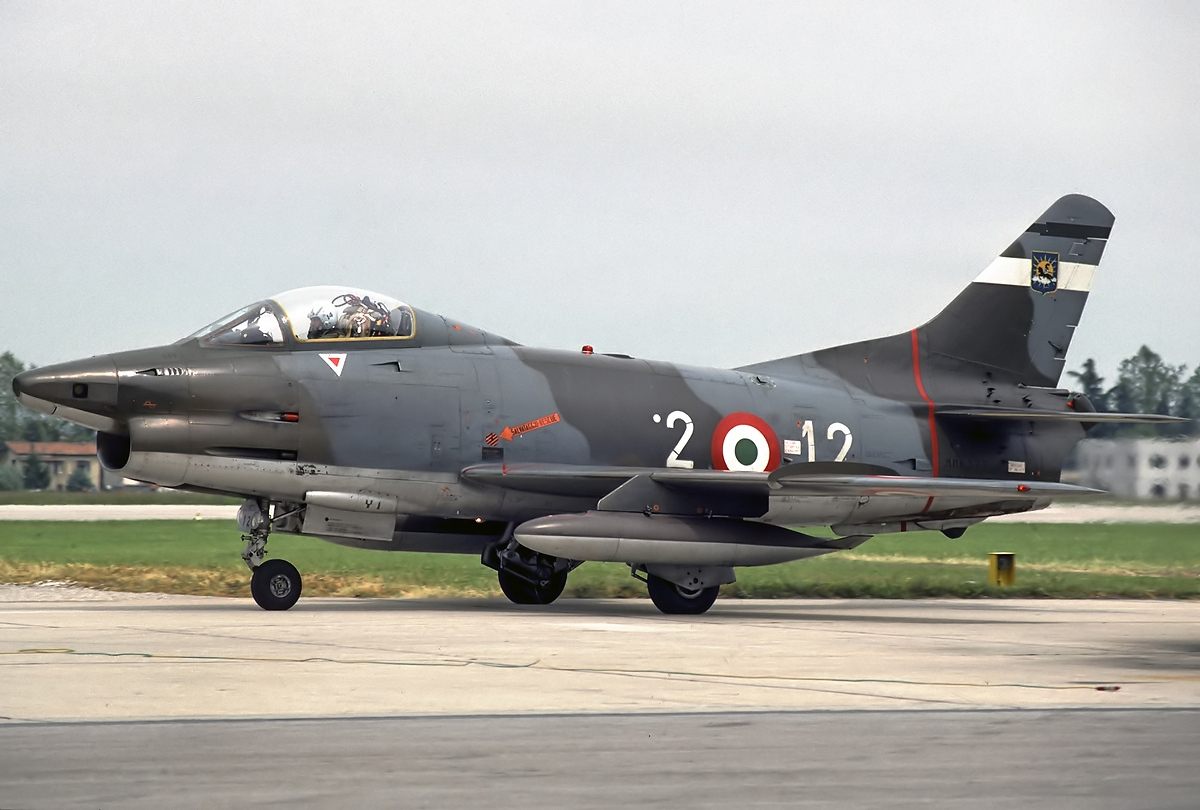
Pictured: a Fiat G91-R-1B of the Italian Air Force (MM6377), the same G.91R reconnaissance variant Cecconi was flying, photographed at Treviso Airport in May 1987 — not a photograph of the actual incident. A photograph attributed to Cecconi's own 1979 series circulates online with a public-domain claim under Italian "simple photograph" copyright law, but Wikimedia Commons itself flags that claim's status outside Italy as "to be clarified," so this file uses the unambiguously licensed aircraft photograph instead.
Theoretical Alignment
Treviso is, at bottom, an identification dispute over a single credentialed observer's photographic and radar-corroborated encounter, not a case that maps cleanly onto the standard hypothesis triangle. The Extraterrestrial Hypothesis earns a modest rating because the object's reported behavior — consistently presenting the same aspect to Cecconi's camera across seven or eight passes, showing no turbulence at close range to a fast jet, and executing abrupt thousand-foot vertical jumps before disappearing from radar and sight simultaneously — is exactly the kind of apparently controlled, non-ballistic performance ETH proponents point to, but the case's official investigation never advanced past a single, poorly substantiated balloon explanation, and no independent modern photogrammetric analysis of the full eighty-plus-frame series has ever been possible because the overwhelming majority of those frames remain unreleased. The Interdimensional Hypothesis finds essentially no purchase — nothing in Cecconi's account, the radar data, or forty-five years of Italian ufological literature suggests materialization, portal activity, or any of IDH's usual explanatory territory. The Psycho-Social Hypothesis is rated low but not zero: it cannot explain a trained reconnaissance pilot's radar-corroborated intercept, but the case's post-1979 history — a five-year internal silence, a Ministry press statement that visibly failed to satisfy its own Air Force colleagues, and a magazine publication that seemingly did not reproduce the same photograph investigators had privately been shown — is substantially a story about institutional and media handling of a report, the kind of human and bureaucratic friction PSH-adjacent analysis is well suited to examining even where it cannot explain the underlying sighting itself.
Background
By 1979, Italy's UFO research community had matured into a genuine, if informal, national movement. The Centro Ufologico Nazionale (CUN, the National Ufological Center), founded in the 1960s, functioned as the country's leading civilian UFO research body, with Antonio Chiumiento, then a young mathematics and economics teacher from Benevento who had become active in ufology after attending a film forum, serving as its vice president. Chiumiento had, by his own account, already investigated several hundred reports by the late 1970s using a self-consciously rigorous methodology — witness interviews conducted in person, an insistence on separating explainable sightings from genuinely anomalous ones, and a stated preference for treating even his most striking cases with caution rather than sensationalism.
Giancarlo Cecconi had no connection to any of this before June 1979. He was, that morning, simply an experienced Italian Air Force reconnaissance pilot completing a routine assignment: a photographic survey mission over the Ligurian Apennines, flown in a Fiat/Aeritalia G.91R single-seat jet from the 14° Gruppo, 2° Stormo, based at Treviso-Sant'Angelo Airport. As he flew back toward base over the area between Rovigo and the Euganean Hills near Padua, with unused film still loaded in his aircraft's tactical cameras, nothing about the flight had been unusual — until the radio call from Istrana changed the rest of his day.
Complete Timeline
| Date | Event |
|---|---|
| 1933 | Giancarlo Cecconi is born in Florence, Italy. |
| June 18, 1979, ~11:25–11:30 AM | Returning from a photo-reconnaissance mission over the Ligurian Apennines, Cecconi is directed by the control tower of Treviso-Sant'Angelo Airport to contact Istrana Air Base's radar center, which has detected an unidentified intruder in restricted airspace near Quinto di Treviso. |
| Same morning | Cecconi closes to 70–80 meters of a matte-black, cylindrical object with a pale dome, completes seven or eight orbits over roughly five minutes, and exposes more than eighty frames on his aircraft's four Vinten tactical reconnaissance cameras. |
| Same morning | During a turn, Istrana's radar controllers report the object has vanished from their scope; the Treviso control tower, observing with binoculars, simultaneously loses visual contact. |
| Late 1979 | Antonio Chiumiento, then vice president of the Centro Ufologico Nazionale (CUN), and co-investigator Maurizio Caruso learn of the case and interview Cecconi directly; Cecconi privately shows them a retained photograph. |
| July 10, 1984 | The Italian Ministry of Defense states, in response to a formal inquiry, that data concerning UFO phenomena can be consulted by civil entities and scholars through its offices. |
| August 24, 1984 | Chiumiento formally requests that the Ministry release Cecconi's photographs and state the military's official opinion of what they depict. |
| November 2, 1984 | The Ministry of Defense responds that the object was "immediately identified" via the onboard camera photographs and "unambiguously identified by photo-interpretation personnel as a cylindrical balloon made of black plastic bags." |
| April 19, 1985 | Epoca magazine publishes journalist Remo Guerrini's article "UFO: rapporto segreto," reproducing three of Cecconi's photographs supplied by the Ministry and repeating the balloon explanation. |
| 1985, following publication | Chiumiento and Caruso note that the photograph Cecconi had privately shown them in 1979 appears more detailed than, and possibly different from, the three images Epoca published. |
| December 1985 | Paolo Toselli, Giampaolo Grassino, and Edoardo Russo found the Centro Italiano Studi Ufologici (CISU) in Turin, modeled in part on France's government-run GEPAN, as a more scientifically oriented alternative within Italian ufology. |
| February 17, 1986 | An official Italian Air Force compilation of UFO case files lists the Cecconi sighting as "unidentified" — directly contradicting the Ministry of Defense's own November 1984 "balloon" finding. |
| March 1988 | Chiumiento publishes "An Italian Pilot's Sighting: And Another Italian Government Cover-Up?" in Flying Saucer Review, Vol. 33, No. 1, introducing the case's documented official contradictions to an international English-language audience. |
| September 1994 | CISU's newly formed Project AIRCAT, coordinated by Marco Orlandi, selects the Cecconi case as one of its first investigations; Orlandi conducts fresh interviews with Cecconi, still resident in Treviso, and confirms the three Epoca photographs genuinely belong to his original 1979 series. |
| August 1995 | Cecconi's own retained "most significant" photograph, showing the object with Treviso airfield structures visible in the background, resurfaces publicly, prompting renewed Italian media coverage; the Ministry of Defense states it holds no further photographs or documentation and expresses no further interest in the case. |
| 1996 | Orlandi publishes CISU's detailed reconstruction of the case in issue 17 of UFO Magazine (Rivista di Informazione Ufologica), the most complete published investigation of the sighting. |
| 2020 | Chiumiento, by then CISU's first president and an honorary CUN member, discusses the Cecconi case among roughly eighty-five career investigations in his book Obiettivo non identificato. |
The Return Flight and the Radar Intercept
Giancarlo Cecconi's morning had begun as an entirely routine assignment. Flying a single-seat Fiat/Aeritalia G.91R tactical reconnaissance jet of the 14° Gruppo, 2° Stormo, he had completed a photographic survey mission over the Ligurian Apennines and was returning east across the Veneto plain toward his home base, Treviso-Sant'Angelo Airport. Passing over the area between Rovigo and the Euganean Hills near Abano Terme, he received a radio call from the Sant'Angelo control tower asking him to switch frequency and contact Istrana Air Base's radar center directly — a separate military airfield a few miles from Treviso proper, home to a different wing but sharing responsibility for the area's restricted airspace. Istrana's controllers told him they had a defined radar contact, with a fixed course and altitude, sitting in restricted airspace near the town of Quinto di Treviso, more or less over the vertical of the Treviso military airfield itself, and asked Cecconi to approach and identify it.
Cecconi still had unused film loaded in his aircraft's four Vinten tactical reconnaissance cameras — two mounted at the front of the cockpit, one forward-facing, one ventral, standard equipment for a reconnaissance-configured G.91R — left over from the morning's survey work. As he approached the reported position at roughly 7,000 feet, he spotted the object directly: a dull, matte-black shape he likened to an oversized fuel tank, with what he described as a fairing bearing two small projecting "mustaches" and, on its upper, slightly flattened surface, a small dome that appeared milky white or nearly transparent, similar in shape to the domed roof panels found on some sports cars of the era. He activated his cameras and closed toward the object.
Seven Passes at Seventy Meters
Cecconi flew a series of tight orbits around the object, seven or eight in total by his own count, closing to a minimum distance of roughly 70 to 80 meters at speeds around 300 knots (450–500 km/h) — extraordinarily close for a jet aircraft maneuvering around an unknown target, and well within visual range for detailed observation even at speed. He estimated the object's dimensions at somewhere between six and eight meters in length and roughly two-and-a-half to three meters in diameter, broadly consistent across his own recollection and the later accounts he gave both Chiumiento in 1979 and CISU investigators in 1994. Throughout the encounter, the object exhibited behavior Cecconi and later investigators considered difficult to reconcile with an inert, wind-blown object: it consistently kept the same frontal, or only slightly angled, aspect turned toward his aircraft no matter which direction he approached from, so that in more than eighty photographic frames he was never able to capture a clean broadside view of its full profile — as though, in the words several investigators have used since, the object were deliberately "aiming" itself at the approaching jet rather than simply drifting with the wind.
The object's altitude behavior was equally distinctive. Rather than holding a constant level or drifting gradually, it moved in discrete vertical jumps of roughly 1,000 feet at a time, climbing from an initial altitude in the neighborhood of 7,000 feet to somewhere around 13,000 feet over the course of the encounter, alternating ascents and descents rather than moving in a single continuous direction. Cecconi reported that despite his aircraft's proximity and airspeed — close enough and fast enough that his own jet wash should have visibly disturbed anything lightweight and unpowered — the object showed no sign of buffeting, tumbling, or being pushed off course by turbulence at any point during his passes. The Treviso control tower, observing independently through binoculars from the ground, radioed that the object appeared to leave a faint bluish trail, a detail Cecconi himself said he did not personally observe from the cockpit — a minor but genuine discrepancy between the two vantage points that investigators have never fully resolved.
A Sudden, Simultaneous Disappearance
The encounter ended as abruptly as it had begun. During one of Cecconi's turns away from the object to set up another pass, Istrana's radar controllers came over the radio to report that the contact had vanished from their scope — by the account Cecconi and subsequent investigators have consistently repeated, a controller's exact words were to the effect of "we've lost it, it's no longer on the screen." In the same moment, the Treviso control tower reported that the object had also disappeared from visual sight. The near-simultaneous loss of both the radar return and the ground-based visual sighting, occurring independently of Cecconi's own cockpit vantage point, is one of the case's most frequently cited evidentiary details: it means the object's disappearance was not merely a matter of Cecconi losing sight of it during a maneuver, but a genuinely corroborated, multi-sensor event recorded by at least three separate observing parties at essentially the same instant. The total encounter, from Cecconi's first visual contact to the object's disappearance, lasted approximately five minutes.
Into the File Cabinet: Five Years of Institutional Silence
Cecconi's report and his exposed film went, as standard procedure required, into internal Italian Air Force channels immediately after he landed. What happened to that material inside the Air Force's own bureaucracy for the next several years is not documented in any source available to this file — no internal memoranda, photo-interpretation reports, or intelligence assessments from 1979–1984 have ever been made public, in contrast to, for example, the Project Blue Book paper trail available for many comparable American cases. What is documented is that Antonio Chiumiento, then vice president of the Centro Ufologico Nazionale, learned of the sighting later in 1979 and, together with co-investigator Maurizio Caruso, secured a direct interview with Cecconi. During that meeting, Cecconi privately showed the two investigators a photograph he had personally retained — not officially released, simply kept by the witness himself — which Chiumiento and Caruso later described as unusually detailed, showing the object clearly and, in later comparisons, seemingly different in character from the images that would eventually reach the public. At Cecconi's request, the investigators kept the case's specifics largely out of print for several years, a restraint Chiumiento's later writing frames as a deliberate choice to protect a cooperative military witness rather than rush a dramatic case into headlines — though, as discussed below, that restraint would eventually be undermined by other parties' handling of the story.
The Ministry's Balloon
By the summer of 1984, five years after the sighting, Chiumiento pressed the question through official channels. On July 10, 1984, in response to a formal inquiry, the Ministry of Defense stated that data concerning UFO-related phenomena could, in principle, be consulted by civil entities and scholars through its offices — an answer that committed to nothing specific but at least confirmed the Ministry held relevant material. On August 24, 1984, Chiumiento formally requested the release of Cecconi's photographs specifically, along with the military's own official opinion of what they depicted.
The Ministry's answer, dated November 2, 1984, was unambiguous in tone if not, ufologists would immediately argue, in substance:
"The object in question was immediately identified and photographed with onboard cameras, and unambiguously identified by photo-interpretation personnel as a cylindrical balloon made of black plastic bags."
The response left researchers, in Chiumiento's own later description, "flabbergasted." Nothing in the Ministry's letter engaged with the specific details Cecconi had reported five years earlier — the object's consistent orientation toward the pursuing aircraft, its absence of turbulence at close range to a fast jet, its stepped vertical climbs, or its simultaneous disappearance from an independent radar track and two separate visual observers. The explanation instead simply asserted that photo-interpretation specialists had settled the matter, without publishing the interpretive reasoning, the specific photographs analyzed, or any comparative reference material that might let outside researchers evaluate the claim for themselves.
Epoca and the Photograph That Didn't Match
The Ministry's balloon explanation reached the Italian public for the first time on April 19, 1985, when the national magazine Epoca published an article by journalist Remo Guerrini titled "UFO: rapporto segreto" ("UFO: Secret Report"). The article reproduced three of Cecconi's photographs, supplied to Epoca by the Ministry itself, and adopted the official balloon explanation without independent challenge. For most of the Italian public, this was the first exposure to the Cecconi case at all — five years and ten months after the sighting itself, and framed from the outset around the Ministry's preferred conventional explanation rather than around the unresolved radar and multi-witness details investigators had spent years trying to pry loose.
What troubled Chiumiento and Caruso specifically was that the three images Epoca published did not, in their recollection, match the photograph Cecconi had privately shown them back in 1979 — the retained print they described as unusually detailed and clear. That discrepancy has never been definitively resolved: it is possible the Epoca photographs were simply a different, less striking subset of the more than eighty frames Cecconi had exposed, selected by the Ministry for reasons never explained; it is possible memory of a six-year-old private viewing had simply drifted; and it is possible, as the more skeptical strand of the case's own proponents have argued, that something in the Ministry's selection or handling of the material was less than fully transparent. Graphic artist Ugo Furlan later produced illustrated reconstructions based on Chiumiento and Caruso's recollection of the retained photograph, an unusual step that itself signals how seriously the investigators treated the apparent mismatch between what they had privately seen and what the public had been shown.
Testing the Balloon: The "UFO-Solar" Theory and Professor Milan
The Ministry's November 1984 statement did not specify what kind of balloon it believed the object to have been beyond "black plastic bags," leaving room for more specific conventional candidates to be proposed and tested against Cecconi's account in the years that followed. The most frequently cited candidate was a commercially sold novelty item marketed under the name "UFO-Solar" — a solar-heated hot-air balloon, popular as a toy and promotional novelty in Italy in the late 1970s, that could reach substantial altitude once inflated by trapped solar heat and released. On its face, a black plastic solar balloon drifting at altitude is a genuinely plausible starting point for a conventional explanation of a black, cylindrical object seen at a distance.
Investigators who examined the specific "UFO-Solar" product found the match considerably weaker on closer inspection. The commercial balloon measured roughly three meters long by about seventy centimeters to one meter in diameter — dramatically smaller than the six-to-eight-meter length and two-and-a-half-to-three-meter diameter Cecconi consistently estimated at close range. The original commercial "UFO-Solar" balloons bore prominent printed lettering advertising the product's own name on their fabric surface, a marking entirely absent from Cecconi's description and from the released photographs. As lightweight, unpowered fabric envelopes, such balloons cannot generate the kind of stable, trackable radar return Istrana's controllers followed continuously through the object's altitude changes, and they were notoriously erratic and wind-driven in flight — the opposite of the stable orientation-holding and controlled-seeming vertical stepping Cecconi described. No standard "UFO-Solar" product incorporated anything resembling the small dome Cecconi photographed on the object's upper surface. Separately, an educator identified as Professor Luigi Milan, from Azzano Decimo, came forward stating that he had released a similar balloon together with his students in early June 1979 that might account for the sighting — but he could not supply a specific date for the release, and the balloon he described did not closely match the dimensions or features Cecconi reported, leaving his account an interesting but unconfirmed lead rather than a resolved explanation.
An Air Force That Contradicted Itself
The clearest evidence that the Ministry's own 1984 explanation had not, in fact, settled the matter internally came from the Italian Air Force's own subsequent paperwork. On February 17, 1986 — just over a year after the Ministry's "unambiguously identified as a balloon" letter — an official Italian Air Force compilation of UFO case files listed the Cecconi sighting simply as "unidentified." No public explanation has ever reconciled this direct contradiction: either the November 1984 statement to Chiumiento overstated a conclusion the Air Force's own broader case-tracking apparatus did not actually endorse, or the 1986 compilation reflected an internal reassessment that was never separately communicated to the researchers who had specifically asked, and been told the case was closed. Either reading is significant. Chiumiento brought this contradiction to an international audience in March 1988, publishing "An Italian Pilot's Sighting: And Another Italian Government Cover-Up?" in the British journal Flying Saucer Review, framing the mismatched official record as itself a form of evidence — not proof of an extraordinary origin, but proof that the government's own dismissal had never actually been as unanimous or as settled as its public statement to Chiumiento had claimed.
CISU, Project AIRCAT, and the 1994 Re-Investigation
In December 1985, a group of Italian researchers including Paolo Toselli, Giampaolo Grassino, and Edoardo Russo founded the Centro Italiano Studi Ufologici (CISU) in Turin, explicitly modeling the new organization's methodology in part on France's government-run GEPAN, with an emphasis on rational, documented, scientifically minded case evaluation over sensationalism. Chiumiento would eventually become CISU's first president, bringing his own long-running Cecconi file with him.
In September 1994, fifteen years after the sighting, CISU's newly created Project AIRCAT — a dedicated research initiative coordinated by Marco Orlandi of Bologna, focused specifically on collecting and analyzing pilot, radar, and military-aircraft UFO reports in Italy and abroad — selected the Cecconi case as one of its first formal investigations. Orlandi conducted fresh telephone and in-person interviews with Cecconi, who still lived in Treviso, reconstructing the 1979 event in far greater procedural detail than had previously been published and cross-checking the pilot's account for internal consistency across a fifteen-year gap. Critically, this re-investigation was able to confirm that the three photographs Epoca had published in 1985 did genuinely belong to Cecconi's original series of more than eighty frames — resolving, at least, the narrower question of the images' basic authenticity, even though it did not resolve the broader question of why so few of the eighty-plus frames had ever been released or explain the earlier discrepancy Chiumiento and Caruso had noted with the privately retained print. Orlandi published the resulting detailed case reconstruction in 1996, in issue 17 of UFO Magazine (Rivista di Informazione Ufologica), which remains the single most thorough published Italian-language investigation of the sighting.
Cecconi's Photograph Resurfaces
In August 1995, Cecconi's own personally retained photograph — the one he had shown Chiumiento and Caruso privately back in 1979, and which they had long argued was more detailed than the officially released images — resurfaced in Italian media, showing the object in clear detail with recognizable structures of the Treviso airfield visible in the background. The resurfacing prompted a fresh round of national press attention to a case that had, by then, been publicly known for a decade. Approached again, the Ministry of Defense stated it possessed no additional photographs or documentation beyond what had already been released, and indicated it had no further interest in studying the phenomenon, characterizing the matter as having no bearing on national security. That statement effectively closed the door on any prospect of the remaining roughly seventy-five to eighty unreleased frames, or any underlying radar data or photo-interpretation report, ever reaching independent researchers through official channels.
Legacy
More than four decades on, the Treviso case occupies a distinctive place in Italian ufology: unlike the great majority of photographic UFO reports, it combines a single credentialed military witness with an independently corroborating ground radar track and multiple additional ground observers, a combination Italian researchers have consistently treated as placing it among the country's two or three most significant postwar sightings. At the same time, the case remains permanently constrained by what was never released — the vast majority of Cecconi's photographic sequence, any underlying radar track data, and the specific photo-interpretation reasoning behind the Ministry's 1984 balloon finding all remain, as far as any publicly available source establishes, inside Italian Air Force or Ministry of Defense files that have never been opened to independent researchers. CISU continues to list the case among its archived investigations, and it remains a frequent reference point in surveys of European military radar-visual UFO cases, cited alongside Lakenheath-Bentwaters and the RB-47 bomber chase as one of the small number of Cold War-era cases in which a trained military aircrew's visual account was corroborated, in real time, by an independent ground radar station.
Circumstantial Evidence
- Independent radar confirmation from Istrana Air Base was precisely time-correlated with Cecconi's own account of the object's disappearance, corroborated further by the Treviso control tower's simultaneous loss of visual contact — three independent observing parties losing the object at essentially the same moment.
- Cecconi's decades-long reputation as an unusually experienced and respected reconnaissance pilot has been cited consistently by every investigator who examined the case, from Chiumiento in 1979 to CISU's Project AIRCAT in 1994, as difficult to reconcile with either fabrication or straightforward misidentification.
- More than eighty photographic frames were exposed on tactical reconnaissance cameras during the encounter, of which fewer than five have ever been made public in any form.
- A five-year gap separated the sighting from any official government statement, during which Cecconi's report and photographs remained entirely within internal Air Force channels.
- A documented, unresolved contradiction exists between the Ministry of Defense's November 1984 statement that the object was "unambiguously identified" as a balloon and the Italian Air Force's own February 1986 official case compilation, which listed the same sighting as "unidentified."
- Investigators Antonio Chiumiento and Maurizio Caruso, who had privately viewed one of Cecconi's retained photographs in 1979, stated that image appeared more detailed than, and possibly different from, the three photographs the Ministry released to Epoca magazine in 1985 — a discrepancy never conclusively resolved.
- The specific "UFO-Solar" commercial balloon proposed by some as the object's mundane identity mismatches Cecconi's reported dimensions by roughly a factor of two to three and lacks the printed manufacturer markings, dome feature, and stable radar-trackable flight characteristics Cecconi and Istrana's controllers both described.
- No independent modern photogrammetric re-analysis of the full photographic series has ever been possible, because the overwhelming majority of the more than eighty exposed frames remains unreleased by the Italian Ministry of Defense.
Key Witnesses
Giancarlo Cecconi
An experienced reconnaissance pilot born in Florence in 1933, Cecconi was returning from a routine photo-reconnaissance mission when Istrana Air Base's radar directed him to an unidentified target. He closed to within 70–80 meters over seven or eight passes, exposing more than eighty photographic frames, and consistently described the object's aspect-holding behavior, absence of turbulence effects, and stepped vertical movements the same way across interviews conducted fifteen years apart, in 1979 and 1994. Investigators uniformly describe him as an unusually credible, reluctant, and professionally respected witness.
Istrana Radar Controllers & Treviso Control-Tower Personnel
Radar controllers at Istrana Air Base first detected the unidentified object, vectored Cecconi to its position by radio, tracked its course and altitude changes throughout the encounter, and reported its disappearance from their scope. Separately, personnel in the Treviso control tower observed the object through binoculars, reported a faint bluish trail Cecconi did not himself notice from the cockpit, and lost visual contact in the same moment the radar contact vanished — independent, multi-sensor corroboration of both the object's presence and its abrupt disappearance.
Antonio Chiumiento
Interviewed Cecconi directly within months of the sighting alongside co-investigator Maurizio Caruso, was privately shown one of Cecconi's retained photographs, and pursued the case through official channels for five years before extracting the Ministry of Defense's November 1984 balloon statement. Published the case's first English-language account in Flying Saucer Review in 1988 and later discussed it in his 2020 retrospective, Obiettivo non identificato.
The Five Observables Assessment
The Five Observables framework, developed by former AATIP director Luis Elizondo, is designed to classify witnessed UAP flight performance against the limits of known technology of their era. Treviso is a genuinely useful case for this framework precisely because it involves an extended, close-range, radar-corroborated observation by a trained aerial observer, rather than a brief or single-frame sighting — but the assessment below is still bounded by what Cecconi and the ground observers actually reported, not by inference beyond the record.
Assessment: Anti-Gravity Lift is rated speculative because the object held stepped altitude changes with no visible propulsion, exhaust, or supporting structure and showed no turbulence response to a fast jet passing within roughly 70–80 meters — consistent with, but not proof of, an unconventional lift mechanism, since no instrument beyond Cecconi's own visual observation ever measured it directly. Instant Acceleration is similarly speculative: the object's final disappearance from both radar and two independent visual observers in the same instant suggests a very rapid departure, but no radar track data or photographic timestamp sequence has ever been released that would allow that speed to be quantified. Hypersonic Velocity is rated absent, since Cecconi was able to match the object's position closely enough, across seven or eight orbits at roughly 300 knots, to expose more than eighty photographic frames — behavior inconsistent with genuinely hypersonic movement. Low Observability is rated absent for the same reason it is rated absent in most photographic cases in this catalogue: the object was continuously visible, trackable by an independent ground radar, and photographed extensively at close range, the opposite of a stealthy or hard-to-detect craft. Trans-Medium travel is rated absent, as no transition between air, water, or any other medium was reported by any witness. As with several other single-encounter cases in this catalogue, the larger point is structural: five minutes of close-range visual and radar observation, however well corroborated, still falls well short of the kind of sustained, instrumented flight-performance data the Five Observables framework was ultimately built to organize.
Evidence Assessment
Supporting Anomalous Origin
- Istrana Air Base's radar independently tracked the object's course and altitude changes throughout the encounter, and its loss of contact was precisely time-correlated with two separate visual observers' loss of sight — a genuinely rare multi-sensor corroboration.
- Cecconi is uniformly described by every investigator across a 45-year span as an unusually experienced, credentialed, and reluctant witness with no established motive to fabricate or exaggerate.
- The object consistently kept the same aspect turned toward Cecconi's aircraft across seven or eight orbits and showed no turbulence response despite his jet passing within 70–80 meters at speed.
- The Italian Air Force's own February 1986 case compilation listed the sighting as "unidentified," directly contradicting the Ministry of Defense's November 1984 "balloon" finding delivered to the same researchers.
- The specific "UFO-Solar" balloon proposed as a mundane explanation mismatches Cecconi's reported dimensions, lacks his described dome feature and printed markings, and cannot plausibly account for a stable, continuously radar-trackable target.
Supporting a Conventional / Balloon Explanation
- The Italian Ministry of Defense's official, on-the-record position, issued in November 1984 after photo-interpretation review, is that the object was identified as a cylindrical black plastic balloon.
- Novelty solar balloons of broadly similar appearance were commercially available and in recreational use in Italy in the late 1970s, and an educator came forward stating he had released a similar balloon with students weeks before the sighting, though without a confirmed date.
- No independent researcher has ever had access to more than a handful of Cecconi's 80-plus photographic frames or to the underlying radar track data, meaning the strongest claims for the object's anomalous behavior rest substantially on witness recollection rather than independently re-examinable primary evidence.
- The apparent discrepancy between the photograph privately shown to Chiumiento and Caruso in 1979 and the three images released to Epoca in 1985 has never been resolved and could, in principle, reflect an imperfect six-year-old memory rather than any substantive inconsistency in the released material.
Why "Disputed"
The Treviso case earns a DISPUTED classification because it combines genuinely unusual multi-sensor corroboration with an evidentiary record that has been deliberately and substantially withheld from independent review for more than four decades. On the strength side: this is one of a small number of cases in this catalogue in which an independent military radar installation tracked an unidentified object in real time, its loss of contact was precisely correlated with two separate ground-based visual observers losing sight of the object at the same moment, and the primary aerial witness was a career reconnaissance pilot whose account has remained internally consistent across interviews conducted fifteen years apart by two different investigators. Working against a stronger rating: the Italian Ministry of Defense's own official explanation, however weakly substantiated in its public statement, has never been directly and rigorously tested against the full evidentiary record, because that record — more than eighty photographic frames, of which fewer than five have ever been released, and whatever radar track data Istrana Air Base generated, none of which has ever been made public — remains almost entirely inside Italian Air Force and Ministry of Defense files that independent researchers have never been permitted to examine. Layered on top of that is a documented, still-unexplained internal government contradiction — a 1984 letter calling the case definitively solved, followed fourteen months later by the Air Force's own official compilation calling the same case "unidentified" — and an unresolved discrepancy between what investigators were privately shown in 1979 and what the Ministry eventually released to the press in 1985. That combination is precisely what this site's rating scale reserves the "Disputed" designation for: not a case built on thin or superficial evidence, but one where genuinely strong corroborating data exists, where the responsible government agency's own explanation does not fully account for that data, and where the public has never been given enough of the underlying record to resolve the dispute either way.
Sensor & Instrumentation Detection Profile
Unlike the great majority of single-witness UFO photographs in this catalogue, Treviso involved two independent instrumented systems operating simultaneously: Cecconi's own aircraft-mounted cameras and a separate military radar installation tracking the same target from the ground. Istrana Air Base's radar center first detected the unidentified object holding position in restricted airspace and vectored Cecconi toward it by radio, then continued tracking the target's course and altitude changes throughout the encounter, and finally reported its disappearance from the scope in the same moment Cecconi and the Treviso control tower lost visual contact — a rare, precisely time-correlated radar-visual match that most photographic UFO cases in this catalogue, including Mariana and McMinnville, simply do not have. Cecconi's G.91R carried four Vinten tactical reconnaissance cameras — two mounted at the front of the cockpit, one forward-facing, one ventral — loaded with unused film left over from the morning's Apennines survey mission, which he activated and exposed across more than eighty individual frames during his passes around the object. That combination of an independent ground radar return and a substantial photographic sequence, both generated by military personnel acting in an official capacity rather than by a civilian bystander, is precisely why Italian ufologists have treated Treviso for more than four decades as one of the country's strongest cases — and precisely why the fact that fewer than five of those eighty-plus frames were ever released to the public, and that no radar data tape or track plot has ever been made public either, remains the case's single most consequential evidentiary gap.
Environmental & Geospatial Context
Treviso sits in the Veneto region of northeastern Italy, roughly 30 kilometers north of Venice, in flat agricultural country threaded by the Sile River. The encounter took place in the airspace between two separate military airfields a few miles apart — Treviso-Sant'Angelo Airport, home in 1979 to the Italian Air Force's 2° Stormo and the airfield Cecconi was returning to, and Istrana Air Base, home to a separate wing and the radar installation that first detected the intruder — near the town of Quinto di Treviso, which lies roughly between the two bases. The sighting occurred at midday under clear conditions; no witness or investigator account describes cloud, haze, temperature inversion, or any other atmospheric factor that might account for an optical misperception, which removes one of the most common conventional explanations available to cases involving distant lights or reflections. The area's dense concentration of active military aviation — two air bases within a few miles of each other, both flying jet aircraft routinely in 1979 — cuts in two directions evidentially: it means conventional aircraft, balloons released for meteorological or novelty purposes, and other mundane aerial traffic were genuinely common in the local sky, but it also means that both bases' personnel, who saw military aircraft, weather balloons, and civilian air traffic on a daily basis, were unusually well positioned to recognize such traffic quickly rather than mistake it for something else.
Observer Credibility & Occupational Profile
Giancarlo Cecconi, born in Florence in 1933, was by 1979 an experienced Italian Air Force reconnaissance pilot holding the rank of Maresciallo (a senior non-commissioned officer/warrant-officer rank roughly equivalent to a senior master sergeant with pilot qualification), assigned to the 14° Gruppo of the 2° Stormo, a fighter-bomber reconnaissance wing. Every investigator who has examined the case — from Antonio Chiumiento, who interviewed him directly within months of the sighting, to Marco Orlandi's CISU team fifteen years later — has described Cecconi in nearly identical terms: a career military aviator with thousands of flight hours, "combat ready" qualified, and, in Chiumiento's own characterization, "one of the most noted and respected figures for seriousness and competence" in his unit. That reputation is precisely what made the Ministry of Defense's eventual balloon explanation so difficult for contemporary investigators to accept at face value — not because rank or experience makes misidentification impossible, but because Cecconi was a trained aerial observer whose entire profession involved distinguishing real objects and aircraft from optical artifacts at speed and distance, flying a camera-equipped reconnaissance jet specifically built for that kind of visual and photographic discrimination. Cecconi was also, by every account, a reluctant rather than eager public figure in the case: he cooperated with Chiumiento's 1979 interview and, fifteen years later, with CISU's Project AIRCAT re-investigation, but did not himself seek media attention, and researchers have specifically criticized outside parties — not Cecconi — for what they characterized as a premature, confidentiality-violating disclosure of details to the press in the 1980s.
Physical & Material Assays
As with several other camera-only cases in this catalogue, there is no debris, no soil sample, no metallurgical assay, and no claim of any recovered physical object in the Treviso case — the closest analog to physical evidence is the photographic film itself, and its custody history is genuinely poor by any modern evidentiary standard. Cecconi's more than eighty exposed frames passed into internal Italian Air Force channels immediately after the flight and were not seen publicly again for over five years; when the Ministry of Defense finally responded to researchers' 1984 inquiry, it released only a handful of frames — ultimately three photographs reproduced in Epoca magazine in April 1985 — while the remaining roughly seventy-five to eighty exposures have never been made public in any form. Compounding the custody problem, Chiumiento and his co-investigator Maurizio Caruso, who had privately been shown one of Cecconi's own retained prints in 1979, later stated that the photograph Cecconi showed them appeared more detailed and different in character from the three images the Ministry ultimately released to Epoca — a discrepancy that has never been resolved because the full original series remains outside independent researchers' hands. In August 1995, Cecconi's own personally retained "most significant" print — showing the object in clear detail with Treviso airfield structures visible in the background — resurfaced publicly, but by that point the Ministry had already stated it possessed no further photographs or documentation to release. No modern photogrammetric re-analysis comparable to what has been applied to the Mariana film or the McMinnville photographs has ever been performed on Cecconi's photographic series, precisely because independent researchers have never had access to more than a handful of its frames.
Historical Precedents & Archive Matches
Treviso belongs to a small category of Cold War-era radar-visual intercept cases involving military reconnaissance or interceptor pilots photographing an unidentified target under active ground-radar guidance, alongside American cases such as the July 1957 RB-47 bomber chase and, in a British context, the 1956 Lakenheath-Bentwaters radar-visual sightings — cases this file's Related Cases section revisits below. What sets Treviso apart within that category is the volume of photographic documentation: eighty-plus exposed frames dwarfs the handful of frames typically available in comparable radar-visual cases, even though the great majority of that volume has never left Italian Air Force custody. Within Italy specifically, the case is treated by CISU and by researchers such as Chiumiento as one of the two or three most significant national UFO cases of the postwar period, comparable in domestic prominence to other well-known Italian sightings, and it became, in 1994, one of the founding case studies for CISU's Project AIRCAT, a dedicated research initiative specifically built around pilot, radar, and military-aircraft UFO reports in Italy and abroad — itself a sign of how central the Cecconi case had become to the way Italian ufology organized its own most rigorous category of evidence.
Material Analysis
Treviso has no physical trace evidence in the conventional sense — no debris, soil sample, or recovered material was ever associated with the case, since the encounter took place entirely in the air with no landing or close-range ground interaction. The closest analog to material evidence is the photographic film itself, and its documented handling history is the case's central evidentiary weakness. Of the more than eighty tactical reconnaissance frames Cecconi exposed during his seven or eight passes, only three were ever officially released, appearing in Epoca magazine in April 1985 after the Ministry of Defense supplied them following a five-year internal hold; a fourth image, Cecconi's own personally retained print, resurfaced independently in August 1995. That leaves roughly seventy-five to eighty exposed frames, along with any underlying Istrana Air Base radar track data, entirely outside independent researchers' hands more than four decades after the sighting. CISU's 1994 Project AIRCAT re-investigation was able to confirm that the three published Epoca photographs genuinely belonged to Cecconi's original series, but could not resolve the earlier, separately reported discrepancy between those images and the print Chiumiento and Caruso were shown privately in 1979, nor could it examine any of the unreleased frames. No independent modern photogrammetric analysis — of the kind applied decades after the fact to the Mariana film or the McMinnville photographs — has ever been possible for Treviso, simply because the raw material to analyze has never left government custody.
Supporting a Genuine Anomaly
- An independent ground radar station tracked the object's course and altitude changes, and its loss of contact was precisely time-correlated with two separate visual observers losing sight of the object.
- The three released photographs, confirmed authentic by CISU's 1994 investigation, are consistent with Cecconi's verbal description of a cylindrical object with a small dome.
- The Italian Air Force's own February 1986 internal compilation contradicted the Ministry's 1984 public "balloon" finding, suggesting the case was not, in fact, unanimously resolved within the government's own ranks.
Supporting a Mundane Origin
- The vast majority of the photographic evidence — more than 95% of the exposed frames — has never been examined by any independent researcher, meaning claims about the object's full appearance rest heavily on witness recollection.
- No underlying radar data, track plot, or photo-interpretation report has ever been published, leaving the Ministry's identification process entirely unverifiable from outside government channels.
- Commercial novelty balloons of generally similar appearance were available and in recreational use in the area at the time, even though the specific "UFO-Solar" product proposed does not closely match Cecconi's reported dimensions.
Conventional Explanation Candidates
Three distinct terrestrial explanations have been advanced for the Treviso case across more than four decades of investigation and official statement, and each deserves individual evaluation.
1. A Black Plastic Balloon (Official Ministry of Defense Explanation)
The Ministry of Defense's own November 1984 position holds that the object was identified via onboard camera photo-interpretation as a cylindrical balloon constructed of black plastic bags. This candidate deserves serious consideration on its face: it is the explanation of the agency with direct access to the full photographic series, and lightweight plastic balloons genuinely were, and remain, a documented source of aerial misidentification worldwide.
Where the Ministry's Balloon Explanation Falls Short
The explanation was delivered as an unelaborated conclusion rather than a documented analysis — no photo-interpretation report, comparative reference imagery, or specific reasoning was ever published alongside it, leaving outside researchers unable to evaluate the claim on its merits. It does not directly address Cecconi's and Istrana's most distinctive reported details: the object's consistent aspect-holding behavior across seven or eight orbits, its absence of any turbulence response at 70–80 meters from a fast jet, its stepped 1,000-foot vertical movements, or its simultaneous disappearance from an independent radar track and two separate visual observers — behavior considerably harder to attribute to an inert, wind-driven fabric envelope than to a simple drifting balloon. Most tellingly, the Italian Air Force's own February 1986 official case compilation listed the same sighting as "unidentified," a direct internal contradiction of the Ministry's supposedly unambiguous 1984 finding that has never been publicly reconciled.
2. The "UFO-Solar" Commercial Novelty Balloon
A more specific version of the balloon theory identifies the object as a commercially available "UFO-Solar" solar-heated novelty balloon, popular in Italy in the late 1970s, with corroborating testimony from an educator, Professor Luigi Milan, who stated he had released a similar balloon with students in early June 1979. This candidate deserves consideration because it offers a concrete, testable commercial product rather than a generic balloon category.
Where the "UFO-Solar" Theory Falls Short
Investigators who examined the actual commercial product found substantial mismatches: the "UFO-Solar" balloon measured roughly three meters long by well under a meter in diameter, against Cecconi's consistent six-to-eight-meter, two-and-a-half-to-three-meter estimate; the commercial product carried prominent printed lettering on its surface that Cecconi never described or photographed; such lightweight fabric balloons cannot generate the kind of stable, continuously trackable radar return Istrana's controllers followed; and Professor Milan could not supply a specific release date, leaving even the basic timeline connection to June 18, 1979 unconfirmed.
3. Administrative Mishandling of a Genuine but Mundane Object
A third, more minimal explanation holds that Cecconi did encounter and photograph a real, physical object — whether an experimental balloon, an unconventional aircraft, or some other conventional aerial device — and that the case's persistent unresolved reputation owes as much to the Ministry of Defense's poor documentation practices, its multi-year internal silence, and the unreleased status of the great majority of the photographic evidence as to any genuine anomaly in what was actually recorded. This candidate is difficult to rule out precisely because the evidence that would resolve it — the roughly seventy-five to eighty unreleased frames and the underlying radar track — has never been made available for independent examination.
The official balloon explanation has never been withdrawn, but neither has it been substantiated with released evidence sufficient to test it, and the Italian Air Force's own internal record contradicts its own Ministry's public finding.
Related Cases
Confirmed Documents & Official Records
No Italian government portal hosts the Ministry of Defense's original 1984–1986 correspondence online; it is known to researchers only through Antonio Chiumiento's contemporaneous investigation and its subsequent publication in Flying Saucer Review (1988) and later English-language case summaries such as this one. This file's own editorial position is that the underlying primary documents remain unreleased, not that a public archive exists.
UNPUBLISHED PRIMARY SOURCE (known only via secondary researcher accounts)CISU's dedicated research project for pilot, radar, and military-aircraft UFO reports in Italy and abroad, which selected the Cecconi case as one of its founding investigations in September 1994.
INDEPENDENT NON-GOVERNMENTAL ARCHIVESearch Government Archives Directly
Further Reading — Recommended Literature
Above Top Secret: The Worldwide U.F.O. Cover-Up
A survey of international government handling of UFO cases that helps situate the Italian Ministry of Defense's contested, contradictory statements on the Cecconi case within a broader worldwide pattern.
The UFO Evidence
The foundational compendium of radar-corroborated and multi-witness UFO cases, useful context for evaluating Treviso's own radar-visual structure against the broader historical case record.
Strange Skies: Pilot Encounters With UFOs
A dedicated study of air-to-air UFO encounters by military and civilian pilots, directly relevant to evaluating Cecconi's own credentials and the reliability of trained aerial observers generally.
UFOs: Generals, Pilots, and Government Officials Go on the Record
Examines the credibility of military and government witnesses internationally, offering useful comparative context for assessing a case built on a single credentialed Air Force pilot's testimony.
Watch the Skies!: A Chronicle of the Flying Saucer Myth
A skeptically inclined general history of the UFO phenomenon, offering a useful counterweight for evaluating how balloon and misidentification explanations have historically been applied — and sometimes overapplied — to strong-seeming cases.
Essential Viewing
Found Footage: 1979 Italian Air Force UFO Encounter — Treviso Case
A focused English-language case history covering Cecconi's intercept, the radar corroboration, and the Ministry of Defense's balloon explanation.
The Cecconi Encounter: Italy's 1979 UFO Mystery
A case retrospective covering Cecconi's background, the intercept itself, and the decades-long dispute over the withheld photographs.
X File 12: The Pilot and the UFO
A case documentary covering Cecconi's mission, the radar-guided intercept, and the photographic sequence in detail.
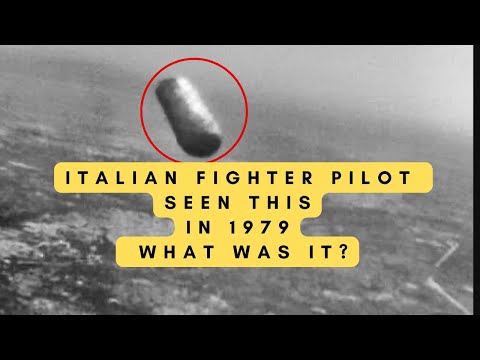
Did a Fighter Jet Really Chase a UFO in 1979?
An examination of the balloon counter-theories against Cecconi's reported observations and the radar record.
Sources
- The Black Vault Case Files. "The UFO Case of Maresciallo Cecconi – June 18, 1979." theblackvault.com
- UFO Insight. "The Cecconi UFO Incident: Photographic Evidence Of An Extraterrestrial Vehicle?" ufoinsight.com
- Infinity Explorers. "Authentic Image Of A UFO Captured Over Italy in 1979 By Giancarlo Cecconi." infinityexplorers.com
- Anomalien. "In 1979, a military pilot photographed a UFO over Italy." anomalien.com
- Silverland — Il mondo degli UFO. "Il caso Cecconi." silverland.info
- Silverland — Il mondo degli UFO. "Antonio Chiumiento" (biographical profile). silverland.info
- What's All This, Then? (WordPress). "The Remarkable Cecconi UFO Case: Cover Up Italian Style." whatsallthisthen.wordpress.com
- Unidentified Phenomena. "Cecconi UFO Incident (1979)." unidentifiedphenomena.com
- UFOAC. "The History of the Famous UFO Images Over Italy Taken in 1979." ufoac.com
- Mistero UFO (Overblog). "Treviso (Italia) – l'avvistamento del maresciallo Giancarlo Cecconi." misteroufo.overblog.com
- VersoIl2012. "Giancarlo Cecconi." versoil2012.altervista.org
- CISU — Centro Italiano Studi Ufologici. "Progetto AIRCAT." cisu.org
- CISU — Centro Italiano Studi Ufologici. Official homepage. cisu.org
- Wikipedia (Italian). "Centro italiano studi ufologici." it.wikipedia.org
- Edizioni Segno. "Obiettivo non identificato," Antonio Chiumiento (2020) — publisher's book page. store.edizionisegno.it
- Wikimedia Commons. "File: UFO photographed by Italian pilot Giancarlo Cecconi, 1979.jpg" (licensing discussion). commons.wikimedia.org
- Wikimedia Commons. "File: Fiat G91-R-1B, Italy – Air Force JP6990484.jpg" (GFDL, source of this file's hero image). commons.wikimedia.org
- Wikipedia. "Istrana Air Base." en.wikipedia.org
- Wikipedia. "Treviso Airport." en.wikipedia.org
- Wikipedia. "Fiat G.91." en.wikipedia.org
- Amazon.com. "Above Top Secret: The Worldwide U.F.O. Cover-Up," Timothy Good. amazon.com
- Amazon.com. "The UFO Evidence," Richard H. Hall. amazon.com
- Amazon.com. "Strange Skies: Pilot Encounters With UFOs," Jerome Clark. amazon.com
- Amazon.com. "UFOs: Generals, Pilots, and Government Officials Go on the Record," Leslie Kean. amazon.com
- Amazon.com. "Watch the Skies!: A Chronicle of the Flying Saucer Myth," Curtis Peebles. amazon.com
See something inaccurate? Have additional information or sources?
Suggest an Edit →Last Updated: August 2026