
The Twining Memo
This case file investigates a document, not a sighting: a three-page, SECRET-classified memorandum sent on September 23, 1947 from Headquarters, Air Materiel Command at Wright Field, Dayton, Ohio, over the signature of Lt. Gen. Nathan F. Twining, in response to a request from Brig. Gen. George Schulgen of Army Air Forces intelligence for an official appraisal of that summer's nationwide "flying disc" reports. Twining's memo opened with a judgment that has been quoted in UFO literature ever since: "the phenomenon reported is something real and not visionary or fictitious." It went on to describe a specific, consistent object morphology reported across hundreds of sightings, to weigh domestic-secret-project, natural-phenomena, and foreign-technology explanations against each other, and to recommend a dedicated, prioritized study — a recommendation that led directly, three months later, to the creation of Project Sign, the U.S. Air Force's first official UFO investigation, five years before Project Blue Book existed. This case file examines the memo's actual text, the intelligence request that prompted it, its documented chain to Project Sign, and how historians and the modern AARO-era disclosure effort have assessed its significance.
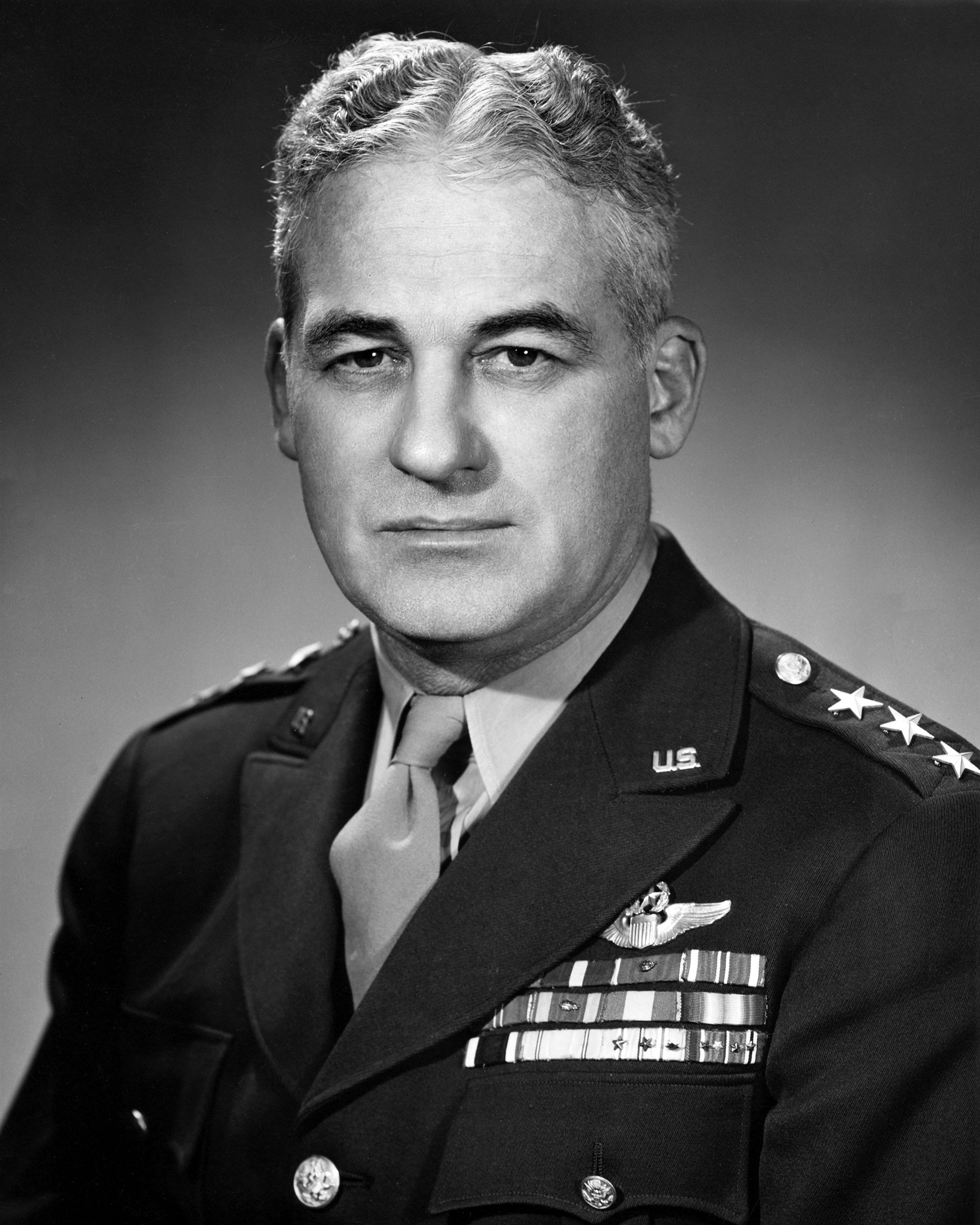
Pictured: Lt. Gen. Nathan F. Twining in the rank he held when he signed the memo, in an official U.S. Air Force portrait sourced via the Air Force Materiel Command History Office — not a scan of the memo itself. Legible full-page scans of the declassified three-page original circulate on multiple independent research archives (linked in Sources and Declassified Records below), but none is hosted at a resolution and license clarity this site could confirm as suitable for a primary hero image; the underlying document's authenticity and text are nonetheless independently cross-verified across those mirrors and against the government's own 1969 Condon Report appendix, discussed later in this case file.
Theoretical Alignment
The memo itself never names extraterrestrial origin as a candidate explanation; its own paragraph 2h explicitly weighs only a domestic classified project or a foreign (possibly Soviet) aircraft with unknown, "possibly nuclear," propulsion as the leading non-natural hypotheses, alongside ordinary natural phenomena such as meteors. Its Extraterrestrial Hypothesis alignment score here reflects how the document has been used and cited within later ufological literature — as the earliest serious official acknowledgment that flying discs might be genuinely unconventional craft — rather than any explicit ETH claim in Twining's own text. The Interdimensional Hypothesis finds essentially no purchase in a 1947 Air Materiel Command engineering-and-intelligence memo built entirely around conventional aircraft performance metrics (speed, climb rate, radius of action). The Psycho-Social Hypothesis scores low specifically because Twining's memo affirmatively rejects it: its opening finding is a direct, explicit repudiation of the "mass hysteria" framing that Schulgen's own parallel FBI-assisted investigation into the disc reports had been oriented around just weeks earlier.
Background: A Summer of Discs
The "flying disc" phenomenon that prompted Twining's memo began in earnest on June 24, 1947, when private pilot Kenneth Arnold reported nine crescent-shaped objects flying in echelon formation near Mount Rainier, Washington — the sighting that gave the American press the term "flying saucer," even though Arnold himself had described the objects' motion, not their shape, as saucer-like. Arnold's account, widely wired across the national press within days, triggered a summer-long wave of copycat reports: by the U.S. Air Force's own later count, more than 850 separate disc sightings were logged across the United States between Arnold's report and the end of July 1947 alone, a volume of simultaneous, geographically dispersed reporting with no precedent in American press or military experience to that point. That wave included the case that would become far more famous in retrospect than Twining's memo itself: the July 1947 recovery of debris from a ranch near Roswell, New Mexico, briefly announced by the 509th Bomb Group's public information office as a "flying disc" on July 8 before being redescribed within a day as a weather balloon — an episode this site treats in full in its own dedicated case file, and one whose relationship to Twining's later memo is addressed directly later in this page.
Press and public reaction to the wave was neither uniformly credulous nor uniformly dismissive. Some newspapers ran the story with open skepticism, treating "flying saucers" as a summer silly-season phenomenon comparable to sea-serpent sightings of earlier decades; others ran breathless front-page coverage suggesting a genuine, unresolved mystery. Inside the military and intelligence establishment, reaction was similarly split between officers inclined to treat the reports as a public-relations nuisance requiring only a firm dismissive statement, and officers — Schulgen and, per the memo examined in this case file, Twining's own AMC staff among them — who treated the sheer reporting volume and the degree of independent convergence on a specific, unusual object description as itself worth a genuine technical assessment rather than a reflexive denial. That split within the officer corps is itself part of why Twining's memo carries the historical weight it does: it represents the more serious-minded institutional response winning out, at least initially, over the dismissive one, in an internal debate whose losing side left little documentary trace of its own.
Inside Army Air Forces intelligence, the summer's volume of reports produced genuine institutional anxiety, but not, initially, anxiety focused on the phenomenon's possible reality. Brig. Gen. George F. Schulgen, chief of the Requirements Intelligence branch of Air Intelligence (AC/AS-2), initially suspected the reports might reflect a Soviet psychological-warfare operation or domestic hysteria rather than any physical object, and in late July 1947 he requested the FBI's assistance in locating and questioning early disc-sighting witnesses — an angle of the case documented in the Bureau's own later-released UFO files. That same month, seeking a technical rather than counterintelligence assessment, Schulgen formally asked Air Materiel Command — the Army Air Forces' engineering, procurement, and technical-intelligence command, headquartered at Wright Field, Dayton, Ohio — for its own considered opinion on what the reported objects might actually be. Air Materiel Command's Commanding General at the time was Lt. Gen. Nathan F. Twining, and the memo bearing his signature is AMC's formal answer to that request.
The institutional moment matters as much as the technical content. Twining's memo is dated just five days after the National Security Act of 1947 took effect (September 18, 1947), which converted the Army Air Forces into an independent U.S. Air Force under its first Chief of Staff, Gen. Carl Spaatz — meaning the "Commanding General, Army Air Forces" the memo is formally addressed to was, within days of its filing, a title already being superseded by the new service's own command structure. Wright Field itself was still a standalone installation when Twining signed the memo; it would not be administratively merged with the adjoining Patterson Field to form Wright-Patterson Air Force Base until January 13, 1948, less than four months later.
Complete Timeline
| Date | Event |
|---|---|
| June 24, 1947 | Kenneth Arnold's Mount Rainier sighting triggers nationwide press coverage of "flying saucers." |
| June–July 1947 | More than 850 flying disc reports are logged across the United States, including the Roswell debris recovery and its rapid public redescription as a weather balloon. |
| Late July 1947 | Brig. Gen. George Schulgen requests FBI assistance investigating early disc witnesses, suspecting possible hysteria or Soviet psychological operations. |
| July 30, 1947 | Schulgen formally requests Air Materiel Command's technical opinion on the flying disc reports. |
| September 18, 1947 | The National Security Act of 1947 takes effect, creating an independent U.S. Air Force under Gen. Carl Spaatz. |
| September 23, 1947 | Lt. Gen. Nathan F. Twining signs "AMC Opinion Concerning 'Flying Discs,'" concluding the phenomenon is "something real and not visionary or fictitious" and recommending a prioritized, coded study. |
| October 1, 1947 | Twining leaves Air Materiel Command to become Commanding General of the Alaskan Department, succeeded at AMC weeks later. |
| December 30, 1947 | Maj. Gen. Laurence C. Craigie, Director of Research and Development, authorizes the formal study Twining recommended — designated Project SAUCER, soon renamed Project Sign. |
| January 13, 1948 | Wright Field and Patterson Field are administratively merged into Wright-Patterson Air Force Base. |
| Late January 1948 | Project Sign begins operations under the Technical Analysis Division (T-2) at Wright-Patterson AFB, led by Col. Howard McCoy. |
| February 1949 | Project Sign is downgraded and renamed Project Grudge, reflecting a more skeptical official posture. |
| March 1952 | Project Grudge is reorganized into Project Blue Book under the Air Technical Intelligence Center (ATIC), led initially by Capt. Edward J. Ruppelt. |
| 1956 | Ruppelt's memoir The Report on Unidentified Flying Objects becomes an early public account connecting Twining's memo to Project Sign's creation. |
| 1968–1969 | The University of Colorado's Condon Report, commissioned by the Air Force, reproduces the Twining letter in full as an appendix. |
| August 13, 1986 | The National Archives formally declassifies the memo per Executive Order 12356, Section 3.3 (NND 863511). |
| 1980s–1990s | Researchers including William Moore and Stanton Friedman publicize the declassified memo, sometimes over-reading its text as an explicit extraterrestrial acknowledgment. |
| 2024 | The Department of Defense's All-domain Anomaly Resolution Office (AARO) publishes its Historical Record Report Volume 1, situating the Twining memo and Project SAUCER/SIGN as the earliest of roughly two dozen distinct official U.S. government UAP-related investigative efforts. |
The Memo's Own Text
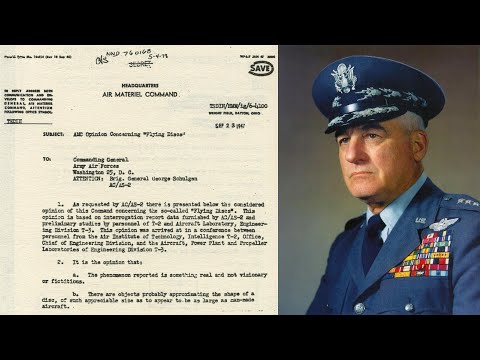
The document itself is unusually short and procedurally plain for a text that has carried this much retrospective weight. Addressed to the Commanding General, Army Air Forces, Washington 25, D.C., with the notation "ATTENTION: Brig. General George Schulgen, AC/AS-2," it opens by stating that the analysis follows "as requested by AC/AS-2," and that it was "arrived at in a conference between personnel from the Air Institute of Technology, Intelligence T-2, Office Chief of Engineering Division, and the Aircraft, Power Plant and Propeller Laboratories of Engineering Division T-3" — language that makes clear this was a genuine, if rapid, multi-office technical assessment rather than a single officer's personal opinion, even though it bears only Twining's signature as the command's senior officer.
Paragraph 2 lays out AMC's considered opinions in eight labeled sub-points. The memo states flatly that "the phenomenon reported is something real and not visionary or fictitious," and that the objects are "probably approximating the shape of a disc, of such appreciable size as to appear to be as large as man-made aircraft." It allows "a possibility that some of the incidents may be caused by natural phenomena, such as meteors," while noting that reported "extreme rates of climb, maneuverability (particularly in roll), and motion which must be considered evasive when sighted or contacted by friendly aircraft and radar, lend belief to the possibility that some of the objects are controlled either manually, automatically or remotely." It then lists the apparent common physical description compiled from the underlying reports: a metallic or light-reflecting surface; absence of any visible exhaust trail except in a few high-performance instances; a circular or elliptical shape, flat on the bottom and domed on top; several reports of formations of three to nine objects flying in tight, well-kept formation; normally no associated sound, apart from three reported instances of "a substantial rumbling roar"; and estimated level-flight speeds "normally above 300 knots."
The memo's final two opinion sub-paragraphs are, in some respects, its most consequential. Sub-paragraph 2f states it would be "possible within the present U.S. knowledge — provided extensive detailed development is undertaken — to construct a piloted aircraft" matching the described performance, "capable of an approximate range of 7,000 miles at subsonic speeds," explicitly framing the reported disc characteristics as within the theoretical envelope of contemporary aeronautical engineering rather than beyond it. Sub-paragraph 2h then lists three considerations demanding attention before drawing any firm conclusion: first, "the possibility that these objects are of domestic origin — the product of some high security project" unknown even to AC/AS-2 or AMC itself; second, "the lack of physical evidence in the shape of crash recovered exhibits which would undeniably prove the existence of these objects" — a sentence whose bearing on Roswell-related claims is discussed in its own section below; and third, "the possibility that some foreign nation has a form of propulsion possibly nuclear, which is outside of our domestic knowledge." Extraterrestrial origin appears nowhere among these three named possibilities.
Paragraph 3 makes AMC's formal recommendation: that Army Air Forces headquarters "issue a directive assigning a priority, security classification and Code Name for a detailed study" of the matter, with resulting data shared across the Army, Navy, Atomic Energy Commission, the Joint Research and Development Board, the Air Force Scientific Advisory Group, NACA, and the RAND and NEPA projects, with a preliminary report due within 15 days of receiving the data and detailed follow-up reports every 30 days thereafter. Paragraph 4 closes by noting that, pending such a directive, AMC would "continue the investigation within its current resources" and immediately formulate "Detailed Essential Elements of Information ... for transmittal thru channels." The memo is signed simply "N. F. TWINING, Lieutenant General, U.S.A., Commanding."
From Recommendation to Project Sign
Twining's paragraph 3 recommendation did not sit unactioned. On December 30, 1947 — just over three months after the memo was signed — Maj. Gen. Laurence C. Craigie, Director of Research and Development under the Deputy Chief of Staff for Materiel at the newly independent U.S. Air Force's headquarters, formally authorized the "detailed study" Twining had asked for. The resulting effort was initially designated Project SAUCER before being renamed Project Sign (administratively coded MCIAXO-3), established under the Technical Analysis Division (T-2) at what had, by then, become Wright-Patterson Air Force Base. Project Sign began substantive operations in late January 1948 under the direction of Col. Howard McCoy, staffed by AMC intelligence and engineering personnel — the same institutional lineage, and in several cases the same individual officers, that had produced Twining's memo four months earlier.
Project Sign's own institutional life was short and its findings were never fully resolved in public: it produced a classified, internally controversial "Estimate of the Situation" before being downgraded in February 1949 into the more skeptically oriented Project Grudge, which was itself reorganized in March 1952 into Project Blue Book under the Air Technical Intelligence Center, initially led by Capt. Edward J. Ruppelt. Ruppelt's own 1956 memoir, The Report on Unidentified Flying Objects, is the earliest widely read public account connecting Twining's memo directly to Project Sign's creation, written by the one officer with first-hand institutional access to both Sign's internal records and Blue Book's own later files. This case file treats the Twining-memo-to-Project-Sign chain as one of the most cleanly documented cause-and-effect sequences in the entire history of U.S. government UFO investigation: an identifiable command memorandum, a named signing officer, a specific recommendation, and a dated authorization three months later establishing exactly the kind of study the memo had requested.
The Memo, Roswell, and the "No Physical Evidence" Sentence
Because Twining commanded Air Materiel Command — the same command whose Foreign Technology division, based at Wright Field, received the Roswell debris for analysis in July 1947 — researcher Stanton Friedman and others have highlighted archival travel records indicating Twining made an unscheduled trip to New Mexico, with stops near Alamogordo Army Air Field and Kirtland Field, Albuquerque, from roughly July 7 to July 11, 1947, in the immediate aftermath of the Roswell debris recovery. Advocates of a Roswell crash-retrieval interpretation have cited that trip as circumstantial evidence Twining personally inspected recovered material. This case file notes that connection honestly while flagging the specific tension it creates with Twining's own memo, written more than ten weeks later: sub-paragraph 2h(2) explicitly lists "the lack of physical evidence in the shape of crash recovered exhibits which would undeniably prove the existence of these objects" as one of three open considerations bearing on the whole question — a direct, signed statement, by the one Air Materiel Command general most plausibly positioned to know if his own command was already sitting on recovered hardware, that no such undeniable physical evidence yet existed. Neither reading fully resolves the other: the July trip's specific purpose was never separately documented in any released record this case file could locate, and Twining's own September sentence could describe either an honest account of the state of AMC's actual holdings in September 1947, or language consistent with an ongoing compartmentalized program his own memo would then not be expected to disclose. This case file's own Conventional Explanation Candidate section below treats the "no physical evidence" reading as the more parsimonious of the two, without treating the question as definitively closed.
It is also worth noting what the memo does not do with respect to Roswell: it never names the New Mexico case, never references a debris recovery of any kind, and treats the entire "flying disc" question in general, nationwide terms rather than pointing to any single incident as decisive. That silence cuts in more than one direction analytically. Skeptics of a Roswell-connection reading note that a genuinely momentous physical-evidence recovery just ten weeks earlier would be an odd thing for AMC's own commanding general to omit entirely from a memo specifically weighing whether physical evidence existed; proponents counter that a genuinely compartmentalized program is exactly the kind of thing a general officer would be expected to omit from a memo destined for wide interagency circulation, including to the Navy, the Atomic Energy Commission, and NACA. This case file does not adjudicate that dispute definitively, since neither position is independently confirmable from the memo's own text, but it treats the tension itself as a genuine, documented feature of the record rather than a settled question either side has fully closed.
The Modern AARO-Era Reassessment
For most of its declassified life, Twining's memo circulated primarily within specialist ufological research circles and the occasional skeptical rebuttal piece — genuinely significant to historians of the subject, but far outside the mainstream disclosure conversation that would eventually surround it. That changed substantially after 2017, when a series of Pentagon-acknowledged "unidentified aerial phenomena" videos, followed by the creation of the Unidentified Aerial Phenomena Task Force (UAPTF), the Airborne Object Identification and Management Synchronization Group, and ultimately the All-domain Anomaly Resolution Office (AARO) in 2022, produced the first sustained official U.S. government re-engagement with the UFO/UAP subject since Project Blue Book's 1969 closure. As part of that re-engagement, AARO undertook a historical review of every prior official U.S. government UAP-related investigative effort dating back to 1945, publishing its findings as a two-part Historical Record Report in 2024.
That report's significance to this case file is direct: AARO's own historians identified roughly two dozen distinct formal and informal U.S. government efforts to study reported UAPs across nearly eight decades, and they trace that entire lineage back to Project SAUCER/SIGN as the earliest formal program — the program this memo's own paragraph 3 recommendation directly produced. In doing so, AARO's official history effectively re-anchors Twining's memo as the documented starting point of an institutional chain the Pentagon itself now formally acknowledges runs continuously, if unevenly and with long gaps in public visibility, from 1947 to the present. This case file treats that modern institutional framing as independently significant evidence of the memo's historical weight, distinct from and more authoritative than the informal, sometimes over-stated status the document has long held within specialist ufological literature: it is no longer only UFO researchers calling this memo foundational, but the Pentagon's own current UAP office, writing in an unclassified 2024 report explicitly designed for public release.
Historians of the broader disclosure movement have drawn a further, more interpretive lesson from the memo's rediscovery and its role in this modern review: that the U.S. government's institutional posture toward UAP reports has cycled between the cautious, resourced seriousness Twining's memo itself displays and the more dismissive, embarrassment-averse posture associated with Project Grudge and, at various points, Project Blue Book, rather than moving in one consistent direction over time. Read this way, the memo's continued citation in 2024 does less to prove anything about the underlying 1947 sightings themselves than to demonstrate that the specific institutional question it first posed — whether flying discs deserved a prioritized, resourced technical study rather than a reflexive dismissal — has recurred, largely unresolved, at multiple points across the full history this site's own catalogue otherwise treats case by case.
Distinguishing the Real Memo from the MJ-12 "Cutler-Twining" Forgery
Because Twining's name recurs across so much of the U.S. government's early UFO documentary record, it is worth explicitly separating this case file's September 23, 1947 memo from a different, much later document bearing Twining's name that most serious researchers on all sides of the UFO debate regard as a proven forgery: the so-called "Cutler-Twining memo," a one-page document dated July 1954 purportedly from presidential aide Robert Cutler to Twining referencing a "NSC/MJ-12 Special Studies Project" briefing, central to the discredited "Majestic-12" document set that surfaced in the 1980s. Independent researchers, including skeptic Philip J. Klass, established that Cutler was verifiably out of the country on the document's purported date, and forensic document analysis identified a Truman signature pasted in from an unrelated, genuine October 1947 memo, complete with matching accidental scratch marks — among several technical anomalies (including typewriter models not manufactured until years after the documents' stated dates) that led the FBI's own investigation and the great majority of UFO researchers, skeptical and proponent alike, to conclude the MJ-12 papers are forgeries. The genuine September 23, 1947 "AMC Opinion Concerning 'Flying Discs'" memo this case file examines has no demonstrated connection to that forgery beyond sharing Twining's name, carries none of the MJ-12 set's documented anomalies, and its own chain of custody — National Archives holdings, 1986 declassification stamp, and multiple independently sourced mirror transcriptions that cross-match down to individual sub-paragraph wording — is essentially undisputed.
Key Figures
This case file has no eyewitnesses of its own; the profiles below are the officers whose actions produced, requested, or acted on the document itself.
Lt. Gen. Nathan F. Twining
Born in Monroe, Wisconsin in 1897, Twining was a career military aviator with combat command experience in both the Pacific and European theaters of the Second World War before taking command of Air Materiel Command in December 1945, a posting that put him in charge of the Army Air Forces' entire technical-intelligence, engineering, and procurement apparatus at exactly the moment the 1947 disc wave broke. He commanded AMC at Wright Field from December 1945 until October 1, 1947 — leaving just days after signing this memo to take command of the Alaskan Department, and shortly after that, Alaskan Command. He went on to become the U.S. Air Force's fourth Chief of Staff (1953–1957) and the first Air Force officer to serve as Chairman of the Joint Chiefs of Staff (1957–1960), a career trajectory that makes him, by a wide margin, the most senior officer whose name appears on any of the earliest declassified U.S. government UFO documents. His name also appears elsewhere on this site in connection with a separate March 1952 memorandum on the Wonsan-Sunchon UFO Incident, written five years later while he served as Vice Chief of Staff of the Air Force — a different document from the one this case file examines, though the recurrence underscores how consistently Twining's own career intersected with the Air Force's earliest UFO record, from Wright Field's engineering laboratories in 1947 to the Pentagon's own senior leadership by the early 1950s.
Brig. Gen. George F. Schulgen
Schulgen headed the Requirements Intelligence branch of Army Air Forces intelligence in 1947 and formally requested Air Materiel Command's technical appraisal of the flying disc reports on July 30, 1947, the specific request Twining's memo answers. Schulgen had separately sought FBI assistance investigating early disc witnesses out of suspicion the reports might reflect hysteria or a Soviet psychological operation — a suspicion Twining's memo directly and explicitly rejected in its opening finding.
Maj. Gen. Laurence C. Craigie
Craigie formally authorized the "detailed study" Twining's memo had recommended on December 30, 1947, converting a command-level recommendation into an actual funded, staffed program — the single administrative act that turned this memo from an internal opinion into the direct cause of Project Sign.
Capt. Edward J. Ruppelt
Ruppelt had no direct role in 1947, joining the Air Force's UFO investigative apparatus only in the early 1950s as head of Project Blue Book, Project Sign's eventual successor. His 1956 memoir is nonetheless the earliest widely circulated public account tracing Twining's memo directly to Project Sign's creation, written from an insider's institutional vantage point Ruppelt held uniquely at the time.
The Five Observables Assessment
Twining made no first-hand observation of any object; this framework instead assesses the specific performance characteristics AMC's own memo attributed to the reported "flying discs" it was synthesizing from the summer 1947 wave, not any independent finding Twining himself generated.
Assessment: The memo attributes one Observable (rapid, evasive acceleration) directly and explicitly to the reported objects, treats a second (trail-less flight) as a real but ambiguous signature, and is silent or negative on the remaining three. This is a notably narrower and more conservative performance profile than many later, more dramatic UAP-performance claims attribute to the same 1947 wave in retrospect — the memo's own language describes challenging but not unambiguously physics-defying flight characteristics.
Evidence Assessment
Supporting the Memo's Genuine Institutional Significance
- The memo's authenticity and text are cross-verified across the National Archives' own holdings, its 1986 declassification stamp, and multiple independently maintained mirror transcriptions (NICAP, Project 1947, DocumentCloud) that match down to individual sub-paragraph wording.
- The U.S. government's own 1969 Condon Report reproduced the letter in full as an appendix, an independent official acknowledgment of the document's authenticity separate from any UFO-advocacy source.
- The specific chain from the memo's paragraph 3 recommendation to Maj. Gen. Craigie's December 30, 1947 authorization of Project Sign is documented by dated, named administrative actions, not inference.
- The memo's opening finding directly and explicitly overruled the mass-hysteria/psychological-operation framing Schulgen's own parallel FBI-assisted inquiry had been oriented around weeks earlier.
- The AARO Historical Record Report (2024) situates this memo and Project SAUCER/SIGN as the documented starting point of an unbroken, officially acknowledged institutional lineage running through Grudge, Blue Book, and into the modern AATIP/AAWSAP/AARO era.
Supporting a More Modest Reading of the Memo's Content
- The memo itself names no extraterrestrial hypothesis; its own leading candidate explanations are a domestic classified project or unknown foreign (possibly Soviet) technology.
- Sub-paragraph 2f explicitly frames the described performance as achievable "within the present U.S. knowledge" given sufficient development — not necessarily beyond contemporary human engineering.
- The memo's recommendation is procedural (a coded, prioritized study with routine progress reporting), the standard bureaucratic response to any unresolved technical intelligence question of the period, not evidence the phenomenon was already understood to be non-human.
- The memo's own paragraph 2h(2) explicitly states no crash-recovered physical evidence existed as of September 1947, directly complicating some later claims connecting the document to a contemporaneous Roswell crash-retrieval.
- Some popular UFO literature has quoted the memo's "something real and not visionary or fictitious" line without its surrounding, far more cautious qualifying context — a documented pattern of selective citation this case file's own text above is written specifically to avoid repeating.
Why "Credible"
This case file assigns a CREDIBLE stamp on an axis specific to a document case rather than a witnessed sighting: not "is the reported phenomenon real," but "is this specific document what it claims to be, and does the documented record support the significance attributed to it." On both counts, the answer is about as strong as this catalogue's documentary cases get. The memo's chain of custody is unusually clean for a 74-year-old declassified record: National Archives holdings, a dated 1986 declassification stamp under a named standard executive-order authority, and independent cross-verification against the Condon Report's own official 1969 government-commissioned reproduction of the same text. Its institutional consequence is equally well-documented and dated: a specific, named recommendation in September 1947 followed by a specific, named authorization in December 1947 that created exactly the study Twining had asked for, beginning an unbroken institutional lineage the Department of Defense's own 2024 AARO history now formally traces from this memo through to the present.
The score sits in the medium-high tier rather than the highest tier this site reserves for cases combining that kind of documentary certainty with independently confirmed physical or instrumented evidence of a genuinely anomalous craft, because this memo does not provide that: its own content is a cautious, hedged 1947 technical opinion recommending further study, explicitly declining to name extraterrestrial origin, explicitly noting the absence of physical evidence, and explicitly treating the reported performance as within reach of contemporary aeronautical engineering given sufficient investment. What is verified beyond real dispute is the document and its consequences; what remains genuinely open is what, if anything, the underlying 1947 disc reports it was synthesizing actually were. Readers looking for a single number that captures "is this real" are, in effect, asking two different questions at once — whether the paper itself is authentic, and whether the phenomenon it describes was ever satisfactorily explained — and this case file's score is calibrated specifically and deliberately to the first of those two questions, which is the one a document-based case file of this particular kind is actually positioned to answer with real confidence, on the documentary record assembled above.
Sensor & Instrumentation Detection Profile
The memo cites no radar, photographic, or instrumented data of its own; it is explicitly a synthesis of "interrogation report data furnished by AC/AS-2" — meaning verbal and written witness debriefs collected by intelligence officers — combined with "preliminary studies" by Air Materiel Command's own engineering laboratories assessing whether the reported performance characteristics were physically achievable, not whether any specific sighting was instrumentally confirmed. No radar log, gun-camera film, or ground-based photograph is cited anywhere in the memo's surviving text, and this case file located no evidence that any such instrumented record specifically tied to the memo's drafting has ever been declassified or referenced by later researchers.
Environmental & Geospatial Context
Not applicable in the conventional sense this site uses for sighting locations: the memo was drafted indoors, at Air Materiel Command's Wright Field headquarters in Dayton, Ohio, synthesizing reports gathered from sighting locations scattered across the United States rather than describing any single site Twining or his staff visited themselves. Wright Field in September 1947 was still a standalone Army Air Forces installation, distinct from the Wright-Patterson Air Force Base it would become after the January 1948 merger with adjoining Patterson Field — a small but historically precise distinction this case file's Quick Stats Grid and location link above preserve deliberately.
Observer Credibility & Occupational Profile
The memo's drafting credentials are institutional rather than individual: it represents the coordinated technical judgment of Air Materiel Command's Air Institute of Technology, its T-2 intelligence staff, and the Aircraft, Power Plant and Propeller Laboratories of its Engineering Division (T-3) — specialist aeronautical engineers and intelligence analysts whose professional expertise was specifically suited to assessing whether the reported flight characteristics were physically plausible, even though none of them had personally witnessed the sightings they were evaluating. Twining's own signature carries the weight of his position as AMC's senior officer rather than personal technical specialization; his later career (Chief of Staff of the Air Force, Chairman of the Joint Chiefs of Staff) reflects a command-track rather than a research-track record, relevant context for weighing how much independent technical judgment, versus institutional sign-off on staff work, his signature actually represents.
This case file weighs that institutional credibility as genuinely strong on its own terms, distinct from the individual-witness credibility framework applied to eyewitness sighting cases elsewhere on this site. A single command's aeronautical engineers reaching a documented, internally coordinated conclusion — arrived at, per the memo's own text, "in a conference between personnel" from four separate specialist offices — carries a different and in some respects more defensible kind of institutional weight than any single witness's account, precisely because it required several independent technical offices to sign onto the same synthesis before it could be sent up the chain under the Commanding General's own signature. That process does not make the underlying 1947 sighting reports themselves any more or less accurate, but it does mean the memo's own conclusion that the reports "lend belief" to controlled flight represents a genuine multi-office technical consensus rather than one officer's unchecked personal impression.
Physical & Material Assays
No physical or material evidence is associated with the memo itself, which is a paper analytical document rather than a piece of physical case evidence. The memo's own text explicitly states, in sub-paragraph 2h(2), that no "crash recovered exhibits" existed as of September 1947 that could "undeniably prove the existence of" the reported objects — the closest the document comes to addressing physical evidence at all, and a statement this case file's earlier Roswell-adjacent section above examines directly rather than treating as settled.
Historical Precedents & Archive Matches
This memo sits at the documented origin point of the entire chain of official U.S. government UFO study efforts this site catalogues elsewhere: Project Sign (1948) directly, and through it Project Grudge (1949) and Project Blue Book (1952–1969), the CIA-convened Robertson Panel (1953) that later reviewed Blue Book's own case files, and ultimately the modern AATIP/AAWSAP and All-domain Anomaly Resolution Office (AARO) era, which the Department of Defense's own 2024 Historical Record Report explicitly traces back to this document and Project SAUCER/SIGN as the earliest of roughly two dozen distinct historical U.S. government UAP-related investigative efforts it identifies. Within this site's own catalogue, Twining's name recurs five years later in a substantively different March 1952 memorandum connected to the Wonsan-Sunchon UFO Incident, written while he served as Vice Chief of Staff of the Air Force — a useful reminder that "the Twining memo" is not a single document across the historical record, and that this case file concerns specifically and only the September 23, 1947 "AMC Opinion Concerning 'Flying Discs.'"
The memo also functions as an unusually early archival benchmark against which every later official U.S. government UAP assessment can be directly compared on its own terms, rather than only by reputation. The Robertson Panel's 1953 report, for instance, adopted a substantially more dismissive institutional posture toward UFO reports than Twining's memo had six years earlier, despite reviewing a broadly similar category of witness evidence — a documented shift in official tone this site's own Robertson Panel case file examines in detail, and one that becomes more legible when read against this memo's own comparatively serious, non-dismissive baseline. The 1969 Condon Report's decision to reproduce Twining's letter in full as an appendix, discussed above, reflects the same dynamic from the opposite direction: even a study whose own conclusions leaned toward closing Project Blue Book altogether treated this specific 1947 document as worth preserving in an official government record, rather than omitting it as an embarrassing early overreaction.
Material Analysis
As established under Physical & Material Assays above, there is no physical trace evidence connected to the memo itself for any forensic or material analysis to examine; the document's only relevant statement on the subject is its own explicit acknowledgment that no crash-recovered exhibits existed at the time of writing. This section restates that finding in the terrestrial-versus-non-terrestrial framework this site applies to material evidence elsewhere in its catalogue, because the memo's own text is direct testimony on the point rather than a silent gap.
Supporting a Non-Terrestrial or Anomalous Reading
- The specific performance profile the memo compiles — a consistent disc morphology, tight multi-object formations, and rapid evasive maneuverability — reflects genuine convergence across hundreds of independently filed 1947 witness reports, not a single anecdote.
- The memo's own drafting staff, credentialed aeronautical engineers, explicitly found the reported performance sufficiently unusual to warrant sustained, prioritized, multi-agency study rather than a routine dismissal.
Supporting a Terrestrial Origin
- The memo's own sub-paragraph 2f explicitly states the described performance was achievable "within the present U.S. knowledge" given sufficient development, framing the objects as within reach of known aeronautical engineering rather than necessarily beyond it.
- The memo's own leading named hypotheses are a domestic classified project or foreign (possibly Soviet) technology — both terrestrial by definition — with natural phenomena such as meteors also explicitly allowed for a subset of reports.
- No physical evidence existed, by the memo's own explicit statement, that could "undeniably prove" any of the reported objects were real physical craft at all, as opposed to a mix of misidentification, natural phenomena, and unconfirmed reports.
The Conventional Explanation Candidate: Assessing What the Memo Actually Establishes
Because this case file concerns an official document rather than a sighting, its "Conventional Explanation Candidate" section asks a correspondingly different question: not "what mundane phenomenon explains an observed object," but "what is the most defensible reading of what Twining's memo itself actually establishes, as against the range of claims later made about it." Three candidate readings deserve direct evaluation.
A Genuine, Cautious Technical Opinion Recommending Further Study
The most textually faithful reading treats the memo exactly as it presents itself: a multi-office technical synthesis concluding that the summer 1947 disc reports, taken together, described something too consistent and too performance-anomalous to dismiss outright, while explicitly declining to name a specific cause and explicitly recommending further investigation rather than announcing a conclusion. This reading accounts cleanly for the memo's actual hedged language throughout paragraph 2, its explicit listing of mundane candidate explanations (domestic project, foreign technology, natural phenomena) in 2h, and its narrowly procedural paragraph 3 recommendation. It is, on this case file's own assessment, the reading best supported by the document's actual text.
Retrospective Over-Reading as an Extraterrestrial Acknowledgment
A second, very common reading in popular UFO literature treats the memo's opening line — "something real and not visionary or fictitious" — in isolation, presenting it as an early official U.S. government acknowledgment that flying discs were non-human craft. This reading is not supported by the memo's own surrounding text, which names no extraterrestrial hypothesis anywhere and explicitly frames the described performance as achievable through advanced but conventional aeronautical engineering. This case file treats this popular reading as a documented pattern of selective quotation rather than an accurate account of the memo's content, without denying that the memo's genuine, undisputed finding — that trained military engineers and intelligence analysts concluded something real, not merely imagined, was being widely reported — remains itself significant on its own, more modest terms.
Institutional Hedging to Justify Continued Program Funding
A third, more skeptical reading holds that AMC's conclusion the phenomenon was "real" served primarily to justify the resourced, prioritized study its own paragraph 3 requested — a routine bureaucratic incentive (any command benefits from being tasked with a funded, prioritized mission) rather than a dispassionate technical finding. This reading is not disprovable from the memo's text alone, but it does not account well for the memo's own explicit rejection of the psychological-hysteria explanation Schulgen's office had initially favored — a position that, if anything, would have made a "there's nothing here" finding the institutionally simpler and lower-effort conclusion to reach.
Genuine, Cautious Technical Opinion
Highly PlausibleDirectly and consistently supported by the memo's own hedged language, explicit candidate-explanation list, and procedural recommendation — the reading best matching the document's actual text.
Retrospective Over-Reading as ET Acknowledgment
Implausible (as a reading of the memo itself)Not supported by the memo's own text, which never names extraterrestrial origin and explicitly frames the described performance as within reach of conventional engineering; a documented pattern of selective quotation rather than an accurate textual reading.
Institutional Hedging for Program Funding
InconclusiveNot disprovable from the text alone, but weakened by the memo's explicit rejection of the lower-effort hysteria explanation Schulgen's office had initially favored.
Related Cases
Confirmed Documents & Official Records
The National Archives' own finding aid for the Air Staff record group holding Project Blue Book and related early Air Force UFO-investigation records, including holdings tracing to this memo's institutional lineage.
Unclassified finding aid; underlying records individually declassifiedA full-page scanned reproduction of the declassified three-page original, bearing the National Archives' own 1986 declassification stamp and case officer initials.
Declassified per E.O. 12356, Section 3.3, NND 863511Jan Aldrich's long-running documentary research archive's own transcription of the memo, cross-checked against the NICAP scan for this case file.
Declassified; mirror transcriptionThe Air Force's own commissioned scientific study reproduced the Twining letter in full as an appendix, an independent official acknowledgment of the document distinct from any UFO-advocacy source.
Unclassified government-commissioned reportThe Pentagon's modern UAP office situates Project SAUCER/SIGN — the direct product of this memo's recommendation — as the earliest of roughly two dozen distinct official U.S. government UAP-related investigative efforts identified in its historical review.
UNCLASSIFIEDSearch Government Archives Directly
Further Reading — Recommended Literature
The Report on Unidentified Flying Objects: The Original 1956 Edition
The earliest widely read public account tracing Twining's memo directly to Project Sign's creation, written by the officer who later ran Project Blue Book, Sign's eventual successor.
Watch the Skies!: A Chronicle of the Flying Saucer Myth
A detailed, skeptically-inclined narrative history situating the memo within the full arc of the 1947 disc wave and the Air Force study programs it produced.
The UFO Controversy in America
A foundational academic history covering Project Sign's origins in direct detail, including the intelligence and engineering staff work behind Twining's memo.
UFOs and the National Security State: Chronology of a Cover-up, 1941–1973
A comprehensive, more advocacy-oriented chronology devoting substantial detail to the memo, the Roswell connection, and the MJ-12 forgery controversy this case file distinguishes it from.
UFOs and Government: A Historical Inquiry
The most detailed scholarly historical treatment of the memo's drafting, the Schulgen request, and Project Sign's formal authorization process.
Essential Viewing
Sources
- National Investigations Committee on Aerial Phenomena (NICAP), "AMC Opinion Concerning 'Flying Discs'" (full declassified scan), September 23, 1947.
- Project 1947 Research Archive, "AMC Opinion Concerning 'Flying Saucers'", transcription and context by Jan Aldrich.
- Project 1947 Research Archive, "SHG — Condon Report, Appendix R: 1947 Twining Letter".
- National Archives and Records Administration, "Records of Headquarters United States Air Force (Air Staff)", Record Group 341 finding aid.
- All-domain Anomaly Resolution Office (AARO), U.S. Department of Defense, Historical Record Report, Volume 1 (2024).
- Eric Wojciechowski, "General Nathan F. Twining and the Flying Disc Problem of 1947", Skeptical Inquirer, March/April 2020.
- Edward J. Ruppelt, The Report on Unidentified Flying Objects (Doubleday, 1956).
- Curtis Peebles, Watch the Skies!: A Chronicle of the Flying Saucer Myth (Smithsonian Institution Press, 1994).
- David M. Jacobs, The UFO Controversy in America (Indiana University Press, 1975), foreword by J. Allen Hynek.
- Richard M. Dolan, UFOs and the National Security State: Chronology of a Cover-up, 1941–1973 (Keyhole Publishing, 2002).
- Michael D. Swords & Robert Powell, with Clas Svahn, Vicente-Juan Ballester Olmos, Bill Chalker, Barry Greenwood, Richard Thieme, Jan Aldrich, and Steve Purcell, UFOs and Government: A Historical Inquiry (Anomalist Books, 2012).
- Wikipedia, "Nathan F. Twining" — used lightly for biographical orientation and cross-checking career dates.
- Wikipedia, "George F. Schulgen".
- Wikipedia, "Project Sign".
- Wikipedia, "1947 flying disc craze".
- Wikipedia, "Majestic 12" — on the "Cutler-Twining memo" forgery this case file distinguishes from the genuine 1947 document.
- Philip J. Klass, "Special Report: New Evidence of MJ-12 Hoax," Skeptical Inquirer (1990), archived at centerforinquiry.org.
- Sign Oral History Project, "Project Sign", History of the United States Air Force UFO Programs.
- Wikimedia Commons, "Lt Gen Nathan F. Twining" (U.S. Air Force official portrait, public domain; sourced via the AFMC History Office) — source of this case file's hero image.
- Case File, The Omni Ledger, The Kenneth Arnold Sighting — the June 1947 sighting that opened the summer disc wave this memo responds to.
- Case File, The Omni Ledger, The Roswell Incident — the July 1947 case whose relationship to this memo is examined directly above.
- Case File, The Omni Ledger, The Robertson Panel — a later link in the same institutional chain this memo began.
- Case File, The Omni Ledger, Wonsan-Sunchon UFO Incident — on Twining's separate, later 1952 memorandum.
See something inaccurate? Have additional information or sources?
Suggest an Edit →Last Updated: August 2026