
The Robertson Panel
This case file investigates a study, not a sighting: over twelve hours across four days in January 1953, five civilian physicists and astronomers — assembled at the Central Intelligence Agency's request and chaired by Caltech's Howard P. Robertson — reviewed the U.S. Air Force's Project Blue Book case files, including the Tremonton, Utah and Great Falls, Montana UFO films, and concluded that reasonable conventional explanations existed for the great majority of sightings. Their formal, signed report recommended the Air Force strip UFOs of "the special status they have been given" through a coordinated public "debunking" and education campaign — a recommendation that shaped official American UFO policy for the next two decades. The panel's own scientific rigor and independence have been disputed ever since, not least by one of its own members.
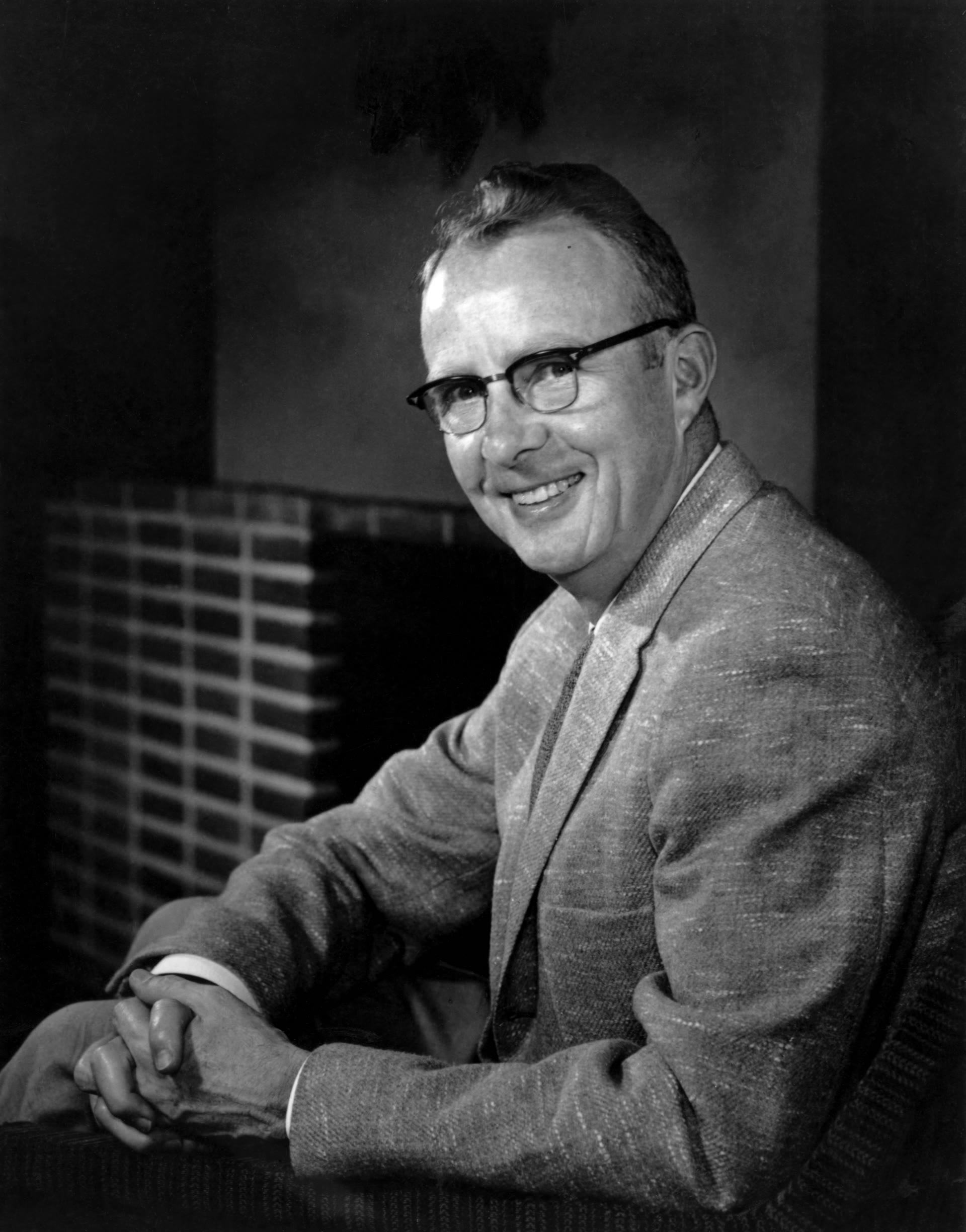
Pictured: physicist Luis W. Alvarez, photographed at Lawrence Berkeley National Laboratory in 1962 — one of the five scientists who signed the Robertson Panel's report, but not a photograph of the panel itself, which is not known to have ever been photographed as a group. No public-domain or rights-clear photograph of chairman Howard P. Robertson, nor of the panel's actual meeting room inside CIA's wartime E Street Complex headquarters, is known to exist.
Theoretical Alignment
The Robertson Panel is one of the clearest institutional expressions of the Psycho-Social Hypothesis ever produced by an arm of the U.S. government, even though the term did not yet exist in 1953. Its own report explicitly frames the UFO problem as one of mass psychology — "clogging of channels of communication," "a morbid national psychology," vulnerability to "mass hysteria" and "hostile propaganda" — rather than a question of what, if anything, physically caused any individual sighting. It gives no weight whatsoever to the interdimensional framing, which did not feature in 1950s Air Force or CIA thinking at all. On the extraterrestrial hypothesis, the panel's own members were personally open to the idea in the abstract (none, per the Durant Report, was "loath to accept" the possibility of extraterrestrial visitation someday) but found no case-specific evidence connecting any reviewed sighting to it, and Dr. Thornton Page went further, calling the odds of intelligent beings elsewhere in the solar system deliberately concentrating their attention on Earth "quite preposterous."
Background
By January 1953, the U.S. Air Force had been formally tracking "flying saucer" reports for more than five years, through a chain of successor projects — SIGN (1948), GRUDGE (1949), and, from March 1952, Project Blue Book under the Air Technical Intelligence Center (ATIC) at Wright-Patterson Air Force Base, Ohio. Blue Book's newly appointed chief, Capt. Edward J. Ruppelt, had spent 1952 trying to professionalize what had been, under GRUDGE, a program with an unofficial mandate to explain sightings away almost regardless of the evidence. That effort collided head-on with the single most intense UFO wave of the Cold War: the summer 1952 Washington, D.C. UFO flap, in which radar operators at Washington National Airport and Andrews Air Force Base tracked unexplained targets on consecutive weekends in July, jet interceptors were scrambled without result, and Air Force Director of Intelligence Maj. Gen. John Samford held the largest Pentagon press conference since World War II to address it. The flap made front-page news for weeks and, more consequentially for this case file, made unidentified flying objects a subject the CIA's own analysts could no longer treat as a purely Air Force problem.
Inside the Agency, that shift traced directly to H. Marshall Chadwell, the CIA's Assistant Director for Scientific Intelligence, who had commissioned an internal study group (Philip G. Strong, Frederick C. E. Oder, and future panel secretary Frederick C. Durant) in August 1952 to assess whether UFO reports posed any genuine intelligence concern. That August study, plus a follow-up visit to ATIC by Chadwell, Howard P. Robertson, and Durant, persuaded Chadwell the subject deserved a formal outside review. He briefed Director of Central Intelligence Walter Bedell Smith that "something was going on that must have immediate attention," framing the concern less around the objects' possible nature than around two very Cold War anxieties: that Soviet agents might exploit UFO hysteria as a psychological-warfare tool, and that a flood of "nocturnal meandering light" reports could overload the same radar and communication channels the country would need intact to detect a genuine surprise attack. On December 4, 1952, the Intelligence Advisory Committee — the interagency body Bedell Smith chaired — formally agreed that the Director of Central Intelligence should "enlist the services of selected scientists to review and appraise the available evidence in light of pertinent scientific theories." That single sentence is the entire founding charter of what became, six weeks later, the Robertson Panel.
The task of actually assembling the panel fell to Chadwell and Robertson together in early January 1953. Robertson was, on paper, an unusual choice to lead a UFO study: his own scientific reputation rested on general relativity and cosmology (the Robertson–Walker metric, still foundational to modern Big Bang cosmology, carries his name), not on aviation, optics, or atmospheric physics. What he did have was a long-standing, high-clearance relationship with U.S. defense and intelligence agencies dating to his World War II ballistics work and continuing through his directorship of the Pentagon's Weapons Systems Evaluation Group — exactly the kind of trusted-insider profile the CIA wanted running a review it needed to be both scientifically credible and discreet. Robertson and Chadwell selected four additional physical scientists, each already cleared for sensitive government work and each, by design, a genuine outsider to the UFO subject rather than an existing believer or debunker: Luis Alvarez, a radar and particle physicist from the University of California; Lloyd Berkner, a geophysicist and president of Associated Universities, Inc.; Samuel Goudsmit, co-discoverer of electron spin and a Brookhaven National Laboratory physicist; and Thornton Page, an astronomer and deputy director of the Johns Hopkins Operations Research Office. Durant, the CIA rocketry analyst who had co-authored the August 1952 study, was assigned as the panel's secretary — the role in which he would go on to write the single most important surviving account of what actually happened in the room.
Complete Timeline
| Date | Event |
|---|---|
| August 1952 | CIA Assistant Director H. Marshall Chadwell commissions an internal study group (Strong, Oder, Durant) to assess whether UFO reports pose an intelligence concern. |
| July 19–27, 1952 | The Washington, D.C. UFO flap produces the largest Pentagon press conference since WWII and elevates UFOs to a CIA-level concern. |
| Autumn 1952 | Chadwell, Howard P. Robertson, and Durant visit the Air Technical Intelligence Center (ATIC) at Wright-Patterson AFB. |
| December 4, 1952 | The Intelligence Advisory Committee, chaired by DCI Walter Bedell Smith, directs the CIA to "enlist the services of selected scientists" to review the evidence — the panel's founding decision. |
| Wednesday, January 14, 1953 (AM) | Chadwell opens the first session; Robertson is named Chairman; the panel views the Tremonton, Utah and Great Falls, Montana films for the first time. Meeting adjourns at 2200. |
| Wednesday, January 14, 1953 (PM) | U.S. Navy Photo Interpretation Laboratory (Anacostia) analysts Lt. R.S. Neasham and Harry Woo brief the panel on their "self-luminous" Tremonton findings; Capt. Edward J. Ruppelt presents ATIC methodology for roughly 40 minutes. |
| Thursday, January 15, 1953 | Ruppelt continues his briefing; Dr. J. Allen Hynek describes Project STORK; seagull footage is screened; Lt. Col. Oder briefs Project TWINKLE; Brig. Gen. William Garland (ATIC commander) joins and endorses the panel's work. |
| Friday, January 16, 1953 (AM) | General discussion; Hynek reads a prepared paper of observations; Maj. Dewey Fournet briefs the panel on his 15 months as Blue Book's Pentagon project officer. |
| Friday, January 16, 1953 (PM) | Lloyd Berkner joins the panel for the first time; tentative conclusions and recommendations are discussed. |
| Saturday, January 17, 1953 (AM) | Robertson circulates a draft report, reviewed and pre-approved by Berkner; the AD/SI reports the USAF Director of Intelligence's favorable reaction to the draft. |
| Saturday, January 17, 1953 (PM) | The panel finalizes and signs its report; all five members individually restate suggestions later compiled into Durant's unofficial "Part II" supplement. |
| February 16, 1953 | Frederick C. Durant submits his 38-page memorandum — the "Durant Report" — documenting the panel's full proceedings to the Assistant Director for Scientific Intelligence. |
| August 1953 | The Air Force issues Regulation 200-2, formalizing a "need to know" reporting policy and public-information restrictions consistent with the panel's recommendations. |
| 1953–1954 | Joint Army-Navy-Air Force Publication (JANAP) 146 classifies certain UFO-related reports and threatens penalties for unauthorized disclosure. |
| 1956 | Ruppelt's book The Report on Unidentified Flying Objects becomes the first public disclosure that the panel existed at all. |
| April 9, 1958 | The Air Force releases a redacted three-paragraph summary and the panel members' names to researcher Leon Davidson under public pressure from NICAP. |
| 1966 | A near-complete, unofficial text of the Durant Report is published in the Saturday Review; J. Allen Hynek writes that the panel had "made the subject of UFOs scientifically unrespectable" for nearly 20 years. |
| October 3, 1992 | Thornton Page, in a letter to researcher James Klotz, states Robertson told the panel in a private opening session that "our job was to reduce public concern." |
| June 26, 2013 | The CIA formally declassifies and releases the complete 38-page Durant Report through its FOIA Electronic Reading Room. |
Four Days in Washington: How the Panel Actually Worked
The Durant Report's day-by-day "History of Meetings" section — the fullest surviving account of the panel's actual proceedings — describes a working rhythm closer to a rushed government review than a deliberate scientific inquiry. The first session opened on the morning of Wednesday, January 14, 1953, with Chadwell reviewing the CIA's prior interest in the subject before formally turning the meeting over to Robertson as chairman. Robertson assigned specific case categories to specific members based on their expertise — radar and visual sightings to Alvarez, "green fireball" and nocturnal-light reports to Page — and the group's first substantive act was to watch, together, the two motion-picture films Air Force analysts considered their strongest available documentary evidence: the July 2, 1952 Tremonton, Utah footage and the August 15, 1950 Great Falls, Montana footage. The session ran until 2200 hours.
The second session, that same evening, brought in outside briefers: Lt. R.S. Neasham and analyst Harry Woo of the U.S. Navy's Photo Interpretation Laboratory at Anacostia presented roughly 1,000 man-hours of frame-by-frame analysis of the Tremonton film, followed by a roughly 40-minute briefing from Capt. Edward J. Ruppelt on ATIC's case-handling methodology. Thursday, January 15 brought two full sessions: Ruppelt continued his briefing in the morning, J. Allen Hynek — then an astronomer at Ohio State University and Blue Book's civilian scientific consultant, several years before his 1956 move to Northwestern — described Battelle Memorial Institute's statistical case-analysis effort (Project STORK), and the panel watched a comparison reel of seagulls in flight. That afternoon Lt. Col. Frederick Oder briefed the group on Project TWINKLE, the Air Force's failed 24-hour camera-watch program for "green fireballs" over New Mexico, and ATIC's commanding general, Brig. Gen. William M. Garland, joined briefly to voice his personal support for the panel's work and to argue for more field investigators and faster case declassification.
Friday, January 16 opened with general discussion and a prepared paper Hynek read to the group, followed by a lengthy briefing from Maj. Dewey Fournet, who had spent the previous 15 months as Blue Book's Pentagon liaison officer and who told the panel that, having eliminated every conventional cause he could identify from a subset of cases, he personally found "extraterrestrial" the only explanation left standing in several of them — a conclusion the assembled physicists, working from what they considered raw, unevaluated witness reports rather than instrumented data, explicitly declined to adopt. It was only on Friday afternoon — the third of four working days — that Lloyd Berkner arrived and joined the panel for the first time, meaning the group's fifth member missed roughly three-quarters of the evidentiary briefings before helping finalize its conclusions. Saturday, January 17 was devoted entirely to drafting: Robertson produced a rough report that morning (already reviewed by Berkner beforehand), the Assistant Director for Scientific Intelligence reported back that the Air Force's own Director of Intelligence had reacted favorably to an advance copy, and the panel spent its final afternoon session wordsmithing and then signing the finished text — followed by an unminuted round of individual members' additional comments and suggestions, which Durant separately compiled into the report's unofficial "Part II."
The Tremonton Film: The Panel Overrules the Navy's Own Analysts
No single piece of evidence occupied more of the panel's attention than the Tremonton footage, and no single finding better illustrates both the group's technical seriousness and the limits of what twelve hours of second-hand review could actually accomplish. Navy Chief Warrant Officer Delbert Newhouse had shot roughly 1,600 frames of Kodachrome film near Tremonton, Utah on July 2, 1952, showing a loose formation of bright objects maneuvering against a clear sky. At Air Force request, the U.S. Navy's Photo Interpretation Laboratory at Anacostia had spent approximately 1,000 professional man-hours producing frame-by-frame plots of the objects' apparent motion and light intensity, and its representatives told the panel directly that the objects showed no "blinking" while traversing roughly 60° of arc and could not, on that basis, be reflective surfaces catching sunlight — leading the Navy team to conclude the objects were "self-luminous."
The panel rejected that conclusion outright, and the Durant Report lists eleven separate technical objections its members raised in the room: that a convex, semi-spherical object can produce a sustained sunlight reflection across a wide arc without any blinking; that no comparative data existed on the reflectivity ("albedo") of birds or polyethylene weather balloons against which to test the self-luminous claim; that the P.I.L.'s own description of the objects as "circular, bluish-white" was exactly what a specular sunlight reflection off a convex surface would be expected to look like; that the Panel considered it methodologically unsound to link the Tremonton and Great Falls cases together at all, given they involved different locations, dates, and (in the panel's view) different explanations; that the measured change in light intensity was too extreme to support the Navy's proposed high-speed-orbital-motion theory; and that the P.I.L.'s photometric analysis had been performed on a duplicate print rather than the original negative, whose lighter background would have altered every brightness measurement built on it. Luis Alvarez led much of this critique, and the panel was visibly persuaded by a comparison reel showing the high reflectivity of seagulls in bright sunlight — concluding the Tremonton objects were "strongly suggest[ive]" of birds, most likely gulls, catching the sun.
What the Robertson Panel did not do is equally important to this case file's assessment of it: it did not commission the specific controlled experiment its own members proposed — photographing polyethylene "pillow balloons" at Tremonton under matching weather conditions, and consulting professional ornithologists on gull flight and reflection characteristics — concluding the cost in technical manpower "could not be justified" against the roughly ten thousand reports the Air Force was receiving annually by 1952. The panel's own report language captures this candidly: "the data available on this sighting was sufficient for positive identification if further data is obtained," an acknowledgment that the bird hypothesis remained, in the panel's own words, unconfirmed rather than proven. No such experiment was ever conducted by any agency, and the Tremonton film's classification has remained contested on this site and elsewhere ever since — a fact this case file's companion page, The Tremonton, Utah UFO Film, examines in full.
Great Falls, Bellefontaine, and the Rest of the Case Docket
Tremonton was the panel's most closely examined case, but Air Force briefers presented a formal docket of 75 pre-selected "best documented" 1951–52 case histories as background evidence (Tab B of the Durant Report), of which the panel discussed roughly eight in real detail and another fifteen more briefly — a total of about 23 of the 75, or under one percent of the more than 1,900 reports Blue Book had logged by that point. The cases singled out for detailed discussion were Bellefontaine, Ohio (August 1, 1952); the Great Falls, Montana film (August 15, 1950); Yaak, Montana (September 1, 1952); the Washington, D.C. area flap (July 19, 1952); Haneda Air Base, Japan (August 5, 1952); Port Huron, Michigan (July 29, 1952); and Presque Isle, Maine (October 10, 1952), alongside Tremonton itself.
For Great Falls, the panel reached a firm, brief verdict: the objects Nick Mariana had filmed were "strongly suspected of being reflections of aircraft known to have been in the area," reclassifying the case from Ruppelt's 1952 "unknown" back to a flat "aircraft" and dropping even the qualifying "possible" language of the Air Force's original 1950 finding. The panel considered this comparatively straightforward — two F-94 jet interceptors were independently confirmed to have been airborne near Great Falls at the relevant time — and explicitly noted that linking Great Falls to Tremonton at all, as some of the source material apparently did, likely reflected a misunderstanding in how the case package had been assembled rather than any genuine similarity between the two. The panel's map-based review of Blue Book's 1952 geographic distribution of unexplained sightings also drew a specific, unresolved observation: clusters appeared near sensitive sites such as Los Alamos (plausibly explained by heightened 24-hour security awareness there) but almost never near the most strategically sensitive installations of all, with no discernible relationship to population centers either — a pattern the panel candidly admitted it "could find no ready explanation for."
The panel also examined two claimed instrumental correlations and dismissed both. A October 1949 report that cosmic-ray counters atop Palomar Mountain, California had gone briefly "off scale" during a visual saucer sighting, and a longer 1950–51 series of anomalous readings logged by an amateur group calling itself the "Los Alamos Bird Watchers Association," were both examined against surviving circuit diagrams; Alvarez quickly identified the readings as ordinary instrumental artifacts an experienced observer would have recognized, and the panel rejected any implied radioactive correlation with UFO sightings. On "Foo Fighters" — the World War II pilot reports of maneuvering balls of light that predated the "flying saucer" terminology by several years — the panel noted that Robertson and Alvarez had personally investigated similar phenomena during the war and still considered at least two of the cases before them likely of the same unexplained-but-mundane character, probably electrostatic or electromagnetic in origin, and "not beyond the domain of present knowledge of physical science."
The Formal Conclusions and Recommendations
The panel's finished report — three typed pages, signed by all five members on January 17, 1953 — is narrower and more precisely worded than most later paraphrases of it suggest. Its central finding: "the evidence presented on Unidentified Flying Objects shows no indication that these phenomena constitute a direct physical threat to national security... there is no residuum of cases which indicates phenomena which are attributable to foreign artifacts capable of hostile acts, and... there is no evidence that the phenomena indicate a need for the revision of current scientific concepts." That is a narrower claim than "UFOs are explained" or "UFOs do not exist" — it is a claim specifically about the absence of a national-security threat and the absence of any need to revise physics, phrased in language its authors chose carefully.
The report's second finding is the one with the longer institutional afterlife: that "the continued emphasis on the reporting of these phenomena does, in these parlous times, result in a threat to the orderly functioning of the protective organs of the body politic," citing the clogging of communication channels, the risk that real hostile indications would be lost among false alarms, and "the cultivation of a morbid national psychology in which skillful hostile propaganda could induce hysterical behavior and harmful distrust of duly constituted authority." From that finding followed the panel's two formal recommendations: first, that national security agencies "take immediate steps to strip the Unidentified Flying Objects of the special status they have been given and the aura of mystery they have unfortunately acquired"; and second, that those agencies "institute policies on intelligence, training, and public education" through "an integrated program designed to reassure the public of the total lack of evidence of inimical forces behind the phenomena," train personnel to identify and reject false sightings quickly, and strengthen the channels for evaluating genuine indications of hostile action. Nowhere in the signed report does the word "debunking" itself appear — that language belongs to Durant's separate, unofficial Part II summary of the members' private discussion, which describes the envisioned program's "two major aims" plainly as "training" and "debunking."
The Debunking and Education Program
Durant's Part II supplement describes an educational campaign the panel discussed in far more concrete, and at points more surprising, detail than the formal report itself. The "training" half was meant to teach military and civilian observers — radar operators, pilots, control-tower staff, Ground Observer Corps volunteers — to correctly recognize balloons, aircraft reflections, meteors, fireballs, mirages, and noctilucent clouds, reducing misidentification at the source. The "debunking" half was explicitly aimed at the public's emotional relationship with the subject: "as in the case of conjuring tricks, there is much less stimulation if the 'secret' is known," the panel argued, proposing mass media — television, motion pictures, popular magazine articles — built around real case histories that had seemed mysterious at first and were later explained. Panel members suggested Princeton psychologist Hadley Cantril, author of the classic 1938 War of the Worlds panic study The Invasion from Mars, as a consultant on mass-psychology messaging; floated broadcaster Arthur Godfrey as a mass-audience communicator; and specifically named the U.S. Navy's Special Devices Center, the Jam Handy Company (a WWII military-training-film contractor), and Walt Disney, Inc.'s animated-cartoon division as potential production partners. The panel estimated the full program would need a minimum of eighteen months to two years to show results, requiring ATIC's own investigative staff to be expanded to support it.
Read closely, this is not a shadowy conspiracy of censorship so much as a strikingly literal, almost bureaucratic 1950s public-relations plan — the same Cold War instinct that produced civil-defense films and duck-and-cover drills, applied to a different anxiety. That does not make it neutral: an official program built explicitly around persuading the public that a phenomenon is not worth worrying about, using entertainment media rather than open scientific publication, is a form of government messaging management by any reasonable definition, whatever its authors' sincerity about the underlying facts.
Watching the Watchers: Civilian UFO Groups
One further recommendation in Durant's Part II supplement has drawn particular scrutiny from later researchers: the panel's explicit note that it "took cognizance of the existence of such groups as the 'Civilian Flying Saucer Investigators' (Los Angeles) and the 'Aerial Phenomena Research Organization' (Wisconsin)," concluding "it was believed that such organizations should be watched because of their potentially great influence on mass thinking." Neither the Los Angeles group nor APRO (which would go on to become one of the most significant American civilian UFO research organizations of the 1950s–70s, run for years by Jim and Coral Lorenzen) was accused of any specific wrongdoing in the report — the concern was framed entirely around influence on public opinion, not subversion in any conventional legal sense. For skeptics of the panel's independence, this recommendation is Exhibit A that the CIA's own scientific advisors, operating with the Agency's founding domestic-surveillance sensitivities already in the room, treated private citizens organizing to study a scientific question as a security concern in its own right — a genuinely uncomfortable historical fact regardless of what one concludes about UFOs themselves.
Classification, Leaks, and the Long Road to Declassification
The panel's report was classified SECRET from the moment it was signed, and the CIA's institutional preference for keeping its own role hidden shaped nearly every subsequent stage of the document's public life. The panel's existence first became public at all only in 1956, when Ruppelt — by then out of the Air Force — described it, without naming its members, in his memoir The Report on Unidentified Flying Objects. Pressure from Donald Keyhoe's National Investigations Committee on Aerial Phenomena (NICAP) and independent researcher Leon Davidson eventually produced a partial 1958 release: three summary paragraphs and the members' names, handed to Davidson by Air Force information officer Maj. L.J. Tacker "for free distribution" on April 9, 1958 — explicitly the short, three-page signed conclusions (Tab A of the Durant Report), not Durant's much longer internal memorandum documenting the actual proceedings. A near-complete, though still not fully official, version of the fuller Durant Report reached the public in 1966 via the Saturday Review, prompting J. Allen Hynek's widely quoted verdict, in the magazine's own science column, that the panel had "made the subject of UFOs scientifically unrespectable, and for nearly 20 years not enough attention was paid to the subject to acquire the kind of data needed even to decide the nature of the UFO phenomenon." The complete, unredacted 38-page Durant Report — including Part II's off-the-record member comments about educational programming and civilian-group surveillance — was not released in full by the CIA's own FOIA Electronic Reading Room until June 26, 2013, sixty years after it was written.
"Reduce Public Concern": The Independence Question
The strongest and most specific challenge to the panel's scientific independence comes not from an outside critic but from one of its own five signing members. In an October 3, 1992 letter to researcher James Klotz, Thornton Page recalled that in the panel's first private session — before any Air Force or Navy evidence had been presented — Robertson told the assembled scientists "that our job was to reduce public concern, and show that UFO reports could be explained by conventional reasoning." No other surviving panel member ever directly disputed or corroborated that specific recollection in writing, and Page's account arrived nearly four decades after the fact, which is a legitimate limit on how much weight it can bear as history. But it is also the single most direct piece of evidence anyone connected with the panel has ever produced about its actual internal mandate, and historian Michael Swords has separately argued, from the Durant Report's own internal structure and CIA correspondence surrounding it, that the panel's fundamental conclusions were substantially settled before its formal review even began — that its purpose was less to determine what was actually happening in the sky than to make the subject, in Swords's phrasing, less politically dangerous.
The circumstantial case for that reading is not limited to Page's letter. The panel reviewed under one percent of Blue Book's total case volume in twelve hours of actual deliberation; one of its five members (Berkner) missed three of its first four working days and reviewed almost none of the underlying evidence firsthand before helping finalize the conclusions; and the panel rejected the U.S. Navy's own professional photo-analysis unit's "self-luminous" Tremonton finding through internal technical argument alone, without ever commissioning the controlled experiment its own members agreed would be needed to settle the question. None of this proves bad faith on the part of Robertson, Alvarez, Berkner, Goudsmit, or Page individually — all five were genuinely accomplished, credentialed scientists with no obvious personal stake in a predetermined outcome, and their technical critique of the Tremonton "self-luminous" claim holds up on its own scientific merits regardless of the panel's mandate. What the record does establish is that a CIA-convened body operating under explicit, if informally stated, instructions to reduce public concern is not equivalent to an independent scientific study convened to find out what was actually happening — and that distinction is the crux of why this case file treats the panel's own rigor, rather than any individual UFO sighting, as the thing actually being assessed.
Legacy: Two Decades of "Scientifically Unrespectable"
Whatever one concludes about the panel's independence, its practical, measurable effects on U.S. UFO policy were substantial and traceable. Within months, the Air Force issued Regulation 200-2 (August 1953), formalizing restricted public disclosure of unexplained sightings, and the tri-service JANAP 146 classified certain UFO-related communications with real disciplinary penalties attached to unauthorized release — both consistent with, though not directly mandated by, the panel's recommendations. Project Blue Book itself continued for another sixteen years under a substantially reduced public posture, closing in December 1969 on the strength of the University of Colorado's Condon Report, a study whose own preordained-conclusion controversies would later draw direct comparisons to Robertson's. Hynek's 1985 reflection to Omni magazine — "I was a thorough skeptic, and I'm afraid I helped to engender the idea that it must be nonsense, therefore it is nonsense" — describes the exact cultural climate the panel had set out, by its own internal language, to produce, even though Hynek himself was present only as an outside consultant rather than a voting panel member. The panel's chilling effect on funded, credentialed scientific attention to the subject is widely credited (or blamed, depending on the source) as the single most consequential government action in the history of American UFO research prior to the post-2017 disclosure era — a genuinely rare case of a twelve-hour committee meeting demonstrably reshaping public discourse for a generation.
Key Figures: The Panel and Its Secretary
The Robertson Panel had no eyewitnesses of its own — it is a documentary review, not a sighting report. In place of witness testimony, the profiles below are the panel's five signing scientists plus the CIA officer who documented their work, whose individual backgrounds and later statements are the actual substance of the independence debate this case file exists to weigh.
Dr. Howard P. Robertson
A cosmologist best known for the Robertson–Walker metric underlying modern Big Bang models, selected to chair the panel less for UFO-specific expertise than for his long-standing, high-clearance relationship with U.S. defense and intelligence agencies as director of the Pentagon's Weapons Systems Evaluation Group. He personally assigned case categories to each panel member, drafted the final report, and — per fellow member Thornton Page's later account — told the group in a private opening session that their job was "to reduce public concern."
Dr. Luis W. Alvarez
A future Nobel laureate (1968) and Manhattan Project veteran who led the technical case that the Tremonton film's objects were most likely sunlit seagulls, and separately identified two claimed "cosmic ray"–UFO correlations as ordinary instrumental artifacts. Alvarez's Tremonton critique remains the single most substantively defensible piece of the panel's fieldwork on its own technical merits, independent of the broader independence controversy.
Dr. Lloyd V. Berkner
An ionospheric-radio pioneer and future "Father of the International Geophysical Year" who joined the panel only on the afternoon of its third working day, after most of the evidentiary briefings had already concluded, though he reviewed and pre-approved Robertson's draft report before the group finalized it. He proposed a technical "doppler filter" fix for the radar mutual-interference problem the panel identified as a likely source of some sightings.
Dr. Samuel A. Goudsmit
Co-discoverer of electron spin and former scientific chief of the wartime Alsos Mission that assessed Nazi Germany's atomic-bomb program. On the panel, Goudsmit argued that even genuine extraterrestrial artifacts, if they existed, would belong to the ordinary domain of natural phenomena subject to scientific study — a position Robertson explicitly disagreed with in the room, per the Durant Report, believing such artifacts would instead be a matter of urgent international concern.
Dr. Thornton L. Page
A radar and electronics specialist who later co-edited the 1972 volume UFO's: A Scientific Debate with astronomer Carl Sagan. Page is the only panel member ever to state, in writing, that Robertson framed the panel's task as reducing public concern rather than neutrally evaluating the evidence — a 1992 admission that remains the single most cited piece of evidence for the panel's compromised independence.
Frederick C. Durant III
A rocketry engineer and 1953 president of the American Rocket Society who authored the 38-page "Durant Report" — both the panel's official minutes and an unofficial Part II supplement recording individual members' off-the-record comments. Durant's own meticulous record-keeping is, ironically, the primary reason later historians and this case file can assess the panel's process critically at all.
The Five Observables Assessment
The panel made no first-hand observation of any craft; this framework instead assesses the performance characteristics attributed to the objects in the case files the panel itself reviewed — principally the Tremonton and Great Falls footage — not any independent finding generated by the panel.
Assessment: Because the panel is itself the evaluating body rather than the observing witness, this grid necessarily measures how its own reviewed source material scores — not an anomalous-performance claim the panel endorsed. The panel's own consistent finding was that none of the "Five Observables" pattern held up under its scrutiny for the cases it examined in detail; every performance claim it considered was, in its assessment, attributable to birds, aircraft, radar interference, or misidentified astronomical phenomena.
Evidence Assessment
Supporting the Panel's Scientific Seriousness
- All five signing members held genuine, independently verifiable, high-level scientific credentials — including a future Nobel laureate (Alvarez) — with no evident personal or financial stake in a predetermined outcome.
- Alvarez's specific technical critique of the Navy Photo Interpretation Laboratory's Tremonton "self-luminous" claim (blinking-arc physics, seagull albedo, duplicate-print brightness error) holds up as genuine, defensible scientific reasoning independent of the panel's broader mandate.
- The panel correctly and skeptically identified two claimed cosmic-ray/UFO instrumental correlations as ordinary artifacts, a genuinely rigorous piece of debunking on the physics merits.
- Secretary Durant's meticulous, candid documentation — including members' unflattering off-the-record comments — is itself evidence the panel was not engaged in a deliberate cover-up of its own process, whatever its substantive biases.
- The panel's core national-security finding (no evidence UFOs represented foreign hostile artifacts) has not been seriously challenged by any subsequent official U.S. study, including the later Condon Report and the post-2017 AARO effort.
Supporting Skepticism of the Panel's Independence and Rigor
- Panel member Thornton Page stated in writing, in 1992, that chairman Robertson told the group its job was "to reduce public concern" before any evidence had been formally reviewed.
- The panel reviewed roughly 23 of Blue Book's several thousand accumulated cases — under one percent — in twelve total hours of deliberation across four days.
- Member Lloyd Berkner did not join the panel until the afternoon of its third working day, missing most of the underlying evidentiary briefings before helping finalize its conclusions.
- The panel overruled the U.S. Navy's own professional Photo Interpretation Laboratory analysts on Tremonton through internal argument alone, without commissioning the controlled balloon/bird experiment its own members agreed would be needed to actually settle the question.
- Historian Michael Swords has argued from the Durant Report's own structure that the panel's core conclusions were substantially predetermined before its formal review began.
- The panel's own recommendation that civilian research groups (the Los Angeles "Civilian Flying Saucer Investigators" and Wisconsin's APRO) be "watched" for their "influence on mass thinking" extended a CIA-adjacent security lens onto private citizens engaged in no more than amateur scientific inquiry.
- The CIA's own institutional secrecy about the panel — full text withheld until 2013, sixty years after the fact — is itself inconsistent with the transparent, disinterested scientific review the panel's defenders describe.
Why "Disputed"
The Robertson Panel earns a DISPUTED classification on an axis specific to this case-file type: not whether any UFO sighting it reviewed was genuinely anomalous, but whether the panel itself functioned as the independent, rigorous scientific review its members' credentials and its official history books have generally credited it with being. On one side of that dispute, the panel's individual technical work — especially Alvarez's Tremonton critique and the group's dismissal of the two claimed cosmic-ray correlations — is genuinely sound science, conducted by genuinely accomplished, unconflicted scientists, and its narrow, careful national-security finding (no evidence of foreign hostile artifacts) has held up for more than seventy years without serious institutional challenge.
On the other side, the process that produced the panel's broader recommendations bears real, documented marks of a predetermined outcome: a sitting panel member's own 1992 admission that the chairman stated the group's job was to reduce public concern before the evidence was reviewed; a review that covered under one percent of the available case record in twelve hours; a fifth member who joined after three-quarters of the briefings had concluded; and a rejection of the Navy's own professional analysts' conclusion without ever running the confirming experiment the panel's own members proposed. Those are not the marks of bad faith by any individual scientist involved, but they are the marks of an institutionally directed review whose scope, timeline, and internal mandate were shaped by the CIA's stated goal of reducing "morbid national psychology" — a goal that sits uneasily beside the panel's later reputation as a dispassionate scientific tribunal. Both things being true simultaneously, on the specific documentary record this case file has assembled, is exactly the condition the "Disputed" designation exists to describe.
Sensor & Instrumentation Detection Profile
The panel generated no sensor data of its own; its "instrumentation" consisted entirely of second-hand access to sensor and photographic records other agencies had already compiled. Its two primary instrumented data sources were the U.S. Navy Photo Interpretation Laboratory's frame-by-frame photometric plots of the Tremonton 16mm Kodachrome footage (approximately 1,000 professional man-hours of analysis) and ATIC's own case-file radar logs from cases such as the Washington, D.C. flap. The panel additionally reviewed circuit diagrams and coincidence-counter records for the two disputed "cosmic ray" correlation claims, and discussed, without adopting, a proposed nationwide network of inexpensive 35mm stereo cameras at airport control towers — a program the panel judged unlikely to produce useful data but useful as a public-relations gesture pending the education campaign's effect.
Environmental & Geospatial Context
Not applicable in the conventional sense used elsewhere on this site: the panel's own work took place indoors, across eight closed sessions in Washington, D.C., at the CIA's Office of Scientific Intelligence, with no fieldwork or original site visits conducted by any panel member. Any geospatial detail in this case file is inherited from the individual reviewed cases, most substantially Tremonton, Utah and Great Falls, Montana. The panel did examine ATIC's own 1952 geographic-distribution map of unexplained sightings across the continental United States, noting unexplained clusters near some but not all sensitive government sites and no clear correlation with population density — a genuine open question the panel did not resolve.
Observer Credibility & Occupational Profile
This dimension is the crux of every serious argument for taking the panel seriously as a scientific body at all. Its five signing members held, without exception, genuine and independently verifiable senior scientific credentials: Howard P. Robertson (Caltech mathematical physicist, National Academy of Sciences member, Pentagon Weapons Systems Evaluation Group director); Luis Alvarez (University of California radar and particle physicist, future 1968 Nobel laureate); Lloyd Berkner (Associated Universities, Inc. president, future "Father of the International Geophysical Year"); Samuel Goudsmit (Brookhaven National Laboratory physics chairman, co-discoverer of electron spin, wartime Alsos Mission scientific chief); and Thornton Page (Johns Hopkins Operations Research Office deputy director, Rhodes Scholar). Secretary Frederick C. Durant, though not a voting member, was himself a credentialed rocketry engineer and 1953 American Rocket Society president. None of the five had any prior public position on UFOs, pro or con, before the panel convened — a genuine point in favor of their individual objectivity, even as the institutional mandate under which they operated (per Page's later account) has been separately, and credibly, disputed.
Physical & Material Assays
The panel conducted no independent laboratory or material analysis of any kind — a fact its own report does not hide, since the document is explicitly a documentary review rather than a primary field investigation. Its closest approach to physical-evidence testing was entirely second-hand: the Navy Photo Interpretation Laboratory's photometric measurements of the Tremonton film (which the panel critiqued rather than independently re-ran) and circuit-diagram review of the disputed cosmic-ray coincidence-counter data. The panel explicitly proposed, but never conducted or commissioned, a controlled field experiment — photographing polyethylene weather balloons under matching lighting and weather conditions at the Tremonton site — that its own members agreed would be needed to move the bird hypothesis from "strongly suggested" to actually confirmed.
Historical Precedents & Archive Matches
The panel sits at the midpoint of a chain of U.S. government UFO-study efforts that both preceded and followed it: Project SIGN (1948) and Project GRUDGE (1949), whose unofficial debunking culture Ruppelt's 1951–52 Blue Book reforms had been actively trying to reverse just as the panel arrived to partially reinstate it; the 1966–68 Condon Committee, whose own later-exposed "trick memo" controversy over predetermined negative conclusions draws an obvious and frequently cited parallel to Page's 1992 Robertson Panel admission; and, internationally, France's COMETA committee and the United Kingdom's Ministry of Defence Project Condign, both later case files on this site that similarly required this site to assess a government-adjacent study's own rigor and independence rather than a witnessed sighting's authenticity. Within Blue Book's own catalog, the panel's specific film findings created lasting precedent for two of this site's most closely related case files, Tremonton and Great Falls/Mariana, both of which carry the panel's 1953 reclassification as one contested data point in a still-unresolved seventy-year analytical history.
Material Analysis
There is no physical or trace evidence associated with the panel itself — no soil samples, no metallurgical residue, no recovered debris, and no photographic negatives held in its own custody (the original Tremonton and Great Falls film prints remained Air Force property throughout). Every physical-evidence claim addressed in this case file is inherited, with attribution, from the underlying case files the panel reviewed: the Navy Photo Interpretation Laboratory's Tremonton photometric plots, and ATIC's own radar logs and case-history photographs. This absence is not a gap in the historical record so much as the defining fact of what kind of document the panel actually produced: an analytical review of pre-existing evidence, not a source of new physical evidence in its own right.
Supporting the Panel's Use of Physical Evidence
- The Tremonton photometric data the panel critiqued was independently produced by a credentialed government laboratory (the U.S. Navy Photo Interpretation Laboratory), not fabricated or exaggerated by the panel.
- The panel's specific technical objections to the Navy lab's methodology (duplicate-print brightness error, absent bird/balloon albedo baseline, unremoved hand-jitter frequencies) are independently checkable against the Durant Report's own text and represent genuine, falsifiable scientific argument.
Supporting Skepticism of the Panel's Physical-Evidence Handling
- The panel performed no independent photographic, photometric, or material analysis of its own during its four days of work.
- The panel explicitly proposed a controlled balloon-photography experiment to confirm its bird hypothesis for Tremonton and then declined to fund or conduct it, leaving its own preferred explanation for the case's central evidence unconfirmed by its own stated standard.
- No independent re-examination of the original Tremonton negative (as opposed to the duplicate print the Navy lab had measured) was conducted by the panel or, so far as the public record shows, by any other government body at the time.
The Conventional Explanation Candidate: Assessing the Panel's Own Rigor
Because this case file concerns a scientific study rather than a sighting, its "Conventional Explanation Candidate" section asks a different question than usual: not "what conventional phenomenon explains an observed object," but "what is the most plausible characterization of what the Robertson Panel actually was and did." Three candidate characterizations deserve serious evaluation, each grounded in the documentary record assembled above.
A Genuine, if Rushed and Narrowly Scoped, Scientific Review
The most parsimonious reading consistent with the panel's actual technical output is that its five members conducted a real, substantively serious scientific review within severe self-imposed time and scope constraints — not a sham, but a genuinely rushed one. This explanation accounts for Alvarez's defensible, falsifiable Tremonton critique; the panel's correct rejection of the cosmic-ray correlation claims; its careful, narrowly worded national-security finding; and Durant's meticulous, unflattering-details-included documentation of the process, none of which a purely cynical rubber-stamp operation would have bothered producing. It struggles to fully account for Page's 1992 "reduce public concern" admission and for the panel's decision not to fund the confirming Tremonton experiment its own members proposed.
An Institutionally Directed Review With a Predetermined Debunking Mandate
The competing reading, advanced most explicitly by historian Michael Swords and supported by Page's own account, holds that the panel's central purpose — set by Robertson at the CIA's implicit direction before any evidence was reviewed — was managing public perception of the UFO problem rather than neutrally investigating it. This explanation accounts cleanly for the compressed timeline, Berkner's late arrival being tolerated without objection, the choice not to fund confirming experiments, the detailed and specific media/education recommendations in Durant's Part II supplement, and the CIA's sixty-year reluctance to release the full record. It does not require any individual panel member to have acted in conscious bad faith — a mandate to "reduce public concern" is compatible with genuinely believing, based on the case files reviewed, that the concern was in fact unwarranted.
A Deliberate Cover-Up of Genuine Extraterrestrial Evidence
A stronger claim, common in more advocacy-oriented UFO literature, holds that the panel was convened specifically to suppress genuine evidence of non-human craft that Air Force officers such as Maj. Dewey Fournet had already concluded was extraterrestrial. This explanation is not disprovable from the documentary record this case file has assembled, but it is also not established by anything in that record: the panel's own members explicitly declined to adopt Fournet's elimination-based reasoning, on the stated grounds that his conclusions rested on raw, unevaluated witness reports rather than instrumented data — a methodological objection that holds up as reasonable scientific caution independent of whether one ultimately finds Fournet's broader conclusion persuasive. No physical evidence, recovered artifact, or corroborated instrument reading in the declassified record supports the stronger cover-up reading beyond what the "predetermined mandate" explanation already accounts for.
Genuine but Rushed Scientific Review
Highly PlausibleConsistent with the panel's demonstrably real technical work (the Tremonton and cosmic-ray critiques) and Durant's candid documentation, though it does not fully explain Page's 1992 admission or the unfunded confirming experiment.
Institutionally Directed, Predetermined Debunking Mandate
Highly PlausibleDirectly supported by a sitting panel member's own written 1992 account, the compressed and narrowly scoped review, the detailed media/education planning, and 60 years of CIA non-disclosure — and fully compatible with individual members having acted in sincere scientific good faith.
Deliberate Cover-Up of Extraterrestrial Evidence
InconclusiveNot disproven, but unsupported by any physical evidence or corroborated instrument data beyond what the predetermined-mandate explanation already covers; rests substantially on Fournet's elimination-based reasoning, which the panel's own members rejected on stated methodological grounds.
Related Cases
Confirmed Documents & Official Records
The complete 38-page internal memorandum by panel secretary Frederick C. Durant, including the day-by-day meeting minutes, the signed formal report (Tab A), the full evidence list (Tab B), and member biographical/expertise summaries (Tab C).
Originally SECRET; declassified in full 2013The short, signed conclusions and recommendations document — the version partially released to researcher Leon Davidson in 1958 — bearing all five panel members' actual signatures.
Declassified; released 2003The CIA's own official public-facing account of the Robertson Panel's Tremonton analysis and its broader role in early UFO investigations, drawing on the Agency's official in-house historian.
UNCLASSIFIEDOver 270 individually declassified CIA records referencing the panel, including internal correspondence to and from Thornton Page and the Agency's later internal debates over how much of the report to release publicly.
Mixed classification; individually declassifiedSearch Government Archives Directly
Further Reading — Recommended Literature
The Report on Unidentified Flying Objects: The Original 1956 Edition
The first public account to reveal the Robertson Panel's existence at all, written by the Air Force officer who ran Project Blue Book through the very period the panel reviewed — essential first-hand context from inside the agency the panel was reviewing.
Watch the Skies!: A Chronicle of the Flying Saucer Myth
A detailed, skeptically-inclined narrative history of American UFO culture that situates the Robertson Panel within the broader arc of Air Force and CIA policy from Kenneth Arnold's 1947 sighting through the 1990s.
UFOs and Government: A Historical Inquiry
The most detailed scholarly historical treatment of the panel's formation, proceedings, and institutional aftermath, authored in part by the historian whose research most directly challenges the panel's claimed independence.
The UFO Controversy in America
A foundational academic history of American UFO research and government engagement with it, written by a Temple University historian with a foreword from Hynek himself, who attended several Robertson Panel sessions as an outside consultant.
UFOs and the National Security State: Chronology of a Cover-up, 1941–1973
A comprehensive, more advocacy-oriented chronology of U.S. military and intelligence UFO engagement that devotes substantial detail to the Robertson Panel and argues for the strongest version of the predetermined-mandate reading this case file evaluates.
Essential Viewing
Sources
- Central Intelligence Agency, "Report of Meetings of Scientific Advisory Panel on Unidentified Flying Objects Convened by Office of Scientific Intelligence, CIA, January 14–18, 1953" (the Durant Report), declassified June 26, 2013.
- Central Intelligence Agency, "Report of the Scientific Panel on Unidentified Flying Objects" (signed formal report, Tab A), January 17, 1953.
- Central Intelligence Agency, FOIA Electronic Reading Room search results for "Robertson panel", including Thornton Page correspondence and internal declassification-review records.
- Central Intelligence Agency, "How To Investigate a Flying Saucer", CIA Stories (citing Gerald K. Haines, "CIA's Role in the Study of UFOs, 1947–90," Studies in Intelligence).
- Gerald K. Haines, "CIA's Role in the Study of UFOs, 1947–90", Studies in Intelligence (Federation of American Scientists mirror), 1997.
- CUFON (Computer UFO Network), "Report of Scientific Advisory Panel on Unidentified Flying Objects Convened by Office of Scientific Intelligence, CIA, January 14–18, 1953" (transcription of the declassified Durant Report).
- The Black Vault, Robertson Panel Report (mirror PDF of the declassified CIA document; used as a fallback cross-check against the official CIA Reading Room text).
- Sign Oral History Project, "The CIA Robertson Panel", History of the United States Air Force UFO Programs.
- Edward J. Ruppelt, The Report on Unidentified Flying Objects (Doubleday, 1956) — first public disclosure that the panel existed.
- J. Allen Hynek, science column, Saturday Review, 1966 — source of the "scientifically unrespectable" assessment and near-complete unofficial publication of the Durant Report's text.
- J. Allen Hynek, interview, Omni magazine, 1985 — "I was a thorough skeptic..." retrospective quote.
- Thornton L. Page, letter to James L. Klotz, CUFON, October 3, 1992 — the primary-source basis for the "reduce public concern" claim, hosted at "Three Items Provided by Dr. Page re Robertson panel", CUFON.
- Michael D. Swords & Robert Powell, with Clas Svahn, Vicente-Juan Ballester Olmos, Bill Chalker, Barry Greenwood, Richard Thieme, Jan Aldrich, and Steve Purcell, UFOs and Government: A Historical Inquiry (Anomalist Books, 2012).
- Curtis Peebles, Watch the Skies!: A Chronicle of the Flying Saucer Myth (Smithsonian Institution Press, 1994).
- David M. Jacobs, The UFO Controversy in America (Indiana University Press, 1975), foreword by J. Allen Hynek.
- Richard M. Dolan, UFOs and the National Security State: Chronology of a Cover-up, 1941–1973 (Keyhole Publishing, 2002).
- Wikipedia, "Robertson Panel" — used lightly for orientation and cross-checking dates/membership against the primary Durant Report text.
- Lawrence Berkeley National Laboratory, "Luis W. Alvarez", official Nobel-laureate biography page.
- Wikimedia Commons, "Portrait of Luis Alvarez" (1962, Donald Cooksey/Lawrence Berkeley National Laboratory, public domain U.S. DOE work) — source of this case file's hero image.
- Bulletin of the American Astronomical Society (BAAS), "Thornton L. Page (1913–1996)", obituary.
- Engineering and Technology History Wiki (ETHW), "Lloyd V. Berkner", biographical entry.
- The Space Review, "Frederick C. Durant (1916–2015)", obituary and career retrospective.
- National Air and Space Museum, Smithsonian Institution, "Remembering Astronautics and Museum Leader Frederick Clark Durant III".
- American Physical Society, "Essay: Samuel Abraham Goudsmit (1902–1978)", Physical Review Letters.
- National Academy of Sciences, "Howard Percy Robertson" biographical memoir.
- Case File, The Omni Ledger, The Tremonton, Utah UFO Film — companion case file on the panel's most closely examined piece of evidence.
- Case File, The Omni Ledger, Mariana UFO Sighting — companion case file on the Great Falls film the panel also reviewed.
- Case File, The Omni Ledger, Washington D.C. UFO Flap — the 1952 event most directly responsible for the panel's convening.
See something inaccurate? Have additional information or sources?
Suggest an Edit →Last Updated: August 2026