
VFA-11 "Cube-in-Sphere" Encounter
On a clear, sunny day in April 2014, two F/A-18F Super Hornets of Strike Fighter Squadron 11 (VFA-11, the "Red Rippers") crossed the single GPS entry point into Warning Area W-72, a restricted training block ten miles east of Virginia Beach, for a routine air combat training sortie. At 12,000 feet, one pilot spotted an object holding perfectly still against a stiff headwind directly ahead of the formation: a dark gray or black cube, its corners touching the inside surface of a surrounding, glassy, near-transparent sphere, roughly five to fifteen feet across. The two jets, only about 100 feet apart, had no room to maneuver; they passed the object on either side, aborted the mission, and returned to base. It is one specific, dated encounter inside the much larger 2014–2015 wave of near-daily sightings later described by Lt. Ryan Graves in his 2023 sworn congressional testimony — the same wave that eventually produced the Pentagon-released "Gimbal" and "GoFast" videos. Unlike those two, this incident left behind no video and no photograph — only a squadron safety report that Graves says went formally unacknowledged, and a description consistent enough across nearly a decade of retelling that a defense journalist eventually traced it to a specific, decades-old radar-decoy patent.
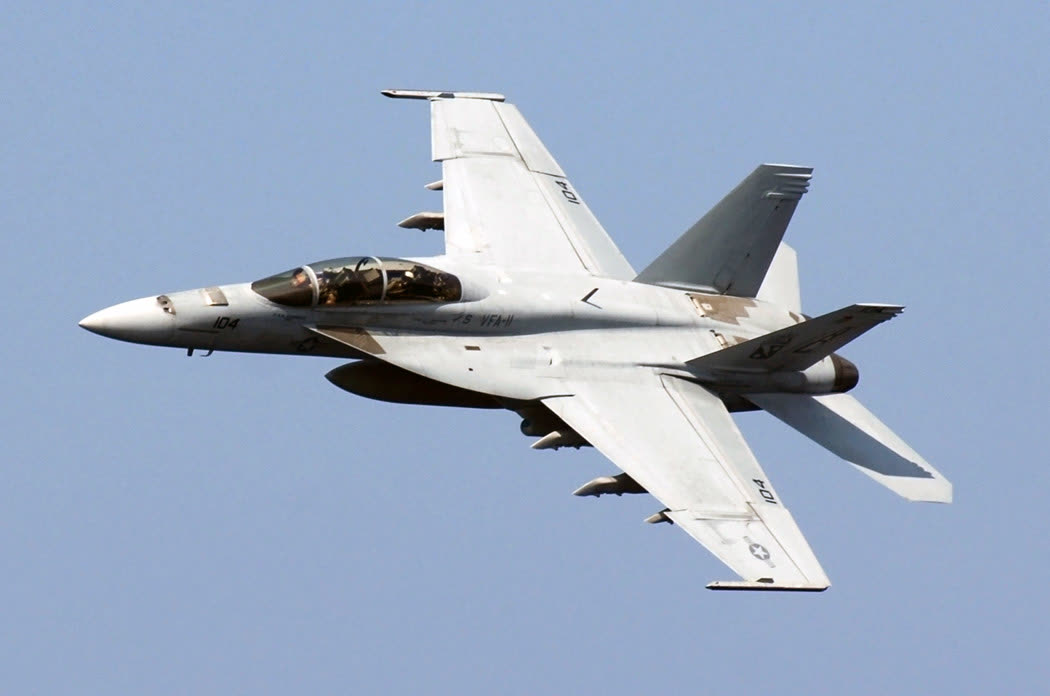
Pictured: an official U.S. Navy photograph of an F/A-18F Super Hornet of VFA-11, the "Red Rippers," banking above a carrier flight deck — not the actual cube-in-sphere object, no image of which was ever released or is known to exist. This is the same squadron and airframe type flown by the two pilots who encountered the object over Warning Area W-72 in April 2014.
Theoretical Alignment
The case aligns only modestly with the Extraterrestrial Hypothesis: the reported behavior (holding stationary against a strong headwind with no visible lift, control surfaces, or propulsion) would be technologically remarkable if accurately observed, but Graves himself has never claimed an exotic origin for the object — he has consistently said only that he cannot explain it. Interdimensional framing finds essentially no support; nothing in the accounts involves any phenomenon beyond ordinary three-dimensional flight characteristics. Psycho-Social alignment is present but limited: the witnesses were trained, credentialed instrument-rated aviators reporting a specific, geometrically detailed object at close range in daylight, which argues against simple misperception, but the brief encounter window, high closure speed, and absence of any independent sensor recording of this specific object leave some room for an ordinary object (most plausibly a balloon-borne radar target) being misjudged in size, distance, or nature under a few seconds of high-stress visual contact.
Background
Strike Fighter Squadron 11 (VFA-11), nicknamed the "Red Rippers," is one of the U.S. Navy's oldest active carrier-based fighter squadrons, home-based at Naval Air Station Oceana in Virginia Beach and, in 2014, flying the two-seat F/A-18F variant of the Super Hornet as part of Carrier Air Wing 1 (CVW-1) aboard the USS Theodore Roosevelt (CVN-71). Lt. Ryan "FOBS" Graves joined the squadron as a junior aviator after commissioning into the Navy in 2009, eventually accumulating more than a decade of service that included two combat deployments (Operation Enduring Freedom and Operation Inherent Resolve) before he separated from active duty in 2019.
According to Graves' own sworn written testimony to Congress, VFA-11's aircraft underwent a radar upgrade in 2014, installing the new Raytheon AN/APG-79 Active Electronically Scanned Array (AESA) system in place of the older mechanically scanned radar the squadron had previously flown with. Almost immediately after the upgrade, aircrew began registering unknown radar contacts inside their assigned training airspace off the Virginia and North Carolina coast. The squadron's first instinct — a reasonable one, given that AESA radar was brand-new hardware for these crews — was to dismiss the returns as software glitches or sensor artifacts tied to the unfamiliar system. That explanation did not hold for long: aircrew began cross-checking the radar contacts against their AN/ASQ-228 ATFLIR (Advanced Targeting Forward Looking Infrared) pods, and the same objects that had appeared on radar also resolved as discrete infrared returns, corroborating that whatever the contacts were, they had a real physical presence rather than being a purely electronic artifact of the new radar.
Over the following months, these contacts stopped being a novelty and became, in Graves' words, "an open secret" among VFA-11's aircrew — common enough that they were folded into the squadron's routine pre-mission briefs, and common enough that pilots developed a kind of shorthand for them ("we're seeing one of those damn things again," in Graves' recollection to The War Zone). Most contacts were sensor-only: a radar return, sometimes an infrared signature, but no direct visual confirmation. Only occasionally did a pilot get close enough, in clear enough conditions, to actually see one of the objects with the naked eye. This case file concerns the single incident from that period, described in the most operational detail across Graves' own public and sworn accounts, in which a visual sighting closed to a distance that forced two aircraft to take evasive action.
Complete Timeline
| Date | Event |
|---|---|
| 2009 | Ryan Graves commissions into the U.S. Navy; later trained as an F/A-18 pilot and flight instructor. |
| Early/mid 2014 | VFA-11's F/A-18Fs are upgraded with the new AN/APG-79 AESA radar; unknown contacts begin appearing almost immediately, initially dismissed as software glitches. |
| Weeks later, 2014 | Aircrew cross-check the radar contacts against ATFLIR infrared imagery and confirm a genuine physical return, not a sensor artifact; sightings become a routine briefing item. |
| April 2014 | Two VFA-11 F/A-18Fs, at 12,000 feet over Warning Area W-72, encounter a dark cube inside a clear sphere fixed at the training area's single GPS entry point; the jets, 100 feet apart, take evasive action and abort the mission. The squadron files a Navy aviation safety report. |
| Summer 2014 – March 2015 | The wider wave of near-daily sightings continues across VFA-11 and other CVW-1 squadrons operating off Virginia and Florida. |
| January 21, 2015 | The "Gimbal" and "GoFast" ATFLIR videos are recorded during the same broader wave, later declassified by the Pentagon (see related case file). |
| 2015 | Rear Admiral Tim Gallaudet, then serving with U.S. Fleet Forces Command, receives a classified SIPRNET email titled "Urgent safety of flight issue" from the fleet's Operations Commander, describing multiple near mid-air collisions with UAP in the Virginia Beach warning areas; the email disappears from his and his deputy's systems the next day and is never again discussed. |
| May 26, 2019 | The New York Times publishes "'Wow, What Is That?' Navy Pilots Report Unexplained Flying Objects," the first extensive public account of the wave, quoting a description of "a sphere encasing a cube." |
| November 25, 2019 | The War Zone (Tyler Rogoway and Tim McMillan) publishes an investigation proposing that the object matches a 1945 U.S. patent for a folding radar-reflector balloon, tying it to the CIA's Cold War Project PALLADIUM; retired CIA officer Gene Poteat and Area 51 veteran T.D. Barnes comment on the resemblance. |
| April 27, 2020 | The Department of Defense officially releases and confirms the authenticity of the Gimbal, GoFast, and Nimitz "Tic Tac" videos, lending broader institutional credibility to the surrounding pilot testimony. |
| May 16, 2021 | Graves appears on 60 Minutes (CBS, Bill Whitaker), describing near-daily UAP contacts throughout 2014–2015 and reframing the phenomenon as a flight-safety issue. |
| February 28, 2023 | Graves publishes an op-ed in Politico, "We Have a Real UFO Problem. And It's Not Balloons," giving his fullest public account of the April 2014 W-72 incident, including the 12,000-foot altitude and the jets' 100-foot separation. |
| July 26, 2023 | Graves testifies under oath before the House Oversight Subcommittee on National Security, the Border, and Foreign Affairs, describing the cube-in-sphere incident in detail alongside fellow witnesses David Fravor and David Grusch. |
| 2024 | AARO publishes its Historical Record Report, Volume I, a broad review of decades of U.S. government UAP-related claims and programs. |
| 2023–2024 | Then-AARO director Sean Kirkpatrick publicly describes "metallic orbs" as the most commonly reported UAP morphology worldwide, floating a next-generation spherical drone hypothesis for a broader, related category of sightings. |
A Squadron's New Radar, and a New Problem
The April 2014 incident cannot be understood in isolation from the radar upgrade that preceded it by only a matter of weeks. AESA radar is a substantially different technology from the mechanically scanned arrays it replaced — it can track many more targets simultaneously, at greater sensitivity, and with a fundamentally different false-target and clutter-rejection profile. A squadron transitioning to new radar hardware experiencing a burst of strange contacts in the weeks immediately following installation is, on its face, exactly the kind of pattern a cautious engineer would want to rule out as a hardware or calibration problem before treating it as anything else. VFA-11's aircrew did exactly that: Graves' testimony describes the sightings as "initially dismissed as software glitches," and only escalated to a genuine concern once ATFLIR infrared imagery independently corroborated a real infrared source at the same bearing and range as the radar returns — a cross-sensor confirmation that is a meaningfully stronger evidentiary standard than a radar contact alone, since a true software artifact affecting only the AESA radar's processing would have no reason to also appear on a physically separate infrared sensor pointed at the same coordinates.
This cross-checking process is itself worth dwelling on because it shapes how seriously the squadron treated what came next. By the time the April 2014 incident occurred, VFA-11's aircrew had already spent weeks satisfying themselves that the contacts they were tracking were not simply an artifact of unfamiliar hardware. When a pilot then visually confirmed an object at close range matching the radar/IR signature's rough characteristics, it landed on a squadron that had already built, through its own internal process of elimination, a working assumption that something physically real was present in their operating area on a recurring basis.
The Entry-Point Encounter
Graves has given the fullest account of the incident itself in his 2023 Politico essay and in his written testimony to the House Oversight Committee, and the two accounts are consistent on every substantive detail. Two F/A-18Fs took off on a clear, sunny day in April 2014 for an air combat training mission, climbing to 12,000 feet and heading for Warning Area W-72, a block of restricted airspace roughly ten miles east of Virginia Beach. All traffic entering W-72 for this kind of exercise funnels through a single defined GPS waypoint at a fixed altitude — a geometric bottleneck built into the training area's own design, meant to keep aircraft separated as they transition from open airspace into the working area.
Just as the two jets crossed that entry threshold, one of the pilots saw an object sitting motionless directly at the waypoint: a dark gray or black cube, its corners or tips touching the interior surface of a surrounding, glassy, near-transparent sphere, by most estimates somewhere between five and fifteen feet in diameter. The object was not drifting with the wind, as a simple balloon might be expected to; per Graves' account it was "motionless against the wind," holding a fixed position at the entry point despite what he elsewhere describes as very strong winds aloft. The two jets, only about 100 feet apart from each other, had crossed the threshold before either pilot could meaningfully react to what he was seeing; they passed the object on either side rather than through it, narrowly avoiding a collision. Both aircrew immediately terminated the training mission and returned to base.
This detail — a fixed geometric entry point that every aircraft using the training area has to pass through, with an object sitting exactly at that point — is one of the case's more distinctive features. It is consistent with several very different explanations: a deliberately placed device intended to be encountered at a predictable location, a genuinely stationary natural or man-made object that happened to be there, or simple coincidence given that any object drifting through the general vicinity of a well-trafficked, geometrically constrained airspace corridor is more likely to be reported precisely because aircraft are guaranteed to pass close to that specific point.
"I Almost Hit One of Those Things"
Graves was not, by his own account, the pilot who had the closest visual encounter with the object; he learned about the near-collision the way a flight lead often learns about a close call — from a shaken squadronmate immediately after the flight. According to reporting that expanded on Graves' account, the pilot involved returned from the sortie "with a look of shock on his face" and told Graves, in essence, "I almost hit one of those things." Some published retellings describe the object as having flown directly between the two jets, passing close by the cockpit of at least one aircraft, though the precise geometry of who passed whom, and by how much clearance, is described somewhat differently across secondhand summaries versus Graves' own first-person written testimony; this case file treats Graves' own written and sworn account — that the jets passed the stationary object on either side at 100 feet of separation — as the most authoritative version, while noting that press paraphrases have sometimes rendered the same incident as the object itself flying between the aircraft.
What happened next is, in some ways, the most operationally significant part of the story. The squadron did exactly what it was supposed to do: it filed a formal aviation safety report through the Navy's internal reporting chain, the same kind of report that would be filed after any near mid-air collision, bird strike, or hazardous airspace incursion. Graves has stated flatly, both in his written testimony and in subsequent interviews, that this report received "no official acknowledgement" and that there was "no further mechanism to report the sightings" beyond that single filing. Whatever the object was, the institutional response to a documented near mid-air collision with an unidentified object was, per the only witness who has spoken publicly about it, silence.
From Open Secret to Public Record
For nearly five years, the cube-in-sphere sightings and the broader wave they belonged to remained confined to VFA-11's own briefing rooms and internal safety paperwork. That changed on May 26, 2019, when The New York Times published "'Wow, What Is That?' Navy Pilots Report Unexplained Flying Objects," co-bylined by Helene Cooper, Ralph Blumenthal, and UAP researcher Leslie Kean. The article was the first mainstream account to put the 2014–2015 East Coast wave on the public record, and it included a specific description — attributed to the pilots' own accounts — of a near mid-air collision with an object resembling "a sphere encasing a cube." The Times reported that the objects showed no visible engine and produced no infrared exhaust plume on the pilots' sensors, yet were tracked reaching altitudes as high as 30,000 feet and, on at least some occasions, hypersonic speeds — though it is worth noting explicitly that those extreme performance claims describe the broader pattern of contacts across the wave generally, not the specific, motionless entry-point object at the center of this case file.
The story resurfaced with far greater reach on May 16, 2021, when Graves appeared in a 60 Minutes segment devoted to Navy UAP encounters, alongside David Fravor discussing the unrelated 2004 USS Nimitz "Tic Tac" case. Correspondent Bill Whitaker's interview let Graves describe, for a national television audience, how his squadron had encountered these objects "every day for at least a couple of years" during training flights off the Atlantic coast, reframing what had previously read as an isolated anecdote into evidence of a sustained, recurring pattern with genuine aviation-safety implications.
Before Congress, Under Oath
Graves' most detailed and most consequential public account came on July 26, 2023, when he testified under oath before the House Oversight Subcommittee on National Security, the Border, and Foreign Affairs — the first congressional hearing to feature on-record testimony from military pilots and a named whistleblower on the subject of UAP. Graves appeared alongside David Grusch, a former intelligence officer whose separate claims about alleged non-human biologics and reverse-engineering programs dominated much of the hearing's press coverage, and Fravor. In his prepared written statement, submitted to the committee and preserved in the official congressional record, Graves gave the account of the W-72 entry-point incident quoted throughout this case file almost verbatim, describing it as "a pivotal incident" in his squadron's growing recognition that something durable and unexplained was operating in their assigned airspace.
During the hearing's question-and-answer period, Graves elaborated further under direct questioning, describing the objects as "dark grey or black cubes... inside of a clear sphere, where the apex or tips of the cubes were touching the inside of that sphere," and estimating some observations placed an object within roughly 50 feet of a lead aircraft — a slightly different framing of distance than his written statement's account of the two jets themselves being 100 feet apart, though both describe the same basic class of near mid-air collision. He also used the hearing to introduce, for the first time publicly in detail, Rear Admiral Tim Gallaudet's account of a 2015 SIPRNET email describing near mid-air collisions with UAP in the same warning-area airspace — an email addressed to senior Fleet Forces Command flag officers that vanished from Gallaudet's and his deputy's email systems within a day, with no further discussion ever occurring among the group despite their routine in-person meetings. Gallaudet has since stated publicly, per Graves' testimony, that after reviewing the underlying report he did not believe the objects represented any known human technology — though it should be noted this is a secondhand characterization of Gallaudet's view relayed through Graves' testimony, not an independent public statement issued directly by Gallaudet about the cube-in-sphere object specifically.
A Broader Aviation-Safety and National-Security Case
Graves has consistently framed the April 2014 near mid-air collision not as an isolated curiosity but as an early, concrete example of a much larger flight-safety gap he has spent years trying to get institutionalized attention for. His written congressional testimony cites the U.S. government's own 2021 Preliminary Assessment on Unidentified Aerial Phenomena, prepared by the Office of the Director of National Intelligence, which documented eleven near mid-air collisions with UAP across the broader military reporting dataset — a figure Graves testified had "grown" by the time of his 2023 appearance. He also cited a specific April 2022 FAA safety alert describing a commercial airliner over West Virginia that experienced a simultaneous double attitude-indicator and double autopilot failure while flying beneath a reported UAP, an incident he argues illustrates that the flight-safety risk extends well beyond military aviation into the commercial airline system that carries millions of civilian passengers.
To address what he has described as a structural absence of any safe, non-stigmatized reporting channel, Graves founded Americans for Safe Aerospace, which by the time of his 2023 testimony had grown to nearly 5,000 members and was actively working with more than 30 individual UAP witnesses, the large majority of them commercial airline pilots reluctant to report incidents through official channels for fear of professional repercussions. Separately, Graves chairs the UAP Integration & Outreach Committee for the American Institute of Aeronautics and Astronautics (AIAA), where he says a volunteer team of nearly 80 PhDs and aerospace engineers has been assembled to apply rigorous scientific method to the broader dataset, an effort explicitly framed as scientific and safety-oriented rather than aimed at proving or disproving any exotic hypothesis. This broader advocacy context does not itself corroborate the specific physical details of the April 2014 W-72 sighting, but it explains why Graves has continued to foreground that single incident in venue after venue over the better part of a decade: for him, it functions as the clearest, most concrete illustration available of a collision risk he argues the Department of Defense and FAA have still not built adequate reporting infrastructure to manage.
Key Witnesses
Ryan Graves
A decade-long Navy aviator and formally trained engineer, Graves is the case's central public reporter rather than its direct eyewitness for this specific incident — he learned of the near-collision from a squadronmate immediately after the flight, and separately experienced the broader radar/infrared pattern of contacts across dozens of his own sorties. He filed the squadron's aviation safety report, later founded Americans for Safe Aerospace to create an intake channel for military and commercial aircrew UAP reports, and gave the fullest public account of the incident in his 2023 Politico essay and his sworn written and oral testimony before the House Oversight Subcommittee that same year. His framing has been notably restrained throughout: he has repeatedly declined to characterize the object as extraterrestrial, describing himself instead as an engineer with "no explanation."
Unnamed VFA-11 Pilot
The pilot who actually saw the cube-in-sphere object at close range during the April 2014 sortie has never been publicly named in any account reviewed for this case file. Graves describes him returning from the flight visibly shaken, and quotes him as saying "I almost hit one of those things." As a serving or former Navy aviator whose identity has been withheld (whether by his own choice, institutional caution, or simply because reporters have not pursued it), his direct testimony has never been independently obtained by a journalist or investigator outside of Graves' own retelling — a genuine limitation on this case's evidentiary strength that should be weighed honestly rather than assumed away.
Tim Gallaudet
Gallaudet did not witness the cube-in-sphere object himself, but his account, relayed through Graves' 2023 congressional testimony, provides independent corroboration that senior Navy leadership was separately alarmed by near mid-air collision reports from the same warning-area airspace during the same general period. His 2015 SIPRNET email episode — received, reviewed, and then inexplicably purged from two officers' accounts within a day, with no further institutional discussion — is one of the more concrete (if secondhand) data points suggesting the concern reached well above squadron level, even as it also underscores how little of the paper trail has ever become public.
The Five Observables Assessment
The Five Observables framework, drawn from the Pentagon's own Advanced Aerospace Threat Identification Program (AATIP) criteria, is applied here specifically to the April 2014 entry-point incident rather than to the broader, multi-year VFA-11 wave (which includes separately reported high-speed and high-altitude contacts not observed in this specific encounter):
Assessment: Of the five observables, this specific incident meaningfully implicates only one — apparent anti-gravity lift, in the sense that an object with no visible wings, rotors, or control surfaces reportedly held a fixed position against a significant headwind. The other four observables associated with the broader AATIP framework (instant acceleration, hypersonic velocity, low observability, and trans-medium travel) are either explicitly absent from this specific encounter as described, or are properties reported elsewhere in the wider 2014–2015 wave rather than in this particular sighting. A stationary object holding position against wind is unusual but is also the signature one would expect from several mundane explanations discussed in the Conventional Explanation Candidate section below, particularly a moored, tethered, or aerodynamically stable lighter-than-air object — making this a comparatively weak case for advanced propulsion specifically, even though the visual encounter itself is well-corroborated as a real near mid-air safety event.
Evidence Assessment
Supporting Anomalous Origin
- Two trained, instrument-rated Navy pilots were direct eyewitnesses at extremely close range (roughly 100 feet of separation between the aircraft themselves), a level of proximity that leaves little room for simple distant misidentification.
- The sighting did not occur in isolation: it followed weeks of independent radar-and-infrared cross-corroboration of similar contacts across dozens of VFA-11 sorties, establishing a documented pattern rather than a single anecdote.
- The object reportedly held a fixed position against a significant headwind with no visible lift, control surfaces, or propulsion of any kind — a genuinely unusual flight characteristic if accurately observed.
- A formal Navy aviation safety report was filed the same day the incident occurred, years before any public UAP interest existed to motivate exaggeration, creating a contemporaneous institutional paper trail independent of Graves' later public advocacy.
- Graves' physical description of the object — a dark cube whose corners touch the interior of a surrounding clear sphere — has remained essentially unchanged across public retellings spanning 2019 (NYT), 2021 (60 Minutes), and 2023 (Politico and sworn congressional testimony), a consistency that argues against the account being invented or substantially embellished over time.
- A senior Navy flag officer, Rear Admiral Tim Gallaudet, independently corroborates that leadership-level concern about near mid-air collisions with UAP in this same warning-area airspace reached Fleet Forces Command by 2015, via a real (if since-vanished) SIPRNET communication.
Supporting Conventional Explanation
- A specific, decades-old U.S. patent for a folding, balloon-borne radar-reflector device is a striking visual and structural match for the reported object — a cube-shaped internal reflector frame suspended inside a spherical envelope — and the underlying technology was demonstrably built and operationally deployed by a real historical program (the CIA's Project PALLADIUM).
- No video, photograph, radar plot, or any other instrumented recording of this specific object has ever been produced or released, unlike the same broader wave's later Gimbal and GoFast videos — the entirety of the evidentiary record for this incident is eyewitness testimony and a still-unreleased internal safety report.
- No independent, second-platform sensor confirmation (a separate aircraft's radar, a ship's radar, or any ground-based tracking) has ever been publicly produced specifically for this incident, as distinct from the broader wave's general radar/IR pattern.
- The sightings began almost immediately after VFA-11 transitioned to unfamiliar new AESA radar hardware, a period during which crews are more likely to encounter genuine sensor artifacts, clutter, or misinterpretation of an otherwise ordinary contact, even if the specific visual sighting described here was not itself a radar-only event.
Why "Disputed"
This case earns a Disputed stamp rather than Credible or Debunked because its two halves pull in genuinely opposite directions with roughly comparable force. On one side, the corroboration is real and specific: a credentialed, sworn, congressionally-testifying military witness; a documented contemporaneous safety report filed the same day, years before Graves became a public UAP advocate; a squadron-wide pattern independently cross-checked across two separate sensor systems before this specific incident occurred; a near mid-air collision serious enough to abort a training mission; and a physical description that has stayed essentially consistent across a decade of retelling in very different venues, from a newspaper interview to sworn congressional testimony. That is a materially stronger evidentiary package than a single uncorroborated eyewitness account. On the other side, this specific incident — unlike its more famous cousins, Gimbal and GoFast, from the same broader wave — has produced no photograph, no video, and no independently releasable sensor recording in over a decade, leaving outside investigators with nothing to analyze except the consistency of testimony itself. And the leading conventional candidate is not a vague, generic "it was probably a balloon" dismissal; it is a specific, well-documented historical device — a folding radar-reflector balloon whose geometry was deliberately engineered to look exactly like a cube fixed inside a sphere — that was demonstrably built, tested, and operationally flown by a real U.S. government program in a comparable maritime theater. Graves' own consistent refusal to claim an exotic origin, insisting instead that he simply lacks an explanation, is itself a mark of witness credibility that cuts against overstating the case in either direction. Until a specific instrumented recording of a cube-in-sphere object surfaces, or the underlying 2014 safety report itself is released and independently examined, this case is best described as a well-corroborated near mid-air safety event of genuinely disputed identity, not a confirmed anomaly and not a resolved mundane sighting.
Sensor & Instrumentation Detection Profile
No radar, infrared, or other instrumented sensor recording specific to the April 2014 entry-point encounter itself has ever been publicly released or is known to exist; this incident, as described in all available accounts, was a purely visual sighting by the two aircrew. Its evidentiary weight instead rests on the broader sensor pattern that surrounded it: VFA-11's newly installed AN/APG-79 AESA radar had, in the weeks prior, registered unknown contacts that aircrew subsequently cross-referenced against ATFLIR infrared pod imagery, confirming that at least some fraction of the squadron's contacts represented genuine physical returns detectable on two independent sensor types rather than a single-sensor artifact. Whether the specific object encountered at the W-72 entry point in April 2014 was also tracked on radar or infrared at the time of the visual sighting is not stated in any account reviewed for this case file — Graves' testimony describes the sighting itself in purely visual terms, without citing a contemporaneous sensor lock. This is a meaningful gap: the January 2015 Gimbal and GoFast incidents, by contrast, are richly instrumented, complete with on-screen ATFLIR telemetry that has allowed outside analysts to conduct genuine frame-by-frame forensic review. No equivalent data trail exists for this case.
Environmental & Geospatial Context
Warning Area W-72 sits in the Atlantic Ocean roughly ten miles east of Virginia Beach, part of a cluster of restricted military training airspace blocks used by carrier air wings based at nearby Naval Air Station Oceana and associated with Naval Station Norfolk, the world's largest naval base. The specific geometry described by Graves — all traffic funneling through a single GPS waypoint at a fixed altitude before dispersing into the working airspace — is a standard feature of how the U.S. Navy structures access to restricted training blocks, intended to keep transiting aircraft predictably separated from one another during entry and exit. The incident occurred at 12,000 feet in daylight, under clear, sunny skies, with Graves specifically noting a strong headwind aloft against which the object appeared to hold a fixed position; some of his later retellings characterize the winds in more dramatic terms ("hurricane-force"), though this case file treats that specific superlative as rhetorical emphasis rather than a documented meteorological measurement, since no contemporaneous weather-station or aircraft instrument reading has been cited for the specific date. The broader wave of sightings this incident belongs to spanned a wide swath of Atlantic training airspace off both Virginia and Florida, encompassing multiple warning areas used by rotating carrier strike groups over a roughly nine-month period.
Observer Credibility & Occupational Profile
The direct eyewitness for this incident was a serving U.S. Navy F/A-18F pilot — a highly trained, instrument-rated military aviator whose profession depends on accurate real-time visual identification of other aircraft and hazards at operationally relevant distances, and whose training and instrumentation make him considerably less prone to simple misidentification than an untrained civilian observer under similar circumstances. His identity has never been made public, which limits independent verification of his account but does not by itself undermine its credibility, since Graves — himself a decade-long Navy aviator, flight instructor, and formally trained engineer with no financial interest in the outcome at the time the safety report was filed in 2014 — is relaying a colleague's contemporaneous, institutionally documented report rather than a secondhand rumor. Graves' broader public credibility has grown considerably since 2019: he has testified under oath before Congress (a context carrying real legal consequences for false statements), founded a formal aircrew-support nonprofit with thousands of members, and been cited and interviewed by outlets ranging from The New York Times to CBS's 60 Minutes. That said, independent skeptic Mick West has raised a legitimate, specific critique worth including for balance: Graves' post-Navy consulting and advocacy work (including through his company Merged Point) gives him an ongoing professional and financial stake in the UAP issue remaining prominent, a conflict-of-interest consideration that, while it does not disprove any specific factual claim, is a fair caveat when weighing the overall credibility of his advocacy separately from the credibility of the original 2014 eyewitness account itself.
Physical & Material Assays
No physical debris, trace evidence, or recovered material of any kind exists for this case, and none has ever been claimed by any witness or investigator. The encounter was purely visual, at operational altitude over open ocean, with no landing, no ground or sea recovery attempt, and no physiological effects reported by either aircrew member. This absence is itself informative: unlike cases involving alleged landing traces or recovered fragments, this incident's entire evidentiary basis is testimonial and administrative (the safety report) rather than physical.
Historical Precedents & Archive Matches
The most direct historical precedent for this case's object description is not another UFO sighting at all, but a real, declassified U.S. intelligence program: Project PALLADIUM, a Cold War electronic-warfare effort led by CIA officer Gene Poteat in the early 1960s, which launched balloon-borne metallic-sphere radar targets from a U.S. Navy submarine off the coast of Cuba specifically to test Soviet radar detection thresholds. A 1945 U.S. patent for a related "airborne corner reflector" device — a folding, cube-shaped metal reflector frame designed to be suspended inside an inflatable spherical balloon envelope — surfaced by defense journalist Tyler Rogoway in 2019, is a strikingly close visual and structural match to the pilots' description. Within the site's own catalog, this case sits alongside two other broadly "sphere"-morphology Navy encounters from different eras and contexts — the 2019 USS Omaha transmedium sphere and the unrelated "Mosul Orb" — and, most directly, its own sibling case from the same squadron and airspace, the January 2015 Gimbal and GoFast videos, which represent the better-instrumented, better-corroborated tail end of the same broader VFA-11 wave.
Material Analysis
There is no physical material to analyze in the conventional sense — no debris, no metallurgical sample, no isotopic assay. The closest analog to physical evidence in this case is documentary rather than material: the original 2014 Navy aviation safety report itself, filed by VFA-11 through official channels in the immediate aftermath of the incident. That report has never been publicly released, FOIA'd, or independently examined by any outside journalist or investigator as far as this case file's research could establish; its existence and general content are known to the public only through Graves' own later description of it. This creates an unusual evidentiary situation: a genuinely contemporaneous, institutionally generated record exists (unlike many decades-old UFO cases where no paperwork was ever filed at all), but the record itself remains locked inside Navy safety channels rather than available for independent forensic review, leaving its true evidentiary weight impossible to assess directly.
Supporting Non-Terrestrial Origin
- The described flight behavior — a fixed position held against a substantial headwind with zero visible lift, control, or propulsion surfaces — has no simple conventional analog if the description is fully accurate and the object was genuinely unmoored and unpowered.
- The incident is embedded within a much larger, independently sensor-corroborated pattern of contacts across the same squadron and airspace, rather than standing alone as a single anecdote.
Supporting Terrestrial Origin
- A real, historically deployed device — a balloon-borne radar-reflector target — is a close geometric match and would be expected to behave almost exactly as described: appearing to "float" with minimal apparent movement relative to wind at certain altitudes and configurations, without any propulsion system to observe.
- No debris, fragment, or any other physical trace was recovered or is claimed to exist, which is itself the expected outcome of a genuine near mid-air collision narrowly avoided rather than an actual impact or any recovery attempt.
The Conventional Explanation Candidate: Airborne Radar-Reflector Balloon
The leading conventional candidate, first proposed by defense journalist Tyler Rogoway at The War Zone in November 2019, holds that the object was a specialized radar-decoy or radar-test balloon of a type with real, documented historical precedent. Rogoway surfaced a 1945 U.S. patent for a folding "airborne corner reflector": a rigid, cube-shaped metal reflector frame designed to be packed flat, then spring open and hang suspended inside an inflatable spherical balloon envelope once airborne — a device whose basic silhouette, when viewed from an aircraft at range, would be almost indistinguishable from "a dark cube inside a clear sphere." Rogoway connected the patent to the CIA's Project PALLADIUM, an early-1960s program that used a U.S. Navy submarine to launch broadly comparable balloon-borne metallic-sphere radar targets off the coast of Cuba, specifically to test Soviet radar detection thresholds. Retired CIA officer Gene Poteat, who led PALLADIUM's technical development, told The War Zone that the visual resemblance to the pilots' reports was "interesting," while cautioning that PALLADIUM's own devices were built to test detection capability rather than to simulate or spoof UFOs specifically — an important distinction, since it means Poteat's comments corroborate the plausibility of the device category, not a specific claim that PALLADIUM-descended hardware itself was flying off Virginia in 2014. Separately, Area 51 veteran T.D. Barnes told the same outlet that the pattern reminded him of classified aerospace flight-testing he had personally witnessed decades earlier, remarking simply that "we are doing it again," a suggestion that some later-generation classified test article, rather than a Cold War museum piece, could be the more current explanation.
Next-Generation Spherical Surveillance Drone
A second, more contemporary candidate holds that the object was an advanced drone rather than a passive balloon target. Then-AARO director Sean Kirkpatrick stated publicly in 2023 that "metallic orbs" — spherical objects roughly one to four meters in diameter, frequently reported worldwide and constituting, in his account, 52% of the UAP reports his office was assessing — represent the single most common morphology in the modern global UAP dataset, and floated the possibility that at least some of these represent "next-generation" drone technology rather than anything exotic. Some commentators have connected this to a 2022 Chinese drone patent describing a spherical shell housing thrusters arranged at the corners of an internal cube-shaped frame, a configuration that would allow rapid, unconventional tumbling maneuvers. This candidate is speculative regarding the specific April 2014 W-72 object — Kirkpatrick's remarks describe the broader global "orb" pattern of the 2020s, not this specific 2014 sighting, and no direct evidence ties this exact incident to any known drone program, foreign or domestic — but it remains a serious, non-exotic explanation for the general "sphere with internal structure" morphology this case shares with a wider modern dataset.
Kirkpatrick's own credibility as a source on this question is itself a live subject of debate that Graves addressed directly in his testimony. Kirkpatrick made his "metallic orbs" remarks at a June 2023 public meeting of NASA's Independent Study Team on UAP, a sixteen-member panel that included astronaut Scott Kelly, oceanographer Paula Bontempi, and Princeton astrophysicist David Spergel as chair. Graves noted in his written testimony that Kirkpatrick had told Congress AARO needed additional Title 50 intelligence-community authorities and access to "scientifically calibrated instruments" to properly characterize UAP, only to state in a subsequent public interview that he already had what he needed — an inconsistency Graves flagged as evidence of the same broader credibility and transparency problem he argues has suppressed serious reporting since 2014. Graves also noted, with visible skepticism, Kirkpatrick's separate public claim that eyewitness testimony "isn't considered credible on its own" by AARO, a standard that, if applied retroactively and without qualification, would appear to place the entirety of VFA-11's original 2014 safety report in an unresolvable evidentiary limbo: too old and too undocumented on sensor data to satisfy a testimony-skeptical modern standard, yet too consistently and credibly reported across a decade to dismiss outright.
Sensor and Human-Factors Misperception During a New Radar Rollout
A third candidate addresses the broader wave rather than this specific sighting directly: it proposes that VFA-11's contemporaneous transition to unfamiliar AN/APG-79 AESA radar hardware created a period of elevated susceptibility to clutter, false tracks, or simple misinterpretation of ordinary contacts (other aircraft, debris, birds, or genuine balloons) as anomalous. This is a reasonable general caution about the wave's early radar contacts, but it does not, on its own, explain the specific April 2014 visual sighting, which involved no radar system at all — a pilot's unaided eye, at close range, in clear daylight. Whatever weaknesses this candidate has in explaining the sensor contacts elsewhere in the wave, it has essentially no direct bearing on the entry-point encounter that is the subject of this case file.
Airborne Radar-Reflector Balloon
InconclusiveA genuinely strong geometric and historical match, corroborated in general terms by the actual technical lead of a real, comparable Cold War program — but no direct evidence ties this specific hardware, or any successor to it, to Virginia Beach airspace in 2014, and Graves' account of the object holding position against a strong headwind is a somewhat unusual behavior for a simple free-floating balloon.
Next-Generation Spherical Drone
InconclusivePlausible as a general category given the well-documented worldwide prevalence of "metallic orb" reports in the years since, but entirely speculative as applied to this specific 2014 incident, which predates the public "orb" discourse by nearly a decade and has no cited evidence of drone-specific behavior (powered maneuvering, recovery, or signal emissions).
Sensor/Human-Factors Misperception
Implausible (For This Incident)A reasonable partial explanation for some of the wave's early radar-only contacts during the AESA transition, but implausible as an explanation for this specific case, since the April 2014 entry-point sighting was a direct, close-range, unaided visual observation with no radar system involved at all.
Related Cases
Confirmed Documents & Official Records
Graves' full sworn written statement to the House Oversight Subcommittee, including his first-person account of the April 2014 W-72 entry-point incident, the safety-report filing, and Rear Admiral Gallaudet's 2015 SIPRNET email.
Official committee repository page for the hearing at which Graves, Grusch, and Fravor testified under oath, hosting the full transcript and all three witnesses' written statements.
The federal government's first public UAP threat assessment, covering the broader 2004–2021 reporting period that includes the VFA-11 wave, cited directly by Graves in his own congressional testimony.
The Pentagon's current UAP case-resolution office maintains its records reading room here; no case entry specific to the April 2014 W-72 encounter has been published as of this writing.
AARO's broad historical review of decades of U.S. government UAP-related claims, programs, and reporting, providing institutional context for how the government now catalogs incidents like the VFA-11 wave.
Further Reading — Recommended Literature
Imminent: Inside the Pentagon's Hunt for UFOs
The memoir of AATIP's former director situates the VFA-11 wave within the same institutional history that eventually produced the government's modern UAP-assessment apparatus.
UFO: The Inside Story of the US Government's Search for Alien Life Here—and Out There
A comprehensive, archivally-grounded history of U.S. government UAP investigation from 1947 forward, including the modern Navy pilot wave and Congress's 2023 hearings.
UFOs: Generals, Pilots, and Government Officials Go on the Record
Kean, who co-bylined the 2019 New York Times article that first broke the VFA-11 wave publicly, compiled this earlier survey of credentialed military and official witness accounts.
In Plain Sight: An Investigation into UFOs and Impossible Science
An investigative journalist's deep dive into the post-2017 disclosure era, including firsthand interviews with Navy pilots and officials connected to the East Coast UAP wave.
Skinwalkers at the Pentagon
An insider account of the DIA's AAWSAP program, the direct institutional predecessor to today's AARO, and the bureaucratic environment that both enabled and constrained early Navy pilot reporting.
Essential Viewing

Former pilot Ryan Graves details UFO sighting before congress
The Independent's coverage of Graves' July 2023 sworn testimony, in which he describes the cube-in-sphere object and the near mid-air collision directly to the House Oversight Subcommittee.
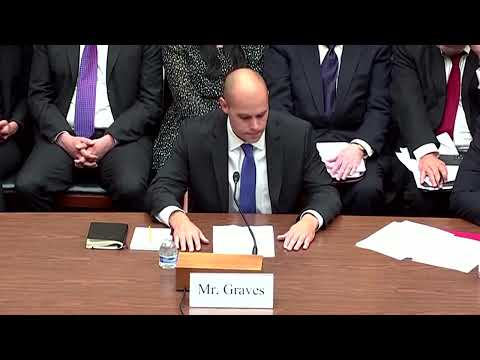
UAP sightings 'routine,' Ex-Navy pilot Ryan Graves says
Reuters' coverage of Graves characterizing the VFA-11 wave — including the entry-point cube-in-sphere incident — as a routine, recurring feature of his squadron's operations off Virginia rather than a rare anomaly.
Sources
- Graves, Ryan. Written Testimony to the House Committee on Oversight and Accountability, July 26, 2023. congress.gov
- U.S. House Committee on Oversight and Government Reform. "Unidentified Anomalous Phenomena: Implications on National Security, Public Safety, and Government Transparency," Hearing Repository, July 26, 2023. docs.house.gov
- Cooper, Helene; Blumenthal, Ralph; Kean, Leslie. "'Wow, What Is That?' Navy Pilots Report Unexplained Flying Objects." The New York Times, May 26, 2019.
- Graves, Ryan. "We Have a Real UFO Problem. And It's Not Balloons." Politico Magazine, February 28, 2023.
- McMillan, Tim. "Area 51 Veteran And CIA Electronic Warfare Pioneer Weigh In On Navy UFO Encounters." The War Zone (TWZ), November 25, 2019. twz.com
- "Devices of Unknown Origin Part II: Interlopers Over the Atlantic." The Debrief. thedebrief.org
- "Mystery of the 'Damn Things.'" Aerospace America (AIAA). aerospaceamerica.aiaa.org
- West, Mick. "No Mere Balloons?" Mick West's Substack. mickwest.substack.com
- CBS News. "UFOs regularly spotted in restricted U.S. airspace." 60 Minutes, May 16, 2021. cbsnews.com
- "I almost hit one of those things!" And the UFO looked like "a sphere encasing a cube." Earthfiles, May 28, 2019. earthfiles.com
- "Former Navy Pilot Describes Chilling UFO Encounter During Congressional Hearing." The Daily Beast, July 2023. thedailybeast.com
- "UFO Hearing: Ex-Navy fighter pilot Ryan Graves describes shapes, size of mysterious objects." Fox News, July 2023. foxnews.com
- "Mysterious Metallic Orbs Flying 'All Over the World,' Pentagon Says at NASA UFO Panel." Vice, 2023. vice.com
- Office of the Director of National Intelligence. "Preliminary Assessment: Unidentified Aerial Phenomena," June 25, 2021. dni.gov
- All-domain Anomaly Resolution Office. UAP Records & Reading Room. aaro.mil
- Department of Defense / AARO. "Historical Record Report, Volume I," 2024. media.defense.gov
- Americans for Safe Aerospace. Official organization site. safeaerospace.org
- The Washington Post. "60 Minutes UFOs: Ryan Graves says he saw them 'every day.'" May 17, 2021.
- CBS News. "UFO hearing key takeaways: What a whistleblower told Congress about UAPs." July 27, 2023. cbsnews.com
- NPR. "Whistleblower testifies U.S. salvaged 'non-human biologics' from UFO crash sites." July 27, 2023. npr.org
- The Omni Ledger. "Gimbal & GoFast (USS Theodore Roosevelt, 2015)" case file, cross-referenced for shared squadron, airspace, and witness background. Internal reference
See something inaccurate? Have additional information or sources?
Suggest an Edit →Last Updated: August 2026