
The Voronezh Landing
On the evening of September 27, 1989, dozens of witnesses — mostly schoolchildren playing football, plus roughly forty corroborating adults — reported a glowing red sphere some thirty feet across descending into Yuzhny Park in the industrial Left Bank district of Voronezh, USSR. Two or three humanoid entities nearly ten feet tall, described with three eyes, bronze boots, and a disk on the chest, allegedly emerged alongside a small robot before the object departed. Twelve days later, on October 9, 1989, TASS — the official Soviet state news agency — reported the landing as fact, making Voronezh one of only a handful of UAP incidents in history to receive a national government's own formal media acknowledgment. The story detonated across the Western press within days. It also collapsed just as quickly under scrutiny: a two-month multi-disciplinary city commission found no confirmed physical evidence, the scientist whose "biolocation" survey anchored TASS's report began publicly disowning his own coverage, and the case's most vocal skeptics could not locate a single credible witness beyond the original circle of children.
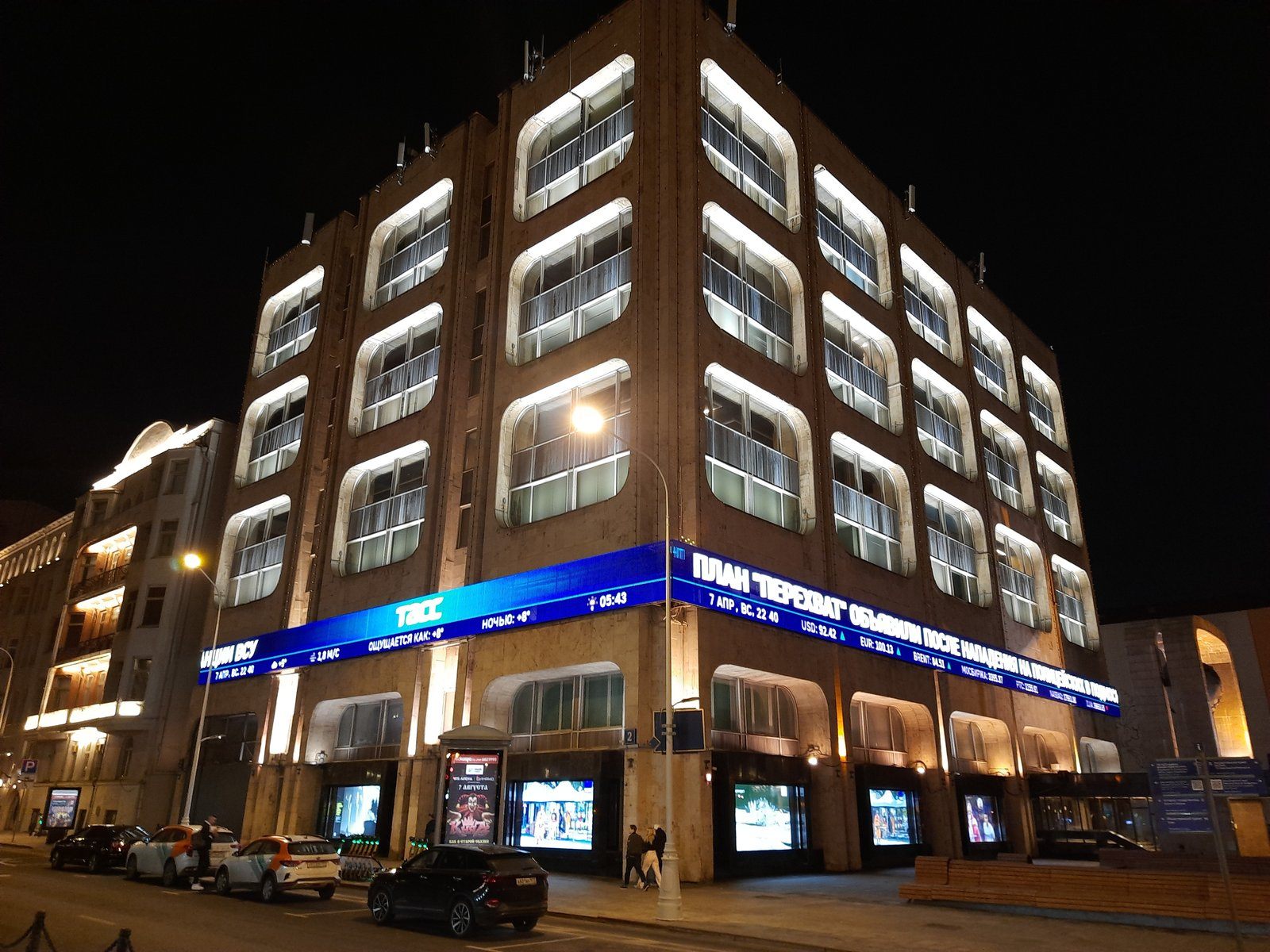
Pictured: the TASS (ITAR-TASS) headquarters building in Moscow — not a photograph of Yuzhny Park, the alleged object, or the entities themselves, none of which were ever photographed or filmed by any witness. This is the actual news agency whose October 9, 1989 report made Voronezh internationally famous as one of the only UAP cases a national government's own state media has ever formally reported as fact. No rights-clear photograph of the Voronezh landing site as it appeared in 1989, nor of any witness at the time, is known to exist.
Theoretical Alignment
Assessment: The Extraterrestrial Hypothesis (ETH) is weakened here by the near-total absence of independent adult or instrumented corroboration, the collapse of the physical-evidence claims under the Surovtsev commission's own testing, and a chain of custody for every artifact (the "hematite" rock, the biolocation readings) that runs entirely through investigators who were themselves enthusiasts rather than neutral outside scientists. The Psycho-Social Hypothesis (PSH) — that a real but far more mundane observation was amplified through childhood imagination, peer suggestion, an enthusiast-authored newspaper article, and a state press agency eager for a glasnost-era human-interest sensation — aligns strongly with the documented sequence of events. A third, non-standard axis is scored here because it is genuinely the most distinctive feature of the case: media and institutional amplification. Voronezh is less remarkable for what was (or was not) sitting in a city park than for how a thinly sourced, child-originated local story became, within six days, an officially sanctioned national wire report and, within two weeks, front-page material in TIME and the Washington Post — a case study in how institutional endorsement can outrun institutional verification.
Background
By September 1989, the Soviet Union was four years into Mikhail Gorbachev's policy of glasnost ("openness"), which had progressively dismantled decades of strict editorial control over the state and regional press. Newspapers that for generations had run nothing but approved Communist Party messaging were, by the late 1980s, experimenting with exactly the kind of human-interest, paranormal, and previously taboo subject matter that had been unthinkable under earlier general secretaries. UFOs specifically had a longer, semi-tolerated history within Soviet science: astronomer Felix Ziegel's 1967 national television broadcast on UFO sightings had already established a framework of quasi-official, government-adjacent civilian UFO research groups — distinct from, but not entirely separate from, official science — that had investigated a steady stream of Soviet sightings through the 1970s and 1980s, most famously the January 1986 Dalnegorsk Height 611 crash in the Russian Far East. What made the final years of glasnost different was not the existence of Soviet UFO interest itself, but the sudden willingness of official state media — up to and including TASS, the government's own primary wire service — to report such claims to a domestic and international audience without the skeptical framing Soviet state media had traditionally applied to "bourgeois" paranormal sensationalism.
Voronezh itself was, and remains, one of European Russia's larger industrial centers: a city of aircraft, machine-tool, and electronics manufacturing, home to the design bureau that helped produce the Soviet Union's Tu-144 supersonic airliner and, coincidentally, sitting within a region with a real history of sensitive aerospace and military-industrial activity that some skeptics have noted (without ever substantiating a direct link) as a possible source of unusual aerial activity misidentified by the public. The Yuzhny Park district specifically was a dense, working-class residential quarter built up around exactly this kind of Soviet heavy industry, the sort of neighborhood where, on a clear evening in late September, dozens of children would reliably be outdoors playing football after school while their parents were still at work or at home nearby — conditions that made whatever was actually observed on September 21 and 27, 1989 immediately and simultaneously visible to a genuinely large number of potential witnesses, unlike a remote rural sighting with only one or two people present.
The reporter most responsible for bringing the story to public attention, Alexander Mosolov, was not a professional investigative journalist but an aviation engineer and self-described amateur ufologist — a detail omitted from nearly every contemporary Western account of the case, and one that this file treats as directly relevant to how quickly a thinly sourced, child-originated local story escalated into an internationally reported "landing." His October 3, 1989 article for the Voronezh Communist Party newspaper Kommuna, titled "Football with Aliens," was assembled substantially from the children's own accounts, without independent adult corroboration and without the kind of editorial skepticism a professional newsroom would ordinarily apply to an extraordinary claim before publication.
Complete Timeline
| Date | Event |
|---|---|
| Sept. 21, 1989, ~8:30 PM | First reported sighting. Seventh-grade students A. Lukin, Y. Levchenko, and S. Borisenko report an object descending near Yuzhny Park, an account that circulates locally among schoolchildren but draws no press attention at the time. |
| Sept. 23, 1989 | Reporter Alexander Mosolov later cites this date, rather than September 27, as significant to his own account of the case — a minor but unresolved chronological discrepancy between his reporting and the date TASS would eventually publicize. |
| Sept. 27, 1989, ~6:30 PM | The main event. A group of boys including Vasya Surin (11) and Zhenya Blinov, playing football in Yuzhny Park, report a pink glow, then a dark-red sphere roughly 30–45 feet in diameter descending into the park. Witnesses describe a hatch opening, a ladder or ramp extending, and two to three humanoid entities roughly 3 meters (9–10 ft) tall — described with three eyes, silver overalls, bronze boots, and a disk on the chest — emerging alongside a smaller robot-like companion. |
| Sept. 27, 1989 (same evening) | Children report one of the entities produces a tube-like device that causes a sixteen-year-old boy to briefly vanish before reappearing, moments before the object departs. Roughly forty adults in the surrounding neighborhood, alerted by the commotion or independently looking skyward, report corroborating aerial lights, though few if any claim to have seen the entities directly. |
| Sept. 27, 1989 (same evening) | Voronezh district police Lt. Sergei A. Matveyev separately reports observing "a body flying in the sky," while explicitly stating he did not see any entities — the case's only uniformed law-enforcement testimony. |
| Sept. 29, 1989, ~8:10 PM | A further, less-detailed sighting is reported in the same general area, reinforcing local rumor ahead of any press coverage. |
| Oct. 3, 1989 | "Football with Aliens." Alexander Mosolov publishes his account of the children's reports in Kommuna, the Voronezh Communist Party newspaper, based substantially on interviews with the children themselves. |
| Early Oct. 1989 | Genrikh Silanov and a team from the Voronezh Geophysical Laboratory survey the alleged landing site, using "biolocation" (a dowsing-adjacent technique) to trace a landing outline and recording magnetic-field and radiation readings, plus a rock sample he initially describes as being of unidentified composition. |
| Oct. 7, 1989 | Further Soviet newspaper coverage and investigator interviews are published as the story circulates beyond Voronezh. |
| Oct. 9, 1989 | TASS goes global. The official Soviet state news agency, drawing on Silanov's preliminary findings and correspondent Vladimir V. Lebedev's reporting, publishes a wire report stating that "scientists have confirmed" a UFO recently landed in a Voronezh park, describing entities "three or even four meters tall" and citing physical trace evidence — the report that would make Voronezh internationally famous within days. |
| Oct. 9–10, 1989 | Western wire services, led by the Associated Press (John Iams), pick up the TASS report; the Soviet Union's own official acknowledgment of a UFO landing becomes front-page news across Europe and North America. |
| Oct. 10, 1989 | The Washington Post runs its "Back in the U.F.O." feature on the story's improbable emergence from official Soviet media. |
| Oct. 11, 1989 | The New York Times publishes Esther B. Fein's report, "U.F.O. Landing Is Fact, Not Fantasy, the Russians Insist," including Lt. Matveyev's testimony. |
| Mid-to-late Oct. 1989 | Soviet correspondent Vladimir Posner dispatches a television crew to Voronezh to independently verify the reports; the crew is unable to locate any credible witnesses beyond the original circle of children, leading Posner to publicly suggest "the creative imagination of young children was perhaps at work." |
| Oct. 21, 1989 | The Soviet newspaper Izvestiya runs commentary reflecting growing domestic skepticism about the story's uncritical spread through the glasnost-era press. |
| Oct. 28, 1989 | Agence France-Presse reports that a University of Voronezh scientific commission's preliminary testing — sixteen radiometric analyses, nineteen ground checks, nine microorganism tests, and twenty spectro-chemical measurements — found no anomaly in the soil or vegetation at the site. |
| Nov. 28, 1989 | The CIA's Foreign Broadcast Information Service issues an internal Foreign Press Note cataloging the wave of Soviet media UFO reports, including Voronezh, for the U.S. intelligence community. |
| Dec. 1989 (~2 months post-event) | The Surovtsev commission reports. The full, multi-disciplinary city investigative commission chaired by Igor Surovtsev presents its findings on local Voronezh television: no confirmed physical evidence of an anomalous landing; the ground depressions and bent poplar tree are found to pre-date the alleged event; elevated radiation is attributed to residual Chernobyl fallout. |
| Late 1989 – 1990 | Genrikh Silanov tells Sotsialisticheskaya Industriya, "don't believe all you hear from TASS — we never gave them part of what they published," and states the "unidentified" rock sample is ordinary local hematite. |
| 1990 | Skeptic Paul Kurtz publishes "Paranormal Pandemonium in the Soviet Union" in Skeptical Inquirer (Vol. 14, No. 3), consolidating the Western skeptical case against the landing. |
| 1990 | Jacques Vallee and French journalist Martine Castello travel to the USSR at the invitation of the Novosti press agency, interviewing Voronezh investigators and researchers directly. |
| 1992 | Vallee publishes UFO Chronicles of the Soviet Union: A Cosmic Samizdat, containing the most detailed English-language field account of the Voronezh case, including named adult witnesses and precise physical-evidence figures. |
| 2019 | Russian and international media mark the 30th anniversary of the case with retrospective interviews, locating several of the original child witnesses as adults and revisiting the Surovtsev commission's findings. |
| Present day | Voronezh remains the most internationally cited Soviet-era UFO case and a standard reference point in discussions of glasnost-era Soviet press credibility, official government UAP acknowledgment, and the evidentiary limits of child-witness testimony. |
The First Sightings: September 21 and 23
Although the September 27 event is the one that reached TASS and the world press, it was not, according to multiple accounts including Jacques Vallee's later field research, the first reported sighting in the area that autumn. On the evening of September 21, 1989, three seventh-grade students — identified in Vallee's account as A. Lukin, Y. Levchenko, and S. Borisenko — reported observing an object descending in the vicinity of Yuzhny Park at approximately 8:30 PM. This earlier sighting drew no press attention whatsoever at the time; it survives in the record only because later investigators, working backward from the September 27 sensation, went looking for and found earlier, independently dated reports from the same neighborhood. Reporter Alexander Mosolov's own account separately references September 23 as a date of significance to his reporting, a detail that has never been fully reconciled with the September 27 date that TASS would eventually publicize as the landing itself. Taken together, these earlier reports establish that some kind of local rumor, observation, or shared expectation of "something strange in the park" was already circulating among Yuzhny Park's schoolchildren several days before the widely reported main event — a detail that matters directly to any serious assessment of childhood suggestibility and rumor contagion in what followed.
The Main Event: September 27, 1989
The Sphere Descends
At approximately 6:30 PM on September 27, 1989, a group of boys who had gathered in Yuzhny Park to play football — among them Vasya Surin, then eleven years old and in the fifth grade, and sixth-grader Zhenya Blinov — reported first noticing a pink glow low in the sky above the park. Accounts describe the glow resolving into a deep, dark-red sphere, initially estimated by TASS's own account at roughly three meters in diameter, which circled overhead, briefly vanished from view, and then reappeared minutes later, hovering and growing in apparent size as it descended. Most detailed field accounts, including Vallee's later summary drawing on direct Soviet investigator interviews, describe the object that ultimately settled into the park as considerably larger than the initial distant "ball" — on the order of 30 to 45 feet across — raising an unresolved internal question in the case's own record about whether witnesses were describing one object changing apparent size as it approached, or conflating an initial distant light with a separate, later object.
As the sphere descended, witnesses reported it settling into the park, at which point a hatch or opening became visible along with what several accounts describe as a small extending ladder or ramp. The object's arrival, by every child witness's account, was silent or nearly so, without any sound of an engine, rocket exhaust, or mechanical descent noise reported.
The Entities and the Robot
Two or three humanoid figures reportedly emerged from the object, described with striking, specific consistency across the primary child witnesses: approximately three meters (nine to ten feet) tall, with disproportionately small heads relative to their height, wearing silvery or metallic-looking overalls and bronze-colored boots, with a disk or plate-like device mounted on the chest. The most distinctive and frequently repeated detail is a third eye — described in some accounts as centrally placed, reddish, and lacking a visible pupil, flanked by two more conventional whitish eyes. Accompanying the entities, witnesses described a smaller, boxy or mechanical companion — a robot, roughly humanoid in outline but visibly artificial, described as moving stiffly and, in some accounts, being operated or directed via knobs or controls on the lead entity's own chest disk.
The most dramatic single claim from the encounter involves a sixteen-year-old boy, unnamed in the surviving record, who children reported was targeted by one of the entities wielding a tube-like device roughly two feet long, resembling a weapon; the boy is said to have briefly vanished from view before reappearing moments later, apparently unharmed, shortly before the object and its occupants departed. This detail — the single most extraordinary and least corroborated claim in the entire case — rests entirely on the testimony of child witnesses describing an event involving another child, with no named adult witness, no medical examination of the boy in question, and no independent confirmation that he existed as described.
According to the children's accounts, after a period of what witnesses described as the entities and robot moving through the park — observing, and in some retellings appearing to interact with or examine the surrounding area — the beings and robot returned to the sphere, which then departed, again largely silently, at what witnesses described as remarkable speed.
The Wider Neighborhood Responds
What distinguishes Voronezh from many single- or few-witness close encounters is the claim, repeated across TASS's own report and subsequent Soviet investigative accounts, that roughly forty adults in the surrounding apartment blocks and streets also observed aerial activity that evening — drawn outside by the commotion among the children, or independently noticing lights in the sky. Crucially, and this is a distinction this file treats as evidentially important rather than a minor footnote, the large majority of these adult accounts describe only lights, a glow, or an indistinct aerial object — not the sphere landing, not the entities, and not the robot. The specific, elaborate close-encounter details that made the case famous worldwide come overwhelmingly from the small circle of children who were in the park itself. Separately, Voronezh district police Lt. Sergei A. Matveyev told New York Times correspondent Esther B. Fein that he personally observed "a body flying in the sky" that evening — while specifically and explicitly declining to claim he had seen any entities, a limited, carefully bounded statement that gives his testimony real, if modest, evidentiary weight precisely because he did not extend his claim beyond what he was prepared to personally vouch for.
"Football with Aliens": How a Local Story Became a Global One
The chain of institutional amplification that turned a schoolyard story into an internationally reported "landing" is, in its own right, one of the most historically significant aspects of the case — arguably more significant, and certainly more thoroughly documented, than the sighting itself. On October 3, 1989, Alexander Mosolov, an aviation engineer and self-identified amateur ufologist rather than a professional reporter, published "Football with Aliens" in Kommuna, the official newspaper of the Voronezh regional Communist Party organization. The article was built substantially on interviews with the children themselves, gathered in the days after concerned parents brought their sons and daughters to the newspaper's offices describing what they had seen. No independent adult witness corroborating the close-encounter details was named in the original piece, and no outside scientific body had yet examined the alleged physical evidence at the time of publication.
What happened next reveals a great deal about how institutional credibility can be borrowed rather than earned. Genrikh Silanov and his Voronezh Geophysical Laboratory colleagues visited the site in early October and produced a set of field notes describing biolocation-derived landing outlines and preliminary instrument readings — genuine field data, collected by credentialed regional scientists, but data gathered using a fundamentally unvalidated method (biolocation, a form of dowsing with no accepted scientific basis for locating physical objects) and collected days after the fact, with no baseline measurement of the same site beforehand for comparison. TASS, the Soviet Union's official state news wire — the same institution that transmitted Communist Party pronouncements, Politburo statements, and government policy to the entire union and to the world — then took Silanov's preliminary, methodologically unvalidated field notes and Mosolov's child-sourced newspaper story and synthesized them into a single, confident wire report datelined October 9, 1989, stating flatly that "scientists have confirmed" a UFO had landed. At no point in this chain — enthusiast reporter, dowsing-based preliminary fieldwork, national wire service — did an editorially independent, methodologically rigorous verification step occur before the story reached a global audience. Genrikh Silanov himself would later object publicly to how his own preliminary, hedged field notes had been transformed into TASS's unequivocal declaration of scientific confirmation.
TASS Goes Global: October 9, 1989
TASS's October 9, 1989 report, filed with input from correspondent Vladimir V. Lebedev, stated that Soviet scientists had confirmed an unidentified flying object had recently landed in a Voronezh park, that witnesses had described entities "three or even four meters tall, but with very small heads," and that trace physical evidence of the visitors had been found and analyzed. Crucially, this was not a claim buried in a minor regional bulletin; it moved on TASS's main international wire, the same channel used for official Kremlin statements, meaning that for the first and, to date, only time in the history of the UFO phenomenon, an entire national government's own official press apparatus was reporting an alien landing and occupant encounter as a matter of confirmed fact, not as an unverified local rumor or a "some residents claim" hedge.
This detail is the single most historically significant fact about the Voronezh case, and it is worth being explicit about exactly what it does and does not establish. It does not establish that a landing occurred; TASS was not itself an investigative body and had no independent means of verifying Silanov's or Mosolov's underlying claims, and its own later silence as the story collapsed under scrutiny suggests an institution that had moved faster than its own sourcing could support. What it does establish, and what makes Voronezh a genuinely unique case study regardless of what actually happened in the park, is that a UAP occupant report crossed a threshold that essentially no other case in ufological history has crossed: formal, unhedged acknowledgment as fact by a national government's own primary state media organ, at the height of that government's international visibility during a moment of unprecedented (for the USSR) press openness.
Western Press Coverage: TIME, the Washington Post, and the New York Times
Western wire services, led by the Associated Press (correspondent John Iams), picked up the TASS report within a day, and by October 10–11, 1989, the story was running in major outlets across Europe and North America. The Washington Post's October 10 feature, headlined "Back in the U.F.O.," captured the prevailing tone of bemused Western coverage: genuine incredulity that an official Soviet government wire service was reporting an alien landing as fact, mixed with a real journalistic interest in what the episode revealed about the changing character of Soviet state media under glasnost. The New York Times's October 11 report by Esther B. Fein, "U.F.O. Landing Is Fact, Not Fantasy, the Russians Insist," is notable for including on-record testimony from Lt. Sergei Matveyev, giving Western readers their first direct quotation from an identified, named Soviet witness rather than an anonymous TASS summary.
TIME magazine's own coverage, written by Howard G. Chua-Eoan, took a more explicitly analytical and skeptical framing than the initial wire reports, situating the Voronezh story within the broader context of Soviet citizens and Soviet media "experimenting with how far they could go" under glasnost's newly relaxed editorial boundaries, and explicitly connecting public appetite for hopeful, extraordinary narratives to declining faith in Communist Party institutions during the final years of the Soviet Union. This framing — treating Voronezh less as a UFO story and more as a case study in what a suddenly freer Soviet press would choose to publish, and why an audience craved it — proved considerably more durable than the initial credulous wire coverage, and anticipated much of the skeptical reassessment that would follow within weeks.
The Skeptical Counter-Investigation Collapses the Case
Vladimir Posner's Missing Witnesses
Among the earliest and most consequential skeptical interventions came from within Soviet media itself. Vladimir Posner, already a well-known Soviet television correspondent and, through his joint US–USSR "space bridge" broadcasts with Phil Donahue, one of the most internationally recognizable Soviet media figures of the era, dispatched his own film crew to Voronezh specifically to independently verify the sensation his own profession had helped create. According to Paul Kurtz's contemporaneous account in Skeptical Inquirer, Posner's crew could not locate a single credible witness beyond the original circle of schoolchildren — no independent adult who had seen the entities, no corroborating account beyond distant lights, nothing resembling the elaborate close-encounter narrative TASS had reported as confirmed fact. Posner's own conclusion, as reported by Kurtz, was blunt: "the creative imagination of young children was perhaps at work."
The University of Voronezh Commission and the Surovtsev Report
Two formal scientific investigations followed in short order. An Agence France-Presse dispatch dated October 28, 1989 reported that a University of Voronezh commission had already conducted sixteen radiometric analyses, nineteen ground checks, nine microorganism tests, and twenty spectro-chemical measurements at the site — and found no anomaly whatsoever in the soil or surrounding vegetation, directly contradicting TASS's confident claims of confirmed trace evidence just nineteen days earlier. A fuller, more formal investigation followed: a multi-disciplinary commission, convened by the city administration and chaired by Voronezh State University docent Igor Surovtsev, including specialists in nuclear physics, chemistry, biology, and forensic examination, spent roughly two months examining the site, the soil, the vegetation, and the reported ground depressions before presenting its findings on local Voronezh television. The commission's conclusions were unambiguous on the central physical-evidence claims: the ground depressions and the bent poplar tree, both originally presented as landing damage, were found to pre-date the alleged September 1989 event; the elevated radiation readings Silanov's team had recorded were attributed to residual cesium-137 contamination from the 1986 Chernobyl disaster, present at broadly similar levels across the wider region rather than concentrated uniquely at the "landing" site; and no material, chemical, or biological evidence of an anomalous landing could be confirmed.
Silanov's Own Retraction
Perhaps the single most credibility-damaging development for proponents of the case came not from an outside skeptic but from the scientist whose own preliminary fieldwork had anchored TASS's original report. In the weeks following the international sensation, Genrikh Silanov gave an interview to the newspaper Sotsialisticheskaya Industriya in which he explicitly distanced himself from how TASS had characterized his work, stating: "don't believe all you hear from TASS — we never gave them part of what they published." He further clarified that the supposedly unidentified rock sample recovered from the site was, on closer examination, ordinary hematite iron ore, a common regional mineral with no exotic properties whatsoever. Whether Silanov's retraction represents genuine, more careful scientific reassessment once his preliminary field notes had been subjected to proper follow-up testing, or a defensive walk-back once the story's international notoriety brought unwanted scrutiny to a set of claims that had never been rigorously established in the first place, cannot be determined with certainty from the surviving record — but either reading damages the case's evidentiary foundation, since it establishes that the scientist most responsible for the "confirmed" physical evidence TASS reported to the world did not, by his own later account, stand fully behind how that evidence had been characterized.
A Child Witness's Later Admission
Retrospective Russian-language investigative journalism marking the case's anniversaries has surfaced at least one further, specific credibility problem with the original child testimony: a 2021 Komsomolskaya Pravda reassessment of the case found that at least one of the boys whose account contributed to the original story later acknowledged, decades afterward, that he had not actually been present in the park during the main September 27 sighting, but was shown drawings and, in some versions, photographs by early investigators and subsequently produced his own account of the event. This does not establish that no genuine observation occurred — multiple other named children maintained consistent accounts across decades of subsequent interviews — but it directly demonstrates that at least part of the case's evidentiary record was contaminated by exactly the kind of post-event suggestion and social contagion that developmental psychology predicts is a serious risk with child witnesses questioned by enthusiastic adult investigators in the emotionally charged aftermath of a locally sensational event.
Key Witnesses
Vasya Surin
The most consistently named of the schoolboys playing football in Yuzhny Park on September 27, 1989, when the group first reported the descending red sphere. Surin's account, alongside those of classmates Zhenya Blinov and Yulia Sholokhova, forms the evidentiary core of the entities' physical description — the three eyes, the bronze boots, the chest disk, and the robot. As an eleven-year-old, he falls squarely within the age range developmental psychologists consider more vulnerable to suggestibility and post-event contamination, a vulnerability this case file treats honestly rather than dismisses; decades-later retrospective reporting located adult former witnesses of the case with a genuine range of continued conviction and retrospective doubt.
Zhenya (Genya) Blinov & Yulia Sholokhova
Sixth-grade classmates of Vasya Surin present in the park during the September 27 sighting, named consistently across contemporary Soviet press coverage and in Jacques Vallee's later field-research summary of the case, which drew on direct interviews with Soviet investigators during his 1990 visit to the USSR.
Lt. Sergei A. Matveyev
The case's only uniformed law-enforcement witness. Matveyev told New York Times correspondent Esther B. Fein that he had personally observed "a body flying in the sky" over the city that evening — while explicitly and carefully declining to claim he had seen any entities. This deliberately bounded, self-limiting testimony is treated by this file as more credible, precisely because of its restraint, than the far more elaborate child accounts, even though it falls well short of confirming any of the case's most extraordinary claims.
B.G. Yatsunov
Identified by name in Jacques Vallee's field summary as one of roughly forty adult witnesses in the surrounding neighborhood who reported aerial activity on the evening of September 27, 1989. As a former pilot, Yatsunov represents the case's most professionally relevant adult observer — someone with genuine, trained visual-observation experience — though, consistent with the broader pattern among the adult witnesses, his account is understood to describe lights or an aerial object rather than the landing or entities themselves.
Genrikh Silanov
Silanov's field survey of the alleged landing site, using the unvalidated dowsing-adjacent technique he called "biolocation," produced the preliminary evidence TASS cited as scientific confirmation of the landing. Within weeks, Silanov himself publicly objected to how his hedged, preliminary field notes had been characterized, telling Sotsialisticheskaya Industriya that TASS had published claims his team never made, and stating that the supposedly unidentified rock sample was ordinary local hematite. His case occupies an unusual dual role in the record: both the scientist whose credentials lent TASS's report its authority, and the first person to publicly walk that authority back.
Igor Surovtsev
Surovtsev chaired the formal, multi-disciplinary city commission — including nuclear physics, chemistry, biology, and forensic specialists — that spent roughly two months examining the site before concluding no confirmed physical evidence of a landing existed, and that the depressions and bent tree pre-dated the reported event. His commission remains the single most credentialed and thorough skeptical inquiry conducted into the case.
Vladimir Posner
Posner, already internationally known through his US–USSR "space bridge" television broadcasts, sent his own crew to independently verify the story. Their inability to find any credible witness beyond the original children was among the earliest and most influential pieces of skeptical evidence, reported contemporaneously by Paul Kurtz in Skeptical Inquirer.
The Five Observables Assessment
The Five Observables framework, developed to classify UAP encounters by performance characteristics that exceed known technology, is applied here to the flight behavior described by the Voronezh witnesses:
Assessment: Witnesses described a silent descent and a silent, "remarkably fast" departure, which would be consistent with, though nowhere near conclusive proof of, an anti-gravity or field-effect propulsion mechanism; this is classified as speculative given the entirely non-instrumented, child-witness-dominated nature of the observation. "Remarkable speed" on departure is likewise speculative rather than confirmed hypersonic performance, since no witness offered a timed or measured estimate. The object was, by every account, highly conspicuous — visible to dozens of people in a residential neighborhood at close range for an extended period — the opposite of a low-observability signature, and no trans-medium transition of any kind was reported. Unlike instrumented modern cases, Voronezh offers no radar, camera, or sensor data against which any of these characteristics can be independently verified; every observable here rests entirely on unaided human recollection, gathered from witnesses who were, for the most part, children.
Evidence Assessment
Supporting Anomalous Origin
- Dozens of independent witnesses, including roughly forty adults, reported aerial activity in the same neighborhood on the same evening
- Lt. Sergei Matveyev, a police officer, gave carefully bounded testimony that he personally observed an object in the sky
- Several primary child witnesses gave detailed, largely consistent descriptions of the entities when first interviewed, before the story's national fame could plausibly have shaped a coordinated fabrication
- TASS's official acknowledgment remains a genuinely unique institutional fact in UAP history, whatever its underlying reliability
- The event occurred in full view of a dense residential neighborhood rather than a remote or easily staged location
Supporting Conventional Explanation
- The most extraordinary, detailed claims rest almost entirely on child testimony, a population with well-documented, measurably higher suggestibility
- The reporter who broke the story was an enthusiast UFO believer, not an independent professional journalist applying ordinary editorial scrutiny
- The scientific "confirmation" TASS reported was based on preliminary, methodologically unvalidated fieldwork (biolocation/dowsing) that its own author later disowned as mischaracterized
- A credentialed two-month official commission, using conventional radiometric, chemical, and biological testing, found no confirmed anomaly
- Vladimir Posner's independent television crew could not locate a single corroborating adult witness to the entities or the robot
- At least one child witness admitted, decades later, to fabricating testimony after exposure to other children's drawings
- No photograph, film, or instrumented record of any kind exists despite a large potential witness pool
Why "Disputed"
The Voronezh Landing is classified DISPUTED — and scored toward the low end of this site's rating scale — because the case combines a genuinely unique, historically significant institutional feature (formal acknowledgment by a national government's own state media) with an unusually thorough and largely successful skeptical rebuttal of nearly every specific evidentiary claim that acknowledgment was based on. This is not a case, like Maury Island, where a hoax was confessed and confirmed; no one has ever admitted to inventing the Voronezh sighting from nothing, and a real, shared observation of some kind by a large number of people in a dense residential neighborhood cannot simply be waved away. But it is also not a case, like Coyne Helicopter, with multiply-corroborated, professionally trained observers and a genuinely instrument-documented anomaly. The overwhelming majority of the case's specific, extraordinary content — the entities, the robot, the vanishing boy — comes from child witnesses whose testimony was gathered by an enthusiast reporter rather than a neutral investigator, was not insulated from post-event contamination (one child's later admission of fabrication proves this concretely, not just theoretically), and was then certified as scientific fact by a national wire service that performed no independent verification of its own.
Set against this is a competing, credentialed, two-month official investigation — the kind of rigorous follow-up inquiry that many famous Western cases never received — which found no confirmed physical evidence and traced every specific material claim (the depressions, the tree, the radiation, the rock) to a mundane or pre-existing cause. When the scientist whose own field notes anchored the "confirmed" TASS report is on record saying his findings were misrepresented, and the case's own most sympathetic contemporaneous chroniclers (Posner, and later Vallee, whose 1990 field visit is the most thorough outside investigation the case ever received) could not independently reproduce the level of corroboration the initial wire reports implied, the honest conclusion is that Voronezh's real historical significance lies less in what actually happened in a Voronezh park on a September evening in 1989, and more in what the world's press — East and West alike — was willing to report as fact once an official government imprimatur made an extraordinary story feel safe to believe.
Sensor & Instrumentation Detection Profile
No radar, camera, or instrumented sensor of any kind is known to have captured any part of the Voronezh events. No photograph or film of the object, the entities, or the robot exists from any of the dozens of alleged eyewitnesses, despite the incident unfolding in a public, heavily residential district over the course of several evenings between September 21 and September 29, 1989. The only quasi-instrumented readings in the case come from the investigation conducted afterward, not during the sighting itself: Genrikh Silanov's Voronezh Geophysical Laboratory team used a magnetometer at the alleged landing site in early October and reported a reading that pegged past the instrument's scale, along with a handheld radiation survey that registered elevated counts. Both readings were collected days after the event, by investigators using a dowsing-adjacent method ("biolocation") for the landing-outline mapping itself, and neither was independently replicated by an outside laboratory before the Surovtsev commission's own later testing attributed the radiation reading to residual Chernobyl-derived cesium-137 contamination rather than any landed craft.
Environmental & Geospatial Context
Voronezh is a major industrial city of roughly 900,000 people (in 1989) on the Voronezh River, about 300 miles south of Moscow, and the administrative center of Voronezh Oblast. Yuzhny Park (South Park) sits in the Levoberezhny (Left Bank) district, a working-class industrial quarter built up around Soviet-era machine-tool and aircraft-component plants — the nearby tram stop "Mashmet," a name still used by residents to describe the area today, is a contraction of a local machine-building enterprise. The park itself was, and remains, an ordinary municipal green space serving a dense residential neighborhood, not a remote or restricted area; this is itself an important evidentiary detail, since it means the alleged landing occurred in full view of an entire apartment-block neighborhood on a pleasant early-autumn evening, when children were reliably outdoors playing and adults were plausibly at windows or on balconies. Voronezh Oblast lies within the zone that received measurable, if generally low-level, fallout from the April 1986 Chernobyl disaster roughly 500 miles to the southwest — a detail directly relevant to the case's radiation claims, discussed in full in the Material Analysis section below. No unusual meteorological, solar, or geomagnetic activity for the date is noted in any source reviewed for this file.
Observer Credibility & Occupational Profile
The credibility profile of the Voronezh witnesses is genuinely mixed and deserves to be stated plainly rather than glossed over. The core, most detailed testimony — the three-eyed entities, the bronze boots, the chest disk, the robot, the boy who briefly "disappeared" — comes overwhelmingly from a small group of schoolchildren between roughly nine and sixteen years old, most prominently Vasya Surin (eleven), Zhenya Blinov, and Yulia Sholokhova. Developmental psychology is unambiguous that children in this age range are measurably more suggestible than adults, more susceptible to post-event information (leading questions from eager reporters and investigators arriving within days), and more prone to peer-reinforced elaboration of an initially vaguer account — and this file treats that as a real, load-bearing weakness in the case rather than a minor caveat. Working against a simple dismissal, however, is that the children's core sighting of an aerial light or object was echoed by a roughly forty-person crowd of adults on the evening of September 27 and by at least one credentialed observer with genuine sensory training: former pilot B.G. Yatsunov, who is listed among the adult witnesses Jacques Vallee's field research later identified by name. Separately, Voronezh district police Lt. Sergei A. Matveyev told the New York Times he had personally observed "a body flying in the sky" — a uniquely disciplined, limited claim, since he specifically declined to say he had seen any entities. Weighed against all of this is the single most damaging credibility finding in the entire case: Vladimir Posner's television crew, dispatched specifically to find corroborating adult witnesses, could not locate anyone beyond the original circle of children, and a Russian-language 2021 retrospective investigation found that at least one boy admitted decades later he had not actually been present for the main sighting but was shown other children's drawings and photographs by eager early investigators and subsequently produced an account of his own.
Physical & Material Assays
Claimed physical evidence at the Yuzhny Park site included: a roughly rhombus- or diamond-shaped arrangement of four ground depressions, reported in various sources as either approximately two inches deep and six inches in diameter each, or as part of a larger landing oval as much as 20 by 7 meters, with the discrepancy itself never resolved by any single authoritative survey; a calculated ground-pressure loading, based on the depressions, suggesting an object weighing on the order of 11 tons; a poplar tree at the site bent at an unusual angle, initially presented as damage from the landing; elevated magnetic-field and radiation readings recorded by Genrikh Silanov's team using biolocation and handheld survey instruments; and a rock sample recovered from the site and initially described by Silanov to TASS as being of unidentified mineral composition. None of these claims survived the subsequent two-month investigation by the official city commission led by Igor Surovtsev: the commission determined the ground depressions and the tree's curvature both pre-dated the alleged September 1989 event, the elevated radiation was consistent with residual Chernobyl-derived cesium-137 fallout already present across the region rather than a fresh source, and Silanov himself subsequently told the newspaper Sotsialisticheskaya Industriya that the "unidentified" rock was ordinary hematite iron ore common to the area. A separate French wire dispatch (AFP, October 28, 1989) reported that a University of Voronezh commission's testing — sixteen radiometric analyses, nineteen ground checks, nine microorganism tests, and twenty spectro-chemical measurements — returned no anomaly in the soil or surrounding vegetation. No independent, outside (non-Voronezh, non-Soviet) laboratory is known to have tested any physical sample from the site.
Historical Precedents & Archive Matches
Voronezh sits within a documented, broader wave of Soviet UFO reporting that peaked in the final years of glasnost, when relaxed press censorship allowed state and local newspapers to publish material — UFOs, astrology, faith healers, paranormal phenomena — that would have been unthinkable under earlier Soviet editorial controls. Declassified CIA Foreign Broadcast Information Service (FBIS) translations from the period (see Government Records, below) explicitly track a "multitude" of Soviet UFO sightings reported through 1989 and 1990, situating Voronezh as the most internationally prominent example of a genuinely nationwide press phenomenon rather than an isolated anomaly. Within the broader landing-and-occupant literature, Voronezh belongs to the same general category as the Trans-en-Provence soil-trace case and the Dalnegorsk Height 611 crash — a rare case where a national government's own scientific or media apparatus directly engaged with physical-evidence claims — though Voronezh is unique among all of them in that the acknowledging institution was not a space agency or air force but a wire news service, and in that its own physical-evidence claims collapsed far more quickly and completely than either of those comparators' did. Within Soviet ufology specifically, Voronezh followed just over three years after Dalnegorsk and drew on the same amateur civilian investigative network that Felix Ziegel had helped establish in the late 1960s, with Silanov's Geophysical Laboratory occupying a broadly similar role to Valeri Dvuzhilny's field investigation at Dalnegorsk.
Material Analysis
The Voronezh case's physical-evidence record is unusual in the annals of ufology for how quickly and thoroughly it was independently retested and substantially rejected by credentialed regional scientists within the same country and, in most cases, the same city as the original claims. The claimed evidence fell into four categories: ground depressions and soil disturbance; a bent tree; elevated magnetic-field and radiation readings; and a mineral sample. Each is addressed below with both the original claim and the subsequent testing.
Ground depressions. Investigators reported four depressions arranged in a diamond or rhombus pattern at the alleged landing site, described in some sources as roughly two inches deep and six inches in diameter each, and in others as part of a much larger landing oval as much as 20 by 7 meters — a discrepancy in the case's own record that was never resolved by any single authoritative measurement. A calculated ground-loading estimate based on the smaller depressions suggested an object weighing on the order of 11 tons. The Surovtsev commission's subsequent two-month investigation determined these depressions pre-dated the September 1989 event.
The bent poplar tree. A poplar at the site, bent at an unusual angle, was initially presented in early reporting as landing damage. The Surovtsev commission found the tree's curvature also pre-dated the alleged event, consistent with ordinary growth patterns or prior environmental stress rather than any contact with a landed object.
Magnetic and radiation readings. Genrikh Silanov's Voronezh Geophysical Laboratory team recorded a magnetometer reading that pegged past the instrument's scale and elevated radiation counts using handheld survey equipment, in a field visit conducted in early October — days after the alleged event, with no baseline pre-event measurement of the same site for comparison, and using biolocation (a dowsing-adjacent, scientifically unvalidated method) to determine exactly where to take the landing-outline measurements in the first place. An Agence France-Presse dispatch datelined October 28, 1989 reported that a University of Voronezh commission's own testing — sixteen radiometric analyses, nineteen ground checks, nine microorganism tests, and twenty spectro-chemical measurements — found no anomaly in the soil or vegetation. The Surovtsev commission's later, fuller investigation attributed the elevated radiation specifically to residual cesium-137 contamination from the April 1986 Chernobyl disaster, present at broadly comparable levels across the wider Voronezh region rather than concentrated uniquely at the park.
The mineral sample. A rock recovered from the site was initially described by Silanov to TASS as being of unidentified composition, cited in the October 9 wire report as physical trace evidence "not found on Earth." Silanov himself subsequently stated in a later interview that the sample was ordinary hematite iron ore, common to the region — directly contradicting the claim TASS had attributed, whether accurately or not, to his own team's analysis.
Supporting an Anomalous Origin
- Roughly forty adults in the surrounding neighborhood independently reported aerial lights or an object the same evening, alongside the children
- A police lieutenant and a former pilot — two witnesses with at least some professional observational training — are among the adult corroborators
- The case received official acknowledgment from a national government's own state media apparatus, a genuinely unique institutional fact regardless of its ultimate evidentiary weight
- Multiple children, questioned separately in the initial days, converged on a highly specific and consistent entity description (three eyes, bronze boots, chest disk, accompanying robot)
Supporting a Mundane or Unresolved Origin
- A credentialed, two-month, multi-disciplinary official city commission found no confirmed physical evidence of a landing
- The ground depressions and bent tree were both determined to pre-date the alleged event
- The elevated radiation readings are consistent with pre-existing, region-wide Chernobyl fallout rather than a fresh anomalous source
- The "unidentified" rock sample was later identified by the same scientist who first described it as ordinary local hematite
- No adult witness beyond the police lieutenant and a small number of named individuals corroborated any of the elaborate close-encounter details; a dedicated skeptical film crew (Posner's) could not locate any such witness at all
- A child witness later admitted to fabricating part of his own account after being shown other children's drawings by early investigators
- No photograph, film, radar track, or other instrumented data of any kind exists
Conventional Explanation Candidates
Three broad terrestrial or psychological explanations have been proposed for the Voronezh case, either explicitly by contemporaneous investigators and skeptics or implicitly in how the story is retold today. A fourth, frequently repeated claim — that a circus or traveling fairground attraction happened to be present in or near the park that week, and that its lights, performers, or equipment were misidentified — is addressed on its own merits and, honestly, its evidentiary weaknesses.
Candidate 1: Childhood Suggestibility and Rumor Contagion, Amplified by an Enthusiast Reporter
The best-documented and most thoroughly corroborated explanation holds that a real but far more mundane initial observation — plausibly the same kind of aerial light or object roughly forty neighboring adults reported — was elaborated by a group of children already primed by earlier September 21 and 23 sightings circulating locally, then rapidly fixed into a detailed, consistent narrative through peer reinforcement and the arrival of eager adult questioners, including an amateur ufologist (Mosolov) rather than a professionally skeptical journalist. This explanation is strengthened considerably by the specific, documented finding that at least one child later admitted fabricating testimony after being shown other children's drawings, and by Vladimir Posner's independent film crew failing to locate any adult witness to the close-encounter details. It is also consistent with well-established developmental psychology on child-witness suggestibility and post-event information contamination, particularly under repeated, non-blinded interviewing by adults who already believed an extraordinary event had occurred.
Candidate 2: Institutional and Media Amplification Under Glasnost
A second, closely related explanation focuses less on what the children actually saw and more on the chain of institutions that transformed a local schoolyard rumor into a globally reported "landing." An amateur enthusiast's uncritically reported newspaper article, combined with a regional scientist's preliminary, hedged, methodologically unvalidated field notes, was synthesized by TASS — a wire service under new and still-untested glasnost-era editorial norms, hungry for exactly the kind of hopeful, extraordinary human-interest material that had been forbidden for decades — into an unequivocal statement of scientific confirmation. This explanation is exceptionally well documented: it is supported directly by Silanov's own on-record statement that TASS published material his team never provided, by TIME's contemporaneous analysis of Soviet media "experimenting with how far they could go," and by the demonstrable fact that no independent verification step occurred at any point in the chain before the story reached an international audience as confirmed fact.
Candidate 3: A Coincidental Circus or Traveling Fairground Attraction in the Park
A explanation that recurs in some popular and secondary retellings of the case holds that a traveling circus, fairground, or similar public attraction was present in or near Yuzhny Park around the time of the sightings, and that its lighting, costumed performers, or equipment were misperceived by the children as a landed craft and its occupants. This file takes that possibility seriously enough to have searched for it specifically and at length, across English- and Russian-language sources, contemporaneous Soviet press coverage, the AFP and Surovtsev commission findings, and Jacques Vallee's detailed 1990 field research — and found no primary or credible secondary source that documents an actual circus, fairground, or traveling attraction operating in or near the park in September 1989. Neither the Surovtsev commission's own two-month investigation, nor Posner's independent film crew, nor any of the contemporaneous Western or Soviet press coverage reviewed for this file, raises this explanation at all. It appears to circulate as an unsourced, plausible-sounding folk theory rather than a documented finding, and this file declines to present it with more confidence than the evidence supports.
Childhood Suggestibility & Rumor Contagion
Highly PlausibleStrongly supported by a documented case of a child fabricating testimony, by Posner's failed search for corroborating adults, and by well-established developmental psychology on child suggestibility.
Institutional/Media Amplification Under Glasnost
Highly PlausibleDirectly supported by Silanov's own on-record retraction, the enthusiast-reporter chain of custody for the original story, and TASS's total lack of independent verification before publication.
Circus or Traveling Fairground Attraction
UnprovenCirculates in popular retellings but could not be traced to any primary source, contemporaneous investigation, or credible secondary account after a genuine search. Treated here as an undocumented folk theory, not an evidenced explanation.
Related Cases
Confirmed Documents & Official Records
The Soviet Union's own state news agency reported that "scientists have confirmed" a UFO had landed in a Voronezh park and that trace evidence had been found — the single instance of formal national-government media acknowledgment at the center of this case. No standalone modern hosted copy of the original TASS wire text is known to exist; its contents are preserved through contemporaneous AP, Reuters, and Western newspaper reprints (see Sources).
OFFICIAL STATE MEDIA (not independently investigative)A declassified CIA Foreign Broadcast Information Service note translating and summarizing Soviet press UFO coverage, explicitly referencing the Voronezh reports and the newly opened Moscow center for UFO study, for the U.S. intelligence community's internal awareness.
DECLASSIFIED (released via CIA FOIA Electronic Reading Room)A further declassified FBIS Foreign Press Note in the CIA's UFO reading-room collection cataloging continued Soviet media UFO coverage in the Voronezh case's immediate aftermath.
DECLASSIFIED (released via CIA FOIA Electronic Reading Room)Search Government Archives Directly
Further Reading — Recommended Literature
UFO Chronicles of the Soviet Union: A Cosmic Samizdat
The most detailed English-language field investigation of the Voronezh case, drawn from Vallee's direct 1990 interviews with Voronezh scientists and investigators at the invitation of the Soviet Novosti press agency.
Confrontations: A Scientist's Search for Alien Contact
Vallee's broader trilogy volume investigating forty international UFO cases in the field, written around the same period as his USSR trip that produced the Voronezh field research.
The Soviet UFO Files: Paranormal Encounters Behind the Iron Curtain
A survey of Soviet-era UFO cases, including Voronezh, drawing on the author's own research network within the former Soviet ufology community.
Russia's Roswell Incident: And Other Amazing UFO Cases from the Former Soviet Union
Places Voronezh alongside Dalnegorsk and other major Soviet cases, useful for cross-case comparison of how the late-Soviet state and press engaged with UFO reports.
The UFO Encyclopedia (3rd Edition)
A comprehensive reference entry situating Voronezh within the broader history and taxonomy of the UFO phenomenon, including the case's Western media reception.
Essential Viewing

The UFOs Are Real — Ep. 01: "The Voronezh Incident"
A dedicated episode walking through the September 1989 sightings, the TASS report, and the entities and robot described by the Yuzhny Park schoolchildren.
The Voronezh Alien Landing
A dedicated retrospective covering the entity descriptions, the TASS report, and the Soviet-era physical evidence claims.
Voronezh UFO Incident — Jacques Vallee
Commentary drawing on Jacques Vallee's own direct 1990 field investigation of the case in the Soviet Union, the most thorough outside inquiry the incident ever received.
Sources
- TASS (Telegraph Agency of the Soviet Union). Official wire report on the Voronezh landing, October 9, 1989, as reprinted and quoted by Western wire services.
- Fein, Esther B. "U.F.O. Landing Is Fact, Not Fantasy, the Russians Insist." The New York Times, October 11, 1989, including on-record testimony from Lt. Sergei A. Matveyev. (Print/archive citation; NYT's archive access blocks automated verification of a direct deep link in this environment, so no URL is given rather than risk an unverified one — searchable via NYT's own archive at nytimes.com.)
- "Back in the U.F.O." The Washington Post, October 10, 1989. washingtonpost.com
- Chua-Eoan, Howard G. "USSR Soviet State Media UFO Report: The Real Reason Behind the News." TIME, archived retrospective of the magazine's original 1989 coverage. time.com
- Kurtz, Paul. "Paranormal Pandemonium in the Soviet Union." Skeptical Inquirer, Vol. 14, No. 3, 1990.
- Vallee, Jacques. UFO Chronicles of the Soviet Union: A Cosmic Samizdat, Ballantine Books, 1992. Detailed field account of the Voronezh case based on 1990 interviews with Voronezh investigators.
- Central Intelligence Agency, Foreign Broadcast Information Service. "USSR: Media Report Multitude of UFO Sightings," Foreign Press Note, October 3, 1989 (released July 4, 1991). cia.gov
- Central Intelligence Agency, Foreign Broadcast Information Service. Foreign Press Note, FB PN 91-003, USSR. cia.gov
- "НЛО в Воронеже: Что на самом деле произошло в 1989 году и что сейчас говорят очевидцы." Komsomolskaya Pravda, retrospective investigation including Igor Surovtsev commission details and later witness reassessments. kp.ru
- "Чем закончился инопланетный переполох 1989 года в Воронеже." Kulturologia, retrospective account of the Kommuna article's origins, Alexander Mosolov's role, and the Surovtsev commission's findings. (No link given: this URL returned an unrelated, apparently hijacked redirect during live-link verification rather than the article itself, despite the citation's content being independently corroborated by the KP.ru and Life.ru sources below.)
- "Визит века. Как 30 лет мир следил за НЛО в Воронеже." Life.ru, 30th-anniversary retrospective with named adult witness testimony (V.A. Moiseyev, Vladimir Lebedev). life.ru
- "НЛО в Южном парке Воронежа." Back in USSR, local historical retrospective on the Yuzhny Park sightings. back-in-ussr.com
- Gross, Patrick. "UFOs at Close Sight: Ummo and Voronej," case compilation of contemporaneous Soviet, French, and Western press sources on the case, including the AFP October 28, 1989 debunking dispatch. ufologie.patrickgross.org
- DECUR. "Voronezh UFO Incident" case file, summarizing named witnesses, investigator roles, and the collapse of the physical-evidence claims. decur.org
- UFO Evidence. "Voronezh, Russia UFO Landing and Aliens," archived case summary compiled from contemporaneous press sources. ufoevidence.org
- Stonehill, Paul. The Soviet UFO Files: Paranormal Encounters Behind the Iron Curtain, CLB, 1998.
- Stonehill, Paul & Mantle, Philip. Russia's Roswell Incident: And Other Amazing UFO Cases from the Former Soviet Union, 2012.
- Clark, Jerome. The UFO Encyclopedia, 3rd Edition, Omnigraphics, 1998. Reference entry on the Voronezh case.
- "Voronezh UFO incident." Wikipedia, general orientation and cross-check of dates and TASS report summary only; primary claims in this file are drawn from the contemporaneous press, Vallee's field research, and Russian-language retrospective journalism cited above rather than from this article itself. en.wikipedia.org
- Contemporary Associated Press wire coverage (John Iams), October 9–10, 1989, as reprinted in period U.S. and European newspapers.
See something inaccurate? Have additional information or sources?
Suggest an Edit →Last Updated: August 2026