
Metallic Hydrogen & Exotic Metamaterials Hypothesis
Proposes that recovered or alleged UAP hull material exhibits an exotic condensed-matter phase — metastable metallic hydrogen, a room-temperature superconductor, or an engineered metamaterial lattice — that could explain extraordinary reported structural strength, weight, and electromagnetic behavior through advanced materials science alone, without requiring any exotic propulsion physics at all.
Speculative, One Retracted Claim Chain, No Verified SampleCore Thesis
If metallic hydrogen, a room-temperature superconductor, or an engineered metamaterial lattice could be synthesized and held stable outside laboratory extremes, the result would be a structural material combining metallic conductivity, an exceptional strength-to-weight ratio, and a tunable electromagnetic response — a purely materials-science account of reported UAP hull behavior that requires no new fundamental physics, only a synthesis and stabilization feat no laboratory on Earth has yet reliably achieved.
Origin & History
Among the theories this site catalogues, the metallic hydrogen and exotic metamaterials hypothesis occupies a distinctive position: it makes no claim about how a craft moves, only about what it might be made of. Where propulsion theories like this site's Vacuum Polarizability and Plasma Sheath/MHD hypotheses attempt to explain reported flight kinematics, this theory instead addresses a narrower, more materials-grounded observable: witness and instrumental reports describing UAP hulls as seamless, riveted-free, capable of surviving extreme aerodynamic loads without visible structural stress, and in several recovered-fragment case files, composed of metal with a purity or elemental profile that a 1950s or 1980s commercial metallurgist would not expect to encounter. The theory's proposed answer is that such a hull, if it exists, might be built from a genuinely exotic but not physically impossible condensed-matter phase — not a new law of physics, but an extreme, currently unreplicated feat of materials engineering.
The theory's foundational document predates the modern UAP era by more than a decade. In 1935, Princeton physicists Eugene Wigner and Hillard Bell Huntington published "On the Possibility of a Metallic Modification of Hydrogen" in the Journal of Chemical Physics, predicting on purely theoretical grounds that ordinary molecular hydrogen, if compressed to a sufficiently extreme pressure, should undergo a phase transition into a metallic state — its electrons no longer bound to individual molecules but instead delocalized across the lattice, conducting electricity the way a metal does. Wigner and Huntington's own estimate placed the required pressure at roughly 25 gigapascals, a figure later high-pressure physics would show was far too low; the actual transition, as decades of subsequent diamond-anvil and shock-compression experiments would establish, requires pressures at least an order of magnitude higher. The prediction's staying power came not from its numerical accuracy but from its physical plausibility: nothing about a metallic hydrogen phase violates any known law of physics, and by the 1970s, planetary scientists had folded the prediction into mainstream astrophysics, proposing that the deep interiors of Jupiter and Saturn — where hydrogen exists under pressures far exceeding anything achievable in an Earth laboratory — consist substantially of exactly this metallic phase, and that its enormous, planet-scale electrical currents are the source of both gas giants' powerful magnetic fields. Metallic hydrogen is not, in other words, a fringe proposal invented to explain UAP hulls; it is mainstream condensed-matter and planetary physics that happens to also motivate a materials-science UAP hypothesis.
What makes metallic hydrogen relevant to a UAP theory specifically, rather than remaining a purely planetary-science curiosity, is a combination of two further, more speculative properties some theorists have proposed the metallic phase might exhibit once created. First, several theoretical treatments have suggested metallic hydrogen might be metastable at ordinary pressure and temperature once formed under extreme compression — meaning a sample synthesized in a laboratory-scale press might, in principle, retain its metallic structure even after the compressing force is removed, rather than instantly reverting to ordinary molecular hydrogen gas. Second, metallic hydrogen has been proposed, again theoretically, as a candidate room-temperature superconductor, since its light nuclear mass and the same delocalized-electron structure responsible for its metallic conductivity are exactly the properties that, in more conventional superconductor theory, favor high critical temperatures. Neither property has ever been experimentally confirmed in a genuine, independently verified metallic hydrogen sample, for a reason central to this entire theory's evidentiary weakness: no laboratory has yet produced a sample that survived long enough, or was independently verified thoroughly enough, to test either claim directly.
The theory's second thread runs through a field with a very different character: engineered metamaterials, which, unlike metallic hydrogen, are neither speculative nor unreplicated. A metamaterial is a structure engineered at a scale smaller than the wavelengths it is designed to manipulate — typically a repeating lattice of sub-wavelength conducting elements — that can produce electromagnetic responses (a negative refractive index, near-total absorption at a specific radar frequency, or the redirection of light around an object) that no naturally occurring bulk material exhibits. Metamaterial research is mainstream, heavily funded, peer-reviewed engineering, with real, demonstrated radar-absorbing coatings and negative-index optical devices already in the published literature; the UAP-specific application of this thread is not the physics itself, which is settled, but the speculative claim that a sufficiently advanced metamaterial hull layering could account for reported low radar cross-sections, abrupt appearance-and-disappearance behavior, or unusual optical distortion around a craft's edges — an application of confirmed engineering principles to an unconfirmed craft, rather than a confirmed craft built from an unconfirmed material.
The theory's UAP-specific application draws its case-file anchors from two of this site's most examined physical-evidence cases, each involving a claimed exotic material rather than a claimed exotic mechanism. The Ubatuba magnesium fragments (Case #157) — three pieces of unusually pure, strontium-doped magnesium recovered from a Brazilian beach in 1957 and tested by more than a dozen laboratories over 65 years — represent the theory's most laboratory-rigorous physical anchor, even though the fragments' magnesium composition is itself a conventional, non-exotic element; what makes Ubatuba relevant here is the pattern of an anomalous purity and trace-element profile in a recovered sample, the same evidentiary shape this theory would predict for a genuinely exotic hull material, tested with genuine analytical rigor and ultimately explained, per the peer-reviewed 2022 re-analysis, within terrestrial isotope limits. Bob Lazar's (Case #005) claimed Element 115 fuel source supplies the theory's most direct, if least corroborated, exotic-materials narrative: a superheavy element Lazar said powered antigravity propulsion aboard the "Sport Model" craft at the S-4 facility near Papoose Lake, Nevada, a claim made in 1989, fourteen years before element 115 (moscovium) was first synthesized in a laboratory in 2003 — though, as later nuclear physics would establish, every synthesized isotope of moscovium is radioactively unstable, decaying within milliseconds, a property sharply at odds with Lazar's description of a stable fuel source that could be handled and stored.
A third case, the Kecksburg Incident (Case #013), contributes a different, more institutional thread to the theory's origin story: an acorn-shaped metallic object with a raised band of hieroglyphic-like symbols, recovered from the Kecksburg woods ravine in Pennsylvania in December 1965 by local firefighters, was reportedly examined by NASA personnel who later confirmed, under FOIA pressure, that fragment-analysis records had once existed — only for those same records to be reported lost by 1987. The parallel to this theory's foundational physics claim is direct: just as the 2017 Silvera-Dias metallic hydrogen sample would later be lost before independent verification could occur, Kecksburg's alleged physical evidence was also lost before any peer-reviewed materials analysis could be completed, leaving both cases in the same evidentiary limbo — a claimed extraordinary material, examined once by credentialed personnel, and never available for re-examination since.
Scientific Foundations
This theory rests on three distinct, unequally credible strands of condensed-matter physics, only one of which — engineered metamaterials — is genuinely mainstream, replicated engineering rather than a disputed or actively fraudulent claim:
1. Static Metallic Hydrogen (Disputed, Unreplicated)
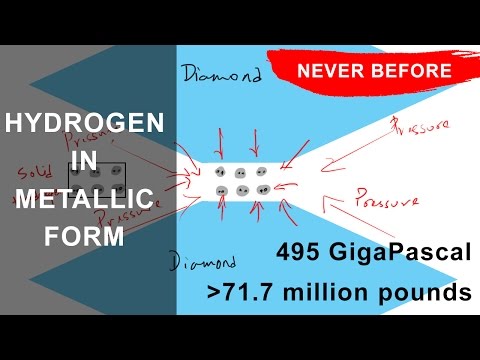
The theory's headline claim traces to a January 2017 Science paper by Harvard physics professor Isaac Silvera and then-postdoctoral fellow Ranga Dias, "Observation of the Wigner-Huntington Transition to Metallic Hydrogen." Using a diamond anvil cell — two gem-quality synthetic diamond tips squeezing a microscopic hydrogen sample between them — Silvera and Dias reported achieving a claimed pressure of 495 gigapascals at 5.5 kelvin, and observing the sample's optical reflectivity rise sharply in a way consistent with a transition to a metallic state. The claim was, from the outset, exceptionally difficult to independently verify for a structural reason inherent to the experiment itself: producing pressures in that range requires diamond anvils shaped to an extremely fine point, and the same geometry that makes such pressures achievable at all also makes the anvils prone to catastrophic fracture. That is exactly what happened to the Harvard team's own sample: during a planned, controlled decompression step intended to test whether the metallic state persisted once the compressing pressure was reduced — direct evidence for the metastability property this theory's UAP application would most need — the diamonds fractured and the sample was lost, before it could be transported to Argonne National Laboratory for the independent X-ray diffraction analysis Silvera and Dias had already arranged. No metallic hydrogen sample from this or any other experiment has been independently verified by a laboratory outside the group that produced it, in the eight years since.
The claim's central weakness is not merely that the sample was lost, but that a credentialed high-pressure physicist has publicly disputed whether the underlying pressure was even achievable in the apparatus Silvera and Dias used. French physicist Paul Loubeyre, whose own competing high-pressure hydrogen research at France's Commissariat à l'Énergie Atomique used a different diagnostic technique — synchrotron infrared reflectivity rather than the interferometric method Silvera and Dias relied on — published his own metallization result in Nature in 2020, reporting evidence of a probable transition to metallic hydrogen at approximately 425 gigapascals, a genuinely lower and, in Loubeyre's assessment, more experimentally defensible pressure than Silvera and Dias's claimed 495. Loubeyre and other high-pressure physicists have separately argued, in comments responding directly to the 2017 paper, that the type of diamonds and loading geometry used could not plausibly have reached 495 gigapascals without failing before the claimed pressure was reached, and that the specific interference-fringe pattern Silvera and Dias interpreted as evidence of metallization is also consistent with ordinary optical artifacts from a stressed, near-failure diamond. Silvera has maintained the original interpretation is correct; the dispute remains unresolved specifically because the one sample that could settle it no longer exists.
2. Dynamic Metallic Hydrogen (Confirmed, but Transient)
A separate, genuinely confirmed strand of metallic hydrogen physics complicates any simple "hoax versus breakthrough" reading of the Silvera-Dias controversy: metallic hydrogen-like states have, in fact, been observed and independently replicated — not as a stable solid, but as a fleeting, dynamically compressed fluid. In 1996, Lawrence Livermore National Laboratory physicists Samuel Weir, Arthur Mitchell, and William Nellis reported metallizing fluid molecular hydrogen at roughly 140 gigapascals using rapid shock compression, in a landmark Physical Review Letters paper. Two decades later, Sandia National Laboratories' Marcus Knudson led a team using the Z Machine's magnetically driven flyer plates to directly observe an abrupt insulator-to-metal transition in dense liquid deuterium near 280 to 305 gigapascals, published in Science in 2015. A third, independent confirmation came from Lawrence Livermore's National Ignition Facility, where physicist Peter Celliers led a 2018 Science paper reporting a similar insulator-metal transition in dense fluid deuterium around 200 gigapascals using laser-driven ramp compression — a third facility, a third compression technique, and a result broadly consistent with the earlier Z Machine finding. What all three of these confirmed results share, and what sharply distinguishes them from the Silvera-Dias claim, is that they describe a transient, dynamically compressed fluid state lasting only nanoseconds under active compression, not a static solid sample that persists once the compressing force is removed — precisely the property this theory's hull-material application requires and precisely the property no confirmed experiment has ever demonstrated.
3. Room-Temperature Superconductivity Claims (Actively Disputed, One Fraud Finding)
A third, adjacent strand belongs in this theory's scientific foundations not because it directly involves hydrogen, but because it shares the same underlying UAP-relevant promise — a material combining extreme conductivity with, potentially, extreme structural or electromagnetic utility — and because its recent history supplies this theory's single clearest cautionary tale about how easily an extraordinary condensed-matter claim can collapse under scrutiny. In July 2023, a South Korean research team led by Sukbae Lee, Ji-Hoon Kim, and Young-Wan Kwon posted preprints describing "LK-99," a copper-doped lead-apatite compound they claimed was a superconductor at room temperature and ordinary atmospheric pressure — a combination that, if genuine, would have been one of the most consequential materials-science discoveries in a century, since every previously confirmed superconductor requires either extreme cold, extreme pressure, or both. The claim triggered an unusually fast, globally distributed replication effort, with laboratories across multiple countries attempting to reproduce the compound within days of the preprint's release. Within roughly a month, independent computational analysis, including work by Lawrence Berkeley National Laboratory physicist Sinéad Griffin identifying unusual electronic flat bands in the material's structure without confirming superconductivity, combined with multiple labs' experimental replications, converged on a conventional explanation: the small levitation effect the original team had presented as evidence of the Meissner effect was attributable to ferromagnetic impurities, chiefly a copper sulfide phase, and the reported resistivity drop to ordinary phase transitions in an impure sample, not superconductivity at any temperature.
The room-temperature superconductivity thread's relevance to this theory sharpens considerably once it is connected back to Silvera and Dias's own metallic hydrogen work through a shared personnel history. After his Harvard postdoctoral period, Dias became a professor at the University of Rochester, where he led two further, separately spectacular room-temperature superconductivity claims: a 2020 paper on carbonaceous sulfur hydride and a 2023 paper on nitrogen-doped lutetium hydride, both published in Nature, both initially hailed as landmark breakthroughs, and both ultimately retracted — in 2022 and 2023, respectively — after co-authors raised concerns about the underlying data. A University of Rochester research-misconduct investigation, commissioned at the request of the National Science Foundation, subsequently found that Dias had committed data fabrication, falsification, and plagiarism; Dias has denied wrongdoing, but the university confirmed his departure in 2024. This matters directly to the credibility of this theory's foundational 2017 metallic hydrogen claim not because fraud in the later papers proves fraud in the earlier one — it does not, and no misconduct finding has been made against the 2017 Silvera-Dias paper specifically — but because it establishes, from the same co-author's later, independently investigated conduct, that extraordinary condensed-matter claims of exactly this type have a documented, credentialed track record of not surviving independent scrutiny, a pattern this theory's proponents cannot responsibly set aside when weighing the one claim central to their own hypothesis.
Government & Military Programs
This theory's government engagement runs through two entirely separate institutional tracks, neither of which was designed to test any UAP-specific materials claim: mainstream, unclassified high-pressure physics research funded through the Department of Energy's nuclear stewardship mission, and a single, now-declassified Defense Intelligence Agency research program that did explicitly list exotic-materials topics among its formal research deliverables. The Department of Energy's National Nuclear Security Administration funds both Sandia National Laboratories' Z Machine and Lawrence Livermore's National Ignition Facility primarily to study material behavior under conditions relevant to nuclear weapons stewardship and inertial confinement fusion; the dense-hydrogen shock-compression experiments described above are a genuine, unclassified, peer-reviewed research byproduct of that much larger mission, not a dedicated metallic-hydrogen or UAP-materials program. No public NNSA or DOE record describes any UAP-specific tasking connected to either facility's hydrogen-compression research.
The Defense Intelligence Agency's Advanced Aerospace Weapon System Applications Program (AAWSAP), executed under contract by Robert Bigelow's Bigelow Aerospace Advanced Space Studies (BAASS) and funded at roughly $22 million across fiscal years 2008 and 2010, is the one government program in this theory's documented history to explicitly commission materials-science research alongside its better-known propulsion-physics topics. AAWSAP's public deliverables took the form of 38 Defense Intelligence Reference Documents (DIRDs), commissioned white papers on topics ranging from traversable wormholes and negative energy to high-frequency gravitational-wave communication; DIA released the full list to its FOIA reading room in March 2022 after sustained public-records pressure. Among the 38 titles is "Invisibility Cloaking," authored by physicist Ulf Leonhardt, alongside further DIRD topics addressing metamaterials and advanced materials for aerospace platforms — the same underlying metamaterial-engineering physics this theory's second thread invokes, commissioned by a U.S. defense intelligence program specifically because its authors judged engineered electromagnetic-response materials relevant enough to advanced aerospace threat assessment to warrant a dedicated review. What the DIRDs do not include is any commissioned review of metallic hydrogen specifically, or any indication that AAWSAP's exotic-materials interest was connected to a specific recovered sample rather than a general survey of frontier materials-science literature.
The distinction between these two government tracks is instructive for gauging how seriously to weight either as evidence for this theory. The DOE-funded shock-compression research is genuinely rigorous, peer-reviewed, mainstream physics, but it was never tasked with, and has never produced, any UAP-relevant finding; its relevance here is purely as background science establishing that transient metallic hydrogen states are real. AAWSAP's DIRDs, by contrast, were explicitly UAP-motivated, but their metamaterials-related content consists of literature reviews and theoretical surveys commissioned from outside academic specialists, not original experimental research, and none of the released DIRDs describes testing any actual recovered material. Taken together, the two programs establish that the government has, at different times and for different reasons, taken both halves of this theory's underlying physics seriously enough to fund real work on them — without ever producing a single document connecting that work to a specific piece of alleged UAP hardware.
Physical Evidence
Unlike several theories on this site built entirely on documentary or patent evidence, this hypothesis has real, if contested, physical evidence at its center — the trouble is that none of it has ever been verified as originating from anything other than a terrestrial source. The Ubatuba fragments remain, 65 years on, the single most laboratory-tested physical sample this site catalogues anywhere in its collection, having passed through Brazil's Mineral Production Laboratory, Oak Ridge National Laboratory, Dow Chemical, the Condon Committee's government contractor, Stanford-arranged testing, and a peer-reviewed 2022 HR-ICPMS isotope re-analysis, every one of which found the same essential composition: magnesium of striking purity carrying a strontium impurity the 2022 study's own authors describe as "not a normal by-product in the manufacture of magnesium." That the material is ordinary magnesium rather than any exotic hydrogen or superconducting phase makes it, if anything, a more sobering data point for this theory than a confirming one: even the most exhaustively tested physical sample in this site's entire catalogue turned out, on its most rigorous isotopic analysis, to fall within terrestrial abundance ranges, while its one genuinely unexplained feature — the strontium — remains a materials-science puzzle rather than confirmed evidence of anything non-terrestrial.
The Silvera-Dias metallic hydrogen sample supplies this theory's second, and in some ways more direct, physical-evidence chapter, precisely because of what happened to it. A sample was demonstrably created — multiple co-authors and independent observers confirm the diamond anvil cell registered the claimed reflectivity change during the 2017 experiment — but it no longer exists, having fractured during the planned decompression step before Argonne's independent verification could occur. This is a fundamentally different evidentiary situation from Ubatuba's: where Ubatuba's fragments survive and have been re-tested by increasingly sophisticated instruments across six and a half decades, precisely because a stable, non-reactive sample sitting in a properly maintained archive can be tested indefinitely, metallic hydrogen's own proposed metastability, the very property that would make it useful as a hull material, is also the property that made independent verification structurally difficult to obtain in the first place: any test rigorous enough to confirm the metallic phase's persistence outside a diamond anvil cell is also a test that risks destroying the fragile, high-pressure-dependent sample being tested.
Crash Retrievals
This theory intersects directly with two of this site's more prominent alleged crash-retrieval and recovered-technology narratives, though in both cases the connection is to a claimed exotic material rather than a directly confirmed one. Bob Lazar's account places an exotic superheavy element, rather than an exotic hydrogen phase, at the center of his claimed propulsion system, describing wedge-shaped Element 115 fuel discs loaded into the Sport Model's reactor at S-4; the 2003 laboratory synthesis of moscovium, fourteen years after Lazar's initial 1989 disclosure, is frequently cited by his supporters as a remarkable predictive success, though every synthesized moscovium isotope's millisecond-scale radioactive instability directly contradicts Lazar's description of a stable, storable, handleable fuel material, a discrepancy his account has never resolved. The Kecksburg Incident supplies this theory's clearest crash-retrieval parallel to the Silvera-Dias sample-loss episode: an acorn-shaped, hieroglyph-marked metallic object recovered by firefighters, reportedly examined and photographed by NASA-connected personnel in the immediate aftermath, whose fragment-analysis records NASA has since confirmed, under FOIA litigation, were lost by 1987 — leaving both this theory's central 2017 physics claim and one of its supporting UAP recovery narratives resting on materials that a credentialed institution once examined and can no longer produce for anyone else to re-examine.
Supporting Case Files
Theoretical Alignment
This theory occupies the same kind of narrow, cross-cutting niche as this site's zero-point energy hypothesis, but on the opposite end of the craft: rather than addressing where a UAP's power comes from, it addresses what a UAP's structure might be made of, and it is fully compatible with, rather than competing against, this site's propulsion and energy theories. A craft built from an exotic metamaterial or metastable metallic hydrogen hull would still need a Vacuum Polarizability-style metric-engineering mechanism, a Plasma Sheath/MHD system, or a Zero-Point Energy source to actually move — this theory says nothing whatsoever about propulsion, only about the material a hull might be built from once a propulsion mechanism is in place. That division of labor is precisely why this theory's strongest case-file matches are physical-evidence cases rather than kinematic ones: Ubatuba and Kecksburg both center on a recovered or examined material rather than any reported flight behavior, and Bob Lazar's account, while nominally about propulsion, is invoked here specifically for its claimed fuel material rather than its claimed gravity-wave mechanism.
This positioning also clarifies what would, and would not, count as confirming evidence specifically for this theory rather than for UAP materials claims generally. A recovered fragment found to be an ordinary terrestrial alloy, however unusual its specific trace-element profile, supports only the narrower claim that recovered UAP-linked materials are worth serious laboratory analysis — exactly the posture Ubatuba's own most careful investigators, from Olavo Fontes in 1957 to Robert Powell's 2022 team, have consistently taken, without ever claiming the material's terrestrial-range isotope ratios constitute confirmation of anything exotic. A verified static metallic hydrogen sample, stable outside a diamond anvil cell and confirmed by an independent laboratory, would be a landmark condensed-matter physics result in its own right, long before it could be connected to any UAP hull specifically; no researcher on either side of the Silvera-Loubeyre dispute has ever claimed such a sample, even if it existed, would constitute direct UAP evidence rather than a materials-science breakthrough that might, afterward, motivate speculation about applications.
Sensor & Instrumentation Detection Profile
Because this theory describes a structural material rather than a propulsion or energy mechanism, its most direct instrumentation signature is destructive laboratory analysis of a physical sample rather than any remote sensor reading taken during a sighting. The techniques Ubatuba's fragments have been subjected to across 65 years — spectrographic analysis, X-ray diffraction, electron-beam microprobe, neutron activation, laser-ablation ICP-MS, and finally high-resolution ICP-MS isotope ratio measurement — represent a near-complete inventory of the analytical chemistry techniques any claimed exotic hull fragment could be subjected to, and the fact that increasingly sensitive instruments kept finding real, if modest, trace elements the earliest, least sensitive spectrograph could not detect at all is itself an important instrumentation lesson: a sample's apparent "impossible purity" is frequently an artifact of an instrument's detection floor rather than a genuine property of the material, a caution this theory's proponents should apply equally to any future claimed exotic-hull fragment. Silvera and Dias's own diamond anvil cell experiment used a fundamentally different instrumentation approach — in-situ optical reflectivity measurement under active compression — precisely because the claimed material could not survive removal from the apparatus for conventional destructive analysis, which is also exactly why Argonne's planned X-ray diffraction step, the one instrumentation approach that might have settled the dispute, was never completed.
Radar cross-section measurement is the theory's most directly relevant sensor modality for its metamaterial thread specifically, since a metamaterial hull's entire proposed UAP relevance rests on its capacity to alter a craft's radar signature rather than its optical or infrared one. No case file in this site's catalogue documents a confirmed instrumented radar cross-section measurement paired with a simultaneously recovered physical fragment from the same object, meaning the metamaterial thread of this theory remains, in a strict evidentiary sense, entirely unconnected to any specific case file's radar data — a gap distinct from, and in some ways more complete than, the gap in the static metallic hydrogen thread, where at least one physical sample, however since lost, was genuinely created and measured under controlled laboratory conditions.
Environmental & Geospatial Context
As a materials theory rather than a location-specific phenomenon, this hypothesis carries no dedicated sighting geography of its own; its research anchors are institutional and laboratory-based — a Harvard physics lab, Brazilian and American government and industrial chemistry labs, Sandia and Lawrence Livermore's shock-compression facilities — rather than any recurring geographic hotspot. Its three supporting case files span markedly different settings: Ubatuba's fragments were recovered from a Brazilian coastal beach in 1957, Kecksburg's object fell in a wooded Pennsylvania ravine in 1965, and Lazar's claimed fuel material was allegedly handled inside a secure Nevada desert facility in 1988 and 1989. No shared climate, terrain, or regional feature connects these three locations; what connects them, in this theory's framework, is only the shared evidentiary shape of a claimed exotic material examined once under time-pressured or ultimately incomplete conditions, whether that incompleteness took the form of a lost NASA fragment-analysis record, a fractured diamond anvil cell, or an entirely uncorroborated whistleblower account.
The three cases also differ sharply in how much of their original physical evidence remains available for any future re-examination, independent of what that evidence has so far shown. Ubatuba is, by a wide margin, in the strongest position: a portion of the original fragments survives in researchers' custody today, allowing the 2022 HR-ICPMS study to be conducted on genuine 1957 material rather than any secondhand description, and leaving the door open to still further re-analysis as instrumentation continues to improve. Kecksburg sits at the opposite extreme, with NASA's own confirmed loss of its fragment-analysis records meaning no independent researcher can subject the case's central physical claim to any further testing at all, however sophisticated. Lazar's case falls somewhere between the two in a different sense entirely: no physical Element 115 sample from his account has ever been produced for testing by anyone, meaning the case's materials claim exists only as testimony, never as an analyzable object, a fundamentally different evidentiary category from either Ubatuba's surviving fragments or Kecksburg's lost ones.
Observer Credibility & Occupational Profile
The credentials underlying this theory's core physics claim are unusually strong by this site's standards, even as the claim itself remains disputed. Isaac Silvera has spent more than four decades as a Harvard physics professor conducting high-pressure hydrogen research, publishing extensively in mainstream, rigorously peer-reviewed venues well before and after the 2017 paper; his academic standing is not seriously disputed by any critic of the 2017 result, including Paul Loubeyre, whose own competing claim comes from an equally credentialed background at France's Commissariat à l'Énergie Atomique and whose critique is explicitly a scientific disagreement over experimental interpretation, not an accusation of misconduct. That specific, credentialed, peer-reviewed disagreement — two serious high-pressure physicists disputing a result using competing experimental data rather than one dismissing the other as fringe — is precisely the kind of scientific dispute this theory's proponents should want to see more of across its wider claims, and its relative rarity elsewhere in this theory's source material is a genuine weakness by comparison.
Ranga Dias's later, independently investigated conduct at the University of Rochester supplies this theory's most serious credibility complication, and this file states the connection carefully rather than either overstating or dismissing it. The University of Rochester's misconduct investigation, commissioned at the National Science Foundation's request, found that Dias committed data fabrication, falsification, and plagiarism in his later room-temperature superconductivity work — a finding specific to those later papers, not to the 2017 Harvard metallic hydrogen result, and one Dias has publicly denied. No misconduct finding has ever been made against the 2017 paper itself, and Isaac Silvera, its senior author, has not been implicated in any of the Rochester findings. What the Rochester investigation legitimately establishes is a documented pattern in one co-author's subsequent conduct on structurally similar extraordinary claims — a pattern this theory's proponents cannot responsibly ignore when weighing how much confidence to place in the one claim central to their own hypothesis, even in the complete absence of any specific misconduct finding against that particular paper. The Ubatuba case's investigator lineage, by contrast, presents an almost entirely different credibility profile: Fritz Feigl was an internationally recognized analytical chemist with no UAP-specific stake in the outcome, Oak Ridge's team were government nuclear-research scientists testing a sample handed to them through ordinary scientific channels, and the 2022 re-analysis team explicitly hedged its own conclusions rather than overclaiming — a pattern of institutional caution this theory's metallic hydrogen thread has, so far, not been tested against to nearly the same degree.
Key Witnesses & Analysts
Two figures anchor this theory's materials-analysis chain of custody at its most rigorous and most institutionally credentialed points, occupying analytical rather than advocacy roles:
Dr. Fritz Feigl
The Austrian-born analytical chemist who oversaw the Ubatuba fragments' first laboratory tests in September and October 1957, initially rejecting a meteorite hypothesis before ordering the spectrographic analyses that produced the case's founding, and later much-qualified, "100% pure magnesium" finding. An internationally recognized spot-test chemistry pioneer with no stake in any UAP interpretation of his results.
Robert M. Powell
Lead author of the 2022 peer-reviewed Journal of Scientific Exploration study that commissioned the first modern HR-ICPMS isotope analysis of the Ubatuba fragment, concluding its magnesium isotopes fall within terrestrial limits while its trace-element isotope data remain genuinely inconclusive — the single most methodologically careful materials analysis any case file connected to this theory has received.
Historical Precedents & Archive Matches
Claims of a single, world-changing material breakthrough that ultimately failed to survive independent scrutiny have a long history in condensed-matter and materials physics, and this theory's proponents inherit that history's cautionary weight whether or not they invoke it explicitly. The 1989 "cold fusion" announcement by Martin Fleischmann and Stanley Pons, claiming room-temperature nuclear fusion in a simple electrochemical cell, is the closest historical analogue to the 2023 LK-99 episode: both generated an immediate, globally distributed wave of attempted replication, and both collapsed within weeks to months once independent labs failed to reproduce the core result under controlled conditions. What distinguishes the more recent LK-99 case, and makes it a genuinely useful precedent for this theory specifically, is the speed and transparency of the correction: preprint servers and rapid, publicly shared replication attempts compressed a process that took cold fusion the better part of a year into a matter of weeks, a methodological improvement in how the broader physics community handles exactly the kind of extraordinary condensed-matter claim this theory's metallic hydrogen thread also rests on.
The specific pattern connecting Ranga Dias's three retracted or disputed claims — the 2017 metallic hydrogen paper, the 2020 carbonaceous sulfur hydride paper, and the 2023 lutetium hydride paper — is itself a historical precedent worth naming directly: a researcher whose early work involved a claim that could not be independently verified before its physical sample was destroyed, followed by a subsequent career built on further claims that were independently verified to involve outright data fabrication. This file draws no conclusion from that pattern about the 2017 paper's underlying truth, since drawing one would require evidence the pattern itself does not supply; what the pattern does supply is a documented reason for elevated scrutiny, of exactly the kind Paul Loubeyre had already, independently, been applying to the 2017 claim's specific experimental interpretation years before the Rochester misconduct findings became public. Kecksburg's lost NASA fragment records supply a different, more institutional precedent: government agencies losing or being unable to produce physical evidence connected to an extraordinary claim is a recurring pattern across this site's case files, from Kecksburg's 1987 record loss to Roswell's decades of contested wreckage accounts, and it is a pattern this theory's proponents should recognize applies to their own field's history just as readily as it applies to more overtly UAP-coded material.
Material Analysis
This theory is, more than any other on this site, explicitly and entirely about material analysis, making this section its most direct evidentiary core rather than a supplementary cross-check. Three separate material claims sit at its center, and they deserve to be weighed separately rather than treated as a single undifferentiated "exotic materials" thesis. The Ubatuba fragments are real, physically surviving, and have been tested by more analytical techniques than any other sample this site's case files reference — and every one of those techniques, across 65 years, has found ordinary magnesium with one genuinely unexplained trace-element feature, not any hydrogen-based or superconducting phase. The Silvera-Dias metallic hydrogen sample was real, briefly, under active laboratory compression, and its claimed properties, however scientifically plausible in principle, were never independently confirmed before the sample's destruction; treating this as equivalent to a verified discovery, as some popular UAP-adjacent commentary has done, significantly overstates what the 2017 paper actually established. Lazar's Element 115 claim has no surviving physical sample at all, resting entirely on testimony, and the one verifiable prediction his account is often credited with — the later real-world synthesis of moscovium — is undercut by his own description of a stable fuel material, directly contradicted by the extreme radioactive instability every synthesized isotope has actually shown.
Cross-referencing this theory's engineered-metamaterials thread against the same three cases produces a notably different picture than either the metallic hydrogen or superheavy-element threads: no case file in this site's catalogue includes any claimed metamaterial fragment, coating sample, or radar-absorbing layer recovered from an alleged craft, meaning the metamaterial half of this theory remains, for now, a purely theoretical extension of confirmed engineering physics to an unconfirmed application, with no physical evidence of its own to analyze at all. This asymmetry matters for weighing the theory as a whole: its metamaterial thread is scientifically the most solid and its physical-evidence base the thinnest, while its metallic hydrogen thread is scientifically the most contested and its physical-evidence base, however incomplete, the most concrete of the three. A theory built from three unequally supported material claims is not thereby invalidated, but it is a theory whose overall credibility should be assessed claim by claim rather than as a single package.
Supporting This Hypothesis
- Metallic hydrogen's underlying physics is mainstream, and dynamic, transient metallization has been independently confirmed at three separate national laboratories
- Engineered metamaterials capable of extreme, tunable electromagnetic responses are real, peer-reviewed, and already deployed in conventional radar-absorbing and optical applications
- The Ubatuba fragments do carry one genuinely unexplained trace-element feature (the strontium impurity) that 65 years of increasingly sensitive laboratory analysis has never fully resolved
- A U.S. defense intelligence program (AAWSAP) judged engineered electromagnetic materials relevant enough to commission a dedicated, named research deliverable on invisibility cloaking
Against This Hypothesis
- The one claimed static metallic hydrogen sample was lost before any independent laboratory could verify it, and a credentialed rival physicist disputes whether the claimed pressure was even achievable
- A co-author of the foundational 2017 paper was later found, in an independent university investigation, to have fabricated and falsified data in structurally similar subsequent claims
- The 2022 peer-reviewed re-analysis of the Ubatuba fragments found their magnesium isotopes fall within ordinary terrestrial limits, not any exotic range
- No case file in this site's entire catalogue includes a physical metamaterial fragment recovered from an alleged craft; the metamaterial thread remains purely theoretical
Theory Development Timeline
| Date | Development |
|---|---|
| 1935 | Eugene Wigner and Hillard Bell Huntington publish "On the Possibility of a Metallic Modification of Hydrogen" in the Journal of Chemical Physics, predicting the phase on theoretical grounds. |
| Sept. 14, 1957 | The Ubatuba magnesium fragments' anonymous letter is published in Rio's O Globo, beginning a materials-testing chain that would run for 65 years. |
| Dec. 9, 1965 | The Kecksburg Incident: firefighters recover an acorn-shaped metallic object with hieroglyphic-like markings from a Pennsylvania ravine. |
| 1988–1989 | Bob Lazar claims to have worked with an Element 115-fueled antigravity reactor at the S-4 facility near Area 51. |
| 1996 | Lawrence Livermore physicists Samuel Weir, Arthur Mitchell, and William Nellis report metallizing fluid molecular hydrogen at 140 gigapascals via shock compression, the first confirmed metallic hydrogen-like state. |
| 2003 | Element 115 (moscovium) is first synthesized in a laboratory, fourteen years after Lazar's original claim; all isotopes prove radioactively unstable. |
| 2015 | Sandia National Laboratories' Marcus Knudson leads a Z Machine study observing an abrupt insulator-metal transition in dense liquid deuterium near 280–305 GPa. |
| Jan. 2017 | Isaac Silvera and Ranga Dias publish "Observation of the Wigner-Huntington Transition to Metallic Hydrogen" in Science, claiming a static sample at 495 GPa; the sample is lost days later when the diamond anvils fracture during decompression. |
| 2018 | Peter Celliers leads a National Ignition Facility study confirming a similar dense-fluid-deuterium metallization near 200 GPa, independently corroborating the Z Machine result. |
| Oct. 2020 | Ranga Dias, now at the University of Rochester, publishes a claimed room-temperature carbonaceous sulfur hydride superconductor in Nature. |
| 2020 | Paul Loubeyre publishes a competing metallic hydrogen result in Nature at ~425 GPa using synchrotron infrared spectroscopy, and publicly disputes the achievability of Silvera and Dias's claimed 495 GPa. |
| Sept. 2022 | Dias's 2020 carbonaceous sulfur hydride paper is retracted by Nature after co-author data concerns. |
| May 22, 2022 | Robert Powell, Michael Swords, Mark Rodeghier, and Phyllis Budinger publish the first HR-ICPMS isotope re-analysis of the Ubatuba fragment, finding terrestrial-range magnesium isotopes. |
| March 2023 | Dias publishes a claimed nitrogen-doped lutetium hydride room-temperature superconductor in Nature. |
| July 2023 | Sukbae Lee, Ji-Hoon Kim, and Young-Wan Kwon post the "LK-99" ambient-pressure superconductor preprints, triggering a global rapid-replication effort. |
| Aug. 2023 | Independent replication and computational analysis (including Sinéad Griffin's LBNL flat-band study) attribute LK-99's reported effects to ferromagnetic impurities, not superconductivity. |
| Nov. 2023 | Dias's 2023 lutetium hydride paper is retracted by Nature. |
| 2024 | A University of Rochester misconduct investigation, commissioned at the NSF's request, finds Dias committed data fabrication, falsification, and plagiarism; his university departure is confirmed the same year. |
Weighing the Evidence
The central scientific critique of this theory is not that its underlying physics is impossible — metallic hydrogen is mainstream, planetary-science-grade condensed matter physics, and engineered metamaterials are already a real, deployed technology — but that every specific claim connecting that physics to a stable, UAP-relevant hull material has either been lost before verification, found to be an artifact of instrument sensitivity, or, in the adjacent superconductivity field, shown to involve outright data fabrication. Only the metamaterial thread survives this critique fully intact, and it does so precisely because it makes no exotic-hull claim that any specific case file's physical evidence could test.
Supporting Arguments
- Transient metallic hydrogen-like states are independently confirmed at three separate national laboratories using three distinct compression techniques
- Engineered metamaterials with genuinely exotic electromagnetic properties are mainstream, peer-reviewed, already-deployed technology, not speculation
- The Ubatuba fragments carry a real, still-unexplained trace strontium impurity that 65 years of increasingly sensitive testing has never fully resolved
- A named U.S. defense intelligence research deliverable (the AAWSAP "Invisibility Cloaking" DIRD) shows the government judged this general materials-science area worth formal study
Skeptical Arguments
- The only claimed static, room-pressure metallic hydrogen sample was destroyed before any independent laboratory could verify it
- A credentialed rival physicist has publicly disputed whether the claimed 2017 pressure was even achievable in the apparatus used
- A co-author of that same 2017 paper was later found, by independent university investigation, to have fabricated data in structurally similar later claims
- The most rigorously tested recovered material connected to this theory (Ubatuba) turned out, on its most sensitive isotope analysis, to be ordinary terrestrial magnesium
Conventional Explanation Candidate
Because this theory rests on claimed exotic materials rather than a single incident, its Conventional Explanation Candidates evaluate whether the specific physical evidence its proponents cite actually requires an exotic hydrogen or metamaterial phase, or whether ordinary metallurgy, instrument limitations, and documented human fallibility — deliberate or otherwise — account for the same evidence just as well.
Doped or Alloyed Conventional Metal (Ubatuba)
PlausibleStrontium is a documented, if unusual, additive in magnesium-based pyrotechnic and signal-flare compositions; a mundane industrial alloy or ordnance-fragment origin remains fully consistent with every laboratory finding to date, and the 2022 isotope study found no terrestrial-range violation that would rule it out.
Uncorroborated Testimony, Possible Fabrication (Lazar)
PlausibleNo physical Element 115 sample has ever been produced, and the specific stability claim central to Lazar's account is directly contradicted by every synthesized moscovium isotope's actual, extreme radioactive instability — a straightforward account requiring no exotic material at all, only an unverified personal narrative.
Instrument-Sensitivity Artifact or Experimental Error (Silvera-Dias)
InconclusivePaul Loubeyre's competing 425 GPa result and public dispute over achievable pressure leave open, but do not conclusively prove, that the 2017 interference-fringe data reflected a diamond-anvil artifact rather than a genuine metallic transition; without the original sample, this cannot be settled either way.
Genuine, Stable, UAP-Grade Exotic Hull Material (This Theory's Core Claim)
ImplausibleAs a complete, UAP-scale explanation, this remains unsupported: no verified static metallic hydrogen or exotic hull sample has ever survived independent testing, no case file includes a recovered metamaterial fragment, and the field's most directly connected researcher has an independently confirmed record of scientific fabrication.
Theoretical Assessment Profile
Six-domain evaluation of this hypothesis
Taken together, the three case files this theory draws on illustrate three genuinely different, non-overlapping evidentiary situations rather than a single consistent pattern of exotic-materials confirmation. Ubatuba offers the deepest, longest-running, and most rigorously instrumented physical-evidence record in this site's entire catalogue, and that very depth of testing is what makes its 2022 terrestrial-range isotope finding so significant: sixty-five years of increasingly sophisticated chemistry, applied by a dozen-plus independent laboratories with no shared institutional stake in the outcome, converged on "unusual but terrestrial" rather than "exotic," leaving only the strontium impurity as a genuine, still-open puzzle. Kecksburg offers a materials claim that might have been just as testable as Ubatuba's, had NASA's own fragment-analysis records not been lost by 1987 — a case where the evidentiary gap is institutional rather than scientific, and one that, unlike Ubatuba, can likely never be closed. Lazar's account offers no physical evidence to test at all, resting entirely on testimony whose one seemingly prescient detail, the later real synthesis of Element 115, is undercut by his own description of the element's properties. None of the three cases, on its own sourced record, requires invoking a genuinely exotic hull material; what they share is only that each, in its own very different way, illustrates how difficult it is to move from a claimed extraordinary material to a verified one, whether the obstacle is a fractured diamond, a lost government file, or the simple absence of anything to test in the first place.
Key Proponents
Dr. Isaac Silvera
Senior author of the 2017 Science paper claiming the first observation of static metallic hydrogen, and the physicist who has most consistently defended that claim's original interpretation against Paul Loubeyre's competing pressure-achievability critique in the years since the sample's loss.
Dr. Garry Nolan
Applies modern forensic isotope and nanoSIMS analysis techniques directly to alleged UAP-linked material fragments, including further Ubatuba-associated samples, representing this theory's most active practicing researcher within the UAP-specific materials-analysis space, though his specific isotope claims remain unpublished in peer review.
Dr. Avi Loeb
Advocates for rigorous forensic materials analysis of recovered anomalous objects and fragments as a general research posture, most directly through the Galileo Project's recovery and laboratory analysis of interstellar meteor spherules — the same evidentiary logic this theory applies to alleged UAP hull material.
Related Cases
Further Reading
Experimental Studies of Metallic Hydrogen at Very High Pressures
Silvera's own scholarly account of decades of diamond-anvil high-pressure hydrogen research, providing the direct technical background to the disputed 2017 metallic hydrogen claim from the physicist who made it.
Hydrogen: The Essential Element
A general-audience history of hydrogen's central role in modern physics, from Heisenberg and Schrödinger's early quantum theory to the element's ongoing high-pressure and astrophysical research programs.
Stuff Matters
An award-winning materials scientist's tour of ordinary and extraordinary materials, useful background for the engineered-metamaterials thread of this theory and for understanding what makes a material's properties genuinely exotic versus merely unfamiliar.
Science Fictions: How Fraud, Bias, Negligence, and Hype Undermine the Search for Truth
A psychologist's detailed account of the modern replication crisis and scientific fraud, directly relevant background for weighing the Ranga Dias misconduct findings against this theory's foundational 2017 claim.
Interstellar: The Search for Extraterrestrial Life and Our Future in the Stars
Loeb's own account of recovering and laboratory-analyzing interstellar meteor spherules, the same forensic-materials research posture this theory's proponents apply to alleged UAP hull fragments.
Essential Viewing

Sources Cited
- Wigner, E. & Huntington, H. B. "On the Possibility of a Metallic Modification of Hydrogen," Journal of Chemical Physics 3, 764, 1935.
- Silvera, I. F. & Dias, R. "Observation of the Wigner-Huntington Transition to Metallic Hydrogen," Science 355, 6326, 2017.
- "Isaac Silvera and Ranga Dias Create Metallic Hydrogen," Harvard Magazine, January 2017.
- "Comment on: Observation of a First Order Phase Transition to Metal Hydrogen Near 425 GPa," arXiv:1907.03198.
- Loubeyre, P.; Occelli, F.; & Dumas, P. "Synchrotron Infrared Spectroscopic Evidence of the Probable Transition to Metal Hydrogen," Nature 577, 631–635, 2020.
- Weir, S. T.; Mitchell, A. C.; & Nellis, W. J. "Metallization of Fluid Molecular Hydrogen at 140 GPa," Physical Review Letters 76, 1860, 1996.
- Knudson, M. D. et al. "Direct Observation of an Abrupt Insulator-to-Metal Transition in Dense Liquid Deuterium," Science 348, 6242, 2015.
- Celliers, P. M. et al. "Insulator-Metal Transition in Dense Fluid Deuterium," Science 361, 6403, 2018.
- "NIF Takes a Quantum Leap into Elusive Metallic Hydrogen," Lawrence Livermore National Laboratory.
- Lee, S.; Kim, J.-H.; & Kwon, Y.-W. "The First Room-Temperature Ambient-Pressure Superconductor," arXiv:2307.12008, 2023.
- Griffin, S. M. "Origin of Correlated Isolated Flat Bands in Copper-Substituted Lead Phosphate Apatite," arXiv:2307.16892, 2023.
- "Superconductivity Scandal: The Inside Story of Deception in a Rising Star's Physics Lab," Nature, 2024.
- "Exclusive: Official Investigation Reveals How Superconductivity Physicist Faked Blockbuster Results," Nature, 2024.
- Snider, E. et al. Retraction Notice, "Room-Temperature Superconductivity in a Carbonaceous Sulfur Hydride," Nature, 2022.
- Dasenbrock-Gammon, N. et al. Retraction Notice, "Superconductivity in a Hydrogen-Rich Material," Nature, 2023.
- "Newly-Released Documents Shed Light on Government-Funded Research Into Worm Holes, Anti-Gravity and Invisibility Cloaks," Vice, 2022.
- "Origins of AATIP/AAWSAP: Programs & DIRDs," UAPedia.
- Powell, R. M.; Swords, M.; Rodeghier, M.; & Budinger, P. "Isotope Ratios and Chemical Analysis of the 1957 Brazilian Ubatuba Fragment," Journal of Scientific Exploration 36(1), 2022.
- Sturrock, P. A. "Composition Analysis of the Brazil Magnesium," Journal of Scientific Exploration 15(1), 2001.
- University of Colorado UFO Project (Condon Committee), Final Report, October 31, 1968 (Ubatuba sample analysis section).
- "Bob Lazar," case file investigation, The Omni Ledger.
- "The Kecksburg Incident," case file investigation, The Omni Ledger.
- "Element 115 (Moscovium)," International Union of Pure and Applied Chemistry synthesis and isotope stability records, 2003–2016.
Have corrections, additional research, or peer-reviewed sources? Help improve this entry.
Suggest an Edit