
Plasma Sheath / Magnetohydrodynamic Propulsion Hypothesis
Proposes that UAPs generate a controlled, ionized plasma sheath around the airframe using magnetohydrodynamic (MHD) principles — a real, if still experimental, area of aerospace research that could explain silent flight, glowing luminosity, radar-return anomalies, and reduced sonic disturbance at high speed without requiring exotic new physics.
Partially Demonstrated, Unconfirmed at UAP ScaleCore Thesis
A craft's own onboard electromagnetic system ionizes the air immediately surrounding its hull into a plasma layer. That layer's interaction with the magnetic field (the Lorentz force) can be used to control airflow, dampen sonic disturbance, and alter the object's radar cross-section, while the ionized layer itself produces the persistent glow, corona, and light-emission effects so frequently reported by UAP witnesses.
Origin & History
The plasma sheath / magnetohydrodynamic (MHD) propulsion hypothesis holds that a UAP's most distinctive reported behaviors — a persistent glow or corona, an absence of the sonic boom or engine noise a conventional craft of similar speed would produce, and radar returns that are either anomalously weak or anomalously strong depending on frequency and geometry — are the observable side effects of a real, if far from mature, branch of applied physics: the deliberate generation and control of a layer of ionized gas (plasma) around a vehicle's hull using electric and magnetic fields. Unlike hypotheses that require an exotic new theory of gravity or inertia, this one rests on physics with a documented, decades-long engineering paper trail on both sides of the Cold War, making it one of the more conservative propulsion frameworks this site catalogues even as its application to actual UAP flight performance remains entirely unconfirmed.
The theory's roots predate the modern UAP era by more than a decade. In 1956, General Electric engineer Arnold Eldredge filed a patent application for an "Object Camouflage Method and Apparatus," proposing that a particle accelerator mounted on an aircraft could produce a surrounding cloud of ionized gas whose density diminished with distance from the hull, refracting and absorbing incident radar energy well enough to make the aircraft effectively invisible to detection. The patent, U.S. 3,127,608, was granted in 1964. It is, as far as the documentary record shows, the first serious engineering proposal that a vehicle could use its own generated plasma field — not paint, not shape, not radar-absorbent material — as its primary means of evading detection, a full eight years before the term "stealth" entered common aerospace usage. Eldredge's patent is notable for how narrowly it frames its own claim: it describes only the ionization-cloud generation and its radar-attenuating effect, without any accompanying propulsion claim, meaning the "sheath" and "propulsion" halves of this theory's modern name began, historically, as two separate engineering problems that only later research programs would attempt to solve together.
The concept moved from patent filing to funded, flight-tested hardware within a decade. The Central Intelligence Agency's Lockheed A-12 Oxcart program — the direct predecessor to the SR-71 Blackbird — pursued at least two independent plasma-based radar-evasion schemes in the 1960s. The first, code-named Project KEMPSTER, used Westinghouse- and General Electric-built electron guns mounted at the aircraft's engine inlets to generate a cloud of ionization intended to scatter radar reflections from the A-12's most radar-reflective feature, its inlet ducts. KEMPSTER hardware was built and flight tested, though it was never adopted operationally, in part because it could only address the inlets and not the aircraft's other radar-reflective surfaces. The second, simpler approach — adding a cesium-based additive to the A-12's JP-7 fuel — ionized the aircraft's own hot exhaust plume, reducing its radar signature from the rear aspect through exactly the same physical principle this theory proposes as an active hull-wide system: a self-generated cloud of ionized gas altering how radar energy interacts with the vehicle. The full technical record, including circuit diagrams and photographs of the KEMPSTER electron guns, remained classified until the CIA released a 288-page Westinghouse engineering report on the program in 2005.
The Soviet Union and later Russia pursued a parallel, independently developed track. In January 1999, the Russian ITAR-TASS news agency published an interview with Anatoliy Koroteyev, director of what was then the Scientific Research Institute for Thermal Processes (renamed the Keldysh Research Center), in which he described a plasma-generation device his institute had developed specifically for radar-cross-section reduction. According to a June 2002 report in the Journal of Electronic Defense, the technology was subsequently tested aboard a Sukhoi Su-27 fighter-bomber and reportedly reduced the aircraft's radar cross-section by a factor of roughly 100. The claimed generator weighed only about 100 kilograms, small enough, proponents argued, to be retrofitted onto an existing tactical aircraft rather than requiring an entirely new airframe. No independent Western verification of the claimed 100-to-1 reduction has ever been published, and the device's operational status, if any, remains unknown outside Russian government channels.
The theory's most direct present-day academic expression comes from mainstream, funded aerospace research rather than fringe engineering. University of Florida associate professor Subrata Roy, working with support from the U.S. Air Force, has spent much of his career developing plasma actuators for aircraft flow control, culminating in a 2008 patent application for a "Wingless Electromagnetic Air Vehicle" (WEAV): a battery-powered, saucer-shaped craft under six inches across, with no propellers, jet engines, or other moving parts, generating lift and thrust entirely through magnetohydrodynamic manipulation of ionized air at its surface. Both the U.S. Air Force and NASA expressed interest in the concept, and the University of Florida sought to license the underlying design. As of the project's last public update, no WEAV prototype had achieved sustained flight in Earth's atmosphere — Roy's own team identified the central obstacle as needing roughly an order of magnitude more thrust than any tested plasma actuator had yet produced, plus a solution to the well-documented problem of plasma fields interfering with a craft's own communications. That last obstacle is not a minor engineering footnote: a plasma layer dense enough to be aerodynamically or electromagnetically useful is, by the same physics, dense enough to block or badly distort radio signals attempting to pass through it, the same "communications blackout" effect that cuts off radio contact with a returning spacecraft during atmospheric reentry. Any craft relying on this theory's mechanism would therefore face an internal design tension between maintaining a plasma sheath strong enough to matter and retaining any ability to communicate, navigate by radio, or receive remote guidance while it does so — a real physical constraint with no proposed solution anywhere in the sourced record for this theory, Roy's WEAV research included.
Scientific Foundations
The hypothesis rests on three linked mechanisms, each grounded in real, peer-reviewed plasma physics and each independently pursued by at least one national aerospace program, even though no combination of them has ever been demonstrated at a scale approaching genuine flight:
1. Radar Cross-Section Reduction via Plasma Reflection
Ionized gas interacts with electromagnetic waves according to its electron density. Below a threshold called the plasma frequency, a layer of sufficiently dense plasma reflects incident radar energy much as a metal surface does; above that frequency, radar energy passes through largely unimpeded. Because a radar signal striking a plasma-shrouded aircraft now reflects twice — once off the plasma layer itself, and once off the metal hull beneath it — the two reflected waves can be engineered to arrive out of phase and destructively interfere, reducing the net signal that returns to the receiving radar. This is the specific mechanism behind both the CIA's 1960s electron-gun research and Russia's Keldysh Research Center claims: a controllable cloud of ionized gas at the correct density, positioned in the correct location relative to the hull, functioning as an active radar-cross-section reduction system that requires no change to the aircraft's physical shape at all.
2. Magnetohydrodynamic (MHD) Boundary-Layer and Flow Control
The propulsion half of the hypothesis borrows directly from magnetohydrodynamics, the physics of how a magnetic field interacts with an electrically conductive fluid. If the air immediately around a hull is ionized into a weakly conductive plasma, an applied magnetic field can exert a Lorentz force on that ionized layer, accelerating, decelerating, or redirecting it independent of any mechanical control surface. Real, non-speculative aerospace research already uses a scaled-down version of exactly this principle: the American Institute of Aeronautics and Astronautics listed plasma actuators for active flow control among its top ten emerging aerospace technologies in 2009, Lockheed Martin Aeronautics has run its own MHD flow-control experiments, and Boeing holds a granted U.S. patent (8,016,247) for a plasma flow-control actuator system using AC-driven electrodes to manage boundary-layer separation on conventional aircraft. NASA's own Glenn Research Center has published peer-reviewed technical reports on magnetohydrodynamic augmented propulsion. None of this existing, real engineering claims to eliminate sonic booms or replace jet propulsion outright — it is used today for comparatively modest drag-reduction and flow-control purposes — but it establishes that the underlying physics this theory extrapolates from is neither exotic nor speculative; it is a genuine, funded, if still narrow, area of applied aerodynamics.
3. Visible Glow as an Ionization Byproduct
Any sufficiently energetic ionization process produces visible light as excited electrons in the surrounding gas fall back to lower energy states, the same basic mechanism behind a neon sign, an aurora, or St. Elmo's fire. A craft actively maintaining a plasma sheath around its hull for stealth or flow-control purposes would, under this theory, unavoidably produce a visible corona or glow as a side effect — directly matching the persistent luminosity reported in a large fraction of UAP sightings, but also directly undermining the stealth half of the theory's own premise, since a genuinely low-observable craft would not want to advertise its presence with a glowing halo. This tension between the theory's stealth claims and its own luminosity predictions is one of its most frequently raised internal weaknesses.
4. Active Flow Control Without Moving Parts — The Fluidic Alternative
Plasma actuation is not the only real research path toward a craft with no visible control surfaces, and distinguishing this theory's specific ionized-gas mechanism from a closely adjacent but physically distinct alternative sharpens rather than weakens its scientific footing. DARPA's Self CORrecting Projectile for Infantry OperatioN (SCORPION) program, run with the Army Research Laboratory and Georgia Institute of Technology from 2001 to 2007, demonstrated that a spin-stabilized 40mm grenade could steer itself using synthetic jet actuators — small, rapid bursts of ordinary air exploiting the Coandă effect, with no ionization and no moving fins. The same underlying idea, scaled up, now anchors DARPA's Control of Revolutionary Aircraft with Novel Effectors (CRANE) program: the Aurora Flight Sciences-built X-65 demonstrator, targeting first flight in 2027, is designed to control roll, pitch, and yaw using jets of pressurized air across its lifting surfaces instead of external moving flaps or rudders. Both SCORPION and CRANE prove that "no visible control surface" is achievable with fluidic rather than plasma-based actuation, which matters directly to this theory: a UAP witness reporting a structureless object with no visible ailerons, flaps, or engine nacelles could, in principle, be describing a fluidic-control craft rather than a plasma-sheathed one, since both produce an externally featureless airframe through entirely different physics. This is a genuine complication for using "no visible control surfaces" alone as UAP evidence specifically for the plasma mechanism this theory proposes, rather than for active flow control in general.
Government & Military Programs
Unlike many propulsion hypotheses on this site, this theory's government connection runs through two independently developed national programs on opposite sides of the Cold War, plus one ongoing, publicly funded American university research effort. Project KEMPSTER, the CIA/Lockheed A-12 program, saw Westinghouse and General Electric build and flight-test electron guns designed to ionize air at the aircraft's engine inlets, work that remained classified until a 288-page Westinghouse engineering report was declassified in 2005; the companion technique of adding cesium to the A-12's JP-7 fuel to ionize its own exhaust plume was likewise real, documented, and flight-tested, though neither system was judged effective enough for full operational deployment. Independently, and without any known coordination with the American effort, Russia's Keldysh Research Center (formerly the Scientific Research Institute for Thermal Processes) pursued the same underlying physics from the opposite direction — radar-cross-section reduction rather than propulsion — culminating in director Anatoliy Koroteyev's public 1999 disclosure and a reported, unverified 2002 test aboard a Su-27. In the present day, the U.S. Air Force has directly funded Dr. Subrata Roy's plasma-actuator and Wingless Electromagnetic Air Vehicle research at the University of Florida, with NASA separately expressing interest, representing the most transparent and currently active government engagement with this theory's core physics anywhere in the historical record covered by this file.
NASA has its own, independently documented history with the propulsion half of this theory. In February 2003, NASA's Marshall Space Flight Center published Technical Publication 2003-212285, authored by Ron J. Litchford and J.W. Cole alongside contractors from LyTec LLC, describing a Magnetohydrodynamic Augmented Propulsion Experiment built to test whether an applied magnetic field could meaningfully boost a rocket engine's performance beyond what pure chemical combustion allows. The experiment's baseline configuration paired a 1.5-megawatt arc-heater, used as a thermal driver, with a 2-megawatt MHD accelerator housed inside a large-bore, 2-tesla electromagnet, using a sodium-potassium-seeded nitrogen flow as the working fluid to make the exhaust gas electrically conductive enough for the magnetic field to act on it. The published report describes the facility's engineering design and diagnostic instrumentation in detail but stops short of claiming a fully successful thrust-augmentation demonstration, situating it, like the CIA's KEMPSTER program and Subrata Roy's WEAV, as a real, funded, and instrumented test of the underlying physics rather than a working operational system.
DARPA's own research portfolio illustrates both how closely related, and how easily conflated, this theory's plasma mechanism is with a physically distinct alternative approach to the same "no visible control surface" goal. The agency's Self CORrecting Projectile for Infantry OperatioN (SCORPION) program, run with the Army Research Laboratory and Georgia Institute of Technology from 2001 to 2007, and its current Control of Revolutionary Aircraft with Novel Effectors (CRANE) program, culminating in the Aurora Flight Sciences-built X-65 demonstrator targeting first flight in 2027, both use ordinary pressurized-air jets rather than ionized plasma to control a vehicle without moving external surfaces. DARPA-funded work at Princeton and the Air Force Research Laboratory has separately examined plasma and MHD interactions specifically for high-speed inlet and combustion flow control, a related but organizationally distinct research thread from SCORPION and CRANE's fluidic approach.
Physical Evidence
As with most mechanism theories on this site, there is no recovered UAP debris or biological material tied to this hypothesis; its evidentiary trail is entirely documentary, patent-based, and experimental. On the documentary side, the record is unusually deep for a UAP propulsion theory: a granted 1964 U.S. patent (3,127,608) for plasma-based radar camouflage; the declassified 2005 Westinghouse report fully describing the CIA's KEMPSTER electron-gun hardware; a granted Boeing patent (8,016,247) for a plasma flow-control actuator in active aerospace use today; and a pending patent application for Subrata Roy's Wingless Electromagnetic Air Vehicle, backed by real U.S. Air Force research funding. On the negative side, no publicly known flight test — American, Soviet/Russian, or academic — has ever demonstrated a plasma sheath system controlling an aircraft's full flight profile the way UAP witnesses describe; KEMPSTER addressed only the A-12's inlets, Russia's claimed 100-to-1 radar reduction has never been independently confirmed outside government channels, and Roy's WEAV has never achieved sustained atmospheric flight. What functions as corroborating evidence for proponents is therefore almost entirely kinematic and visual: reported glowing coronas, an absence of sonic booms at reported high speed, and anomalous radar behavior in cases such as the WWII-era Foo Fighters phenomenon and the 1967 Malmstrom AFB missile-shutdown incidents.
The documentary record also contains a cautionary counter-example worth stating plainly: not every plasma-aircraft patent filing reflects institutional backing or engineering seriousness. Between 2005 and 2010, an individual inventor named Gary Gochnour filed a series of patent applications — including "Fusion Energy System and Plasma Propulsion Aircraft" (US20060102795A1) and a companion tubular design (US20090127383A1) — describing lenticular, saucer-shaped aircraft lifted by rotating plasma vortices, powered by onboard nuclear fusion of boron and hydrogen isotopes, and capable of operating as submersibles or spacecraft with equal ease. Unlike Subrata Roy's WEAV or the Boeing and NASA work cited above, Gochnour's applications carried no university, military, or corporate sponsor, and every one of them was eventually abandoned by the U.S. Patent and Trademark Office without being granted. The contrast is instructive: a patent application alone, absent institutional review, funding, or a working prototype, is a weak form of evidence, and this theory's credibility rests specifically on the small subset of its patent record — Eldredge's, Boeing's, Roy's — that cleared a higher bar than Gochnour's did.
Crash Retrievals
This hypothesis makes no claim about recovered craft, crash debris, or reverse-engineered biological material of any kind. It is a mechanism theory about how an already-observed, already-flying object might achieve its reported visual and kinematic signature, not a claim about the object's origin or what may have happened to it after any given sighting. The closest the historical record comes to anything resembling a "retrieval" narrative under this framework is entirely institutional: the CIA's own KEMPSTER hardware, which was built, tested, and ultimately shelved rather than operationally deployed, and whose full engineering description sat classified for roughly four decades before its 2005 declassification. No alleged crash site, wreckage fragment, or occupant account is invoked anywhere in the sourced record for this theory. This is a meaningful difference from crash-retrieval-centered hypotheses elsewhere on this site: because this theory's proponents built and tested real, if only partially successful, hardware (the KEMPSTER electron guns, the NASA MHD Augmented Propulsion Experiment's arc-heater and accelerator rig, Subrata Roy's WEAV components), the theory's evidentiary weaknesses are weaknesses of performance and scale rather than of documentation. Every piece of equipment this theory rests on is independently verifiable as having existed and been tested; what remains unverified is whether any of it, individually or combined, produces an effect large enough to explain a UAP encounter.
Supporting Case Files
Theoretical Alignment
Of the propulsion hypotheses this site catalogues, the plasma-sheath/MHD framework is the most directly aimed at the visual and acoustic observables rather than the kinematic ones: it was built to explain why witnesses so often report a glowing, colored light rather than a solid, metallic-looking hull, and why fast-moving objects are so frequently described as silent. Both the WWII-era Foo Fighters and the glowing red-orange object reported at Malmstrom AFB in 1967 fit this profile closely: luminous, apparently structureless objects, observed at close range, that multiple witnesses explicitly noted made no engine noise. Where the theory is comparatively weak is on the instantaneous, high-G maneuvering and abrupt trans-medium transitions this site's Extraterrestrial Hypothesis and metric-engineering theories (such as this site's Vacuum Polarizability and Bismuth-Magnesium Waveguides pages) are built specifically to address; nothing in plasma physics as currently understood grants a craft freedom from inertia or the ability to instantly reverse direction, so a plasma sheath, even if fully realized, would need to be paired with a genuinely separate propulsion mechanism to account for the most extreme reported UAP kinematics rather than standing alone as a complete explanation. In that sense the theory occupies a specific, narrower niche among this site's propulsion frameworks: where Vacuum Polarizability and the Pais-effect-derived Inertial Mass Reduction hypothesis attempt to explain how a craft could defeat inertia itself, plasma-sheath/MHD propulsion does not attempt that at all, and instead answers a more modest but still genuinely open question — why so many UAP reports describe an object that looks, sounds, and reads on radar unlike any conventional aircraft, independent of how fast or abruptly it maneuvers. The Rendlesham Forest case illustrates the boundary of that niche well: its reported pulsing light and elevated radiation readings sit comfortably within what a plasma sheath could produce, but the object's reported structured, triangular shape and close-range physical presence on the forest floor sit outside what this theory, on its own, was ever built to explain.
Sensor & Instrumentation Detection Profile
Because this theory describes an active electromagnetic field effect at the hull rather than a conventional propulsion signature, its own physics predicts a distinctive, if genuinely double-edged, instrumentation footprint. Radar is the modality most directly implicated: a real plasma layer of the correct density would, by the theory's own math, either strongly attenuate a return (the KEMPSTER/Russian stealth application) or produce an anomalously large, diffuse, or otherwise unusual return depending on frequency and geometry — either behavior would itself be a detectable anomaly relative to a conventional aircraft's expected radar cross-section, which is precisely the kind of unusual return investigators point to in radar-tracked cases generally. The frequency dependence matters specifically here: a given plasma layer only reflects radar energy below its own characteristic plasma frequency, which rises with electron density, so the same ionized cloud that fully masks a target from one radar band could be effectively transparent to a higher-frequency system probing the same airspace moments later — a real physical property of plasma stealth that would, if it were actually in play, produce exactly the kind of inconsistent, frequency-dependent radar detections that recur across this site's radar-visual case files, rather than a uniformly reduced or uniformly enhanced signature. Electromagnetic-interference logging is the instrumentation class most directly tied to this theory's own strongest real-world case correlation: the Malmstrom AFB incidents involved documented interference with missile guidance-and-control electronics coincident with a reported glowing object, exactly the kind of localized EM disturbance an active ionization field would be expected to produce nearby. Infrared sensors would, in principle, register the elevated temperature of an ionization layer, though no dedicated IRST analysis has ever isolated a plasma-sheath thermal signature from an ordinary hot-body reading in any UAP case. Optical spectroscopy is the one sensor modality that could, in theory, directly distinguish this mechanism from any other glowing-light explanation, since ionized gas emits a characteristic line spectrum tied to its specific atmospheric composition; physicists Jianyong Cen, Ping Yuan, and Simin Xue demonstrated exactly this technique works in principle when they captured the first optical spectrum of a natural ball lightning event with slitless spectrographs in 2014, but no comparable spectroscopic analysis exists for any UAP case in this site's catalogue, a genuine and so far unfilled evidentiary gap for the theory.
Environmental & Geospatial Context
As a mechanism theory rather than a site-specific one, plasma-sheath/MHD propulsion carries no dedicated geographic footprint of its own — its institutional anchor is a scattered set of national research programs (American, Soviet/Russian, and academic) rather than a single sighting location. The cases its proponents point to as kinematically and visually consistent span sharply different environments and eras: the Foo Fighters phenomenon occurred over European and Pacific combat airspace in 1944–45, tracked (or, more precisely, failed to be tracked) by period airborne-intercept radar; the Malmstrom AFB incidents took place at a nuclear missile field in rural Montana; and the Rendlesham Forest case unfolded in a wooded area adjacent to twin NATO air bases in Suffolk, England. That spread is itself a limitation: because the theory explains a visual and acoustic signature rather than a recovered artifact or a specific test range, it has no dedicated environmental dataset of its own, only whichever glowing, silent-flight cases elsewhere in this catalogue happen to match the pattern its mechanism predicts. The theory's own institutional research sites are similarly scattered and, notably, do not overlap with any of its supporting UAP cases: the CIA's KEMPSTER work and the NASA Marshall Space Flight Center MHD experiment were both conducted in the continental United States (respectively, unspecified classified test locations and Huntsville, Alabama), Russia's Keldysh Research Center claims originate from Moscow, Subrata Roy's WEAV research is based at the University of Florida in Gainesville, and the 2014 ball lightning spectrum that supplies this theory's clearest natural-phenomenon precedent was captured near Lanzhou, in China's Gansu province, during an unrelated thunderstorm field study roughly 0.9 kilometers from the observing spectrographs. No two of these research locations share any documented connection to each other or to any UAP sighting location covered elsewhere on this site, underscoring that this theory is assembled from independently developed threads of research rather than a single coordinated program with one identifiable home base.
Observer Credibility & Occupational Profile
The theory's real-world proponents span an unusually wide credibility range for a single UAP hypothesis. At the most credentialed end sits Dr. Subrata Roy, a tenured University of Florida associate professor whose plasma-actuator research has drawn direct, documented funding from the U.S. Air Force and expressed interest from NASA — a level of institutional engagement matched by few other propulsion theories this site covers. Anatoliy Koroteyev occupied a comparably senior institutional position, as director of a real Russian government research center, though his organization's specific radar-cross-section-reduction claims have never been independently verified outside Russian channels, leaving a real gap between his institutional credibility and the claim's external verification. The American side of the historical record, Project KEMPSTER, was executed by named contractors (Westinghouse and General Electric) working directly for the CIA on a program whose full technical description is now a matter of declassified public record, among the most thoroughly documented episodes covered by any theory on this site. The pattern across all three threads is consistent: real institutions and real funding, but a claim that has never been independently replicated by an outside laboratory or shown to scale to a full, UAP-explaining flight profile. NASA's own contribution to the record, the 2003 Magnetohydrodynamic Augmented Propulsion Experiment, was likewise credentialed rather than fringe — led by Marshall Space Flight Center researcher Ron J. Litchford with contractor engineers from LyTec LLC — and the Chinese physics team that captured ball lightning's first optical spectrum in 2014, Jianyong Cen, Ping Yuan, and Simin Xue of Northwest Normal University, published in one of the most rigorously peer-reviewed venues in physics, Physical Review Letters. Set against Gary Gochnour's abandoned, unsponsored individual patent filings, the overall credibility profile of this theory's real evidentiary base is high relative to many propulsion hypotheses on this site, even though none of that credibility has yet translated into a demonstrated, flying, UAP-explaining system.
Key Witnesses & Analysts
Two figures anchor the documentary record this theory rests on most directly, one supplying its clearest institutional claim and the other its most direct scientific engagement with the natural phenomenon this theory's critics point to as the more mundane alternative:
Anatoliy Koroteyev
The Russian government scientist whose January 1999 interview with the ITAR-TASS news agency first publicly disclosed his institute's plasma-generation device for radar-cross-section reduction, and whose institute's technology was later reported by the Journal of Electronic Defense to have been tested aboard a Su-27 in 2002 — the single most senior named government figure on record directly attached to this theory's stealth-application claim.
Chris Allen Broka
Author of the 2020 physics paper "Foo Fighters and Microwave Oven Plasma Balls," which proposed that an aircraft's own onboard radar could ionize its hot engine exhaust into a self-sustaining, radar-illuminated plasma trailing the aircraft — a mechanism Broka found physically plausible in principle for at least some historical foo-fighter reports, and one that supplies this theory's most direct real-world physical precedent for a naturally occurring, rather than deliberately engineered, aircraft-generated plasma glow.
Ron J. Litchford
Lead author of NASA Technical Publication 2003-212285, the Magnetohydrodynamic Augmented Propulsion Experiment, which built and instrumented a real 1.5-megawatt arc-heater and 2-megawatt MHD accelerator to test whether a magnetic field could augment chemical-rocket thrust — the most directly government-funded, peer-published American attempt to measure MHD propulsion physics of any program covered in this file, and one that stopped short of claiming a successful thrust-augmentation demonstration.
Historical Precedents & Archive Matches
The idea of a glowing, plasma-like light pacing a moving vehicle is far older than either the UAP era or the aerospace patents this theory builds on. Sailors have described St. Elmo's fire — the corona-discharge glow that appears on ship masts and aircraft wingtips during strong electric fields — for centuries under names like "corposant," treating it as a real, if poorly understood, natural phenomenon long before plasma physics existed as a formal discipline. Ball lightning occupies a similar historical position: a persistently reported, still only partially explained natural phenomenon of glowing, sometimes mobile spheres of light, documented in the scientific literature since at least the 19th century. Both provide this theory's proponents with a genuine natural-world precedent that a discrete, glowing, ionized-gas phenomenon is physically real and does not require any deliberate engineering to occur — the same natural mechanism the WWII foo-fighter reports were compared against within weeks of the first sightings, when Time magazine's January 1945 coverage explicitly floated St. Elmo's fire as one of the leading candidate explanations. The deliberate-engineering half of this theory then layers Cold War-era stealth research on top of that older natural-phenomenon backdrop, the same two-track structure — a real natural analog, plus a real but far more speculative engineered extrapolation from it — that recurs across several of this site's other propulsion hypotheses.
Ball lightning's status shifted from folklore to directly measured physics only recently. In January 2014, physicists Jianyong Cen, Ping Yuan, and Simin Xue, working from Northwest Normal University in Lanzhou, China, published the first optical spectrum ever recorded of a naturally occurring ball lightning event in Physical Review Letters. The team had been using slitless spectrographs roughly 0.9 kilometers away to study an ordinary thunderstorm's cloud-to-ground lightning strikes when a ball lightning event formed unexpectedly and was captured on both video and spectrograph. The resulting spectral lines matched the elemental signatures of silicon, iron, and calcium — the constituent elements of soil — persisting for the object's entire multi-second lifetime, strong direct evidence for the leading scientific model in which a lightning strike vaporizes soil into an incandescent, slowly cooling plasma ball rather than any more exotic mechanism. This 2014 measurement is, as far as the documentary record shows, the closest thing to a rigorous, instrument-confirmed physical description of exactly the kind of discrete, mobile, glowing ionized-gas object this theory's natural-analog argument depends on — and it is also a useful contrast: no comparably direct spectroscopic measurement has ever been obtained for any reported UAP, leaving this theory's own core phenomenon better instrumented in its purely natural form than in any of the deliberately engineered or UAP-sighting contexts it is otherwise invoked to explain.
Material Analysis
Unlike hypotheses built on recovered physical debris, this theory has no exotic-material claim of its own — its hardware, where it exists at all, uses entirely conventional aerospace materials (electrodes, capacitor banks, particle-accelerator components) arranged to generate and control an electromagnetic field, not any novel substance recovered from an incident. The closest thing to a physical artifact anywhere in this theory's documented history is the KEMPSTER electron-gun hardware itself, real, built equipment whose circuit diagrams and photographs were declassified in 2005, alongside Subrata Roy's small, still-unflown WEAV prototype components. Cross-referenced against this site's case files, the theory is invoked to explain visual and acoustic signatures rather than physical trace evidence: the Foo Fighters and Malmstrom AFB cases are the strongest matches, since both involve a reported glow and, in Malmstrom's case, documented electromagnetic interference consistent with a nearby ionization source. Cases built around recovered ground-trace evidence, such as Socorro's landing-gear impressions or Rendlesham Forest's own tripod marks and elevated radiation readings, sit only partly within this theory's scope, since it addresses a craft's visible and electromagnetic signature in flight rather than what it might leave behind on the ground. The one directly relevant physical-materials question this theory does raise, and cannot yet answer, is what electrode or hull material could survive sustained contact with an actively maintained ionized-gas layer at flight-relevant temperatures without eroding; NASA's own MHD Augmented Propulsion Experiment used an expendable, heat-sink-style channel design specifically because its own hardware was not expected to survive prolonged exposure to the ionized flow it generated, a real engineering limitation that any UAP-scale, sustained-flight application of this theory would have to solve and that no source reviewed for this file claims has been solved.
Supporting This Hypothesis
- Real, granted patents (U.S. 3,127,608; Boeing's 8,016,247) describe specific, working mechanisms already in limited aerospace use today
- Two independent Cold War-era national programs (American and Soviet/Russian) pursued the same underlying physics without any known coordination
- Active, current U.S. Air Force funding of Subrata Roy's plasma-actuator research at the University of Florida
- Builds on the Lorentz force and plasma-frequency reflection, mainstream, experimentally confirmed physics
Against This Hypothesis
- No plasma-sheath system, American, Russian, or academic, has ever controlled a full aircraft flight profile
- Russia's claimed 100-to-1 radar reduction has never been independently verified outside government channels
- The predicted visible glow directly undermines the theory's own stealth claims
- Roy's WEAV has never achieved sustained atmospheric flight; his own team cites a roughly order-of-magnitude thrust shortfall
Theory Development Timeline
| Date | Development |
|---|---|
| 1956 | General Electric engineer Arnold Eldredge files a patent application for an "Object Camouflage Method and Apparatus," proposing an aircraft-mounted particle accelerator to generate a radar-attenuating ionized-gas cloud. |
| 1959 | Serious academic research into plasma acceleration via Lorentz forces for propulsive purposes begins in earnest, laying the theoretical groundwork for magnetohydrodynamic propulsion as a distinct field. |
| 1964 | Eldredge's patent is granted as U.S. 3,127,608, the first granted American patent describing plasma-based radar camouflage. |
| 1960s | The CIA's Lockheed A-12 Oxcart program pursues Project KEMPSTER (Westinghouse/GE electron guns ionizing air at the engine inlets) and cesium-additive JP-7 fuel (ionizing the exhaust plume), both flight-tested but never adopted operationally. |
| 1976–1983 | Aerospace engineer Leik Myrabo, then a doctoral student and later an RPI faculty member, develops the laser-driven "lightcraft" concept, a beamed-energy vehicle that ionizes air into propulsive plasma beneath the craft — a closely related beamed-plasma-propulsion approach later funded by the Strategic Defense Initiative and the U.S. Air Force Research Laboratory. |
| Jan 1999 | Keldysh Research Center director Anatoliy Koroteyev discloses his institute's plasma-generation radar-stealth device in a published ITAR-TASS interview. |
| Apr 1997–Oct 2000 | AFRL- and NASA-funded Lightcraft Technology Demonstrator flight tests at White Sands Missile Range's High Energy Laser Systems Test Facility culminate in a Guinness World Record altitude of 233 feet for a laser-propelled vehicle on October 2, 2000. |
| Jun 2002 | The Journal of Electronic Defense reports that Russian plasma-stealth technology was tested aboard a Su-27 fighter-bomber, reportedly reducing its radar cross-section by a factor of roughly 100. |
| 2005 | The CIA declassifies a 288-page Westinghouse engineering report detailing the full technical design of the Project KEMPSTER electron guns. |
| 2005–2010 | Individual inventor Gary Gochnour files a series of patent applications (including US20060102795A1 and US20100243796A1) describing lenticular, saucer-shaped aircraft propelled by rotating plasma vortices; all are later abandoned without ever being granted. |
| 2008 | University of Florida associate professor Subrata Roy, with U.S. Air Force research funding, files a patent application for the "Wingless Electromagnetic Air Vehicle" (WEAV), a battery-powered plasma-propelled craft with no moving parts. |
| 2009 | The American Institute of Aeronautics and Astronautics lists plasma actuators for active flow control among its top ten emerging aerospace technologies, citing Lockheed Martin's own MHD flow-control experiments. |
| 2020 | Physicist Chris Allen Broka publishes "Foo Fighters and Microwave Oven Plasma Balls," proposing that period airborne radar could have ionized an aircraft's own hot exhaust into a self-sustaining trailing plasma glow. |
Weighing the Evidence
The central scientific critique of this theory is not that its underlying physics is fringe — plasma-frequency radar reflection and Lorentz-force flow control are both mainstream, textbook electrodynamics — but that seven decades of funded, serious engineering effort across two rival superpowers and a modern American university have never scaled the effect past a narrow, partial application. KEMPSTER addressed only an aircraft's inlets; Russia's claimed 100-to-1 reduction has no independent confirmation; and Roy's own WEAV research team has openly stated the concept needs roughly an order of magnitude more thrust than anything yet demonstrated before it could fly at all, let alone match the reported performance of a top-tier UAP encounter. The gap between the theory's demonstrated building blocks and its full UAP-explaining claim is best measured in scale rather than kind: NASA's MHD Augmented Propulsion Experiment ran at a few megawatts in a laboratory test cell; the Keldysh Research Center's claimed generator weighed roughly 100 kilograms and, even taken at face value, addressed only radar visibility, not propulsion; and Roy's WEAV measured under six inches across. None of the real, verifiable hardware this theory can point to approaches the size, power, or endurance a full-scale, human-detectable aircraft performing the maneuvers described in cases like the Foo Fighters or Malmstrom AFB would require, which is the central reason this theory remains unsubstantiated at UAP scale even though its individual components are each independently real.
Supporting Arguments
- Two independent, real national programs (CIA/Lockheed and Russia's Keldysh Research Center) separately pursued the same core physics without any known coordination between them
- Granted, working patents (U.S. 3,127,608 for plasma camouflage; Boeing's 8,016,247 for plasma flow-control actuators) prove the underlying mechanisms are not purely theoretical
- Current, active U.S. Air Force funding of Subrata Roy's plasma-actuator research demonstrates continuing, serious institutional interest in the exact physics this theory proposes
- The predicted glow, silent flight, and radar anomalies map cleanly onto real witness reports in cases such as the Foo Fighters and Malmstrom AFB
Skeptical Arguments
- No plasma-sheath system has ever demonstrated full-aircraft flight control at any scale, in any nation's program
- Russia's specific 100-to-1 radar-reduction claim has never been independently verified outside government sources
- A visible glow bright enough to match UAP witness reports would defeat the theory's own stealth rationale
- The theory does not explain instant, high-G maneuvering or trans-medium transition without an entirely separate propulsion mechanism
Conventional Explanation Candidate
Because this theory concerns a physical mechanism rather than a single incident, its Conventional Explanation Candidates evaluate whether the evidence its proponents cite — glowing, silent, radar-anomalous objects — actually requires deliberate plasma-sheath engineering, or whether long-documented natural and conventional alternatives explain the same reports just as well.
Natural Ball Lightning / St. Elmo's Fire
PlausibleGenuine, centuries-documented atmospheric-electrical phenomena in which naturally ionized gas produces a discrete, glowing, sometimes mobile light — the leading conventional explanation floated for the Foo Fighters within weeks of the first 1944–45 reports, and one that requires no deliberate engineering or exotic craft at all.
Own-Radar-Induced Exhaust Plasma (Broka Mechanism)
PlausibleChris Allen Broka's 2020 physics paper proposes that a period aircraft's own airborne radar could ionize its hot engine exhaust into a self-sustaining, radar-illuminated plasma trailing the aircraft — a mechanism Broka found physically plausible for at least a subset of historical glowing-object reports, without requiring any deliberate UAP-side engineering whatsoever.
Classified Conventional Aircraft Using Real Plasma Actuators
InconclusiveBecause plasma actuators for flow control and radar-signature reduction are now a real, if narrow, area of active aerospace research, a classified test aircraft genuinely using this technology could plausibly be misidentified as something more exotic than it actually is; this cannot be confirmed or ruled out without access to classified test-range records.
Deliberate, Fully Engineered UAP Plasma-Sheath Propulsion
ImplausibleAs a complete explanation for top-tier UAP performance, this remains unsupported: seventy years of funded attempts across two rival national programs and a modern academic effort have never produced a system controlling a full flight profile, and the visible glow the mechanism requires directly undercuts its own stealth rationale. It would also need to be paired with an entirely separate, equally unproven propulsion or inertia-defeating mechanism to account for the instantaneous, high-G maneuvering reported in the most extreme UAP encounters, since plasma physics alone grants a craft no exemption from ordinary momentum or acceleration limits.
Theoretical Assessment Profile
Six-domain evaluation of this hypothesis
Taken together, the three case files this theory draws on form a rough historical arc rather than a single unified pattern. The Foo Fighters predate any of the deliberate engineering this theory catalogues by more than a decade, meaning that whatever glowing, silent objects Allied and Axis aircrews actually saw in 1944–45, they cannot have been witnessing an application of plasma-stealth or MHD-propulsion research that did not yet exist — if this theory's engineered mechanism applies at all to that case, it can only be through the natural, non-deliberate pathways (St. Elmo's fire, ball lightning, or Broka's own-radar-induced exhaust plasma) rather than any government program. By 1967, when the Malmstrom AFB incidents occurred, Project KEMPSTER had already been built and flight-tested for several years, so a deliberately engineered plasma effect is at least chronologically possible there in a way it was not in 1944, though no source connects Malmstrom to any specific classified program. By 1980, at Rendlesham Forest, both the American and Soviet stealth-plasma programs and the earliest lightcraft research were underway, yet the case's own reported structured, triangular object and ground-level physical presence sit outside what a plasma sheath alone was ever proposed to explain. No version of this theory, in its current sourced form, accounts for all three cases through a single, consistent mechanism — a limitation any future refinement of the hypothesis would need to address directly rather than treat as a minor inconsistency.
Key Proponents
Dr. Subrata Roy
Mechanical and aerospace engineer whose U.S. Air Force-funded plasma-actuator research culminated in a 2008 patent application for the "Wingless Electromagnetic Air Vehicle" (WEAV), a battery-powered, saucer-shaped craft with no moving parts, generating lift and thrust entirely through magnetohydrodynamic manipulation of ionized air. Both the Air Force and NASA expressed interest in the concept, though no prototype has achieved sustained atmospheric flight.
Leik Myrabo
Developer of the laser-driven "lightcraft" concept, in which a ground-based pulsed laser ionizes air beneath the vehicle into propulsive plasma. Funded successively by the Strategic Defense Initiative, NASA, and the U.S. Air Force Research Laboratory, Myrabo's prototypes achieved real, flight-tested altitudes of over 200 feet at White Sands Missile Range, setting a Guinness World Record in October 2000 — the most directly flight-proven beamed-plasma propulsion work of any proponent covered on this page.
Anatoliy Koroteyev
Senior Russian government scientist whose 1999 public disclosure of his institute's plasma-generation radar-stealth device, and its reported 2002 test aboard a Su-27, remains the most senior institutional claim behind this theory's stealth-application half, though never independently verified outside Russian government channels.
Related Cases
Further Reading
Skunk Works: A Personal Memoir of My Years at Lockheed
The insider memoir of Lockheed's classified aircraft division from the U-2 through the SR-71 and Stealth Fighter, covering the same A-12 Oxcart program that produced the CIA's real Project KEMPSTER plasma-stealth research.
Ball Lightning and Bead Lightning: Extreme Forms of Atmospheric Electricity
A monograph reviewing the physical evidence for ball lightning and related atmospheric plasma phenomena — the natural-world precedent this theory's critics point to as a mundane alternative to deliberately engineered plasma propulsion.
Introduction to Plasma Physics and Controlled Fusion
The standard graduate-level textbook on plasma physics fundamentals, covering the electron-density and plasma-frequency physics underlying both radar-cross-section reduction and magnetohydrodynamic flow control.
Frontiers of Propulsion Science
An edited anthology covering the full breadth of theoretical and applied advanced-propulsion research, including chapters on magnetohydrodynamic and plasma-based propulsion concepts alongside more speculative metric-engineering approaches.
The Hunt for Zero Point: Inside the Classified World of Antigravity Technology
An aerospace journalist's investigation into Cold War-era classified propulsion and stealth research, tracing the broader institutional culture of secrecy that also produced the CIA's declassified KEMPSTER program.
Essential Viewing

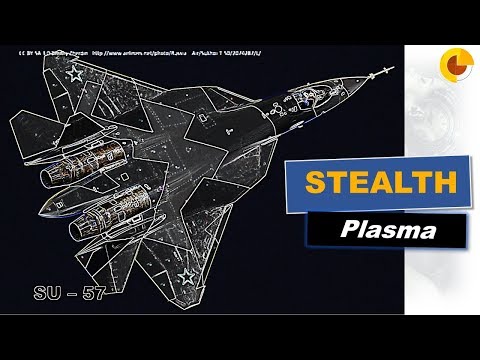

Sources Cited
- Eldredge, A. "Object Camouflage Method and Apparatus," U.S. Patent 3,127,608, General Electric, filed 1956, granted 1964.
- "The SR-71 Blackbird's Predecessor Created 'Plasma Stealth' By Burning Cesium-Laced Fuel," The War Zone.
- "CIA's Predecessor To The SR-71 Blackbird Tested Electron Guns To Hide From Radars," The War Zone.
- "Plasma Stealth," Wikipedia, citing the 2005 declassified CIA/Westinghouse Project KEMPSTER report.
- "Russia Working on Stealth Plasma," Journal of Electronic Defense, June 2002.
- "Leik Myrabo," Wikipedia.
- Myrabo, L. N. & Mead, F. B. "The Lightcraft Technology Demonstrator (LTD) Program," Defense Technical Information Center, 2002.
- Myrabo, L. N. et al. "Ground and Flight Tests of a Laser Propelled Vehicle," 1998.
- "University of Florida Professor Designs Plasma-Propelled Flying Saucer," University of Florida News, June 2008.
- Gochnour, G. "Fusion Energy System and Plasma Propulsion Aircraft," U.S. Patent Application 20060102795A1, filed 2005.
- Boeing Company. "Plasma Flow Control Actuator System and Method," U.S. Patent 8,016,247.
- NASA Glenn Research Center. "Magnetohydrodynamic Augmented Propulsion Experiment," NASA/TP-2003-212285.
- Broka, C. A. "Foo Fighters and Microwave Oven Plasma Balls," arXiv:2004.10653, April 2020.
- "Science: Foo-Fighter," Time magazine, January 15, 1945.
- Central Intelligence Agency & Westinghouse Electric Corporation. Project KEMPSTER Engineering Report (declassified 2005).
- "Project KEMPSTER: Lockheed A-12 and Plasma Stealth," Secret Projects Forum.
- "WEAV: Patent Application For A Plasma-Propelled Flying Saucer," Science 2.0.
- Cen, J.; Yuan, P.; & Xue, S. "Observation of the Optical and Spectral Characteristics of Ball Lightning," Physical Review Letters 112, 035001, January 2014.
- Litchford, R. J.; Cole, J. W.; et al. "Magnetohydrodynamic Augmented Propulsion Experiment," NASA/TP-2003-212285, Marshall Space Flight Center, February 2003.
- "SCORPION Program," Wikipedia, citing DARPA/Army Research Laboratory records.
- "Control of Revolutionary Aircraft with Novel Effectors (CRANE)," DARPA.
- Gochnour, G. "Tubular Plasma Aircraft," U.S. Patent Application 20090127383A1, filed 2008 (abandoned).
Have corrections, additional research, or peer-reviewed sources? Help improve this entry.
Suggest an Edit