
Zero-Point Energy Extraction Hypothesis
Proposes that UAP propulsion draws usable energy directly from quantum vacuum fluctuations (the Casimir effect) rather than any onboard fuel source — a genuine, if still unproven, frontier of theoretical physics that could explain a craft's apparently unlimited endurance without requiring any refueling or visible exhaust.
Patented, Experimentally InconclusiveCore Thesis
By cycling ordinary matter through microscopic Casimir cavities — regions where the geometry of two closely spaced conducting surfaces restricts which quantum vacuum field modes can exist — a craft could, in principle, repeatedly draw small increments of energy from the surrounding vacuum itself, providing continuous power without carrying, burning, or ever needing to replenish any fuel.
Origin & History
The zero-point energy extraction hypothesis holds that a UAP's apparently unlimited operational endurance — no refueling, no visible exhaust, and reported flight durations or repeated appearances that would exhaust any conventional onboard fuel supply — is explained not by a more efficient engine, but by an entirely different category of power source: the quantum vacuum itself. Unlike propulsion theories that describe how a craft might move, this is specifically an energy-source theory, addressing where a craft's power comes from rather than how that power is converted into thrust, and it is one of the very few hypotheses on this site whose central physical premise — that "empty space" is not actually empty, but seethes with measurable quantum fluctuations — is mainstream, textbook, experimentally confirmed physics rather than speculation.
That premise traces to Dutch physicist Hendrik Casimir's 1948 prediction that two uncharged, perfectly conducting plates placed extremely close together in a vacuum would be pulled toward one another by the pressure difference created when the plates' own geometry excludes certain wavelengths of the vacuum's own fluctuating electromagnetic field from the gap between them. Casimir's prediction remained a theoretical curiosity for nearly half a century until physicist Steve Lamoreaux measured the force to within about 5% of the predicted value in 1997, establishing beyond reasonable dispute that vacuum-fluctuation forces are real and measurable, not a mathematical artifact of the theory used to describe them.
The leap from "the vacuum has measurable structure" to "that structure can be tapped as a usable power source" was first made explicit in a peer-reviewed venue by physicist Robert L. Forward, then affiliated with both Hughes Research Laboratories in Malibu, California, and the U.S. Air Force Rocket Propulsion Laboratory at Edwards Air Force Base. In a 1984 paper published in Physical Review B, "Extracting Electrical Energy from the Vacuum by Cohesion of Charged Foliated Conductors," Forward proposed what he called a "vacuum-fluctuation battery": a stack of charged conducting plates held apart by a slightly-too-weak electrostatic repulsion, allowing the Casimir force to slowly pull the plates together and, in doing so, add real, extractable energy to the electric field between them. Forward's paper is the theory's foundational document — a credentialed aerospace physicist, publishing in one of the field's most rigorously peer-reviewed journals, proposing a specific, mechanically concrete device rather than a vague assertion that "the vacuum has energy."
The theory's most direct present-day expression is a granted U.S. patent rather than a speculative proposal. Astrophysicist Bernard Haisch, working with University of Colorado Boulder electrical engineering professor Garret Moddel, filed "Quantum Vacuum Energy Extraction" in September 2005; it was granted as U.S. Patent 7,379,286 in May 2008 and remains active. Their mechanism differs from Forward's mechanical plate-cohesion approach: rather than harvesting energy from moving plates, it proposes flowing noble-gas atoms through microscopic Casimir cavities, where the restricted vacuum modes cause the atoms' own electrons to drop briefly to lower energy states and release that energy, before the atoms re-absorb energy from the ambient vacuum field upon exiting the cavity and are ready to repeat the cycle. Moddel's own subsequent research, including a 2012 experimental test of the concept and a notably self-critical 2019 theoretical reassessment, forms the most scientifically rigorous thread running through this theory's entire documented history.
Forward's specific proposed device deserves closer description, because its mechanical logic is the direct ancestor of the thermodynamic objection that would eventually be raised against it. The vacuum-fluctuation battery consists of a stack of parallel conducting plates, each carrying a like electrical charge, so that ordinary electrostatic repulsion pushes the plates apart. Forward's proposal was to charge the plates just enough that this repulsion very slightly exceeds the attractive Casimir force between them at their initial separation — meaning the stack starts in a state where the two forces very nearly balance, with repulsion holding a narrow edge. As the plates are allowed to slowly discharge, drawing off a small fraction of their stored charge as usable current, the electrostatic repulsion holding them apart weakens, and the ever-present Casimir attraction, unaffected by the plates' charge, begins to win out, drawing the plates measurably closer together. That motion is where the extractable energy actually appears: work done by an attractive force pulling two charged conductors together can, with the right electrical coupling, be diverted into an external circuit rather than dissipated purely as heat, in principle allowing the discharge current to be captured as usable electrical output. The catch, which Forward's 1984 paper does not resolve and which Moddel's 2019 reassessment would later state explicitly, is that the plates can only complete that particular fall once. Once fully discharged and drawn together to their minimum separation, no further slow collapse remains available to extract from; recharging the plates and forcing them back apart to repeat the cycle requires expending energy on the separation step, and nothing in Forward's proposal demonstrates that step can be accomplished for less energy than the collapse itself yields.
Haisch's engagement with the quantum vacuum did not begin with the 2005 patent filing; it was the culmination of nearly two decades of published theoretical work with physicist Alfonso Rueda addressing a related but distinct question: whether an object's inertia — its resistance to acceleration — could itself arise from the object's own charged particles interacting with the same zero-point electromagnetic field responsible for the Casimir effect. Haisch, Rueda, and physicist Hal E. Puthoff jointly published "Inertia as a Zero-Point-Field Lorentz Force" in Physical Review A in 1994, proposing that what physics calls inertial mass might be, at bottom, a Lorentz-force drag effect exerted by the vacuum field on any accelerating charge, rather than an intrinsic property of matter in its own right. That inertia research and the later energy-extraction patent are conceptually related but logically separable claims: the inertia hypothesis concerns the vacuum field's role in resisting acceleration, while the patent concerns extracting usable energy from that same field, and it is possible in principle to accept one without the other. Haisch's decade as an editor of the Astrophysical Journal, one of the most rigorously refereed journals in observational astronomy, is a credential earned independently of either the inertia hypothesis or the energy-extraction patent, and it speaks to his standing within mainstream astrophysics rather than to the correctness of either more speculative research program.
Scientific Foundations
The hypothesis rests on a single, experimentally confirmed physical foundation, extended by three distinct and not equally credible proposed extraction mechanisms:
1. The Casimir Effect (Confirmed Foundation)
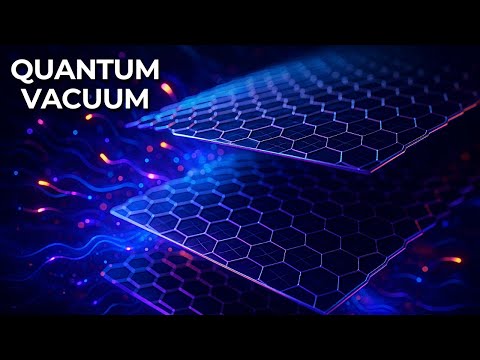
Two closely spaced conducting plates restrict which wavelengths of the vacuum's fluctuating electromagnetic field can exist in the gap between them, compared to the unrestricted field outside. This asymmetry in vacuum-fluctuation pressure produces a genuine, measurable attractive force pulling the plates together — a real, mainstream quantum electrodynamics effect, not a fringe claim. Lamoreaux's 1997 measurement and numerous subsequent replications have confirmed the effect to high precision. Nothing about the Casimir effect's existence is in dispute; the dispute begins entirely at the next step, when this confirmed force is proposed as a usable, repeatable energy source rather than a one-time, finite attraction between two plates that, once they touch, can produce no further energy.
Lamoreaux's 1997 measurement is worth describing in more detail because its precision is central to why physicists treat the Casimir effect as settled rather than merely plausible. Using a torsion pendulum to measure the minute force between a spherical lens and a flat plate across separations of roughly 0.6 to 6 micrometers, Lamoreaux recorded a force that matched the value predicted by quantum electrodynamics to within about 5 percent — a level of agreement that leaves essentially no room for the effect to be some other, unrelated interaction masquerading as vacuum-fluctuation pressure. This matters for the extraction hypothesis specifically because it means any skepticism directed at zero-point energy extraction has to be aimed squarely at the extraction step itself, not at the existence of the underlying force; a critic cannot dismiss the entire hypothesis simply by calling the Casimir effect unproven, since it is not.
2. Mechanical Extraction via Plate Cohesion (Forward's Approach)
Forward's 1984 "vacuum-fluctuation battery" proposed doing electrical work on a stack of charged plates as the Casimir force pulls them together, extracting energy in the process. The proposal is mechanically specific and was taken seriously enough to be studied for decades afterward, but it faces a fundamental, and ultimately fatal, thermodynamic objection: the plates can only move closer together once, and once they have collapsed to their minimum separation, no further energy can be extracted without expending at least as much energy pulling them back apart again. Garret Moddel and Olga Dmitriyeva's own 2019 theoretical assessment concluded that this class of extraction, along with a related "nonlinear processing" approach, violates basic thermodynamic principles of detailed balance and cannot be made to work regardless of engineering refinement.
The thermodynamic objection to mechanical, plate-based extraction is best understood through that principle of detailed balance, which Moddel invokes throughout his 2019 reassessment: any process that can run one way must, under the same physical laws, be equally capable of running in reverse, and a genuinely repeatable energy-extraction cycle requires the "forward" step (letting the plates fall together) to release strictly more usable energy than the "reverse" step (pulling them back apart) consumes. For a system interacting only with a static, unchanging vacuum field, no such asymmetry exists: the same Casimir force that pulls the plates together resists their separation with exactly the same strength, so separating them again costs at least as much energy as collapsing them yielded, with any real-world friction or resistive loss in the plates' supporting circuitry making the round trip a net loser rather than a net winner. This is precisely the failure mode Moddel and Dmitriyeva describe as ruling out both Forward's plate-cohesion approach and the broader "nonlinear processing" category: neither proposes any mechanism by which the vacuum field itself changes state between the extraction step and the recharging step, and without such a change, detailed balance guarantees the two steps cancel out.
3. Pumping Atoms Through Casimir Cavities (Haisch & Moddel's Approach)
The mechanism behind Haisch and Moddel's own granted patent avoids Forward's fatal flaw by using a continuously renewable working substance — a flowing gas — rather than a pair of plates that can only be compressed once. Because fresh atoms are always entering the cavity from outside and re-absorbing vacuum energy after they exit, the process is, in principle, continuously repeatable rather than a single, exhaustible event. Moddel and Dmitriyeva's 2019 assessment is notably more favorable to this specific approach than to the other two: it "does not appear to violate" the same thermodynamic principles that rule out mechanical plate-based extraction, though the paper is explicit that other, unresolved obstacles remain, and that the one directly relevant experimental test conducted so far produced results the authors themselves described as "tantalizing but inconclusive," with power output well below theoretical predictions.
The atom-pumping mechanism escapes the plate-cohesion trap specifically because it does not ask the same patch of vacuum field to be exploited twice in succession. Each atom entering a Casimir cavity encounters a vacuum field already altered by the cavity's own geometry, restricted to a narrower set of allowed modes than the field outside; the atom's electron orbitals, settling toward their lowest available energy state within that restricted field, drop to a level lower than the one they occupy outside the cavity, releasing the energy difference. Critically, when that same atom then exits the cavity and re-enters the unrestricted vacuum field beyond it, the field it encounters there is the ordinary, unmodified ambient zero-point field, not the same depleted region it just drew energy from — the atom re-absorbs energy from what is, for practical purposes, an inexhaustible external reservoir rather than needing to recharge the specific cavity it just passed through. Because a continuous stream of fresh atoms can enter the cavity while previously processed atoms exit and re-absorb energy elsewhere, the process, at least on paper, avoids the single-use trap that dooms plate cohesion. Moddel and Dmitriyeva's conclusion that this approach "does not appear to violate" thermodynamic principles is a narrower and more conditional claim than it might first sound: it means the mechanism does not fail for the same specific reason plate cohesion fails, not that no other obstacle exists, which is consistent with the same paper's description of the one direct experimental test of the mechanism as producing power well below theoretical prediction.
Government & Military Programs
This theory's government engagement runs through two distinct, independently run American programs, neither of which set out to build a UAP-explaining power source, but both of which took the underlying physics seriously enough to fund real research into it. NASA's Breakthrough Propulsion Physics Program, active from 1996 to 2002 under program manager Marc G. Millis, spent roughly $1.2 million over six years systematically assessing fourteen categories of proposed revolutionary propulsion and power physics; of the six approaches the program's final assessment judged nonviable and the four it flagged as unresolved, the Casimir effect was placed among the four topics recommended for continued research rather than dismissed outright, one of the program's more encouraging conclusions for any hypothesis covered on this site. Separately, DARPA's Casimir Effect Enhancement program, launched in 2009 under DARPA physicist Thomas Kenny and running for roughly two years, funded five research groups — at Harvard, Yale, the University of California, Riverside, and the Argonne and Los Alamos National Laboratories — to develop new methods of engineering Casimir forces at surfaces. DARPA's own stated goals for the program centered on nanodevice adhesion, drag reduction, and levitating microstructures rather than energy generation specifically, and Kenny's own assessment, that a follow-on program would depend on whether the initial research "delivers," suggests the results did not clearly justify continued Casimir-specific funding at the same scale.
DARPA's Casimir Effect Enhancement program divided its roughly two years of funding across five institutions chosen for complementary expertise rather than a single unified approach: Harvard and Yale contributed fundamental theoretical and experimental Casimir-force research, the University of California, Riverside brought expertise in the micro- and nanofabrication techniques needed to build the closely spaced surfaces any Casimir application requires, and the Argonne and Los Alamos National Laboratories supplied the materials-science and large-scale experimental-physics infrastructure needed to test proposed surface treatments at a scale individual university labs could not easily match on their own. The program's own stated ambition, "to develop new methods to control and manipulate attractive and repulsive forces at surfaces based on engineering quantum phenomena," was framed around reducing nanodevice adhesion, decreasing aerodynamic drag, and enabling levitating microstructures — not energy generation — meaning DARPA's institutional interest in the Casimir effect ran through an entirely different application than the one this theory is built around. Any energy-extraction implications of the program's results are, at most, an indirect byproduct of research funded for other purposes rather than a direct test of Haisch and Moddel's own patented mechanism.
NASA's Breakthrough Propulsion Physics Program's broader assessment supplies useful context for how seriously, relatively speaking, the Casimir effect was actually taken within that review. Of the fourteen topics Millis's program systematically assessed over its six years and roughly $1.2 million budget, six were judged nonviable outright, meaning the program's own physicists concluded the proposed physics could not work as described. The Casimir effect was one of four topics placed in a middle category, recommended for continued research rather than dismissed, putting it in the company of ideas the program considered worth further public investment even though unproven. The remaining four topics were left formally unresolved rather than sorted into either the "nonviable" or "recommended" categories, including the Abraham-Minkowski controversy over how electromagnetic fields carry momentum inside a medium, quantum-vacuum-based interpretations of inertia and gravity (the same broad research area Haisch and Rueda's inertia work belongs to), and the reported Podkletnov force beam, an unrelated claim of an anomalous force effect from a rotating superconductor. Placing the Casimir effect alongside the four topics recommended for continued study, rather than among the six the program's own scientists ruled out, is among the more favorable data points in this theory's documented history, though it falls well short of an endorsement that extraction at any useful scale is actually achievable.
Physical Evidence
As with most mechanism theories on this site, there is no recovered UAP hardware or debris tied to this hypothesis; its evidentiary trail is entirely documentary, patent-based, and experimental. On the documentary side, the record includes two genuinely granted U.S. patents describing distinct extraction mechanisms: Fabrizio Pinto's "Method and Apparatus for Energy Extraction" (U.S. 6,477,028), granted in November 2002 and since expired for non-payment of maintenance fees in 2020 (a routine administrative lapse, not a revocation on technical grounds), and Haisch and Moddel's "Quantum Vacuum Energy Extraction" (U.S. 7,379,286), granted in 2008 and still active. On the experimental side, Moddel led a real, physical test of his own patented mechanism, "Test of Zero-Point Energy Emission from Gases Flowing Through Casimir Cavities," presented at the 2012 Space, Propulsion & Energy Sciences International Forum, in which gas was actually flowed through a real Casimir-cavity apparatus and its energy output measured. The result was neither a confirmation nor a clean refutation: the 2019 Moddel-Dmitriyeva reassessment characterizes the 2012 data as showing a real signal but at power levels well below what the underlying theory predicted, language the authors themselves chose ("tantalizing but inconclusive") specifically to avoid overstating what a single, modest experimental result actually showed.
Crash Retrievals
This hypothesis makes no claim about recovered craft, crash debris, or reverse-engineered biological material of any kind. It addresses only where a craft's power might come from, not where the craft itself came from or what happened to it after any given sighting. The closest the historical record comes to a "retrieval" narrative under this framework is Moddel's own laboratory apparatus, a small, university-built Casimir-cavity test rig that produced a real but weak and ambiguous energy signal rather than any physical artifact resembling UAP hardware. No alleged crash site, wreckage fragment, or occupant account is invoked anywhere in the sourced record for this theory.
Supporting Case Files
Theoretical Alignment
Of the theories this site catalogues, zero-point energy extraction occupies a genuinely unusual niche: it is not a competing explanation for how a UAP flies, maneuvers, or evades radar, but a candidate answer to a quieter, easily overlooked observable — the apparent absence of any conventional fuel source, exhaust plume, or refueling requirement across sightings that sometimes describe sustained operation over hours, days, or, in Hessdalen's case, decades. It is fully compatible with, rather than competing against, this site's other propulsion hypotheses (Vacuum Polarizability, Plasma Sheath/MHD Propulsion, Bismuth-Magnesium Waveguides), each of which describes a mechanism for converting energy into motion or a stealth effect but generally leaves the question of where that energy originates unaddressed. Where the theory is weakest is in scale: even its own most sympathetic proponents' own experimental results (Moddel's 2012 test) measured power output far below what would be needed to run any propulsion system at all, let alone one capable of the extreme kinematics reported in this site's radar-visual cases.
This positioning also clarifies what would, and would not, count as confirming evidence for this specific theory rather than for UAP propulsion theories generally. A UAP encounter featuring extreme, inertia-defying maneuvering with no accompanying energy-source anomaly would support this site's metric-engineering theories without supporting this one at all, since zero-point energy extraction makes no claim about how energy, once generated, gets converted into thrust or maneuvering capability. Conversely, a case featuring a sustained, unexplained energy release or radiant-power signature with no unusual maneuvering — closer to what the Hessdalen, Trans-en-Provence, and Vandenberg case files each individually offer — is the kind of evidence this theory is actually built to address, even though none of those three cases provides direct confirmation that the specific mechanism at work is a Casimir-cavity process rather than some other, unidentified energy source. The theory's proponents have never claimed a case-file match constitutes evidence for the Casimir-cavity mechanism specifically, only that the mechanism could, in principle, explain observations of unexplained energy release that other propulsion theories leave unaddressed.
Sensor & Instrumentation Detection Profile
Because this theory describes an energy source rather than a propulsion or stealth mechanism, it predicts a comparatively narrow and indirect instrumentation signature. Radiant power output is the most directly relevant measurement, and it is also the single measurement this theory's own proponents have already attempted under laboratory conditions: the 2012 Moddel test instrumented a real Casimir-cavity apparatus specifically to measure emitted power, the same underlying quantity that Massimo Teodorani's 2004 Hessdalen study attempted to estimate in the field, calculating radiant power up to 19 kilowatts from self-regulating light clusters using standard photometric methods rather than any Casimir-specific instrumentation. Electromagnetic-interference logging is relevant wherever a proposed extraction mechanism involves strong applied fields, connecting this theory to cases such as the Vandenberg AFB incident's witness-described "directed-energy" discharge, though no instrumentation from that 1964 case was ever preserved for independent analysis. Thermal and mineralogical analysis, the technique GEPAN's government laboratories applied to the Trans-en-Provence soil trace, is relevant to this theory only insofar as any large, localized energy-release event, whatever its true source, should leave a measurable thermal signature at its point of contact with the ground; GEPAN's own findings describe exactly that kind of signature without identifying its cause. No sensor network anywhere in the sourced record for this theory has ever recorded a reading its own proponents identify as a confirmed zero-point energy detection outside a laboratory setting.
The 100-kilowatt figure claimed for some Hessdalen events during the 2002 EMBLA mission, led by Stelio Montebugnoli and Jader Monari alongside Bjørn Gitle Hauge and Erling Strand, is a useful benchmark for gauging the scale gap between this theory's laboratory results and its case-file correlations: even taking that higher estimate at face value rather than Teodorani's more conservative 19-kilowatt figure, both numbers dwarf the power output Moddel's 2012 experimental apparatus actually measured, underscoring that no instrumented reading anywhere in this site's catalogue has ever been shown to originate from a Casimir-cavity process specifically rather than from an unidentified source of comparable or greater magnitude. Later instrumentation efforts at Hessdalen shifted away from radiant-power measurement toward mapping the valley's own geology: the 2018 and 2024 VLF electromagnetic ground surveys conducted by Georgios Vargemezis and Jacques Zlotnicki, working with Hauge, Anna-Lena Kjøniksen, and Strand, mapped conductive sulfide mineral deposits across a roughly six-by-twelve-kilometer elliptical zone tied to an underlying gabbro intrusion — an entirely different instrumentation approach aimed at identifying a conventional geological energy source rather than any vacuum-fluctuation signature. That two entirely different investigative teams, using entirely different instruments across four decades, have never converged on a single settled explanation for the same valley's energy output illustrates just how difficult it remains to instrumentally distinguish an exotic energy-source claim from a mundane one still awaiting a complete conventional explanation.
Environmental & Geospatial Context
As an energy-source theory rather than a case-specific one, zero-point energy extraction carries no dedicated sighting geography of its own; its research anchor is institutional (a University of Colorado laboratory, DARPA- and NASA-funded programs) rather than a specific class of location. The cases its proponents might point to as consistent with an unconventional, undepletable power source span markedly different settings and timescales: the Hessdalen phenomenon has recurred in the same remote Norwegian valley for more than four decades, the longest-running instrumented light phenomenon in this site's entire catalogue; Trans-en-Provence was a single, brief 1981 encounter in rural southern France; and the Vandenberg AFB incident occurred over a missile test range on the California coast in 1964. No shared geological, atmospheric, or institutional feature connects these three locations, underscoring that this theory, like the site's other mechanism hypotheses, borrows whichever unexplained-energy-signature cases exist elsewhere in the catalogue rather than generating its own dedicated dataset.
The three supporting case files also differ sharply in how much environmental documentation exists to work with, independent of what that documentation ultimately shows. Hessdalen benefits from by far the deepest environmental record of the three, spanning Erling Strand's instrumented monitoring since 1984, Teodorani's 2004 photometric analysis, the 2002 EMBLA mission's radio and optical instrumentation, and the 2018-2024 VLF geological surveys — a sustained research investment no other case connected to this theory approaches. Trans-en-Provence, by contrast, generated an intensive but narrowly time-bound investigation: GEPAN's Note Technique n°16 was produced within roughly eighteen months of the 1981 encounter and, once published in March 1983, was never followed by decades of continued on-site monitoring the way Hessdalen was, leaving its environmental record thorough for a single incident but static rather than cumulative. The Vandenberg AFB incident sits at the opposite extreme: a single 1964 event on an active military test range, revisited only decades later through AARO's 2024 documentary review rather than through any contemporaneous or follow-up physical fieldwork, meaning its environmental record consists entirely of after-the-fact document review rather than any instrumented measurement taken at the time. That spread, from Hessdalen's four decades of continuous instrumentation to Vandenberg's single archival review, illustrates that this theory's supporting cases were not selected because they share a comparable evidentiary foundation, but because each, in its own very different way, documents an energy signature its own investigators were never able to fully explain.
Observer Credibility & Occupational Profile
The theory's core proponents are unusually credentialed for a UAP-adjacent hypothesis, though their formal academic standing tracks the mainstream Casimir-effect physics far more closely than it does any UAP application of it. Robert Forward held simultaneous positions at Hughes Research Laboratories and the U.S. Air Force Rocket Propulsion Laboratory when he published his foundational 1984 paper in a mainstream, rigorously peer-reviewed physics journal. Bernard Haisch spent a decade as an editor of the Astrophysical Journal and built his career at Lockheed Martin's Solar & Astrophysics Laboratory before turning to zero-point-field research; his patent co-inventor Garret Moddel is a tenured University of Colorado Boulder professor whose Casimir-cavity research has been the subject of ordinary peer-reviewed publication, not just patent filings. What distinguishes this theory's credibility profile from several others on this site is Moddel's own willingness, in his 2019 paper with Dmitriyeva, to publicly rule out two of the three extraction approaches he had himself been associated with on thermodynamic grounds — a level of public self-correction that is genuinely rare in this site's source material and that should, if anything, raise confidence in the honesty of his remaining, more guarded claim about the one approach he judges not yet ruled out.
The credibility of this theory's case-file connections rests on a different, and generally less academically insulated, set of investigators than the credibility of its core physics. Massimo Teodorani, whose 2004 Journal of Scientific Exploration paper supplies the theory's most frequently cited radiant-power figure for Hessdalen, published in a journal that, unlike Physical Review B or Atoms, specializes in topics mainstream physics venues typically decline to referee — a genuine step down in institutional rigor from the Forward, Haisch, Moddel, and Pinto material this theory otherwise rests on. INRA biologist Michel Bounias's chlorophyll analysis of the Trans-en-Provence alfalfa, and the GEPAN government investigation Jean-Jacques Velasco led more broadly, sit closer to the mainstream end of that spectrum, since GEPAN was a government-chartered scientific body operating under CNES with direct approval from CNES director Yves Sillard, rather than an independent researcher publishing outside conventional peer review. The overall pattern is one this theory shares with several others on this site: the core physical claim, Casimir-effect energy extraction, rests on unusually strong, mainstream credentials, while the specific case-file evidence invoked to connect that claim to actual UAP sightings rests on a more uneven mix of government investigators, credentialed specialists working outside their primary field, and independent researchers publishing in lower-circulation venues.
Key Witnesses & Analysts
Two figures shaped the institutional record behind this theory's government-funded half, occupying program-management roles rather than advocating for any specific UAP application of the physics they oversaw:
Marc G. Millis
NASA physicist who managed the Breakthrough Propulsion Physics Program from 1996 to 2002 and authored its final assessment of fourteen candidate revolutionary-propulsion topics, placing the Casimir effect among the four categories recommended for continued research rather than the six ruled out entirely — a comparatively encouraging, though still non-committal, verdict from the single most systematic government review this theory has ever received. Later co-edited Frontiers of Propulsion Science, expanding on the program's findings.
Thomas Kenny
The DARPA physicist who oversaw the agency's 2009–2011 Casimir Effect Enhancement program across five funded research institutions, and whose own stated assessment, that a follow-on program would depend on whether the initial research "delivers," is the most direct on-record government verdict on the program's uncertain practical payoff.
Historical Precedents & Archive Matches
The idea that empty space might be quietly tapped as an energy source has a long and, for most of its history, disreputable lineage that this theory's proponents are careful to distinguish themselves from. Nineteenth- and early twentieth-century "free energy" and perpetual-motion claims, almost universally later shown to violate the first or second law of thermodynamics, gave the broader concept of "energy from nothing" a durable reputation for pseudoscience that any serious modern proposal has to actively work against. What sets this theory's core physics apart from that history is that the Casimir effect is not a claim of energy from nothing at all: the vacuum's zero-point field genuinely exists and has been directly measured, so the live scientific question is narrowly whether a specific, engineered process can access a small fraction of that already-confirmed energy repeatedly, rather than whether the underlying physics is real in the first place. Moddel and Dmitriyeva's 2019 paper functions as a direct, modern echo of exactly the thermodynamic scrutiny that sank the free-energy movement a century earlier, applied rigorously to the authors' own patented mechanism rather than to an outside claim — the same kind of internal self-policing this site has found in NAWCAD's null test of the Pais Effect and NASA's own inconclusive 2003 MHD Augmented Propulsion Experiment.
The nineteenth- and early twentieth-century free-energy and perpetual-motion movement that gave "energy from nothing" its lasting bad reputation took many forms, from mechanical over-balanced wheels claimed to run forever once set in motion, to electrical devices claimed to output more power than they consumed, almost all of them eventually shown, on close inspection, either to conceal a hidden power source, to rely on a measurement error that masked ordinary energy losses, or simply to not work at all once tested by anyone outside the inventor's own circle. What made that movement recognizable as pseudoscience in retrospect was less any single failed device than a consistent pattern of behavior: claims advanced without independent replication, extraordinary output claims that grew vaguer rather than more precise under scrutiny, and inventors who resisted rather than welcomed rigorous third-party testing. Moddel and Dmitriyeva's 2019 paper is worth reading against that historical backdrop specifically because it inverts the pattern rather than repeating it: rather than an outside skeptic subjecting the claim to scrutiny over the claimant's objections, the paper's authors are the claim's own originators, voluntarily subjecting two of their own three proposed mechanisms to the same thermodynamic analysis that would doom a typical nineteenth-century free-energy device, and reporting the negative result in a peer-reviewed journal rather than setting it aside. That behavior — an inventor publishing the specific reasons two of his own three ideas do not work — is close to the opposite of the historical pattern that earned the broader free-energy field its reputation, and it is one of the stronger, if indirect, pieces of evidence in this theory's favor: not that the remaining claim is true, but that its proponent is applying a genuinely disinterested standard rather than a self-serving one.
Material Analysis
Unlike hypotheses built on recovered physical debris, this theory has no exotic-material claim of its own; its hardware, where it exists at all, consists of conventional laboratory apparatus — conducting plates, gas-flow chambers, and standard vacuum equipment — arranged to exploit an already-understood field effect, not any novel substance. Cross-referenced against this site's case files, the theory is invoked to explain an absence (of fuel, of refueling, of a conventional exhaust signature) rather than any positive physical trace, making its strongest case-file matches ones where investigators specifically noted the absence of an identifiable power source alongside a real, measured energy signature: Hessdalen's decades of instrumented radiant-power measurements with no confirmed source, and Trans-en-Provence's thermally altered soil with no identified heat source at the scene. Cases centered on a recovered structured craft, such as Roswell's debris field, sit outside this theory's explanatory scope, since it addresses a power source's origin rather than any hull or wreckage.
The absence of any exotic-material claim also means this theory's evidentiary standard differs structurally from hypotheses that do rest on recovered debris: where a materials-based theory can be falsified or supported by a single definitive laboratory analysis of a physical sample, this theory can only be tested by replicating its proposed mechanism and measuring its output, which is exactly what Moddel's 2012 experiment attempted and what the 2019 reassessment evaluated. That structural difference cuts both ways. It means the theory is not vulnerable to the kind of chain-of-custody or sample-contamination objections that dog many recovered-material claims elsewhere on this site, since there is no physical sample whose provenance could be questioned. But it also means the theory can never be strengthened by a single dramatic discovery the way a well-documented metal fragment might strengthen a crash-retrieval case; its only path to stronger support is the comparatively slow, incremental one of repeated, independently replicated laboratory measurement — a path that, more than four decades after Forward's original 1984 proposal, has produced exactly one directly relevant experimental result.
Supporting This Hypothesis
- The Casimir effect itself is confirmed, mainstream, experimentally measured physics, not speculation
- A real, granted, currently active U.S. patent (7,379,286) describes a specific, continuously repeatable extraction mechanism
- NASA's own Breakthrough Propulsion Physics Program recommended continued research into the Casimir effect rather than ruling it out
- Co-inventor Garret Moddel has publicly ruled out two competing extraction approaches on thermodynamic grounds, lending credibility to his more guarded claim about the third
Against This Hypothesis
- The only direct experimental test of the patented mechanism produced power far below theoretical predictions, described by its own authors as merely "tantalizing"
- Two of the three historically proposed extraction methods have been shown by the theory's own proponents to violate thermodynamics
- DARPA's Casimir Effect Enhancement program does not appear to have produced a clear follow-on success
- No demonstrated device has come remotely close to the power output needed to run any propulsion or life-support system
Theory Development Timeline
| Date | Development |
|---|---|
| 1948 | Dutch physicist Hendrik Casimir predicts that two uncharged, closely spaced conducting plates will be pulled together by a pressure imbalance in the surrounding quantum vacuum's fluctuating field. |
| 1984 | Robert L. Forward, affiliated with Hughes Research Laboratories and the U.S. Air Force Rocket Propulsion Laboratory, publishes "Extracting Electrical Energy from the Vacuum by Cohesion of Charged Foliated Conductors" in Physical Review B, proposing a mechanical "vacuum-fluctuation battery." |
| 1989 | Bernard Haisch and colleagues begin publishing on zero-point-field contributions to inertia and gravity, laying theoretical groundwork later extended toward energy-extraction claims. |
| 1996–2002 | NASA's Breakthrough Propulsion Physics Program, managed by Marc G. Millis, systematically assesses fourteen candidate revolutionary propulsion and power topics on roughly $1.2 million in total funding, placing the Casimir effect among four categories recommended for continued research. |
| 1997 | Physicist Steve Lamoreaux publishes the first high-precision experimental confirmation of the Casimir force, agreeing with theory to within about 5% and establishing that vacuum-fluctuation forces are physically real. |
| May 2000 | Fabrizio Pinto files "Method and Apparatus for Energy Extraction," describing a separate Casimir-effect-based extraction approach. |
| Nov 2002 | Pinto's application is granted as U.S. Patent 6,477,028. |
| Sep 2005 | Bernard Haisch and Garret Moddel file "Quantum Vacuum Energy Extraction," proposing to pump gas atoms through Casimir cavities to repeatedly harvest vacuum energy. |
| May 2008 | Haisch and Moddel's application is granted as U.S. Patent 7,379,286. |
| 2009–2011 | DARPA's Casimir Effect Enhancement program, led by physicist Thomas Kenny, funds Casimir-force research at Harvard, Yale, UC Riverside, Argonne National Laboratory, and Los Alamos National Laboratory. |
| 2012 | Garret Moddel presents "Test of Zero-Point Energy Emission from Gases Flowing Through Casimir Cavities" at the Space, Propulsion & Energy Sciences International Forum, physically testing the mechanism behind his own 2008 patent. |
| 2019 | Moddel and Olga Dmitriyeva publish "Extraction of Zero-Point Energy from the Vacuum" in Atoms, concluding that two of three proposed extraction classes violate thermodynamics while describing their own 2012 experimental results as "tantalizing but inconclusive." |
| 2020 | Pinto's U.S. Patent 6,477,028 expires for non-payment of maintenance fees, an administrative lapse rather than a technical revocation. |
Weighing the Evidence
The central scientific critique of this theory is not that its foundational physics is fringe — the Casimir effect is confirmed, mainstream quantum electrodynamics, and even NASA's own systematic review left the door open to further study — but that every serious attempt to scale it into a genuinely useful power source has either been shown to violate thermodynamics outright or has produced real but vanishingly small results. Forward's original 1984 mechanism and the broader "nonlinear processing" category have both been ruled out by the theory's own proponents on thermodynamic grounds; only the pumping-through-Casimir-cavities approach behind Haisch and Moddel's own patent remains theoretically open, and its one direct experimental test to date fell well short of its own predictions.
Supporting Arguments
- The Casimir effect is experimentally confirmed to high precision, giving this theory a genuinely mainstream physical foundation most UAP theories lack
- A real, granted, active U.S. patent (7,379,286) describes a specific, continuously repeatable mechanism, not a vague assertion
- NASA's own Breakthrough Propulsion Physics Program recommended continued Casimir-effect research rather than dismissing it as one of six nonviable topics
- The theory's own leading proponent has publicly and rigorously ruled out two competing approaches, a rare degree of self-correcting scientific honesty in this site's source material
Skeptical Arguments
- The one direct experimental test of the surviving mechanism produced power far below theoretical predictions, in the authors' own words "tantalizing but inconclusive"
- Two of the three historically proposed extraction methods have been shown to violate basic thermodynamic principles
- DARPA's dedicated Casimir Effect Enhancement program does not appear to have produced a clear practical follow-on
- No demonstrated device has approached the power output that would be needed to power any propulsion or life-support system, let alone a craft matching top-tier UAP performance
Conventional Explanation Candidate
Because zero-point energy extraction is a mechanism theory about a power source rather than a claim about a single incident, its Conventional Explanation Candidates evaluate whether the evidence its proponents cite — unexplained energy signatures and apparently fuel-free endurance — actually requires tapping the quantum vacuum, or whether long-documented natural and conventional alternatives account for the same observations just as well.
Geological / Piezoelectric Energy Release
PlausibleFor Hessdalen specifically, Massimo Teodorani's piezoelectric quartz-strain model and later dusty-plasma and geobattery proposals offer a genuinely mundane, geologically grounded energy source drawing on the valley's own mineral-rich bedrock, requiring no vacuum-energy extraction at all to explain sustained, recurring luminous energy release.
Conventional Directed-Energy Weapon or Test Article
InconclusiveFor the Vandenberg AFB incident's witness-described energy discharge, a classified conventional directed-energy or countermeasure test remains a live possibility neither confirmed nor excluded by AARO's own 2024 review, which could account for an apparent energy discharge without invoking any exotic power source.
Unidentified Conventional Heat Source
InconclusiveGEPAN's own Trans-en-Provence report explicitly declined to identify a cause for the site's thermal and mechanical trace; a conventional but unidentified heat source cannot be excluded, though none has ever been proposed that fits the documented pressure and temperature profile as well as an undefined energy-release event does.
Deliberate, Fully Engineered Zero-Point Power Source (This Theory's Core Claim)
ImplausibleAs a complete, UAP-scale explanation, this remains unsupported: the only direct experimental test of a working extraction mechanism produced power orders of magnitude below what any propulsion or sustained-flight system would require, and two of the three historically proposed methods have been ruled out by the theory's own proponents.
Theoretical Assessment Profile
Six-domain evaluation of this hypothesis
Taken together, the three case files this theory draws on illustrate different, non-overlapping edges of what an unexplained-energy-source claim can and cannot establish. Hessdalen offers the deepest and longest-running instrumented record of any case on this site, but four decades of measurement have produced competing conventional explanations — Teodorani's piezoelectric model, the later dusty-plasma and geological-battery proposals, and the VLF-mapped sulfide deposits — that this theory's proponents have never needed to disprove, only to note do not yet add up to a single settled account, leaving room, but not confirmation, for an alternative energy source. Trans-en-Provence supplies a single, well-documented instance of localized heating and ground compression with no identified conventional cause, the kind of anomalous but bounded energy-release signature this theory predicts, but GEPAN's own investigators stopped at describing the effect rather than proposing any specific mechanism behind it, so the case corroborates only that an unexplained energy event occurred, not that a Casimir-cavity process was responsible. Vandenberg is the weakest match of the three by this theory's own logic: a witness account of what may have been a directed-energy discharge is, if anything, closer to the deliberate, engineered application this theory's patents describe than to the passive, ambient extraction its core mechanism proposes, and AARO's 2024 review left the underlying event as unresolved as GEPAN left Trans-en-Provence, correlating it with a conventional antiballistic-missile test without confirming either account. No single one of the three cases, on its own sourced record, requires invoking zero-point energy extraction rather than a conventional explanation already on record for it; what the three cases share is only that each documents a real, still-unexplained energy signature that this theory remains available, but unproven, to explain.
Key Proponents
Robert L. Forward
Published the theory's foundational 1984 Physical Review B paper proposing a mechanical "vacuum-fluctuation battery" using the Casimir force on charged conducting plates. The mechanism was later shown by other researchers to violate thermodynamics as a repeatable energy source, but Forward's paper established zero-point energy extraction as a serious, peer-reviewed engineering proposal rather than speculation.
Dr. Bernard Haisch
Co-inventor, with Garret Moddel, of U.S. Patent 7,379,286, "Quantum Vacuum Energy Extraction" (granted 2008), proposing to harvest vacuum energy by cycling gas atoms through Casimir cavities. A decade-long editor of the Astrophysical Journal and co-developer of the quantum vacuum inertia hypothesis with Alfonso Rueda.
Dr. Garret Moddel
Co-inventor of the Haisch-Moddel patent and lead author of the theory's only direct experimental test (2012) and its most rigorous self-assessment (2019, with Olga Dmitriyeva), which ruled out two competing extraction approaches on thermodynamic grounds while describing his own mechanism's test results as real but far below prediction.
Related Cases
Further Reading
Tapping the Zero Point Energy
An early, influential popular treatment arguing for the engineering feasibility of zero-point energy extraction — useful as a primary example of the enthusiastic proponent literature this theory's more rigorous academic critiques (Moddel and Dmitriyeva) directly respond to.
The God Theory: Universes, Zero-Point Fields, and What's Behind It All
Astrophysicist and patent co-inventor Bernard Haisch's own book connecting his zero-point-field physics research to broader questions about the universe's underlying structure.
The Casimir Effect: Physical Manifestations of Zero-Point Energy
A graduate-level monograph developing the Green's-function theory of Casimir forces — the experimentally confirmed physics both Forward's and Haisch/Moddel's extraction proposals build on.
Frontiers of Propulsion Science
Written in part by the actual program manager of NASA's Breakthrough Propulsion Physics Program, expanding on that program's own assessment of the Casimir effect as a candidate topic for continued research.
The Hunt for Zero Point: Inside the Classified World of Antigravity Technology
An aerospace journalist's investigation into Cold War-era classified antigravity and zero-point-energy research, tracing the broader institutional culture this theory's DARPA and NASA programs sit within.
Essential Viewing

Sources Cited
- Casimir, H. B. G. "On the Attraction Between Two Perfectly Conducting Plates," Proceedings of the Royal Netherlands Academy of Arts and Sciences, 1948.
- Forward, R. L. "Extracting Electrical Energy from the Vacuum by Cohesion of Charged Foliated Conductors," Physical Review B 30, 1700, 1984.
- Lamoreaux, S. K. "Demonstration of the Casimir Force in the 0.6 to 6 µm Range," Physical Review Letters 78, 5, 1997.
- Pinto, F. "Method and Apparatus for Energy Extraction," U.S. Patent 6,477,028, granted November 2002.
- Haisch, B. & Moddel, G. "Quantum Vacuum Energy Extraction," U.S. Patent 7,379,286, granted May 2008.
- Moddel, G. et al. "Test of Zero-Point Energy Emission from Gases Flowing Through Casimir Cavities," Space, Propulsion & Energy Sciences International Forum, 2012.
- Moddel, G. & Dmitriyeva, O. "Extraction of Zero-Point Energy from the Vacuum: Assessment of Stochastic Electrodynamics-Based Approach as Compared to Other Methods," Atoms 7(2), 51, 2019.
- "Research in a Vacuum: DARPA Tries to Tap Elusive Casimir Effect for Breakthrough Technology," Scientific American.
- "Breakthrough Propulsion Physics Program," Wikipedia, citing NASA program records.
- Millis, M. G. "NASA Breakthrough Propulsion Physics Program: Program Summary and Key Findings," NASA Glenn Research Center, 2004.
- "Bernard Haisch," Wikipedia.
- "Zero-Point Energy Technology," Garret Moddel faculty page, University of Colorado Boulder.
- Haisch, B.; Rueda, A.; & Puthoff, H. E. "Inertia as a Zero-Point-Field Lorentz Force," Physical Review A, 1994.
- Haisch, B. & Moddel, G. "Quantum Vacuum Energy Extraction," U.S. Patent Application 20070241470A1 (companion filing).
- "Science: Foo-Fighter" and contemporaneous 1940s press coverage of energy-anomaly explanations (comparative historical framing).
- Cole, D. C. & Puthoff, H. E. "Extracting Energy and Heat from the Vacuum," Physical Review E, 1993.
- Cole, D. C. & Puthoff, H. E. "Apparent Endless Extraction of Energy from the Vacuum by Cyclic Manipulation," NASA Technical Reports Server, 1999.
Have corrections, additional research, or peer-reviewed sources? Help improve this entry.
Suggest an Edit