
Alderney UFO Sighting
Shortly before 3 p.m. on April 23, 2007, Captain Ray Bowyer, a 50-year-old Aurigny Air Services pilot with more than eighteen years of flying experience, was flying a scheduled Trislander service south toward Alderney in the Channel Islands when he sighted a huge, brilliant yellow-gold object hanging motionless in the sky roughly 2,000 feet below his aircraft. As he watched, a second, identical object appeared further off toward Guernsey. Two passengers aboard his aircraft independently reported unusual colored lights at the same moment, and Bowyer relayed what he was seeing to Jersey air traffic control — who, minutes later, told him that a second airline captain, flying a Blue Islands Jetstream on an unrelated route between the Isle of Man and Jersey, had just radioed in an near-identical sighting of his own. Bowyer filed a formal safety report with the UK Civil Aviation Authority describing flattened disc- or cigar-shaped structures he estimated, at their farthest observed distance, at up to a mile in length. Jersey's radar recorded no solid corroborating return. The Ministry of Defence's own file on the case, withheld for years, was eventually released to the National Archives as record DEFE 24/2081/1 — and the sighting remains, by the assessment of independent researchers and the UK press alike, one of Britain's most credentialed and carefully documented modern UFO encounters.
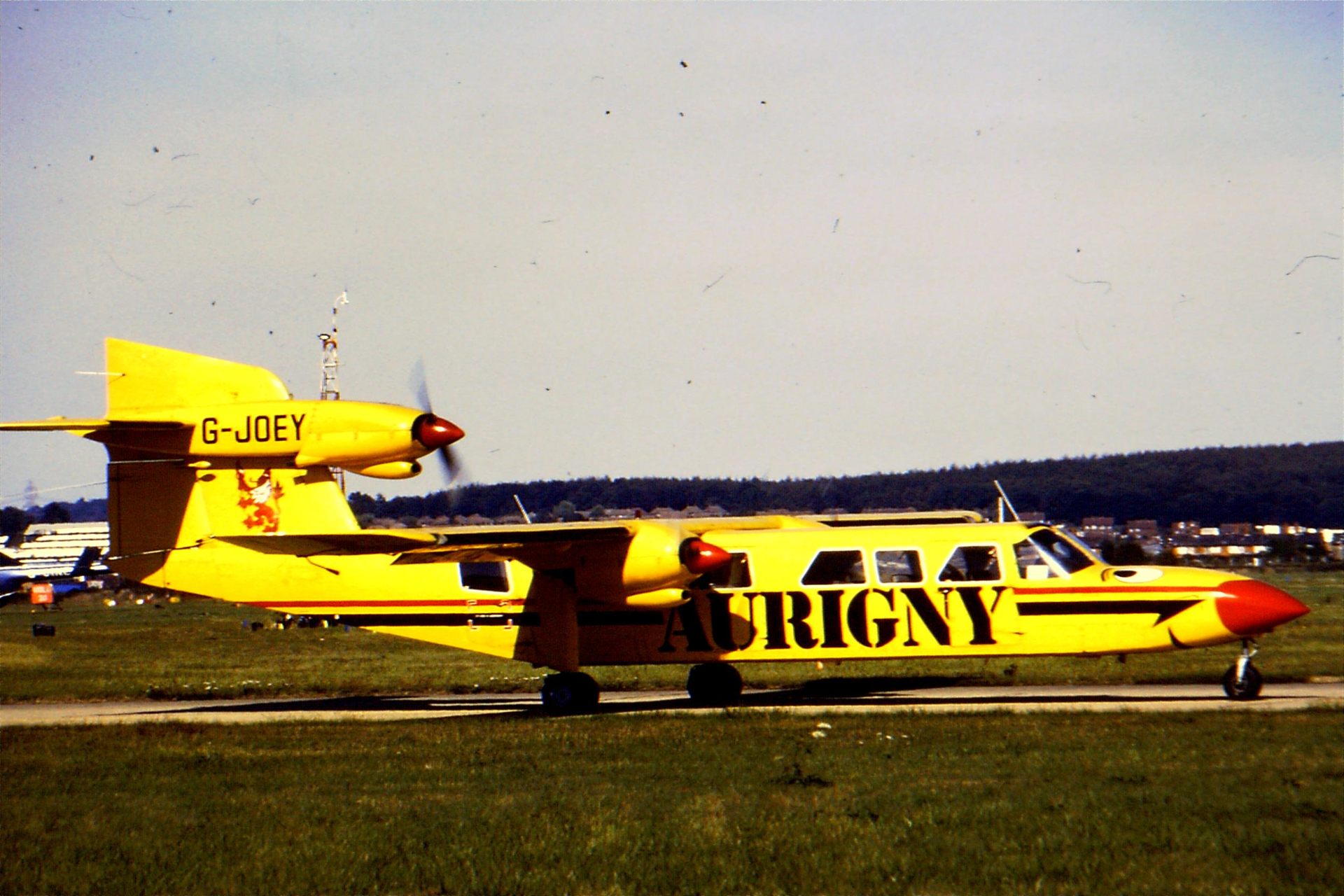
Pictured: an Aurigny Air Services Britten-Norman BN-2A Mk III Trislander — the same aircraft type, operator, and Southampton–Alderney (SOU–ACI) route Captain Bowyer was flying on April 23, 2007 — photographed at Southampton Airport. This is not a photograph of the sighting itself; no photograph or video of the object(s) is known to exist, since neither Bowyer nor his passengers had a camera to hand and no ground observer captured an image. (CC BY-SA 2.0, Gordon Bevan, Wikimedia Commons.)
Theoretical Alignment
The case aligns only weakly with any single UAP framework, largely because the objects were reported as stationary and non-interactive throughout the encounter — there was no approach, no pursuit, and no maneuver of the kind that would strongly favor a controlled-craft interpretation over a natural or optical one. What keeps the Extraterrestrial Hypothesis in play at all is the object's reported solidity, sharp edges, internal banding, and the fact that it was independently triangulated from two separated, moving aircraft on different headings — a form of corroboration a true optical phenomenon (which exists only along a specific observer-to-light sightline) cannot readily produce. The case aligns poorly with Psycho-Social explanations given that the primary witness was a trained, on-duty commercial pilot with no history of anomalous reports across a twenty-year flying career, corroborated within minutes by a second, wholly independent captain who had no opportunity to coordinate a story with him.
Background
Aurigny Air Services, the airline Bowyer flew for, has served as the primary lifeline carrier for the Channel Islands since 1968, operating short inter-island hops connecting Guernsey, Jersey, Alderney, and the UK mainland with a fleet that, in 2007, still relied heavily on the Britten-Norman BN-2A Mk III Trislander — a three-engined, high-wing utility airliner purpose-built for exactly this kind of short, low-altitude island-hopping route, and an aircraft type Aurigny operated in greater numbers, and for longer, than any other airline in the world. Bowyer's own route that afternoon, Southampton to Alderney, was one he had flown as a matter of routine for years; by his own account this was an ordinary working day, not a special or unusual flight in any respect, which is itself part of what makes the sighting notable — it was witnessed by a pilot with no reason to be primed for anything out of the ordinary and every professional incentive to interpret ambiguous stimuli conservatively.
The wider context in the spring of 2007 was, in UK ufology terms, a relatively quiet one: the Ministry of Defence's small UFO desk (staffed, at various points in earlier decades, by figures like Nick Pope) was in the process of winding down its involvement in individual case assessment, a process that would culminate a few years later in the closure of the dedicated UFO reporting line altogether. The MoD's operating position, consistently applied across the department's history, was that its interest in any reported sighting began and ended with the narrow question of whether UK airspace or defense was under threat — a mandate that, whatever its logic for a defense ministry, meant a case like Alderney, involving no military assets and no approach toward populated UK territory, was destined for minimal official investigation regardless of how well-corroborated the underlying testimony turned out to be. It is against that institutional backdrop that Bowyer's report entered the system: not investigated for its own sake, but processed, filed, and eventually declassified as one of hundreds of similar reports the department had quietly logged and set aside over the decades.
Complete Timeline
| Date / Time | Event |
|---|---|
| Apr 23, 2007, ~14:55 BST | Captain Ray Bowyer departs Southampton on a scheduled Aurigny Air Services Trislander service to Alderney, carrying five passengers. |
| ~15:00 BST, ~30 miles from Alderney, 4,000 ft | Bowyer spots a bright yellow-gold light approximately 10 miles west of Alderney (roughly 40 miles from his aircraft). His initial impression is that it may be sunlight reflected off large greenhouse glasshouses on Guernsey. |
| Shortly after | Using binoculars, Bowyer resolves the light into a sharply defined, flattened disc- or cigar-shaped object — "like a CD on its edge" — bright yellow-gold with a dark grey/black band roughly two-thirds of the way along its length, aspect ratio approximately 15:1. The object appears stationary, at an altitude he estimates at roughly 2,000 feet. |
| Same period | A second, apparently identical object becomes visible further off, positioned closer to Guernsey. Two passengers aboard the aircraft independently report seeing unusual colored lights at the same time. |
| ~15:00–15:10 BST | Bowyer radios Jersey Air Traffic Control. Zone controller Paul Kelly checks his radar and reports no solid contact, at most a very faint, ambiguous primary return he considers likely meteorological. |
| Same period, separately | Captain Patrick Patterson, flying a Blue Islands BAe Jetstream from the Isle of Man to Jersey on an unrelated route, independently observes a bright object roughly 1,950 feet below his own aircraft in the same general Alderney–Guernsey–Sark corridor. |
| Same period | Jersey ATC relays word to Bowyer that a second pilot has separately reported a similar sighting — the first either man learns of the other's observation. |
| Same afternoon | At least two visitors staying on Sark independently report seeing two bright yellow objects in the sky while returning to their hotel, unaware of either pilot's sighting. |
| ~15:09–15:15 BST | The first object remains continuously, clearly visible for approximately nine minutes; the full encounter, including the second object, lasts roughly twelve to fifteen minutes before Bowyer, prioritizing his passengers' safety and his flight schedule, discontinues close observation and continues to land at Alderney. |
| After landing, Apr 23 | Bowyer files a formal report with Aurigny's operations department and, as required by UK aviation regulation, submits an occurrence report to the Civil Aviation Authority. |
| Apr 25, 2007 | The Ministry of Defence states publicly it will not investigate the sighting, citing its standard policy of assessing reports only for UK defense significance. |
| ~Late April/early May 2007 | The MoD subsequently states the incident occurred within French, not UK, airspace, placing it outside its jurisdiction. |
| ~2 weeks later | The MoD releases further information, including reference to Patterson's independent statement; the Royal Air Force separately states Jersey's ATC radar is "secondary only" and incapable of primary contact — a claim in tension with controller Kelly's own account of a faint primary return. |
| June 2007 | Bowyer is interviewed by CNN and ITV about the sighting. |
| October 2007 | Bowyer submits a supplementary set of drawings of the two objects to the CAA. |
| Jul 30, 2008 | "Alderney Lights," the fourth episode of the documentary series Britain's Closest Encounters, examines the case in depth, featuring interviews with Bowyer and researcher David Clarke. |
| Nov 12, 2007 | Bowyer speaks at a UFO panel event at the National Press Club in Washington, D.C., organized by filmmaker James Fox and journalist Leslie Kean and moderated by former Arizona Governor Fife Symington III, alongside military and civilian witnesses from seven countries. |
| Aug 7, 2011 | The MoD's file on the case is released to the UK National Archives as part of a further tranche of declassified UFO records, catalogued as DEFE 24/2081/1. |
| 2013 | David Clarke publishes a partial transcript of the Jersey ATC recording and a technical assessment concluding the radar evidence is inconclusive and possibly attributable to a surface vessel. |
| 2021 | Journalist Gideon Lewis-Kraus revisits the case in a major New Yorker feature on the U.S. government's evolving posture toward UAP; Bowyer, interviewed again, offers a larger retrospective size estimate ("the size of five or six battleships") than his original 2007 statements. |
The Sighting Begins
Bowyer's Trislander was roughly thirty miles out from Alderney, cruising at 4,000 feet on a routine, entirely uneventful leg of a route he had flown for years, when he first noticed a bright yellow-gold light off to the side, roughly ten miles west of the island and, by his estimate, some forty miles from his own position. His first, unremarkable explanation was that he was seeing sunlight reflecting off one of the large commercial greenhouse structures — "vineries" — that dot Guernsey's landscape, a plausible enough guess for a pilot who flew this corridor daily and had likely seen exactly that kind of glare before. What broke that assumption was continued observation: raising his binoculars, Bowyer found the light resolving into something with a definite, sharply bounded shape rather than the diffuse, flickering character of a distant reflection. He would later describe it in strikingly specific, almost technical language — "a very sharply defined, solid, bright yellow-gold object with a couple of black bands on the side that were kind of shimmering," elsewhere comparing it to "a CD on its edge": a thin, elongated form with a length-to-height ratio he estimated at roughly 15:1, carrying a distinct dark grey or black band about two-thirds of the way along its length, with what he described as a shifting, sparkling boundary of blues and greens along one interface, strobing gently every second or so. Nothing in the object's visual profile, he was clear, resembled any aircraft he recognized from two decades of professional flying.
As Bowyer continued toward Alderney, a second object came into view beyond the first, positioned further west, closer to Guernsey, and by his account effectively identical in appearance to the first — the same yellow-gold coloring, the same banded structure, the same apparently motionless hang in the sky. Both objects remained, by every account, entirely stationary throughout the period Bowyer observed them: no directed movement, no approach toward his aircraft, no visible change in altitude or heading. He estimated their altitude at approximately 2,000 feet, well below his own cruising level, positioning them somewhere in the open airspace over the sea between the three islands rather than over any single one of them. Bowyer would later tell interviewers he found he was able to look directly at the object through binoculars "without discomfort" — a detail he and later commentators would cite as one argument against the object being anything related to direct sunlight glare, since staring at the sun itself, or its immediate reflected glare, is reliably uncomfortable even briefly.
Two passengers seated in the Trislander's cabin, without prompting from Bowyer, independently reported seeing something unusual at the same time — described in press coverage as "an orange light... like an elongated oval," a somewhat different color characterization than Bowyer's own "yellow-gold" but broadly consistent in describing a large, sharply defined, unfamiliar aerial light. Passenger corroboration from inside the same aircraft carries less independent evidentiary weight than a wholly separate witness group would, since the passengers were necessarily sharing Bowyer's general field of view and cabin environment, and it is not established from the public record whether Bowyer himself first drew their attention to it or whether they noticed independently. Even so, the fact that more than one person aboard, without being fed a specific script, converged on a broadly matching description of an unusual bright light in that part of the sky adds at least a modest layer of corroboration beyond Bowyer's account alone.
The Radio Call and the Second Pilot
With the sighting ongoing, Bowyer made the operationally sensible decision to notify air traffic control — both to have the observation logged in real time by an independent party and, more immediately, because an apparently large, unidentified object in controlled airspace at his altitude and route raised a legitimate safety concern serious enough that some later accounts characterized his report as effectively an informal near-miss or airspace-conflict notification. He reached Jersey's zone controller, Paul Kelly, and described what he was seeing. Kelly's response, preserved (imperfectly) in the ATC recording and later published in transcript form, was that his radar showed nothing solid corresponding to Bowyer's description — he would characterize what little he did see as, at most, a very faint primary contact he judged more likely to be of meteorological origin, such as a patch of unusually reflective cloud or precipitation, than a discrete physical object.
What happened next is the detail that elevates Alderney above the great majority of single-witness sightings: within a short window of Bowyer's own report, Jersey ATC informed him that another pilot, flying an entirely different route, had independently radioed in a broadly matching observation. That second pilot was Captain Patrick Patterson, at the controls of a Blue Islands British Aerospace Jetstream flying from the Isle of Man toward Jersey — a route that, geographically, would have brought him through or near the same general stretch of Channel airspace from a different direction and altitude than Bowyer's Southampton-to-Alderney track. Patterson reported a bright object roughly 1,950 feet below his own aircraft, broadly consistent in position and description with what Bowyer and his passengers were describing from their vantage point. Critically, Patterson had no prior knowledge of Bowyer's sighting when he made his own report; the two pilots' accounts reached the record independently and were only connected to each other after the fact, by air traffic control acting as an intermediary — a structure that rules out the most common explanation for multi-witness UFO reports, namely one witness's account contaminating or priming another's before either has finished forming their own impression. Patterson subsequently submitted his own separate written report to the CAA, a second, independently generated paper trail alongside Bowyer's.
Independent Ground Witnesses
The aerial sighting was not the only observation logged that afternoon. At least two visitors staying on the island of Sark — the small, car-free Channel Island lying between Guernsey and Alderney, directly under or near the flight corridor both aircraft were using — independently reported seeing two bright yellow objects in the sky while walking back to their hotel that same afternoon, with no apparent awareness at the time that two separate airline pilots were reporting essentially the same phenomenon from the air. A further, less-detailed report reached BBC Radio Guernsey from a listener describing a sighting near Les Casquettes lighthouse, off Alderney's western tip. None of these ground witnesses are named as extensively in the surviving record as Bowyer or Patterson, and their accounts are documented mainly through secondhand press summaries rather than formal written statements comparable to the CAA occurrence reports — a real limitation on how much independent weight they can bear evidentially. Even with that caveat, a geographically dispersed set of observers — two aircraft on different routes and altitudes, plus at least one ground vantage point on Sark — converging on a broadly matching description of two large, stationary, brightly colored aerial objects, within the same narrow window on the same afternoon, is a corroboration pattern well beyond what the median UFO report can offer.
The Object's Reported Characteristics in Detail
Setting the broad narrative aside, several of the more specific details Bowyer provided are worth examining closely, since they are what most directly bear on how well any single conventional explanation can account for the sighting. The object's edges, in Bowyer's account, were sharp and well defined rather than soft or diffuse — a detail that cuts against simple glare or unfocused reflection, both of which tend to produce fuzzy-edged bright patches rather than a crisply bounded geometric shape. Its coloring was consistently described as a saturated yellow-gold, occasionally elaborated as having a graphite-grey or black band roughly two-thirds along its length, with a narrower zone at that boundary described as shimmering or strobing with blues and greens roughly once per second — a level of structured, multi-color internal detail considerably more specific than "a bright light in the sky." The 15:1 length-to-height aspect ratio Bowyer estimated through binoculars is likewise a specific, falsifiable claim rather than a vague impression, describing something long, thin, and flattened rather than a simple point or disc. Bowyer's estimate of the object's absolute size grew substantially between his original 2007 statements (in which he compared it, at various points, to a Boeing 737 fuselage, and separately floated a "mile wide" estimate based on its angular size at an assumed forty-mile viewing distance) and his 2021 retrospective description to the New Yorker, in which he characterized it as "the size of five or six battleships" — a form of estimate inflation over a fourteen-year gap that is worth flagging honestly as a caution about memory and narrative drift in long-standing witness accounts, even where the core structural description (shape, color, banding, apparent stationarity) remained materially consistent across that same period.
Key Researchers
- Dr. David Clarke — Investigative journalist and Associate Professor at Sheffield Hallam University who has tracked successive National Archives UFO file releases for decades. Published the most rigorous independent analysis of the Alderney case, including a 2013 transcript of the Jersey ATC recording and a technical assessment of the radar evidence, concluding the radar data was "not helpful" and possibly attributable to a surface vessel, while separately noting the visual sightings themselves could not be "explained satisfactorily." Has described the case as one of the more intriguing entries among the MoD's declassified "X-Files."
- Michael Maunder — Author of Lights in the Sky: Identifying and Understanding Astronomical and Meteorological Phenomena, who proposed the sun dog (parhelia) explanation for the sighting, drawing on his published expertise in atmospheric and astronomical optical phenomena.
- Nick Pope — Former UK Ministry of Defence UFO desk investigator, who characterized the Alderney sighting as "the sort of sighting that is taken seriously and should be investigated thoroughly," noting that pilots are trained observers whose professional standing makes casual misidentification less likely than for an average civilian witness.
- Leslie Kean and James Fox — Journalist and documentary filmmaker who organized the November 2007 National Press Club UFO panel in Washington, D.C., at which Bowyer presented his account alongside military and civilian witnesses from seven countries, moderated by Fife Symington III.
Key Witnesses
Captain Ray Bowyer
Primary witness and the case's best-documented voice. A 50-year-old commercial captain with more than eighteen years of flying experience at the time of the sighting, Bowyer observed two stationary, sharply defined, banded yellow-gold objects for approximately nine to fifteen minutes through binoculars, filed a same-day CAA occurrence report, supplied supplementary drawings in October 2007, gave interviews to CNN and ITV, appeared in the 2008 documentary Britain's Closest Encounters, and spoke at the November 2007 National Press Club UFO panel in Washington, D.C. His account has remained structurally consistent across nearly two decades of retelling, though his absolute size estimate for the object grew substantially between 2007 and a 2021 New Yorker interview.
Captain Patrick Patterson
The case's second independent commercial-pilot witness. Flying a scheduled BAe Jetstream service from the Isle of Man to Jersey — an unrelated route that happened to cross near the same stretch of Channel airspace — Patterson independently observed a bright object roughly 1,950 feet below his own aircraft at approximately the same time as Bowyer's sighting, with no prior knowledge of Bowyer's report. He subsequently submitted his own separate written statement to the Civil Aviation Authority, providing a second, wholly independent paper trail corroborating the general time, location, and appearance of the phenomenon.
Paul Kelly
The on-duty controller Bowyer contacted during the sighting. Kelly checked his radar in real time and reported no solid contact, at most a very faint, ambiguous primary return he judged likely to be of meteorological origin — an assessment later scrutinized, and found largely unhelpful either way, by researcher David Clarke's 2013 transcript analysis. Kelly was also the intermediary who informed Bowyer that a second pilot (Patterson) had independently reported a similar sighting.
Passengers Aboard the Trislander
Two of the five passengers aboard Bowyer's aircraft independently reported seeing unusual colored lights at the same time as his own sighting, describing what press coverage characterized as "an orange light... like an elongated oval." Their accounts carry less independent evidentiary weight than a fully separate witness group would, since they shared Bowyer's cabin and general vantage point, but their spontaneous, broadly matching description adds a modest corroborating data point beyond the pilot's testimony alone.
Visitors on Sark
At least two visitors staying on the small island of Sark, near the flight corridor both aircraft were using, independently reported seeing two bright yellow objects in the sky that same afternoon while returning to their hotel, apparently unaware of either pilot's simultaneous aerial sighting until the story broke in the press days later — a genuinely independent, ground-based corroboration of the two-object description.
The Five Observables Assessment
Assessment: A sustained, apparently unsupported hover at roughly 2,000 feet implies some form of lift with no visible propulsion or structure, but because the entire case is testimonial rather than instrumented, this is classified as speculative rather than confirmed. No instant acceleration, hypersonic movement, or maneuvering of any kind was reported at any point — the objects, by every witness account, remained stationary for the full duration of the sighting, which is itself one of the case's more unusual features relative to typical "dogfight" or high-performance UAP reports. Low observability is explicitly absent: the object was brightly self-luminous and easily, continuously tracked by binoculars from a moving aircraft for up to fifteen minutes without difficulty. No air-to-water or other trans-medium transition was ever reported, consistent with an encounter that took place entirely over open water without the object approaching either the sea surface or land.
Evidence Assessment
Supporting Anomalous Origin
- Two fully independent, professionally licensed commercial pilots, flying separate aircraft on unrelated routes, gave broadly matching descriptions of a large, stationary, structured object within the same narrow time window
- Patterson's report reached the record without any prior knowledge of Bowyer's sighting, ruling out simple witness contamination between the two primary observers
- Two passengers aboard Bowyer's aircraft independently, spontaneously described unusual colored lights matching the general location and character of his sighting
- At least two ground witnesses on Sark independently reported two bright yellow objects the same afternoon, with no apparent knowledge of either aerial sighting
- Bowyer's initial, mundane explanation (sunlight off Guernsey greenhouses) was his own first hypothesis, which he abandoned only after sustained observation revealed a sharply bounded, banded, structured object — the behavior of a careful, non-credulous observer rather than someone primed to see a UFO
- Both primary witnesses filed named, professionally consequential reports with the Civil Aviation Authority, a regulator whose scrutiny gives commercial pilots a strong incentive against exaggeration
- An academic researcher (David Clarke) who investigated the case in depth concluded he was "unable to explain the UAP sightings satisfactorily," leaving genuine, unresolved room for the possibility of unusual physical processes
- The sighting's ~9–15 minute duration, far longer than a momentary glimpse, reduces the likelihood of simple misperception
Supporting Conventional Explanation
- No radar system reliably confirmed a discrete physical object at the reported position; the one faint contact recorded may correspond to a surface vessel rather than anything aerial
- Sun dogs (parhelia), a well-documented atmospheric optical phenomenon, were seriously proposed by a published expert on atmospheric optics and match several reported features (bright yellow-gold coloring, position roughly consistent with the sun's angle that afternoon)
- No photograph, video, or any instrumented sensor recorded the object; the entire case rests on testimony
- Bowyer's absolute size estimate grew substantially (from Boeing 737-scale to "five or six battleships") between his original 2007 statements and a 2021 retrospective interview, a pattern consistent with some degree of narrative or memory drift over time
- The Ministry of Defence, after review, concluded the sighting posed no threat to UK defense and declined to investigate further
Why "Credible"
Alderney earns a CREDIBLE rating, placing it in the same tier as cases like Red Bluff and slightly above it, on the strength of a witness-corroboration structure that is, in one specific respect, stronger than almost any other case on this site: two fully independent, professionally licensed commercial airline captains, flying separate aircraft on unrelated routes, with no opportunity to coordinate their accounts before both had been separately logged by air traffic control, converged on a closely matching description of a large, stationary, structured aerial object at essentially the same location and time. That structure — simultaneous, geographically separated, occupationally credentialed, mutually uncontaminated corroboration — is difficult to produce by chance and is not easily explained away by any single conventional account, including the case's own strongest candidate. Passenger testimony from within Bowyer's own aircraft and independent ground observation from visitors on Sark add further, if individually weaker, corroborating layers. Both pilots' willingness to file named, professionally consequential reports with their industry regulator, and the Ministry of Defence's own decision to retain rather than discard the resulting file until its 2011 declassification, both weigh in the case's favor.
What keeps the case from the "Verified" tier, and from scoring even higher within "Credible," is the genuine absence of reliable instrumented confirmation and the real, unresolved strength of its leading conventional rival. Unlike a case where the official explanation is demonstrably, checkably wrong — astronomically impossible star positions, a documented launch log placing a balloon at the exact wrong time — Alderney's leading skeptical candidate, sun dogs, is a legitimate atmospheric-optics phenomenon proposed by a credentialed expert in exactly that subject, and it accounts for real features of the sighting (color, general sky position) even as it struggles badly with others (the reported 2,000-foot altitude, the sharp edges, and above all the multi-aircraft triangulation problem). No radar system produced a reliable track; the one ambiguous contact recorded may well have been a boat. No photograph or instrument recorded anything. A case whose strongest conventional rival remains genuinely contested rather than cleanly refuted, resting on testimony corroborated across an unusually strong two-independent-pilot structure but without any instrumented backstop, sits solidly in the Credible tier — a case that, by the honest assessment of even the researchers who investigated it most rigorously, remains not satisfactorily explained.
Sensor & Instrumentation Detection Profile
The case's instrumented record is thin and, on close examination, unhelpful to either side of the debate. During the encounter, Bowyer radioed Jersey Air Traffic Control's zone controller, Paul Kelly, who checked his radar scope in real time and reported that nothing solid appeared on it — at most, by his own account, "a very faint primary contact," which he considered likely to be of meteorological origin rather than a discrete aerial target. Because the object(s) were reported as stationary, Jersey's secondary surveillance radar (which relies on aircraft transponders and typically filters out non-moving returns as clutter) would not have displayed them under normal operation regardless of whether something physical was present at that position. Popular retellings of the case have sometimes claimed that Jersey's primary, low-level radar system separately recorded two slow-moving targets for a 55-minute period, distinct from the known transponder-equipped aircraft in the area; this claim circulated widely in press and online coverage but does not hold up against the more rigorous record. In 2013, academic researcher Dr. David Clarke published a transcript of the actual air-traffic-control recording and, together with a subsequent independent technical review, concluded that "the radar evidence examined is not helpful in establishing the presence of unusual phenomena," noting that the one faint contact recorded below the visually estimated position of one object "may have been associated with an identifiable moving surface vessel" — that is, very possibly a boat on the water, not the reported aerial object at all — and that the low sample rate and use of moving-target-indication (MTI) filtering further degraded what little data existed. Muddying the picture further, when the Royal Air Force was asked to comment on the radar question weeks later, it stated that Jersey's air traffic control radar was "secondary only" and "therefore unable to achieve primary radar contact" — a claim that directly contradicts Kelly's own account of having checked a primary return, however faint, and one of several small but genuine inconsistencies between different official statements on the case. No FLIR, gun-camera, weather-radar loop, or other instrumented sensor is known to have recorded the object.
Environmental & Geospatial Context
Alderney is the northernmost and third-largest of the Channel Islands, a self-governing dependency within the Bailiwick of Guernsey, lying roughly ten miles off the Cotentin coast of Normandy and separated from mainland Britain by more than sixty miles of open Channel water. The sighting occurred not over the island itself but over the sea corridor between Alderney, Guernsey, and Sark — wide open airspace with unobstructed sightlines in every direction, crossed daily by a small number of short-hop inter-island flights and by longer routes, like the Blue Islands service Captain Patterson was flying, passing through en route to Jersey or the UK mainland. The afternoon was clear and sunny with good visibility, conditions explicitly cited by proponents of the case's leading conventional explanation as consistent with the kind of high-altitude cirrus ice-crystal cloud that produces sun dogs (parhelia); no contemporaneous meteorological report confirming actual cirrus cover at the relevant altitude over the sighting location has been located, however, and this remains an inference rather than a documented fact. Geologically, the Channel Islands sit within a region of low but non-zero seismic activity in the English Channel/Dover Strait area; five days after the sighting, on April 28, 2007, a magnitude 4.3 ML earthquake struck near Folkestone, Kent — more than 130 miles to the northeast of Alderney and on the opposite, English side of the Channel — a coincidence in timing (but not location) that some commentators later raised in connection with the sighting. No French or UK military exercise, missile test, or training area is documented as active in the immediate vicinity of the sighting position at the relevant time, and the location itself, over open water roughly equidistant from Alderney, Guernsey, and Sark, does not correspond to any charted danger area or restricted airspace on either side of the Channel.
Observer Credibility & Occupational Profile
The case's evidentiary weight rests overwhelmingly on the occupational credentials of its two primary witnesses, both licensed, professionally examined commercial airline captains with no history of anomalous reporting. Ray Bowyer was, at the time of the sighting, a 50-year-old captain with Aurigny Air Services holding more than eighteen years of flying experience, the bulk of it flying the same short inter-island routes daily — a pilot, in other words, whose entire professional competence rested on the ability to reliably distinguish familiar air traffic, coastal lighting, and weather phenomena from something genuinely anomalous, since misjudging any of those things routinely would be a career-ending failure of airmanship. Bowyer's own account is notable for its restraint: his first instinct on spotting the light was the mundane explanation that it might be sunlight reflecting off large greenhouse ("vinery") glass structures on Guernsey, and he only escalated his assessment after continued observation through binoculars revealed a sharply bounded, banded, apparently solid structure inconsistent with a simple reflection. Patrick Patterson, the second pilot, was likewise a professionally licensed captain, flying a scheduled Blue Islands service on an entirely unrelated route (Isle of Man to Jersey) that happened to pass near the same stretch of Channel airspace; critically, Patterson's report reached the record independently of Bowyer's, relayed to Bowyer only after the fact by air traffic control, meaning the two men's descriptions cannot be explained by one witness's account contaminating the other's in the moment. Both men filed formal, named reports with the Civil Aviation Authority — a regulator that treats a pilot's professional standing as directly at stake in the accuracy of any safety report they file, which cuts hard against any incentive to exaggerate or fabricate. The passenger testimony is weaker evidentially, since passengers aboard the same aircraft as Bowyer were necessarily sharing his vantage point and, in at least some cases, had the object pointed out to them, but two passengers' independent, unprompted descriptions of "unusual colored lights" broadly consistent with what Bowyer himself reported still add a modest corroborating data point. The ground witnesses on Sark, by contrast, appear to have made their observation entirely independently of the two aircraft, with no evidence either group of witnesses was aware of the other's sighting until press coverage broke days later.
Physical & Material Assays
No physical or material evidence of any kind exists in this case. Nothing was recovered from the ground or sea, no debris or landing trace was ever reported (unsurprising, since the entire encounter took place over open water at altitude), and no photograph, video, or audio recording of the object is known to survive — neither Bowyer nor his passengers had a camera to hand in the cockpit or cabin, and no ground-based observer on Sark, Guernsey, or Alderney is known to have photographed the sky at the relevant time. The closest things to durable physical artifacts the case has produced are entirely documentary: Bowyer's original April 23, 2007 CAA occurrence report and a supplementary set of drawings he provided to the CAA in October 2007, Patterson's separate written statement to the same regulator, and the Ministry of Defence's internal file, which survived in government hands for years before its 2011 release to the National Archives as DEFE 24/2081/1. These are genuine primary-source artifacts — contemporaneous, signed, and institutionally logged — but they document testimony, not the object itself.
Historical Precedents & Archive Matches
Alderney belongs to a small, high-value category of UK cases anchored by professionally licensed pilot testimony rather than lay civilian reports — a category researchers have long argued deserves more weight than the average sighting precisely because of what commercial licensing and type-rating requires of an observer. The most directly comparable UK case on record is the Rendlesham Forest Incident of December 1980, which similarly generated an official MoD file and became a touchstone case for UK ufology, though Rendlesham involved military rather than civilian witnesses and included physical trace claims Alderney does not share. Structurally closer still is the pattern seen in the 1986 JAL Flight 1628 case over Alaska, in which a highly experienced cargo captain's sighting was partially corroborated by a separate aircraft and by ground radar, generating a rare FAA-investigated, professionally-witnessed case with a genuinely disputed conventional explanation. The two-separate-pilots-two-separate-aircraft corroboration structure at Alderney also echoes, in miniature, the multi-witness radar-visual pattern established at RAF Lakenheath-Bentwaters in 1956, though that case had a far stronger (if also contested) radar component than Alderney's ambiguous single blip. David Clarke, who has spent much of his career combing successive National Archives UFO file releases, has specifically described Alderney as one of the more intriguing entries among the declassified MoD "X-Files," a characterization consistent with how the file has been treated by other researchers working the same archive.
Material Analysis
As with the great majority of purely visual aerial encounters, Alderney has produced no physical or material evidence in the conventional forensic sense — no soil disturbance, no recovered debris, no metallurgical or isotopic sample, and no burn or landing trace of any kind, a straightforward consequence of an encounter that took place entirely over open water at altitude rather than on or near land. The case's closest analogue to physical evidence is documentary rather than material: Bowyer's contemporaneous CAA occurrence report and his October 2007 supplementary drawings, Patterson's independent written statement, and the surviving Ministry of Defence file, released to the National Archives in 2011 as DEFE 24/2081/1. These are genuine primary-source artifacts in the sense that they are dated, signed, and institutionally preserved records created close in time to the event by the people who experienced it directly — a meaningfully stronger evidentiary form than an undated secondhand retelling, even though none of them constitute physical trace evidence of the object itself. The single quasi-instrumented record the case generated, the faint and disputed radar contact, functions analogously to physical evidence in that it was, however briefly, an independent data source outside the witnesses' own testimony — but because it was never confirmed as a reliable primary target, and was subsequently assessed as possibly attributable to a boat on the water, it cannot be treated as corroborating physical evidence in any meaningful sense.
Supporting Non-Terrestrial or Genuinely Anomalous Origin
- Two independently generated, dated, signed CAA occurrence reports exist from two separate professional pilots, a documentary record considerably more substantial than an undated secondhand retelling
- The Ministry of Defence's own file on the case, preserved and eventually declassified rather than destroyed, indicates the report was taken seriously enough within government to be retained for years
Supporting Terrestrial or Misidentification Origin
- The complete absence of any physical trace, photograph, or instrumented recording is consistent with a purely optical/atmospheric phenomenon, which by definition leaves nothing behind to recover or photograph accidentally
- Without a reliable radar track, there is no independently re-examinable instrument record the way an archived, printed Blue Book radar plot sometimes offers researchers
The Conventional Explanation Candidate
Three genuinely distinct terrestrial explanations have been proposed for the Alderney sighting, plus a narrower fourth candidate addressing the radar component alone. Each deserves serious, honest evaluation on its own terms — the Omni Ledger's editorial standard is to weigh the strongest available conventional case exactly as carefully as the anomalous reading, not to dismiss it because the case is a favorite of ufology, and not to accept it uncritically because a credentialed expert proposed it.
Sun Dogs (Parhelia) — Atmospheric Ice-Crystal Optics
The most seriously proposed conventional explanation comes from Michael Maunder, author of the reference work Lights in the Sky: Identifying and Understanding Astronomical and Meteorological Phenomena, who suggested the sighting was consistent with sun dogs (parhelia) — bright, often colored patches of light produced when sunlight refracts through hexagonal ice crystals in high-altitude cirrus cloud, typically appearing at approximately 22 degrees to either side of the sun and at the same apparent altitude above the horizon as the sun itself. Conditions that afternoon (clear, sunny, good visibility) are consistent with, though not independently confirmed as having actually produced, the kind of thin cirrus cloud sun dogs require, and the reported positions of the two objects were, by some accounts, roughly 22 degrees from the sun's position — a genuinely suggestive match. The theory also accounts reasonably well for the bright yellow-gold coloring Bowyer described, since sun dogs commonly show a reddish tint closest to the sun fading through yellow toward a bluish-white outer edge, broadly consistent with the shimmering blue-green boundary Bowyer reported.
The explanation has real, specific problems, however, that the CEC standard requires stating plainly rather than glossing over. Sun dogs form in cirrus-level ice crystals typically found at 20,000 feet or higher — not at the roughly 2,000 feet Bowyer explicitly estimated for the objects, a mismatch of an order of magnitude that Bowyer himself, along with other witnesses, specifically cited in rejecting the theory. More fundamentally, a sun dog is a fixed-geometry optical phenomenon that exists only along a specific sightline between a given observer, the sun, and the ice crystals producing the halo — it has no true physical location in three-dimensional space, moves with the observer exactly as a rainbow does, and cannot in principle be triangulated to a single, shared, fixed point by two separated observers viewing from different positions and headings the way a real physical object can be. Bowyer and Patterson, flying different aircraft on different routes at different times relative to each other, nonetheless converged on a broadly consistent description of an object at essentially the same geographic position — a pattern considerably harder to explain via independent, coincidentally similar sun dogs (each pilot's own, personal, sun-relative halo, misidentified by each as a fixed external object) than it first appears, though it is not strictly impossible, since two pilots flying similar headings relative to the sun at a similar time of day could plausibly generate visually similar personal sun-dog geometries independently. Bowyer's own report of being able to view the object "without discomfort," and its consistently sharp, unmoving edges rather than the softer, more diffuse character typical of an atmospheric halo, add further, if not conclusive, friction to the theory. Even David Clarke's own formal investigation, working with outside experts specifically to test whether a satisfactory conventional explanation existed, concluded it could not "explain the UAP sightings satisfactorily" — a notably candid admission from a researcher not otherwise inclined toward anomalous readings of MoD case files.
Earthquake Lights (Seismic Luminescence)
Bowyer himself, when the possibility was raised by a BBC interviewer, said he would accept earthquake lights as a possible explanation — a scientifically documented, if still incompletely understood, phenomenon in which mechanical stress on certain rock types generates transient electrical charges capable of producing visible light, associated in some historical cases with luminous phenomena preceding or accompanying seismic events. The theory drew added attention because a magnitude 4.3 ML earthquake struck near Folkestone, Kent, five days after the sighting, on April 28, 2007 — a temporal coincidence that at least one geophysicist is reported to have examined in connection with the case. The theory does not hold up well on closer examination, however: the Folkestone epicenter lay more than 130 miles northeast of Alderney, on the opposite side of the Channel, with no documented geological connection between the two locations' fault systems; the sighting occurred five days before, not during or immediately preceding, the seismic event, a gap most earthquake-light research associates with a much narrower pre-shock window measured in hours to at most a few days at the epicenter itself; and, perhaps most fundamentally, the sighting took place entirely over open sea water rather than over or near the kind of stressed continental rock formations earthquake-light mechanisms are understood to require, a point independent researchers examining the theory have specifically flagged as making an over-water origin unlikely.
Sunlight Reflection off Greenhouses (Guernsey Vineries)
Bowyer's own first, immediate hypothesis — that he was seeing sunlight reflecting off Guernsey's large commercial greenhouse glass structures — deserves inclusion precisely because it was the leading witness's own initial, non-anomalous instinct, evidence of a cautious observer rather than one primed to see a UFO. It does not survive the rest of the sighting, however: a fixed ground-based reflection would present at a essentially constant bearing from a single, specific point on Guernsey as Bowyer's aircraft continued to move, not as a large, stable object independently locatable by a second aircraft on an entirely different heading and route; nor would greenhouse glare naturally explain the internal banding, the sharply defined edges, or the extended duration over which the object's apparent size and position remained essentially unchanged from two different, non-stationary vantage points.
Radar Contact as a Misidentified Surface Vessel
A narrower, more defensible partial explanation addresses only the radar component of the case: David Clarke's technical review concluded the one faint primary contact recorded may have corresponded to an identifiable moving surface vessel on the water below, rather than to anything aerial at all. This is a genuinely plausible, and arguably the single most defensible, conventional finding to emerge from the case — but by design it explains only the ambiguous radar blip, not the extended visual sighting independently reported by two pilots, several passengers, and multiple ground witnesses.
Sun Dogs (Parhelia)
InconclusiveINCONCLUSIVE. A genuinely credible optical explanation for some features (color, sun-relative position), seriously undermined by the reported 2,000 ft altitude (versus the 20,000+ ft cirrus layer sun dogs require) and by the geometric difficulty of two separately positioned observers triangulating a true observer-relative optical artifact to one shared location. Even the case's own formal investigators could not resolve it either way.
Earthquake Lights
ImplausibleIMPLAUSIBLE. The nearest associated earthquake struck 130+ miles away, on the opposite side of the Channel, five days later — well outside the geographic and temporal window earthquake-light mechanisms are understood to require — and the sighting occurred over open water rather than over stressed continental rock.
Sunlight Reflection off Guernsey Greenhouses
ImplausibleIMPLAUSIBLE as a complete explanation, though plausible only as Bowyer's own first, brief misimpression before continued observation and independent triangulation from a second aircraft ruled it out.
Radar Contact as Misidentified Surface Vessel
Inconclusive (radar leg only)INCONCLUSIVE, and the single most defensible conventional finding on offer — but it addresses only the faint, ambiguous radar blip, not the independently corroborated multi-witness visual sighting that anchors the case.
Related Cases
Confirmed Documents & Official Records
The MoD's own file on the Alderney sighting, containing Bowyer's report and related correspondence, released as part of the department's ongoing UFO file declassification program and catalogued under reference DEFE 24/2081/1.
UNCLASSIFIED (declassified, with redactions)The National Archives' overview of the full Ministry of Defence UFO file collection, within which the Alderney case (DEFE 24/2081/1) is catalogued alongside hundreds of other declassified reports spanning six decades.
UNCLASSIFIED (declassified)The CAA's official page describing the Mandatory Occurrence Reporting (MOR) scheme under which Bowyer and Patterson each filed their same-day and follow-up safety reports on the sighting; individual MOR submissions are not published, but the regulatory framework itself is a matter of public record.
Public regulatory informationSearch Government Archives Directly
Further Reading — Recommended Literature
UFOs: Generals, Pilots, and Government Officials Go on the Record
By the journalist who co-organized the November 2007 National Press Club panel at which Bowyer presented his account; this book, drawing on that same body of credentialed testimony, situates Alderney within the broader case Kean makes for taking professionally-witnessed sightings seriously.
The UFO Files: The Inside Story of Real-life Sightings
Written by the Sheffield Hallam academic who produced the most rigorous independent radar and ATC-transcript analysis of the Alderney case, drawing on his decades of work with the National Archives' declassified MoD UFO files.
Out of the Shadows: UFOs, the Establishment and the Official Cover-Up
Clarke's earlier, foundational study of how the British government's UFO files were compiled, restricted, and eventually released — the same institutional pipeline that produced the Alderney file (DEFE 24/2081/1) declassified in 2011.
Lights in the Sky: Identifying and Understanding Astronomical and Meteorological Phenomena
The reference work by the author who first proposed the sun dog (parhelia) explanation for the Alderney sighting; essential reading for evaluating that hypothesis's genuine strengths and its specific altitude and geometry problems in this case.
The UFO Encyclopedia, 4th Edition
The definitive modern UFO reference work, with an extensively cross-referenced entry situating Alderney among the small set of post-2000 European cases anchored by multiple credentialed commercial-pilot witnesses.
Essential Viewing
Captain Ray Bowyer on His Encounter w/ MASSIVE UFOs, Alderney 2007
A first-person, in-depth interview with Captain Ray Bowyer, walking through the sighting, the CAA report, and the radar and MoD aftermath directly in his own words.
2007-04-23: Alderney UFO with Captain Ray Bowyer
A case-focused review of the April 23, 2007 sighting, dedicated specifically to the Alderney encounter and its documentary record.
Sources
- Wikinews. "Pilots spot 'UFOs' near the Channel Islands," April 26, 2007 (sourcing Joel de Woolfson, This is Guernsey, and BBC News). en.wikinews.org
- The Register. "UK airline pilots spot giant UFO — 'Mile wide' mystery object hovers off Channel Islands," April 27, 2007. theregister.com
- How and Whys. "UK Most Credible UFO Incident: British Channel Islands UFO Sighting In 2007." howandwhys.com
- British UFO Research Association (BUFORA). "The Alderney Channel Islands UFO Incident." bufora.org.uk
- Mysterious Britain & Ireland. "2007 Alderney UFO Sighting." mysteriousbritain.co.uk
- Metabunk (discussion forum, citing David Clarke's technical report and ATC transcript analysis). "The Alderney UFO sighting." metabunk.org
- Openminds.tv. "Credible UFO sighting by pilots and crew in new UK files." openminds.tv
- On This Day in Guernsey. "Aurigny pilot Ray Bowyer spots a UFO near Alderney." history.gg
- Clarke, David. "The Inconvenient Truth is Out There…," August 7, 2011 (National Archives DEFE 24/2081/1 release). drdavidclarke.co.uk
- Clarke, David. "Air Traffic Control, UFOs and the FOIA," August 19, 2012 (CAA Mandatory Occurrence Reports, including the Alderney case). drdavidclarke.co.uk
- The National Archives (UK). "Digital copy of DEFE 24/2081: UFO reports; with redactions." discovery.nationalarchives.gov.uk
- The National Archives (UK). "UFO reports," Explore the Collection. nationalarchives.gov.uk
- UK Civil Aviation Authority. "Occurrence reporting" (Mandatory Occurrence Reporting Scheme). caa.co.uk
- British Geological Survey. "Folkestone Earthquake, 28 April 2007, 07:18 UTC, 4.2–4.3 ML." earthquakes.bgs.ac.uk
- Maunder, Michael. Lights in the Sky: Identifying and Understanding Astronomical and Meteorological Phenomena, Springer, 2007 (sun dog/parhelia analysis proposed for this case).
- Lewis-Kraus, Gideon. "How the Pentagon Started Taking U.F.O.s Seriously," The New Yorker, April 30, 2021 (2021 retrospective interview with Bowyer).
- Wikipedia contributors. "2007 Alderney UFO sighting" (used only for cross-checking uncontested chronological facts against the primary sources above). en.wikipedia.org
- Wikipedia contributors. "Britten-Norman Trislander" (aircraft type background). en.wikipedia.org
- Bevan, Gordon. "Aurigny Trislander G-JOEY at SOU," Wikimedia Commons (hero photograph source and license). commons.wikimedia.org
- "Britain's Closest Encounters," Season 1, Episode 4: "Alderney Lights" (documentary, first broadcast July 30, 2008; directed by Nigel Levy, featuring interviews with Ray Bowyer and David Clarke).
- National Press Club UFO panel, Washington, D.C., November 12, 2007 (organized by James Fox and Leslie Kean, moderated by Fife Symington III; Bowyer among the panelists).
See something inaccurate? Have additional information or sources?
Suggest an Edit →Last Updated: August 2026