
Carson Sink Incident
At 3:40 PM MST on July 24, 1952, U.S. Air Force Lieutenant Colonels John L. McGinn and John R. Barton were flying a twin-engine B-25 bomber, requisitioned from Hamilton Field north of San Francisco, at 11,000 feet over the Carson Sink desert east of Reno, Nevada, en route to Colorado Springs, when three bright silver, delta-shaped objects banked sharply toward their aircraft and closed to within 400 to 800 yards in a matter of seconds before accelerating away and vanishing in roughly four seconds total. The two colonels — senior Pentagon staff officers whose duties put them in daily contact with the specifications and silhouettes of every U.S. and known foreign aircraft type then flying — estimated the objects' speed at a minimum of three times that of an F-86 Sabre, one of the fastest operational fighters in the world at the time. On landing, they personally telephoned Air Defense Command headquarters and confirmed that no civilian or military aircraft of any kind had been operating anywhere near Carson Sink at that hour. Logged as Project Blue Book case #1584, the sighting was formally filed as "Unidentified" and has never been revised. Captain Edward J. Ruppelt, the officer who headed Blue Book at the time, later wrote in his own book that it was "a good UFO report with an unknown conclusion" — and, by the assessment of Blue Book's own surviving records, it remains one of the strongest cases the program's "Unidentified" file ever produced.
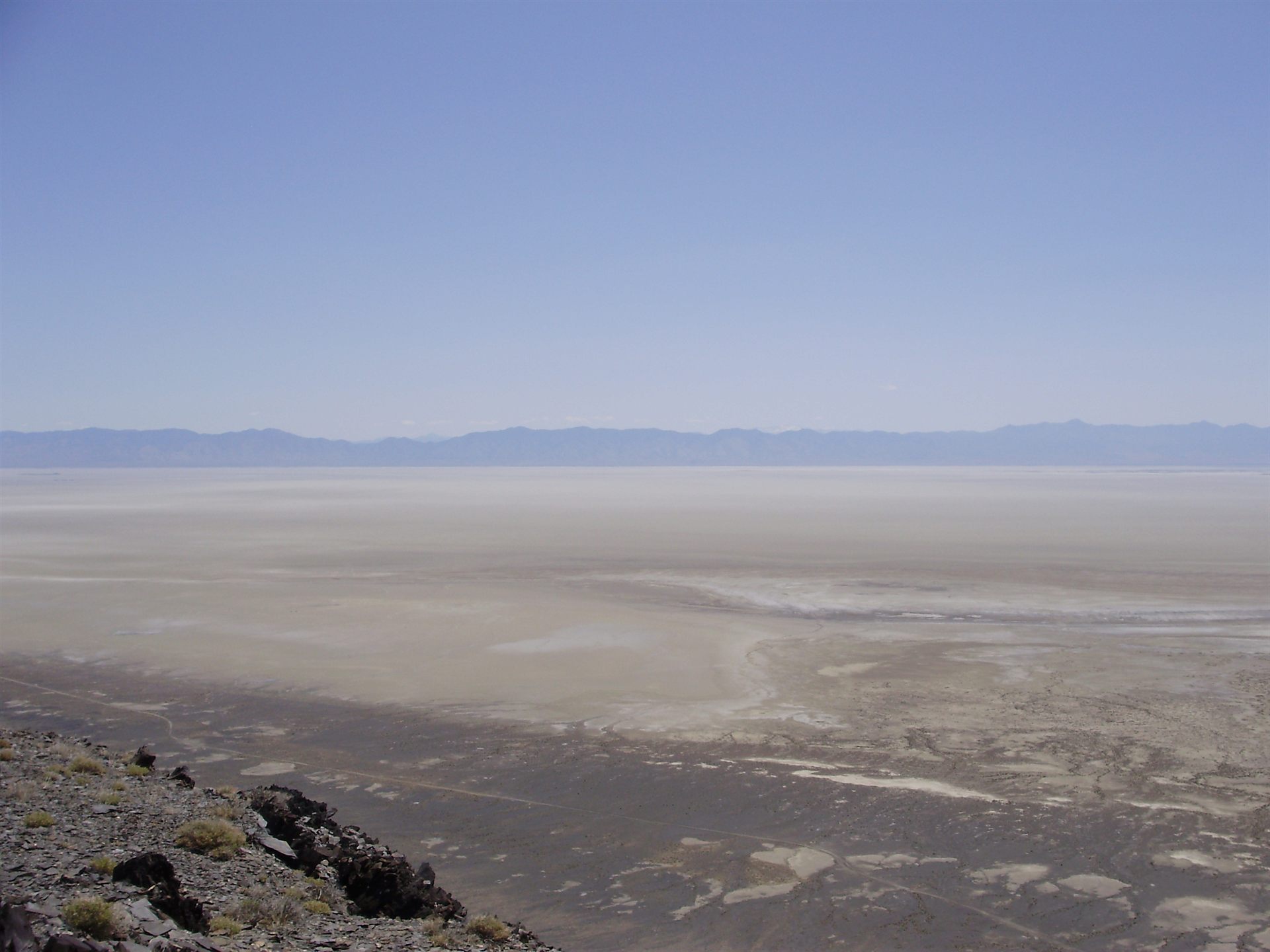
Pictured: the Carson Sink playa in Churchill County, Nevada, viewed from Topog Peak — the same high desert basin the B-25 crossed at 11,000 feet on July 24, 1952, though not the exact flight path or vantage point of the encounter itself. No photograph of the incident exists; the sighting lasted only three to four seconds and neither colonel had a camera aboard the bomber. (CC BY-SA 3.0, Famartin, Wikimedia Commons.)
Theoretical Alignment
The case aligns most readily, though modestly, with the Extraterrestrial Hypothesis insofar as it describes three physically solid, structurally consistent craft executing a coordinated maneuver — a synchronized hard bank toward the B-25 — at a rate of closure and departure speed that both witnesses, professional military pilots, judged categorically beyond any aircraft either one recognized. It aligns poorly with the Interdimensional Hypothesis, since nothing in the account involves reality distortion, missing time, or any anomaly beyond extreme aerodynamic performance. It aligns essentially not at all with Psycho-Social explanations: both witnesses were sober, on-duty, professionally trained officers making a routine cross-country ferry flight with no prior expectation of encountering anything unusual, and their first instinct on landing was not to publicize the story but to quietly telephone Air Defense Command to rule out a mundane cause.
Background
By July 1952, Project Blue Book was barely four months old. Captain Edward J. Ruppelt had reorganized the Air Force's UFO investigation effort out of the smaller, more dismissive Project Grudge that March, renaming it Blue Book and adopting the term "Unidentified Flying Object" specifically to replace the more sensational and press-friendly "flying saucer." Blue Book operated under the Air Technical Intelligence Center (ATIC) at Wright-Patterson Air Force Base in Dayton, Ohio, with a mandate that was explicitly dual: determine whether the reports represented any threat to national security, and separately, evaluate them on their scientific merits rather than dismiss them reflexively. The timing put Ruppelt's young organization directly in the path of the largest single surge of sighting reports the Air Force would ever process — 1952 alone would generate 1,501 official Blue Book reports, roughly triple the volume of any prior year, cresting through the summer months and forcing ATIC to develop, in cooperation with the Battelle Memorial Institute, a new machine-indexing system simply to keep the incoming case files organized.
Carson Sink itself, the location, had no prior connection to the UFO phenomenon before that afternoon; it was, and remains, simply a vast, empty, sparsely traveled stretch of Nevada high desert along a federal cross-country air corridor — the kind of place two colonels flying a requisitioned bomber from California to Colorado would cross without incident on any other day. Hamilton Field, the B-25's point of origin, was itself a major U.S. Army Air Forces and, by 1952, U.S. Air Force installation north of San Francisco in Marin County, California, used routinely for exactly this kind of cross-country aircraft ferrying and personnel transport between West Coast and interior bases. The bomber's destination, Colorado Springs, was home to Ent Air Force Base, headquarters of the Air Defense Command since the command's establishment in January 1951 — the same headquarters McGinn and Barton would telephone within hours of the sighting to check their own account against official air-traffic records, a detail that only makes sense in light of exactly where their flight was already headed that day.
McGinn and Barton's own positions at the Pentagon placed them near, though not directly inside, the growing institutional anxiety about UFO reports that would culminate later that same month in President Truman's own quiet inquiry into the Washington sightings and, the following January, in the CIA-convened Robertson Panel. Neither colonel is documented as having any prior involvement with UFO reporting, investigation, or advocacy before July 24, 1952; their sighting was, by every account in the record, an unplanned, unsought encounter during an otherwise routine ferry flight — precisely the kind of witness profile Blue Book's own analysts considered most credible: professionally qualified, institutionally unmotivated to fabricate or embellish, and reporting through official channels rather than to the press.
Complete Timeline
| Date / Time | Event |
|---|---|
| July 24, 1952, daytime | Lt. Cols. John L. McGinn and John R. Barton depart Hamilton Field, north of San Francisco, in a twin-engine B-25 bomber requisitioned for a cross-country ferry flight to Colorado Springs, Colorado, flying the Green 3 federal airway. |
| 3:40 PM MST | At 11,000 feet and 185 knots airspeed over the Carson Sink area east of Reno, Nevada, the two pilots spot three unidentified objects ahead and to their right, at roughly the 1 o'clock position. |
| Same moment | The three objects — bright silver, delta or arrowhead-shaped, each with a distinct ridge running nose to tail, no visible tail fins or canopy, flying in a tight V formation — make a sharp, coordinated left bank and accelerate directly toward the B-25. |
| Within seconds | The objects close to an estimated 400 to 800 yards (roughly 1,200 to 2,400 feet) from the bomber, comparable in apparent size to F-86 fighters at that range, before continuing past and away. |
| ~4 seconds after first sighting | The objects, now estimated by the pilots to be traveling at a minimum of three times the speed of an F-86 Sabre, pass out of visual range entirely; the total encounter, from first sighting to disappearance, lasts approximately three to four seconds. |
| Later that day | McGinn and Barton continue their flight and land at Colorado Springs, home of Ent Air Force Base, headquarters of the Air Defense Command. |
| On landing | The two colonels personally telephone Air Defense Command headquarters to check whether any known aircraft, civilian or military, had been operating near Carson Sink at 3:40 PM. ADC and Flight Service records confirm no such traffic, and no weather or research balloon activity, anywhere in the area. |
| July 24–25, 1952 | The sighting is formally logged as an Air Intelligence Information Report and forwarded to the Air Technical Intelligence Center (ATIC) at Wright-Patterson Air Force Base — one of approximately 22 reports reaching ATIC that single day and roughly 100 logged worldwide for July 24, near the peak of the 1952 wave. |
| Following days | Blue Book investigators research every delta-wing jet aircraft then flying — at that date operated essentially exclusively by the U.S. Navy in prototype and test form — and confirm none were within any plausible distance of the Green 3 airway that afternoon. |
| 1952 (case closed, unresolved) | Project Blue Book formally classifies the Carson Sink sighting "Unidentified" — Case #1584 — after exhausting the standard categories (aircraft, balloon, astronomical, and known experimental craft) without finding a match. |
| January 1953 | Major Dewey Fournet, Blue Book's Pentagon liaison, presents a "motions study" of radar-visual and multiple-witness cases to the CIA-convened Robertson Panel, arguing that a subset of cases showed evidence of intelligently controlled flight; the Carson Sink sighting is identified as "Case 11" in Fournet's presentation materials, one of a seventeen-case handout distributed to the panel. |
| 1956 | Edward J. Ruppelt publishes The Report on Unidentified Flying Objects, discussing the Carson Sink case directly and characterizing it as "a good UFO report with an unknown conclusion." |
| 2000 | Researcher Michael D. Hall includes the case in UFOs: A Century of Sightings and, with Wendy A. Connors, in Captain Edward J. Ruppelt: Summer of the Saucers — 1952, both drawing on Ruppelt's private papers and the underlying Blue Book file. |
| September 25, 2005 | NICAP's Francis Ridge compiles and publishes a consolidated case directory for the Carson Sink sighting, cross-referencing the original Blue Book documents (case file, Air Intelligence Information Report, witness statements, and World Aeronautical Chart) with Ruppelt's and Hall's published accounts. |
The Sighting Begins
McGinn and Barton's flight from Hamilton Field to Colorado Springs was, up to 3:40 PM that afternoon, entirely unremarkable — a routine cross-country ferry mission of exactly the kind Pentagon staff officers with active pilot ratings flew regularly to move aircraft and personnel between bases. Cruising eastbound at 11,000 feet and roughly 185 knots along the Green 3 federal airway, with clear skies and unlimited visibility over the open Nevada desert below, the two colonels first noticed three objects ahead of and to the right of their aircraft, at approximately the 1 o'clock position. At that first glimpse, before the objects' subsequent behavior made clear that nothing conventional could explain what they were seeing, there was nothing yet to suggest the encounter would become anything more than a passing curiosity — three aircraft-sized shapes, silver in color, some distance ahead.
That impression lasted only a moment. The three objects, moving in a tight V formation, executed a sharp, synchronized left bank and accelerated directly toward the B-25 — a maneuver both pilots would later describe in near-identical terms, underscoring that neither man's account was an independent invention but a shared, corroborated observation of the same coordinated movement. As the objects closed distance, their shape resolved with enough clarity for two trained aircraft-recognition specialists to describe it in specific, technical terms: bright silver or silver-white in color, delta or arrowhead-shaped in planform, each with a distinct ridge running the full length from nose to tail along the dorsal centerline, and critically — the detail both men emphasized — with no visible tail fin, rudder, or empennage of any kind, and no visible canopy or cockpit. This is not the vague, generic description a startled or untrained witness typically offers; it is the kind of specific negative detail (no tail, no canopy) that a witness only reliably supplies when they are actively, consciously comparing what they are seeing against the mental catalog of known aircraft silhouettes their job requires them to maintain — and finding no match.
The Pass and the Departure
The objects' closest approach brought them to an estimated 400 to 800 yards from the B-25 — roughly 1,200 to 2,400 feet, a distance at which the pilots judged the objects' apparent size to be comparable to an F-86 Sabre fighter, itself a roughly 37-to-40-foot aircraft. At that range and apparent size, with clear skies and full daylight, McGinn and Barton had, for a brief window, about as good a visual vantage point on an unidentified aerial object as any Blue Book witness would ever report having — close enough to resolve real structural detail, far enough to avoid any risk of collision, and observed from the relatively stable platform of a large twin-engine aircraft in level flight rather than a fast, maneuvering fighter or a moving ground vehicle.
What ended the encounter was the objects' own departure, and it is this detail — more than the initial sighting or even the close pass itself — that produced the case's single most striking and most heavily scrutinized claim. Rather than continuing on a steady course past the bomber, the three objects accelerated away and vanished from sight entirely within a total elapsed time, from first sighting to disappearance, of approximately three to four seconds. Based on the distance the objects appeared to cover in that interval, McGinn and Barton independently arrived at the same estimate: the objects were traveling at a minimum of three times the speed of an F-86 Sabre. The F-86, in its production variants flying in 1952, had a top speed in the neighborhood of 685 miles per hour at altitude — meaning the colonels' estimate placed the departing objects at roughly 2,000 miles per hour or more, comfortably supersonic and, if accurate, well beyond the performance envelope of any aircraft either the United States or any other nation was known or believed to be flying in 1952. It is worth being precise about what kind of claim this is: it is a visual estimate, made by two skilled and unusually well-qualified observers, during an extremely brief and high-stress event, with no instrument timing, radar track, or independent confirmation to cross-check it against. That the estimate came from two independent, professionally trained witnesses who arrived at essentially the same figure lends it real weight; that it remains, in the end, an estimate rather than a measurement is an honest limitation of the case, and is treated as such throughout this file.
After Landing: The Call to Air Defense Command
What happened next is, in the assessment of Blue Book's own investigators and of researchers since, one of the case's most evidentially significant details — and one that receives comparatively little attention next to the dramatic close pass itself. McGinn and Barton continued their flight without further incident and landed at Colorado Springs, home to Ent Air Force Base and, since January 1951, headquarters of the Air Defense Command. Rather than filing a report and moving on, or alternatively saying nothing at all, the two colonels took the deliberate, self-initiated step of personally telephoning Air Defense Command headquarters to ask a direct question: had any aircraft, civilian or military, been operating anywhere near the Carson Sink area at approximately 3:40 PM that afternoon? The answer, checked against Air Defense Command's own tracking records and Flight Service's separate traffic logs, was unambiguous: no civilian or military aircraft of any kind, and no weather or research balloon, had been anywhere near that location at that time.
This detail matters for two distinct reasons. First, procedurally: it demonstrates that the witnesses themselves, unprompted by any outside investigator, treated their own account with exactly the kind of skepticism a careful reader should bring to any extraordinary claim — they went looking for the mundane explanation before anyone else did, and they went looking at the two agencies (Air Defense Command and Flight Service) best positioned to actually have a record of it. Second, evidentially: because that check happened within hours of the sighting, while records were fresh and complete, rather than being reconstructed by a later researcher working from incomplete archives decades afterward, it carries a level of contemporaneous reliability that many far more famous UFO cases' "no other traffic" claims cannot match. The negative result did not, and could not, confirm what the objects were. But it closed off, cleanly and at the time, the single most statistically common explanation Blue Book applied to ambiguous sightings: a conventional aircraft the witness simply failed to recognize.
Blue Book's Investigation
The Carson Sink report reached the Air Technical Intelligence Center at Wright-Patterson Air Force Base as an Air Intelligence Information Report, one of the standard forms used throughout the Air Force for exactly this kind of unusual-observation account, and it entered ATIC's system at the single busiest moment in the young Blue Book's short history: one of roughly 22 reports that reached ATIC that specific day, and one of approximately 100 UFO reports logged worldwide for July 24, 1952 alone, as the summer flap approached its peak. Rather than treat the report as simply one more case to be processed and closed as quickly as possible — a fair criticism leveled at Blue Book in many other, weaker cases — investigators pursued the aircraft-identification question seriously. Because the witnesses' own description specified a delta or arrowhead wing planform with no tail, investigators researched every delta-wing jet aircraft then flying anywhere in the U.S. inventory. In the summer of 1952, true delta-wing aircraft were still a genuine rarity: the type existed only in a small handful of experimental and prototype forms, operated essentially exclusively by the U.S. Navy in flight-test status rather than in any operational squadron. Blue Book's investigators traced those aircraft's actual locations for July 24, 1952, and confirmed that none were within any plausible distance of the Green 3 airway over Nevada that afternoon. Investigators separately checked for weather balloon and research balloon activity in the area and found none. With every standard explanatory category exhausted — known aircraft, known experimental aircraft, balloons, and astronomical phenomena, none of which fit a report of three discrete, structured, maneuvering objects observed for several seconds in clear daylight — Blue Book filed the Carson Sink sighting as "Unidentified."
The Robertson Panel and Fournet's Motion Study
The Carson Sink case's significance did not end with its formal Blue Book classification. In January 1953, in the immediate aftermath of the Washington, D.C. sightings and the resulting public and Congressional pressure on the Air Force, the Central Intelligence Agency convened a panel of senior physical scientists — chaired by physicist H.P. Robertson and known ever since as the Robertson Panel — to review Blue Book's most significant cases and assess whether UFO reports posed any genuine threat to national security. Major Dewey Fournet, the Air Force officer serving as Blue Book's Pentagon liaison, presented the panel with what has become known as his "motions study": an analysis of a curated set of the strongest available multiple-witness and radar-visual cases, organized specifically around the question of whether the reported objects' movements showed evidence of intelligent control rather than random or natural motion. The Carson Sink sighting was included among that select group — identified in Fournet's own presentation materials as "Case 11" of a seventeen-case handout distributed to the panel — specifically because the objects' synchronized hard bank toward the B-25, followed by a coordinated, near-simultaneous departure, was difficult to explain as anything other than a deliberately piloted or guided maneuver by all three objects acting in concert.
The Robertson Panel's ultimate findings, delivered after several days of closed-door review, were more cautious than Fournet's own conclusions: the panel found no evidence of a direct security threat and characterized many of the individual case reports Fournet presented as, in its own words, "raw, unevaluated" material rather than fully verified data, while suggesting terrestrial explanations remained available in at least some of the cases reviewed. That the Carson Sink case survived that scrutiny well enough to remain, in the panel's own working files, uncategorized among the explained cases — and that Blue Book itself never revisited or reclassified it — is itself a meaningful data point: of the small set of cases serious enough to be handed to a CIA-convened scientific review panel at the height of official concern over the UFO question, Carson Sink was one that no reviewer, skeptical or otherwise, ever produced a specific, documented conventional explanation for.
Ruppelt's Own Assessment
Captain Edward J. Ruppelt headed Project Blue Book through the entire period covered by this case — from the reorganization that created it in March 1952, through the July flap, and through the Robertson Panel review the following January — and remained, throughout the rest of his career and after leaving the Air Force, the single most consequential inside voice on which Blue Book cases genuinely resisted explanation and which did not. In his 1956 book The Report on Unidentified Flying Objects, the first account of Blue Book's work written by someone who had actually run the program, Ruppelt discussed the Carson Sink sighting directly and characterized it in terms he used sparingly: "a good UFO report with an unknown conclusion." Coming from the one person in the entire chain of investigation with both the security clearance to review the complete, unredacted case file and the institutional authority to have closed the case as explained had he found a credible basis to do so, that assessment carries a specific and unusual weight. Ruppelt was, by his own later account, privately skeptical of several of Blue Book's own official explanations for other cases — including, famously, his doubts about the temperature-inversion theory floated for the July 1952 Washington sightings, a theory he had a hand in originating under pressure and came to regret. His willingness to single out Carson Sink specifically, in print, as one of the files that genuinely earned its "Unidentified" status rather than merely defaulting to it, is among the strongest institutional endorsements any Blue Book "Unknown" case received from within the program itself.
Key Researchers
- Edward J. Ruppelt (1923–1960) — Head of Project Blue Book throughout the entire period covered by this case, from its March 1952 reorganization through the Robertson Panel review. His 1956 book, The Report on Unidentified Flying Objects, is the primary published source for his personal, on-the-record characterization of Carson Sink as "a good UFO report with an unknown conclusion," carrying unique institutional weight given his complete access to the unredacted case file.
- Maj. Dewey Fournet — Blue Book's Pentagon liaison, who selected Carson Sink as one of a small set of cases ("Case 11" of seventeen) presented to the CIA-convened Robertson Panel in January 1953 as evidence that some UFO reports showed patterns of apparently intelligently controlled flight.
- Michael D. Hall — Researcher and, with Wendy A. Connors, co-author of Captain Edward J. Ruppelt: Summer of the Saucers — 1952 and author of UFOs: A Century of Sightings, both of which document the Carson Sink case using Ruppelt's private papers and the underlying Blue Book file.
- Francis Ridge — NICAP compiler who assembled and published the consolidated case directory for Carson Sink, cross-referencing the original digitized Blue Book documents with the published Ruppelt and Hall accounts.
Key Witnesses
Lt. Col. John L. McGinn
Co-pilot and primary witness aboard the B-25, McGinn was a career Air Force command pilot whose Pentagon assignment placed aircraft recognition and fighter-operations expertise at the center of his day-to-day duties. His account of the sighting — the objects' delta shape, dorsal ridge, absent tail and canopy, coordinated bank, and extreme departure speed — matched Barton's independent description in every material detail. Immediately after landing at Colorado Springs, McGinn joined Barton in personally contacting Air Defense Command headquarters to check the sighting against known air traffic before any outside investigator prompted them to do so.
Lt. Col. John R. Barton
Pilot and co-witness aboard the B-25 alongside McGinn, Barton held a separate operations post at Air Force Headquarters and, like McGinn, brought a professional aircraft-identification background to the encounter. Blue Book's surviving case documentation preserves Barton's own witness statement among the original Air Intelligence Information Report materials. His corroboration of McGinn's account — arrived at independently, from the same brief and fast-moving encounter — is central to the case's evidentiary weight, since it rules out the possibility that only one man's perception, rather than a shared external event, produced the report.
The Five Observables Assessment
Assessment: Anti-gravity lift is classified absent: nothing in the account describes hovering, levitation, or any lift behavior inconsistent with conventional winged flight — the objects banked and accelerated like aircraft, not like a craft defying gravity in place. Instant acceleration is speculative rather than confirmed: the objects' rapid departure implies an extraordinary rate of acceleration, but with no instrument timing, this rests entirely on the pilots' visual impression of how quickly the objects covered distance and vanished. Hypersonic performance is likewise speculative: the pilots' own estimate (roughly three times an F-86's speed, or approximately 2,000 mph) would be solidly supersonic and, if accurate, would exceed any documented 1952-era aircraft, but it falls short of the strict hypersonic threshold (Mach 5+) and remains an unconfirmed visual estimate rather than a measured value — it is nonetheless the case's single most emphasized and most scrutinized data point. Low observability is explicitly absent: the objects were bright silver and clearly, continuously visible at close range in full daylight for the entire encounter. No trans-medium transition of any kind was reported.
Evidence Assessment
Supporting Anomalous Origin
- Two independent, on-duty, highly credentialed Air Force officers — both professional command pilots assigned specifically to fighter operations and aircraft-recognition duties at the Pentagon — gave matching, detailed accounts of an object neither recognized
- Their descriptions of a delta/arrowhead shape with a dorsal ridge, no tail, and no canopy are unusually specific technical negatives that only witnesses actively comparing what they saw against known aircraft silhouettes would reliably supply
- On landing, and without prompting from any outside investigator, both officers proactively contacted Air Defense Command to check their own account against official air-traffic records — a self-skeptical, evidence-seeking response inconsistent with fabrication or exaggeration
- Air Defense Command and Flight Service records, checked the same day, confirmed no known civilian or military aircraft and no balloon activity anywhere near Carson Sink at 3:40 PM
- Project Blue Book's own investigators independently researched every delta-wing jet aircraft then flying and confirmed none were within any plausible distance of the sighting location
- Blue Book, despite the enormous case volume of the July 1952 flap and institutional pressure to close reports quickly, filed the case as "Unidentified" rather than forcing a weak conventional match
- Edward J. Ruppelt, the officer who personally headed Blue Book throughout this period and had full access to the unredacted file, singled the case out in his own book as "a good UFO report with an unknown conclusion"
- Maj. Dewey Fournet selected the case as one of a small number presented to the CIA-convened Robertson Panel as evidence of apparently intelligently controlled flight behavior
Supporting Conventional Explanation
- The entire encounter lasted only three to four seconds — an extremely narrow window for even highly trained observers to judge shape, distance, and especially speed with precision
- The case's most striking claim, that the objects traveled at roughly three times an F-86's speed, is a visual estimate with no radar track, gun-camera film, or instrument timing to verify it
- No third-party witness, ground observer, or radar station independently observed the objects themselves; the case's corroboration is a negative record (no other known traffic) rather than a positive, independent confirmation of what was seen
- Only two witnesses exist in total, both aboard the same aircraft and sharing the same vantage point, rather than multiple independent observation locations
- The case is now more than seventy years old, and no further evidence — photographic, documentary, or testimonial — has surfaced since the original 1952 file to test the account against
Why "Credible"
Carson Sink earns a CREDIBLE rating on the strength of an unusually specific and unusually well-qualified witness pair, backed by a same-day negative traffic-record check and an explicit institutional endorsement from Blue Book's own chief investigator — while falling short of "Verified" because the case remains, in the end, a brief testimonial sighting with no radar track, photograph, or physical evidence of any kind to independently corroborate what the two colonels saw. Lieutenant Colonels John L. McGinn and John R. Barton were not merely trained pilots; their actual Pentagon assignments in fighter operations and aircraft recognition made them among the small number of U.S. Air Force officers professionally best-positioned to recognize a genuinely unfamiliar aircraft silhouette, and their independent, matching descriptions of a specific delta-shaped, tailless, canopy-less craft are difficult to attribute to ordinary misperception from witnesses with that background. Their own conduct afterward — immediately and voluntarily contacting Air Defense Command to check the sighting against official records, rather than publicizing it — is the behavior of witnesses actively seeking to disprove their own extraordinary experience, and the resulting negative traffic record, obtained the same day rather than reconstructed later, closes off the single most common conventional explanation with unusual contemporaneous reliability. What tips the case above the mid-range "Disputed" tier occupied by cases like Thomas Mantell is the combination of that witness quality with Blue Book's own chief, Edward Ruppelt — the one person with full access to the complete case file and the institutional authority to close it as explained — personally and specifically endorsing it in print as one of the files that genuinely earned its unresolved status. Weighed against this is the case's real and honestly acknowledged limitation, shared with no small number of otherwise strong Blue Book files: the entire encounter lasted three to four seconds, produced no instrument data of any kind, and rests on the testimony of only two witnesses, however well-qualified, sharing a single vantage point. That combination — exceptional witness credentials and a clean, contemporaneous elimination of the ordinary explanation, offset by real brevity and a complete absence of instrumented or independent corroboration — places Carson Sink solidly in the Credible tier, comparable to, and by the measure of witness-occupational relevance arguably exceeding, Red Bluff, while still resting on testimony alone rather than any retained physical or instrumented record.
Sensor & Instrumentation Detection Profile
No radar, camera, gun-camera film, or any other instrumented sensor captured the Carson Sink encounter. In the summer of 1952 the Air Defense Command's permanent radar picket network was still being built out across the western United States, and the airspace over the Carson Sink — a remote, largely unpopulated alkali playa along the Green 3 federal airway — had no dedicated ground radar coverage at that altitude and distance from the nearest stations. The only instrumentation genuinely in play was the B-25's own flight instruments: airspeed indicator (185 knots, per the pilots' report), altimeter (11,000 feet), and compass heading, which together allowed McGinn and Barton to establish the relative geometry of the encounter — the objects' bearing, closing distance, and approximate altitude relative to their own aircraft — with more precision than an untrained civilian observer could have supplied. Beyond the aircraft's own instruments, the case's only other quasi-instrumented data point is negative rather than positive: after landing, the colonels' direct telephone call to Air Defense Command headquarters, cross-checked against Flight Service's own traffic records, confirmed that no known aircraft, balloon, or other registered air traffic of any kind was operating anywhere near Carson Sink at 3:40 PM that afternoon. That negative record does not detect the objects the way a radar return would, but it does something almost as valuable evidentially: it closes off, by contemporaneous official record rather than after-the-fact reconstruction, the single most common category of explanation for a fast-moving aerial object — a conventional aircraft that the witnesses simply misidentified.
Environmental & Geospatial Context
The Carson Sink is a vast, largely flat alkali playa in the Carson Desert of Churchill County, Nevada — the ancient lakebed remnant of Pleistocene-era Lake Lahontan, roughly 32 miles long and 29 miles wide, bounded by the West Humboldt Range to the north and the Stillwater Range to the east, and lying northwest of the town of Fallon. It is one of the most sparsely populated and visually unobstructed stretches of airspace in the continental United States: no significant terrain, structures, or ground clutter exist to interfere with sightlines at altitude, and on a clear July afternoon with unlimited visibility, an object the size and brightness the colonels described would have been unusually easy to observe cleanly against an otherwise empty sky. The B-25 was flying eastbound along the Green 3 federal airway, a designated cross-country air corridor used for exactly the kind of point-to-point ferry flight McGinn and Barton were making from Hamilton Field to Colorado Springs. The encounter occurred at 11,000 feet — well above any ground-level heat-shimmer or mirage layer that can form over open desert on a hot summer afternoon, a detail directly relevant to evaluating (and, as discussed below, substantially weakening) any optical-illusion explanation for the sighting. No unusual solar, geomagnetic, or meteorological activity is documented for the date or location beyond ordinary clear high-desert summer conditions.
Observer Credibility & Occupational Profile
Carson Sink's evidentiary weight rests almost entirely on the exceptional occupational credentials of its two witnesses, both of whom the case's own Blue Book investigators singled out as unusually well-positioned to recognize a genuinely unfamiliar aircraft. Lieutenant Colonel John L. McGinn held a position within the Fighter Branch of the Deputy of Operations at U.S. Air Force Headquarters in the Pentagon, and Lieutenant Colonel John R. Barton served in the Pentagon's AFOOP-OP-D operations office. Both men were career command pilots with several thousand flying hours logged between them by 1952, and both held assignments that required them, as a matter of routine professional duty, to stay current on the design, performance, and silhouette of every aircraft type — American, Soviet, and otherwise — then in service or under active development anywhere in the world. This is a materially different and stronger credibility profile than "trained pilot" alone: these were not merely men who could fly an airplane competently, but two of the relatively small number of U.S. Air Force officers whose actual day job in 1952 was tracking, cataloguing, and briefing others on exactly the kind of aircraft silhouette recognition that a misidentification explanation for this case would require them to have gotten wrong, at a range of 400 to 800 yards, in broad daylight, under clear skies.
Their conduct after landing reinforces rather than undercuts that credibility. Neither officer went to the press, and neither appears to have treated the encounter as anything but a professional anomaly requiring a professional response: they landed, taxied in, and directly telephoned Air Defense Command headquarters to check whether any known traffic could explain what they had seen — the same self-skeptical, evidence-seeking instinct a careful witness brings to any unusual incident report, and notably the opposite of the behavior one would expect from officers seeking attention or embellishing a story. It is also worth noting, in the interest of precision, what their training did and did not establish: aircraft-recognition expertise and thousands of hours of flying time make McGinn and Barton unusually well-qualified to judge whether an object matched any known aircraft silhouette, but neither man was a professional accident investigator or a trained instrument-based observer, and their headline claim — that the objects were traveling at a minimum of three times an F-86's speed — remains a visual estimate made during a three-to-four-second high-stress event, not an instrument-timed measurement. That distinction, and its consequences for how much weight the speed estimate specifically can bear, is addressed directly in the Conventional Explanation Candidate and Evidence Assessment sections below.
Physical & Material Assays
No physical or material evidence of any kind exists in connection with the Carson Sink case. Nothing was recovered from the ground because nothing ever approached the ground: the encounter took place entirely at altitude, over open desert, between an aircraft in level cruise flight and three objects that closed distance, banked, and departed without ever coming close enough to leave any trace, debris, or residue for later recovery. No photograph or film exists, and none was ever claimed to exist — a three-to-four-second encounter left neither officer time to reach for a camera even had one been aboard, and B-25 ferry flights of the era were not typically equipped with gun cameras or other automatic photographic recording systems as a matter of course. The case is, in the strictest sense, a purely testimonial one: two credentialed witnesses, a negative traffic-record cross-check, and nothing more in the way of physical corroboration.
Historical Precedents & Archive Matches
Carson Sink occurred during, and is best understood as part of, the single largest concentrated wave of UFO reports in Project Blue Book's entire twenty-two-year history: the American "flap" of June–August 1952, which peaked in the same window as the Carson Sink sighting and crested spectacularly just days later with the two consecutive weekends of radar-visual sightings over the nation's capital that became known as the Washington, D.C. UFO Flap. Air Technical Intelligence Center (ATIC) records for July 24, 1952 alone — the same day as the Carson Sink sighting — show it as just one of approximately 22 reports that reached ATIC that day and one of roughly 100 logged worldwide, a volume the Air Force's investigators found genuinely alarming at the time. Ten days earlier, on July 14, 1952, Pan American World Airways pilots had reported the equally well-documented Nash-Fortenberry Sighting over Chesapeake Bay, another case built on exceptionally credentialed professional-pilot testimony from the same wave. What distinguishes Carson Sink within that already dense summer of reports is the specific combination of witness rank and occupational relevance: unlike the Washington sightings (radar operators and airline pilots) or Nash-Fortenberry (commercial aviators), Carson Sink's witnesses were Pentagon staff officers assigned specifically to fighter operations and aircraft recognition — a credentialing profile the case shares with almost no other sighting from the entire 1952 wave, and one of the reasons Blue Book's own investigators, and later Ruppelt personally, treated it as unusually significant among that summer's enormous volume of reports.
Material Analysis
There is no physical or material evidence associated with the Carson Sink case in any form. The encounter took place entirely in flight, at 11,000 feet over open desert, between an aircraft in level cruise and three objects that closed distance and departed without any ground contact, landing, or close-range material interaction of any kind. No debris, residue, soil disturbance, or recovered fragment exists because the entire event occurred in open air far above the ground. No photograph, film, or other imaging record was captured, and none was ever claimed — the encounter's extreme brevity (three to four seconds) left no realistic opportunity for either colonel to retrieve and operate a camera even had one been available aboard the bomber, and B-25 ferry aircraft of the era were not equipped with automatic gun-camera or photographic recording systems as standard equipment. The single closest thing to a physical case artifact is the original Air Intelligence Information Report itself and its accompanying witness statements, preserved in Project Blue Book's archived case files (now digitized and publicly available) — a contemporaneous, dated documentary record created within the Air Force's own official reporting channel, rather than a reconstruction assembled by outside researchers years or decades after the fact.
Supporting Non-Terrestrial or Genuinely Anomalous Origin
- The original Blue Book case file, including both officers' individual witness statements, was generated the same day through official Air Force channels — a preserved, dated, primary documentary record rather than a later reconstruction
- The negative Air Defense Command / Flight Service traffic check was performed contemporaneously, while records were complete and fresh, rather than reconstructed by researchers decades later from incomplete archives
Supporting Terrestrial or Misidentification Origin
- The complete absence of any photographic, radar, or physical trace record is consistent with (though does not by itself prove) a fast, transient visual event of purely conventional origin
- Without any instrument data, the case's evidentiary weight rests entirely on witness testimony, however credentialed, which is inherently more vulnerable to perceptual error under brief, high-stress viewing conditions than an instrumented record would be
The Conventional Explanation Candidate
Project Blue Book's own investigators, and researchers since, have considered several genuinely plausible-sounding terrestrial explanations for the Carson Sink sighting. Each deserves serious, specific evaluation on its own terms rather than a reflexive dismissal — The Omni Ledger's editorial standard is to weigh the strongest available conventional case exactly as rigorously as the anomalous reading, and Carson Sink's own strength as a case rests precisely on how poorly each of the standard candidates actually fits the specific, detailed facts on record.
Misidentified Formation of Jet Aircraft
The single most common explanation for any fast-moving, multi-object UFO sighting is a formation of conventional jet aircraft, seen briefly and at an unfamiliar angle. This is, in principle, the strongest available candidate for Carson Sink, since formation flying by fighter aircraft was common Air Force and Navy practice in 1952, and a tight three-ship element banking sharply could plausibly present an unfamiliar silhouette to an observer under brief, high-stress viewing conditions. It fails, however, against the specific facts of this case in three separate ways. First, the witnesses were not average pilots but Pentagon staff officers whose actual professional duties centered on fighter-aircraft operations and recognition — precisely the two men in the entire United States Air Force least likely to mistake a standard swept-wing jet fighter silhouette, viewed at 400 to 800 yards, for a completely different delta or arrowhead planform with no tail and no canopy. Second, Air Defense Command and Flight Service records, checked the same day, found no aircraft of any kind — military or civilian, friendly or otherwise — operating anywhere near Carson Sink at 3:40 PM. Third, even accounting for the possibility of an unlogged classified test flight, Blue Book's own investigators specifically researched every delta-wing jet then flying (a genuinely small and closely tracked population of aircraft in 1952) and confirmed none were anywhere near the sighting location.
Meteor or Bolide
A bright meteor or bolide entering the atmosphere can produce a fast-moving, brief aerial light and is among the most common misidentification sources for daytime UFO reports generally. It does not fit Carson Sink's specific reported behavior. Meteors and bolides travel on essentially straight, ballistic trajectories determined by their entry velocity and the pull of gravity; they do not execute a coordinated sharp bank turn, and three independent meteors could not plausibly maintain a stable V formation both before and after such a turn while remaining visually distinct as separate objects with described structural detail (a delta shape, a dorsal ridge) rather than a single streaking point or trail of light. A meteor event is also typically accompanied by a visible glowing trail or fireball effect distinct from the flat, reflective metallic appearance both witnesses specifically described.
Optical Illusion or Atmospheric Refraction
Mirages and refraction effects are a genuine and well-documented source of aerial misidentification, particularly over hot desert terrain where ground-level heat shimmer can distort the apparent shape and motion of distant objects. This explanation is substantially weakened by the specific geometry of the Carson Sink encounter: the sighting occurred at the B-25's own cruise altitude of 11,000 feet, well above any ground-level heat-mirage layer, rather than at low altitude looking across the desert floor. A stable optical illusion is also difficult to reconcile with a report describing three discrete objects executing a coordinated maneuver relative to a moving aircraft — parallax effects from the B-25's own forward motion would tend to break apart, not reinforce, a static or slowly shifting refraction artifact over a multi-second observation.
Unpublicized Classified or Experimental Aircraft
The early 1950s were an active period of secret U.S. delta-wing aircraft development, including the Convair XF-92A and early Douglas F4D Skyray prototype testing, and it is fair to ask whether the colonels witnessed an unacknowledged classified test flight rather than something genuinely unknown even to the government. Blue Book's investigators specifically pursued this angle and found no known program aircraft anywhere near Nevada that day; the reported performance — three aircraft in synchronized formation, closing and departing at an estimated multiple of F-86 speed within seconds — also exceeds what is independently documented for any American test aircraft flying in 1952. This candidate cannot be entirely excluded given the genuine secrecy surrounding period test programs, but it remains speculative rather than evidenced.
Misidentified Formation of Jet Aircraft
InconclusiveINCONCLUSIVE. The strongest candidate in principle, but undermined by the witnesses' specific aircraft-recognition expertise, the confirmed absence of any traffic in official records, and Blue Book's own delta-wing aircraft location check.
Meteor or Bolide
ImplausibleIMPLAUSIBLE. A ballistic meteor trajectory cannot produce a coordinated group bank turn or a stable multi-object V formation, and does not match the described flat, silver, structured appearance.
Optical Illusion / Atmospheric Refraction
ImplausibleIMPLAUSIBLE. The encounter occurred at 11,000 feet, well above any ground-level heat-mirage layer, and the described coordinated relative motion is difficult to reconcile with a static refraction artifact.
Unpublicized Classified or Experimental Aircraft
InconclusiveINCONCLUSIVE. Cannot be fully excluded given genuine period secrecy, but no known 1952 U.S. test aircraft matches the reported performance, and Blue Book's own check found no program aircraft in the area.
Related Cases
Confirmed Documents & Official Records
The National Archives' overview and finding aid for the complete Project Blue Book collection (1947–1969), within which the Carson Sink case file (#1584) is catalogued chronologically among the roughly 12,600 reports the Air Force investigated.
UNCLASSIFIED (declassified)NICAP's consolidated directory page for the case, compiled by Francis Ridge, linking the original Air Intelligence Information Report, witness statements, and the Blue Book Master Index page for the July 23–24, 1952 sightings.
Private archive hosting declassified USAF documentsResized scans of the original Blue Book case file pages (Project Blue Book Archive references MAXW-PBB12-1385 through 1390 and MAXW-PBB2-296), including the Air Intelligence Information Report, object description form, and World Aeronautical Chart, hosted via NICAP's case directory.
Declassified USAF documents (digitized)NICAP's compilation of Maj. Dewey Fournet's "motions study" cases presented to the CIA-convened Robertson Panel in January 1953, identifying the Carson Sink sighting as "Case 11."
Private archive (non-government)Search Government Archives Directly
Further Reading — Recommended Literature
The Report on Unidentified Flying Objects
The primary published source for Ruppelt's own characterization of Carson Sink as "a good UFO report with an unknown conclusion," written by the one officer with complete access to Blue Book's unredacted case files during the exact period this sighting occurred.
Captain Edward J. Ruppelt: Summer of the Saucers — 1952
A detailed documentary history of Blue Book's 1952 investigations, drawn directly from Ruppelt's private papers and unedited manuscript, covering the exact summer flap during which the Carson Sink sighting occurred.
UFOs: A Century of Sightings
A chronological survey of major twentieth-century UFO sightings that discusses the Carson Sink case directly (p. 187), focusing on reports from military and professionally credentialed witnesses considered especially reliable.
The UFO Controversy in America
The definitive early academic history of official U.S. government UFO investigation, with detailed coverage of Project Blue Book's institutional posture during the 1952 wave and the CIA's Robertson Panel review that followed.
The UFO Encyclopedia, 4th Edition
The definitive modern UFO reference work, situating Carson Sink among the small set of Project Blue Book "Unidentified" cases anchored by exceptionally credentialed military-pilot testimony and a documented, contemporaneous investigative effort.
Essential Viewing
No Videos Available
Sources
- NICAP (Francis Ridge, compiler). "UFO Report: The Carson Sink, Nevada Case; July 24, 1952" (case directory), 2005. nicap.org
- NICAP (Fran Ridge & Dan Wilson, compilers). "Carson Sink, Nevada Case" report page. nicap.org
- NICAP (Michael David Hall, compiler). "Carson Sink, Nevada Case" report page. nicap.org
- NICAP. "The Radar-Visual 'Motions' Study" (Dewey Fournet's Robertson Panel case handout, identifying Carson Sink as "Case 11"). nicap.org
- Ruppelt, Edward J. The Report on Unidentified Flying Objects. Doubleday & Company, 1956, p. 10 (Carson Sink discussion).
- Hall, Michael D. UFOs: A Century of Sightings. Galde Press, 2000, p. 187.
- Hall, Michael D., and Wendy A. Connors. Captain Edward J. Ruppelt: Summer of the Saucers — 1952. Rose Press International, 2000.
- Jacobs, David Michael. The UFO Controversy in America. Indiana University Press, 1975 (Air Force investigative posture and Robertson Panel background, 1952–1953).
- U.S. National Archives and Records Administration. "Project BLUE BOOK: Unidentified Flying Objects." archives.gov
- Gross, Loren E. (compiler). "UFOs at Close Sight: Blue Book Unknown #1584, Carson Sink, July 24, 1952." Patrick Gross UFO History archive. patrickgross.org
- Wikipedia contributors. "Carson Sink" (geography and coordinates of the playa itself; used only for orientation on the location's physical geography, not for case narrative). en.wikipedia.org
- Wikipedia contributors. "Robertson Panel" (general background on the January 1953 CIA-convened panel and Maj. Fournet's presentation to it). en.wikipedia.org
- Famartin (photographer). "2012-05-28 View southeast across the Carson Sink from Topog Peak in Nevada.jpg." Wikimedia Commons, CC BY-SA 3.0 (hero photograph source and license). commons.wikimedia.org
- Clark, Jerome. The UFO Encyclopedia, 4th Edition. Visible Ink Press, 2024 (general Project Blue Book "Unknowns" reference context).
- National Archives. "Project Blue Book: Unidentified Flying Objects — The 701 Unidentified Cases" (background on Blue Book's overall Unidentified caseload, of which Carson Sink is one). archives.gov
- NICAP. "Project Blue Book Master Index, 23–24 July 1952 Sightings" (MAXW-PBB2-296), referenced via the Carson Sink case directory as part of the original digitized Blue Book documentation. nicap.org
- UFO Evidence archive. "Carson Sink Case" summary entry (secondary compilation cross-referencing the NICAP and Ruppelt accounts). patrickgross.org
- U.S. Air Force Historical Research Agency background on Hamilton Field/Hamilton Air Force Base as a Cold War-era cross-country ferry and transport installation (used only for background on the B-25's point of origin, not case narrative). archives.gov
- Air Defense Command organizational history, Ent Air Force Base, Colorado Springs (headquarters since January 1951; destination of the B-25 and point of the colonels' post-landing traffic-record check). en.wikipedia.org
- North American B-25 Mitchell technical background (twin-engine medium bomber type flown by McGinn and Barton; general aircraft-type reference). en.wikipedia.org
See something inaccurate? Have additional information or sources?
Suggest an Edit →Last Updated: August 2026