
Hanford Site Radar-Visual Intercept
On the afternoon of May 21, 1949, ground radar and telescope-equipped observers at the Hanford radar station, together with the operations crew of the 637th Aircraft Control and Warning Squadron, tracked a silvery, disc-shaped object hovering at 17,000–20,000 feet in restricted airspace over the Hanford Atomic (Engineer) Works — the Atomic Energy Commission's plutonium production complex in south-central Washington State. An F-82 Twin Mustang night fighter was scrambled from nearby Moses Lake Air Force Base to intercept it, but the object reportedly accelerated away faster than a jet fighter and exceeded ground radar's range before the pilot ever achieved contact of his own. The Air Force's own investigating officer concluded that "two separate and distinct alert conditions" had occurred that afternoon — the disc sighting, and an unrelated, later radar contact that turned out to be a civilian aircraft dropping rodeo advertising leaflets — yet Project Blue Book's surviving case index filed the entire incident under a single "aircraft" disposition, a classification this case file's research finds does not actually address the original disc report at all.
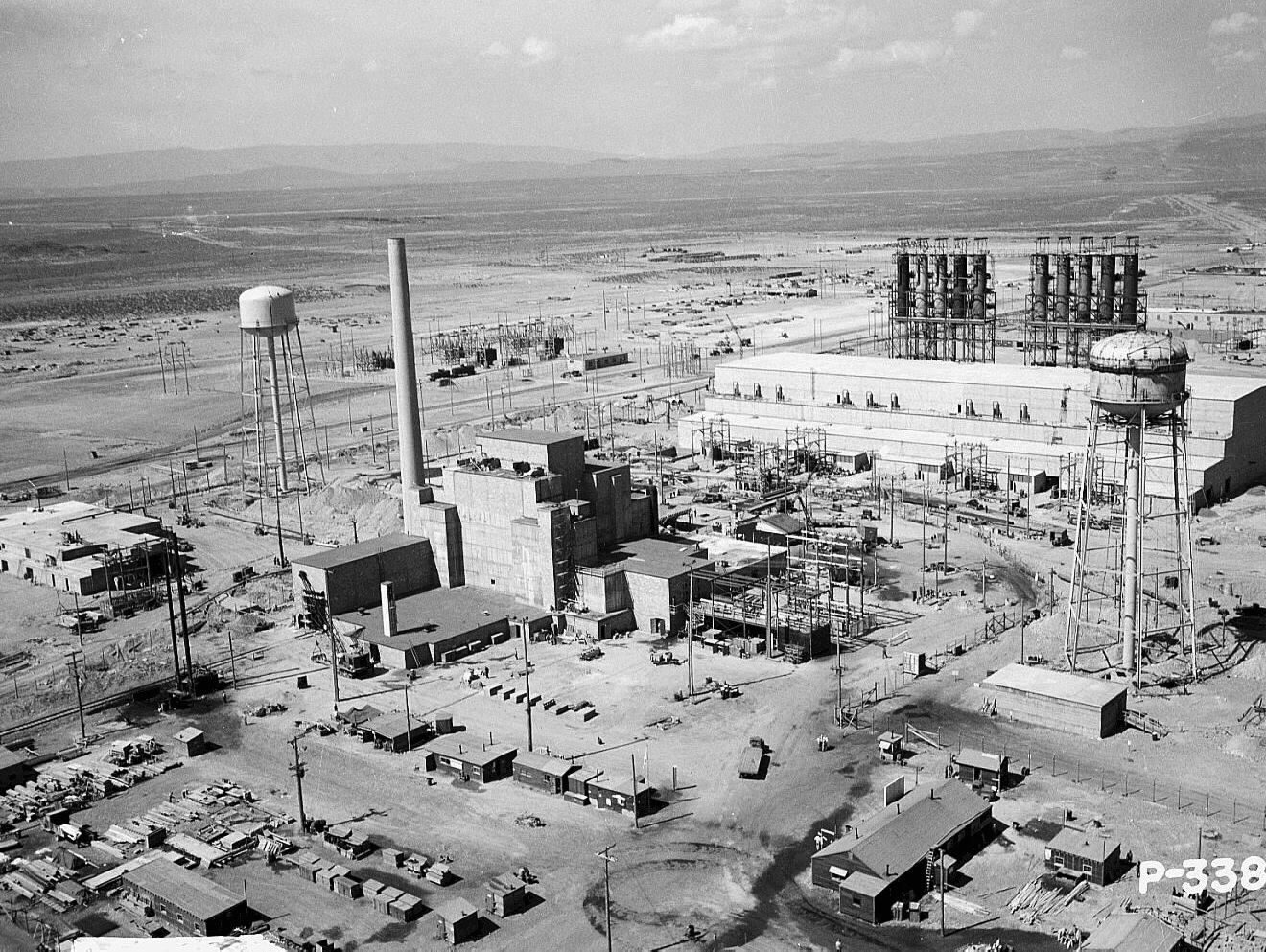
Pictured: the B-Reactor area of the Hanford Site, Washington, photographed circa 1944 by the U.S. Army Corps of Engineers — the same restricted plutonium-production complex, five years before this incident, whose airspace the Hanford radar station and 637th Aircraft Control and Warning Squadron were tasked with monitoring. This is not a photograph of the object or the intercept itself; no photograph of the disc, the radar scope, or the responding F-82 is known to exist in any archive consulted for this case file — only a declassified Air Intelligence Information Report and its later transcriptions.
Theoretical Alignment
Hanford's case draws real Extraterrestrial Hypothesis weight from its dual-sensor confirmation — a trained radar-station crew's telescope-assisted visual sighting, corroborated independently by a separate Aircraft Control and Warning squadron's own radar track — and from a reported departure speed that outran a contemporary jet-class interceptor before the object also outran ground radar's own range. It carries essentially no Interdimensional Hypothesis signature: every description in the surviving record is of a solid, radar-reflective, visually resolvable disc rather than anything suggestive of a phenomenon crossing between planes of existence. The Psycho-Social/Mundane reading carries unusually strong weight for a different reason than most cases this catalogue rates similarly: not because the witnesses are suspected of error, but because the case's own official resolution is internally incoherent. Project Blue Book's surviving case index disposes of the incident as "Aircraft," yet the Air Force's own contemporaneous investigating officer explicitly stated that the disc sighting and the "aircraft" explanation involved two separate, unconnected events on the same afternoon — meaning the official record's own logic never actually explains what the radar station and the 637th ADCC crew reported seeing and tracking.
Background
The Hanford Site was established in 1943 by the Manhattan Engineer District on roughly 670 square miles of sparsely populated shrub-steppe along the Columbia River in Benton County, Washington, chosen for its remote location, abundant river water for reactor cooling, and access to hydroelectric power from Grand Coulee Dam. Its purpose was to produce weapons-grade plutonium at industrial scale, first at the B Reactor — the world's first full-scale nuclear reactor, which went critical in September 1944 — and eventually across a chain of production reactors and chemical separations plants. Plutonium produced at Hanford fueled the Trinity test device detonated near Alamogordo, New Mexico on July 16, 1945, and the "Fat Man" bomb dropped on Nagasaki three weeks later, making the site, alongside the Los Alamos and Oak Ridge laboratories, one of the three pillars of the American atomic bomb program. With the 1946 creation of the civilian Atomic Energy Commission (AEC), Hanford's mission continued and expanded into the Cold War, its restricted airspace and grounds guarded by a combination of AEC security personnel, contractor security forces, and, from 1948 onward, a dedicated Air Force fighter-interceptor presence.
That dedicated presence existed because of a documented, specific concern rather than generic Cold War caution. Beginning in late November and December 1948, a wave of unexplained aerial "green fireballs" began appearing with unusual frequency in the skies over Albuquerque, New Mexico, in the immediate vicinity of Kirtland Air Force Base, Sandia Base, and, most pointedly, the Atomic Energy Commission's Los Alamos Scientific Laboratory. Astronomer Lincoln La Paz, a University of New Mexico meteor specialist brought in to assess the phenomena, along with Kirtland intelligence officers, Air Defense Command personnel, and several of Los Alamos's own physicists, reported observing the fireballs firsthand and found their behavior inconsistent with ordinary meteors. A January 31, 1949 FBI memorandum from the Bureau's San Antonio field office to Director J. Edgar Hoover, titled "Protection of Vital Installations" and classified Confidential, documented repeated December 1948 intrusions into restricted airspace over Los Alamos on at least nine separate dates and noted that the "Flying Saucer"/"Flying Disc" matter was considered Top Secret by Army and Air Force intelligence specifically because of the pattern's concentration around atomic installations. On February 16, 1949, the AEC, the military, and Los Alamos's own leadership — laboratory director Norris Bradbury, physicists Edward Teller and Frederic Reines, and La Paz himself — convened a formal conference at Los Alamos to assess the fireballs as a possible security threat, a meeting that led directly to the Air Force's classified Project Twinkle, a network of camera and observation posts intended to gather instrumented data on the phenomena.
This is the specific institutional climate Hanford's own May 1949 incident sits inside: by the spring of 1949, the AEC and the Air Force had already spent several months treating unexplained aerial activity near atomic installations as a matter requiring dedicated, high-level investigation, not dismissal. Former Project Blue Book chief Edward J. Ruppelt, in his own 1956 insider account of the era, later wrote generally that UFOs "were habitually reported from areas around 'technically interesting' places like our atomic energy installations, harbors, and critical manufacturing areas" and discussed alleged incidents at both Oak Ridge and Hanford as part of his history of the 1948–49 "Green Fireballs" period — this case file's own research was able to confirm via Wikipedia's summary of Ruppelt's book that both sites are discussed there, though a direct, verifiable quotation of Ruppelt's specific Hanford passage could not be retrieved from the publicly available Project Gutenberg text during this case file's research, a limitation disclosed honestly rather than papered over with an invented quote.
Hanford's own dedicated air-defense component arrived in this same window. Moses Lake Air Force Base, roughly 65 miles northeast of the Hanford Site, reopened as a permanent Air Defense Command installation on August 26, 1948, and on November 26, 1948 received the 325th Fighter-Interceptor Group, whose 317th Fighter (All-Weather) Squadron began transitioning from war-surplus Northrop P-61 Black Widow night fighters to the newer North American F-82 Twin Mustang. Aviation histories of the base are explicit and consistent about its purpose: "the primary mission of Larson-based ADC aircraft was to protect the secret Hanford Atomic Works and the Grand Coulee Dam." A second squadron, the 319th Fighter Interceptor Squadron, arrived from McChord Air Force Base on September 2, 1949 — several months after this case's own May 21 intercept, meaning the F-82 that responded that afternoon almost certainly belonged to the 317th, the only F-82 squadron then present at the base. The base was renamed Larson Air Force Base in 1950, in honor of Major Donald A. Larson, and closed in 1966; its runways today form Grant County International Airport.
Parallel to this fighter-interceptor buildup, the Air Force's own radar surveillance apparatus over the Hanford region was also standing up in real time. The 637th Aircraft Control and Warning Squadron — the unit whose operations crew this case's own investigating officer names directly — had been activated on May 21, 1947, exactly two years before this incident, at Long Beach Municipal Airport, California, before relocating to McChord Air Force Base in April 1948 and then, by the time of this case, into the Moses Lake/Hanford defense sector; the squadron would move again to a permanent site at Saddle Mountain, Washington (later Othello Air Force Station) on January 1, 1951. In May 1949, then, both halves of the response documented in this case — the ground radar detection and the airborne intercept attempt — were being carried out by units still in the process of being fully established in the region, a detail that helps explain both why the response existed at all and why its documentary record is comparatively thin next to the more mature, better-staffed installations this site's other 1970s-era nuclear-site case files describe.
Complete Timeline
| Date | Event |
|---|---|
| 1943 | The Manhattan Engineer District establishes the Hanford Engineer Works on the Columbia River in south-central Washington State to produce weapons-grade plutonium. |
| Sept. 1944 | Hanford's B Reactor, the world's first full-scale nuclear reactor, goes critical. |
| Jan.–Feb. 1945 | U.S. Navy F6F Hellcat fighters based at Naval Air Station Pasco, near Hanford, make repeated unsuccessful attempts to intercept a bright, fast-moving object reported hovering over the plant — the site's earliest documented aerial intrusion, corroborated decades later by former pilot Clarence "Bud" Clem and by declassified Fourth Air Force records. |
| Aug. 6 & 9, 1945 | Hanford-produced plutonium fuels the "Fat Man" weapon dropped on Nagasaki, following the Trinity test three weeks earlier. |
| 1946 | The civilian Atomic Energy Commission (AEC) assumes control of Hanford from the Army. |
| Nov.–Dec. 1948 | A wave of unexplained "green fireballs" begins over Albuquerque, New Mexico, concentrated around Kirtland AFB, Sandia Base, and the AEC's Los Alamos Scientific Laboratory, drawing direct AEC and Air Force intelligence concern. |
| Jan. 31, 1949 | An FBI memorandum, "Protection of Vital Installations," documents repeated December 1948 airspace intrusions over Los Alamos and characterizes the matter as Top Secret to Army and Air Force intelligence. |
| Feb. 16, 1949 | The AEC, Los Alamos leadership, and the Air Force convene a formal conference at Los Alamos on the fireball phenomena, leading to the classified Project Twinkle observation program. |
| Aug. 26, 1948 | Moses Lake Air Force Base reopens under Air Defense Command, tasked with protecting the Hanford Site and Grand Coulee Dam. |
| Nov. 26, 1948 | The 325th Fighter-Interceptor Group arrives at Moses Lake AFB; its 317th Fighter (All-Weather) Squadron begins transitioning to the F-82 Twin Mustang. |
| May 21, 1949, afternoon | A silvery, disc-shaped object is visually sighted through a telescope by Hanford radar station personnel and independently confirmed on radar by the operations crew of the 637th Aircraft Control and Warning Squadron, hovering at 17,000–20,000 feet over restricted airspace above the Hanford Atomic Plant. |
| May 21, 1949, afternoon (later) | An F-82 fighter is scrambled from Moses Lake AFB and directed to search for the object; before the aircraft reaches the area, the object reportedly departs to the south at a speed exceeding that of a jet fighter and passes beyond the range of ground radar. The pilot never obtains visual or radar contact of his own. |
| May 21, 1949 (same afternoon, later) | A second radar contact is registered over the same restricted airspace; investigation identifies it as a commercial aircraft dropping advertising leaflets for a local rodeo. |
| May 21, 1949 (investigation) | The Air Force's investigating officer files a report concluding that "two separate and distinct alert conditions existed on the afternoon of 21 May 1949" and that "there is no connection between the two events." |
| 1949 (Blue Book processing) | Project Blue Book's surviving case index records a single disposition of "Aircraft" for the incident — a label this case file's research finds textually applies to the second, leaflet-dropping-plane event rather than to the original disc sighting. |
| Sept. 2, 1949 | The 319th Fighter Interceptor Squadron arrives at Moses Lake AFB from McChord AFB, becoming the base's second F-82 unit — after this case's own incident. |
| Jan. 1, 1951 | The 637th Aircraft Control and Warning Squadron relocates to a permanent radar site at Saddle Mountain, Washington, later renamed Othello Air Force Station. |
| July 30–Aug. 4, 1950 | A follow-up wave of "round" objects is reported over the Hanford AEC Plant above 15,000 feet; a confidential memo by Major U.G. Carlan documents a coordinated alert of anti-aircraft units, radar stations, Air Force fighter squadrons, and the FBI. |
| Dec. 10, 1952 | Near Hanford, the crew of a patrolling F-94 jet obtains an ARC-33 airborne radar lock-on against a large, round, white light with reddish "window" markings closing on their aircraft — a separate, later Hanford-area radar/visual case. |
| 1956 | Former Project Blue Book chief Edward J. Ruppelt discusses recurring UFO reports around "technically interesting" AEC installations, including Hanford and Oak Ridge, in The Report on Unidentified Flying Objects. |
| 2008 / 2017 | Robert Hastings situates Hanford's documented aerial-intrusion history within his broader UFOs & Nukes research project on UAP activity at U.S. nuclear weapons sites. |
| 2026 | This case file is published, replacing this site's "Coming Soon" queue placeholder with a fully researched investigation; research for this file confirmed the placeholder's May 21, 1949 date and F-82/disc/plutonium-plant description against NICAP's own chronology and declassified-document transcriptions. |
The Afternoon of May 21, 1949: What the Record Actually Says
Unlike several of this site's other nuclear-site case files, Hanford's core incident is not reconstructed from decades-later witness interviews or a rich, multi-page official report. It survives, in every source this case file's research could locate, as a single tightly compressed paragraph in a period Air Intelligence Information Report, later folded into Project Blue Book's own files and preserved in transcribed form by the National Investigations Committee on Aerial Phenomena (NICAP). NICAP's own 1949 chronology entry for the case, drawn from that original report, reads in full: "Afternoon. An F-82 fighter was dispatched from Moses Lake AFB, near Hanford, Washington, to intercept a flying disc that was observed hovering in restricted air space over the Hanford Atomic Plant at an altitude of 17,000 to 20,000 feet. The silvery, disc-shaped object had been visually sighted by crew and personnel from the Hanford radar station and confirmed on radar." A parallel NICAP page transcribing the underlying document adds the detail that, once airborne, the object "suddenly took off in a southerly direction at a speed greater than that of a jet fighter" and "sped out of the range of ground radar" before the intercepting aircraft could reach it — and that the object was never seen by the F-82 pilot himself.
Read closely, this short passage actually describes two independent, near-simultaneous forms of detection converging on the same target: a visual sighting made through a telescope by personnel stationed at the Hanford radar station, and a separate, corroborating radar return. This case file's research treats that convergence as the single strongest evidentiary feature of the entire incident — not because either detection method is individually remarkable, but because they were obtained by observers with different instruments, and evidently different immediate duties, arriving at the same description (a hovering disc, at the same general altitude, in the same airspace) at effectively the same time. A visual misperception on its own, or a radar anomaly on its own, is a routine occurrence; two independent sensor channels converging on the same object at the same moment, over one of the most closely monitored airspaces in the country, is a materially less common evidentiary profile.
What the record does not preserve is almost as informative as what it does. No name of any Hanford radar station observer, any member of the 637th ADCC operations crew, the F-82 pilot, or the investigating officer survives in any source this case file consulted. No specific clock time beyond "afternoon" is given. No description of the object's precise shape beyond "disc" and "silvery" is offered — no stated diameter, no described surface features, no reported sound. This case file discloses that thinness plainly rather than inventing narrative color to compensate for it; every named-witness case file this site has published this session (Oscoda, Loring, Malmstrom, Minot) benefits from a richer surviving documentary or testimonial record than Hanford's own May 1949 incident does, and readers comparing this file to those should understand that difference as a real, disclosed limitation of the surviving primary source, not an editorial choice.
The "Two Separate and Distinct Alert Conditions"
The single most consequential sentence in this case's entire surviving record was written not by a witness but by the Air Force's own investigating officer, assessing the day's events after the fact. As transcribed by NICAP from the original Air Intelligence Information Report, the officer concluded: "It is believed that two separate and distinct alert conditions existed on the afternoon of 21 May 1949. The first was caused by the sightings of Flying Saucers (noted) by Hanford using a telescope and the operations crew of the 637th ADCC. The second was caused by the dropping of leaflets by an aircraft into the Hanford area. It is believed that there is no connection between the two events."
This sentence does two things simultaneously that matter enormously for how this case should be read. First, it confirms, in the Air Force's own contemporaneous internal language, that the disc sighting was treated as a real "Flying Saucer" report worth investigating in its own right — not dismissed at the time as an obvious misidentification of the leaflet plane. Second, and more importantly, it explicitly separates that report from the second, mundane, fully explained event (the leaflet-dropping commercial aircraft), stating in plain terms that the two "alert conditions" have "no connection." That distinction is the investigating officer's own conclusion, reached the same year the events occurred, not a reinterpretation imposed by this case file decades later.
The F-82 That Never Made Contact
The intercept itself is the case's most operationally significant, and most disappointing, sequence. An F-82 Twin Mustang — almost certainly from the 317th Fighter (All-Weather) Squadron, the only F-82 unit stationed at Moses Lake AFB in May 1949, since the base's second squadron did not arrive until that September — was scrambled and vectored toward the Hanford Atomic Plant with instructions, as NICAP's transcription records, to "search for the object and intercept it in hopes that it might be a disk." Before the aircraft could close the distance, the object reportedly departed the area at a speed exceeding that of a jet fighter, heading south, and exited the range of the ground radar that had been tracking it. The F-82 pilot himself never obtained either a visual sighting or an independent radar contact of his own — a detail this case file emphasizes because it means the case's entire sensor record rests on the ground-based detection alone; the airborne intercept, while a real, dispatched, and documented military response, contributed no additional corroborating data of its own to the case, only its own failure to arrive in time.
That failure carries a further piece of honest ambiguity this case file's research could not resolve. The specific F-82 variant flying with the 325th Fighter (All-Weather) Group at this period — the F-82F and F-82G models, both purpose-built for the group's all-weather interception mission — carried their own onboard radar (an AN/APG-28 set on the F, an SCR-720C set on the G, housed in a distinctive centerline pod between the aircraft's twin fuselages) specifically so an intercepting pilot could find a target without relying purely on ground-controlled vectoring and eyesight. No source consulted for this case file specifies which exact F-82 variant flew this particular intercept, nor whether its own onboard radar was employed, malfunctioned, or was never brought to bear before the object outran the aircraft's own ground-radar guidance. This case file discloses that gap rather than assuming either possibility.
Blue Book's "Aircraft" Disposition and Why It Fails to Fit
Project Blue Book's own surviving case index, per the NICAP source most directly focused on this case's declassified paper trail, lists this incident's official disposition as "Aircraft" despite the investigating officer's own explicit statement that the disc sighting and the leaflet-dropping aircraft were unconnected events. This case file's research treats that mismatch as a genuine, documentable problem with the official record, not a matter of interpretation. A conventional explanation that is textually tied, in the source document itself, to a different sighting than the one it is filed against does not actually explain the sighting it is filed against — it explains something else, correctly, while leaving the original report exactly as unresolved as it was before the leaflet plane was ever identified. Whether this reflects simple administrative carelessness in how Blue Book's index summarized a two-event report into a single case-line disposition, or a more deliberate choice to close out an otherwise-unresolved atomic-site sighting with the one mundane explanation the day's events happened to offer, cannot be determined from any source this case file consulted. What can be said with confidence is that, on the Air Force's own contemporaneous logic, the object seen through a telescope and tracked on radar over the Hanford Atomic Plant on the afternoon of May 21, 1949 was never actually given a conventional explanation in the surviving record — it was, at most, administratively bundled with one that belonged to a different event.
Key Witnesses
Hanford's case is unusual among this catalogue's military intercept files in that no individual witness — not a single name, rank, or duty title beyond unit designation — survives in any source this case file's research could locate. This section presents the identifiable parties honestly, by role and unit rather than by invented names, consistent with this site's practice elsewhere of disclosing an unnamed witness rather than fabricating identifying detail that does not exist in the record.
Hanford Radar Station Personnel (Names Not Preserved)
Unidentified crew and personnel stationed at the Hanford radar station who first visually sighted the silvery, disc-shaped object through a telescope, hovering at an estimated 17,000–20,000 feet over the restricted airspace they were tasked with monitoring. Their occupational role — radar-station duty at an Atomic Energy Commission production site during a period of documented, elevated official concern about aerial activity near atomic installations — implies a baseline of security-cleared, trained observation, though no individual name, rank, or specific job title survives in the declassified record.
637th Aircraft Control and Warning Squadron Operations Crew (Names Not Preserved)
The operations crew of the 637th Aircraft Control and Warning Squadron (referred to in the original document as the "637th ADCC"), who independently confirmed the object on radar at the same time the Hanford radar station's own personnel had it in view visually. The squadron, activated May 21, 1947 — exactly two years before this incident — was, at the time of this sighting, still in the process of establishing itself in the Moses Lake/Hanford defense sector before its eventual 1951 relocation to a permanent site at Saddle Mountain.
F-82 Pilot, 317th Fighter (All-Weather) Squadron (Name Not Preserved)
The unnamed pilot of the F-82 Twin Mustang scrambled from Moses Lake AFB and directed to search for and, if possible, identify the object. He never obtained his own visual or radar contact before the object reportedly departed the area at high speed; his aircraft's specific variant, and whether its own onboard SCR-720C or AN/APG-28 intercept radar was successfully employed during the search, are not specified in any source consulted.
Investigating Officer (Name Not Preserved)
The unnamed officer who authored the case's Air Intelligence Information Report and its accompanying assessment, concluding that "two separate and distinct alert conditions" had occurred that afternoon and that the disc sighting and the leaflet-dropping-aircraft contact were unconnected. This officer's own analytical distinction is, per this case file's own research, the single most important piece of the surviving record for understanding why Blue Book's later "Aircraft" disposition does not actually resolve the original sighting.
The Five Observables Assessment
Assessment: Anti-Gravity Lift is rated Speculative: the object was reported hovering motionless at 17,000–20,000 feet for an unspecified duration, behavior consistent with either a genuine lift-based hover or simply a very high-altitude balloon or aircraft holding position, and no source consulted describes a vertical launch, landing, or any other maneuver that would confirm the former specifically. Instant Acceleration is rated Present on the strength of the one specific behavioral detail every source agrees on: the object "suddenly took off" once the intercept was underway, departing in a controlled, purposeful direction (south) rather than simply drifting off. Hypersonic is rated Speculative rather than Present, in contrast to how this site has rated some comparable cases, because no source consulted for this case file provides any quantified speed figure at all — only the qualitative comparison "a speed greater than that of a jet fighter," which could describe anything from a modest performance edge over a 1949-era F-82 (whose top speed was roughly 460 mph) to a genuinely extreme figure, and this case file's research treats an unquantified qualitative comparison as meaningfully weaker evidence than even the disputed numeric estimates (e.g., "~1,000 knots") this site discloses cautiously in its other nuclear-site files. Low Observability is rated Speculative: the object was visible to the naked eye/telescope throughout its stationary phase, and its departure from radar coverage is explicitly described as the object exceeding the radar's range rather than the radar losing a return on a target that remained within range — a distinction with real significance, since simply flying beyond a set's range is a mundane limitation of 1949-era ground radar and does not, on its own, indicate a reduced radar cross-section. Trans-Medium is rated Absent, since nothing in this case involves any transition into or out of water, ground, or any other medium.
Evidence Assessment
Supporting Anomalous Origin
- Two independently tasked observation channels — a telescope-equipped visual watch at the Hanford radar station and a separate radar track by the 637th Aircraft Control and Warning Squadron's operations crew — converged on the same description (a hovering silvery disc at 17,000–20,000 feet) at effectively the same time, a materially stronger evidentiary profile than a single-sensor or single-witness report
- The sighting occurred over one of the most closely monitored, security-conscious airspaces in the entire United States at that specific moment in history, during a documented period of elevated official AEC and Air Force concern about aerial activity near atomic installations nationally (the concurrent Los Alamos green fireball wave and Project Twinkle)
- A real, dispatched military response followed within the same afternoon — an F-82 fighter scrambled and vectored with explicit instructions to attempt an intercept — rather than the report being logged and left uninvestigated
- The Air Force's own contemporaneous investigating officer explicitly and specifically distinguished the disc sighting from the day's separate, fully mundane leaflet-aircraft event, undermining any simple retroactive claim that the whole incident was "probably just the leaflet plane"
- Project Blue Book's own surviving disposition for this case ("Aircraft") does not, on close reading, textually correspond to the original disc sighting at all, meaning the sighting that prompted the actual intercept attempt was never given any documented conventional explanation in the surviving record
Supporting Conventional Explanation
- No individual witness name, rank, or specific duty title survives for any participant in this case, making independent follow-up, credibility assessment, or later interview — the kind this site's better-corroborated nuclear-site cases benefit from — permanently impossible
- The entire surviving primary account is a single short paragraph in a period intelligence report, transcribed and preserved only through NICAP's own secondary presentation; this case file's research could not locate or directly examine a primary-source scan of the original Air Intelligence Information Report or the Blue Book case file itself
- No quantified speed, size, sound, or duration figure survives for any part of the sighting; every performance claim rests on the single qualitative phrase "a speed greater than that of a jet fighter"
- The F-82 pilot never obtained his own visual or radar contact, meaning the only sensor data in the entire case comes from ground-based observers rather than from any independent airborne confirmation
- The object's departure from radar coverage is explicitly described as exceeding the set's range rather than a return vanishing from within range, a detail consistent with ordinary 1949-era radar limitations rather than necessarily indicating an extraordinary low-observability signature
Why "Disputed"
This case earns a DISPUTED classification with a credibility score of 36/100, placing it below this catalogue's Thomas Mantell case (Disputed, 38) and well below Oscoda AFB Sighting (Disputed, 70), while sitting above cases this site rates as thinner still, such as Fort Benning (Personal, 14). The case's genuine strength — independent, near-simultaneous confirmation across two separately tasked sensor channels (a telescope-equipped visual watch and an Aircraft Control and Warning squadron's radar track), occurring inside one of the most closely monitored restricted airspaces in the country during a documented, contemporaneous period of elevated AEC and Air Force concern about atomic-site aerial activity — is real and meaningfully rarer than a single uncorroborated account. It is also genuinely notable that the case's own official "Aircraft" disposition does not, on close textual reading, actually correspond to the original disc sighting, leaving that sighting technically unexplained in the surviving record rather than conventionally resolved.
What keeps this case well short of Mantell's already-modest 38, let alone this site's higher-rated cases, is the near-total absence of identifying and quantifying detail. No witness name of any kind survives. No numeric speed, altitude-hold duration, size, or sound detail survives beyond the coarse figures already quoted. The F-82 intercept, while a real dispatched response, produced no corroborating data of its own — the pilot never saw or tracked anything. And this case file's own access to the underlying record runs entirely through a single short paragraph as preserved and transcribed by NICAP, with no primary-document image examined directly, a limitation this case file discloses in the same terms this site applies to its comparably thinly-sourced files. A case whose central evidentiary strength is a real, dual-sensor, same-moment convergence at a maximally sensitive site, but whose entire surviving textual record amounts to a few unnamed sentences with no quantified performance data and no examinable primary document, is exactly the profile this site's "Disputed" rating in its lower-middle range exists to describe.
Sensor & Instrumentation Detection Profile
Hanford's case rests on two distinct, contemporaneously operating sensor channels. The first is the visual channel: personnel at the Hanford radar station used a telescope — not simply the naked eye — to observe the object, a detail that indicates a deliberate, optically-assisted observation rather than a fleeting glance, though no source consulted specifies the telescope's magnification or the observers' distance from the object. The second is the radar channel: the operations crew of the 637th Aircraft Control and Warning Squadron obtained an independent confirming return, this case file's research believes most likely from one of the early Cold War long-range search sets (such as the AN/CPS-5 or AN/CPS-1 family the squadron and its sister units in the sector are documented to have operated) then coming into service across the Pacific Northwest's air-defense network, though no source consulted specifies the exact radar model used in this particular track. A third, potential onboard sensor channel — the F-82 interceptor's own SCR-720C or AN/APG-28 radar, depending on variant — was present in principle but never produced data, since the pilot never achieved contact. No infrared, electromagnetic, or radiological sensor data of any kind is documented for this case, consistent with the general instrumentation available to, and the specific documentary record preserved by, a 1949-era Air Defense Command unit.
Environmental & Geospatial Context
The Hanford Site occupies a broad, arid expanse of shrub-steppe desert along a bend of the Columbia River in Benton County, in Washington's Columbia Basin — flat-to-rolling terrain with long, largely unobstructed sightlines, punctuated by isolated basalt ridges such as Rattlesnake Mountain along the site's southwestern boundary. This open, low-population terrain was itself one of the original reasons the Manhattan Engineer District selected the location in 1943, and it incidentally created favorable conditions for exactly the kind of sustained, unobstructed telescope observation the Hanford radar station's personnel are documented to have used. No specific meteorological record for the afternoon of May 21, 1949 was located in any source consulted for this case file; the object's reported visibility at 17,000–20,000 feet via telescope implies clear or largely clear sky conditions, but this case file's research could not confirm cloud cover, visibility, or wind data for that specific afternoon. Larson Air Force Base (Moses Lake AFB) sits roughly 65 miles northeast of the Hanford Site, across similarly open Columbia Basin terrain — a flight distance the scrambled F-82 evidently could not close before the object departed, a real geographic constraint on the intercept's outcome independent of any question about the object's own nature.
Observer Credibility & Occupational Profile
Every identifiable party in this case held an occupational position that ordinarily supports real credibility: radar-station duty at an active Atomic Energy Commission plutonium production facility, and Aircraft Control and Warning squadron operations duty, are both specialized, security-cleared military and quasi-military roles whose entire function is trained, sustained aerial observation and the correct operation of contemporary radar equipment — not incidental bystanders reporting something unusual, but personnel whose specific job was to watch this exact airspace for exactly this kind of intrusion. The F-82 pilot, similarly, was a trained Air Defense Command interceptor pilot flying a first-line 1949 night/all-weather fighter. This is a meaningfully professional witness pool by occupation, in the same general category as the trained radar operators and security personnel this site's other nuclear-site case files describe.
Set against this, the case's occupational credibility cannot be individually verified in the way this site's better-documented cases allow, because no name attaches to any of these roles. Unlike Oscoda AFB Sighting's thirteen named, rank-and-unit-identified Air Force personnel, or Robert Salas's decades of on-record public testimony for the Malmstrom case, Hanford's witnesses exist in the historical record only as anonymous job titles inside a single declassified paragraph. This case file treats that as a genuine, disclosed limitation rather than a reason to inflate the witnesses' credibility by assumption: a real, professionally credible occupational category is not the same evidentiary category as an individually verifiable, named, and cross-examinable witness.
Physical & Material Assays
No physical trace evidence of any kind exists for this case. The object was never reported to land, and its entire documented interaction with the physical world consists of a telescope-assisted visual sighting and a corroborating ground radar return. No debris, landing-site impression, or material sample was ever recovered or is claimed to exist in any source consulted for this case file. See Material Analysis below for a full discussion of what does and does not survive of the case's documentary record itself.
Historical Precedents & Archive Matches
Hanford's May 1949 incident is not an isolated data point even within its own site's history. The earliest documented precedent dates to January–February 1945, four years before this case and while the plant was still under wartime Army control: U.S. Navy F6F Hellcat fighters based at Naval Air Station Pasco, near Hanford, made repeated unsuccessful attempts to intercept a bright, fast-moving object reported hovering over the plant on at least three separate nights, according to a declassified Fourth Air Force Daily Diary entry dated January 23, 1945 (obtained via Project 1947 researcher Jan Aldrich) stating the sightings resulted "from an unidentified aircraft flying over the Hanford Engineering Company Plant at Pasco, Wash. on at least three nights in the past month," with a companion entry two days later noting the object had been "detected by radar on several nights in the past three weeks." Former Navy Lieutenant Junior Grade Clarence R. "Bud" Clem, who served as a communications relay during these events and was later interviewed at length by researcher Robert Hastings before his death in 2014, described the object chased by fellow pilot Lieutenant Commander Richard Brown (with Ensign C.T. Neal flying as standby) as an intensely bright, fast-moving light that showed "no form, no substance to it whatsoever, just a bright light," moving northwest in a straight line without maneuvering.
A second, closely related precedent follows just over a year after this case's own incident: a confidential memorandum dated August 4, 1950 and authored by Major U.G. Carlan, based on information from Lieutenant Colonel Mildren, documents that "since 30 July 1950 objects, round in form, have been sighted over the Hanford AEC Plant," observed above 15,000 feet, with "Air Force jets" attempting interception "with negative results." The memo describes a coordinated, multi-agency alert — "all units including the anti-aircraft battalion, radar units, Air Force fighter squadrons, and the Federal Bureau of Investigation" — placed on watch for further activity, with the AEC itself confirming an ongoing investigation. The close structural similarity to this case's own May 1949 incident (round/disc objects, high altitude, a failed jet intercept, Hanford's restricted airspace specifically) makes the 1950 wave this case file's single closest chronological and geographic precedent, and this case file's own research treats the two incidents as plausibly connected data points in a longer pattern rather than coincidental repeats.
A third, later Hanford-area case extends the pattern into the jet-radar era: on the night of December 10, 1952, the crew of a patrolling F-94 jet interceptor near Hanford obtained a radar lock-on, using the aircraft's own ARC-33 airborne radar set, against a large, round, white light with two reddish "window"-like markings, reported closing on the F-94 on what the crew perceived as a collision course while flying at 26,000–27,000 feet — a case this site's research found separately documented and distinct from, though geographically and thematically continuous with, this file's own May 1949 incident.
Beyond Hanford's own site-specific history, this case sits inside the same broader national pattern this site's UFOs and Nukes theory page addresses at length: researcher Robert Hastings' documented pattern of reported UAP activity concentrated at American nuclear weapons facilities from the late 1940s onward. Former Blue Book chief Edward Ruppelt's own discussion of recurring reports around "technically interesting" AEC sites specifically named both Hanford and Oak Ridge, the latter the subject of a separately documented June 1952 radar-and-visual sighting pursued by an Air Force plane. This site's own still-unpublished "Coming Soon" queue separately lists Oak Ridge as a future case file (#203); this file does not attempt to cover that separate Tennessee incident, restricting its own scope to Hanford's own May 1949 night.
Material Analysis
There is no physical object, debris, or trace sample connected to this case; "material" here refers instead to the case's actual surviving evidentiary substrate — the original Air Intelligence Information Report, the investigating officer's own assessment, and the Project Blue Book case index that later filed the incident away — since that documentary record is the only tangible thing this case file's research was able to assess, and even then only through NICAP's own secondary transcription rather than a primary document image examined directly.
The Surviving Documentary Record
The core of this case's paper trail is a same-year Air Intelligence Information Report, filed under what later became Project Blue Book's administrative system, documenting the disc sighting, the F-82 intercept attempt, the separate leaflet-aircraft radar contact, and the investigating officer's assessment distinguishing the two. This report and its accompanying Blue Book case-file materials have been preserved and republished, in transcribed form, by NICAP — whose site hosts what this case file's research treats as the most detailed and directly document-sourced surviving presentation of the case's text — and discussed in summary form by IdyllopusPress's compilation of declassified Hanford-area material, by TheUFOChronicles' survey of Hanford's broader aerial-intrusion history, and, per Wikipedia's own summary of his book, by former Blue Book chief Edward Ruppelt in his 1956 published account of the era. The investigating officer's own "two separate and distinct alert conditions" quotation is preserved consistently across the NICAP pages this case file's research consulted, a point in favor of its authenticity as an accurate transcription of the underlying document, even though this case file's own research could not locate or directly examine a scanned image of that original document.
What Does Not Survive
No photograph, film, or physical trace of the object is known to exist in any archive consulted for this case file. This case file's own research was also unable to locate a directly examined, high-resolution scan of the original 1949 Air Intelligence Information Report or the underlying Project Blue Book case-file pages themselves — every specific quotation and figure presented in this file traces back to NICAP's own transcription of that document, not to this case file's own independent reading of a primary-source image. No individual witness name survives in any source consulted, a limitation distinct from, but compounding, the absence of a primary document image: even a directly examined original document might well not preserve names that a period intelligence report, written to protect operational security at an atomic weapons site, had reason to omit or redact in the first place.
Supporting Non-Terrestrial or Unexplained Origin
- A same-year official Air Force report, rather than a report reconstructed from memory years later, anchors the case's core facts and the investigating officer's own analytical distinction between its two events
- Independent confirmation across two separately tasked sensor channels (visual/telescope and radar), obtained through normal military and AEC security channels rather than surfacing first through press or ufological contact
- The investigating officer's own contemporaneous conclusion that the disc sighting and the later-explained leaflet aircraft were unconnected undercuts any simple retroactive claim that Blue Book's "Aircraft" disposition resolves the original sighting
Supporting Terrestrial or Mundane Origin
- This case file's research could not directly examine a primary-source image of the original Air Intelligence Information Report or Blue Book case file, relying instead on a single secondary transcription source (NICAP) for every specific quotation
- No photograph or physical trace exists to allow any independent modern re-analysis of the object itself
- No individual witness name survives to allow follow-up interview, credibility assessment, or cross-examination of any kind, a limitation this specific case shares with very few other files in this catalogue
The Conventional Explanation Candidate (CEC): The Leaflet-Dropping Aircraft (and Why It Doesn't Actually Fit)
Project Blue Book's own filed disposition for this case is "Aircraft," and any honest treatment of the record has to begin with that candidate on its own terms rather than dismissing it out of hand. The known facts supporting it are real: a civilian aircraft dropping advertising leaflets for a local rodeo did register on radar over the restricted Hanford airspace that same afternoon, and was positively identified as exactly that. The candidate fails, however, for a reason internal to the case's own documentation rather than an external objection this case file is raising independently: the Air Force's own investigating officer, writing at the time, explicitly stated that this event and the original disc sighting were separate and unconnected. A conventional explanation that the investigating body's own contemporaneous analysis rules out as the explanation for the sighting in question cannot be treated as resolving that sighting, regardless of how the case was later filed in a summary index.
Misidentified High-Altitude Balloon
A weather, research, or (less plausibly, given the date) Skyhook-type balloon holding position at 17,000–20,000 feet is a serious candidate this case file's research could not rule out. Balloons of this kind were a documented, if not yet fully publicly disclosed, source of high-altitude "disc" and "saucer" reports throughout this exact period, and a stationary, silvery, disc-like object at high altitude is broadly consistent with a balloon's own visual profile, particularly one viewed through a telescope from a considerable distance where its true shape and scale would be difficult to resolve precisely. This candidate sits somewhat uncomfortably against the reported departure "at a speed greater than that of a jet fighter," since a free balloon does not accelerate away under its own power in a controlled southerly direction — though a balloon caught in a sudden, strong upper-level wind shift could conceivably produce an apparent rapid movement away from an observer's position without any powered acceleration on the object's own part, a possibility this case file's research could not confirm or exclude given the absence of any recorded wind data for the date.
Unidentified Conventional or Experimental Aircraft
A conventional aircraft — whether an unannounced military test flight, a misidentified civilian plane at unusual altitude, or an aircraft of a type the Hanford observers simply did not recognize — remains a candidate this case file's research could not exclude, particularly given how close in time and place this incident sits to the much better-documented 1948–49 concentration of unusual aerial reports around other AEC sites, several of which involved conventional aircraft eventually being ruled in or out only after dedicated follow-up investigation. This candidate accounts reasonably well for the reported high-speed departure but less comfortably for the sustained, motionless hover at high altitude that both the telescope observers and the 637th ADCC's radar independently reported before the intercept attempt began; a period military or civilian aircraft holding a fixed high-altitude position for an extended, unrecorded interval, directly over a nuclear weapons production site's most sensitive airspace, without immediately prompting a faster or more forceful response than a single unarmed-in-context interceptor, is a less natural fit than a hovering unconventional object or a stationary balloon.
Radar Anomalous Propagation Corroborated by Coincidental Visual Misidentification
A ground radar anomaly — atmospheric ducting or temperature-inversion propagation producing a spurious, apparently stationary and then apparently fast-departing return — is a documented phenomenon capable of explaining an isolated radar-only report. It does not, on its own, explain why telescope-equipped visual observers at the Hanford radar station independently reported the same general description (a hovering silvery disc) at the same time; for this candidate to work, it would additionally require a coincidental, simultaneous, and matching visual misidentification of some real but mundane object (a distant aircraft, a balloon, or even an astronomical object under unusual atmospheric conditions) by a separate set of trained observers, a compounding coincidence this case file's research finds considerably less parsimonious than either of the two candidates above.
Genuine Unconventional Aerial Object
This reading remains genuinely open, and in this case file's own assessment somewhat better supported than in several comparably-rated cases in this catalogue, precisely because of the specific way the official record fails to resolve it: the one conventional explanation Blue Book actually filed for this incident is, by the investigating officer's own contemporaneous account, an explanation for a different event. It is tempered by the same limitations disclosed throughout this case file: no quantified performance data, no photograph or physical trace, no named witness, and no primary-document access for this case file's own research.
The Leaflet-Dropping Aircraft (Blue Book's Filed Disposition)
ImplausibleIMPLAUSIBLE as an explanation for the original disc sighting specifically. The leaflet plane is a real, positively identified event — but the Air Force's own contemporaneous investigating officer explicitly stated it was unconnected to the disc sighting, making it a correct explanation for the wrong event.
Misidentified High-Altitude Balloon
InconclusiveINCONCLUSIVE. A documented source of comparable "disc" reports in this exact period, plausibly consistent with a stationary, silvery, high-altitude object, but sits uncomfortably against the reported controlled, high-speed southerly departure with no wind data available to test the alternative that it merely drifted rapidly.
Unidentified Conventional or Experimental Aircraft
InconclusiveINCONCLUSIVE. Could account for the high-speed departure but fits less naturally with a sustained, motionless high-altitude hover independently confirmed by two separate sensor channels over one of the era's most closely watched restricted airspaces.
Radar Anomalous Propagation
ImplausibleIMPLAUSIBLE as a complete explanation. Would require a coincidental, simultaneous, matching visual misidentification by a separate set of trained telescope observers, a compounding coincidence this case file's research finds considerably less parsimonious than the alternatives.
Genuine Unconventional Aerial Object
InconclusiveINCONCLUSIVE. Supported by the official record's own failure to resolve the original sighting with a matching conventional explanation, but limited by the total absence of quantified performance data, named witnesses, and primary-source document access.
Related Cases
Confirmed Documents & Official Records
NARA's own finding aid describing the Project Blue Book textual case files (arranged chronologically by date and location on 94 rolls of microfilm), the official federal repository within which this case's own Blue Book file is indexed.
DECLASSIFIEDA declassified FBI San Antonio field office memo to Director Hoover documenting December 1948 airspace intrusions over the AEC's Los Alamos installation — direct documentary evidence of the specific institutional concern about atomic-site aerial activity active just months before this case's own May 1949 Hanford incident.
DECLASSIFIED (CONFIDENTIAL)This case file's research could not obtain a directly legible primary-source image of the original 1949 Air Intelligence Information Report or Hanford's own specific Project Blue Book case-file pages; the quoted text above is drawn from NICAP's own transcription of that document, not from this case file's own examination of the original image.
Search Government & Military Archives Directly
Further Reading — Recommended Literature
UFOs & Nukes: Extraordinary Encounters at Nuclear Weapons Sites
The foundational research project situating Hanford's documented aerial-intrusion history within decades of reported UAP activity at U.S. nuclear weapons sites, drawn from interviews with more than 150 retired military veterans.
The Report on Unidentified Flying Objects: The Original 1956 Edition
The first Project Blue Book chief's own insider account of the era this case belongs to, including his discussion of recurring reports around "technically interesting" AEC installations such as Hanford and Oak Ridge.
Watch the Skies!: A Chronicle of the Flying Saucer Myth
An aerospace historian's detailed chronicle of the late-1940s flying saucer period, including the green fireballs wave, Project Grudge, and the broader official investigative climate this case's May 1949 intercept occurred within.
The UFO Encyclopedia (3rd Edition)
A comprehensive, two-volume reference work covering early Cold War UFO cases and the declassified documentation behind them, useful for cross-referencing this case against the broader 1947–1969 Blue Book record.
The UFO Controversy in America
An academic historian's account of how the U.S. government's own UFO investigations, including Project Blue Book's case-disposition practices, evolved from 1947 onward — directly relevant to understanding how a case like Hanford's could be filed under a disposition that does not fully match its own record.
Essential Viewing
No Videos Available
A reasonable search effort for this case file found no video that is primarily and specifically about the May 21, 1949 Hanford radar-visual intercept itself, as distinct from broader recent-news coverage of the 1948–49 "green fireballs" period generally. Per this site's Video Verification & Thumbnail Protocol, a thinly-covered case with no genuinely dedicated video coverage is presented honestly rather than padded with off-topic or tangential content.
Sources
- NICAP. "Hanford AEC/F-82 Case. May 21, 1949." nicap.org
- NICAP. "UFO Report" (Hanford, May 21, 1949, declassified document transcription). nicap.org
- NICAP. "1949 Chronology." nicap.org
- NICAP. FOIA document collection, August 4, 1950 Carlan memorandum on the follow-up Hanford AEC Plant sightings wave. nicap.org
- IdyllopusPress. "The Shape of Things to Come (declassified)." idyllopuspress.com
- The UFO Chronicles. "Reports Confirm UFO Activity at the Hanford Nuclear Weapons Plant During World War II." theufochronicles.com
- The UFO Chronicles. "UFO Activity at Nuclear Weapons Sites." theufochronicles.com
- Patrick Gross. "ACUFO Catalog — Case of the Hanford Nuclear Plant, Washington, USA, in January 1945." ufology.patrickgross.org
- Patrick Gross. "UFOs at Close Sight: Hanford AEC Plant Sighting, USA, December 10, 1952." ufologie.patrickgross.org
- Openminds.tv. "UFOs Over Atomic Plants — Part 2." openminds.tv
- The Black Vault Document Archive. "1949 FBI UFO Memo Describes Technology at Least 50 Years Ahead of Humans" (FBI memorandum, "Protection of Vital Installations," Jan. 31, 1949). theblackvault.com
- National Archives and Records Administration. "Project BLUE BOOK: Unidentified Flying Objects." archives.gov
- "637th Radar Squadron." Wikipedia. en.wikipedia.org
- "Larson Air Force Base." Wikipedia. en.wikipedia.org
- "North American F-82 Twin Mustang." Wikipedia. en.wikipedia.org
- "The Report on Unidentified Flying Objects." Wikipedia. en.wikipedia.org
- Ruppelt, Edward J. The Report on Unidentified Flying Objects (1956), full text. gutenberg.org
- Hastings, Robert L. UFOs & Nukes: Extraordinary Encounters at Nuclear Weapons Sites (2008; 2nd ed. 2017), via ufohastings.com
- Wikimedia Commons. "File: Hanford B-Reactor Area 1944.jpg" (U.S. Army Corps of Engineers, public domain via National Archives), source of this case file's hero image. commons.wikimedia.org
- "Hanford Site." Wikipedia (general background on the facility's Manhattan Project origins and AEC-era history). en.wikipedia.org
- "Green Fireballs." Wikipedia (background on the concurrent 1948–49 Los Alamos/Kirtland/Sandia aerial-phenomena wave and Project Twinkle). en.wikipedia.org
See something inaccurate? Have additional information or sources?
Suggest an Edit →Last Updated: August 2026