
Fort Benning Abduction Case
On the night of September 2, 1977 — by his own account, recovered only under hypnosis 14 years later — 25-year-old Private John Vasquez says he and as many as 1,300 fellow soldiers of Fort Benning, Georgia's 1st Battalion, 1st Infantry were struck by descending lights during a live-fire night exercise, lost hours they could never account for, and were quietly examined afterward by Army medical staff who told them only that a measles outbreak was to blame. This case file was commissioned to replace a "Coming Soon" queue placeholder describing, in general terms, soldiers experiencing "missing time and physiological effects" investigated by Army medical staff at Fort Benning in September 1977 — a description that does correspond to a real, if extraordinarily thin, documented claim: Vasquez's self-published 2000 book Incident at Fort Benning, more than two decades of talk-radio and podcast appearances, a single corroborating witness who did not come forward until 2011 and died months later, and a direct, on-the-record decision by researcher Budd Hopkins's own investigative team to walk away from the story after interviewing Vasquez in person. Unlike several other placeholders this site has had to remove outright for describing events that could not be found anywhere in the record, this one has a real name, a real book, and a real trail of media appearances behind it — but the trail leads to a single, uncorroborated witness whose memory of the event did not exist until therapy produced it, a base and an Air Force that separately deny the specific military exercise he says triggered it, and a story shaped as much by a book contract and a television camera as by anything that can be independently verified. This file presents all of it, including where it falls apart.
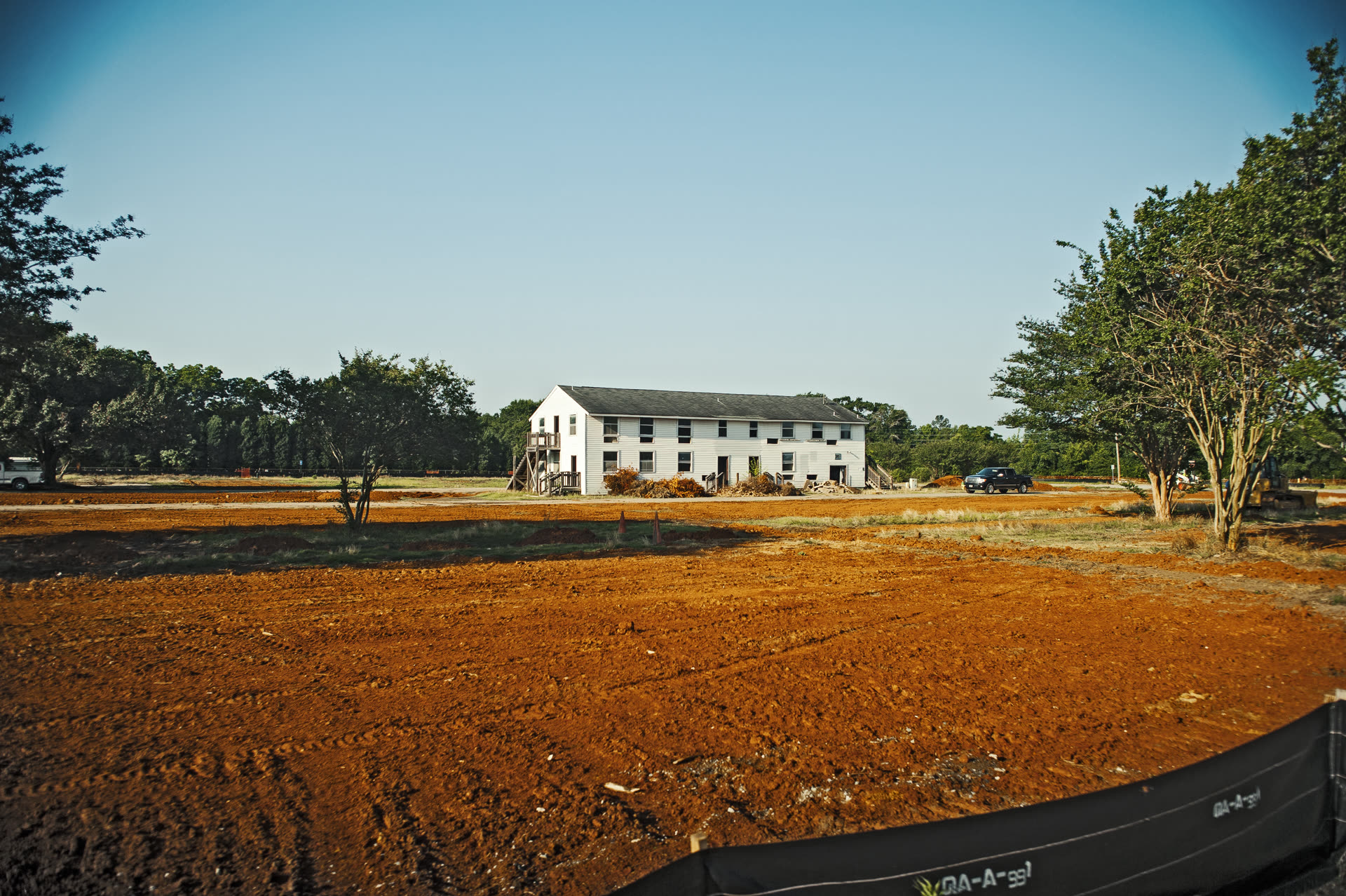
Pictured: the last surviving World War II–era wooden training barracks in Fort Benning's historic "Splinter Village" section, photographed by MCoE Public Affairs in June 2016 shortly before its demolition. This is not a photograph from the night of the alleged 1977 incident, nor of the specific unit area or range involved — no photograph connected to Vasquez's or Norton's claims is known to exist. It is offered only as an honest, period-appropriate image of the kind of built environment that stood on post during the era in question; Fort Benning's own training ranges, where the incident is said to have occurred, are not open ground the public can photograph.
Theoretical Alignment
This case aligns overwhelmingly with the Psycho-Social/Mundane framework, for reasons this file discloses plainly rather than softening. The entire narrative rests on memories that did not exist in either primary participant's own conscious recall until hypnotic regression produced them — 14 years after the fact for Vasquez, and by his own account only after a decade of unexplained anxiety and nightmares first drove him to seek therapy for an unrelated reason. Hypnotic regression's capacity to generate vivid, sincerely held, but factually unreliable memories — particularly when the subject already has cultural exposure to a well-established abduction narrative template, as any American adult did by the early 1990s following Budd Hopkins' own 1981 Missing Time, the Hills' 1966 case, and a decade of film and television treatments — is not a fringe skeptical talking point; it is a mainstream finding in cognitive psychology, discussed at length in this file's Conventional Explanation Candidate section. The Extraterrestrial Hypothesis reading draws only on the raw content of what was eventually recalled (lights, missing time, an examination) without any of the corroboration, physical evidence, or independent instrumentation that this site's higher-scoring cases possess. The Interdimensional Hypothesis has nothing distinct to attach to here. This case file's own reading, weighted heavily toward the mundane end of the scale, does not require concluding that either man is lying; it requires only accepting what a substantial body of memory research already establishes about hypnotically recovered testimony recorded decades after the fact, especially when, as detailed below, a book contract, a talent agent, and a television camera were already part of the process before the story reached its public audience.
Background
Fort Benning sits on the Georgia–Alabama border just south of Columbus, Georgia, and has served as the home of the U.S. Army's Infantry School since 1918. Named originally for Confederate general Henry L. Benning, the post was briefly redesignated Fort Moore in 2023 as part of a Department of Defense effort to remove Confederate namesakes from military installations, then reverted to Fort Benning in 2025 under a new namesake, World War I veteran Cpl. Fred G. Benning — a naming history with no bearing on the 1977 events themselves, but relevant to any reader cross-referencing sources published under either name. By the late 1970s, Fort Benning was one of the U.S. Army's largest and busiest training installations, running Infantry Advanced Individual Training (AIT), Officer Candidate School, and Ranger School simultaneously across a sprawling reservation of ranges, forests, and cantonment areas.
John Vasquez, by his own account a 25-year-old private assigned to Delta Company, 1st Battalion, 1st Infantry, says he was among a formation of roughly 1,200 to 1,300 soldiers assembled on a range at Fort Benning on the evening in question for a live-fire exercise connected to a weapons-testing program he and his co-author would later identify as "JAWS" — an acronym, in their telling, for "Joint Attack Weapons System." A real U.S. military test program bearing a similar name and acronym did exist in this general era, evaluating attack helicopters and close-air-support aircraft (the A-10 Thunderbolt II entered service in 1977, and joint Army-Air Force weapons evaluations involving Cobra and early Apache-program helicopters were genuinely underway at various Army posts through the late 1970s), which is the one piece of background color in Vasquez's account with some independent historical plausibility. Whether a "JAWS" test specifically occurred at Fort Benning, on the specific date claimed, is a separate question this case file could not resolve and treats honestly as contested — see the Historical Precedents and Conventional Explanation sections below.
No account of this case can be separated from the way it reached the public: not through a contemporaneous 1977 news report, an official inquiry, or a UFO-organization case file opened at the time, but through Vasquez's own decision, beginning around 1991, to seek out a hypnotherapist after years of unexplained nightmares and anxiety he did not yet connect to any specific memory. What emerged from those sessions became, after roughly nine years of what he and co-author Bruce Stephen Holms describe as personal research, the 2000 book Incident at Fort Benning (Timeless Voyager Press) — the case's single point of origin, and the source every subsequent radio interview, podcast appearance, and web article ultimately traces back to.
Complete Timeline
| Date | Event |
|---|---|
| 1918 | Fort Benning is established as the home of the U.S. Army Infantry School. |
| September 2, 1977, evening | The incident, as Vasquez's earliest published account (1998) dates it: Pvt. John Vasquez says a formation of roughly 1,300 soldiers on a night range was struck by descending lights; soldiers reported paralysis, confusion, and, afterward, missing time. Other retellings across the same 30-year span place the date at September 1, 3, or 14, 1977 — a discrepancy this file discloses rather than resolves. |
| 1977 (same period) | A documented rubella/measles-type outbreak affected the battalion, per period newspaper references Vasquez himself later located; Army medical staff cited this outbreak, not any anomalous event, as the reason for the medical checks some soldiers recall receiving. |
| 1989 | Vasquez, by his own account already experiencing unexplained anxiety and recurring nightmares, first seeks psychological counseling; some retellings place his first hypnotherapy sessions this year rather than 1991. |
| 1991 | Vasquez undergoes hypnotic regression and says he recovers, for the first time consciously, detailed memories of the September 1977 event, including a "female voice" communicating telepathically and a physical examination aboard an unidentified structure. |
| 1991 | Vasquez separately discovers that his own official military personnel file contains no record documenting his assignment to Fort Benning during the relevant period — a gap he presents as evidence of a cover-up and this case file treats, absent any independent verification, as unconfirmed. |
| Early 1990s | Researchers connected to abduction investigator Budd Hopkins interview Vasquez in person; the investigation is discontinued after Hopkins' associate describes the account as "extremely convoluted" and privately suspects it may be a hoax or "psy-op." |
| 1998 | UFO Magazine (UK) editor Graham Birdsall publishes the case's first substantial print interview with Vasquez, headlined around the claim that 1,300 soldiers were "abducted" at Fort Benning on September 2, 1977. |
| 2000 | Vasquez and co-author Bruce Stephen Holms publish Incident at Fort Benning (Timeless Voyager Press), the case's foundational and still-primary documentary source. |
| 2000s | Vasquez makes numerous further radio and early podcast appearances (including with UFO talk-radio host Rob McConnell) discussing the case; some accounts describe a talent agent managing rights to his story and a local television crew present during at least one on-camera regression session. |
| March 2011 | Sgt., by then retired as Command Sgt. Maj., James Norton comes forward publicly for the first time, more than 33 years after the event, saying he independently recalled a nearly identical experience after encountering Vasquez's media appearances; Norton also claims to possess a metal fragment recovered from the incident bearing unknown markings. |
| November 13, 2011 | Per a contemporaneous ufology blog account (not independently confirmed by this case file's research through any mainstream obituary or news source), Norton is found unconscious while posted at Fort McClellan, Alabama, and hospitalized. |
| November 21, 2011 | Norton dies in intensive care, per the same blog account, of complications attributed to cancer and hepatitis C — roughly eight months after his first public statements about Fort Benning. No verified news obituary connecting his death to the case, nor any evidence of foul play, was located by this case file's research; some ufology commentary nonetheless frames the timing as suspicious, a framing this file explicitly does not endorse. |
| 2013 | John Vasquez dies after complications from a road accident involving a drunk driver, followed by a stroke, per online ufology retrospectives; this case file could not independently verify these circumstances through any mainstream obituary. |
| 2020 | The "Conspiracy Theories" podcast (Parcast/Spotify) covers the case in a two-part episode, ultimately concluding that the near-total absence of corroborating evidence is itself the case's most notable feature, regardless of which explanation is favored. |
| 2026 | This case file is published, correcting the "Coming Soon" queue's generic placeholder description into a fully sourced account, and assigning it this site's "Personal" classification rather than "Disputed" given the case's single-witness origin and the specific, disclosed problems detailed throughout. |
The Night of September 2, 1977, According to John Vasquez
By Vasquez's own published account, first given in detail to UFO Magazine's Graham Birdsall in 1998 and later expanded in Incident at Fort Benning, he and his fellow soldiers of Delta Company, 1st Battalion, 1st Infantry, were assembled in an open field on a Fort Benning range around 7:30 p.m. for what he understood to be a live-fire exercise tied to a new weapons-testing program. He describes a sudden, blinding white light descending over the field, some soldiers dropping into what looked like immobilization while others ran and screamed, and being struck himself, twice, before losing consciousness. He recounts a female voice communicating with him telepathically, and says he later awoke inside a large structure filled with hundreds of beds occupied by fellow servicemen, before finding himself back among his unit with no injuries and no explanation offered by anyone in his chain of command. Named individuals appearing in this and later retellings include a "Sgt. Santini," a "Sgt. Turner," soldiers identified only as "Jones," "Hackett," and "Alan," and a Delta Company captain present that evening — none of whom, as far as this case file's research could determine, has ever independently confirmed any part of Vasquez's account on the record.
Vasquez's account also describes at least two further, separate incidents in the days that followed: patrols in a wooded training area during which his unit reported repeatedly passing the same campsite, watches stopped or frozen at inconsistent times (7:40, 3:30, and 4:45 are all given in different retellings), and sightings of what he described as "dark, shadow-type" figures. In his account, a mysterious female lieutenant, unconnected to his normal chain of command, arrived roughly five days after the initial event, adding a further, unverifiable layer to an already unverifiable story. He reports that soldiers afterward experienced vomiting, loss of balance, and behavioral changes, and that unit leadership conducted debriefings while instructing personnel not to discuss the events outside official channels — an instruction that, if it occurred, left behind no order, memorandum, or after-action report this case file's research could locate.
What Vasquez Says Happened to His Records
A central pillar of Vasquez's case for a cover-up, repeated across every interview and in the book itself, is that when he began actively researching the incident around 1991, he discovered his own official military personnel file contained no documentation of his assignment to Fort Benning during the relevant period, despite what he says was his genuine service there. He and Holms present this, along with a claim that the U.S. Air Force separately confirmed in writing that a "JAWS" test had been conducted at the base in question (a document he says was later reclassified such that it would be withheld even from a Freedom of Information Act request), as the book's central documentary evidence. This case file's own research could not independently locate, examine, or verify either the personnel-file gap or the alleged USAF confirmation letter; both claims rest entirely on Vasquez's own description of documents he says he once held, not on any document this case file could itself inspect. Directly conflicting with this claim, other researchers who separately contacted the Joint Staff Panel, Fort Benning's own public affairs office, and Fort Meade regarding the alleged "JAWS" test each reported back that the relevant offices had no record or knowledge of any such exercise having been conducted at Fort Benning — a direct, unresolved contradiction this case file discloses rather than adjudicates in Vasquez's favor.
The 1991 Regression and the 14-Year Gap
Vasquez has been consistent across every interview located by this case file's research on one central fact: he did not consciously remember any part of the events described above for 14 years after they allegedly occurred. His own account holds that persistent, unexplained anxiety and recurring nightmares eventually led him to seek psychological help around 1989, and that hypnotic regression sessions beginning around 1991 — and continuing, by some accounts, for years afterward — produced the detailed narrative that became the book. This case file treats that gap and that recovery method as the single most important, and most honestly disclosable, fact about the entire case, for the same reason clinical and forensic psychology treats it as significant in any context: memories retrieved under hypnosis, particularly years or decades after the fact and particularly on a subject already primed by broad cultural familiarity with an established abduction narrative (missing time, telepathic communication, an examination table, later corroborated by a second witness rather than an independent contemporaneous record), are well documented in mainstream psychological research to be vivid, sincerely felt, and detailed — and, independently of all three of those qualities, unreliable as historical fact. This is not a claim invented for this case file; it is the substance of decades of published research on hypnotic suggestibility and confabulation, discussed further in the Conventional Explanation Candidate section below.
It is also the case file's basis for one further, specific, disclosed observation: by 1991, when Vasquez's memories first emerged, the "grey alien abduction" narrative template — missing time, telepathic contact, physical examination by unfamiliar beings, later corroboration by another witness exposed to the same public account — was not merely available in general American popular culture (Betty and Barney Hill's case had been public since 1966, and dramatized on network television in 1975) but had specifically already been codified as a recognizable clinical category by Budd Hopkins' own 1981 book Missing Time, a work this case file's own Further Reading section below recommends for exactly this reason: it is both a foundational primary text of the genre Vasquez's story belongs to, and, independently, a useful reference for understanding the narrative scaffolding already available to any hypnotherapy subject by 1991.
Budd Hopkins' Team Investigates — and Walks Away
One of the more evidentially significant, and least publicized, facts about this case is that it did receive a direct, in-person look from researchers connected to Budd Hopkins, then the most prominent working investigator of abduction claims in the United States and the author of the very "missing time" framework Vasquez's account fits. According to a firsthand account later posted to a Paracast Community Forums discussion by a researcher who says he personally accompanied Hopkins to interview Vasquez, the team found the story "extremely convoluted" and ultimately decided "not to pursue it any further," with the same researcher stating he personally suspected the account might be "a sophisticated psy-op" rather than either a genuine anomalous experience or a straightforward hoax. The same account notes that Vasquez had, by that point, already retained an agent to manage commercial rights to his story, and that a local television crew was present filming during at least one hypnotic regression session — circumstances that, whatever their bearing on Vasquez's own sincerity, meaningfully complicate any assessment of the regression sessions as a neutral clinical process rather than one already shaped by the expectation of eventual publication and broadcast. This case file was unable to independently confirm Hopkins' own personal assessment beyond this secondhand forum account, since no published statement from Hopkins himself specifically addressing the Fort Benning case was located; the account is presented here as the most detailed record available of how a leading, sympathetic-to-the-phenomenon investigator's own team evaluated and ultimately declined this specific case.
James Norton's 2011 Corroboration, and His Death Eight Months Later
James Norton, a buck sergeant (E-5) at Fort Benning in 1977 who went on to a full Army career and retired as a Command Sergeant Major, is the case's only other named, on-the-record witness — and he did not come forward at all until March 2011, more than 33 years after the event and only after, by his own account, encountering Vasquez's media appearances and book. Norton's account substantially mirrors Vasquez's: he describes being sent to a range shortly before midnight with 1,200 to 1,300 troops for live-fire testing of the same "JAWS" weapons system, orbs appearing in the sky, and what he called "lasers crisscrossing" overhead. He went further than Vasquez in one specific, and specifically unverifiable, respect: Norton claimed to have personally recovered a metal fragment from the scene bearing unknown, "hieroglyphic" markings, and to have kept it buried on his own property ever since — a piece he described as unable to be burned or cut with a hacksaw, and which would return to its original shape if bent. Despite stating publicly, through UFO researcher Paul Dale Roberts and in several 2011 radio interviews, that he was willing to show this object to "credible ufologists and to the media," no researcher, journalist, laboratory, or photograph is known to have ever actually examined it; the claim exists solely as Norton's own description of an object nobody else has seen. This case file treats an unverifiable, physically extraordinary artifact volunteered only in a witness's own words, and never produced, as a significant negative credibility signal rather than as corroborating physical evidence — the same standard this site applies to any comparable claim elsewhere.
Norton's public disclosures also included a claim, repeated in several 2011 ufology blog posts, that he had been contacted and pressured by an NSA representative to stop discussing the 1977 events, and that he believed himself under surveillance as a result. No documentation of any such contact was produced or independently verified. Norton was found unconscious while posted at Fort McClellan, Alabama on November 13, 2011, and died in intensive care on November 21, 2011, per contemporaneous ufology-community blog posts (not independently confirmed by this case file's research through any mainstream news obituary); those same posts attribute his death to cancer and hepatitis C, explicitly medical causes rather than any claim of foul play, though several ufology commentators have since juxtaposed the timing of his death with his NSA-pressure claims in a way that implies, without directly asserting, a sinister connection. This case file states plainly that no evidence of any such connection exists in the record it could locate, and that natural medical causes, as stated in the only sources available, are the only substantiated explanation for Norton's death.
Key Witnesses
This case has exactly two named witnesses across its entire nearly 50-year public history, and both recovered their core memories of the event well after the fact — Vasquez under hypnosis 14 years later, Norton by his own account after 33 years of exposure to Vasquez's own public story. No independent, contemporaneous witness statement from September 1977 itself, and no third named witness at any point since, has ever surfaced.
John Vasquez
A 25-year-old infantry private at the time of the alleged incident, Vasquez did not consciously recall any part of the event until hypnotic regression beginning around 1991, 14 years later. He spent the following decade researching and publicizing the case, co-authoring Incident at Fort Benning (2000) and giving numerous radio and media interviews until his death in 2013. Interviewed in person by researchers connected to Budd Hopkins, who ultimately declined to pursue the case further.
James Norton
Came forward publicly in March 2011, more than three decades after the event and only after encountering Vasquez's media presence, describing a substantially similar experience and claiming to possess an unverified metal fragment from the scene. Died in November 2011, roughly eight months after his first public statements, of stated natural causes (cancer and hepatitis C) according to the only sources this case file's research could locate.
The Five Observables Assessment
The Five Observables framework, drawn from the Pentagon's own AATIP-era analytical criteria, is applied here to the phenomena described in Vasquez's and Norton's testimony:
Assessment: Neither Vasquez nor Norton, across nearly 50 combined years of retelling, ever describes a discrete craft performing an observable flight maneuver; the phenomenon as reported consists of descending or crisscrossing lights and, separately, a period of lost time and an alleged indoor examination with no described transit between the field and wherever that examination supposedly occurred. Anti-Gravity Lift, Instant Acceleration, and Hypersonic performance are rated Absent because no flight behavior of any kind is actually described for any object to exhibit. Low Observability is rated Speculative only because no light source was ever visually resolved into a craft by either witness, which is equally consistent with an unresolved conventional light source (flares, tracer fire, aircraft lighting during a live-fire exercise at night) as with anything exotic. This case is one of the weakest matches on this site to the Five Observables framework, a fact this file states plainly regardless of how the case's overall credibility is otherwise assessed.
Evidence Assessment
Supporting Anomalous Origin
- Two named individuals, separated by more than three decades and by their own account with no direct contact before 2011, describe substantially similar core details (orbs/lights, missing time, a live-fire exercise setting)
- A real historical military testing program bearing a similar name and acronym to "JAWS" was genuinely active in this general era, lending Vasquez's account at least a plausible factual anchor for its military-exercise backdrop
- Neither witness has any documented history of hoaxing prior to this case, and Vasquez pursued the story for over a decade at some evident personal and financial cost rather than a single quick payoff
- The reported physiological effects (vomiting, disorientation, balance loss) are consistent, in isolation, with genuine physical distress experienced by real soldiers on the date in question, whatever its ultimate cause
Supporting Conventional Explanation
- Neither witness's core memory of the event existed in their own conscious recall until years (Vasquez, 14) or decades (Norton, 33) after the fact, and both were substantially recovered or elaborated through hypnosis, a method with well-documented reliability problems for historical fact
- Norton did not come forward until after direct exposure to Vasquez's own already-public story, and his account's most extraordinary specific claim — an indestructible, hieroglyph-marked metal fragment — has never been produced for any independent examination despite his own stated willingness to show it
- Researchers connected to Budd Hopkins, a leading and broadly sympathetic investigator of abduction claims, personally interviewed Vasquez and chose not to pursue the case, with one participant specifically suspecting a hoax or "psy-op"
- Official channels contacted by other researchers (the Joint Staff Panel, Fort Benning itself, and Fort Meade) each denied any knowledge of the specific "JAWS" test Vasquez says triggered the event, directly contradicting his own claim of a USAF confirmation letter that has never itself been produced or independently verified
- No soldier among the reported 1,200 to 1,300 present has ever corroborated either account on the record; at least one period service member from the same base and years has stated on the record that he recalls nothing unusual at all
- The regression and disclosure process was, by credible secondhand account, already entangled with a literary agent and a television film crew well before the story reached its public audience, complicating any claim that the recovered memories emerged from a neutral clinical process
- No contemporaneous 1977 press report, official inquiry, or UFO-organization case file exists; every detail beyond the bare fact that Fort Benning experienced a real measles/rubella outbreak that year rests on testimony recorded 14 to 49 years after the fact
Why "Personal"
This case file assigns the PERSONAL classification with a credibility score of 14/100 — among the lowest scores this site has assigned to any published case, and below both this site's other Personal-classified anchors: the Ängelholm UFO Memorial (Personal, 16), an uncorroborated single-witness account that at least originated as a contemporaneous 1946 report rather than a memory recovered decades later under hypnosis, and this site's own founding Founder's Sighting (Personal, 38), which benefits from multiple contemporaneous family witnesses reporting the same night rather than a single primary account assembled 14 years after the fact. It also scores well below this site's John Sheppard Sighting (Disputed, 30), the weakest of this site's Disputed-tier calibration cases, because that case's single-family account was at least reported close in time to the event itself and was never contradicted by an official denial of its own claimed backdrop. What separates this case from even those thin cases, and keeps its score this low rather than merely low, is a specific and disclosed combination: a sole originating witness whose entire narrative did not exist in conscious memory until produced by hypnosis 14 years after the fact; a corroborating second witness who appeared only after public exposure to the first witness's own story, made an extraordinary and never-produced physical-evidence claim, and died of stated natural causes within eight months of coming forward; a direct, in-person evaluation by a sympathetic and prominent abduction researcher's own team that ended in a decision not to proceed, with a stated suspicion of hoax; and an official, if secondhand-reported, denial from military records custodians of the very exercise the case's central claim depends on. None of this proves the underlying experience did not happen in some form to Vasquez and Norton personally — hence Personal rather than Debunked, since this file locates no smoking-gun proof of deliberate fabrication either — but it falls well short of anything this site's Disputed or higher tiers require.
Sensor & Instrumentation Detection Profile
No radar track, photograph, film, audio recording, or instrument reading of any kind exists anywhere in the record for this case, at any point across nearly 50 years. No period Fort Benning air-defense radar log, no contemporaneous 1977 photograph, and no medical record beyond Vasquez's and Norton's own later verbal description of examinations they say occurred has ever been produced or independently examined by any researcher, journalist, or this case file's own research. Norton's claimed metal fragment is the closest thing to a physical exhibit connected to the case, and it has never been subjected to any instrumented test (metallurgical, isotopic, or otherwise) by any party outside Norton himself, nor even been photographed for public release despite his stated willingness to display it.
Environmental & Geospatial Context
Fort Benning occupies a large forested reservation straddling the Chattahoochee River on the Georgia–Alabama border, with extensive live-fire ranges historically used for night training exercises involving flares, tracer ammunition, and illumination rounds — all genuine, mundane sources of unexpected aerial light phenomena during exactly the kind of live-fire exercise Vasquez and Norton both describe. No specific meteorological record for the evening of September 2, 1977 (or the alternate dates given in other retellings) survives in any source located by this case file's research. Early September in west-central Georgia is reliably warm and humid, consistent with the general absence of any weather-related detail in either witness's account.
Observer Credibility & Occupational Profile
Both named witnesses were, at the time of the alleged event, junior enlisted infantrymen with no scientific, aviation, or radar training relevant to assessing an aerial phenomenon — a genuine, disclosed limitation this case file weighs the same way it would for any comparable witness elsewhere on this site. James Norton's subsequent full Army career, culminating in the senior enlisted rank of Command Sergeant Major, is a real, verifiable credential that speaks to his general competence and reliability as a soldier over a long service career, and this case file credits it as a modest positive signal; it is not, however, evidence bearing on the specific, extraordinary claims he made only in 2011, more than three decades after his active-duty service at Fort Benning and well after any institutional oversight of his statements. Neither witness brought any occupational expertise to bear on the specific phenomenon each described, and neither underwent any independent, professionally supervised memory-recovery process of the kind that would meaningfully strengthen a hypnotically-derived account's evidentiary weight.
The broader institutional context of 1977 also deserves disclosure, since it bears on how much weight any single junior enlisted soldier's account from this specific period can reasonably carry. The mid-to-late 1970s U.S. Army, in the years immediately following the end of the Vietnam War and the transition to the all-volunteer force in 1973, was widely and publicly criticized at the time for genuine training-quality and discipline problems — the so-called "hollow Army" era, marked by well-documented recruiting shortfalls, uneven basic and advanced individual training standards, and morale problems across many stateside posts, Fort Benning included. This context does not itself explain or discredit any specific claim in this case, but it is a real, disclosed factor relevant to assessing how reliably a large formation of recent draft-era and early volunteer-era recruits, undergoing a disorienting live-fire night exercise, might perceive and later recall an unexpected event under stress, fatigue, and inconsistent supervision — entirely independent of whatever role hypnosis later played in shaping the specific narrative that emerged.
Physical & Material Assays
No physical trace evidence connected to this case has ever been collected, tested, or independently examined by anyone outside the two primary witnesses. James Norton's claimed metal fragment — described as bearing unknown markings and as resistant to burning, cutting, and permanent deformation — is the only physical exhibit ever mentioned in connection with the case, and it has never been produced for inspection by any researcher, journalist, or laboratory despite Norton's own repeated public statements of willingness to do so before his death in November 2011. No soil sample, photograph, medical record, or any other tangible object connected to the alleged 1977 event exists in any archive, private collection, or publication this case file's research could locate. This total absence, more than four decades on, is one of the case's most fundamental and disclosed limitations.
Historical Precedents & Archive Matches
This case belongs to a recognizable subgenre of Cold War–era American UFO literature: the military-base "mass encounter" claim surfaced years or decades later through a single self-published account, frequently via hypnotic regression, and rarely if ever corroborated by any second contemporaneous witness. This site's own Herbert Schirmer Sighting (Ashland, Nebraska, December 1967) shares this case's core structural feature most closely: a single law-enforcement or military witness whose most detailed memories emerged only under hypnosis, in Schirmer's case within weeks rather than years, which this site's own case file on that encounter treats as a genuinely stronger evidentiary position than the 14-year gap present here. The foundational text of the entire genre, Betty and Barney Hill's 1961 New Hampshire encounter, similarly relied heavily on hypnotic regression conducted by Dr. Benjamin Simon, but benefited from two independent witnesses reporting missing time within days of the event itself, well before either underwent hypnosis — a meaningfully stronger starting position than Vasquez's single, isolated, 14-years-delayed recollection. This site's Travis Walton case (Snowflake, Arizona, November 1975) offers a different, useful contrast: six co-workers independently and immediately reported Walton's disappearance the same night, before any hypnosis was involved, giving that case a contemporaneous multi-witness anchor this Fort Benning case entirely lacks despite its far larger claimed number of total witnesses. No official U.S. military UFO-reporting channel (Project Blue Book had already been closed in 1969, eight years before this alleged event) or Georgia-based civilian UFO organization is known to have opened any file on Fort Benning in 1977 itself; the case's entire paper trail begins with Vasquez's own 1991 hypnotherapy.
The contrast with this site's own Rendlesham Forest Incident (RAF Bentwaters/Woodbridge, England, December 1980) is instructive precisely because it is the closest thing to a genuine peer case: another U.S. military installation, only three years later, where multiple security personnel reported an anomalous object in nearby woodland. The evidentiary gap between the two cases is enormous. Rendlesham produced a contemporaneous internal memorandum (the Halt Memo) written and signed within days by a deputy base commander, radiation readings taken at the reported landing site shortly afterward, and multiple named security policemen independently describing the same core events without decades of intervening hypnosis. Fort Benning has none of this: no memorandum, no on-site physical measurement of any kind, and a single originating witness whose account did not exist in any form until 14 years afterward. The comparison is offered here specifically because it illustrates what a genuinely stronger version of a "military base UFO encounter" case looks like in the documentary record, and how far short of that standard this case falls.
Material Analysis
There is no physical object, debris, soil sample, or trace evidence connected to this case in any archive this case file's research could locate. "Material" here refers instead to the case's actual surviving evidentiary substrate: two men's own recorded verbal testimony, given 14 and 33-plus years after the fact respectively, and a single self-published book that remains the origin point for every later retelling.
Norton's Unproduced Metal Fragment
The single specific physical claim in this case's entire history is James Norton's description of a metal fragment, allegedly recovered from the incident site and bearing unidentified markings he characterized as resembling hieroglyphics, which he said could not be burned or cut and would return to its original shape after bending. Descriptions of exactly this kind — an ordinary-looking metal object assigned exotic, untestable physical properties by the person describing it, never subjected to actual instrumented examination, and never produced for independent viewing despite the claimant's own stated willingness — recur across UFO literature and are treated by this site, consistently with how it has evaluated comparable claims elsewhere, as a significant negative credibility signal rather than as evidence. No photograph of the object, no measurement, and no laboratory report of any kind exists in the public record.
What This Case File Could Not Verify
This case file's own research could not independently examine Vasquez's personnel file, could not locate or verify the USAF letter he says confirmed a "JAWS" test at Fort Benning, could not verify the 1977 measles/rubella outbreak beyond secondary ufology-source summaries of unnamed period newspaper coverage, and could not locate any mainstream news obituary for either Vasquez (d. 2013) or Norton (d. 2011) independently confirming the circumstances of either death beyond ufology-community blog accounts. Each of these gaps is disclosed here explicitly rather than papered over, consistent with this site's practice on every comparably thin case.
Supporting Non-Terrestrial or Unexplained Origin
- Two witnesses, separated by three decades with no apparent direct contact before 2011, describe a broadly similar core narrative involving lights, missing time, and a live-fire military exercise
- A real historical military weapons-testing program with a similar name genuinely existed in this era, giving the account's setting at least partial independent plausibility
- No conclusive, single documentary proof of deliberate fabrication by either man was located by this case file's research
Supporting Terrestrial or Mundane Origin
- Both witnesses' core memories were substantially produced or recovered via hypnosis, years to decades after the fact, a method with well-documented unreliability for establishing historical fact
- The case's only claimed physical evidence (Norton's metal fragment) has never been produced for any independent examination despite repeated stated willingness to do so
- A prominent, broadly sympathetic abduction researcher's own investigative team interviewed the primary witness and declined to pursue the case, citing suspicion of hoax
- Official records custodians separately deny any knowledge of the specific military exercise central to the claim
- A literary agent and television camera were reportedly already involved before or during the regression process that produced the core narrative
- No corroboration exists from any of the other 1,200-plus soldiers reportedly present
The Conventional Explanation Candidate (CEC)
This case admits several distinct, non-exclusive conventional explanations, none definitively provable from the available record, each evaluated here on its own specific, disclosed merits.
Misperceived Illumination Ordnance and Night Live-Fire Exercise Effects
Both Vasquez's and Norton's accounts describe the initiating phenomenon — descending or crisscrossing lights during an active night live-fire weapons exercise — in terms fully consistent with illumination flares, tracer fire, or aircraft signal lighting, all genuinely present at any large-scale nighttime Army live-fire range. Given that a real weapons-testing exercise of some kind does appear to have been genuinely underway (even if its exact name and date remain contested), ordinary battlefield illumination equipment misperceived under dark, disorienting, high-stress conditions by young, likely fatigued soldiers is a strong candidate for the visual component of the story, independent of anything that happened afterward in memory.
Hypnotically Confabulated or Culturally Templated Memory
Given that neither witness's detailed narrative existed in conscious memory until years (Vasquez) or decades (Norton) after the fact, and both narratives were substantially shaped or produced by hypnotic regression conducted after each man had, by his own account, already been independently exposed to a well-established cultural abduction template (missing time, telepathic contact, an examination), this explanation holds that a real but far more mundane experience of disorientation, fear, or minor physical distress during a genuinely disorienting night exercise was later reconstructed, in good faith, into a far more elaborate and specific narrative through the hypnosis process itself — a well-documented phenomenon in mainstream memory research, discussed in this file's Further Reading recommendation of Susan Clancy's Abducted.
Deliberate Hoax or Commercially Motivated Embellishment
The involvement of a literary agent and a filming television crew during at least part of the regression and disclosure process, Norton's appearance only after Vasquez's story was already public and profitable, Norton's unproduced but maximally dramatic physical-evidence claim, and Budd Hopkins' own team's stated suspicion of a hoax all lend this explanation real, if entirely circumstantial, weight. This case file cannot prove deliberate fabrication by either man from the available record, and therefore does not adopt this explanation as proven, but it cannot honestly be ranked below the anomalous-origin explanation either.
Deliberate Military Psychological Experiment or Memory Manipulation
Floated by at least one published reader of the book and picked up by later podcast coverage as the theory some commentators find intriguingly unfalsifiable, this explanation holds that soldiers may have been unwitting subjects of a classified psychological or pharmacological experiment, with the total absence of any supporting record cited by proponents as evidence of a successful cover-up rather than evidence the event did not occur. This case file treats this explanation as unproven and, on the available record, unfalsifiable in a way that makes it scientifically unsatisfying regardless of its narrative appeal — the same absence of evidence cited in its favor is equally, and more simply, explained by the event never having happened as described.
Genuine Extraterrestrial or Unexplained Encounter
The reading favored by Vasquez, Norton, and most popular ufological coverage of the case. Its central weakness is structural: it rests entirely on the content of memories recovered under a method with well-documented reliability problems, corroborated only by a second witness who arrived after public exposure to the first account and whose own most dramatic claim was never verified, and it has no positive, independent evidence of any kind — no radar, no photograph, no produced physical sample — in its favor.
Misperceived Illumination Ordnance
PlausiblePLAUSIBLE as an explanation for the initial visual trigger, given a genuine night live-fire exercise setting common to both witnesses' accounts.
Hypnotically Confabulated / Culturally Templated Memory
PlausiblePLAUSIBLE and, in this case file's own assessment, the single best-supported explanation for how a real but far more mundane experience became this specific, elaborate narrative.
Deliberate Hoax or Commercial Embellishment
InconclusiveINCONCLUSIVE. Strong circumstantial signals (agent, TV crew, a suspicious researcher's own team) but no proof of deliberate fabrication by either named witness.
Military Psychological Experiment
ImplausibleIMPLAUSIBLE as stated. Unfalsifiable and unsupported by any actual document; its own proponents cite absence of evidence as its proof.
Genuine Extraterrestrial Encounter
ImplausibleIMPLAUSIBLE on the available record. Rests entirely on hypnotically recovered testimony with no independent corroboration or physical evidence.
Related Cases
No Confirmed Government Documents Located
This case was never investigated by any government or military body as a UFO report. Project Blue Book had already closed in 1969, eight years before the alleged 1977 event, and no successor program (AATIP, AAWSAP, or today's AARO) has any public record referencing Fort Benning in this connection. Vasquez's own claimed USAF confirmation letter regarding a "JAWS" test has never been produced for independent inspection, and separate inquiries by other researchers to the Joint Staff Panel, Fort Benning, and Fort Meade reportedly found no record of any such exercise. Readers wishing to search official channels directly for themselves can use the archives below.
Search Government & Military Archives Directly
Further Reading — Recommended Literature
Incident at Fort Benning
The case's sole foundational source, written by its primary witness and co-author after roughly nine years of personal research following his 1991 hypnotic regression; essential as the origin document every later retelling traces back to.
Missing Time: A Documented Study of UFO Abductions
The foundational text that codified the "missing time" abduction narrative a decade before Vasquez's own recovered memories emerged, and written by the same researcher whose team later interviewed Vasquez and declined to pursue his case.
Abducted: How People Come to Believe They Were Kidnapped by Aliens
A psychologist's research-based account of how sincere, non-delusional people come to hold vivid false memories of alien abduction, directly relevant to assessing Vasquez's and Norton's own hypnotically recovered testimony.
The Interrupted Journey: Two Lost Hours Aboard a Flying Saucer
The original account of Betty and Barney Hill's 1961 case, the genre's foundational text and the source of the cultural "missing time" template already well established by the time Vasquez underwent his own regression in 1991.
The UFO Encyclopedia: The Phenomenon from the Beginning
The standard English-language reference work for situating a thinly-sourced, single-book case like this one within the wider documented history of the abduction genre.
Essential Viewing
Military soldier John Vasquez talks about a bizarre 1977 UFO incident at Fort Benning, Georgia
Eyes On Cinema — Vasquez's own recorded account of the incident and his 1991 hypnotic regression, the case's primary witness speaking directly on camera.
Cmd. Sgt. Maj. James Norton | 1977 UFO Incident at Ft. Benning
Norton's own 2011 public account, given the same year he died; the case's only corroborating witness testimony, subject to the same credibility caveats discussed throughout this file.
Sources
- Birdsall, Graham. "1,300 Soldiers Abducted at Fort Benning, Georgia, USA, 2nd Sept 1977" (interview with John Vasquez). UFO Magazine (UK), May/June 1998; reproduced via RR0. rr0.org
- Holly, Chris. "The Strange Encounters of John Vasquez, Fort Benning: September 1977." UFO Casebook, 2009. ufocasebook.com
- "The 1977 Fort Benning Incident: Unexplained UFO Encounters & Soldier Testimonies." rhino-lute-3zay.squarespace.com
- Roberts, Paul Dale. "James Norton UFO Evidence." Unexplained Mysteries. unexplained-mysteries.com
- "Fort Benning 1977" — discussion thread including firsthand account of Budd Hopkins' team's investigation and decision not to proceed. The Paracast Community Forums. theparacast.com
- "Command Sergeant Major James Norton Claims PROOF of UFOs!" The Paracast Community Forums. theparacast.com
- "Cmd Sgt Maj James Norton Has Passed Away." Information Machine (blog), Nov. 2011. information-machine.blogspot.com
- "John Vasquez (R.I.P.) | Military Soldier John Vasquez Re-Lives The Ft. Benning UFO Abduction Incident." Information Machine (blog), 2013. information-machine.blogspot.com
- "Incident at Fort Benning Pt. 1." Conspiracy Theories podcast (Parcast/Spotify) transcript. podcasts.happyscribe.com
- "Incident at Fort Benning Pt. 2." Conspiracy Theories podcast (Parcast/Spotify) transcript. podcasts.happyscribe.com
- Vasquez, John & Holms, Bruce Stephen. Incident at Fort Benning (Timeless Voyager Press, 2000). Publisher and edition details. abebooks.com
- Vasquez, John & Holms, Bruce Stephen. Incident at Fort Benning — preview. Google Books. books.google.com
- "Fort Benning." Wikipedia, consulted for installation history and 2023/2025 renaming context. en.wikipedia.org
- "Hegseth Restores Fort Moore to Fort Benning in Honor of WWI Soldier." U.S. Army, March 2025. army.mil
- "Fort Benning, Briefly Fort Moore, Is Fort Benning Again." Georgia Recorder. georgiarecorder.com
- "Joint Attack Helicopter Instrumented Evaluation." Wikipedia, consulted for background on real, contemporaneous joint Army/Air Force attack-helicopter and close-air-support weapons testing programs of the late 1970s. en.wikipedia.org
- Wikimedia Commons. File:Blue Skies and red Clay.jpg, photographer Patrick A. Albright (MCoE Public Affairs), CC BY-SA 4.0. commons.wikimedia.org
- "Military Soldier John Vasquez Talks About a Bizarre 1977 UFO Incident at Fort Benning, Georgia." Eyes On Cinema, YouTube. youtube.com
- "Cmd. Sgt. Maj. James Norton | 1977 UFO Incident at Ft. Benning." YouTube. youtube.com
- Clancy, Susan A. Abducted: How People Come to Believe They Were Kidnapped by Aliens (Harvard University Press, 2005) — consulted for the psychology of hypnotically recovered abduction memory.
- Hopkins, Budd. Missing Time: A Documented Study of UFO Abductions (1981) — consulted for the origin and codification of the "missing time" abduction narrative Vasquez's own account follows.
See something inaccurate? Have additional information or sources?
Suggest an Edit →Last Updated: August 2026