
The Imjärvi Incident
On the bitterly cold evening of January 7, 1970, forestry worker Aarno Heinonen and farmer Esko Viljo, both experienced cross-country skiers, stopped to rest in a forest clearing along their habitual route near Imjärvi, a small lakeside village in what was then the rural municipality of Heinola, Finland. What followed became one of the most internationally reported close encounters in Scandinavian ufology: an elongated, fire-colored object crossing the sky, a bee-swarm hum, a pale grey disc roughly two to three meters across that descended to within a few meters of the two men, a reddish-grey mist carrying a sulfurous smell, a small light that bloomed into a spinning, spark-throwing disc, and, for a handful of seconds, a thin, roughly one-meter-tall humanoid figure in a pale green protective suit holding a pulsating black box. Within minutes both men were unable to stand; within hours their skin had reddened and swollen; within a day Heinonen could barely rise from bed. A local physician, unable to reach any diagnosis, noted that the symptoms resembled those of radiation exposure, though his rural clinic had no instrument to test for it. Soil and snow samples from the site were later sent as far as Chalmers University of Technology in Sweden, and Uppsala University's own high-voltage physics institute was consulted about atmospheric electricity. The case reached the cover of Flying Saucer Review within the year and remains, more than five decades on, one of the most frequently cited encounters in Finnish UFO literature — a reputation this case file finds substantially complicated by what happened to Heinonen next: over the following two years he reported more than twenty further UFO encounters of his own, including a sustained, increasingly contactee-flavored relationship with a beautiful, fluent-Finnish-speaking "spacewoman" who claimed to be 180 years old.
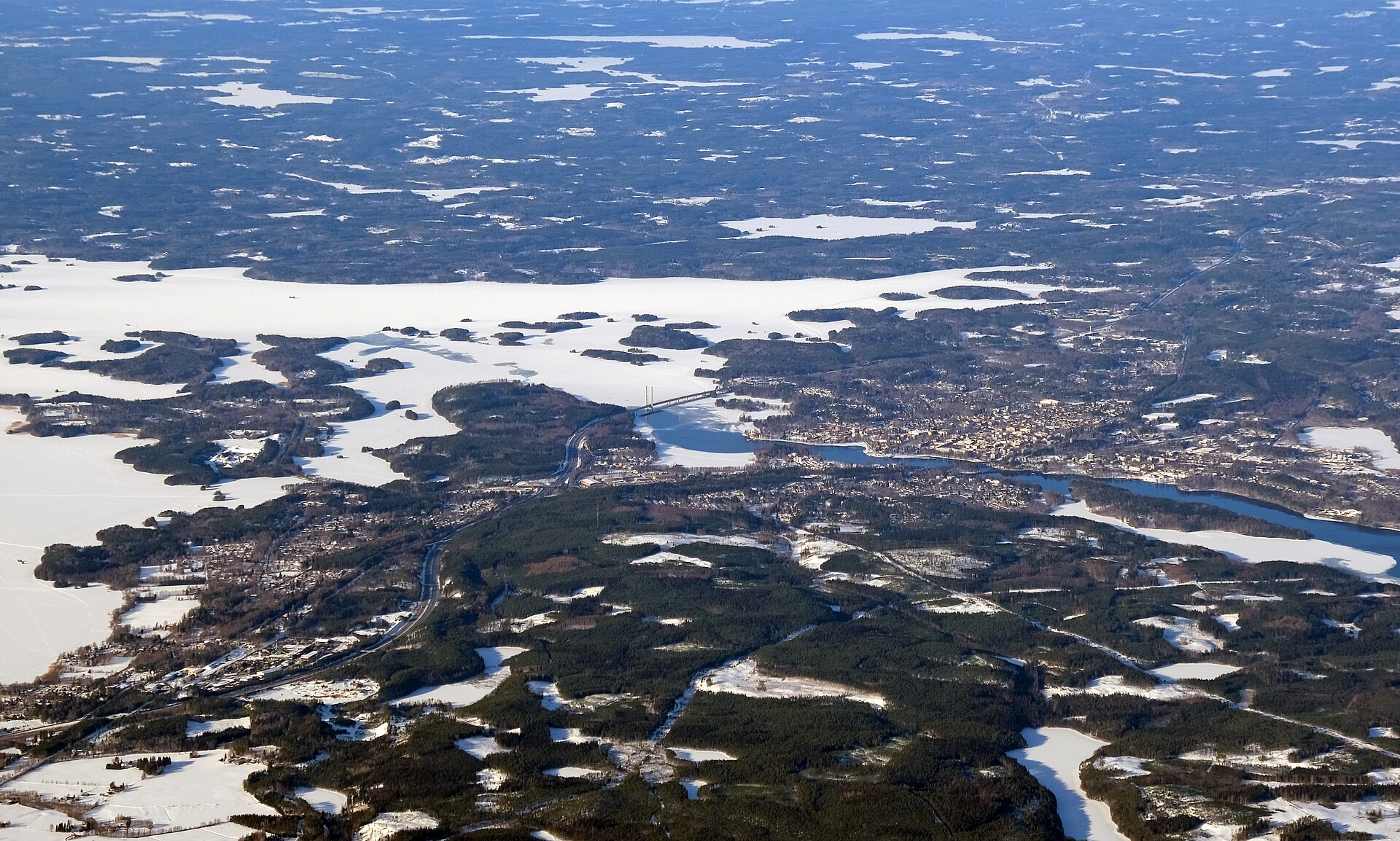
Pictured: an aerial view of Heinola, Päijänne Tavastia, the Finnish town whose former rural municipality (Heinolan maalaiskunta, merged into Heinola in 1977) included the village of Imjärvi at the time of the 1970 encounter. This is not a photograph of Imjärvi itself, the encounter site, or the object — no photograph of any of these is known to exist; period newspaper and stock-photo agency images circulating online are staged post-hoc reconstructions, not contemporaneous photographs of the event. Photo by Kallerna, 2022, licensed CC BY-SA 4.0.
Theoretical Alignment
This case tilts toward the Psycho-Social/Mundane reading without settling there conclusively. The Extraterrestrial Hypothesis draws whatever support it has from a genuinely detailed, internally consistent physical description — a structured, silent craft with a repeatable morphology, a humanoid occupant seen independently by both men, and same-day medical findings a rural physician could not explain — the kind of texture a simple hoax or a pure atmospheric misperception does not usually produce on its own. The Psycho-Social/Mundane reading draws its weight from two directions at once: a real, documented category of prank/pyrotechnic hoax that fits several specific reported details (the sulfur smell, the colored sparks, the brief duration) uncomfortably well, and, more decisively, the credibility collapse that followed — Heinonen's subsequent two years of more than twenty further UFO encounters and a sustained "contact" relationship with a humanoid space-woman, a trajectory this case file's own research treats as a serious, disclosed reason to discount rather than reinforce the original account's most extraordinary claims. The Interdimensional Hypothesis draws modest support only from the object's unexplained, instantaneous appearance and disappearance and the mist's own strange behavior, without any of the more distinctive IDH markers (missing time, interdimensional travel claims, reality distortion) present in the core 1970 account itself.
Background
Imjärvi is a small lake and the rural village that takes its name from it, sitting within what was, in January 1970, the separate rural municipality of Heinolan maalaiskunta — a jurisdiction distinct from the adjoining town of Heinola until the two were merged in 1977. The area is typical of Finnish Lakeland: forested, sparsely populated, dotted with small farms and lake shorelines, and, in the depth of a Finnish January, plunged into short days and severe cold. Cross-country skiing along familiar forest and lakeside routes was, and remains, an entirely ordinary way for rural Finns to travel and to recreate through the winter months, exactly the activity Aarno Heinonen, a 36-year-old forestry worker, and Esko Viljo, a 38-year-old farmer, were engaged in on the afternoon of January 7, 1970, when they set out on what multiple sources describe as their habitual ski route, as they had many times before.
Every source consulted for this case file describes both men in strikingly similar terms: sober, hardworking, unremarkable rural Finns, not associated with any prior interest in UFOs, spiritualism, or the paranormal, and vouched for locally as calm, sensible, and abstinent from alcohol. A neighbor identified in some secondary accounts as Matti Haapaniemi, described as a local municipal council member, is reported to have specifically vouched for both men's character to journalists and investigators in the case's immediate aftermath — testimony this case file discloses as coming from a single secondary source rather than independent verification, but consistent with the broader, multiply-sourced characterization of Heinonen and Viljo as ordinary, credible witnesses rather than known hoaxers or fantasists prior to January 1970.
The case's earliest and closest documentary source is Finnish ufologist Tapani Kuningas (1945–2009), who was only 24 at the time of the encounter but had already begun collecting and publishing Finnish UFO reports. Kuningas's 1970 survey Ufoja Suomen taivaalla ("UFOs in Finland's Sky"), published by Kirjayhtymä the same year as the encounter, gathered roughly a thousand Finnish sightings and included a detailed account of the Imjärvi case — making it, unusually for a case this well-known internationally, one documented in the open Finnish literature within the same calendar year it occurred, rather than years or decades later. Kuningas went on to co-found the Finnish UFO Researchers Association (Suomen Ufotutkijat ry) in 1973, serve as its first chairman, and edit Ultra, Finland's long-running magazine of ufology and "rajatieto" (border-knowledge/fringe science), from 1972 until his death in 2009 — the same figure whose work anchors this site's separate case file on the Finnish Air Force's Pori radar-visual sighting less than a year before Imjärvi.
Complete Timeline
| Date | Event |
|---|---|
| February 1969 | According to a secondary account of this case, a 16-year-old identified as Matti Kontulainen reports an intensely bright, silent light passing low overhead while skiing near Imjärvi — a possible local precedent this case file could not independently corroborate beyond that single source. |
| January 7, 1970, ~4:00 PM | Aarno Heinonen and Esko Viljo set out on their habitual cross-country ski route near Imjärvi in clear, windless, −17°C weather. |
| January 7, 1970, ~4:30–4:45 PM | After roughly 30 minutes of skiing, the two men stop to rest in a forest clearing; Viljo first notices an elongated, fire-colored object with a torch-like trail approaching from the south before it vanishes. |
| Same moment | A pale, cloud-like flash appears above the men, followed by a bee-swarm-like humming sound and the appearance of a pale grey, disc-shaped object 3–4 meters above them, roughly 2–3 meters in diameter. |
| Same moment | A reddish-grey mist with a sulfurous smell is emitted from the object; a small ball of light descends from the mist to about a meter above the snow and "spreads" into a spinning, color-shifting disc that throws off red, green, and violet sparks for two to three seconds. |
| Same moment | Heinonen reports feeling pulled backward at the pelvis; both men briefly see a small, roughly one-meter-tall humanoid in a pale green protective suit holding a black box with a pulsating light, visible for only a few seconds before it vanishes. |
| Same moment, ~10 seconds total | The mist disperses, the object appears to contract, rotate, and shoot upward, and the encounter ends; no physical trace is visible afterward at the site. |
| January 7, 1970, following minutes | Both men, initially silent with shock, begin experiencing numbness, cold-then-hot sensations, joint pain, and nausea; the roughly half-kilometer walk home takes over twenty minutes. |
| January 7, 1970, evening | With their condition worsening — Viljo's face swelling and reddening, both men in pain — they travel by taxi to the Heinola clinic, where Dr. Pauli Kajanoja finds abnormally low blood pressure suggestive of shock but reaches no diagnosis, and prescribes sedatives and sleeping medication. |
| January 8, 1970 | Heinonen's condition is worse, not better: he struggles to rise, his back is stiff and stooped, and his headache and vomiting resume; a second doctor's visit yields more sedatives, which seem to worsen his subsequent balance and memory problems. |
| January 1970 | The case draws early coverage in the Finnish press; soil and snow samples from the site are eventually forwarded to Chalmers University of Technology in Sweden for radiological analysis, and Uppsala University's Institute for High Voltage Research is separately consulted about atmospheric electricity. |
| Following ~4 months | Heinonen's balance, memory, and sleep continue to be disrupted by nightmares; he is unable to attempt work again until roughly four months after the encounter. Viljo's recovery is faster, though he too reports aftereffects lasting into spring. |
| May/June 1970 | Flying Saucer Review first reports the case in its World Round-Up section. |
| July/August 1970 | Flying Saucer Review carries a full feature-length article on the case. |
| September/October 1970 | The Imjärvi case appears on the cover of Flying Saucer Review. |
| Late 1970 | Flying Saucer Review's final 1970 issue carries further follow-up detail on the case. |
| 1970 | Tapani Kuningas's survey Ufoja Suomen taivaalla is published, documenting the Imjärvi case within the same year it occurred. |
| 1970–1972 | Heinonen reports more than twenty further UFO sightings, some in Viljo's company, escalating into direct contact claims. |
| 1972 | Heinonen describes a series of encounters with a humanoid "spacewoman" — young-looking, fluent in Finnish, claiming to be 180 years old — a claim Swedish ufologist Anders Liljegren later assessed as reading more like mythology than a continuation of credible testimony. |
| 1973 | Tapani Kuningas co-founds the Finnish UFO Researchers Association (Suomen Ufotutkijat ry) and becomes its first chairman. |
| 1977 | Heinolan maalaiskunta, the rural municipality that included Imjärvi in 1970, is merged into the town of Heinola. |
| 1994 | Kuningas publishes 100 ufoa Suomessa ("100 UFOs in Finland"), which again includes the Imjärvi case among the country's most significant reports. |
| 2026 | This case file is published, replacing the "Coming Soon" queue's placeholder entry. |
Rest Stop in a Winter Clearing
By the most detailed contemporaneous account available — Tapani Kuningas's 1970 rendering of what Heinonen and Viljo told him, itself the ultimate source nearly every later retelling of this case traces back to — the two men had skied for roughly half an hour along their habitual route before stopping in a forest clearing to rest, as they routinely did. The sky was clear, the air windless and around −17°C, and, given the season and hour, the light would have been the low, dim glow of a Finnish winter dusk. Nothing about the outing to that point differed from countless other afternoons the two men had spent on skis together.
Esko Viljo was the first to notice anything unusual: an elongated, fire-colored object approaching from the south, trailing what Kuningas's account describes as something resembling a torch behind it, moving in complete silence. The object then disappeared, only for a pale, cloud-like burst of light to appear directly above the two skiers moments later. A sound resembling the hum of a swarm of bees followed, and in the next instant, three to four meters above them, a pale grey, saucer-shaped object came into view — roughly two meters in diameter (other accounts give closer to three), its underside marked by three pale hemispherical projections surrounding a raised, trumpet- or horn-shaped central structure that glowed with light on both sides. Heinonen tried to flee. He found that he could not move.
Mist, Sulfur, and a Spinning Disc of Light
Once the object had, in Kuningas's phrase, "stabilized its position," it began releasing a greyish-red mist in the men's direction. Both later described a sulfur-like smell in the air, faintly stinging the nose and throat — a specific sensory detail that, as this case file's Conventional Explanation Candidate section below discusses at length, is also precisely the smell a homemade pyrotechnic device would produce. As the mist thickened, a small ball of light roughly 15 centimeters across appeared at its center and descended to about a meter above the snow. It then "spread" into a bright, roughly one-meter-diameter disc whose color shifted gradually from pale toward a fiery red, ringed by a thin, roughly one-centimeter-thick dark border.
For two to three seconds, this small disc threw off short, roughly ten-centimeter red, green, and violet rays or sparks in an arc, reaching perhaps three meters outward. At the same moment, Heinonen reported the distinct sensation of being pulled backward, hard, at the pelvis — one of this case's more physically specific and less easily rationalized details, since it describes a directional force rather than a vague feeling of dread or cold. The dark ring bordering the disc then began to contract from its edges while rising, appearing to spin itself into a roughly oval-shaped ball before shooting upward and out of view.
The Figure in the Green Suit
It was in this same brief window that both men reported seeing a small humanoid figure. Heinonen, glancing toward Viljo, was startled to see a small being off to the side dressed in a pale or light green protective suit, holding what looked like a black device in its hands. Viljo, who was facing the light phenomenon more directly, independently reported seeing the same figure. Descriptions across the secondary literature converge on a being approximately 90 centimeters to one meter tall, very thin, with pale, waxy-looking skin, a hooked or beak-like nose, and small ears, wearing a light or pale green one-piece coverall, darker green boots, and white gloves; some accounts add a metallic, cone-shaped helmet. The black device it held is consistently described as emitting a pulsating yellow light. The figure was visible for only a couple of seconds before it vanished — not walking or flying away, but simply ceasing to be there, in a manner neither witness could explain. Heinonen then observed the surrounding mist appear to tear apart near Viljo's position and dissipate. The entire sequence, from the appearance of the disc to the figure's disappearance, lasted around ten seconds by Kuningas's account.
This case file flags directly that the humanoid's appearance is the single detail on which the two men's own retellings have shown the most drift across later interviews: at least one secondary account notes that Heinonen's own sketches of the figure varied between a broader-shouldered and a narrower-shouldered build across different tellings, while Viljo's depiction remained more consistent. Given that neither man had any obvious motive to embellish this specific detail relative to the rest of an already extraordinary account, this case file treats the inconsistency as more consistent with the ordinary unreliability of memory and freehand sketching under stress than with deliberate fabrication — but discloses it rather than presenting a single, artificially clean description as definitive.
The Walk Home and the Onset of Illness
Neither man spoke for a long moment after the object departed. According to Kuningas's account, real physical symptoms began within three or four minutes: Heinonen, who had been turned with his right side toward the phenomenon throughout, felt that entire side of his body first grow cold, then abruptly hot; numbness crept into his leg and hand; his joints began to ache; his back tightened into a stoop; and nausea set in. What should have been a walk of well under a kilometer took the two men more than twenty minutes to complete, each supporting the other. Heinonen briefly stopped at his own home before continuing on to check on Viljo.
Viljo initially believed himself unaffected, but within a couple of hours his face had visibly swollen, and the skin of his face, hands, and forearms had reddened. His eyes became painfully sensitive to light, with a sensation of pressure behind them; his joints ached, and a headache set in. With both men now in serious distress, they traveled by taxi to the clinic in Heinola.
Medical Examination and the Following Weeks
At the clinic, Dr. Pauli Kajanoja examined both men. According to the most detailed secondary account of this examination, he found Heinonen's blood pressure abnormally low, a finding consistent with physiological shock, but reached no specific diagnosis; multiple sources describe him remarking that the presentation resembled the aftereffects of radiation exposure, while explicitly noting that his rural clinic had no instrument capable of measuring radiation to test that impression. He prescribed sedatives, circulatory medication, and sleeping tablets, and sent both men home.
The following morning brought no improvement, and for Heinonen, matters worsened: he had serious difficulty simply rising from bed, his legs felt weak and unsteady, his back remained stiff and bent, and his headache and vomiting returned. A second medical visit produced only further sedatives, which several secondary accounts describe as having made his subsequent symptoms — worsening balance, unreliable memory, and disturbing nightmares — if anything more pronounced in the following days and weeks rather than better. It would be roughly four months, by Kuningas's account, before Heinonen felt able to attempt returning to work. Viljo's own recovery, while still marked by aftereffects lasting into the spring — ongoing joint pain, headaches, and, per at least one secondary account, dark urine lasting for weeks — was comparatively faster, and he did not lose his capacity to work entirely.
This case file discloses plainly that no surviving instrument reading, blood test result, or hospital chart from this examination has been located or independently verified in any source consulted; every detail of Dr. Kajanoja's findings passes through secondary retellings of what he is reported to have said, not through this case file's own examination of a primary medical record.
Scientific Consultation: Uppsala and Chalmers
What sets this case apart from a great many contemporaneous Scandinavian UFO reports is the degree to which it drew genuine, named scientific engagement rather than remaining purely a matter for ufological literature. Soil and snow samples taken from the site of the encounter were forwarded to the nuclear chemistry division of Chalmers University of Technology in Gothenburg, Sweden, for radiological testing; the results, per every source consulted, showed no radiation above normal background levels — a negative finding for the specific "radiation exposure" impression Dr. Kajanoja had raised, though it does not by itself rule out a different, non-radiological physical cause for the men's symptoms.
Separately, Uppsala University's Institute for High Voltage Research was consulted about whether the object and its effects might be explained by known atmospheric electrical phenomena, such as ball lightning; the institute's conclusion, per multiple secondary sources, was that the case showed no clear connection to known lightning or atmospheric-electricity behavior. Within Finland itself, Professor Matti Tuuri of the University of Helsinki, an electrophysicist, reportedly examined details of the case and suggested that some form of electrical or radiative exposure was "not impossible" as a contributing factor to the men's injuries, while stopping well short of offering it as a confirmed mechanism. Taken together, these three consultations represent a genuine, if ultimately inconclusive, attempt by working physicists and a nuclear chemistry laboratory to test specific physical hypotheses against physical evidence — a level of institutional scientific engagement this catalogue does not find on every case of comparable evidentiary weight, and one this case file credits as a real point in the case's favor even though none of the three consultations produced a positive, confirming result.
From Local Clinic to International Cover Story
The case reached an international audience unusually quickly for a rural Finnish sighting. The Gothenburg-based Swedish UFO information organization GICOFF (active 1969–1979, headed by Sven-Olof Fredriksson and Björn Högman) investigated the case directly, and journalists from the British journal Flying Saucer Review followed, examining both men's demeanor and consistency for themselves. FSR's own coverage escalated across 1970: a brief mention in the May/June World Round-Up section, a full feature-length article in the July/August issue, and, by September/October, the case's placement on the magazine's cover — with further follow-up detail appearing in the year's final issue. This is, by the standards of this catalogue's other European contact cases, an unusually fast and sustained escalation of international ufological interest for an encounter involving only two rural, previously unknown witnesses.
Within Finland, Tapani Kuningas's own 1970 book gave the case an early and lasting anchor in the domestic literature, and it has been revisited repeatedly since — in Kuningas's own later 100 ufoa Suomessa (1994), in the archives and case pages maintained by the Swedish ufological organization UFO-Sverige and the Finnish research association FUFORA (successor context to Suomen Ufotutkijat ry), and in a steady stream of Finnish-language podcast episodes, blog retrospectives, and YouTube documentary segments into the 2020s. It is routinely described, across sources spanning five decades and several countries, as one of Finland's best-known and most carefully documented UFO cases — a reputation this case file finds earned by the case's genuine documentary trail (a same-year book, a same-day medical visit, named scientific consultations) rather than by any decisive proof of what actually happened in that clearing.
Corroborating Distant Witnesses
Two secondhand, distant sightings reported from the same evening are cited in several secondary accounts as loosely corroborating the timing and general direction of the Imjärvi encounter, though neither describes anything resembling the close-range disc-and-humanoid encounter itself. A farmer's wife identified as Elna Siitari, living roughly 15 kilometers away, is reported to have seen an unusual light in the sky that same evening in the general direction of Imjärvi. Separately, a boy in the nearby locality of Paaso, about 10 kilometers to the north, is reported to have described a bright glow in the sky while out gathering firewood at around the same time. This case file discloses that both accounts reach the modern record only through secondary English-language ufological summaries rather than through any primary Finnish source this research was able to examine directly, and that "a light in the sky the same evening" is, on its own, a common enough report in any rural area that it constitutes weak corroboration at best — consistent with the timing and rough direction of Heinonen and Viljo's account, but nowhere near sufficient to independently confirm the specific, detailed encounter the two men described.
The Credibility Problem: Heinonen's Escalating Contacts
No honest accounting of this case can set aside what happened to Aarno Heinonen over the two years that followed. By multiple accounts, he went on to report more than twenty further UFO sightings between 1970 and 1972, some of them in Viljo's company, but increasingly centered on Heinonen alone. Beginning in 1972, these escalated into direct contact claims: Heinonen described repeated meetings with a humanoid female figure — described as strikingly beautiful, roughly 1.5 meters tall, with shoulder-length hair, blue eyes, and a rustling yellow trouser suit — who, he said, spoke fluent Finnish, opened conversations with an ordinary "Hyvää päivää" ("good day"), and claimed to be 180 years old despite appearing about 20, hailing from what she described as a "green and pleasant land." He described her carrying a silvery sphere with three protruding aerials, receiving small gifts (among them a green pen and a stone) that were later reported lost, and experiencing repeated camera failures whenever he attempted to photograph her or the other beings he claimed to encounter, including, in at least one telling, a camera that vanished along with its subject.
The Swedish ufologist Anders Liljegren — a co-founder of UFO-Sweden in 1970 and later a founding archivist of the Archives for the Unexplained (AFU) in Södertälje — assessed these later "spacewoman" contact claims as resembling mythology and folklore far more than a continuation of credible eyewitness testimony, specifically citing the complete absence of any physical evidence across dozens of subsequent claimed encounters. This case file's own judgment aligns with that assessment for the post-1970 material specifically: a pattern of escalating, evidence-free contact claims, especially ones matching well-worn "Nordic/Venusian" contactee tropes already circulating in the wider UFO subculture by the early 1970s, is a serious, disclosed reason to discount those later claims heavily. Whether or how far that same doubt should be projected backward onto the original, medically and scientifically documented January 1970 encounter is a separate judgment call this case file addresses directly in its "Why Disputed" section below, rather than treating the two questions as automatically the same.
Discrepancies Across the Retellings
Beyond the humanoid's shifting sketched proportions noted above, this case file's own research surfaced several further inconsistencies worth disclosing directly. The exact time of the initial sighting is given anywhere from roughly 4:00 to 4:45 PM across different secondary sources, a range this case file attributes to the ordinary imprecision of recalling an exact clock time under shock rather than to any deeper inconsistency. The distance and cardinal direction between Imjärvi and Heinola varies meaningfully across sources — some giving roughly 15–16 kilometers to the northwest of Heinola, others to the northeast — a discrepancy this case file was not able to resolve definitively from the sources available, though this case file's own check of each settlement's approximate coordinates suggests a bearing closer to north-northeast. The object's diameter is given as anywhere from roughly two to three meters depending on the source, and the humanoid's height as anywhere from about 90 centimeters to one meter. None of these specific discrepancies are large enough, on their own, to suggest a fundamentally different underlying story; taken together, they are consistent with an account that has passed through more than five decades of retelling, translation between Finnish, Swedish, and English, and summarization across dozens of secondary sources, without ever being anchored to a single authoritative primary transcript this case file was able to examine directly.
Key Witnesses
Aarno Heinonen
The more severely affected of the two men, reporting right-side numbness, joint pain, back pain, nausea, and roughly four months of incapacity following the January 1970 encounter. Went on to report more than twenty further UFO sightings over the following two years and, from 1972, a sustained series of contact claims involving a humanoid "spacewoman" — a trajectory this case file treats as a serious, separately assessed credibility complication rather than straightforward continuing corroboration of his original account.
Esko Viljo
Independently corroborated Heinonen's account of the disc and the humanoid figure while facing the phenomenon more directly himself. Suffered facial swelling and reddening, joint pain, and headaches following the encounter, with a comparatively faster recovery than Heinonen's; continued to be described in secondary sources as more consistent than Heinonen in his depiction of the humanoid across later interviews, and less associated with the subsequent escalating contact claims.
Dr. Pauli Kajanoja
Examined both men the evening of the encounter, finding Heinonen's blood pressure abnormally low in a pattern consistent with shock, but reaching no specific diagnosis; reported by secondary sources as remarking that the presentation resembled radiation exposure while noting his clinic lacked any instrument to test for it. His contemporaneous, same-day clinical examination is one of this case's more evidentially significant features, though this case file could not locate or examine any surviving primary chart of his findings.
Prof. Matti Tuuri
Consulted on the case and reported to have judged some form of electrical or radiative exposure "not impossible" as a contributing factor to the witnesses' injuries, without endorsing any specific confirmed mechanism — a cautious, genuinely scientific assessment this case file treats as neither confirming nor debunking the anomalous elements of the case.
Tapani Kuningas
The case's single most important documentary source, having gathered and published Heinonen and Viljo's account within the same year it occurred. Later co-founded and chaired the Finnish UFO Researchers Association (1973) and edited Ultra magazine from 1972 until his death in 2009; his work also anchors this catalogue's separate Pori 1969 case file.
Anders Liljegren
Assessed Heinonen's post-1970 "spacewoman" contact claims as resembling mythology and folklore rather than credible continuing testimony, citing the total absence of physical evidence across dozens of later encounters — the case's clearest skeptical voice specifically addressing the contactee material rather than the original 1970 encounter.
Matti Haapaniemi
Reported in secondary sources to have vouched publicly for Heinonen and Viljo's sober, sensible character in the case's immediate aftermath. This case file discloses that this specific detail traces to a single secondary source rather than independent verification, while noting it is consistent with the broader characterization of both men found across every source consulted.
The Five Observables Assessment
Assessment: Anti-Gravity Lift is rated Speculative: the object held a stable hover 3–4 meters up and departed by rising rather than by any conventional aerodynamic means described by either witness, but no source describes an actual lift mechanism, only the observed outcome. Instant Acceleration is likewise rated Speculative rather than Present: the object's final departure is described as shooting upward quickly, but no witness gives a specific speed or rate of climb precise enough to support a firmer rating, unlike this catalogue's cases with a calculated numeric speed figure. Hypersonic Velocity is rated Absent, since no source claims any specific extreme velocity for this object at any point in the encounter. Low Observability is rated Present (Claimed) on the strength of the object's total, unexplained disappearance at the encounter's end and the humanoid figure's similarly instantaneous vanishing — though this case file notes that "vanishing from view in a wooded clearing at dusk" is a substantially weaker form of this observable than a stealth-defeating radar signature, since no radar or other instrument was tracking the object at any point for it to evade. Trans-Medium Travel is rated Absent as inapplicable; no body of water or other medium transition is reported or relevant to this case.
Evidence Assessment
Supporting Anomalous Origin
- Two independent witnesses, previously unremarkable and locally vouched-for as sober and credible, gave broadly consistent accounts of a structured craft and a humanoid figure, observed from slightly different vantage points
- A same-evening medical examination by a licensed physician documented real, unexplained physiological findings (abnormally low blood pressure consistent with shock) rather than resting solely on the men's own self-reported symptoms
- The case drew genuine, named scientific consultation — Chalmers University of Technology's radiological analysis and Uppsala University's Institute for High Voltage Research — rather than remaining confined to ufological literature alone
- The specific, physically detailed sensation Heinonen described (being pulled backward at the pelvis at a precise moment in the sequence) is an unusual, hard-to-fabricate-for-effect detail rather than a generic claim of fear or dread
- Two secondhand distant light sightings reported the same evening are at least broadly consistent with the timing and rough direction of the encounter
Supporting Conventional Explanation
- The reported sulfurous smell and the colored sparks thrown from the small disc are both consistent with a homemade pyrotechnic or flare-type device, a mundane candidate this case file's Conventional Explanation Candidate section treats as a serious possibility
- No photograph, film, physical trace, or independent instrumented record (radar, tracking, or otherwise) of the object exists in any source consulted for this case file
- Aarno Heinonen went on to report more than twenty further UFO encounters over the following two years, escalating into direct "contact" claims with a humanoid space-woman that a Swedish ufologist specifically assessed as resembling mythology rather than credible testimony — a serious credibility complication for the witness's account generally
- Scientific consultation produced only negative or inconclusive findings: no radiation above background levels, and no confirmed connection to known atmospheric electricity, neither confirming nor explaining the men's symptoms
- Specific details (exact time, exact distance and bearing to Heinola, the object's exact diameter, the humanoid's exact height) vary meaningfully across the secondary sources that reconstruct this case, consistent with an account shaped by more than five decades of retelling and cross-language translation
Why "Disputed"
This case earns a DISPUTED classification with a credibility score of 34/100, placing it in the lower portion of this catalogue's Disputed range — below Thomas Mantell (Disputed, 38), where the underlying event's basic reality (a pilot died pursuing something) was never in question even though a strong conventional candidate exists, and well below the Cisco Grove Encounter (Disputed, 52) and the Vranov nad Dyjí Helicopter Incident (Disputed, 43), both of which lack this case's later credibility problem. It sits meaningfully above single-witness cases built on a demonstrated hoax motive with no independently documented physical findings, such as the Sonny DesVergers Scoutmaster Case (Disputed, 22).
What keeps this case above the bottom of the Disputed range is real: two independent, locally credible witnesses rather than one; a same-evening clinical examination by a named physician documenting genuine, unexplained physiological findings rather than relying solely on self-report; and real, named scientific consultation (Chalmers, Uppsala, a University of Helsinki physicist) that at least attempted to test physical hypotheses against physical evidence, however inconclusively. Few genuinely fabricated cases carry this combination of same-day medical documentation and named institutional scientific follow-up.
What holds this case down in the lower half of the Disputed range, rather than the middle or upper tiers, is a combination of two separate weaknesses. First, on ordinary evidentiary grounds: no photograph, film, physical trace, or instrumented record of the object exists, the case rests entirely on two witnesses' testimony (plus weak, secondhand distant-light corroboration), and several specific reported sensory details — the sulfur smell, the colored sparks, the brief ten-second duration — fit an ordinary pyrotechnic hoax candidate uncomfortably well. Second, and more decisively, on witness-credibility grounds: Aarno Heinonen's own subsequent trajectory, from a single frightening encounter to more than twenty further sightings and a sustained, folklore-adjacent "contact" relationship with a humanoid spacewoman, is exactly the pattern this catalogue treats as a serious, disclosed reason for caution, independent of whatever one concludes about the January 1970 event's underlying reality. This case file's own judgment is that something genuinely frightening and physically consequential very likely did happen to both men in that clearing — the same-day medical findings are hard to dismiss as pure invention — but that the specific extraordinary details (a structured disc, a humanoid occupant) carry meaningfully less evidentiary weight once Heinonen's later trajectory is taken into account than they would from a witness whose only reported encounter was this one.
Sensor & Instrumentation Detection Profile
No radar, camera, or other instrument recorded any part of this encounter; every account of the object and the humanoid figure rests entirely on Heinonen and Viljo's own direct visual observation. The only instrumented component of this case's evidentiary record came after the fact and was aimed at the aftermath rather than the encounter itself: Chalmers University of Technology's nuclear chemistry division tested soil and snow samples from the site for radioactivity (finding only normal background levels), and Dr. Kajanoja's clinical examination of the two men, though it produced no instrument-based radiation reading, did document a real, measured physiological finding — abnormally low blood pressure — using standard clinical equipment. No source consulted for this case file identifies any surviving photograph, sketch made at the scene, or physical measurement of the object's dimensions beyond the two witnesses' own visual estimates.
Environmental & Geospatial Context
The encounter took place in the depth of a Finnish Lakeland winter: a clear, windless evening at approximately −17°C, in a forested, sparsely populated rural landscape typical of the Päijänne Tavastia region. Imjärvi's own setting — a small lake ringed by forest and scattered farms, well outside any city, airport, or military installation — offers no obvious source of ordinary aircraft or ground-vehicle lighting that would trivially explain a close-range sighting, though it likewise offers no independent radar or air-traffic infrastructure that might have corroborated it. The severe cold is itself a relevant environmental factor this case file's Conventional Explanation Candidate section returns to: cold exposure and physical exertion can independently produce some of the men's reported symptoms (chill, exhaustion, disorientation), though it does not on its own explain the facial swelling, reddening, or the specific shock-like blood pressure finding Dr. Kajanoja documented. The short winter daylight hours meant the encounter occurred in low, dim dusk light, a lighting condition this case file's research notes as relevant to how confidently fine details of the object and the humanoid could have been resolved at the reported distance, without treating that observation as proof the sighting was a simple misperception.
Observer Credibility & Occupational Profile
Heinonen and Viljo were, at the time of the encounter, ordinary rural working men — a forestry worker and a farmer, respectively — with no documented prior involvement in ufology, spiritualism, or any comparable claim, and locally vouched for as sober and sensible. This is a real point in the case's favor relative to witnesses with an established pattern of extraordinary claims predating the encounter in question. It is also, as discussed at length above, a status that did not survive the following two years intact for Heinonen specifically: whatever his credibility as an ordinary, first-time witness in January 1970, his subsequent trajectory into a sustained contactee role by 1972 changes how his testimony should reasonably be weighted going forward, even if it says nothing definitive about what he and Viljo actually experienced that first evening. Viljo's comparatively more limited later involvement in Heinonen's subsequent contact claims is one reason this case file treats his corroboration of the original 1970 account as carrying somewhat more independent weight than it might if both men's later histories had converged identically.
Dr. Kajanoja and Professor Tuuri both bring genuine professional credentials to this case's periphery — a licensed rural physician and a university electrophysicist, respectively — though neither witnessed the encounter itself, and both offered only cautious, non-definitive assessments (shock-like symptoms of unclear origin; electrical exposure "not impossible") rather than confirming any specific anomalous mechanism.
Physical & Material Assays
No debris, imprint, burn mark, or other physical trace of the object itself is reported by any source consulted for this case file at the encounter site; the mist and light phenomena are described as leaving no visible mark on the snow once the encounter ended. The only physical material actually tested in connection with this case was the ground itself — soil and snow samples from the site, sent to Chalmers University of Technology's nuclear chemistry division for radiological analysis, which found radioactivity no higher than normal background levels. This is a genuine, if negative, physical assay: it rules out one specific hypothesis (elevated on-site radioactivity) without confirming or explaining any other. No blood, urine, or tissue sample from either witness is known to have been preserved or independently tested by any laboratory; Dr. Kajanoja's own clinical findings (the low blood pressure reading) were not, so far as any source consulted indicates, retained as a specimen or record beyond his own examination.
Historical Precedents & Archive Matches
Within this catalogue, the Imjärvi Incident belongs most directly alongside the Finnish Air Force's "Seven Balloons of Pori" case (April 1969), the only other Finnish case yet published on this site and one documented by the same researcher, Tapani Kuningas, within roughly a year of each event — though Pori's military, radar-corroborated profile gives it a structurally different, and in this catalogue's own assessment stronger, evidentiary basis than Imjärvi's civilian, testimony-only close encounter. Structurally, Imjärvi's combination of a landed or near-landed craft, a brief close-range humanoid sighting, and documented physical aftereffects on the witnesses places it in the same broad category as the Falcon Lake Incident (May 1967), where witness Stefan Michalak suffered a grid-pattern burn injury after a close encounter with a landed object — a case this catalogue rates considerably more credible (82/100) than Imjärvi, in substantial part because Michalak's burn pattern left a specific, physically examined, and never fully explained injury, whereas Imjärvi's physical findings (low blood pressure, swelling, dark urine) are less specific and were never laboratory-analyzed as tissue evidence. It also belongs alongside the Cisco Grove Encounter (September 1964) as a case combining a close-range humanoid presence with an unusual gas or mist element, though Cisco Grove's single-witness, overnight-siege narrative and this catalogue's own assessment of it (Disputed, 52) differ meaningfully from Imjärvi's two-witness, same-day medically documented profile. No specific prior UFO report at Imjärvi itself, distinct from the loosely corroborating February 1969 sighting noted above, was located in any source consulted for this case file.
Material Analysis
No debris, wreckage, or fragment attributed to the object itself exists for this case; "material" here refers to the case's actual surviving evidentiary substrate — Tapani Kuningas's 1970 written account, the soil and snow samples analyzed by Chalmers University of Technology, and the secondary documentary record built up across five decades of Finnish, Swedish, and English-language ufological literature.
The Surviving Documentary Record
The core of this case's paper trail is Kuningas's Ufoja Suomen taivaalla (1970), written and published within the same year as the encounter, later reinforced by his 100 ufoa Suomessa (1994). Flying Saucer Review's 1970 coverage — the World Round-Up mention, the July/August feature, the September/October cover placement, and the year's final follow-up — constitutes the case's earliest international documentary record. Finnish Wikipedia's own dedicated article, the Swedish ufological archive UFO-Sverige's case page, and the Finnish research association FUFORA's own English-language survey of significant Finnish cases all independently synthesize this same underlying material, generally agreeing on the encounter's core sequence while showing some of the minor factual drift across specific details (exact time, exact distance to Heinola, object diameter) this case file discloses above.
What Does Not Survive, or Could Not Be Directly Verified
No primary transcript of Kuningas's original 1970 interviews with Heinonen and Viljo, no surviving chart from Dr. Kajanoja's clinical examination, and no original laboratory report from Chalmers University of Technology or Uppsala University's Institute for High Voltage Research was located or directly examined by this case file's own research; every detail attributed to these sources in this case file passes through secondary ufological summaries rather than this case file's own inspection of a primary document. This is a real, disclosed limitation on how much independent verification this case file was able to perform, distinct from (though related to) the case's own inherent evidentiary weaknesses discussed elsewhere in this file.
Supporting Non-Terrestrial or Unexplained Origin
- Two independent, locally credible witnesses gave broadly consistent accounts of a structured object and a humanoid figure from different vantage points
- A same-evening clinical examination documented a real, measured physiological finding (abnormally low blood pressure) that the examining physician himself could not explain
- Genuine scientific consultation was sought and conducted (Chalmers, Uppsala, a University of Helsinki electrophysicist), reflecting a case taken seriously enough to warrant real institutional attention rather than dismissed outright
Supporting Terrestrial or Mundane Origin
- No photograph, physical trace, or instrumented record of the object survives in any form; the entire encounter rests on two witnesses' testimony
- The reported sulfur smell and colored sparks are consistent with a mundane pyrotechnic or flare-type device
- All scientific consultations produced negative or inconclusive findings, neither confirming nor explaining the reported physical effects
- Aarno Heinonen's subsequent two years of escalating contact claims, independently assessed by a Swedish ufologist as resembling folklore rather than credible testimony, is a serious complication for the witness's overall reliability
The Conventional Explanation Candidate (CEC): A Pyrotechnic Prank, an Atmospheric Misperception, or a Genuine Unknown
This case file assesses three broad conventional candidates against the account Kuningas recorded in 1970, alongside the possibility that no available conventional candidate fully accounts for the reported physical aftermath.
A Homemade Pyrotechnic Device or Prank
Several of this case's most specific sensory details — a sulfur-like smell stinging the nose and throat, a small object throwing off red, green, and violet sparks in a brief burst, and a total encounter duration of only about ten seconds — are also precisely the signature of a simple homemade flare, firework, or signal-device, the kind of prank equipment that would have been genuinely available to rural Finnish teenagers or adults in 1970. This case file treats this as the strongest single conventional candidate for the small secondary disc-and-sparks portion of the encounter specifically. It fits less comfortably with the larger, structured, silently hovering primary object both men described in some detail, with the humanoid figure's independently corroborated appearance, or with the specific, same-day clinical finding of low blood pressure consistent with genuine physiological shock rather than simply being startled by a loud firework.
Ball Lightning or Atmospheric Electrical Phenomenon
Ball lightning and related atmospheric electrical phenomena were the specific hypothesis Uppsala University's Institute for High Voltage Research was consulted to test, and its conclusion, per every source consulted, was that the case showed no clear connection to known lightning or atmospheric-electricity behavior. This case file treats natural atmospheric electricity as a poor fit independent of that consultation as well: no thunderstorm activity is reported on a clear, windless January evening, and no known form of ball lightning is documented producing a structured, hemisphere-marked disc shape or an accompanying humanoid figure.
Cold Exposure, Panic, and Ordinary Physiological Shock
Severe cold, sudden fright, and the physical exertion of the walk home could plausibly account for some of the men's reported symptoms in isolation — general malaise, chill, disorientation, even a degree of genuine physiological shock reflected in low blood pressure. This case file assesses this candidate as a real partial contributor to the overall physical picture, but not as a standalone explanation for the encounter's visual and olfactory content: cold and fright do not, on their own, generate a shared, mutually corroborated visual account of a structured disc and a humanoid figure, nor do they explain the specific reddening and swelling reported in Viljo's face and hands within hours, a presentation more consistent with some form of direct exposure (to heat, light, or a chemical/electrical agent) than with cold and anxiety alone.
Genuine Unexplained Encounter
This reading remains open given the case's combination of two independently corroborating, previously credible witnesses, a same-day clinical finding no examining physician could explain, and negative-but-genuine scientific consultation that ruled out at least the specific hypotheses it tested (on-site radioactivity, atmospheric electricity) without offering a positive alternative. It is tempered heavily by the total absence of any photographic or instrumented evidence, the strong partial fit of a mundane pyrotechnic candidate to several specific sensory details, and, most decisively, Aarno Heinonen's own subsequent two-year trajectory into folklore-adjacent contactee claims that a Swedish ufologist specifically assessed as lacking any supporting physical evidence.
Homemade Pyrotechnic Device or Prank
PlausiblePLAUSIBLE as a partial explanation. The sulfur smell, colored sparks, and brief duration fit a flare or firework-type device well; it fits the larger structured object, the corroborated humanoid sighting, and the same-day shock-like clinical finding considerably less well.
Ball Lightning / Atmospheric Electricity
ImplausibleIMPLAUSIBLE. Uppsala University's own Institute for High Voltage Research found no connection to known lightning or atmospheric-electricity phenomena, and no storm activity is reported on a clear, still evening.
Cold Exposure, Panic, and Physiological Shock
InconclusiveINCONCLUSIVE as a partial contributor. Plausibly compounds the men's physical distress, but does not by itself generate a shared visual account of a structured object and a humanoid, nor explain the specific facial swelling and reddening reported within hours.
Genuine Unexplained Encounter
InconclusiveINCONCLUSIVE. Supported by two corroborating, previously credible witnesses and a genuine same-day clinical finding, but limited by the total absence of physical evidence and heavily complicated by the lead witness's later folklore-adjacent contactee trajectory.
Related Cases
Search Finnish Government & Defence Archives Directly
No Finnish government or military file on this case was located or verified in this case file's own research; every source consulted describes the Imjärvi Incident as never having received any formal government or military investigation, having instead been documented and investigated by civilian ufological organizations and a popular science journal. The search portals below are provided for readers who wish to pursue primary verification directly.
Further Reading — Recommended Literature
The UFO Encyclopedia, 4th Edition (2-Volume Set)
A broad, cross-referenced reference work covering close-encounter and humanoid-contact cases worldwide, useful for situating Imjärvi within the wider Cold War-era pattern of European CE3 reports.
Passport to Magonia: On UFOs, Folklore, and Parallel Worlds
A foundational comparative study connecting UFO humanoid-contact reports to older folklore traditions, directly relevant to assessing the escalating "spacewoman" contact claims that followed Heinonen's original 1970 encounter.
Confrontations: A Scientist's Search for Alien Contact
Vallée's own field investigations of dozens of international close-encounter cases, offering useful comparative context for evaluating a two-witness CE3 report with documented physical aftereffects like Imjärvi.
The Humanoids
Originally a 1966 Flying Saucer Review special issue surveying worldwide humanoid-occupant landing reports; directly relevant given FSR's own extensive 1970 coverage of the Imjärvi case, including its September/October cover placement.
Alien Contact: The First Fifty Years
A year-by-year survey of UFO history from 1947 onward by a leading British ufologist, useful for situating Imjärvi's January 1970 timing within the broader wave of contact-era European reports of that period.
Essential Viewing

Tutkitaan ufotapausta | Imjärven mysteeri
A Finnish-language investigative walkthrough of the Imjärvi case (Setämiehet), covering the January 1970 encounter, the medical aftermath, and the case's place in Finnish UFO history.

3. Suomalaiset UFO-havainnot! | Imjärven UFO-havainto & Porin UFO-aalto
A Finnish-language episode (Jenna & Vanessa) covering both the Imjärvi encounter and the Pori UFO wave together, directly relevant to this case file's own pairing of the two as this catalogue's two published Finnish cases.
Sources
- Imjärvi.fi (village community site). "Ufoja Imjärven taivaalla 7.1.1970," citing Tapani Kuningas, UFOja Suomen taivaalla. imjarvi.fi
- Suomen Wikipedia. "Imjärven ufotapaus." fi.wikipedia.org
- UFO-Sverige. "Mysteriet i Imjärvi." ufo.se
- FUFORA (Suomen Ufotutkijat ry). "Some Significant Finnish UFO Cases." fufora.fi
- Mysteerien maailma. "Imjärven ufotapaus." mysteerienmaailma.com
- Taivaanlaiva.fi. "Imjärven tapaus (1970) – talviyön valoilmiö, joka pysäytti kaksi hiihtäjää." taivaanlaiva.fi
- UFO Evidence (archive of Jenny Randles/Flying Saucer Review-derived case summaries). "Two Skiers Encounter Humanoid at Imjärvi, Finland." ufoevidence.org
- UFO Evidence. "Aarno Heinonen's 1972 Contacts with Extraterrestrial Being." ufoevidence.org
- Above the Norm News. "Skiers, a UFO, and a Humanoid: The 1970 Imjärvi Incident." abovethenormnews.com
- UFO Insight. "The Imjärvi and Kinnula Alien Humanoid Encounters." ufoinsight.com
- AFU (Archives for the Unexplained). "Anders Liljegren." afu.se
- Suomen Wikipedia. "Tapani Kuningas." fi.wikipedia.org
- Suomen Wikipedia. "Suomen Ufotutkijat." fi.wikipedia.org
- Yle Elävä Arkisto. "Tapani Kuningas: Ufot karttavat meitä." yle.fi
- Wikimedia Commons. "File:Heinola aerial.jpg" (Kallerna, CC BY-SA 4.0), source of this case file's hero image. commons.wikimedia.org
- YouTube (oEmbed-verified). "Tutkitaan ufotapausta | Imjärven mysteeri" (Setämiehet). youtube.com
- YouTube (oEmbed-verified). "3. Suomalaiset UFO-havainnot! | Imjärven UFO-havainto & Porin UFO-aalto" (Jenna & Vanessa). youtube.com
- Kansallisarkisto (National Archives of Finland), official search portal, consulted for primary-record verification. kansallisarkisto.fi
- Puolustusvoimat (Finnish Defence Forces), official site, consulted for primary-record verification. puolustusvoimat.fi
See something inaccurate? Have additional information or sources?
Suggest an Edit →Last Updated: August 2026