
Sonny DesVergers Scoutmaster Case
On the night of August 19, 1952, Boy Scout troop leader D.S. “Sonny” DesVergers pulled his car onto the shoulder of Military Trail, a lonely blacktop road roughly ten miles inland from the coastal highway south of West Palm Beach, Florida, after he and three of his scouts spotted lights flickering in a roadside palmetto thicket. Armed with a machete and two flashlights, he pushed into the brush alone. He emerged some time later — by his own account after being knocked unconscious by a ball of red fire discharged from a hovering, dome-topped disc — with singed arm hair, burn holes in his cap, and a story that made front pages across the country within days. Captain Edward J. Ruppelt, then heading Project Blue Book, flew to Florida twice to investigate personally. What he found was one of the most thoroughly documented case studies in the entire history of Blue Book: a scoutmaster whose Marine Corps record, criminal history, and small-town reputation for tall tales collapsed under scrutiny almost as fast as the story had made headlines — sitting alongside two pieces of physical evidence, scorched grass roots and spark-burned holes in a cap, that Ruppelt's own laboratory analysts could never explain. Ruppelt closed the file as “the best hoax in UFO history.” Independent skeptic Donald H. Menzel reached the identical verdict eleven years later by an almost entirely different route. This case file lays out both investigations in full, verbatim where the record allows, because the case's own reputation — that DesVergers's credibility didn't merely weaken but essentially disintegrated under examination — is itself the central, load-bearing fact of the file.
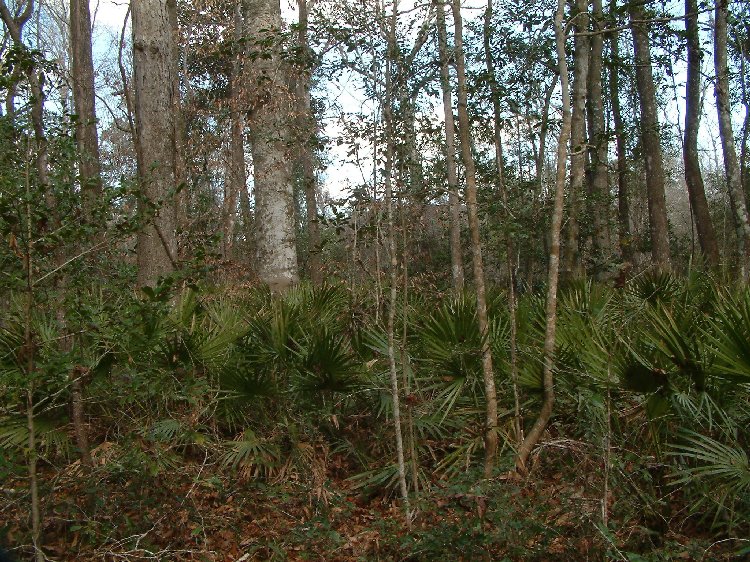
Pictured: a dense stand of saw palmetto (Serenoa repens) beneath an oak canopy, photographed at Edward Ball Wakulla Springs State Park in North Florida (WV-Mike, CC BY 3.0, via Wikimedia Commons) — representative of the type of waist-high palmetto scrub DesVergers described pushing through. This is not a photograph of the actual 1952 site, whose exact location on Military Trail was never precisely pinpointed in any source consulted for this case file, nor of the actual encounter, for which no photograph, film, or physical craft of any kind has ever been produced.
Theoretical Alignment
This case aligns overwhelmingly with the Psycho-Social/Mundane framework, and this case file states that plainly rather than hedging to preserve narrative tension. The lone piece of evidence for a genuine craft is a single, uncorroborated witness's own account — a witness whose own Air Force investigators, after two separate trips to Florida, concluded had a documented history of fabrication, a prior criminal record he had concealed, and a clear and quickly pursued financial motive to sell the story. The Extraterrestrial Hypothesis reading is not zero only because two specific physical findings — charred grass roots and cap-perforation burns — were never mechanistically explained by either the Air Force's own lab or by independent skeptics; those two data points are the entire remaining basis for treating this file as anything other than fully closed. The Interdimensional Hypothesis finds essentially no support: nothing reported here suggests a phenomenon existing outside conventional physical space, only a solid-seeming object interacting with solid ground in ordinary, if unexplained, ways.
Background
Military Trail is one of the oldest north-south roads in Palm Beach County, tracing its route back to a Second Seminole War-era supply road connecting forts along Florida's east coast. By 1952 it ran, in long unpaved and lightly paved stretches, through sparsely settled scrub pine and saw-palmetto flatwoods well inland of U.S. Route 1 and the coastal towns of West Palm Beach, Lake Worth, and Lantana — exactly the kind of dark, rural corridor where a passing motorist's headlights or a landing aircraft's lights could appear, to someone unfamiliar with the area at night, as something considerably stranger.
D.S. “Sonny” DesVergers was, in the words of the man who came to know his case file better than perhaps anyone else who ever worked it, “a very pleasant chap, in his early thirties, not at all talkative but apparently willing to co-operate.” By his own account to Ruppelt's team, he had lived in Florida his entire life, attended a private military preparatory school, completed some college coursework, and then joined the Marine Corps, telling investigators “rather hairy stories” of Pacific combat service. After the war he worked as an auto mechanic, then at a turpentine plant in Georgia, then opened and later sold a gas station back in Florida, and by August 1952 was working as a clerk in a local hardware store. Some months earlier, a local church had organized a new Boy Scout troop, and DesVergers had volunteered to serve as its scoutmaster — the role that, within days, would put his name in newspapers nationwide and permanently attach the word “hoax” to it.
August 1952 sat at the tail end of what Ruppelt's own later writing calls the “Big Flap” — the summer's extraordinary nationwide surge of UFO reports that peaked with the July 1952 Washington, D.C. radar-visual sightings and Major General John A. Samford's unprecedented Pentagon press conference on July 29. That press conference briefly cut Blue Book's incoming report volume from roughly fifty a day to ten within a week, but, as Ruppelt himself recorded, it was widely misread by some field intelligence officers as a signal that the Air Force had lost interest in UFOs altogether — producing exactly the kind of sloppy, under-verified initial reporting that would characterize the DesVergers case's first twenty-four hours, when an “operational immediate” telex reached Blue Book describing the scoutmaster, sight unseen, as a “solid citizen.”
Complete Timeline
| Date | Event |
|---|---|
| Aug. 19, 1952, ~11:00 p.m. | A weekly Boy Scout meeting near West Palm Beach breaks up early; DesVergers offers to drive four boys home. He drops one off, then continues with the remaining three toward the stock car track and, later, another boy's home along Military Trail. |
| Aug. 19, ~11:00–11:15 p.m. | DesVergers reports seeing lights among the pines off the road; after driving on and reconsidering twice, he turns the car around, parks opposite the lights, and — leaving the boys with instructions to seek help at a nearby farmhouse if he is not back in fifteen minutes — enters the woods alone with a machete and two flashlights. |
| Aug. 19, shortly after | DesVergers later recounts noticing a “sharp” or “pungent” odor and a faint warmth on reaching a clearing roughly 80 yards into the thicket, then seeing a large, dark, circular object hovering roughly 30 feet above him. He describes a door opening, a ball of red fire drifting toward him, and losing consciousness as it enveloped him. |
| Aug. 19, ~11:20–11:30 p.m. | The three boys, watching DesVergers's flashlight beam from the car, see a red glow engulf him and see him fall; they run to a nearby farmhouse for help. The farmer alerts the Florida Highway Patrol, which relays the report to the Palm Beach County Sheriff's Office. |
| Aug. 19–20, shortly after midnight | Deputy Sheriff Mott N. Partin and a local constable arrive, collect the boys, and find DesVergers — by the deputy's own account, more frightened than he had “ever seen” anyone — stumbling out of the ditch beside the road. At the sheriff's office he is found to have burns on his arms, face, and cap; the deputy calls the Air Force. |
| Aug. 20, morning | An intelligence officer at a nearby Air Force base wires Project Blue Book at Wright-Patterson AFB, Ohio, describing the scoutmaster as a “solid citizen.” Capt. Edward Ruppelt is notified by phone within hours. |
| Aug. 20, afternoon | Ruppelt, equipment specialist 2nd Lt. Robert M. Olsson, and two pilots depart Wright-Patterson for Florida in an Air Force B-25, arriving at the local air base by evening. |
| Aug. 20–21 | Ruppelt's team interviews DesVergers directly, arranges a flight surgeon's physical examination, collects his cap and machete for laboratory analysis, and inspects the site with a Geiger counter, finding the grass under the alleged hover point undamaged on visual inspection and no debris, burned matches, or flare residue anywhere in the area. |
| Aug. 22–23 | A second, independent deputy sheriff tips Ruppelt off the record that DesVergers's Marine Corps discharge was less clean than represented. The same weekend, DesVergers is quoted in the local press claiming “high brass” from Washington interrogated him and hinting the full story would cause “national panic” if told; he has also hired a press agent. |
| Late Aug. 1952 | Ruppelt's team returns to Florida a second time, confirms DesVergers was discharged from the Marines for being AWOL and stealing a car, served time in a federal reformatory in Chillicothe, Ohio, and gathers extensive testimony from townspeople describing a long-standing local reputation for exaggeration. |
| Aug. 29, 1952 | The FBI laboratory in Washington, D.C. reports on the cap: the scorch pattern shows it was flat when burned, and several minute holes were “very probably” made by an electrical spark — a finding the lab could not further explain. |
| Early Sept. 1952 | An agronomy laboratory at Wright-Patterson reports that grass and soil samples from the site — nearly left behind in Florida and shipped up only after the fact — show roots charred as if heated from below to roughly 300°F, while the blades themselves are undamaged except at tips that touched the ground. |
| Fall 1952 | Ruppelt's team reenacts the sighting at night under similar lighting conditions and finds that no one, even standing on the car roof, can see a person in the clearing where DesVergers claimed the boys watched him fall — undermining the boys' own corroborating testimony. |
| 1952 (formal disposition) | Project Blue Book closes the case as a hoax rather than logging it as Unidentified — a disposition Ruppelt would later summarize in print as “the best hoax in UFO history.” |
| 1956 | Ruppelt publishes The Report on Unidentified Flying Objects, devoting a full chapter (“Hoax or Horror?”) to a detailed, largely verbatim account of the case and its investigation. |
| 1963 | Donald H. Menzel and Lyle G. Boyd independently retell and re-analyze the case in The World of Flying Saucers, reaching the same hoax conclusion by a somewhat different evidentiary path. |
| 2019 | History Channel's dramatized series Project Blue Book loosely adapts the case as its Season 1, Episode 7, “The Scoutmaster,” relocating and fictionalizing much of the underlying record. |
| 2026 | This case file is published, correcting and expanding the “Coming Soon” queue's placeholder description, whose core physical-evidence claim — grass scorched from below — this case file's research confirms is drawn accurately from Ruppelt's own primary account. |
Into the Palmetto Thicket: DesVergers's Own Account
The single most detailed surviving source for what DesVergers said happened is Ruppelt's own chapter, which recounts the story largely as DesVergers told it directly to the six-person team gathered to hear it: Ruppelt himself, Olsson, the two pilots, the local intelligence officer, and his sergeant. According to that account, the scout meeting had broken up early, and DesVergers had offered to drive four boys home. He dropped one off, and the conversation among the remaining three turned to a stock car race and the condition of the track after recent rain; they drove out to look at it, then turned south on a black-top road roughly ten miles inland from the coastal highway to take another boy home. It was on this road, bordered by scrub pine and palmetto thickets, that DesVergers said he first noticed a light off to his left among the pines.
He slowed, asked the boys if they had seen it, and, when none had, started to drive on — until the light reappeared and all three boys saw it too. He stopped the car, and though the boys were frightened to be left alone, he decided, after some hesitation, to go back and investigate. His own explanation to Ruppelt for why a grown man would walk alone into a rattlesnake-infested palmetto thicket at night was specific and, on its face, plausible: the lights looked like they could be an airplane going down, and as a scoutmaster he felt his conscience would never forgive him if someone had actually been hurt and he had not checked. He told the boys that a fifteen-minute radio program had just started on the car radio, and that if he had not returned by the time it ended, they should run to a farmhouse they had passed and get help. He then set off wearing a faded denim cap, carrying a machete and two flashlights — one a spare kept in his back pocket.
Roughly fifty yards in, he ran into dense palmetto undergrowth and pushed through it for about thirty yards, navigating by checking the North Star to hold a straight easterly heading. He told Ruppelt that he became aware of an odd, “sharp” or “pungent” smell and a very slight change in temperature at this point — sensations he said he barely registered consciously until they intensified later. Noticing a change in the shadows ahead, he stopped to shine his flashlight forward and found a clearing. The boys in the car, who could track his position by his flashlight beam bobbing among the trees, watched him stop at its edge.
DesVergers said both the odor and the heat grew “almost unbearable” and “oppressively moist” as he stepped into the open ground, and that he was overcome by a sudden, specific feeling of being watched. Looking up for the North Star, he found he could no longer see any stars at all — because, he said, almost the entire sky above him was blotted out by a large, dark shape roughly thirty feet up. He described backing away, getting clear enough of the object to see its silhouette against the sky: circular, slightly concave underneath, smooth and gray — he compared its color and texture to a gray linoleum-topped desk in the intelligence officer's own room — with a central dome or turret and a thick rim lined with evenly spaced vanes, each separated by a small nozzle-like opening.
The Fireball and the Blackout
His next recollection, he told investigators, was a sudden impulse toward fury: he wanted to strike at the object with his machete, even though he had no way of reaching it. Before he could act on the impulse, he said the shadows on the object's dome shifted slightly and he heard a sound he compared to “the opening of a well-oiled safe door.” He froze, and a small ball of red fire began drifting toward him, expanding as it approached into a cloud of red mist. He dropped his light and machete, covered his face with his arms, and lost consciousness as the mist enveloped him.
The three boys watching from the car corroborated this much independently and immediately, before they had any chance to compare notes with DesVergers himself: they estimated he had been gone about five minutes when they saw him stop at the clearing's edge, walk in, pause, then shine his light upward — which they assumed at the time was simply him looking at the trees again. What they said they saw next was a large red fireball engulfing him and watched him fall, at which point they abandoned the car and ran for the farmhouse. DesVergers told investigators he had no sense of how long he was unconscious; he recalled leaning against a tree, the sensation of wet, dew-covered grass, and then a sudden return of awareness, after which he ran back toward the road, met the deputy sheriff and constable already on scene with the boys, and told his story “so excited he could hardly get his story told coherently,” in Ruppelt's own words.
The Boy Scouts' Corroboration and the Farmhouse Alarm
Secondary reconstructions of the case — drawing on the surviving Blue Book file more granularly than Ruppelt's own book, which never names the boys — identify the three scouts present at the encounter as Bobby Ruffing, age 12, David Rowan, age 11, and Chuck (Charles) Stevens, age 10, with a fourth boy dropped off earlier in the evening before the sighting began. According to Ruppelt's own account, the farmer and his wife who received the frightened boys had “a little difficulty getting the story out of them, they were so excited,” managing only to understand that their scoutmaster was in trouble down the road. The farmer called the Florida State Highway Patrol, which relayed the report to the county sheriff's office — the first of several links in a chain that, within a day, would carry the story from a rural Palm Beach County palmetto thicket to Project Blue Book's front door at Wright-Patterson.
Ruppelt's team, in a detail this case file treats as one of its more methodologically interesting features, deliberately structured their first formal interview with DesVergers as a lie-detection exercise without a polygraph: each of the six people present privately picked one insignificant detail from his account in advance, then separately requestioned him on it once he finished telling the whole story, on the theory that a fabricated account would either be repeated perfectly, suggesting rehearsal, or inconsistently, suggesting invention on the spot. By Ruppelt's own account, DesVergers “passed the test with flying colors,” and the team's initial, collective impression that first night was that his story “sounded good.” This case file discloses that detail honestly because it is directly relevant to how quickly and how far the case's credibility later collapsed — the same six trained interviewers who found him credible on the first night would, within roughly a week, be actively working to disprove him.
Air Technical Intelligence Center Responds
Ruppelt's own account of receiving the case is unusually personal and specific for a Blue Book file this old. He recorded that Project Blue Book had, by mid-August 1952, settled back into a normal rhythm after the exhausting “Big Flap” of July, joking that his colleague Lieutenant Andy Flues's Coca-Cola consumption had dropped from twenty bottles a day in mid-July to a normal five. The DesVergers case arrived on the morning of August 20 as an “operational immediate” telex urgent enough that the Air Technical Intelligence Center's duty officer came to Ruppelt's house rather than reading it to him over the phone. Ruppelt immediately called the Florida intelligence officer directly, who told him the local police had already verified the story and the fact of the burns, and who Ruppelt specifically instructed to get DesVergers to submit to an immediate physical examination — both to obtain hard evidence and, in Ruppelt's own words, because he “could imagine the rumors that could start about the scoutmaster's condition.”
Ruppelt then called his superior, Colonel Dunn, then chief at ATIC, who authorized the trip and arranged an Air Force B-25 to save time over commercial airlines. Within two hours, Ruppelt, 2nd Lt. Robert M. Olsson (carrying a borrowed Geiger counter and a camera), and pilots Capt. Bill Hoey and Capt. David Douglas were airborne for Florida — a response speed and personal seniority (the head of Blue Book himself flying out same-day) that this case file's research found matched by few other cases in this catalogue, and that stands as strong direct evidence the Air Force treated the initial report as serious and credible, whatever it later concluded.
“I Had the Immediate Impression That He Was Telling the Truth”
Ruppelt's own words, quoted here directly, describe his first reaction to meeting DesVergers in person: “He was a very pleasant chap, in his early thirties, not at all talkative but apparently willing to co-operate. While he was giving us a brief personal history, I had the immediate impression that he was telling the truth.” That first, favorable impression matters to this case file's overall assessment for a specific reason: it establishes that the eventual hoax verdict was not a snap judgment by a skeptical investigator predisposed to disbelieve, but a conclusion Ruppelt's own team arrived at only gradually, over roughly two weeks, and only after DesVergers's own subsequent behavior and background actively pushed them toward it.
That evening, an Air Force flight surgeon who had examined DesVergers that morning gave his report to Ruppelt directly: minor burns on the arms and backs of the hands, possible minor burning inside the nostrils, and singed hair consistent with a “flash heat.” Comparing the burn severity to a light sunburn, the surgeon told Ruppelt he had no specific theory for the mechanism but noted it could have been produced with something as simple as a cigarette lighter — and demonstrated by lightly singeing his own arm with one on the spot. The surgeon, asked only to perform a physical examination, nonetheless volunteered an unprompted piece of advice: check the man's Marine Corps records, because “something didn't ring true.” Ruppelt's own account records that he did not initially agree; the story still sounded credible to him at that point.
Lab Analysis, Round One: The Machete and the Cap
The next morning, Ruppelt's team and local officials walked the site with the deputy and constable, checking the area with the borrowed Geiger counter as a precaution rather than an expectation, and finding nothing. They searched inch by inch for a burned match, flare drippings, or anything else that should not have been in an isolated patch of woods, checked nearby trees for lightning-strike damage, and found none. Critically, on this first visual inspection, Ruppelt recorded explicitly that “the blades of grass under which the UFO supposedly hovered were not burned” — the investigators, at this stage, found nothing to contradict DesVergers's story, and Ruppelt wrote candidly that “to be very honest, we were trying to prove that this was a hoax, but were having absolutely no success. Every new lead we dug up pointed to the same thing, a true story.”
The team collected DesVergers's cap and machete for laboratory analysis. The machete went to the materials lab at Wright-Patterson, where technicians tested whether it was magnetized, radioactive, or had been heated — Ruppelt noted dryly that “no knife was ever tested so thoroughly for so many things” — and found it to be, in every respect, an ordinary, unmagnetized, unradioactive, unheated knife. The cap was separately sent to a laboratory in Washington, D.C. with a single governing question: did the cap's burns, chemical residue, or any other property substantiate or refute DesVergers's story.
It was only after this first round of testing that anyone on the team thought to ask about the single most obvious piece of physical evidence: soil and grass samples from directly beneath the alleged hover point. Samples had, in fact, been collected — and then, in the rush to catch a flight back to Dayton, left behind in Florida entirely. Ruppelt had them shipped up separately and turned over to an agronomy laboratory, a step whose outcome would not become clear for several more weeks and would ultimately do more than any other single piece of evidence to keep this case controversial seven decades later.
A Deputy's Phone Call: The Marine Corps Record Unravels
The team had planned to fly home commercial on a Saturday, the B-25 having been grounded for maintenance, when Ruppelt received a phone call that evening from a different sheriff's deputy than the one who had first met DesVergers coming out of the woods — one who, on his own initiative, had done some independent checking into the scoutmaster's background. What he had found was that DesVergers had been discharged from the Marine Corps after only a few months of service, not for the Pacific combat tours he had described, but for being absent without leave and stealing an automobile, and that he had subsequently served time in a federal reformatory in Chillicothe, Ohio. The deputy, by Ruppelt's own account, was careful to note that this fact alone proved nothing about the UFO story — but thought Ruppelt should know it regardless.
The very next morning, before Ruppelt's team had even acted on that tip, the local paper ran DesVergers's story on its front page, quoting him as saying “high brass” from Washington had questioned him late into the night. Ruppelt's own accounting of who had actually been in the room — “no ‘high brass,’ just four captains, a second lieutenant, and a sergeant” — makes clear the claim was a fabrication DesVergers had reason to know was false, since the team had openly told him where they were stationed and their ranks. The article went further, quoting DesVergers as saying he and the Air Force both knew what he had seen but that he could not say, because it would cause “national panic” — and reporting that he had hired a press agent. Ruppelt wrote that he could excuse “high brass from the Pentagon” as ordinary press exaggeration, “but this ‘national panic’ pitch was too much,” and that this specific moment — not the deputy's tip, not the flight surgeon's suspicion — is what he identified as the point he had “just about decided to give up on this incident and write it off as ‘Unknown’” before events instead pushed him toward the opposite conclusion. He called Pentagon liaison Maj. Dewey Fournet before leaving Florida to request further checking on DesVergers's background.
“If He Told Me the Sun Was Shining, I'd Look Up to Make Sure”: The Second Trip
By the end of that week, Ruppelt had received the full military and reformatory record, which confirmed the deputy's tip and added further unflattering detail. Struck by the gap between what DesVergers had told the team in person and what the paper record showed, Ruppelt decided the discrepancy warranted a second trip to Florida — timed, by necessity, to fit between two hurricanes moving through the region that week. On this visit, the team deliberately avoided DesVergers himself and instead spent their time with roughly a dozen people in his hometown who had known him for years, tracing his reputation from boyhood forward and independently vetting the reliability of those sources before trusting their accounts.
What they heard was consistent and unflattering: DesVergers had a long-standing local reputation, entirely independent of the UFO story, for embellishing and inventing tall tales. Ruppelt recorded one specific characterization verbatim — a townsman's remark that “if he told me the sun was shining, I'd look up to make sure” — as representative of how DesVergers was generally regarded. The team also, on this second trip, spoke with the boy scouts again at a regular troop meeting rather than immediately after the event, and separately staged a night-time reenactment of the sighting under matching lighting conditions. The reenactment could not reproduce the boys' claimed sightline at all: nobody on the team, even standing on the roof of the car, could see a person silhouetted in the clearing where DesVergers said he fell. Ruppelt's own account is careful and fair to the boys specifically, noting that “none of us ever believed the boy scouts were in on the hoax,” and concluding instead that they were “undoubtedly so impressed by the story that they imagined a few things they didn't actually see” — a distinction this case file preserves, since it means the boys' own credibility problem is one of suggestibility rather than deception, a materially different and lesser finding than the one reached about DesVergers himself.
The Lab Reports Return: A Cap Burned by “Electrical Spark,” and Roots Charred to 300°F
Two laboratory findings arrived after the second Florida trip, and they cut in opposite directions — a tension this case file treats as the single most important fact about the entire record, because it is the reason neither Ruppelt nor any subsequent researcher has ever been able to call this case fully, cleanly solved. The Washington laboratory's report on the cap found that its scorch pattern showed the hat had been flat, not on someone's head, when it was burned, and identified several very small holes — missed on the initial field inspection — that had “very probably” been made by an electrical spark. That was, in Ruppelt's own words, “all the lab could find” — a finding that ruled out some explanations (an open flame held directly to a worn cap) without positively identifying what had actually produced the holes.
Then, weeks after nearly everyone involved — in Ruppelt's own words, “everyone who was familiar with the incident, except a few people in the Pentagon” — had settled on hoax as the likely verdict, the agronomy lab called with a question that reopened the entire case: “How did the roots get charred?” Ruppelt recorded not even understanding the question at first. The lab explained that in examining the grass samples, they had knocked the soil off the roots and found them charred, while the blades themselves showed no heat damage at all except at the very tips of the longer blades that had been bent over, touching the ground. The lab had reproduced the effect experimentally, finding that heating a live grass clump, roots down in sand and dirt, to roughly 300°F over a gas burner would char the roots exactly this way — but could not identify how such heating could have been produced under real field conditions without disturbing the soil or leaving behind bulky equipment.
Ruppelt's team checked every conventional possibility they could think of once this report came in: there were no hot underground springs in the area, no unusual soil chemistry, nothing that could account for the effect naturally. Ruppelt's own summary of the logical bind this created is worth quoting directly: “The only way it could have been faked would have been to heat the earth from underneath to 300 degrees F., and how do you do this without using big and cumbersome equipment and disturbing the ground? You can't.” He further narrowed the list of people who had physically handled the samples to three — the lab itself, the Florida intelligence officer, and himself — and stated plainly that he did not believe any of the three had faked the result. His own conclusion, recorded in 1956, was direct: “the charred grass roots from Florida are still a mystery.”
Ruppelt's Own Speculative “Induction Heating” Theory
Ruppelt used the remainder of his chapter to float, explicitly as speculation he did not personally believe, a theory that a genuine hovering craft generating a powerful alternating magnetic field could induce eddy currents and resistive heating in damp, mineral-bearing sand — the same physical principle used in industrial induction furnaces — which could in turn explain both the charred roots (heat from below, via the ground) and the cap's spark-pattern burn holes (electrical arcing from the same field), while a brief few seconds of exposure would explain why DesVergers's own metal objects (a flashlight, coins, the machete) were not damaged. He connected this, again explicitly as speculation rather than a real proposal, to Albert Einstein's unified field theory linking electromagnetism and gravitation, and noted that the same field could plausibly ionize air into the “sharp” or “pungent” ozone smell DesVergers described, and that ozone in sufficient concentration can itself cause unconsciousness. Ruppelt was explicit that he found this line of reasoning “interesting” precisely because it tied together every otherwise-unexplained detail at once — and equally explicit that he did not believe it was the actual answer. This case file presents the theory for exactly what its own author said it was: an intellectually tidy, entirely unproven piece of speculation, not a competing scientific finding.
Donald Menzel and Lyle Boyd's Independent Verdict
Eleven years after Ruppelt's book, Harvard astronomer Donald H. Menzel and co-author Lyle G. Boyd retold the case in their own 1963 book, The World of Flying Saucers, reaching an unambiguous hoax verdict — but doing so via an account that both omits the charred-root finding entirely and asserts a more definitive physical explanation than Ruppelt's own record supports. Menzel and Boyd's version states flatly that “the laboratory report from the Federal Bureau of Investigation showed that the burn on the cap was made by a cigarette, and the ‘burns’ on the hand and arm proved to be only superficial scorching of the hair and could easily have been produced by the flame of a kitchen match” — a considerably more conclusive claim about the cap than the “very probably…an electrical spark” finding Ruppelt himself, working from the same underlying FBI report, actually records. Menzel and Boyd also state that a study of the landscape showed the boys could not have seen a “machine” from the road, that aircraft regularly landing nearby with their lights on could explain the original lights in the pines, and that “the scene had been set in advance for a frightening incident,” noting that DesVergers had been discussing flying saucers with the boys in the car before he ever claimed to see anything.
This case file discloses the discrepancy between the two skeptical accounts honestly rather than picking whichever version reads more conclusively. Menzel and Boyd's chapter, titled “Panic” and covering the entire 1952 UFO wave in a few pages per incident, reads as a condensed, secondhand retelling rather than a fresh investigation, and its more absolute framing of the cap evidence is not independently corroborated by this case file's own research beyond Menzel and Boyd's own text. Ruppelt, by contrast, personally led both Florida trips, interviewed the principals directly, and published his account only three years after the events, while explicitly acknowledging what his own investigation could not explain. Where the two skeptical treatments agree — that DesVergers fabricated the encounter, that his prior record and reputation made him an unreliable narrator, and that the overall case should be closed as a hoax — this case file treats as very well-supported. Where they diverge — on whether the physical evidence was fully or only partially explained — this case file follows Ruppelt's own more cautious, first-hand account as the more reliable source, since it is closer to the primary record and more forthcoming about its own investigation's limits.
What Became of the Physical Evidence, and of DesVergers Himself
DesVergers's cap was never returned to him. Ruppelt's account dispenses with any implied intrigue around this directly: investigators had repeatedly asked, during their initial interviews, whether the cap had been burned before the encounter or had been recently ironed, and were told each time that the boys would have noticed any burn marks earlier because they had been handling the cap at the scout meeting, and that the cap was new and had never been washed or ironed. Rumor later held that the Air Force kept the cap as proof of the sighting's authenticity; Ruppelt states plainly that the actual reason was simply that DesVergers himself said he did not want it back.
Beyond the case file itself, DesVergers's subsequent life is thinly documented in the sources available to this case file's research. He is reported to have sold his account to the Sunday newspaper supplement The American Weekly the following year, and secondary accounts describe him losing his hardware-store job and facing a degree of community ostracism as the hoax finding became widely known locally. This case file's research could not independently verify further biographical detail — his life, career, and eventual death are not documented in any source consulted here with the same rigor as the 1952 investigation itself, and this case file discloses that gap honestly rather than filling it with unverified claims found on less rigorous UFO-interest sites.
Key Witnesses
D.S. “Sonny” DesVergers
The case's only witness to the alleged craft itself. Initially struck Ruppelt's own investigating team as credible and passed an improvised truth-detection exercise on his first interview, but his credibility collapsed as investigators uncovered a concealed “Other Than Honorable” Marine Corps discharge for AWOL and auto theft, a subsequent term in a federal reformatory, a long-standing hometown reputation for tall tales, a hired press agent, and self-serving fabrications (a false claim of “high brass” interrogation) made to the press within days of the event. Ruppelt's team ultimately concluded the entire incident was staged, though it could never determine exactly how two specific pieces of physical evidence — the cap's spark-pattern burn holes and the charred grass roots — were produced.
Bobby Ruffing (age 12)
One of the three scouts present in the car during the encounter. Secondary reconstructions of the case identify him among the boys who watched DesVergers's flashlight beam in the thicket and saw the red glow that appeared to engulf him. Ruppelt's own contemporaneous account does not name the boys individually but treats their corroborating testimony as sincere rather than complicit — a night-time reenactment later found their claimed sightline into the clearing could not actually be achieved even standing on the car roof, suggesting genuine suggestibility rather than deliberate deception.
David Rowan (age 11)
A second of the three scouts present. Like the other boys, his corroboration was limited to distant lights, the movement of DesVergers's own flashlight beam through the brush, and a red flash of light at the moment DesVergers said he was struck — not a direct view of any craft.
Chuck (Charles) Stevens (age 10)
The youngest of the three scouts present, and by several secondary accounts the member of the group most often quoted in later retrospectives on the case as an adult recalling the event.
Capt. Edward J. Ruppelt
Personally led both Florida investigative trips, interviewed DesVergers directly, arranged all laboratory analysis, and authored the single most detailed surviving account of the case in his 1956 book. His own investigative record is unusually candid for an official Air Force conclusion, explicitly preserving evidence (the charred grass roots) that complicated rather than confirmed his own final hoax verdict.
2nd Lt. Robert M. Olsson
Accompanied Ruppelt on both Florida trips, operated the borrowed Geiger counter during the on-site search, and participated in the second trip's background interviews and night reenactment.
Deputy Sheriff Mott N. Partin
Among the first responders to the boys' farmhouse alarm; found DesVergers coming out of the ditch beside the road and, by Ruppelt's account, remarked that in all his years in law enforcement he had never seen a man so frightened. His initial call to the Air Force set the entire Blue Book investigation in motion.
The Five Observables Assessment
Assessment: This case scores about as low on the Five Observables framework as any file in this catalogue, and the reason is structural: every one of the framework's five criteria depends on a report of the object's own behavior, and the only source for that behavior is a single witness whose credibility investigators themselves rejected. Anti-Gravity Lift is rated Present only in the narrow sense that DesVergers described the object motionless above the ground with no visible support — a claim with zero independent corroboration, since none of the three boys ever reported seeing the object itself. Instant Acceleration and Hypersonic performance are both rated Absent because DesVergers never described the object moving at all; it was static throughout his entire account, and he lost consciousness before any departure could be observed. Low Observability is rated Absent, as the object was described as large enough to “blot out most of the sky” from directly beneath it — the opposite of a stealthy signature. Trans-Medium travel is Absent and not applicable. This case file's own view is that a Five Observables assessment this uniformly weak, on a case this heavily documented as fabricated by its own official investigators, is exactly the outcome the framework should produce when applied honestly rather than generously.
Evidence Assessment
Supporting Anomalous Origin
- Grass roots recovered from beneath the alleged hover site were found charred as if heated from roughly 300°F from below ground, while the blades themselves showed no heat damage — a finding Ruppelt's own agronomy lab reproduced experimentally but could not explain as achievable in the field without bulky equipment that was never found at the site
- Minute holes in DesVergers's cap were assessed by an FBI laboratory as “very probably” caused by an electrical spark, a mechanism the lab itself could not further account for
- DesVergers's own initial interview passed an improvised, unannounced truth-detection exercise conducted by six trained Air Force personnel, and his very first physical examination found genuine, if minor, burns and singed hair consistent with a flash-heat exposure
- Ruppelt's team's own contemporaneous field search found the grass under the object's alleged hover point visually undamaged and located no burned matches, flare residue, or debris that would have positively proven a staged flare or firework
- Even Ruppelt himself, writing with three years' hindsight and full knowledge of DesVergers's discredited background, stated plainly in print that the charred grass roots remained “still a mystery”
Supporting Conventional Explanation (Hoax)
- DesVergers concealed an “Other Than Honorable” discharge from the Marine Corps for being AWOL and stealing an automobile, along with a subsequent term in a federal reformatory, presenting fabricated stories of Pacific combat service instead
- Independent, corroborated testimony from roughly a dozen long-term acquaintances described a well-established local reputation for tall tales and exaggeration entirely independent of the UFO claim, including one specific characterization — that people would “look up to make sure” even if he said the sun was shining — that Ruppelt recorded as broadly representative
- DesVergers made verifiably false public claims within days of the event, including a fabricated account of “high brass” from Washington interrogating him (the actual team was four captains, a lieutenant, and a sergeant) and a threat that the full story would cause “national panic”
- He hired a press agent and pursued a magazine/newspaper sale of his story (ultimately placed with The American Weekly) within days of the encounter, establishing a direct financial motive
- A night-time reenactment under matching lighting conditions found the boys' claimed sightline into the clearing where DesVergers said he fell could not be achieved even standing on the roof of the car, undermining their corroboration as an accurate independent observation rather than a suggestible impression
- An Air Force flight surgeon demonstrated that the arm and hand “burns” — assessed as no worse than a light sunburn with singed hair — could be readily reproduced with an ordinary cigarette lighter
- Independent skeptical analysis by Donald Menzel and Lyle Boyd, published eleven years later from the same underlying FBI report, described the cap burn as caused by a cigarette and the arm burns as consistent with a kitchen match — a more conclusive characterization of the same lab finding Ruppelt recorded more cautiously
Why “Disputed”
This case earns a DISPUTED classification with a credibility score of 22/100 — low within this catalogue, comparable to the Arak F-14 Radar Intercept (Disputed, 21) and well below the low end of this site's genuinely contested radar-visual cases such as Thomas Mantell (Disputed, 38). That placement reflects a case whose central witness's own credibility did not merely weaken under scrutiny but essentially collapsed: a concealed criminal record and reformatory sentence, a documented, independently corroborated local reputation for fabrication, verifiably false public statements made within days of the event, an undisguised financial motive pursued almost immediately, and a formal, deliberate reenactment that discredited even his supporting witnesses' own testimony. The U.S. Air Force's own investigators — the same team that initially found DesVergers personally credible — reached this conclusion themselves, closing the file not as Unidentified but explicitly as a hoax, and an entirely independent 1963 skeptical review by Donald Menzel and Lyle Boyd reached the identical verdict by its own separate route.
What keeps this case from scoring even lower, in the range of this catalogue's most cleanly solved hoaxes such as the Maury Island Incident (Debunked, 14) or the Aurora UFO Crash (Debunked, 8), is that this case file's own primary source — Ruppelt's first-hand 1956 account, written with full knowledge of every discrediting fact above — explicitly and repeatedly states that two specific pieces of physical evidence were never mechanistically explained: the charred grass roots recovered from beneath the alleged hover site, and the electrical-spark-pattern holes burned through DesVergers's cap. Ruppelt's own proposed speculative explanation for both (induction heating from a genuine craft's magnetic field) was offered by its own author as speculation he did not believe, not a competing finding, and this case file treats it accordingly. But the fact that the Air Force's own investigator, having every incentive and every piece of discrediting information needed to close the file as a clean, fully explained hoax, chose instead to disclose in print that two specific evidentiary details remained unexplained, is itself evidentiarily significant, and it is the entire reason this case sits in the “Disputed” category at the bottom of this catalogue's range rather than in “Debunked” alongside cases with a fully closed conventional explanation.
Sensor & Instrumentation Detection Profile
No radar, camera, radiation detector, or any other instrumented sensor recorded this event as it happened; the entire real-time record consists of unaided human testimony from DesVergers and the three boys. The only instruments involved at all entered after the fact, during the Air Force's own investigation: a borrowed Geiger counter used to sweep the site for radioactivity (finding none), a materials-lab battery of magnetism, radioactivity, and heat tests on the machete (finding nothing unusual), an FBI laboratory examination of the cap's burn pattern and residue (finding scorch marks and spark-pattern holes it could not further explain), and an agronomy laboratory's thermal and chemical analysis of the grass and soil samples (finding root charring consistent with roughly 300°F heating from below, which it could reproduce experimentally but not explain as field-achievable). This case file's own assessment is that the after-the-fact laboratory work here is unusually thorough for a 1952 Blue Book file — considerably more so than many contemporaneous cases — even though it was applied to trace physical evidence rather than to any real-time instrumented detection of the object itself.
Environmental & Geospatial Context
The encounter site sat in sparsely settled scrub pine and saw-palmetto flatwoods along Military Trail, roughly ten miles inland from the heavily traveled U.S. Route 1 coastal corridor south of West Palm Beach — terrain that, at night, would have offered minimal ambient light and made unfamiliar lights (whether an approaching aircraft's landing lights, a distant vehicle, or something else) stand out sharply against an otherwise dark tree line. Both Ruppelt's own account and Menzel and Boyd's independent retelling specifically note that aircraft preparing to land at a nearby airport regularly overflew this exact area with their landing lights on, and that from a vantage point on the road, those lights could plausibly appear to be moving through the woods themselves — the leading candidate explanation this case file's own Conventional Explanation Candidate section below treats for the initial “lights in the pines” that started the entire sequence of events. This case file's research could not verify a specific primary meteorological record for the evening of August 19, 1952; a secondary case reconstruction describes scattered thunderstorm activity to the west, high humidity, and broken cloud cover around 3,000 feet, but that detail is disclosed here with the caveat that it could not be independently confirmed against an original weather log.
Observer Credibility & Occupational Profile
This case presents an unusually stark occupational and credibility contrast within a single file. DesVergers held a position — Boy Scout troop leader — that Ruppelt's own account explicitly flags as carrying a strong presumptive-credibility bonus in the eyes of 1952 investigators (“since scoutmasters are traditionally upright citizens, the story seemed to merit attention,” in Menzel and Boyd's phrasing), precisely the kind of socially-trusted civic role this site's Observer Credibility framework generally treats as a positive signal. That presumption is exactly what collapsed under investigation: a concealed criminal record, a documented pattern of fabrication independent of the UFO claim, and self-serving public statements demonstrably false on their face. This case file treats that collapse as the single most important credibility finding in the entire record — a reminder that a witness's social role or apparent respectability is not itself evidence, and can actively mislead investigators (as it initially misled Ruppelt's own team) until independently verified against hard records.
The three boy scouts present a materially different profile: children with no independent motive to fabricate, whose corroboration Ruppelt's own team concluded was sincere rather than deceptive, but whose sightline claims did not survive an honest physical reenactment. This case file rates their testimony as a case study in suggestibility rather than dishonesty — a distinction Ruppelt himself was careful to draw, and one this case file preserves rather than collapsing all four witnesses into a single “unreliable” bucket. The investigating team itself — career Air Force intelligence officers, an equipment specialist, two pilots, and a flight surgeon, operating with direct Pentagon liaison support and unusually fast, senior-level response (the head of Blue Book personally traveling to Florida twice within roughly two weeks) — represents a strong, professionally credentialed investigative body whose own conclusions this case file weighs heavily, precisely because that same team's initial instinct was to find DesVergers credible, and its final hoax verdict was reached only reluctantly and only after specific, disclosed, hard evidence forced it.
Physical & Material Assays
Three physical items were laboratory-tested in connection with this case: the machete (tested for magnetism, radioactivity, and heat damage at the Wright-Patterson materials lab; found ordinary in every respect), the scout cap (tested at an FBI laboratory in Washington, D.C. for burn pattern and chemical residue; found to have been scorched while lying flat, with several minute holes assessed as “very probably” caused by electrical sparking), and grass and soil samples from beneath the alleged hover site (tested at a Wright-Patterson-affiliated agronomy laboratory; found to have roots charred consistent with roughly 300°F heating applied from below ground, with the blades themselves undamaged except at tips touching the soil). No debris, landing-gear impression, or any fragment of a physical craft was ever recovered or claimed to exist. See Material Analysis below for full discussion of what each of these three assays could and could not establish.
Historical Precedents & Archive Matches
The DesVergers case sits at the tail end of the extraordinary nationwide UFO reporting surge of summer 1952, immediately following the July Washington, D.C. radar-visual sightings and General Samford's Pentagon press conference — a period Ruppelt's own writing calls the “Big Flap.” Menzel and Boyd's own retelling places it explicitly at the close of “the panic of 1952,” grouping it in their book's “Panic” chapter alongside the September 1952 Flatwoods Monster sighting near Sutton, West Virginia — a case they treat with the same skeptical framework, finding a probable meteor and a startled, imaginative family confronting an ordinary woodland animal rather than a genuine monster. This case file's own research treats the pairing as instructive: both cases involve genuinely frightened, sincere witnesses whose accounts, examined closely, dissolve into ordinary explanations once investigators apply the same rigor Ruppelt's team applied here.
Within this site's own catalogue, the case's closest analogs are its other documented hoaxes with a compelling initial physical-evidence hook: the Maury Island Incident, where the FBI concluded a slag-debris claim was fabricated, and the Gulf Breeze UFO Sightings, where Ed Walters's photographs were eventually matched almost exactly to a foam model recovered from his own former attic. What distinguishes DesVergers from both is that his case's investigators never achieved that same final, clean, mechanistic closure — no foam model, no matching photographic geometry, no confession. On the other side of this catalogue's physical-trace spectrum sit cases like Trans-en-Provence and Falcon Lake, where ground trace and burn evidence anchor considerably higher credibility scores because the witnesses themselves were never independently shown to have fabricated the surrounding narrative. DesVergers's case occupies an unusual, genuinely uncomfortable middle position: overwhelming circumstantial evidence of fabrication, sitting directly alongside a small residue of trace physical evidence its own investigators could never mechanistically explain.
Material Analysis
This case's physical evidence is genuinely unusual within this catalogue: rather than a single ambiguous trace, it consists of three separately lab-tested items that point in different evidentiary directions at once. This section discusses each in turn, then weighs them together against the overwhelming circumstantial case for fabrication developed above.
The Machete: A Clean Result That Proves Nothing Either Way
The Wright-Patterson materials lab's battery of tests on DesVergers's machete — checking for magnetism, radioactivity, and heat exposure — found nothing unusual whatsoever. This case file's own assessment is that this result is genuinely neutral rather than exculpatory or incriminating: an ordinary machete used to hack through palmetto brush would be expected to show no anomalous properties regardless of whether the surrounding story was true or fabricated, since nothing in DesVergers's own account suggested the machete itself had been exposed to the object or the fireball directly.
The Cap: Scorched Flat, Perforated by “Probably” an Electrical Spark
The FBI laboratory's finding on the cap carries more genuine ambiguity than either skeptical account fully acknowledges on its own. Ruppelt's own primary-source record states the burn pattern showed the cap had been lying flat, not worn, when scorched — a detail this case file treats as mildly incriminating, since a cap burned while off DesVergers's head is more consistent with a staged prop than with an in-the-moment injury sustained while wearing it during a genuine encounter. But the same report's characterization of the small perforating holes as “very probably” caused by an electrical spark is explicitly hedged, not conclusive, and Menzel and Boyd's later, more confident claim that the burn was simply “made by a cigarette” is not independently corroborated by this case file's own research beyond their own book's text. This case file's position is that the cap evidence, read honestly, supports staging more than it refutes it, but stops short of the fully closed, mechanistically explained finding some retellings imply.
The Grass Roots: The Evidence Neither Skeptical Account Fully Resolves
The charred grass roots remain, in this case file's own assessment, the genuinely unresolved core of the entire case. Menzel and Boyd's 1963 retelling does not mention this finding at all — a significant omission, since it is the single piece of evidence Ruppelt's own 1956 account treats as most resistant to a hoax explanation. Ruppelt's team verified the effect was experimentally reproducible (heating live grass clumps to roughly 300°F in a lab setting charred the roots identically) while being unable to identify how the same effect could have been produced in an open field, at night, by one person, without leaving behind heavy equipment or disturbed soil that a subsequent site search would have found. This case file's own research, consulting the same sources available to Ruppelt, could not identify a more mundane mechanism either — not a buried flare, not a chemical accelerant, not a natural geological heat source. This does not, in this case file's assessment, mean DesVergers's account of a hovering craft is true; it means one specific piece of physical trace evidence in an otherwise thoroughly discredited case remains a genuine, disclosed gap in the record rather than a fully closed loop.
Supporting Non-Terrestrial or Unexplained Origin
- Root-level grass charring consistent with roughly 300°F heating from below ground, reproduced experimentally in a laboratory setting but never explained as achievable under real outdoor field conditions without equipment that was never located
- Cap perforations independently assessed by an FBI laboratory as “very probably” caused by an electrical spark, a mechanism the same report could not further account for
- The Air Force's own lead investigator, publishing three years later with full knowledge of every discrediting fact about DesVergers, chose to disclose rather than suppress or paper over the unexplained grass-root finding
Supporting Terrestrial or Mundane (Staged) Origin
- The cap's scorch pattern indicates it was burned while lying flat rather than while worn, consistent with deliberate staging rather than an in-the-moment injury
- DesVergers's own concealed criminal record, documented reputation for fabrication, verifiably false public statements, and swiftly pursued financial motive collectively establish means, pattern, and motive for a staged hoax independent of the physical evidence question
- A formal night-time reenactment found the boys' own claimed corroborating sightline into the clearing physically impossible to achieve, undermining the supporting witness testimony surrounding the physical evidence's context
- No debris, equipment, landing trace, or any fragment of an actual craft was ever recovered, despite an inch-by-inch search of the site conducted within roughly a day of the event
The Conventional Explanation Candidate (CEC): A Deliberately Staged Hoax
Every serious investigation of this case — Ruppelt's own 1952–53 Air Force inquiry, Menzel and Boyd's 1963 independent skeptical review, and this case file's own research drawing on both — converges on the same leading candidate: that DesVergers deliberately staged the encounter, most likely using a cigarette lighter or a similar small ignition source to produce the cap and skin burns, and using his own prior conversation about flying saucers in the car to prime the boys' expectations before ever claiming to see anything unusual. This candidate is treated seriously here specifically because it is the conclusion the Air Force's own investigators reached only reluctantly, after their initial instinct was to find DesVergers credible, and only once specific, independently verified facts — his concealed record, his documented reputation, his verifiably false statements, his financial motive — accumulated past the point of reasonable doubt.
Landing-Light Misidentification (The Initial “Lights in the Pines”)
Both Ruppelt's account and Menzel and Boyd's independently note that aircraft regularly approached a nearby airport on landing paths that would have carried their lights over or near this stretch of Military Trail, and that from a moving car on a dark rural road, distant landing lights moving among a tree line could plausibly be mistaken, at least initially, for something in the woods themselves. This candidate accounts well for the very first, ambiguous “lights among the pines” that DesVergers and the boys agreed they saw before he ever entered the thicket, but it does not by itself explain anything that happened afterward — the burns, the cap, or the grass — and this case file treats it as, at most, the innocent trigger for a genuinely staged event that followed.
Genuine Anomalous Event
This reading survives, in a narrow and heavily qualified form, on the strength of the two physical findings neither skeptical account could fully close: the charred grass roots and the cap's spark-pattern perforations. It is directly and severely undermined by every circumstantial fact about DesVergers's own background, conduct, and motive, and by the demonstrated impossibility of the boys' own corroborating sightline. Ruppelt's own account records that only “a few people in the Pentagon” held this view even at the time, against the overwhelming consensus of everyone directly involved in the investigation.
Deliberately Staged Hoax
Highly PlausibleHIGHLY PLAUSIBLE as the overall verdict, supported by a concealed criminal record, a documented reputation for fabrication, verifiably false public statements, a swift financial motive, and a failed reenactment of the boys' own corroborating sightline. Remains INCONCLUSIVE only in its precise mechanism for two specific physical findings — the charred grass roots and the cap's spark-pattern holes — that neither the Air Force's own investigators nor this case file's research could positively explain.
Landing-Light Misidentification
PlausiblePLAUSIBLE as the explanation for the initial, ambiguous lights that first drew DesVergers's attention off the road. Does not extend to any subsequent element of the account — the burns, the cap damage, or the grass-root charring — which this candidate does not attempt to address.
Genuine Anomalous Event
ImplausibleIMPLAUSIBLE as an account of the overall incident, given the scale and specificity of the evidence against DesVergers's credibility. Kept from a rating of fully disproven only by two disclosed, unexplained physical findings that a small minority of contemporaneous Pentagon observers, per Ruppelt's own account, found sufficient to withhold full closure.
Ruppelt's Speculative Induction-Heating Theory
Unproven / SpeculativeUNPROVEN AND SPECULATIVE by explicit statement of its own author. Ruppelt floated this theory — a genuine craft's alternating magnetic field inducing eddy-current heating in damp soil — only to note it tied together every unexplained detail at once, while stating plainly that he did not believe it was the actual answer. This case file treats it as a thought experiment, not a competing evidentiary finding.
Related Cases
Confirmed Documents & Official Records
NARA's own guide to the declassified Project Blue Book records (Microfilm Publication T1206, 94 rolls) that hold this case's original 1952 case file.
DECLASSIFIEDThe CIA's own declassified-document collection on UFOs, covering the same 1952 Big Flap period this case sits at the tail end of, including internal Agency material on how the government tracked and responded to that year's wave of reporting.
DECLASSIFIED (various)This case file's research relied primarily on Edward Ruppelt's own 1956 book-length account, itself drawn directly from his personal role leading the original 1952 investigation, and on Donald Menzel and Lyle Boyd's independent 1963 retelling, rather than on this case file's own direct examination of the original Blue Book microfilm frame images, which were not separately consulted for this file.
Search Government & Military Archives Directly
Further Reading — Recommended Literature
The Report on Unidentified Flying Objects: The Original 1956 Edition
Contains Ruppelt's own full chapter, “Hoax or Horror?,” the single most detailed primary-source account of this case's investigation, in his own words.
The World of Flying Saucers: A Scientific Examination of a Major Myth of the Space Age
Contains Menzel and Boyd's own independent retelling and skeptical analysis of the case, in their chapter “Panic,” reaching the same hoax verdict as Ruppelt by a partly different evidentiary path.
Captain Edward J. Ruppelt: Summer of the Saucers — 1952
Drawing on Ruppelt's own private papers, this study of Blue Book's 1952 leadership era provides essential context for the “Big Flap” period this case sits at the end of, and for how Ruppelt's own investigative instincts developed.
The UFO Encyclopedia, 4th Edition (2-Volume Set)
The standard comprehensive reference for cataloged UFO cases, useful for situating this Florida case within the broader documented pattern of 1950s American hoax and physical-trace claims.
Watch the Skies!: A Chronicle of the Flying Saucer Myth
A rigorously researched, skeptically inclined cultural history of American UFO reporting during exactly this period, useful context for how a case like this one shaped and was shaped by the broader 1952 “flap” atmosphere.
Essential Viewing
No Videos Available
This case file's research located no video, documentary segment, or news report found to be genuinely, primarily about the real 1952 DesVergers case, as opposed to History Channel's 2019 dramatized Project Blue Book episode “The Scoutmaster,” which relocates and substantially fictionalizes the underlying events. Consistent with this site's video verification standard and its policy against treating History Channel dramatizations as a reputable analytical source, no substitute video has been included in its place.
Sources
- Ruppelt, Edward J. The Report on Unidentified Flying Objects (1956), Chapter Thirteen, “Hoax or Horror?” Full text: sacred-texts.com
- Menzel, Donald H., and Lyle G. Boyd. The World of Flying Saucers: A Scientific Examination of a Major Myth of the Space Age (1963), Chapter VII, “Panic,” section “The Scoutmaster's UFO.” Full text: gutenberg.org
- History.com. “This Scoutmaster Had a Run-in with a UFO. The Kids Saw it Too.” history.com
- Saturday Night Uforia. “The Scoutmaster's Tale” (detailed chronological reconstruction citing the underlying Blue Book case file). saturdaynightuforia.com
- Randle, Kevin. “A Different Perspective: Project Blue Book Episode Seven — Sonny Desvergers, The Florida Scoutmaster.” kevinrandle.blogspot.com
- AIPT Comics. “The scoutmaster encounter of ‘Project Blue Book’: ‘The best hoax in UFO history’?” aiptcomics.com
- UFO Casebook. “UFO Physical Trace Cases: Florida Scoutmaster.” ufocasebook.com
- National Archives and Records Administration. “Project BLUE BOOK: Unidentified Flying Objects.” archives.gov
- Central Intelligence Agency. FOIA Reading Room, “UFOs: Fact or Fiction?” collection. cia.gov
- Wikipedia. “Edward J. Ruppelt.” en.wikipedia.org
- Wikipedia. “The Report on Unidentified Flying Objects.” en.wikipedia.org
- Wikipedia. “Project Blue Book.” en.wikipedia.org
- Wikipedia. “Military Trail (Florida).” en.wikipedia.org
- Palm Beach Past. “The Military Trail You Don't Know” (local historical background on the road's origin and 1950s condition). palmbeachpast.org
- Hall, Michael D., and Wendy Connors. Captain Edward J. Ruppelt: Summer of the Saucers — 1952 (2000).
- Clark, Jerome. The UFO Encyclopedia, 4th ed. (2 vols.).
- Peebles, Curtis. Watch the Skies!: A Chronicle of the Flying Saucer Myth.
- Wikimedia Commons. “File:Saw palmetto Serenoa repens and Oak Forest at Edward Ball Wakulla Springs State Park in Florida.jpg,” photograph by WV-Mike (CC BY 3.0), source of this case file's hero image. commons.wikimedia.org
- This site's own case file, “Maury Island Incident” (June 1947), for a comparable early hoax case with an FBI-examined physical-evidence claim. The Omni Ledger
- This site's own case file, “Gulf Breeze UFO Sightings” (Nov. 1987), for a comparable hoax case reaching full mechanistic closure that this case never achieved. The Omni Ledger
See something inaccurate? Have additional information or sources?
Suggest an Edit →Last Updated: August 2026