
Kapustin Yar UAP Sighting
On the night of July 28–29, 1989, seven Soviet signal-corps soldiers across two neighboring army units near Kapustin Yar, the USSR's premier ballistic-missile proving ground in the Astrakhan semi-desert, filed handwritten depositions describing a glowing, dome-topped disc that hovered for roughly two hours over a rocket weapons depot, traced a beam in circles across a building wall, and outran a scrambled jet fighter before departing toward Akhtubinsk. Unlike the Voronezh landing two months later, this case was never reported by TASS or any Soviet newspaper — it remained a sealed KGB file until October 24, 1991, when outgoing Committee deputy chairman N.A. Sham transmitted it, as part of a 124-page declassified dossier nicknamed the "Blue Folder," to cosmonaut Pavel Popovich, just two months before the Soviet Union itself dissolved. It is one of the few Cold War-era Soviet military UAP reports whose English translation can be traced, footnote by footnote, back to a named KGB document, a named translator, and a Rockefeller-funded briefing prepared for the U.S. Congress — and one of the very few that the KGB's own case summary admits, in writing, it could not fully resolve.
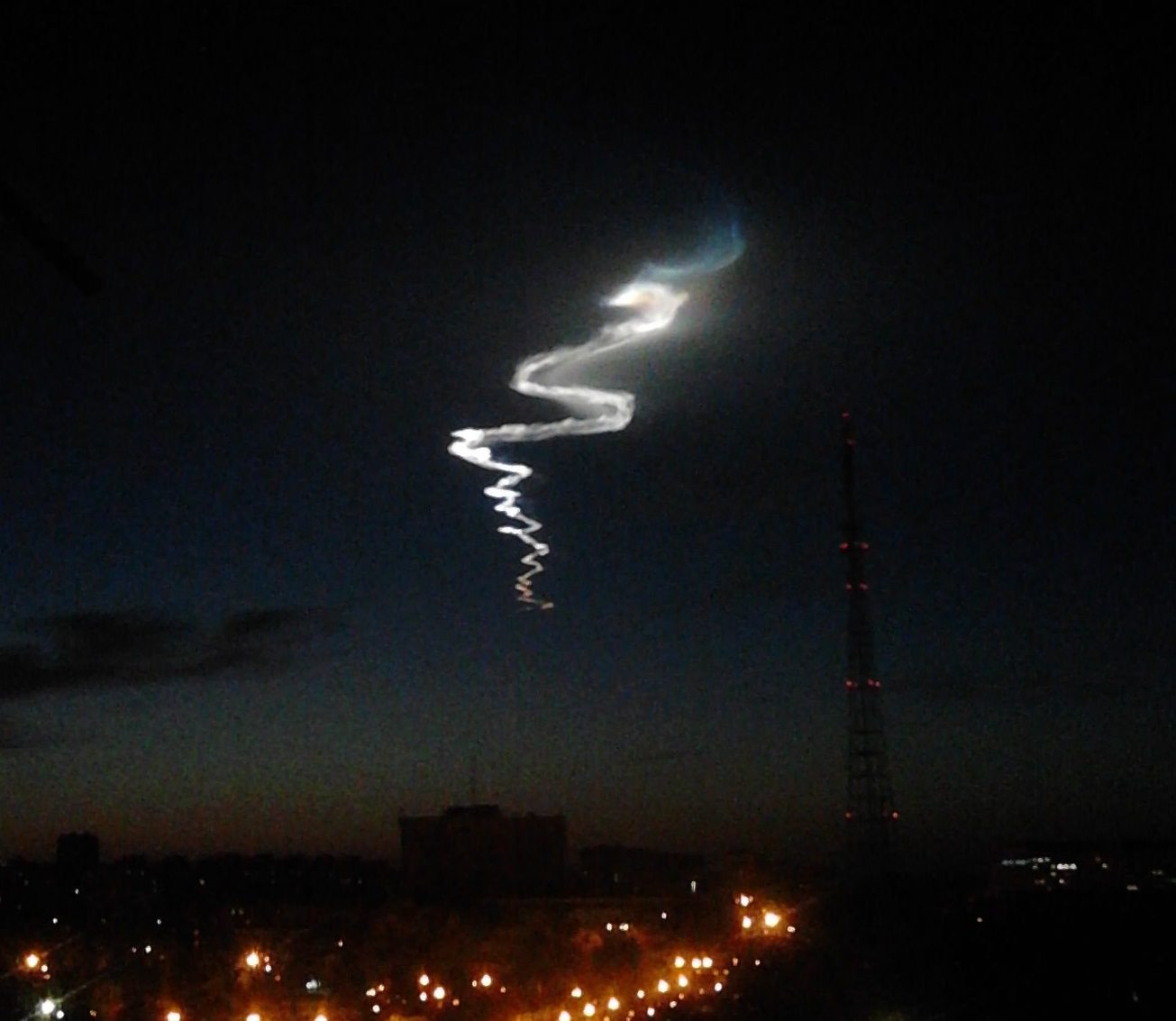
Pictured: a real 2017 Topol-M ICBM launch from the Kapustin Yar test range itself, its rocket-stage-separation exhaust glowing and refracting through upper-atmosphere ice crystals — not a photograph of the object the 1989 witnesses described. No photograph of the reported disc exists; the KGB file preserves only Ensign Voloshin's own hand-drawn sketch, which has never been published in a rights-clear, reproducible form. This image is included specifically because it illustrates, honestly and from the same facility, exactly the kind of naturally occurring missile-launch light phenomenon this file's own skeptical analysis discusses as a serious, unresolved candidate explanation (see Conventional Explanation Candidate, below).
Theoretical Alignment
Assessment: The Extraterrestrial Hypothesis (ETH) is neither strongly supported nor cleanly ruled out here — seven trained signal-corps witnesses across two units gave broadly consistent, independently written depositions describing genuinely anomalous flight behavior (silent hovering, abrupt multi-directional acceleration, and successful evasion of an intercepting jet), which is a real evidentiary strength; but the total absence of radar, photographic, or scramble-mission data in the released file (a gap the KGB's own case summary explicitly acknowledges) leaves the claim resting on unaided testimony alone. Aerospace misidentification scores moderately: Kapustin Yar was, and remains, one of the most rocket- and missile-active patches of airspace on Earth, and nighttime missile launches, stage separations, and target-drone tests are all independently documented at the site during this general period — a serious, unrefuted candidate discussed at length below. The strongest, best-evidenced alignment by far is with institutional secrecy itself: whatever the seven witnesses saw, the Soviet state's response was not disclosure but classification, interrogation, and two years of silence — the exact opposite of how the same government's own press apparatus would handle the unrelated Voronezh case just nine weeks later.
Background
Kapustin Yar was established by Soviet government decree on May 13, 1946, in the empty steppe north of the Astrakhan region, under the command of Lieutenant General Vasily Voznyuk, who would run the range for the next 27 years. Its first mission was building on technology and personnel captured from defeated Nazi Germany: on October 18, 1947, the site conducted the Soviet Union's first-ever ballistic missile launch, firing one of eleven captured German A-4 (V-2) rockets. For the next decade, Kapustin Yar was the USSR's only missile proving ground, testing the R-1, R-2, R-5 Pobeda, R-12, and R-14 missile families that would form the backbone of Soviet strategic rocket forces; five low-yield atmospheric nuclear tests were also conducted at the site between 1957 and 1961. On March 16, 1962, the range launched the Kosmos 1 satellite, formally inaugurating its second life as a functioning cosmodrome alongside its missile-testing role — a role Kapustin Yar continues to serve for the Russian military today, including launches as recent as the S-400 and S-500 air-defense systems and the RT-2PM Topol mobile ICBM. Western intelligence took the site seriously enough, decades before the events of this case, to risk a specially-equipped Royal Air Force reconnaissance Canberra on a hazardous high-altitude overflight of Kapustin Yar in August 1953 (Project Robin), during which Soviet MiG interceptors were scrambled and managed only minor damage to the British aircraft before it escaped south across the Caspian Sea — a real, declassified precedent for exactly the kind of jet-versus-unidentified-aerial-target chase that would recur, on a far smaller and stranger scale, 36 years later. The closed administrative town of Znamensk was built alongside the village of Kapustin Yar itself specifically to house the range's scientists, officers, and their families; both remained off-limits to unauthorized visitors and omitted from ordinary Soviet maps for most of the Cold War.
By the summer of 1989, the Soviet Union was four years into glasnost, Mikhail Gorbachev's policy of relaxing decades of rigid Communist Party editorial control over the press. UFO reporting had a longer, semi-tolerated history within Soviet science than most Western observers assumed at the time: astronomer Felix Ziegel's 1967 national television broadcast on UFO sightings had already established a network of quasi-official civilian research groups, and in late 1978, in direct response to the widely-witnessed September 1977 Petrozavodsk Phenomenon, the USSR's Academy of Sciences and Ministry of Defense jointly stood up two parallel, classified research programs — "Setka-AN" under the Academy, led by IZMIRAN director Vladimir Migulin with physicist Yuli Platov running the day-to-day workgroup, and "Setka-MO" under the Ministry of Defense, directed for roughly a decade by Colonel Boris Sokolov. Between 1978 and 1990, these two programs together examined on the order of 3,000 reports; a 2000 retrospective co-authored by Platov and Sokolov themselves in the Bulletin of the Russian Academy of Sciences concluded that more than 90 percent were explainable by rocket launches, balloon flights, satellite reentries, and other ordinary aerospace or atmospheric activity, while finding "no evidence of UFO landings, contacts with UFO pilots, or abductions." It was against this specific institutional backdrop — a decade-old, still-classified military and scientific apparatus already quietly investigating exactly this kind of report — that the July 28–29, 1989 Kapustin Yar sighting occurred, and it is a genuinely different backdrop from the one that would produce Voronezh's very different, and very public, story two months later.
What makes Kapustin Yar's own path through that apparatus distinctive is how completely it stayed inside it. The KGB file that documents this case — titled, in its own English translation, "Communication on Observation of Anomalous Event in the District of Kapustin Yar (July 28, 1989)" — sat inside Soviet state security's own archive, untouched by any newspaper, wire service, or state broadcaster, for more than two years. It surfaced only as part of a much larger, 124-page compilation titled "Cases of Observations of Anomalous Occurrences in the Territory of the USSR, 1982–1990," covering seventeen regions of the country, which outgoing KGB deputy chairman N.A. Sham formally transmitted on October 24, 1991 — in the final chaotic months of the USSR's existence, under sitting KGB chairman Vadim Bakatin's broader push to dismantle and open the agency following the failed August 1991 coup — to cosmonaut Pavel Popovich, then president of the All-Union Ufological Association. Popovich, in turn, passed custody of what researchers nicknamed the "Blue Folder" (Sinyaya Papka) to naval-officer-turned-ufologist Vladimir Azhazha. The Kapustin Yar file's own English translation is credited to Dimitri Ossipov; excerpts first appeared in the West in the Moscow-published magazine Aura-Z (No. 1, March 1993), under the header "Classification: 'Secret' — From the KGB Archives," through the involvement of Chilean-American ufologist Antonio Huneeus. Two years later, Don Berliner, working with Marie Galbraith and Huneeus on a case compendium funded by philanthropist Laurance Rockefeller and formally presented to members of the U.S. Congress under the joint imprint of the Center for UFO Studies (CUFOS), the Fund for UFO Research (FUFOR), and the Mutual UFO Network (MUFON), reprinted and analyzed the case in full in the UFO Briefing Document: The Best Available Evidence (1995) — the single most detailed English-language account of the case, and the primary source this file draws on throughout.
Complete Timeline
| Date | Event |
|---|---|
| May 13, 1946 | Soviet government decree formally establishes the 4th Missile Test Range "Kapustin Yar" in the Astrakhan steppe under Lt. Gen. Vasily Voznyuk. |
| Oct. 18, 1947 | The USSR's first-ever ballistic missile launch takes place at Kapustin Yar, using a captured German A-4 (V-2) rocket. |
| 1957–1961 | Five low-yield atmospheric nuclear weapons tests are conducted at the range. |
| Mar. 16, 1962 | Launch of the Kosmos 1 satellite establishes Kapustin Yar as an active cosmodrome alongside its missile-testing role. |
| 1978 | Following the 1977 Petrozavodsk Phenomenon, the USSR Academy of Sciences ("Setka-AN," under Vladimir Migulin and Yuli Platov) and Ministry of Defense ("Setka-MO," under Col. Boris Sokolov) each stand up classified programs to log and evaluate Soviet UFO reports. |
| July 28, 1989, ~22:10–22:12 | Personnel of the signal center at the first military unit begin observing what depositions describe as up to three luminous objects simultaneously, at an estimated distance of 3–5 km. |
| July 28, 1989, 23:20 | A captain at the telegraph center telephones duty officer Ensign Valery Voloshin, reporting an unidentified "flying saucer" hovering over the military unit for over an hour. |
| July 28, 1989, ~23:20–23:30 | Voloshin confirms the sighting with the operations signal officer, then climbs an antenna tower with Private Tishchayev to observe directly. |
| July 28, 1989, 23:30 | A second, neighboring military unit begins its own independent observation of the object(s), continuing until 01:30 the following morning. |
| July 28, 1989, ~23:30–24:00 | The object hovers over the unit's logistics yard, then moves toward and over the rocket weapons depot at an altitude of roughly 20 m (65 ft); a bright beam appears from its underside, tracing two or three circles across a depot building. |
| July 28–29, 1989 (overnight) | The object departs toward the railway station and a cement factory, then returns to hover over the weapons depot at 60–70 m (200–240 ft) altitude; the first guard shift and its commander continue observing. |
| Overnight | The command post orders a fighter aircraft scrambled to intercept; multiple witnesses independently report hearing (and, per 1st Lt. Klimenko, identifying by engine noise) an approaching jet, which is unable to close on or clearly observe the object before it evades. |
| July 29, 1989, 01:30 | The object departs in the direction of Akhtubinsk and disappears from view, ending the roughly two-hour sighting (23:30–01:30) at the second unit. |
| Following days, July 1989 | Four of the seven witnesses are formally interrogated by KGB officers and write handwritten depositions; an unnamed KGB officer compiles a brief case summary at the front of the file. |
| Sept. 27, 1989 | The unrelated Voronezh Landing occurs roughly 750 km to the northwest — a case that, unlike Kapustin Yar, TASS would report to the world within weeks. |
| Aug.–Dec. 1991 | Following the failed August coup, KGB chairman Vadim Bakatin oversees the agency's dismantling and a new posture of cooperation with declassification requests. |
| Oct. 24, 1991 | KGB deputy chairman N.A. Sham signs and transmits a 124-page declassified dossier, "Cases of Observations of Anomalous Occurrences in the Territory of the USSR, 1982–1990," including the Kapustin Yar file, to cosmonaut Pavel Popovich. |
| Dec. 1991 | The Soviet Union formally dissolves, roughly two months after the Kapustin Yar file's declassification. |
| 1991–1993 | Popovich passes custody of the "Blue Folder" to Vladimir Azhazha; the Kapustin Yar file is translated into English by Dimitri Ossipov. |
| March 1993 | Excerpts of the KGB file, including the Kapustin Yar case, are published in English in the Moscow magazine Aura-Z (No. 1), with involvement from Antonio Huneeus. |
| Oct. 1994 | ABC News' Prime Time Live, working from a separate, privately-sold Sokolov document collection plus independent reporting, airs a "KGB UFO Files" segment covering both the Usovo (1982) and Kapustin Yar cases. |
| Dec. 1995 | Don Berliner, Marie Galbraith, and Huneeus publish the fullest English-language analysis of the case in UFO Briefing Document: The Best Available Evidence, presented by CUFOS, FUFOR, and MUFON to members of the U.S. Congress. |
| 2000 | Yuli Platov and Boris Sokolov co-publish a retrospective in the Bulletin of the Russian Academy of Sciences finding >90% of the ~3,000 Setka-era reports mundane and no confirmed evidence of alien contact. |
| Present day | Kapustin Yar remains an active Russian missile and air-defense test range; the July 1989 sighting remains uncorroborated by any instrumented record and unresolved by any published investigation beyond the original KGB case summary. |
The First Unit: A Signal Officer Climbs the Tower
The most detailed single account in the entire case comes from Ensign Valery N. Voloshin, the officer-on-duty at his unit's signal center on the night of July 28, 1989. At approximately 23:20, a captain from the telegraph center telephoned Voloshin to report that "an unidentified flying object, which he called a flying saucer, was hovering over the military unit for over an hour." Rather than dismiss the call, Voloshin first confirmed the sighting with his own operations signal officer on duty, then climbed the lower section of an antenna tower together with Private Tishchayev to observe the object directly — a small but meaningful detail, since it shows the report moving up through a normal chain of internal verification before any wider alarm was raised.
Voloshin's own deposition, preserved and translated in the KGB file, is worth quoting at length precisely because of how procedural and unembellished its language is — the register of a soldier filing a report, not a witness reaching for dramatic effect: "One could clearly see a powerful blinking signal which resembled a camera flash in the night sky. The object flew over the unit's logistics yard and moved in the direction of the rocket weapons depot, 300 meters [1,000 ft] away. It hovered over the depot at a height of 20 meters [65 ft]. The UFO's hull shone with a dim green light which looked like phosphorous. It was a disc, 4 or 5 m. [13–17 ft.] in diameter, with a semispherical top." He continued: "While the object was hovering over the depot, a bright beam appeared from the bottom of the disc, where the flash had been before, and made two or three circles, lighting the corner of one of the buildings… The movement of the beam lasted for several seconds, then the beam disappeared and the object, still flashing, moved in the direction of the railway station." Voloshin went on to describe the object subsequently hovering over the logistics yard, railway station, and a cement factory in turn, before returning a second time to the rocket weapons depot and climbing to hover at 60–70 meters (200–240 ft). At 01:30, by his account, "the object flew in the direction of the city of Akhtubinsk and disappeared from sight." He specified that he had observed the entire sequence continuously for exactly two hours, from 23:30 to 01:30, and that the object's flashes "were not periodical" — an observational detail with no obvious mundane analogue he offers himself, and one this file does not attempt to resolve on his behalf. Private Tishchayev's own deposition, filed separately, is recorded as essentially confirming Voloshin's account in its particulars.
The KGB's own anonymous case-summary officer, writing at the front of the file, corroborates the core outline independently of either soldier's personal narrative: "Military personnel of the signal center observed UFOs in the period from 22:12 hrs. to 23:55 hrs. on 28 July 1989. According to the witnesses' reports, they observed three objects simultaneously, at a distance of 3–5 km. [2–3 mi.]." This summary account describes a slightly earlier and broader timeframe than Voloshin's own personal 23:30–01:30 observation window at the neighboring unit, and it explicitly notes multiple objects (up to three) at greater range, rather than Voloshin's single object at close quarters — a genuine internal complexity in the file that this file treats as evidence of two related but not perfectly identical observation sequences at two adjacent units, rather than a single, seamless narrative artificially smoothed for tidiness.
The Second Unit: Triangulation, Color, and a Felt Approach
At the neighboring military unit, a separate guard shift — Corporal Levin and Privates Bashev, Kulik, and Litvinov — was alerted by 1st Lieutenant Klimenko and independently observed up to three objects performing what their own depositions describe as "fantastic acrobatics" in the night sky. One witness recorded: "Suddenly, it flew in our direction. It approached fast and increased in size. It then like divided itself in three shining points and took the shape of a triangle. Then it changed course and went on flying in the same sector." Another gave a more physically vivid account of the object's approach: "After veering, it began to approach us and its speed could be felt physically… Its flight was strange: no aircraft could fly in this manner. It could instantly stop in the air… it could float… because the word 'fly' would not be adequate, it was as if the air was holding it, preventing it from falling. At all times that I observed it, it was blinking, blinking without any order and constantly changing colors (red, blue, green, yellow)." A third deposition, evidently describing a separate but overlapping observation, recorded: "there was a flying object, resembling an egg, but flatter. It shone brightly alternating green and red lights. This object gathered a great speed. It accelerated abruptly and also stopped abruptly, all the while doing large jumps up or down. Then appeared a second and then a third object. One object rose to low altitude and stopped… Later a second object disappeared, and only one stayed. It moved constantly along the horizon."
All of these accounts converge on the same climax: the arrival of an intercepting jet fighter. According to Lt. Klimenko's own deposition, "the airplane, which could be identified by its noise, approached the object, but the object disengaged so fast, that it seemed the plane stayed in one place" — a description of relative motion so extreme that, taken at face value, it implies a closing-speed differential well beyond any contemporary jet fighter's performance envelope. Berliner and Huneeus, the case's most careful English-language analysts, are candid that this claim cannot be independently checked: no scramble order, radar plot, or pilot's own after-action report survives in the released file to confirm what the fighter crew itself experienced, saw, or failed to see.
Key Witnesses
Ensign Valery N. Voloshin
The case's single most detailed and highest-ranking witness. Voloshin received the initial report by telephone from a telegraph-center captain, confirmed it through his own chain of command before acting, and personally observed the object for a continuous two-hour period (23:30–01:30) from an antenna tower, tracking its movement between the logistics yard, the rocket weapons depot, the railway station, and a cement factory. His hand-drawn sketch of the object is the only surviving graphical record in the case, later reproduced in the Moscow magazine Aura-Z and in researcher Michael Hesemann's published work.
Private Dmitry Tishchayev
Climbed the antenna tower together with Ensign Voloshin to observe the object directly; his own deposition is recorded in the KGB file as essentially confirming Voloshin's account of the object's appearance and movements.
1st Lieutenant Klimenko
Alerted the guard shift of Corporal Levin and Privates Bashev, Kulik, and Litvinov to the sighting at the neighboring unit. Klimenko's own deposition provides the case's most specific account of the failed jet intercept, describing an aircraft he could identify by its engine noise approaching the object, which "disengaged so fast, that it seemed the plane stayed in one place."
Corporal Levin & Privates Bashev, Kulik, and Litvinov
The four enlisted members of the guard shift alerted by 1st Lt. Klimenko, whose individually filed depositions describe up to three objects performing rapid triangulating movements, color changes (red, blue, green, yellow), and a physically "felt" high-speed approach. Levin was the senior enlisted witness among the group; Bashev, Kulik, and Litvinov each filed separate written statements corroborating the group's shared observation.
The Five Observables Assessment
The Five Observables framework is applied to the performance characteristics reported in this case:
Assessment: Anti-gravity lift and instant acceleration are both scored as present-per-testimony (not instrumentally confirmed) on the strength of multiple, independently written depositions describing the object hovering motionlessly, "as if the air was holding it," then instantly stopping, reversing, or accelerating away hard enough to leave a pursuing jet fighter effectively stationary by comparison — a genuinely striking and consistent claim across witnesses from both units. Hypersonic performance is scored speculative rather than confirmed, since no witness offered a timed or instrumented speed estimate; the "outran the jet" description is qualitative, not measured. Low observability is scored absent: every witness described the object as brightly self-illuminated, blinking, and easily visible at several kilometers, the opposite of a stealthy signature. Trans-medium travel is likewise absent — nothing in any deposition describes the object interacting with water, ground, or any medium beyond open air. Unlike more heavily instrumented modern cases, every one of these observables here rests entirely on unaided testimony from seven witnesses, with no radar, video, or telemetry to independently corroborate the claimed performance envelope.
Evidence Assessment
Supporting Anomalous Origin
- Seven witnesses across two separate military units gave independently written depositions that converge on a consistent core description — a disc-shaped, hovering, brightly luminous object exhibiting abrupt, high-performance maneuvers
- The witnesses were occupationally trained observers at an active missile range, making them comparatively unlikely to misidentify the base's own routine rocket and aircraft activity, which they would have seen repeatedly
- A jet fighter was scrambled to intercept, and multiple independent witnesses describe it failing to close the distance — a claim of an unusual performance envelope corroborated across more than one deposition
- The KGB itself treated the report seriously enough to interrogate four of the seven witnesses rather than dismiss it, and preserved the file for over two years rather than destroying it
- The case's own most careful English-language analysts (Berliner & Huneeus) explicitly declined to offer a confident conventional explanation, given the file's incompleteness
Supporting Conventional Explanation
- No radar, photographic, or other instrumented corroboration exists for any part of the sighting, despite an active jet intercept attempt that plausibly would have generated exactly such a record had one been released
- Kapustin Yar was, and remains, an extremely aerospace-active site, with nighttime rocket launches, stage separations, target-drone tests, and flares all independently documented in the same general period — a serious, uneliminated source of exactly the kind of luminous, maneuvering light phenomenon described
- The KGB file's own compilers acknowledge it is incomplete, meaning any assessment — anomalous or conventional — is necessarily provisional rather than a final, examined verdict
- The most extreme performance claim (a jet fighter left effectively motionless by comparison) rests on subjective visual impression under night conditions, a context in which relative-motion misjudgment is a well-documented human perceptual limitation
- Four of the seven depositions were produced only after KGB interrogation, introducing an unknown degree of investigator influence on the final written record
Why the World Never Heard About It: Kapustin Yar Versus Voronezh
The single most analytically important fact about this case may not be anything the witnesses reported, but what happened — and did not happen — afterward. Nine weeks after the Kapustin Yar sighting, on September 27, 1989, the unrelated Voronezh Landing occurred roughly 750 km to the northwest, and within twelve days TASS, the Soviet Union's own official state news wire, ran a report stating flatly that "scientists have confirmed" an alien landing and occupant encounter — a genuinely unprecedented act of official media acknowledgment that made Voronezh front-page news from Washington to Tokyo within days. Kapustin Yar received no remotely comparable treatment. No Soviet newspaper, television broadcast, or wire report of any kind is known to have mentioned it in 1989, 1990, or 1991; it surfaced publicly only because the KGB itself, as an institution actively being dismantled after the failed August 1991 coup, chose to declassify a much larger anomalous-phenomena archive that happened to include it.
The explanation for this divergence is not mysterious, and this file does not treat it as one. Voronezh's core sources — schoolchildren's accounts filtered through an amateur-ufologist newspaper reporter and a regional geophysical laboratory's preliminary field notes — were, by their nature, civilian, public, and immediately shareable with any journalist who asked. Kapustin Yar's sources were exactly the opposite: uniformed military personnel, filing reports through an internal chain of command, at a facility whose location, purpose, and very existence had been an official state secret for over four decades. A Soviet reporter covering a park in Voronezh faced no institutional barrier; a Soviet reporter attempting to cover an active-duty signal unit's report from inside a closed nuclear-and-missile proving ground faced the entire weight of Soviet military secrecy, KGB counterintelligence procedure, and the range's own decades-old policy of appearing on no ordinary map. Glasnost loosened what the Soviet press could publish about UFOs in general terms; it did not, in 1989, extend to what the Soviet military would voluntarily disclose about its own most sensitive strategic installation. The two cases are best understood not as competing data points about how seriously the late Soviet state took UFO reports, but as a natural experiment in what happens to structurally similar reports depending entirely on whether the witnesses answer to a newspaper editor or to a military chain of command.
Why "Open"
This case is classified OPEN — deliberately distinct from "Disputed," which this site reserves for cases where two well-developed, actively competing explanations argue directly against each other in the historical record. Kapustin Yar has never had that kind of public argument, because it was never public: no Soviet commission, skeptical investigator, or rival ufologist ever formally examined it and published a rebuttal, the way Igor Surovtsev's commission did for Voronezh or a documented Skyhook balloon program has for Thomas Mantell. What exists instead is a single, internally incomplete government document — one whose own compilers, writing with direct access to the KGB translation, state outright that critical pieces (radar data, the fighter's own report) were never included or never existed in the first place. That is a genuinely different epistemic situation from a case that has been investigated and remains contested; it is a case that has simply never been investigated by anyone with the authority or access to close the file, and the honest reflection of that is a moderate, middle-of-the-scale score rather than a confident verdict in either direction.
Weighing for anomalousness: seven trained, occupationally relevant military witnesses across two separate units, writing independently, converged on a consistent core account of sustained, purposeful-seeming, high-performance flight behavior, including apparent evasion of an actual intercept attempt — a stronger evidentiary floor than a single-witness account, and stronger than many far more famous cases that rest on one or two observers. Weighing against: there is no instrumented data of any kind, the location itself hosted exactly the sort of nighttime rocket and missile activity capable of producing a strange, disc-like, color-shifting light show (as the 2009 Norway Spiral concretely demonstrates for a directly comparable Russian missile program), and the file's own compilers — sympathetic, careful researchers with every incentive to claim more than the evidence supported — declined to do so. Kapustin Yar therefore sits, appropriately, in the broad middle of this site's rating scale: neither a case with strong, still-unaddressed skeptical objections to a specific dated event (which would push it toward Disputed, like Mantell), nor one with genuinely strong multi-instrument corroboration (which would push it toward Credible, like Coyne Helicopter), but a case where the file was simply closed by history — by the collapse of the government that generated it — before anyone competent to resolve it ever tried.
Sensor & Instrumentation Detection Profile
No radar track, gun-camera footage, photograph, or other instrumented record of the July 28–29, 1989 sighting has ever been released, and this absence is not a gap this file is speculating about — it is a limitation the source document itself flags. Don Berliner and Antonio Huneeus, compiling the case for the Congressionally-briefed UFO Briefing Document (1995) directly from the translated KGB file, wrote plainly that "the KGB file on the case is obviously incomplete, since there is no data on the jet scramble mission or whether ground or airborne radar detection was also reported." A fighter aircraft was unambiguously scrambled — multiple witness depositions independently corroborate hearing and, in 1st Lt. Klimenko's account, identifying an approaching aircraft by its engine noise — but no after-action report from that intercept attempt, no radar operator's log, and no still or motion photography from any of the seven witnesses survives in the declassified record. The only surviving graphical record is a hand-drawn sketch by Ensign Valery Voloshin, reproduced from the KGB file by German researcher Michael Hesemann and the Moscow magazine Aura-Z in 1993, which is itself testimony rendered as a drawing rather than an independent instrumented capture.
Environmental & Geospatial Context
The Kapustin Yar test range sits in the Caspian lowlands of Astrakhan Oblast, roughly 100 km east of Volgograd, in a flat, semi-arid steppe (Köppen BSk) landscape with almost no natural or artificial light pollution outside the range's own military installations. Late July in this region is reliably hot and dry — average highs near 35°C (95°F), overnight lows near 21°C (70°F), roughly a 9% chance of measurable rain on any given July day, and among the year's clearest, least cloud-covered skies — conditions that make an unobstructed, high-visibility night sighting entirely unsurprising on meteorological grounds alone, and that also mean nothing about the weather itself offers any exotic or unusual explanation for what the witnesses reported. Geospatially, the location could not be more relevant to the sighting's own content: the object hovered directly over an active rocket weapons depot at a facility that had, by 1989, spent more than four decades as the Soviet Union's primary site for ballistic-missile, cruise-missile, and satellite-launch testing — described by Berliner and Huneeus as "somewhat equivalent to the White Sands Proving Grounds in New Mexico." The object's reported departure vector, toward the town of Akhtubinsk, points directly at what was already, in 1989, the headquarters of the 929th State Flight Test Centre — the Soviet/Russian military's primary fixed-wing test-flight establishment, roughly analogous to Edwards Air Force Base — making it entirely plausible, though unconfirmed in the surviving file, that the intercepting fighter itself originated from Akhtubinsk rather than a home-station alert unit.
Observer Credibility & Occupational Profile
The seven witnesses were uniformed Soviet Army personnel on active duty at a signal/communications center attached to a guarded rocket weapons depot — not civilians, not children, and not amateur investigators, but soldiers whose specific job was monitoring and reporting exactly the kind of unusual aerial activity a missile test range would need to flag. Their occupational familiarity with the base's own routine activity is a real, double-edged credibility factor this file treats honestly rather than one-sidedly: on one hand, personnel stationed for months or years at an active missile range are precisely the population least likely to mistake an ordinary rocket launch, target-drone test, or flare for something anomalous, since they would have seen the genuine article repeatedly; on the other hand, that same familiarity means their collective judgment that this event was not routine carries more, not less, evidentiary weight than an equivalent claim from untrained civilian witnesses. The most detailed and highest-ranking account came from the officer-on-duty, Ensign Voloshin, whose deposition forms the spine of the entire case; it is independently corroborated in its broad strokes by Private Tishchayev, who watched alongside him from the same antenna tower, and by the separate guard-shift party of 1st Lt. Klimenko, Corporal Levin, and Privates Bashev, Kulik, and Litvinov at the neighboring unit, whose accounts of a triangulating, color-changing, physically "felt" approach were gathered independently. Four of the seven wrote their statements only after being formally interrogated by KGB officers — a detail that cuts both ways evidentiarily, since it establishes the state itself treated the report seriously enough to interrogate its own soldiers, while also meaning the surviving depositions were shaped, to an unknown degree, by an intelligence-service interview process rather than a neutral scientific one.
Physical & Material Assays
No physical trace evidence of any kind — ground marks, burned vegetation, metallic fragments, or radiological residue — is described anywhere in the declassified KGB file, and none has surfaced in any of the Western secondary literature that has examined this case since 1993. This is, on its own terms, an unremarkable and expected absence: no witness claimed the object landed, touched the ground, or left the area near the antenna tower or weapons depot at any point during the roughly two-hour sighting, so there was never a specific site for KGB investigators or later researchers to test. Popular, undocumented web accounts describing recovered "titanium honeycomb" debris or a crashed craft at Kapustin Yar circulate widely but attach to an entirely separate, uncorroborated legend discussed in Historical Precedents below — not to this event, and not to any claim in the actual 1991 declassified file, the 1993 Aura-Z translation, or the 1995 Berliner/Huneeus reprinting that together constitute this case's real documentary record.
Historical Precedents & Archive Matches
Kapustin Yar's July 1989 sighting sits inside a well-documented broader phenomenon: a marked increase in Soviet UFO reporting, both civilian and military, across the final years of Mikhail Gorbachev's glasnost policy, feeding into the Academy of Sciences' and Ministry of Defense's parallel "SETKA" research programs that had been quietly cataloging such reports since 1978. Its nearest and most famous chronological neighbor is the Voronezh Landing, which occurred just nine weeks later, on September 27, 1989, roughly 750 km to the northwest — and the contrast between the two cases is itself one of this file's central findings, discussed in full in the Background and Conventional Explanation sections below. Within the specific sub-genre of UAP reports near nuclear or missile installations, Kapustin Yar belongs to the same broad category as the American Loring AFB Nuclear Storage Area case (1975) and the Malmstrom AFB Sighting (1967) — incidents in which an object was reported hovering with apparent purpose over a facility storing live nuclear or strategic weapons, evading or outperforming an intercepting aircraft, and leaving behind exactly the kind of incomplete, classification-driven paper trail that recurs across all three cases regardless of which country's air force was involved. Within Soviet ufology's own institutional history, the case is one of a comparatively small number attributable to a specific, named primary document (rather than a compiled folklore account), placing it alongside the Petrozavodsk Phenomenon (1977) as one of the few Soviet-era cases where the chain of custody from original report to English-language publication can be traced through named investigators — Yuli Platov for Petrozavodsk, and the Popovich–Azhazha–Hesemann–Huneeus chain for Kapustin Yar.
Material Analysis
This case has no physical or material evidence to analyze, and this file states that plainly rather than padding around it. No witness at either military unit described the object landing, touching the ground, or making contact with any structure; the reported beam is described as illuminating a building's corner from a distance, not burning, scorching, or otherwise physically marking it. No soil sample, metallic fragment, radiological reading, or biological effect appears anywhere in the seven depositions, the KGB's own case summary, or any of the Western secondary sources (Hesemann, Berliner, Huneeus) that have examined the case since 1993. The absence of a landing or physical contact point means there was never a specific site for either Soviet investigators or later researchers to test in the way that, for example, the Voronezh or Trans-en-Provence cases generated ground depressions and soil samples for laboratories to examine.
This absence is worth distinguishing explicitly from a separate, unrelated body of online claims about a supposed 1948 UFO crash and recovered "titanium honeycomb" debris at Kapustin Yar, and from a widely circulated tabloid legend describing Soviet soldiers "turned to stone" by an alien energy weapon at an unspecified Siberian base. A 2025 CIA-document fact-check traced that second story specifically to a March 27, 1993 Ukrainian newspaper article in Ternopil Vechirny, which itself cited an American tabloid, Weekly World News — not a real KGB record, and not Kapustin Yar at all, but a different, wholly unrelated, and fictional-sounding tale that the CIA's own declassified file merely reprinted, without endorsement, as a curiosity from the foreign press. Neither the 1948 crash legend nor the "turned to stone" story appears anywhere in the actual 1991 KGB declassification, the 1993 Aura-Z translation, or the 1995 Berliner/Huneeus analysis that together make up this case's real documentary record, and this file does not treat either as evidence for or against what the seven named 1989 witnesses actually reported.
Supporting Non-Terrestrial Origin
- No claim of physical evidence exists to contradict or complicate the witness testimony, unlike cases where recovered "trace evidence" later collapsed under testing
- The witnesses' own occupational familiarity with the base's routine light phenomena makes their collective judgment that this was anomalous somewhat more meaningful than an untrained observer's would be
Supporting Terrestrial Origin
- The total absence of any physical trace is equally consistent with there having been nothing solid to leave a trace — i.e., a light phenomenon (rocket exhaust, flare, or atmospheric effect) rather than a physical craft
- No metallurgical, isotopic, or soil data of any kind exists to test any hypothesis, terrestrial or otherwise, leaving this domain entirely unresolved rather than supportive of either interpretation
The Conventional Explanation Candidate: Missile-Range Light Phenomena
The single most plausible terrestrial explanation for this case is also the one most directly suggested by the location itself: Kapustin Yar was an active ballistic-missile, cruise-missile, and satellite-launch testing range throughout 1989, and nighttime missile and rocket activity is independently documented at the site across this era, including target-drone comparison tests explicitly referenced in declassified CIA photo-reconnaissance analysis of the facility. Rocket stage separations, in particular, are known to produce a genuinely striking, easily misidentified luminous phenomenon sometimes called the "twilight phenomenon" — unburned propellant and water vapor in the exhaust plume condensing, freezing, and expanding in the thin upper atmosphere, catching sunlight (or in this case, potentially other illumination) at an angle that can look, to an untrained or even a trained eye at night, like a glowing, maneuvering, colored object rather than a receding rocket component. The most famous modern illustration of exactly this effect is the 2009 "Norway Spiral," a brilliant blue-white luminous spiral that appeared over Norway and was widely reported as a UFO before Russian officials confirmed it was the failed launch of a Bulava intercontinental ballistic missile from a submarine in the White Sea — a real, publicly acknowledged, and strikingly similar case of a Russian military rocket launch producing a luminous aerial phenomenon that independent civilian observers, with no access to the launch schedule, genuinely could not distinguish from an anomalous craft. This file takes that parallel seriously rather than treating it as merely suggestive: if a Bulava failure in 2009 could produce a spiral bright and strange enough to lead international news coverage before the mundane cause was confirmed, an unannounced overnight test at the USSR's own primary missile range in 1989 — conducted, by definition, with no independent civilian observers present to immediately correct the record — is a serious, unresolved candidate for at least part of what the seven Kapustin Yar witnesses saw.
Signal Flares or Illumination Ordnance
A second, related candidate holds that some or all of the sighting resulted from military signal flares, illumination rounds, or similar pyrotechnic ordnance used during a nighttime exercise at or near the depot — a mundane, well-precedented source of brightly colored, sometimes erratically drifting aerial lights on any active military installation, and one that would not require any of the witnesses to have fabricated or exaggerated their account, only to have misjudged the nature of an authorized but unannounced activity elsewhere on their own base.
Ball Lightning Near the Antenna Installation
A third, more speculative candidate notes that the primary witnesses, Voloshin and Tishchayev, made their closest observation from an antenna tower — a location with exactly the kind of concentrated electrical infrastructure sometimes associated with reports of ball lightning, a genuine but still poorly understood atmospheric electrical phenomenon capable of producing a luminous, sometimes color-shifting, erratically moving sphere. Ball lightning remains scientifically contested even as a basic phenomenon, with no fully accepted physical theory and persistent difficulty producing reproducible laboratory data, which makes it, honestly, a weaker and less falsifiable candidate than the missile-range light-phenomenon explanation above — included here for completeness and because of the antenna-tower detail, not because this file considers it the leading candidate.
Missile-Range Light Phenomena (Stage Separation / "Twilight Phenomenon")
InconclusiveStrongly supported by the location's documented, extensive nighttime rocket-testing activity and by the real 2009 Norway Spiral precedent, but no specific launch record for the night of July 28–29, 1989 has been located to confirm it, and the described close-range hovering and beam behavior are a less clean match to a rapidly receding rocket stage than to the initial distant "spiral" phase of the Norway case.
Signal Flares or Illumination Ordnance
InconclusiveA mundane, well-precedented possibility on any active military base at night, but nothing in the file specifically documents a flare exercise that evening, and the reported two-hour duration, silent operation, and abrupt intercept-evading acceleration sit awkwardly against typical flare behavior (which falls, burns out, and does not evade aircraft).
Ball Lightning
UnprovenBall lightning itself remains a scientifically contested, poorly reproducible phenomenon; invoking it here explains the antenna-tower setting but not the multi-kilometer range, multi-object count, or two-hour duration reported by the second unit's witnesses.
Related Cases
Confirmed Documents & Official Records
The primary source for this entire case: seven handwritten witness depositions, a witness sketch, and an anonymous KGB case summary, part of a larger 124-page dossier transmitted by KGB deputy chairman N.A. Sham to cosmonaut Pavel Popovich. English translation credited to Dimitri Ossipov. No standalone modern hosted scan of the original Russian-language KGB file is known to exist; its contents are preserved through the 1993 Aura-Z English excerpt and the full 1995 Berliner/Huneeus reprinting (see Sources).
DECLASSIFIED BY THE KGB (1991), NOT INDEPENDENTLY RE-VERIFIEDA declassified CIA Foreign Broadcast Information Service note cataloging the broader wave of Soviet media UFO coverage in this period, providing outside U.S. intelligence-community context for the general climate in which the Kapustin Yar file was eventually declassified. It does not itself name Kapustin Yar, which never reached the Soviet press this note was tracking — a fact this file treats as significant in its own right (see Background, above).
DECLASSIFIED (released via CIA FOIA Electronic Reading Room)A declassified CIA analytical document confirming the range's decades-long role as an active guided-missile and target-drone testing site — independent government documentation of the exact kind of routine aerospace activity discussed as a candidate explanation below, though this specific document concerns the facility generally rather than the 1989 sighting.
DECLASSIFIED (released via CIA FOIA Electronic Reading Room)Search Government Archives Directly
Further Reading — Recommended Literature
UFO Briefing Document: The Best Available Evidence
The primary English-language source for this case — a Rockefeller-funded compendium presented to Congress that reprints and analyzes the translated KGB Kapustin Yar file in full, footnoted back to the original document and translator.
UFO Chronicles of the Soviet Union: A Cosmic Samizdat
Vallee's direct 1990 field research inside the USSR at the invitation of the Novosti press agency, providing essential context for the parallel civilian Soviet ufology network and the Voronezh case discussed throughout this file.
The Soviet UFO Files: Paranormal Encounters Behind the Iron Curtain
A survey of Soviet-era UFO cases by a former Soviet citizen and founder of the Russian Ufology Research Center, situating Kapustin Yar within the wider history of Soviet military and civilian UFO reporting.
Russia's Roswell Incident: And Other Amazing UFO Cases from the Former Soviet Union
Places Kapustin Yar's broader "Russian Roswell" reputation alongside Dalnegorsk and other major Soviet cases for cross-case comparison.
UFOs and Government: A Historical Inquiry
A rigorously sourced, multi-national scholarly history of government UFO investigation programs, useful for situating the Soviet Setka-AN/Setka-MO commissions within a genuinely comparative international framework.
Essential Viewing
No Videos Available
A genuine search was made for video coverage directly and primarily about this specific 1989 case. What surfaced instead were generic "Kapustin Yar: Russia's Area 51" clickbait videos conflating this case with the unrelated 1948 crash legend, and a History Channel UFO Files episode — a source this site's editorial standards exclude as unreliable for analysis (see AGENTS.md). No video from a reputable production (in the mold of Unsolved Mysteries or Eyes on Cinema) focused specifically and primarily on the July 1989 Kapustin Yar signal-corps sighting itself could be located. Rather than pad this section with off-topic or unreliable material, this file states that honestly.
Sources
- Berliner, Don, with Marie Galbraith & Antonio Huneeus. UFO Briefing Document: The Best Available Evidence. Presented by CUFOS, FUFOR & MUFON, December 1995. Full text: archive.org
- KGB file, "Communication on Observation of Anomalous Event in the District of Kapustin Yar (July 28, 1989)," English translation by Dimitri Ossipov, as reprinted in Berliner et al., UFO Briefing Document (1995), footnotes 125–131.
- "Classification: 'Secret' — From the KGB Archives." Aura-Z, No. 1, Moscow, March 1993. First English-language publication of Kapustin Yar file excerpts.
- UFO Evidence. "UFO hovers over Russian military base near nuclear test site of Kapustin Yar." Case summary sourced to Michael Hesemann (1998), including Ensign Voloshin's witness sketch. ufoevidence.org
- UFO Evidence. "Multiple Witness Case at Russian Missile Base," reprint of Don Berliner's case narrative. ufoevidence.org
- Central Intelligence Agency, Foreign Broadcast Information Service. Foreign Press Note, FB PN 91-003, USSR. cia.gov
- Central Intelligence Agency. "Comparison of Target Drones Observed at Astrakhan Airfield Northwest and Kapustin Yar Guided Missile Test Center, USSR." cia.gov
- "Kapustin Yar." Wikipedia, general orientation on the range's founding, missile-testing and cosmodrome history, and coordinates only; primary case claims in this file are drawn from Berliner/Huneeus and the ufoevidence.org/Hesemann material cited above rather than from this article. en.wikipedia.org
- "Voronezh UFO incident." Wikipedia, cross-check of TASS coverage dates and details for comparative analysis. en.wikipedia.org
- Skeptical Inquirer. "A History of State UFO Research in the USSR," retrospective on the Setka-AN/Setka-MO programs, Yuli Platov, Vladimir Migulin, and the 1978–1990 Soviet Academy of Sciences/Ministry of Defense investigation. skepticalinquirer.org
- Openminds.tv. "Soviet Nukes and UFOs," case summaries including Ensign Valery N. Voloshin's deposition and Colonel Boris Sokolov's role. openminds.tv
- Sticco, Gene. "Knapp's 'Russian UFO files' are mostly old news, even in 1993 Russia." ASIRP Journal, critical analysis of the Sokolov/Knapp/ABC News document chain versus the separate, officially declassified 1991 KGB Blue Folder, including Boris Sokolov and Yuli Platov's 2000 Bulletin of the Russian Academy of Sciences retrospective. asirpjournal.substack.com
- Damn Interesting. "UFOs, KGB, and the Russian 'Blue Book.'" Overview of the Blue Folder's declassification history and Colonel Sokolov's public statements. damninteresting.com
- UFO Casebook. "KGB's Secret UFO Files Finally Made Public," including the Kapustin Yar case, Pavel Popovich, and Vladimir Azhazha's roles as custodians of the Blue Folder. ufocasebook.com
- Pravda. "KGB's Secret UFO Files Finally Made Public," corroborating account of the Blue Folder's 1991 declassification and custody chain. english.pravda.ru
- Komsomolskaya Pravda. "КГБ открыл тайны НЛО," Russian-language coverage of the 1991 KGB declassification, the Kapustin Yar incident's location and witness names, and the October 24, 1991 transmission letter from Deputy Chairman N.A. Sham to Pavel Popovich. kp.ru
- Kyiv Post. "Did Soviet Soldiers Turn to Stone in Alien Encounters, According to CIA?" Fact-check tracing the unrelated "soldiers turned to stone" tabloid legend to a 1993 Ukrainian newspaper citing the American tabloid Weekly World News, distinguishing it from the genuine, KGB-documented Kapustin Yar case. kyivpost.com
- NBC News Cosmic Log. "Russia admits missile caused UFO lights," on the 2009 Norway Spiral and its confirmed cause (a failed Bulava ICBM launch), cited here as a directly comparable precedent for Russian/Soviet missile-testing light phenomena. nbcnews.com
- Wikipedia. "2009 Norwegian spiral anomaly," background and technical explanation of the missile-launch "twilight phenomenon" cited in the Conventional Explanation Candidate section. en.wikipedia.org
- Weather Atlas. Astrakhan, Russia climate data (July averages, precipitation frequency, cloud cover), used for the Environmental & Geospatial Context section. weather-atlas.com
- Vallee, Jacques. UFO Chronicles of the Soviet Union: A Cosmic Samizdat. Ballantine Books, 1992.
- Stonehill, Paul. The Soviet UFO Files: Paranormal Encounters Behind the Iron Curtain. CLB, 1998.
- Stonehill, Paul & Mantle, Philip. Russia's Roswell Incident: And Other Amazing UFO Cases from the Former Soviet Union, 2012.
- Swords, Michael & Powell, Robert, et al. UFOs and Government: A Historical Inquiry. Anomalist Books, 2012.
- Platov, Yuli & Sokolov, Boris. Retrospective analysis of Setka-AN/Setka-MO's ~3,000-case archive (1978–1990), Bulletin of the Russian Academy of Sciences, 2000, as summarized in Sticco (ASIRP Journal) and Skeptical Inquirer sources above.
See something inaccurate? Have additional information or sources?
Suggest an Edit →Last Updated: August 2026