
Project Magnet
This case file investigates a government research program, not a witnessed sighting: on December 2, 1950, Canada's Department of Transport formally approved "Project Magnet," a geomagnetic research program proposed eleven days earlier by senior radio engineer Wilbert B. Smith to test his own theory that flying saucers might exploit unusual properties of Earth's magnetic field for lift and propulsion. It became Canada's first official government UFO investigation — predating the United States' Project Blue Book by more than a year in continuous operation, if not in founding sequence. Smith built an instrumented field station at Shirleys Bay, west of Ottawa, equipped with a magnetometer, a gamma-ray counter, a radio receiver, and a recording gravimeter, and ran it for roughly three and a half years before the Department of Transport quietly withdrew funding in mid-1954. This case file examines the program's actual documented history: Smith's own proposal and its approval, the Shirleys Bay observatory's design and its one widely cited instrument reading, the parallel and considerably more skeptical Defence Research Board committee (Project Second Storey) that reviewed the same underlying question, Smith's own later drift into esoteric contactee claims, and how the program is treated today by Library and Archives Canada, the federal Sky Canada Project review, and independent historians.

Pictured: Shirleys Bay on the Ottawa River, Ontario, in a modern photograph — the same shoreline location, roughly sixteen kilometers west of downtown Ottawa, where Smith's instrumented field station stood from late 1952/1953 until 1954. This is not a period photograph of the original observatory building or its equipment, and it is not a photograph of Wilbert Smith himself; no public-domain or clearly rights-clear photograph of either was located for this case file despite a genuine search of Wikimedia Commons, Library and Archives Canada's own digitized holdings, and the University of Ottawa archives that hold Smith's personal papers. The Ottawa Journal published a period photograph of the station alongside its November 11, 1953 report, but this site could not locate a copy with clear, reusable licensing.
Theoretical Alignment
Project Magnet's Extraterrestrial Hypothesis alignment reflects Smith's own personal, publicly stated conclusion — first in a June 1952 preliminary report and again in a 1953 follow-up — that flying saucers were probably "emissaries from some other civilization" using magnetic principles for propulsion, a conclusion this case file treats as the program director's honestly documented belief rather than a proven institutional finding, since it was never validated by the program's own instruments and was explicitly not shared by the parallel Defence Research Board review discussed below. The Interdimensional Hypothesis finds almost no purchase here: Smith's entire theoretical framework was built on conventional, if speculative, terrestrial physics — extracting energy from Earth's own magnetic field — not on any claim of higher-dimensional or interdimensional access. The Psycho-Social Hypothesis scores meaningfully higher than in most of this catalogue's document-driven cases specifically because of Smith's own later biography: his post-1954 turn toward claimed telepathic contact with "Space Brothers," an amateur research club, and self-published esoteric writings is a well-documented pattern consistent with contactee-era psycho-social dynamics, even though this case file treats that later material as distinct from, and not retroactively discrediting of, the documented 1950–1954 official government program itself.
Background
Wilbert Brockhouse Smith was born in 1910 in Lethbridge, Alberta, and earned bachelor's and graduate degrees in electrical engineering from the University of British Columbia, completing his master's degree in 1934. He spent the mid-1930s as chief engineer of Vancouver radio station CJOR before joining Canada's federal Department of Transport in 1939, where he helped design the country's wartime radio signal monitoring system. Over the following decade Smith built a substantial, entirely conventional engineering career: he worked on radio wave propagation and ground-wave conductivity studies, frequency and power standards, ship-to-shore communications, antenna design, and the investigation of atmospheric effects including auroras, cosmic radiation, and geomagnetism; in 1947 he established Canada's far-northern ionospheric monitoring network, and by 1949–1950 he was serving as Canada's chief delegate to the North American Regional Broadcasting Agreement (NARBA) conferences that set continental broadcast standards. By 1952 he held the title of Senior Radio Engineer in the Department of Transport's Broadcast and Measurements Section. None of this career track suggested an unusual figure; Smith's later, far more famous work grew directly out of his own long-standing professional interest in geomagnetism, not from any prior involvement in UFO research.
The specific catalyst for Project Magnet was a conversation Smith had in Washington, D.C., on September 15, 1950, arranged through a Canadian Embassy military attaché identified in his own later notes as Lt. Col. Bremner. Smith met with Dr. Robert I. Sarbacher, an electrical engineer and consultant to the U.S. Department of Defense's Research and Development Board, and asked him directly about the flying saucer reports then dominating American tabloid coverage (including Frank Scully's since-discredited 1950 book Behind the Flying Saucer Mystery). According to Smith's own contemporaneous memo recording the exchange — a separate document from the formal project proposal discussed below, and one that would not become public for more than three decades — Sarbacher told him that the saucer reports were substantially correct, that recovered material was under study by a small group reporting to Dr. Vannevar Bush, and that the entire subject was "classified higher even than the H-bomb." Sarbacher's own later 1983 letter to researcher William Steinman broadly corroborated that he had made statements of this kind to a Canadian official, though he also stated in that same period that his own personal knowledge of the underlying material was second-hand. This case file treats the Sarbacher conversation as important documented context for Smith's own state of mind and motivation heading into his November 1950 proposal, while noting explicitly that it is not, on its own, independent proof of anything about actual UFO physical evidence; it is examined in far more ufological literature as evidence about what Sarbacher said than as evidence about what the U.S. government actually possessed.
Smith formalized his proposal in a memorandum dated November 21, 1950, addressed to the Department of Transport's Controller of Telecommunications and titled, according to multiple independently sourced transcriptions, "Geo-Magnetics." The memo laid out Smith's theoretical case for treating Earth's magnetic field as a potential energy source and explicitly connected that theoretical program to the flying saucer question, citing his recent conversations in Washington as evidence "the existence of a different technology is borne out by the investigations which are being carried on at the present time in relation to flying saucers," and stating: "We believe that we are on the track of something which may well prove to be the introduction to a new technology." Before sending the memo forward, Smith discussed the proposal with Dr. Omond Solandt, chairman of Canada's Defence Research Board, who agreed the work should proceed "as rapidly as possible" and offered the Board's cooperation. On December 2, 1950, Commander C.P. Edwards, Deputy Minister of Transport for Air Services, formally established Project Magnet, appointing Smith engineer-in-charge with a small supporting staff of engineers and technicians working part-time alongside their other Department of Transport duties.
Complete Timeline
| Date | Event |
|---|---|
| 1939–1950 | Wilbert B. Smith builds a conventional engineering career at Canada's Department of Transport, working on wartime signal monitoring, ionospheric research, and international broadcast standards. |
| September 15, 1950 | Smith interviews U.S. Research and Development Board consultant Dr. Robert I. Sarbacher in Washington, D.C., and records Sarbacher's claim that flying saucers are real and the subject is classified above the H-bomb. |
| November 21, 1950 | Smith submits his "Geo-Magnetics" memorandum proposing a research project connecting Earth's magnetic field to possible flying-saucer propulsion; Dr. Omond Solandt of the Defence Research Board endorses the plan. |
| December 2, 1950 | The Department of Transport formally establishes Project Magnet under Commander C.P. Edwards; Smith is appointed engineer-in-charge. |
| April 22, 1952 | The Defence Research Board separately establishes Project Second Storey, an interdepartmental committee chaired by astronomer Peter Millman, to develop an official government position on UFO reports. |
| June 1952 | Smith issues a preliminary Project Magnet report concluding that flying saucers likely originate with an extraterrestrial civilization and likely use magnetic propulsion principles. |
| 1952–1953 | Smith establishes and equips a dedicated field observatory at Shirleys Bay, on the Ottawa River, with a magnetometer, gamma-ray counter, radio receiver, and recording gravimeter. |
| 1953 | Smith issues a follow-up report reiterating his 1952 conclusions. |
| November 11, 1953 | The Ottawa Journal publishes a front-page report on the Shirleys Bay station, drawing public and press attention to a program the Department of Transport had not widely publicized. |
| August 8, 1954, 3:01 p.m. EST | Shirleys Bay's instruments record a pronounced, unexplained gravimeter deflection; dense fog prevents any visual observation of the sky. |
| August 10, 1954 | The Department of Transport issues a press release publicly confirming three and a half years of UFO-related research, while announcing the program's funding is ending — a decision it states had already been made the previous June. |
| 1954 | The Defence Research Board's Project Second Storey concludes, after six meetings since 1952, that UFOs "neither posed a security threat, nor were of scientific interest," and the committee is dissolved. |
| 1955 | Smith testifies before a House of Commons Special Committee on Broadcasting that no UFOs were ever confirmed detected at Shirleys Bay. |
| 1954–1962 | Smith continues geomagnetic and UFO-related research informally and at his own expense after federal funding ends, alongside his continuing, unrelated official Department of Transport engineering career. |
| 1957 | Smith is promoted to Superintendent of Radio Regulations Engineering, Telecommunications Division — a purely conventional posting reflecting his ordinary professional standing within the Department. |
| 1959 | Smith presents claimed experimental "artificial gravity" research to the Illuminating Engineering Society's Canadian Regional Conference. |
| December 27, 1962 | Smith dies of cancer in Ottawa at age 52; his wife later arranges publication of his unfinished manuscript, The New Science. |
| 1963 | Smith is posthumously awarded the Lieutenant-Colonel Keith S. Rogers Memorial Engineering Award for his contributions to Canadian broadcasting technical standards — recognition for his conventional engineering career, unconnected to Project Magnet. |
| 1969 | Smith's November 21, 1950 memo is downgraded from Top Secret to Confidential; it and other Project Magnet records are progressively declassified and transferred to Library and Archives Canada in the years that follow. |
| 2022 | Historian Matthew Hayes publishes Search for the Unknown: Canada's UFO Files and the Rise of Conspiracy Theory, situating Project Magnet as the origin point of Canada's federal UFO-reporting apparatus. |
| 2022 | The Government of Canada's Office of the Chief Science Advisor launches the Sky Canada Project, its own historical review explicitly tracing current federal UAP-reporting practice back through Project Magnet and Project Second Storey. |
The Shirleys Bay Observatory and Its Instruments
Project Magnet's most tangible legacy is not any paper conclusion but a physical field station: an instrumented observatory Smith built on Department of Transport property at Shirleys Bay, a shallow inlet of the Ottawa River roughly sixteen kilometers west of downtown Ottawa. Sources consulted for this case file give somewhat different dates for exactly when the site became operational — some place its establishment around October 1952, while the Ottawa Journal's own November 11, 1953 report describes the station's full instrument suite as already installed and running by that date — and this case file discloses that uncertainty honestly rather than picking whichever date reads most precisely; what is well documented is that the station was fully equipped and staffed by the time the Journal ran its story. The observatory's instrument suite consisted of four devices feeding a single multiple-pen graphical recorder that produced continuous paper traces Smith and his small staff checked periodically for anomalous disturbances: a magnetometer to detect local magnetic field variations, a gamma-ray counter to detect radiation, a sensitive radio receiver tuned to listen for anomalous transmissions, and a recording gravimeter designed to detect minute variations in local gravitational field strength. The underlying premise, as Smith explained it publicly, was straightforward: if flying saucers really did exploit geomagnetic or gravitational effects for lift and propulsion, a genuinely close overflight should register on one or more of these instruments even if no one happened to be looking at the sky at the same moment.
That premise was tested, in Smith's own account, exactly once in a way that produced a result worth reporting publicly. At 3:01 p.m. EST on August 8, 1954, the Shirleys Bay recorder registered what multiple secondary sources describe as a pronounced, unexplained gravimeter deflection unlike the signatures the station's operators had learned to associate with passing aircraft or routine instrument drift. Dense fog blanketed the site at the time, and neither Smith nor his associates could see anything in the sky to correlate with the reading. This case file treats that August 1954 event as Project Magnet's single most substantive piece of purported instrumented evidence, and treats it honestly: a genuine, logged anomaly on a real scientific instrument, recorded by a credentialed engineer running a legitimate government facility, but one that arrived with no visual corroboration whatsoever and was never independently replicated or explained by any follow-up investigation before the station's funding ended two days later. The research for this case file specifically and carefully checked for any credible claim of an instrumented reading from August 1950 — a date that would predate Project Magnet's own December 2, 1950 formal approval by several months — and located none: no source consulted, including Smith's own surviving writings excerpted in secondary compilations, LAC's declassified holdings summaries, or Matthew Hayes's 2022 scholarly history, describes any instrument reading from that early date, for the simple reason that no instrumented station yet existed to produce one. Readers encountering a claim of an August 1950 Project Magnet instrument reading elsewhere should treat it as unverified; the well-documented instrumented anomaly in the program's history is the one described above, from August 1954, not 1950.
Project Second Storey: A Parallel and More Skeptical Review
Project Magnet did not operate in isolation, and this case file's assessment of its credibility depends significantly on a second, separate government body that examined the same underlying question at the same time and reached a considerably more skeptical conclusion. On April 22, 1952, the Defence Research Board established Project Second Storey (also referred to in some records as Project Second Story, Project Flying Saucers, or Project Theta), an interdepartmental committee explicitly created, per its own founding documents, in connection with Project Magnet's existence. Unlike Smith's program, Second Storey was never an investigative body in its own right; it was an advisory committee, chaired by Peter Millman, an astronomer at the Dominion Observatory who was, by every account located for this case file, personally skeptical that UFOs represented anything extraterrestrial and who reportedly regarded the whole exercise as a limited use of the Board's time and resources. The committee's practical output was modest: it developed and attempted to standardize a UFO sighting report form for use across federal departments, a form that saw limited real adoption, and it worked to identify conventional explanations — misidentified aircraft, balloons, and astronomical objects such as meteors — for the reports that reached it.
Second Storey met six times between 1952 and 1954 before concluding, in the Defence Research Board's own language, that UFOs "neither posed a security threat, nor were of scientific interest," a finding that led directly to the committee's dissolution in 1954 and, per the federal government's own modern Sky Canada Project review discussed later in this case file, to responsibility for collecting Canadian civilian UFO reports passing to the Royal Canadian Mounted Police, with government scientists thereafter largely disengaging from the subject. The contrast this case file draws directly is this: two separate, contemporaneous federal Canadian bodies examined essentially the same 1950s wave of flying saucer reports, and reached opposite institutional conclusions — Smith's own Project Magnet reports in 1952 and 1953 argued for probable extraterrestrial origin and magnetic propulsion, while the Defence Research Board's own advisory committee, chaired by a professional astronomer with no stake in Smith's program, concluded the same year that the underlying phenomenon merited no further security or scientific attention at all. Both conclusions are genuinely part of the documented Canadian government record; neither cancels the other out, but their coexistence is itself important context this case file treats as central to assessing Project Magnet's real institutional standing rather than peripheral to it.
The August 1954 Closure and Its Aftermath
Project Magnet's federal funding ended abruptly from the public's point of view but not, per the Department of Transport's own account, from an internal one. On August 10, 1954 — just two days after the Shirleys Bay gravimeter's most notable reading — the Department issued a press release publicly acknowledging, for the first time, that it had been conducting UFO-related research for three and a half years, while simultaneously announcing the program's closure. The Department's own release specifically stated that the decision to end funding had actually been made in June 1954, before the August 8 instrument reading occurred, a detail this case file treats as significant: whatever the gravimeter recorded that afternoon, it did not change a bureaucratic decision that predated it, and there is no documented evidence the two events were causally connected inside the Department beyond the coincidence of timing that later secondary accounts sometimes imply. Smith continued operating at Shirleys Bay informally and at his own expense after the withdrawal of federal support, maintaining the site and his broader geomagnetic research program until his death in December 1962, though without the institutional backing, published reports, or public profile the 1950–1954 official phase had carried.
In 1955, in a detail this case file finds notable for how it complicates any simple "cover-up" reading of the program's closure, Smith himself testified before a House of Commons Special Committee on Broadcasting that no UFOs had actually been detected at Shirleys Bay — a direct, on-the-record statement from the program's own founder and chief advocate, made to a parliamentary body, that the observatory's instruments had not, in fact, confirmed anything. Read alongside his contemporaneous 1952 and 1953 published conclusions favoring extraterrestrial origin, that 1955 testimony illustrates a genuine tension in Smith's own public statements about his program's results, one this case file discloses rather than resolves in either direction: it is possible to read the 1955 testimony as Smith speaking narrowly and precisely about confirmed detections while still personally believing what he wrote in 1952 and 1953, or to read it as a more candid, parliamentary-context admission that the program's instrumented results never actually supported his own publicly stated theoretical conclusions. Both readings are consistent with the documented record; this case file does not adopt either as definitively correct.
Wilbert Smith's Later Career and the "Space Brothers"
This case file treats Smith's post-1954 biography honestly and separately from the documented 1950–1954 official government program, consistent with the Department of Transport's own bureaucratic separation of the two: Smith's conventional engineering career continued uninterrupted and, on its own terms, successfully. He was promoted to Superintendent of Radio Regulations Engineering, Telecommunications Division, in 1957, and was posthumously awarded the Lieutenant-Colonel Keith S. Rogers Memorial Engineering Award in 1963 for his genuine, substantial contributions to Canadian broadcasting technical standards — recognition entirely unconnected to his UFO research and a clear indicator that his professional colleagues and superiors continued to regard him as a credible, capable working engineer regardless of his personal beliefs about flying saucers.
At the same time, and increasingly after Project Magnet's federal funding ended, Smith's personal involvement with the UFO subject moved in a markedly more esoteric direction than his 1950–1954 program had ever officially endorsed. He founded the Ottawa New Sciences Club, an amateur research and discussion group, and began writing and publishing material describing what he presented as telepathic contact with extraterrestrial beings he and his circle called the "Space Brothers," material later compiled and published after his death as The Boys from Topside (1969). He also claimed, later in his life, to have built a working antigravity device that he subsequently dismantled, reportedly telling his wife he believed "the world was not ready for it," and presented claimed experimental artificial-gravity research to the Illuminating Engineering Society's Canadian Regional Conference in 1959. Separately and more contentiously, some later secondary accounts attribute to Smith a claim that the U.S. Air Force loaned him a physical UFO fragment that he in turn passed to an unnamed, undisclosed "highly classified group" — a claim this case file could not independently verify from any primary Smith document and treats as an unconfirmed, contested biographical claim rather than an established fact, consistent with how skeptical researchers examining Smith's broader UFO-debris claims have treated it. None of this later material is part of Project Magnet's own official 1950–1954 documentary record, and this case file does not treat it as retroactively invalidating that record's genuine authenticity; it is, instead, essential honest context for understanding why Smith's later reputation among both ufologists and mainstream historians is considerably more complicated than that of a straightforward government scientist.
Key Figures
This case file concerns an official government research program rather than a witnessed sighting; the profiles below are the individuals whose documented actions built, endorsed, or reviewed Project Magnet itself.
Wilbert B. Smith
Smith is discussed at length throughout this case file's Background, program-history, and later-career sections above.
Dr. Omond Solandt
Solandt reviewed and endorsed Smith's November 1950 proposal on behalf of the Defence Research Board before it was formally approved, offering the Board's scientific cooperation.
Peter M. Millman
Millman chaired the Defence Research Board's parallel and considerably more skeptical review committee from 1952 to 1954, ultimately concluding UFOs were "not amenable to scientific inquiry" and recommending an end to further government investigation — a documented institutional counterweight to Smith's own contemporaneous conclusions.
Dr. Robert I. Sarbacher
Sarbacher's September 15, 1950 conversation with Smith in Washington, D.C. — in which he reportedly confirmed flying saucers were real and the subject highly classified — is documented context for Smith's motivation heading into his formal proposal, and was broadly corroborated by Sarbacher's own later 1983 letter to researcher William Steinman, though Sarbacher there also described his personal knowledge as second-hand.
The Five Observables Assessment
Project Magnet involved no witnessed craft and produced no confirmed detection of one; this framework is applied here, as it was for this catalogue's other document- and program-driven case files, to what the program's own instruments and Smith's own theoretical writings actually claimed, rather than to any independently observed object.
Assessment: Anti-Gravity Lift is rated Speculative rather than Present specifically because it was the entire theoretical premise Smith's program was built to test — that Earth's magnetic field could be exploited for lift and propulsion — yet Project Magnet's own instruments never once confirmed that mechanism in operation; the single August 1954 gravimeter deflection is consistent with, but does not prove, that theory, since no visual sighting accompanied it and no alternative instrumented cause was ever ruled out either. Low Observability is likewise rated Speculative on a genuinely unusual basis: the one notable instrument reading in this program's history occurred during conditions (dense fog) that made visual confirmation impossible regardless of whether anything was actually present, which is a very different and much weaker evidentiary situation than a case where a craft is demonstrably seen but fails to register on radar. Instant Acceleration, Hypersonic performance, and Trans-Medium travel are all rated Absent, since no craft, trajectory, or medium-transition event of any kind was ever observed, instrumented, or specifically theorized within Project Magnet's own documented work.
Evidence Assessment
Supporting Project Magnet's Genuine Institutional Significance
- The program's founding, funding, staffing, instrumentation, and closure are all independently documented across Department of Transport and Defence Research Board records now held and declassified by Library and Archives Canada, contemporaneous Ottawa Journal reporting, and the Department's own August 1954 public press release.
- Smith was a genuinely credentialed, professionally respected radio engineer with a substantial, entirely conventional career both before and after Project Magnet, including a posthumous engineering award for unrelated broadcasting-standards work.
- The Shirleys Bay observatory was a real, physically built instrumented field station, not merely a paper proposal, and it did log at least one credible, still-unexplained multi-instrument anomaly on August 8, 1954.
- The program is treated as historically significant and genuine by independent, non-advocacy sources, including historian Matthew Hayes's 2022 scholarly monograph and the Government of Canada's own 2022 Sky Canada Project historical review, which traces current federal UAP-reporting practice directly back to it.
- Smith's September 1950 account of his conversation with Dr. Robert Sarbacher was broadly corroborated more than three decades later by Sarbacher's own 1983 letter, an unusual instance of independent, if partial, confirmation for a decades-old secondhand claim.
Supporting a More Limited Reading of the Program's Actual Findings
- Project Magnet's own instruments never confirmed a single unambiguous detection; the sole notable August 1954 reading arrived during fog with no visual corroboration and was never independently replicated or explained.
- Smith himself told a House of Commons committee in 1955 that no UFOs had actually been detected at Shirleys Bay, directly complicating his own earlier 1952 and 1953 published conclusions favoring extraterrestrial origin.
- The Defence Research Board's own parallel review body, Project Second Storey, chaired by a professional astronomer, examined the same underlying question at the same time and concluded UFOs were "not amenable to scientific inquiry," a direct institutional counterweight to Smith's personal conclusions.
- Smith's later, well-documented claims of telepathic contact with extraterrestrial "Space Brothers" and an undisclosed loaned UFO fragment are not corroborated by any primary Project Magnet document and are treated with skepticism by researchers who have examined his broader claims.
- No claim of an August 1950 instrument reading — sometimes repeated in secondary UFO literature — could be verified by this case file's research; no instrumented station existed at that early date, months before the program's own December 2, 1950 formal approval.
Why "Credible"
This case file assigns a CREDIBLE stamp and a score of 60/100, calibrated specifically to a government-program case rather than to witness testimony: the question this score answers is not "did flying saucers visit Ottawa," but "is Project Magnet what it claims to be, and how strong is the documented institutional and scientific record behind it." On the first question, the answer is essentially settled and strong: this was a real, formally approved, funded, staffed, and instrumented Canadian federal government program, run by a genuinely credentialed engineer, with a documentary trail — declassified memoranda, contemporaneous press coverage, an official closure announcement, and modern federal and academic historical review — that is about as clean and independently corroborated as this catalogue's other document-driven cases, such as the comparably scored Twining Memo.
The score sits in the medium tier, below the Twining Memo's 74, for reasons specific to this case's own evidentiary profile rather than as a generic downgrade. Where the Twining Memo's institutional consequence was clean and positive — a specific recommendation followed within months by a specific, successful authorization (Project Sign) — Project Magnet's own most direct institutional counterpart, the Defence Research Board's Project Second Storey, reached the opposite conclusion at essentially the same time, recommending an end to further government scientific interest in the subject. Project Magnet's own instrumented results never rose above one ambiguous, visually uncorroborated reading, and its own director told Parliament in 1955 that no UFOs had actually been detected — a direct qualification of his own earlier published conclusions from someone in the best possible position to know what his instruments had actually shown. Layered on top of that is Smith's own later, well-documented turn toward telepathic-contact and esoteric claims, which this case file does not treat as retroactively discrediting the documented 1950–1954 official program, but which it also cannot simply set aside when weighing how much confidence to place in Smith's own personal scientific conclusions as opposed to the institutional fact of the program's existence. What is verified beyond real dispute is that Canada ran a genuine, serious-minded official investigation into this question for more than three years, built real instrumentation to test a real hypothesis, and left behind an unusually rich, still-studied documentary record; what remains genuinely unresolved is whether that investigation's own director's headline conclusions were ever actually supported by his own program's results.
Sensor & Instrumentation Detection Profile
Unlike most of this catalogue's witness-testimony cases, Project Magnet is itself, in large part, a case about an instrumentation program. The Shirleys Bay station's four-instrument suite — magnetometer, gamma-ray counter, radio receiver, and recording gravimeter, all feeding a shared multi-pen graphical recorder — represented a genuine, if modest, attempt to apply continuous automated monitoring to the UFO question nearly two decades before radar-visual cases like this catalogue's own Fort Monmouth Radar-Visual Incident or Coyne Helicopter case would apply comparable instrumented rigor to individual sightings elsewhere. The station's design assumed that any close overflight exploiting geomagnetic or gravitational effects would register on at least one channel even without a simultaneous visual sighting — a genuinely testable, falsifiable premise, and one this case file credits Smith for building real equipment to test rather than relying on witness testimony alone. The August 8, 1954 gravimeter deflection is the program's only documented positive instrument result; this case file was unable to locate any surviving raw trace data, magnetometer or gamma-ray channel readings from that same afternoon, or any technical post-analysis of the anomaly beyond the qualitative "large and unexplainable deflection" description that recurs across secondary sources, an honest gap in the available public record rather than a settled technical finding either way.
Environmental & Geospatial Context
Ottawa in the early 1950s sat within the broader early Cold War buildup of Canadian and North American defense infrastructure, though Shirleys Bay itself was, and remains, a quiet, sparsely developed stretch of Ottawa River shoreline rather than a military installation — the site later became home to a Communications Research Centre Canada campus and, today, a National Capital Commission-protected wetland and bird conservation area. The specific meteorological conditions at the time of the program's one notable reading are documented with unusual precision for a 1954 case: dense fog blanketed the site at 3:01 p.m. on August 8, 1954, which this case file's own Sensor & Instrumentation section above treats as directly material, since it is the specific reason no visual observation exists to accompany the gravimeter's trace. No specific geomagnetic-storm, solar-activity, or other space-weather data for that exact date and hour was located in any source consulted for this case file, an honest gap disclosed here rather than papered over with an invented explanation; readers should treat the absence of any documented terrestrial-geomagnetic explanation for the reading as a genuine unresolved question, not as evidence favoring any particular cause.
Observer Credibility & Occupational Profile
Project Magnet's central credibility question is unusually concentrated on a single individual. Wilbert Smith held a genuine graduate-level engineering education, a fifteen-year record of substantive, unrelated technical accomplishment at the Department of Transport before Project Magnet began, and a continuing, successful engineering career afterward that culminated in a posthumous professional award — a occupational profile this case file rates as genuinely strong on conventional engineering credentials, comparable to other credentialed-professional witnesses elsewhere in this catalogue. Where Smith's profile diverges sharply from a typical credentialed witness is in the nature of his claims: he was not reporting something he personally saw, but advancing his own theoretical interpretation of instrumented data and secondhand testimony, and that interpretation grew progressively more speculative over time, culminating in claims of direct telepathic extraterrestrial contact that go well beyond anything a strictly engineering-credentialed assessment would normally support. This case file weighs those two facts side by side rather than letting either one stand alone: Smith's formal qualifications made him a credible person to design and run a real instrumented research program, and did produce that real program; those same qualifications do not, on their own, make his personal theoretical conclusions about what the program's results meant any more or less correct, and his later career trajectory is itself evidence that his own confidence in those conclusions eventually outpaced what his instruments had actually shown.
The Defence Research Board's Peter Millman offers a useful comparative credibility profile: a working professional astronomer with no personal or institutional stake in Project Magnet's success, examining the identical underlying wave of reports through Project Second Storey at the same time, and reaching a considerably more conservative conclusion. Neither man's professional credentials are in question; what differs is how each interpreted the same category of evidence, a genuine and disclosed point of expert disagreement this case file treats as more informative than either verdict taken in isolation.
Physical & Material Assays
No physical or material trace evidence of any craft exists in connection with Project Magnet. The program's own instrumented output was electronic and mechanical — magnetometer, gamma-ray, radio, and gravimeter traces on paper — not any recovered physical object, fragment, or sample. The single, separately sourced and unverified secondary claim that Smith personally received a physical UFO fragment on loan from the U.S. Air Force, discussed above under his later career, is not supported by any primary Project Magnet document this case file's research could locate, and is treated here explicitly as an unconfirmed claim rather than physical evidence with any documented chain of custody.
Historical Precedents & Archive Matches
Project Magnet sits at the documented origin point of Canada's entire federal UFO-reporting history, a lineage this catalogue has already traced in its own Shag Harbour Incident case file, which describes Project Magnet and its Defence Research Board successor, Project Second Storey, as "the origin of Canada's federal UFO-reporting apparatus" that the National Research Council inherited responsibility for by 1967, thirteen years after Smith's own program lost its funding. The Government of Canada's own 2022 Sky Canada Project historical review, published by the Office of the Chief Science Advisor, makes that same institutional lineage explicit from the government's own current perspective, tracing today's fragmented, multi-agency Canadian UAP-reporting landscape back through Project Magnet and Project Second Storey, and noting that responsibility for civilian reports passed to the Royal Canadian Mounted Police after 1954 before eventually reaching the National Research Council. Within this same catalogue, Smith's name also recurs, unlinked to any figure card, in the background sections of both the Fox Lake, Yukon Sighting and Shag Harbour case files, each of which cites Project Magnet as the historical starting point for the broader Canadian institutional apparatus each later case eventually encountered.
Internationally, Project Magnet also functions as a useful direct comparison point against this catalogue's American document-driven cases. It is a close contemporary of the Twining Memo (1947) and, like that document, predates the U.S. Air Force's Project Blue Book (1952) by several years; unlike Twining's memo, which led directly to a successor U.S. government investigative program, Project Magnet's own most direct Canadian successor body, Project Second Storey, concluded the opposite of what Smith himself had argued, an asymmetry this case file's Why "Credible" section above treats as central to its own score.
Material Analysis
As established under Physical & Material Assays above, Project Magnet produced no recovered physical object or trace sample of any craft; "material" in this case file's own sense refers instead to the program's genuine documentary and instrumented substrate — declassified memoranda, contemporaneous press coverage, and one instrument trace — which this section assesses directly since that record is the only tangible evidentiary base this program actually generated.
The Surviving Documentary Record
Project Magnet's paper trail is unusually well preserved and independently accessible for a program of this age and obscurity. Library and Archives Canada holds the declassified Department of Transport and Defence Research Board records generated by both Project Magnet and Project Second Storey, searchable in part through its own "Canada's UFOs: The Search for the Unknown" online database and virtual exhibition; Smith's personal papers, separately acquired by retired military pilot and researcher Arthur Bray, were later donated to the University of Ottawa's Archives and Special Collections. Smith's own November 21, 1950 proposal memorandum and his separate contemporaneous account of the September 1950 Sarbacher conversation both survive and have been independently transcribed and cross-checked across multiple research archives, including a rare instance (the 1983 Sarbacher letter) of a decades-later independent partial corroboration of a key claim.
What Remains Genuinely Unresolved
No surviving raw instrument-channel data from the August 8, 1954 gravimeter reading, beyond its qualitative secondary-source description, was located for this case file, nor was any contemporaneous technical follow-up analysis of that specific anomaly. No period photograph of the Shirleys Bay station or of Smith himself with clear, reusable public-domain licensing was located despite a genuine search across Wikimedia Commons, Library and Archives Canada's digitized holdings, and secondary compilations of the Ottawa Journal's own November 1953 photography. This case file discloses both gaps honestly rather than filling them with invented specifics.
Supporting a Genuine, Well-Documented Government Investigation
- Independent declassified archival holdings (Library and Archives Canada), contemporaneous press coverage (the Ottawa Journal, the Department of Transport's own August 1954 release), and modern federal (Sky Canada Project) and academic (Matthew Hayes) historical review all independently confirm the program's authenticity and scope.
- The program produced a real, physically built and instrumented field station testing a specific, falsifiable hypothesis, not merely a paper proposal.
Supporting a More Limited Scientific Result
- The program's own single notable instrument reading was never independently replicated, technically analyzed in surviving detail, or visually corroborated.
- The program's own director told a parliamentary committee in 1955 that no UFOs had actually been detected, directly qualifying his own earlier published theoretical conclusions.
The Conventional Explanation Candidate: Assessing the Program's Own Claims
Because this case file concerns a government research program rather than a sighting, its Conventional Explanation Candidate section asks a correspondingly different question: not "what mundane phenomenon explains an observed object," but "what is the most defensible reading of the program's own theoretical claims and instrumented results, as against the range of things later claimed about it." Three candidate readings deserve direct evaluation.
A Genuine, Serious Research Effort That Produced an Inconclusive Result
The reading this case file finds best supported by the documentary record treats Project Magnet exactly as its own surviving paper trail describes it: a real, good-faith attempt by a credentialed engineer to apply instrumented scientific method to an open question, which built genuine equipment, ran for several years, logged one ambiguous but not-nothing anomaly, and was closed down for ordinary bureaucratic and budgetary reasons rather than through any exposed fraud or scandal. This reading accounts cleanly for the program's clean documentary trail, its genuine instrumentation, its director's simultaneous personal conviction and 1955 parliamentary candor about the absence of confirmed detections, and its ultimately inconclusive but honestly reported outcome.
Institutional Overreach by an Increasingly Convinced True Believer
A second reading, more skeptical of Smith's own conclusions specifically, holds that Smith's personal conviction about extraterrestrial origin and magnetic propulsion consistently outran what his own instruments actually demonstrated, and that his later, well-documented telepathic-contact claims retroactively suggest a research director whose objectivity had already begun to erode well before the program's official 1954 closure. This reading draws real support from the documented gap between Smith's confident 1952 and 1953 published conclusions and his more modest 1955 parliamentary testimony, and from his post-1954 trajectory toward explicitly esoteric claims; it does not, however, on its own impugn the genuine reality, funding, and instrumentation of the 1950–1954 official program itself, which this case file treats as a separate and independently well-documented question.
Quiet Bureaucratic Discomfort Rather Than Genuine Scientific Closure
A third reading holds that the Department of Transport's 1954 closure decision, and the Defence Research Board's parallel Project Second Storey verdict the same year, reflected institutional discomfort with the subject's public visibility and potential for ridicule more than a genuine, rigorous scientific determination that nothing was there — a pattern this catalogue has documented in other contemporaneous government UFO programs. This reading is not disprovable from the surviving record alone, but it is weakened by the fact that Second Storey's own chairman, Peter Millman, was a working astronomer reaching a professional judgment on the merits rather than a purely administrative figure managing public relations, and by the absence of any documented internal Defence Research Board pressure campaign against Smith's program beyond the ordinary budgetary process.
Genuine Research, Inconclusive Result
Highly PlausibleDirectly and consistently supported by the program's clean documentary trail, its real instrumentation, and its own director's honestly disclosed 1955 parliamentary candor about the absence of confirmed detections.
An Increasingly Convinced True Believer
InconclusiveWell supported as an account of Smith's own personal trajectory and later esoteric claims, but does not on its own undermine the independently documented reality of the 1950–1954 official program.
Bureaucratic Discomfort Over Genuine Closure
Implausible (as the primary explanation)Not disprovable outright, but weakened by Project Second Storey's own chairman being a working astronomer reaching a professional judgment on the merits rather than a public-relations-driven administrative figure.
Related Cases
Confirmed Documents & Official Records
The federal archive's own searchable database of declassified UFO-related records from the Department of National Defence, Department of Transport, National Research Council, and RCMP, including Project Magnet's own holdings.
Declassified; archived for reference (not actively updated)The current federal government's own official review of Canada's UAP-reporting history, explicitly tracing today's fragmented, multi-agency landscape back through Project Magnet and Project Second Storey.
UNCLASSIFIED — official federal publicationA research summary of the Defence Research Board's parallel review committee, drawing on the same declassified record base as Library and Archives Canada's own holdings, and directly relevant to this case file's assessment of Project Magnet's institutional standing.
Declassified; secondary research summary of primary Defence Research Board recordsSearch Government Archives Directly
Further Reading — Recommended Literature
Project Magnet: The Lights In The Sky Are Not Stars
Primary-source material directly from Smith's own Project Magnet writings, compiled with additional research context by Cameron and Musgrave.
Search for the Unknown: Canada's UFO Files and the Rise of Conspiracy Theory
The definitive modern scholarly history of Canada's federal UFO-reporting apparatus, opening with a full chapter on Smith and Project Magnet as its origin point.
The UFO Files: The Canadian Connection Exposed
A detailed archival study drawing on declassified Canadian government files, including material on Smith, Project Magnet, and the broader Canadian UFO-investigation apparatus.
Above Top Secret: The Worldwide U.F.O. Cover-Up
Includes detailed treatment of the Smith-Sarbacher conversation and Smith's own memo, an important secondary source for the Washington context behind Project Magnet's founding.
The Boys from Topside
Smith's own later, explicitly esoteric writings on claimed extraterrestrial contact, included here as primary-source documentation of his post-Project Magnet turn discussed directly in this case file — not as evidence supporting its claims.
Essential Viewing
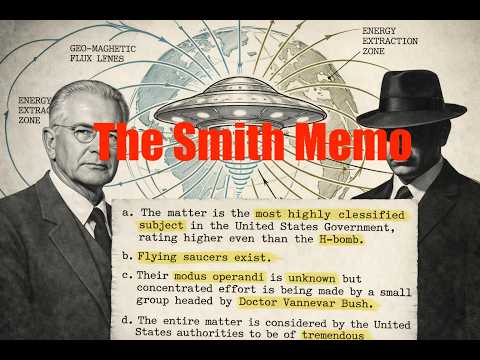
Classified Higher Than the H-Bomb: Wilbert Smith, Project Magnet, and the 1950 UFO Memo
A documentary-style breakdown of Smith's 1950 memo and the Sarbacher connection, from the independent research channel The Future Past. Noted transparently: this is a small, non-mainstream channel rather than a major broadcast documentary series — included because it is verified, via its own official metadata, to be exclusively and directly about this case's founding document rather than a compilation or tangential topic.
Head of Canada's Secret Project Magnet — 'We Are Not Alone'
A short archival-footage piece centered on Smith's own on-camera statements about Project Magnet's aims. Noted transparently: another small independent channel rather than a major broadcast outlet, included on the same basis as the video above — verified via official metadata to be directly and exclusively about this case.
Sources
- Government of Canada, Office of the Chief Science Advisor, "Management of Public Reporting of Unidentified Aerial Phenomena in Canada" (Sky Canada Project, 2022).
- Library and Archives Canada, "Canada's UFOs: The Search for the Unknown" (archived database and virtual exhibition).
- DECLASSIFIED, "Project Second Storey", research summary of Defence Research Board records.
- Wikipedia, "Project Magnet (UFO)" — used lightly for timeline orientation and cross-checking dates.
- Wikipedia, "Wilbert Brockhouse Smith".
- Wikipedia, "Project Second Storey".
- Wikipedia, "Shirleys Bay".
- Mysteries of Canada, "Project Magnet — Wilbert Smith — Canadian UFO Researcher".
- Rex Research, "Wilbert B. Smith: Project Magnet" (primary memo transcriptions, including the November 21, 1950 "Geo-Magnetics" memo).
- Matthew Hayes, Search for the Unknown: Canada's UFO Files and the Rise of Conspiracy Theory (McGill-Queen's University Press, 2022).
- Matthew Hayes, "'Then the Saucers Do Exist?': UFOs, the Practice of Conspiracy, and the Case of Wilbert Smith", Journal of Canadian Studies.
- David Clarke, "Canada's UFO Files: book review" (2022), review of Hayes's Search for the Unknown.
- Palmiro Campagna, The UFO Files: The Canadian Connection Exposed (Dundurn Press, 2010).
- Timothy Good, Above Top Secret: The Worldwide U.F.O. Cover-Up (William Morrow, 1988), on the Smith-Sarbacher conversation.
- Wilbert B. Smith, The Boys from Topside (Saucerian Books, 1969, posthumous).
- Metabunk, "Wilbert B Smith, Project Magnet, and his Claims of UFO Debris" — a skeptical research thread examining Smith's later, unconfirmed debris claims.
- Case File, The Omni Ledger, The Shag Harbour Incident — on Project Magnet's role as the origin of Canada's federal UFO-reporting apparatus.
- Case File, The Omni Ledger, The Twining Memo — a contemporary American document-driven government case used for direct comparison.
See something inaccurate? Have additional information or sources?
Suggest an Edit →Last Updated: August 2026