
Oak Ridge UFO Intrusions
Beginning in earnest on the night of October 12, 1950 and continuing in bursts through mid-December, ground radar operators of the U.S. Air Force's Aircraft Control and Warning network, together with Atomic Energy Commission security patrolmen, civilian laboratory employees, and at least one Air Force major, reported at least a dozen separate radar-corroborated visual intrusions over the restricted airspace of the Oak Ridge atomic reservation in eastern Tennessee — home to the Y-12, K-25, and X-10 plants that had enriched the uranium for the Hiroshima bomb five years earlier. The U.S. Army's Counter Intelligence Corps opened a formal investigation, background-checked the witnesses, and explicitly rejected balloons, birds, insect swarms, and mass hysteria as explanations "because of the simultaneous witnessing of the objects with the reported radar sightings." FBI Director J. Edgar Hoover personally directed a follow-up on possible "radar jamming by ionization," and by December the Army's Counter Intelligence Corps had been placed on immediate high alert for any further "flying saucer" data. This case file anchors on October 13, 1950 — the date this site's own placeholder entry originally cited, and a real, separately catalogued incident within the wave — while documenting the full multi-week pattern the surviving record actually describes.
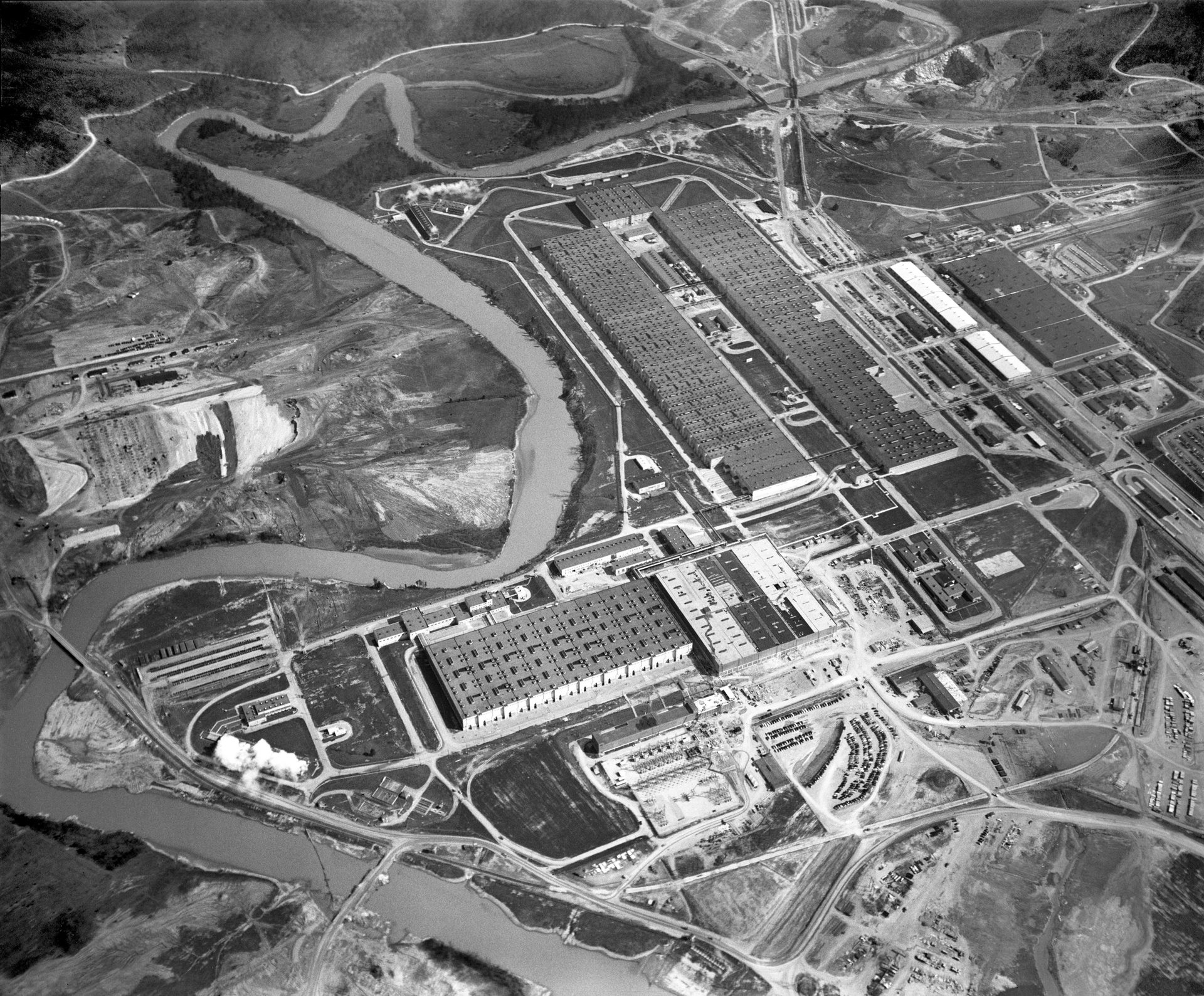
Pictured: an aerial view of the K-25 gaseous diffusion plant at Oak Ridge, Tennessee, photographed April 6, 1950 by Ed Westcott, the Manhattan Project's and AEC's official on-site photographer — taken just over six months before this case's own wave of intrusions, and the same restricted K-25 control zone over which AEC guard John Isabell reported a spinning silver-white sphere on October 16, 1950. This is not a photograph of any of the reported objects themselves; no photograph of any of the wave's dozen-plus sighted objects, nor of the radar scopes that repeatedly corroborated them, is known to survive in any archive consulted for this case file.
Theoretical Alignment
Oak Ridge's case draws genuine Extraterrestrial Hypothesis weight from its sheer repetition — not one isolated radar-visual convergence but at least half a dozen across a ten-week span, each independently corroborated by a separately tasked radar crew, and each investigated by professional security and intelligence personnel who explicitly, contemporaneously rejected the standard mundane catalogue. It carries almost no Interdimensional Hypothesis signature: every described object is solid, radar-reflective, and visually resolvable, with nothing suggestive of a phenomenon transiting between planes of reality. The Psycho-Social/Mundane reading carries unusually strong weight for a specific, disclosable reason: the wave's own internal variety works against it as a single phenomenon. A bullet-shaped diving object, a spinning sphere, a gunmetal balloon-like shape, a slow color-shifting light, and a shape-changing translucent blob are not five descriptions of one craft; they are the profile of at least several distinct causes — a reading reinforced by the Air Force's own December 1950 technical conclusion that most of the radar returns were "radar angels" (temperature-inversion ground clutter), and by the hard fact, disclosed in full below, that Oak Ridge's own radar-defense system was successfully spoofed by a homemade balloon-and-foil hoax within a year of this wave's end.
Background
The Oak Ridge reservation was established in 1942 by the Manhattan Engineer District as the Clinton Engineer Works, a roughly 59,000-acre secured tract carved out of Anderson and Roane Counties in eastern Tennessee, chosen for its remoteness, abundant Tennessee Valley Authority electric power, and defensible ridge-and-valley terrain. Three separate uranium-processing plants rose inside its fences: Y-12, using electromagnetic separation (calutrons); K-25, a vast gaseous-diffusion cascade; and the smaller S-50 thermal-diffusion plant, all working toward the same goal of enriching uranium-235 for a weapon. A fourth site, X-10, housed the Graphite Reactor, the world's second man-made nuclear reactor and the pilot plant that first demonstrated plutonium production at scale. Oak Ridge-enriched uranium fueled the "Little Boy" weapon dropped on Hiroshima on August 6, 1945; three days later, plutonium produced at the Hanford Site in Washington State fueled "Fat Man" over Nagasaki — making Oak Ridge, alongside Hanford and Los Alamos, one of the three pillars of the wartime Manhattan Project, and this case file's own subject the direct Tennessee counterpart to this site's recently published Hanford Site Radar-Visual Intercept. Throughout the war, Ed Westcott, the site's only camera-authorized employee, documented the reservation's construction and operations for the Army Corps of Engineers; his surviving negatives, now held by the National Archives and largely in the public domain as U.S. government work product, supply this case file's own hero image above. With the 1946 creation of the civilian Atomic Energy Commission, Oak Ridge's mission continued into the Cold War under a combined AEC Security Division, contractor guard force, and Air Force fighter-radar presence, guarding what remained one of the most sensitive industrial sites in the country.
Oak Ridge's own aerial-intrusion history predates this case's central 1950 wave by several years. In July 1947, Oak Ridge resident W. R. Presley, living at 218 Illinois Avenue, took a series of photographs showing what he described as some kind of device in the air near his home; he shared prints with acquaintances around the reservation and with reporters at the Knoxville News-Sentinel, which ran a story on the photographs. The resulting concern reached Washington: a letter to FBI Director J. Edgar Hoover, drafted by AEC chief investigator George Rathman together with Colonel C.D. Gasser of the Nuclear Energy for the Propulsion of Aircraft (NEPA) research program, recorded that "it was the opinion of Mr. Rathman that the photographs were, without a doubt, authentic." Rather than treating the images as a curiosity, investigators moved to recover as many prints as they could and returned them to Air Force Intelligence, instructing recipients to "say nothing to anyone" — a response driven, per the surviving correspondence, less by fear of an extraterrestrial visitor than by concern the images might depict a Soviet nuclear-propelled aircraft or missile overflying one of the country's most sensitive atomic sites. No copy of the original Presley photographs is known to have survived in public archives; this case file's own research, including a direct attempt to locate them within the U.S. Department of War's 2026 UAP document release described near the end of this file, could not confirm that the images themselves were included in that release, only correspondence describing them.
This 1947 episode sat inside the same broader institutional climate this site's Hanford case file documents in detail: the late-1948/early-1949 "green fireballs" wave concentrated around Kirtland Air Force Base, Sandia Base, and the AEC's own Los Alamos Scientific Laboratory in New Mexico, investigated by meteor astronomer Lincoln La Paz and formally assessed at a February 16, 1949 Los Alamos conference that led directly to the classified Project Twinkle observation program. A January 31, 1949 FBI memorandum, "Protection of Vital Installations," explicitly tied the flying-saucer matter's Top Secret classification to its concentration around atomic sites. Per a general survey of the period's official posture, by 1949 standing orders existed for Air Defense Command fighters to fire on potentially hostile aircraft found violating the restricted airspace over both the Hanford Site and Oak Ridge specifically — the single clearest documentary link between how seriously the two reservations' airspace was treated, a full year and a half before this case's own October–December 1950 wave began.
Oak Ridge's own dedicated radar-defense unit stood up in the same window this wave occurred in. In April 1950, a small detachment under Captain Jack A. Rockwell — Detachment 5 of the 661st Aircraft Control and Warning Squadron — set up at McGhee Tyson Airport in Knoxville, tasked specifically with identifying aircraft violating the Oak Ridge Air Space Reservation and directing interceptor fighters against unauthorized intrusions. That detachment was formally redesignated the 663rd Aircraft Control and Warning Squadron on November 27, 1950 — after this wave's October and most of its November activity, meaning the radar unit tracking the bulk of this case's own targets was, at the time, still the newly stood-up Detachment 5 rather than the better-known 663rd it would soon become, before eventually relocating to a dedicated radar site atop Cross Mountain near Briceville. Fighter cover, per the same general survey, was drawn at various points from squadrons operating out of Fort Knox, Kentucky, though no source consulted for this case file could confirm a single, consistent fighter-squadron designation across every intercept attempt this wave describes — a gap this case file discloses rather than papers over with an invented unit number.
Complete Timeline
| Date | Event |
|---|---|
| 1942 | The Manhattan Engineer District establishes the Clinton Engineer Works (Oak Ridge) in Anderson and Roane Counties, Tennessee, to enrich uranium for the atomic bomb program. |
| 1943–45 | Ed Westcott, the reservation's sole authorized photographer, documents the construction of the Y-12, K-25, S-50, and X-10 plants. |
| Aug. 6, 1945 | Oak Ridge-enriched uranium fuels the "Little Boy" weapon dropped on Hiroshima; Hanford-produced plutonium fuels "Fat Man" over Nagasaki three days later. |
| 1946 | The civilian Atomic Energy Commission (AEC) assumes control of Oak Ridge from the Army. |
| July 1947 | Resident W. R. Presley photographs an unexplained aerial device near his home at 218 Illinois Avenue; AEC investigator George Rathman judges the photos "without a doubt, authentic" in a letter to FBI Director Hoover; prints are recovered and recipients told to "say nothing to anyone." |
| Nov. 1948–Feb. 1949 | The "green fireballs" wave over Los Alamos, Kirtland AFB, and Sandia Base draws sustained AEC and Air Force intelligence concern, leading to Project Twinkle; by 1949, standing fire-on-sight orders reportedly cover restricted airspace over both Hanford and Oak Ridge. |
| March 1–2, 1950 | A radar station near Knoxville detects unidentified objects positioned directly over Oak Ridge on consecutive nights; no flights are scheduled from nearby Smyrna Air Base. |
| April 1950 | Detachment 5 of the 661st Aircraft Control and Warning Squadron, under Capt. Jack A. Rockwell, is activated at McGhee Tyson Airport, Knoxville, tasked with policing the Oak Ridge Air Space Reservation. |
| Oct. 12, 1950, ~11:25–11:30 PM | Radar detects 11 or more unidentified targets over the Oak Ridge restricted zone; an F-82 is scrambled but the pilot obtains no visual contact. |
| Oct. 13, 1950 | NICAP catalog entry 501013, "Sightings by AEC security patrols" — this case file's anchor date, and the date the site's own placeholder entry originally cited; several secondary compilations place the Rymer/Moneymaker Solway Gate sighting (detailed below under Oct. 15) on this date instead, a discrepancy this case file discloses rather than resolves by assumption. |
| Oct. 15, 1950 (BBU 819), 3:20–3:25 PM | AEC Security Patrol Trooper Edward D. Rymer, University of Tennessee Research Farm caretaker John Moneymaker, and Capt. Joe Zarzecki observe two shiny silver bullet/bladder-shaped objects dive with a smoke trail near Solway Gate; one vanishes, the other hovers 50 feet away at low altitude, departing and returning several times; Knoxville radar detects corroborating targets simultaneously; an F-82 is scrambled and sees nothing. |
| Oct. 16, 1950, ~1:30 & 2:55 PM | AEC security guard John Isabell observes a spinning, silver-white spherical object over the K-25 plant, circling southwest and reappearing at altitude; radar detects an indistinct target every third or fourth sweep over the same restricted area; an F-82 is scrambled roughly 15 minutes after the object vanishes and passes thousands of feet below where it had been. |
| Oct. 20, 1950, 3:27 & 4:55 PM | Radar detects unidentified targets 20–25 miles from Knoxville Airport; security superintendent Larry P. Riordan separately observes a gunmetal-gray, balloon-like object 8–10 feet long near the X-10 control zone; an F-82 searches for 90 minutes and finds nothing. |
| Oct. 21, 1950 | An Army Counter Intelligence Corps summary concludes standard explanations (mass hysteria, birds, balloons, insect swarms) "have been rejected because of the simultaneous witnessing of the objects with the reported radar sightings; because of the reliability of the witnesses," after a background check of witness employment and FBI records. |
| Oct. 23, 1950, ~4:30 PM | Oak Ridge laboratory employee Francis Miller observes an "aluminum flash" near Scarboro School; a nearby Geiger counter registers a burst of alpha and beta radiation a Health and Research Division official calls "unexplained"; Knoxville radar reports no detection at the time. |
| Oct. 24, 1950, ~6:45–7:18 PM | Security officer William B. Fry, his wife and son, and Air Force Major Lawrence Ballweg observe a light changing from red to orange to brilliant blue over roughly 33 minutes; radar independently detects an unidentified target at 5,000 feet in the same vicinity from 6:30–7:20 PM, matching the visual sighting's duration closely; an F-82 makes passes until about 7:15 PM without visual contact. |
| Oct. 25–29, 1950 | Further radar-only detections (2–3 AM, Oct. 25) and visual reports, including seven witnesses at Knoxville Airport (Oct. 29) describing a fast-moving, smoke-trailing circular object one experienced observer states "was not an aircraft." |
| Nov. 5, 1950 (BBU 829) | Radar tracks an object at roughly 80 mph over the restricted area at 9:29 AM; an F-82 trails it 20 miles without visual contact. At 11:55 AM, NEPA illustrator Don Patrick observes a translucent, pear-to-bean-shaped object rapidly changing outline; Blue Book lists the case Unidentified. |
| Nov. 29–30, 1950 | Radar targets return between 5–11 PM; scrambled fighters see nothing. A Geiger counter simultaneously records an abnormal alpha/gamma radiation increase with no identified source; Oak Ridge officials hold a two-day meeting on early-warning radar's "operational difficulties." |
| Dec. 4–5, 1950 | FBI SAC Knoxville discusses AEC speculation that radioactive-material releases could explain the anomalous radar targets; FBI Director Hoover sends an urgent teletype directing investigation of "possible radar jamming by ionization of particles in the atmosphere." |
| Dec. 5, 1950 (technical meeting) | ATIC and intelligence officials conclude the radar targets are most likely "radar angels" — ground returns bent downward by atmospheric temperature inversion. |
| Dec. 5, 1950 (visual), ~12:50 PM | The wife of a security officer observes a polished-aluminum, disc-shaped object near the Post Office building; a second woman independently reports the same or a similar object ten minutes later heading the opposite direction. ATIC's later claim that witnesses saw a conventional aircraft is contradicted by the two known aircraft airborne at the time, both roughly 14 miles south. |
| Dec. 8, 1950 | The Army's Counter Intelligence Corps is placed on "Immediate High Alert" for any data concerning flying saucers, marked strictly confidential. |
| Dec. 14, 1950 | Radar scopes are "blanketed" with unidentified targets directly over the AEC's Oak Ridge projects; scope photographs are taken; the targets are never identified, and the incident is not listed among Blue Book's official Unknowns despite its documentation elsewhere. |
| Late Dec. 1950 – 1951 | Lt. Col. John Hood's proposed research program ("Technical Approaches to the Problems of UFOs" — wide-area and portable radiation counters, Geiger/magnetometer-equipped aircraft, improved radar) is implemented; sightings largely cease as the program comes online, and it "effectively died" by late 1951. |
| 1951 | Oak Ridge scientists Alan D. Conger and Kimball C. Atwood III secretly launch six helium balloons rigged with an aluminum-foil radar target from a laboratory roof, triggering a real radar detection and fighter scramble — a hoax neither man confesses for years. |
| June 20–21, 1952, ~10:58–11:15 PM | A Ground Observer Corps spotter and GCI radar detect a slow-moving target near the AEC's Oak Ridge Laboratory; an F-47 piloted by Lt. James W. Wilson pursues a white blinking light from roughly 10,000 to 27,000–28,000 feet, unable to close for a firing position before it outclimbs the aircraft. |
| 1956 | Former Blue Book chief Edward J. Ruppelt discusses recurring reports around "technically interesting" AEC sites, including Oak Ridge and Hanford, in The Report on Unidentified Flying Objects. |
| 2008 / 2017 | Robert Hastings situates Oak Ridge's documented aerial-intrusion history within his broader UFOs & Nukes research project. |
| May 8, 2026 | The U.S. Department of War, together with AARO, the FBI, DOE, and other agencies, releases the first tranche of declassified UAP files under the PURSUE program, including an FBI case file discussing Oak Ridge sightings from 1947 into the 1950s. |
| 2026 | This case file is published, replacing this site's "Coming Soon" queue placeholder with a fully researched investigation confirming the placeholder's October 1950/AEC-security-patrol description against NICAP's chronology, the Army CIC's own surviving summary, and Blue Book's Unknowns catalog. |
The October 1950 Wave, Night by Night
Unlike this site's Hanford case file, which survives as a single compressed paragraph, Oak Ridge's own October–December 1950 wave is documented across dozens of individually dated entries drawn from FBI files, Army CIC summaries, and Project Blue Book's own surviving index — a considerably richer, if also considerably messier, evidentiary record. The wave's opening night, October 12, 1950, was radar-only: between roughly 11:25 and 11:30 PM, the McGhee Tyson-based radar detachment picked up eleven or more unidentified targets moving over the Oak Ridge restricted zone. An F-82 was scrambled and vectored toward two of the targets; the pilot saw nothing, and no ground witness reported a visual sighting that night. Taken alone, this would be an unremarkable radar anomaly. It matters here chiefly as the wave's opening beat — the first of several nights across the next ten weeks in which the same detachment's scopes would show unexplained returns over the same airspace.
October 13 and the Rymer/Moneymaker Discrepancy
The case's own anchor date, October 13, 1950, survives in NICAP's own Category 2 (Close Encounters) catalog as entry 501013, "Sightings by AEC security patrols" — a genuine, independently coded incident distinct from the neighboring entry 501015, "AEC Security Patrol Encounters Object 200' Away." This case file's research found a real, disclosable discrepancy at exactly this point: several secondary compilations (including at least one detailed narrative summary consulted for this case file) place the well-known Rymer/Moneymaker/Zarzecki sighting at Solway Gate — two shiny silver objects, a smoke trail, a pear-shaped or bullet-shaped profile clearing a fence and tree line — on October 13 itself, while NICAP's own separately consulted chronology page and Brad Sparks' comprehensive Blue Book Unknowns catalog both date the same witnesses' encounter to October 15, cataloguing it as BBU 819. This case file could not resolve which date is the transcription error and which is correct from any source consulted; both are treated honestly below, with the fuller, better-corroborated account presented under its Sparks-catalog date of October 15 rather than arbitrarily split into two separate incidents.
October 15: Two Objects at Solway Gate
At approximately 3:20–3:25 PM on October 15, 1950, AEC Security Patrol Trooper Edward D. Rymer and John Moneymaker, a caretaker at the University of Tennessee Research Farm, were near the Solway Gate entrance to the Oak Ridge control zone when they observed what one contemporaneous account describes as an aircraft appearing to begin an outside loop at 12,000–15,000 feet, trailing what they first took for smoke before realizing it was the object's own tail. A separate, independently sourced summary of the same general incident describes two shiny silver objects "shaped like bullet or bladder" diving with a smoke trail; one vanished while the other descended to a very low hover — five to six feet off the ground, roughly 50 feet from the witnesses — before departing and returning several times at progressively greater distances. Capt. Joe Zarzecki is named as a third witness in at least one version of the account. Knoxville radar registered corroborating unidentified targets at the same time, and an F-82 was scrambled; its pilot saw nothing. Whatever the precise shape (the sources disagree on "bullet," "bladder," and "pear-shaped" in ways this case file cannot fully reconcile), the case's evidentiary core is the same as several of this wave's strongest nights: a trained AEC security officer and a civilian caretaker converging on the same general description at the same moment a separately tasked radar crew independently registered anomalous targets.
October 16: The Spinning Sphere Over K-25
The following day brought a cleaner, single-witness account with its own radar corroboration. AEC security guard John Isabell reported, at approximately 1:30 PM and again at 2:55 PM, a silver-white spherical object spinning about its own axis at roughly 2,000 feet over the K-25 plant, traveling in a wide circle to the southwest before reappearing at higher altitude. Radar simultaneously picked up an indistinct target roughly every third or fourth antenna sweep over the same restricted K-25 area — a more intermittent, harder-to-classify signature than the clean corroborating tracks of other nights, consistent either with a genuinely small or low-reflectivity target, or with exactly the kind of marginal, borderline return December's technical review would later attribute to atmospheric ducting. An F-82 was scrambled roughly fifteen minutes after the object had already disappeared and passed thousands of feet below the object's last reported altitude — a response gap this case file notes plainly rather than glossing over, since a fifteen-minute-late intercept flying well below the target's reported altitude could not plausibly have achieved contact regardless of the object's true nature. Security guards that same evening additionally reported "strange, loud noises," a detail no source consulted connects concretely to the daytime sighting beyond simple temporal proximity.
October 20: A Balloon That Wasn't a Weather Balloon
Radar activity resumed on October 20, with unidentified targets detected 20–25 miles from Knoxville Airport at 3:27 PM; the responding pilot (identified in one source only by the surname "Wolf," of a squadron this case file could not confirm with certainty against independent records) was unable to identify any of the targets. Roughly ninety minutes later, at 4:55 PM, Larry P. Riordan, Superintendent of Security for the X-10 control zone, separately observed a generally round object, eight to ten feet long and colored "lead or gunmetal," that appeared to "come together at the bottom in wrinkles," with something hanging below it. Riordan's first instinct — a balloon without its basket — is exactly the kind of candid, self-skeptical initial read this case file treats as a credibility point rather than a weakness; he specifically determined it was not a standard weather balloon before filing the report as an unidentified object. An F-82 searched the area for ninety minutes and found nothing. AEC Weather Section chief J. Holland's own subsequent review of the period's balloon-launch logs found no timing correlation with any of the wave's sightings except, possibly, this October 20 daylight object — a genuinely disclosed point in the conventional-explanation column that this case file does not minimize.
The Army CIC's Own Contemporaneous Assessment
On October 21, 1950, in the middle of the wave rather than after it, the Army's Counter Intelligence Corps issued a summary of its own investigation to that point. Rather than treating the sightings as an obvious case of mass misperception, the CIC's own report states plainly that "possibilities of practical jokers, mass hysteria, balloons... have been rejected because of the simultaneous witnessing of the objects with the reported radar sightings; because of the reliability of the witnesses." The CIC had, by its own account, thoroughly checked the involved witnesses' backgrounds against employment records and FBI files and found no basis to discredit the professional security personnel involved. This is, in this case file's own assessment, the single most consequential document in the entire wave: a contemporaneous, credentialed federal investigative body, reviewing the case in real time rather than years later, explicitly declined to write off the pattern as ordinary misperception — a conclusion this case file treats with the same weight the Hanford file gives that case's own investigating officer's contemporaneous "two separate and distinct alert conditions" finding.
October 23: An Aluminum Flash and an Unexplained Radiation Burst
Oak Ridge laboratory employee Francis Miller, driving on Benton Valley Road near Scarboro School around 4:30 PM on October 23, watched what he described as an "aluminum flash" descend rapidly at 1,000–2,000 feet, moving south-southeast before disappearing over a ridge; he heard no sound. A background Geiger counter operating in the vicinity registered a burst of alpha and beta particle activity at the same time, which a Health and Research Division official described as "unexplained," adding that no intentional or accidental radioactive release had occurred at the site that month. Knoxville's radar station, notably, reported no detection of anything at the relevant time or location — making this one of the wave's few genuinely radar-silent visual incidents, and one where the strongest corroborating instrument reading (the Geiger counter) is itself of uncertain relevance, since neither this case file's own research nor, per the surviving FBI file (compiled by researcher Barry Greenwood and filed November 10, 1950), any contemporaneous investigation could establish a causal link between the flash and the radiation reading rather than mere coincidence in time.
October 24: Thirty-Three Minutes Over the Fry Family
The wave's single longest-duration sighting came the following evening. Beginning around 6:45 PM, William B. Fry, Assistant Chief of Security for Project NEPA, together with his wife and son and Air Force Major Lawrence Ballweg, watched a light object cycle through colors — "from a reddish hue to a bright orange and again to a brilliant light blue" — while drifting five to ten degrees north-to-south relative to the fixed stars, for a duration this case file's own research calculates at roughly 33 minutes before the object disappeared around 7:18–7:20 PM. Radar independently detected an unidentified target at 5,000 feet in the same general vicinity beginning at 6:30 PM, with the target itself vanishing from the scope at 7:20 PM — a close enough match to the visual sighting's own end time that this case file treats it as the strongest single instance of extended, near-real-time instrumented/visual correlation anywhere in the wave, considerably longer than either the Solway Gate or K-25 encounters. An F-82 made repeated passes over the area until roughly 7:15 PM without obtaining visual contact. Weather that evening was reported as excellent — calm air, a cloudless sky except for slight distant haze — ruling out the kind of low-cloud or haze-driven light refraction that might otherwise explain a slowly color-cycling light.
October 25–29: A Noise, a Colonel, and Seven Witnesses at the Airport
The wave's final days in October produced a scatter of smaller reports: a radar-only detection of several slow-moving objects between 2 and 3 AM on October 25; an intermittent noise "like the blast of a jet," reported at 5 AM on October 26 by Col. Edwin Thompson with no aircraft in sight, echoing the "strange, loud noises" security guards had reported on the evening of October 16; and, on October 29, a sighting witnessed by seven people simultaneously at Knoxville Airport of a fast-moving circular object trailing smoke to the southwest, with one witness who described himself as having flying experience stating flatly, per the surviving account, that "this object was not an aircraft." No radar corroboration is recorded for the October 29 airport sighting in any source consulted, leaving it, on its own, a strong multi-witness account but without the dual-sensor convergence that distinguishes the wave's stronger nights.
November–December: Radiation, Radar Angels, and Hoover's Office
November opened with the wave's other officially catalogued Blue Book Unknown. At 9:29 AM on November 5, 1950 (BBU 829), radar tracked an object moving at roughly 80 miles per hour over the restricted area; an F-82 pursued the target for twenty miles without ever obtaining visual contact of its own — a slower, more sustained radar-only pursuit than the wave's earlier, briefer intercept attempts. Just over two hours later, at 11:55 AM, NEPA Division illustrator Don Patrick separately observed a translucent, light-grey object with a darker core that changed shape rapidly — "from a pear shape to a bean shape and other sausage like shapes" — while a dark, roughly triangular portion of the object remained constant throughout. Patrick's own first assumption was a balloon, until the speed and character of the shape changes and the object's "rapid, darting movements" convinced him otherwise; Project Blue Book's surviving index lists the case Unidentified rather than resolving it to any specific conventional cause.
Late November brought the wave's second documented radiological anomaly. Between 5 and 11 PM on November 29–30, radar targets returned to the Oak Ridge area; scrambled fighters again found nothing visually. At around 7 PM the same evening, a Geiger counter recorded what the surviving record describes as an abnormal increase in alpha and gamma radiation "that could not be attributed to a known source." Oak Ridge officials convened a two-day meeting afterward specifically to discuss the early-warning radar network's own "operational difficulties" — an internal acknowledgment, independent of any question about the sightings' ultimate nature, that the detection system itself was proving hard to fully trust or characterize.
December opened with the case reaching the FBI's most senior levels. On December 4 and 5, the Bureau's Knoxville Special Agent in Charge discussed with headquarters a theory then circulating within the AEC: that releases of radioactive material from the plant itself might be generating the anomalous radar targets by ionizing the surrounding atmosphere. Director Hoover personally responded with an urgent teletype instructing that "arrangements should be made to obtain all facts concerning possible radar jamming by ionization of particles in the atmosphere," and specifically directing investigation of whether an incident northeast of Oliver Springs, Tennessee, might connect to the broader pattern. That same week, at a separate technical meeting, officials from the Air Technical Intelligence Center (ATIC) and other intelligence offices concluded that the bulk of the radar targets were most likely "radar angels" — false or exaggerated returns produced when a temperature inversion bends radio energy back down toward the ground, a well-documented and genuinely mundane radar artifact. This case file treats that conclusion as a real, serious, and probably correct explanation for a meaningful share of this wave's more marginal, intermittent, or unaccompanied-by-visual radar contacts — while noting, as detailed further in the CEC section below, that it does not obviously account for the wave's better-corroborated nights, where a visual description matched a simultaneous, sustained radar track rather than a fleeting or intermittent one.
A visual sighting on the very same day as that technical meeting complicates a purely "radar angels" reading of the whole affair. Around 12:50 PM on December 5, the wife of a security officer observed what she described as a highly polished aluminum or metal object, round and flat or disc-like, passing roughly two miles away near the Post Office building at about 500 feet, flying eastward, for about a minute. Ten minutes later and at a different location, a second woman independently reported the same or a very similar object heading in the opposite direction, westward. Weather was clear with a light six-mile-per-hour east wind; no balloon launches were scheduled near that time, and while two aircraft were airborne in the general area, both were roughly fourteen miles to the south — a distance this case file's research finds difficult to reconcile with ATIC's own later characterization of the sighting as a misidentified aircraft, since the only two known aircraft aloft were nowhere near where either witness placed the object. Whether this represents ATIC applying its "aircraft" explanation carelessly, or a genuine data gap in what aircraft were actually airborne that afternoon, cannot be resolved from any source consulted for this case file; it is disclosed as a real, documented tension in the official record rather than smoothed over in either direction.
The wave's final documented escalation came within days. On December 8, the FBI was informed that the Army's Counter Intelligence Corps had been placed on "Immediate High Alert" for any data whatsoever concerning flying saucers, with the information marked strictly confidential and not to be disseminated. On December 14, radar scopes were, per the surviving description, "blanketed" with a group of unidentified targets directly over the AEC's Oak Ridge projects; scope photographs were taken, and the targets were never identified — yet this incident, despite being independently documented, does not appear among Project Blue Book's own official list of Unknowns, a gap in the official record this case file discloses without speculating further about its cause. As the winter progressed, Lt. Col. John Hood's December 5 proposal for a dedicated technical research program — wide-area and portable radiation counters, aircraft equipped with Geiger counters and magnetometers, and improved height/range/azimuth radar — moved toward implementation; as it came online in early 1951, the wave of sightings largely stopped, and the research program itself, according to the surviving record, "effectively died" by late 1951 without producing a definitive published conclusion of its own.
The 1951 Hoax That Almost Wasn't Confessed
The single most important piece of context for judging Oak Ridge's radar-detection system's real-world reliability arrived within a year of the wave's end, and from inside the reservation's own scientific staff. In 1951, Alan D. Conger, a professor of radiobiology, and Kimball C. Atwood III, a senior biologist, both working at Oak Ridge, used a helium tank left over from a laboratory open house to inflate six balloons, tied them together, and attached a six-foot strip of aluminum foil beneath them as a deliberate radar target, launching the assembly from their building's roof. The improvised target was picked up by the radar station at Pilot Mountain, triggering a genuine Air Force fighter scramble. What happened next is, in this case file's own assessment, the more instructive part of the story: as military aircraft began buzzing the area and their own scientist colleagues started seriously discussing the object as a possible genuine anomaly, neither Conger nor Atwood found the nerve to admit what they had done, and the hoax went unconfessed for years, the two men simply hoping the Air Force or AEC would never trace it back to them. The story only came to light when Conger's own son, years later, came across a description of what he recognized as his father's prank cited as a genuine case history in a published book on UFO sightings drawn from Air Force records, and Conger himself eventually confirmed the hoax publicly in a magazine article. This case file treats the episode as directly, concretely relevant to assessing every other radar-corroborated sighting in this wave: it demonstrates, with total certainty rather than speculation, that Oak Ridge's own detection-and-response chain — ground radar, a scramble order, and a responding fighter — could be triggered by a genuinely trivial, deliberately mundane object, and that at least two Oak Ridge scientists judged the atmosphere around flying-saucer reports serious enough that admitting a harmless prank felt, to them, more dangerous than staying silent.
1952 and the F-47 Pursuit
Oak Ridge's aerial-intrusion history did not end with the 1950 wave's official cooling-off. On the night of June 20–21, 1952, a Ground Observer Corps spotter and a Ground Control Intercept radar operator — by this point almost certainly the redesignated 663rd Aircraft Control and Warning Squadron, whose radar coverage the earlier 1950 detachment had grown into — detected a slow-moving target approaching the AEC's Oak Ridge laboratory area from roughly ten miles north-northeast of Maryville, Tennessee. An F-47 fighter on combat air patrol, piloted by Lt. James W. Wilson, was vectored to intercept. Wilson reported a white light, variously described as six to eight inches or six to eight feet in diameter, blinking until the object "put on power," with no discernible aircraft silhouette visible around the light itself. Climbing from roughly 10,000 feet to somewhere between 22,000 and 28,000 feet while pursuing at approximately 290 miles per hour indicated airspeed, Wilson found the object able to outclimb and outmaneuver his own fighter at every turn; his controller obtained authorization from the Air Defense Control Center to fire on the object if a shot presented itself, but Wilson was never able to achieve a firing position. Former Blue Book chief Edward J. Ruppelt documented the case directly in his own published account, noting specifically that "the pilot could see no silhouette around the light." A separate summary consulted for this case file, drawing on the same general Ruppelt-era material, dates a similarly described Oak Ridge ground-observer/radar case to July 21, 1952 rather than June 21 — a second date discrepancy this case file discloses honestly rather than resolves, since the available sources do not make clear whether this reflects one incident transcribed with two different dates, or two genuinely separate June/July 1952 Oak Ridge events.
The 2026 Disclosure
On May 8, 2026, the U.S. Department of War — the federal defense department's restored historical name — released the first tranche of documents under the interagency PURSUE (Presidential Unsealing and Reporting System for UAP Encounters) program, publishing roughly 160 files at a dedicated government portal. Contemporaneous reporting by Knoxville's own WVLT-TV and by NPR both confirm that the release includes material specifically discussing Oak Ridge, describing it as part of a broader FBI case file (Bureau file number 62-HQ-83894) covering UFO-related reports from the late 1940s into the 1950s and beyond. This case file's own research attempted, but could not fully complete, a direct examination of the specific Oak Ridge-related documents within that release: the government's own hosting domain returned access errors to this case file's automated research tools on repeated attempts, and no secondary source consulted could confirm that the original Presley photographs themselves — as opposed to correspondence describing them — were included among the released files. What can be said with confidence, based on the reporting that did resolve successfully, is that this 2026 disclosure represents an official, government-sourced acknowledgment that Oak Ridge's 1947-into-1950s aerial reports were serious enough to remain part of the FBI's own retained UFO case file for more than seventy-five years, and that a fuller primary-document review of that specific release, once its access issues are resolved, would be a natural next step for any future update to this case file.
Key Witnesses
Edward D. Rymer
Rymer, an AEC-employed security trooper, was one of the two primary witnesses to the wave's Solway Gate sighting (dated Oct. 13 or Oct. 15, 1950 depending on source), observing two shiny, silver, bullet- or bladder-shaped objects dive with a smoke trail before one vanished and the other hovered at very low altitude close enough to be observed in detail. As an armed, uniformed AEC officer whose specific job was watching this exact restricted airspace, his account was one of several the Army CIC specifically background-checked and found no reason to discredit.
John Moneymaker
A civilian caretaker at the University of Tennessee's research farm adjoining the Oak Ridge control zone, Moneymaker was present alongside Trooper Rymer for the Solway Gate sighting, independently corroborating the object's description and behavior from a civilian, non-security vantage point.
John Isabell
Isabell reported the wave's cleanest single-witness sighting, a silver-white sphere spinning about its own axis over the K-25 plant on October 16, 1950, observed twice within roughly ninety minutes and loosely corroborated by an intermittent radar return over the same restricted zone.
Larry P. Riordan
Riordan, the senior security official for the X-10 (Graphite Reactor) control zone, observed a gunmetal-gray, balloon-like object on October 20, 1950, and is notable for his own candid, self-skeptical first assessment — suspecting a balloon without its basket — before actively ruling out a standard weather balloon and filing the sighting as unidentified. His occupational seniority and his own skeptical first instinct both weigh in favor of his account's basic reliability.
William B. Fry and Family
Fry, together with his wife and son, observed the wave's longest single sighting on October 24, 1950 — a color-cycling light tracked for roughly 33 minutes and independently matched almost minute-for-minute by a simultaneous radar target. As a family group including two civilian, non-security witnesses alongside a trained security official, their account benefits from a broader base of independent corroboration than most single-witness reports in this wave.
Maj. Lawrence Ballweg
Ballweg was present with the Fry family for the October 24, 1950 sighting, adding a trained Air Force officer's independent corroboration to a family account that might otherwise have carried less institutional weight on its own.
Don Patrick
Patrick, a technical illustrator for the Nuclear Energy for the Propulsion of Aircraft program, observed a translucent, rapidly shape-shifting object on November 5, 1950, notable for his own trained illustrator's eye for form and his explicit account of updating his initial "balloon" assumption once the object's behavior contradicted it. Blue Book's surviving index lists his sighting Unidentified.
The Five Observables Assessment
Assessment: Anti-Gravity Lift is rated Speculative: several nights (Oct. 15's low hover, Oct. 24's slow color-cycling light) describe sustained, apparently controlled positioning at low speed or a standstill, but no source consulted describes an unambiguous vertical launch or landing that would confirm lift-based flight specifically rather than a slow-moving balloon or aircraft. Instant Acceleration is rated Present, primarily on the strength of the October 15 Solway Gate account's diving object and rapid departures/returns and the Isabell sphere's sudden reappearance at altitude after its wide southwest circuit — behavior consistent across multiple independently witnessed nights rather than a single uncorroborated claim. Hypersonic is rated Speculative: the only explicit numeric speed figure preserved anywhere in this wave is the Nov. 5 radar's roughly 80 mph track, a figure well within conventional aircraft performance and not remotely hypersonic; no other night offers any quantified speed data at all. Low Observability is rated Present for a specific, disclosed reason distinct from most other cases in this catalogue: several nights show a genuine mismatch between visual and radar detection ranges and durations (the Oct. 16 sphere's intermittent every-third-sweep radar signature despite a sustained, continuous visual sighting being the clearest example), a pattern consistent with a radar cross-section that varies unusually as the object maneuvers, though this case file discloses that the same pattern is at least equally consistent with the object being at the edge of the radar's reliable detection envelope for entirely mundane reasons. Trans-Medium is rated Absent, since no report in this wave involves any transition between air, ground, or water.
Evidence Assessment
Supporting Anomalous Origin
- At least half a dozen separate nights across a ten-week span show a visual sighting corroborated by an independently tasked ground radar crew at essentially the same time — a repeated pattern, not a single isolated convergence
- The Army's own Counter Intelligence Corps, investigating in real time rather than retrospectively, explicitly rejected mass hysteria, balloons, birds, and insect swarms after background-checking the witnesses' employment and FBI records and finding no basis to discredit them
- Several witnesses (Riordan, Patrick) explicitly report starting from a mundane first assumption (a balloon) and only revising it after direct observation contradicted that explanation — a self-skeptical pattern that argues against simple wishful misperception
- The October 24 Fry-family sighting's 33-minute visual duration is matched almost minute-for-minute by an independent 50-minute radar track in the same airspace, a degree of sustained dual-sensor correlation this catalogue rarely documents this cleanly
- The wave drew direct, escalating attention from FBI Director Hoover's own office and produced a Counter Intelligence Corps "Immediate High Alert," a level of senior federal engagement that indicates the contemporaneous investigators themselves did not treat the matter as routine
Supporting Conventional Explanation
- The wave's own internal variety — a diving bullet-shape, a spinning sphere, a balloon-like shape, a slow color-cycling light, a shape-shifting blob, and a polished disc — is difficult to reconcile with a single consistent craft or phenomenon, and more consistent with several distinct, independent causes
- ATIC's own December 1950 technical review attributed the bulk of the radar returns to "radar angels," a genuine, well-documented atmospheric-ducting artifact, and this case file's own research finds that explanation plausible for several of the wave's more marginal, intermittent, or visually-uncorroborated radar contacts
- A documented 1951 hoax by two Oak Ridge scientists proves, with certainty rather than speculation, that the exact radar-detection-and-scramble chain this wave repeatedly describes could be triggered by a trivial, deliberately mundane object
- AEC Weather Section chief J. Holland's own balloon-launch log review found a plausible timing correlation for at least one sighting (Oct. 20), and Riordan's own object description (a round shape "coming together at the bottom in wrinkles," something hanging below) is difficult to distinguish from a genuine, if unusually described, balloon
- No photograph, film, or physical trace of any object survives from any night in this wave, and the original 1947 Presley photographs — the closest thing to physical evidence anywhere in this case file's broader Oak Ridge history — are themselves lost rather than independently examinable today
Why "Disputed"
This case earns a DISPUTED classification with a credibility score of 45/100, placing it modestly above this catalogue's Hanford Site Radar-Visual Intercept (Disputed, 36) and Thomas Mantell (Disputed, 38), while sitting well below Oscoda AFB Sighting (Disputed, 70) and far below Coyne Helicopter (Credible, 81). The case's genuine strength is real and, in some respects, richer than Hanford's own comparable record: at least half a dozen separately dated nights across a ten-week span each show an independently corroborated radar-visual convergence, involving a dozen or more named, occupationally credible witnesses whose backgrounds the Army's own Counter Intelligence Corps specifically checked and found no reason to discredit — a considerably deeper evidentiary base than Hanford's single unnamed paragraph, and one that drew documented concern all the way to FBI Director Hoover's own office.
What keeps this case solidly in Disputed territory rather than Credible is the same body of evidence cutting the other way just as clearly. The wave's descriptions do not cohere into one consistent craft, which argues for several independent, probably mundane causes rather than one genuine anomaly appearing repeatedly. The Air Force's own December 1950 technical review attributed most of the radar activity to a known, mundane atmospheric artifact. And most concretely of all, a real, documented 1951 hoax by two of Oak Ridge's own scientists proves beyond any dispute that this exact site's detection-and-response chain could be, and was, triggered by something completely mundane — a fact this case file weighs heavily against every other radar-corroborated sighting in the wave, even the better ones, because it establishes the system's real, demonstrated false-positive rate rather than leaving that question purely theoretical. A case with this much genuine, contemporaneous, professionally-vetted corroboration, sitting alongside this much documented, disclosed conventional-explanation strength and one outright proven hoax against the same detection system, is exactly the profile a mid-range Disputed rating exists to describe.
Sensor & Instrumentation Detection Profile
This wave's evidentiary record rests on three distinct, contemporaneously operating detection channels, more than most single-incident case files in this catalogue can draw on. The first is direct human visual observation, made by AEC security personnel, Oak Ridge civilian employees, and at least one Air Force officer, typically with the naked eye rather than any optical aid; no source consulted describes binoculars, telescopes, or cameras being used by any witness during the sighting itself, a genuine limitation compared with, for example, the telescope-assisted observation this site's Hanford case file documents. The second is ground radar, operated across the wave by Detachment 5 of the 661st Aircraft Control and Warning Squadron (redesignated the 663rd on November 27, 1950) from its McGhee Tyson Airport station near Knoxville; this case file's own research could not determine the exact radar set model in use during the 1950 wave, though the unit's later, better-documented 663rd-era equipment reportedly included search radars typical of the period's Air Defense Command network. The third channel, used on at least two occasions (Oct. 23 and Nov. 29–30), is a fixed Geiger counter monitoring background radiation levels near the reservation — an instrumentation type unique among this site's nuclear-site case files, reflecting Oak Ridge's specific character as an active uranium-processing facility rather than simply a guarded storage or command site. No infrared, photographic, or magnetometer data survives from the 1950 wave itself, though Lt. Col. Hood's unrealized 1951 research proposal specifically called for adding magnetometer- and Geiger-equipped aircraft to future monitoring, an acknowledgment that the wave's actual 1950 instrumentation was considered insufficient even by the officials investigating it at the time.
Environmental & Geospatial Context
The Oak Ridge reservation sits within the ridge-and-valley terrain of the Great Appalachian Valley in eastern Tennessee, its individual plants (Y-12, K-25, X-10) separated by low forested ridgelines that both concealed the site's compartments from one another for wartime security and, incidentally, complicate straightforward sightline analysis for any individual witness's reported bearing and distance. McGhee Tyson Airport, the wave's radar station, sits roughly 20 miles east-southeast of the main Oak Ridge plants, in the broader Knoxville area, itself within the same general Tennessee Valley terrain. No comprehensive meteorological record for the full wave survives in any source consulted for this case file; specific incidents note their own local conditions (Oct. 24's calm, cloudless evening with slight distant haze; Dec. 5's clear sky with a light six-mile-per-hour east wind), but no site-wide log of cloud cover, temperature-inversion strength, or wind conditions across the full ten-week period was located, which materially limits any attempt to test the "radar angels" (temperature-inversion) explanation systematically across every individual night rather than only the nights where local weather happens to have been separately recorded.
Observer Credibility & Occupational Profile
This wave's witness pool is, on balance, one of the more occupationally credible in this catalogue precisely because so many of its members held jobs whose entire function was watching this exact airspace for exactly this kind of intrusion: AEC security patrolmen and guards, a control-zone security superintendent, a NEPA program's own assistant chief of security, and at least two Air Force officers. The Army CIC's own October 21, 1950 background check of witness employment and FBI records, and its explicit conclusion that the witnesses' reliability was a factor weighing against a mundane explanation, is a genuinely unusual degree of contemporaneous, credentialed vetting for a UFO case of this era — considerably more than this catalogue's Hanford file, whose witnesses have no names to check at all, and comparable in spirit, if not in scale, to the multiply-corroborated military-crew cases this site rates most highly.
Set against that occupational strength, several considerations temper it. Two of the wave's own more distinctive witnesses — Riordan and Patrick — specifically began with a mundane first assumption (a balloon in each case) before revising it, a pattern this case file credits as a sign of self-skepticism but which also demonstrates how close several of these sightings sat, in the witnesses' own initial judgment, to an ordinary explanation. And unlike a small number of named, security-cleared witnesses whose testimony can be weighed individually and in depth, this wave's evidentiary strength comes substantially from aggregate pattern — many separate, briefly-documented nights — rather than from any single witness's account being independently examinable in the extended depth this site's better-documented named-witness cases (such as Robert Salas's decades of Malmstrom testimony) allow.
Physical & Material Assays
No object, debris, or landing trace was ever recovered from any night in this wave; every reported object remained airborne throughout each sighting. The wave's two Geiger-counter radiation anomalies (Oct. 23 and Nov. 29–30) are the closest thing to instrumented physical data this case file's research identified, and neither was ever conclusively tied to the concurrent visual sighting rather than treated as a coincidental, separately unexplained reading; no soil, air, or material sample connected to either radiation event is known to survive for modern re-analysis. The 1947 Presley photographs, discussed above under Background, represent the closest historical approach to physical photographic evidence anywhere in Oak Ridge's broader UFO history, but the original prints themselves are lost, leaving only secondhand correspondence describing AEC investigator George Rathman's contemporaneous judgment that they appeared authentic — a judgment this case file cannot independently verify without the images themselves.
Historical Precedents & Archive Matches
Oak Ridge's own site history extends both before and after this case's central 1950 wave. The earliest documented precedent, per this case file's own research, is the July 1947 W. R. Presley photograph incident described above, itself contemporaneous with a broader national uptick in "flying disc" reports following the June 1947 Kenneth Arnold sighting. A closer and more direct institutional precedent is the November 1948–February 1949 "green fireballs" wave over Los Alamos, Kirtland Air Force Base, and Sandia Base, documented at length in this site's Hanford Site Radar-Visual Intercept case file; that file's own research separately notes that former Blue Book chief Edward Ruppelt's 1956 book discusses recurring reports around "technically interesting" AEC installations by name at both Hanford and Oak Ridge, and that standing 1949 fire-on-sight orders reportedly covered restricted airspace over both sites specifically — making Hanford this case file's single closest national-pattern precedent and comparison point, notwithstanding the two sites' very different individual evidentiary records (Hanford's single thin paragraph versus Oak Ridge's dense multi-week documentary trail). This case sits, more broadly, inside the same pattern researcher Robert Hastings' UFOs & Nukes project and this site's own UFOs and Nukes theory page document at length across American nuclear-weapons and nuclear-materials sites from the late 1940s onward. Within Oak Ridge's own subsequent history, the June 1952 F-47 pursuit documented above extends the same basic pattern — radar-corroborated intrusion, failed fighter intercept — two years past this wave's own end, while the 1951 Conger-Atwood hoax, discussed in its own dedicated section above, stands as this case file's most concrete, doubly-relevant precedent: both a genuine piece of Oak Ridge's own UFO history and the single clearest proof this catalogue has encountered that this specific site's detection system could produce a false positive.
Material Analysis
As with several of this site's other radar-and-radiation-adjacent case files, "material" evidence here refers less to any recovered object than to the surviving documentary and instrumented record itself — FBI files, Army CIC summaries, Project Blue Book's own case index, and the two isolated Geiger-counter readings — since no physical object, debris, or trace connected to any single sighting survives for direct modern examination.
The Surviving Documentary Record
This case file's own research drew on a comparatively wide spread of independent secondary compilations of the underlying primary record: NICAP's own Oak Ridge sightings chronology and its formal Category 2 (Close Encounters) catalog codes (including entries 501013 and 501015); Brad Sparks' comprehensive Blue Book Unknowns catalog, which separately confirms this wave's two officially catalogued Unknowns (BBU 819 and BBU 829); a detailed FBI-file-sourced narrative compilation (via the "Ghost Doctor" and Openminds.tv summaries of the underlying Bureau documents); and general national-security-history coverage of the December 1950 FBI/Hoover involvement. These independent compilations substantially agree on the wave's broad shape — multiple radar-corroborated nights, CIC investigation, Hoover's personal involvement, a "radar angels" technical conclusion — while disagreeing on specific details at the margins, most notably the October 13 vs. October 15 date for the Rymer/Moneymaker sighting and the June 21 vs. July 21, 1952 date for the F-47 pursuit, both disclosed honestly above rather than silently resolved in either direction.
What Does Not Survive
No photograph or film of any object reported during this wave is known to exist in any archive consulted for this case file. The original 1947 Presley photographs are lost; this case file's own attempt to locate them within the U.S. Department of War's May 2026 UAP document release could not confirm their inclusion, only correspondence describing them. No scope photograph from the December 14, 1950 "blanketed" radar incident, despite being explicitly described as taken, was located in any source consulted. No soil or air sample from either Geiger-counter anomaly is known to survive. This case file discloses these absences plainly rather than treating the wave's genuinely extensive textual documentation as a substitute for physical or photographic evidence it simply does not have.
Supporting Non-Terrestrial or Unexplained Origin
- Multiple independent contemporaneous federal records (FBI, Army CIC, Project Blue Book) corroborate the wave's broad outline without needing to rely on any single potentially unreliable narrator
- The Army CIC's own real-time background-check of witness credibility, rather than a retrospective assessment, strengthens the case that the underlying reports were made in good faith by reliable observers
- At least two incidents (Oct. 23 and Nov. 29–30) are accompanied by an independently instrumented radiological anomaly, a category of corroborating evidence essentially unique to this site among this catalogue's nuclear-facility case files
Supporting Terrestrial or Mundane Origin
- No primary-source document image (an original FBI teletype, CIC report, or Blue Book case file page) was directly examined by this case file's own research; every specific quotation traces to a secondary transcription or compilation
- The 1947 Presley photographs, the closest thing to direct photographic evidence in this case file's entire scope, are themselves lost and cannot be independently examined today
- Neither Geiger-counter anomaly was ever conclusively linked to its concurrent visual sighting rather than being a separate, coincidentally-timed unexplained reading
The Conventional Explanation Candidate (CEC): Radar Angels and a Proven Hoax
Any honest accounting of this wave has to weigh two genuinely strong conventional candidates against the corroborated visual reports, rather than treating the case as a single either/or proposition. The first is the Air Force's own contemporaneous technical conclusion: at a December 5, 1950 meeting, ATIC and intelligence officials determined that the bulk of the radar activity likely represented "radar angels," spurious returns produced when a temperature inversion refracts radar energy back toward the ground, mimicking a genuine airborne target. This is a well-documented, genuinely mundane radar phenomenon, and this case file's own research finds it a strong candidate specifically for the wave's more marginal, intermittent, or radar-only nights — the October 25 pre-dawn detections, for instance, or the Isabell sphere's own oddly intermittent "every third or fourth sweep" signature. It struggles considerably more with the wave's better-corroborated nights, where a sustained, continuous visual sighting (Oct. 24's 33 minutes, for example) was matched by an equally sustained, continuous radar track over nearly the same duration; a temperature-inversion artifact does not typically also produce an independent, simultaneously matching visual sighting from separate human observers.
The Proven 1951 Hoax as a Conventional-Explanation Precedent
The second, and in this case file's own assessment more concretely damaging, candidate is not a theory but a demonstrated fact: the 1951 Conger-Atwood balloon-and-foil hoax proves that Oak Ridge's radar-and-scramble detection chain could be triggered by a deliberately trivial object, constructed from leftover party balloons and aluminum foil by two amateur pranksters with no engineering effort at all. This case file weighs that precedent heavily against the wave's radar-corroborated sightings not because it proves any specific 1950 sighting was itself a hoax — no evidence connects the two events beyond occurring at the same site within roughly a year — but because it establishes, with certainty, that the underlying detection system's real false-positive threshold was low enough for an amateur prank to clear it. A detection system demonstrated capable of being fooled by six party balloons and a foil strip cannot be assumed reliable by default for any of the wave's own radar contacts, however well the visual and radar timing otherwise line up.
Misidentified Balloons and Conventional Aircraft
Beyond the deliberate 1951 hoax, ordinary, non-malicious balloons and aircraft remain live candidates for several individual nights. Riordan's own October 20 object — round, "coming together at the bottom in wrinkles," something hanging below — is difficult to distinguish from a genuine balloon whose canopy had partially deflated or twisted in flight, notwithstanding Riordan's own determination that it was not a standard weather balloon; and AEC's own balloon-launch log review found a plausible timing match for that specific night. Patrick's November 5 shape-shifting translucent object likewise began, in his own first assessment, as a balloon, and a partially deflated or wind-buffeted balloon can genuinely appear to "change shape" as its silhouette twists relative to an observer, though Patrick's account of "rapid, darting movements" sits less comfortably with this explanation than with his own eventual conclusion that something more unusual was involved. Conventional aircraft, similarly, cannot be excluded for any of the wave's higher-altitude, more distant sightings, particularly given the general national background of intensified military flight activity as Korean War mobilization accelerated through the fall of 1950.
Genuine Unconventional Aerial Activity
This reading remains open for a meaningful minority of the wave's nights — particularly October 15's low-altitude hover-and-return pattern and October 24's sustained, matched dual-sensor color-cycling light — precisely because these specific incidents resist both the "radar angels" and simple-misidentification candidates more successfully than the wave's weaker nights do. It is tempered, as throughout this case file, by the total absence of any surviving photograph, film, or quantified performance figure for any of these stronger incidents, and by the proven vulnerability of the site's own detection system documented above.
Radar Angels (Temperature Inversion)
InconclusiveINCONCLUSIVE. A genuine, official, well-documented explanation for the bulk of the wave's more marginal or radar-only contacts, but it does not comfortably explain the nights where a sustained visual sighting matched an equally sustained, simultaneous radar track.
Proven 1951 Hoax as Systemic Precedent
Highly Plausible (as a demonstrated systemic vulnerability)HIGHLY PLAUSIBLE that the same detection-and-response system had a real, demonstrated false-positive vulnerability — though this does not itself prove any specific 1950 sighting was a hoax, only that the system's reliability cannot be assumed by default.
Misidentified Balloons
Plausible (for specific nights)PLAUSIBLE specifically for the Oct. 20 and Nov. 5 sightings, where witnesses' own first instinct was a balloon and at least one balloon-launch timing correlation was independently confirmed; less plausible for nights describing rapid, controlled, directional movement.
Unidentified Conventional Aircraft
InconclusiveINCONCLUSIVE. Cannot be excluded for the wave's higher-altitude or more distant sightings, particularly against the backdrop of rising Korean War-era flight activity, but does not obviously fit the lowest-altitude, most sustained close-range encounters.
Genuine Unconventional Aerial Activity
InconclusiveINCONCLUSIVE. Remains the best-fitting reading for a minority of the wave's strongest, best dual-sensor-corroborated nights, but is limited throughout by the total absence of photographic evidence and by the proven vulnerability of the same detection system to a mundane hoax.
Related Cases
Confirmed Documents & Official Records
NARA's own finding aid describing the Project Blue Book textual case files on 94 rolls of microfilm, the official federal repository within which this wave's two catalogued Unknowns (BBU 819 and BBU 829) are indexed.
DECLASSIFIEDA declassified FBI San Antonio field office memo to Director Hoover documenting December 1948 airspace intrusions over the AEC's Los Alamos installation — direct documentary evidence of the same institutional concern about atomic-site aerial activity that frames this case's own October–December 1950 Oak Ridge wave.
DECLASSIFIED (CONFIDENTIAL)This case file's own research also identified, but could not directly and reliably access, specific Oak Ridge-related material within the U.S. Department of War's May 8, 2026 PURSUE program document release (an FBI case file, Bureau number 62-HQ-83894, reportedly covering 1947-into-1950s UFO reports including Oak Ridge). That release is discussed in the "The 2026 Disclosure" section above; this case file declines to cite a specific document URL from it that its own research could not independently confirm resolves to matching content, consistent with this site's link-verification standards.
Search Government & Military Archives Directly
Further Reading — Recommended Literature
UFOs & Nukes: Extraordinary Encounters at Nuclear Weapons Sites
The foundational research project situating Oak Ridge's documented aerial-intrusion history within decades of reported UAP activity at U.S. nuclear weapons and nuclear-materials sites, drawn from interviews with more than 150 retired military veterans.
The Report on Unidentified Flying Objects: The Original 1956 Edition
The first Project Blue Book chief's own insider account of the era this case belongs to, including his own direct documentation of the June 1952 F-47 pursuit near Oak Ridge and his broader discussion of recurring reports around "technically interesting" AEC installations.
Watch the Skies!: A Chronicle of the Flying Saucer Myth
An aerospace historian's detailed chronicle of the late-1940s/early-1950s flying saucer period, including the green fireballs wave, Project Grudge, and the broader official investigative climate this wave's October–December 1950 intercepts occurred within.
The UFO Encyclopedia (3rd Edition)
A comprehensive, two-volume reference work covering early Cold War UFO cases and their declassified documentation, useful for cross-referencing this wave against the broader 1947–1969 Blue Book record and its Unknowns catalog.
The UFO Controversy in America
An academic historian's account of how U.S. government UFO investigations, including the Air Force's own "radar angels" technical reviews, evolved from 1947 onward — directly relevant to understanding ATIC's December 1950 conclusions about this wave's radar activity.
Essential Viewing
No Videos Available
A reasonable search effort for this case file found no video that is primarily and specifically about the October–December 1950 Oak Ridge wave itself, as distinct from general-interest coverage of 1950s "flying saucer" culture or brief news segments about the unrelated May 2026 Department of War document release. Per this site's Video Verification & Thumbnail Protocol, a case with no genuinely dedicated video coverage is presented honestly rather than padded with off-topic or tangential content.
Sources
- NICAP. "Oak Ridge, TN Sightings Chronology, 1950." nicap.org
- NICAP. "UFO Incident at Oak Ridge, TN, 11/10/1950" (FBI file, Oct. 23, 1950 incident, compiled by Barry Greenwood). nicap.org
- NICAP. "UFO Report" (Oak Ridge, June 21, 1952 F-47 incident). nicap.org
- NICAP. Category 2 (Close Encounters) Catalog, entries 501013 and 501015. nicap.org
- Sparks, Brad. "Comprehensive Catalog of Project Blue Book UFO Unknowns" (BBU 819, BBU 829, Oak Ridge, Oct.–Nov. 1950). nicap.org
- The Ghost Doctor. "The UFO's of Oak Ridge." theghostdoctor.com
- Openminds.tv. "UFOs Over Atomic Plants — Part 3." openminds.tv
- The Saucers That Time Forgot. "High Alert! UFO Over Oak Ridge National Laboratory, circa 1951" (Conger-Atwood hoax). thesaucersthattimeforgot.blogspot.com
- WVLT-TV (Knoxville). "'Source of great concern' | Newly-released Pentagon documents outline decades-old Oak Ridge UFO sightings" (May 8, 2026). wvlt.tv
- NPR. "UFO files released: Defense Department publishes trove of records" (May 8, 2026). npr.org
- National Archives and Records Administration. "Project BLUE BOOK: Unidentified Flying Objects." archives.gov
- The Black Vault Document Archive. "1949 FBI UFO Memo Describes Technology at Least 50 Years Ahead of Humans." theblackvault.com
- "United States UFO files." Wikipedia (background on the May 2026 PURSUE/Department of War document release). en.wikipedia.org
- "UFO reports and atomic sites." Wikipedia (general background on Oak Ridge/Hanford fire-on-sight orders and the 1952 Ruppelt-documented incident). en.wikipedia.org
- "663rd Radar Squadron." Background via Abandoned Online, "Briceville Air Force Base." abandonedonline.net
- "Ed Westcott." Wikipedia (Manhattan Project/AEC official photographer, source of this case file's hero image). en.wikipedia.org
- Wikimedia Commons. "File: Air View K-25 General 1950 Oak Ridge (13151395144).jpg" (DOE/Ed Westcott, public domain). commons.wikimedia.org
- Ruppelt, Edward J. The Report on Unidentified Flying Objects (1956), full text. gutenberg.org
- Hastings, Robert L. UFOs & Nukes: Extraordinary Encounters at Nuclear Weapons Sites (2008; 2nd ed. 2017), via ufohastings.com
- "Oak Ridge, Tennessee." Wikipedia (general background on the reservation's Manhattan Project origins and AEC-era history). en.wikipedia.org
- "Green fireballs." Wikipedia (background on the concurrent 1948–49 Los Alamos/Kirtland/Sandia aerial-phenomena wave and Project Twinkle). en.wikipedia.org
- This site. Hanford Site Radar-Visual Intercept case file (closest direct nuclear-site precedent and comparison point).
See something inaccurate? Have additional information or sources?
Suggest an Edit →Last Updated: August 2026