
The Simulation Hypothesis
UAPs reframed not as physical spacecraft but as system glitches, rendering-latency errors, administrative cursors, or direct developer interventions in the code underlying a simulated universe.
Unfalsifiable FrameworkCore Thesis
UAPs are not physical spacecraft piloted by biological entities from other planets. Instead, they represent system glitches, rendering latency errors, administrative cursors, or direct developer interventions in the simulation code, explaining why they appear to bypass the standard laws of thermodynamics and general relativity.
Origin & History
The Simulation Hypothesis is a modern, philosophically challenging framework that explains the physics-defying characteristics of UAPs by proposing that our physical reality is a computer-generated simulation. Originally formalized by Oxford philosopher Nick Bostrom in 2003, this theory suggests that a highly advanced civilization with massive computational power has constructed a virtual universe populated by conscious minds (us). Under this model, UAPs are not physical spacecraft piloted by biological entities from other planets. Instead, they represent system glitches, rendering latency errors, administrative cursors, or direct developer interventions in the simulation code, explaining why they appear to bypass the standard laws of thermodynamics and general relativity.
The philosophical foundation of the Simulation Hypothesis lies in the rapid development of human technology. In only a few decades, human society has progressed from basic two-dimensional games like Pong to massive, photorealistic virtual worlds populated by AI. If we project this trend forward by thousands or millions of years, it is inevitable that our descendants will possess the capability to run "ancestor simulations" — detailed virtual universes indistinguishable from reality. Mathematically, if such simulations exist, the number of virtual minds would vastly exceed the number of biological minds, making it highly probable that we are currently living inside a simulation rather than the original physical universe.
This virtual framework resolves the fundamental physical paradoxes of UAPs. In a computer simulation, the laws of physics are not absolute; they are lines of code written by the programmer. If a developer wants to move a cursor or a target across the screen, it does not need to obey inertia, gravity, or friction. It can accelerate at thousands of Gs, execute right-angle turns, and disappear instantly because it has no physical mass. Under this model, UAPs represent the administrative tools, data collectors, or software updates utilized by the simulators to monitor and edit the virtual environment, making their "impossible" flight dynamics entirely logical within a virtual system.
The idea gained mainstream traction well beyond academic philosophy in 2016, when Elon Musk stated at Recode's Code Conference that the odds humanity is experiencing "base reality" are "one in billions," citing the trajectory from Pong to photorealistic 3D games as evidence of an inevitable computing arc. Computer scientist and game designer Rizwan Virk took the argument a specific step further in his 2019 book The Simulation Hypothesis, applying Bostrom's probability framework directly to UAP flight characteristics — arguing that instantaneous velocity shifts and apparent teleportation read less like exotic propulsion and more like the rendering shortcuts a game engine takes when a physical model isn't worth computing in full. In 2022, physicist Dr. Melvin Vopson of the University of Portsmouth added an independent scientific thread, proposing a "second law of infodynamics" in the journal AIP Advances — the claim that informational entropy in physical systems decreases over time, a pattern he argues is consistent with a computationally optimized, simulated universe. Researcher Jacques Vallée, better known as the co-originator of the Interdimensional Hypothesis, has separately and only partially aligned himself with this reframing, noting that UAP behavior resembles a control system manipulating human consciousness and information more than a physical craft obeying orbital mechanics.
Scientific Foundations
The Simulation Hypothesis proposes three linked mechanisms by which a computational substrate would produce exactly the anomalous kinematic signatures documented in UAP case files, each addressing a different category of reported behavior.
1. Rendering Latency & Geometry Clipping
The primary mechanism is rendering latency. When UAPs are observed appearing out of thin air, shape-shifting, or passing through solid matter (like mountains or oceans) without collision, they are executing "geometry clipping." In a virtual environment, if the processor experiences high load or a rendering error, objects can fail to render correctly, showing clipping anomalies or delayed loading. UAP shape-shifts are explained as the simulation updating the graphic model of the object in real-time, or visual artifacts generated by the rendering engine struggling to resolve high-speed movement within the local coordinate frame.
2. Administrative Cursors & Code Edits
The second mechanism is the "administrative cursor." To monitor the stability of the simulation, the programmers deploy diagnostic tools. These tools (UAPs) navigate through the virtual environment, collecting data on the simulation's performance, physical constants, and the cognitive development of the simulated minds (us). The erratic, zig-zag movement of glowing orbs is compared to a cursor moving across a computer screen, executing precise, zero-inertia vector shifts that are impossible for physical mass but standard for a software pointer.
3. Software Updates & Hotfixes
The third mechanism is "simulation updates." When UAPs monitor nuclear facilities or execute localized electromagnetic shutdowns, they are applying software hotfixes to prevent simulated minds from causing critical system crashes. If a nuclear detonation or advanced physics experiment threatened to corrupt the local database or crash the simulation server, the programmers would intervene, utilizing UAP probes to slow down or halt the event. This explains why UAPs appear to target high-energy installations — they are administrative routines protecting the integrity of the virtual world.
Government & Military Programs
Unlike the Extraterrestrial Hypothesis, no declassified U.S. government program — Project Blue Book, AATIP, the UAP Task Force, or AARO — has ever evaluated UAP incidents through a digital-substrate or simulation-theory lens. The Pentagon and AARO's public reporting frameworks classify incidents strictly as "unidentified," pending conventional, foreign-adversary, or (unresolved) exotic explanations; a metaphysical reframing of the underlying reality itself falls outside any current federal investigative mandate and has never been addressed in a DoD, ODNI, or congressional document. The one point of institutional contact is indirect: the Five Observables framework — developed by former AATIP director Luis Elizondo to classify anomalous performance characteristics captured on military sensors — is the same taxonomy this theory borrows and reinterprets below, even though AATIP itself formulated the framework with a physical, not virtual, craft in mind. That borrowing illustrates the theory's general relationship to official UAP disclosure: it does not dispute the sensor data federal investigators have released, only the ontological category — physical spacecraft versus non-physical software process — that the anomalous readings are assigned to.
The Five Observables
The Five Observables framework, developed by former AATIP director Luis Elizondo, is used to classify UAP encounters based on performance characteristics that exceed known technology. Applied to a metaphysical reframing rather than a single case or a derived physical mechanism, it tests how directly the render-engine analogy accounts for each characteristic, as opposed to whether that account is falsifiable:
Assessment: All five observables are rated speculative under the Simulation Hypothesis, and for the same underlying reason: the theory offers a reinterpretation for each, but never a derivable mechanism the way a physical propulsion model would. Anti-gravity lift is reframed as a non-event — a simulated object has no mass to lift, so "hovering" is simply a coordinate that isn't being updated by the physics engine. Instant acceleration and hypersonic velocity are both explained as artifacts of unconstrained position updates: a rendered object can jump between coordinates instantly because it was never bound by an inertia calculation, and "speed" only exists if the engine bothers to interpolate between frames, which an administrative process need not do. Low observability is attributed to selective rendering — the object is drawn only for the sensors or observers the simulation currently needs to process, then culled. Trans-medium travel is explained by the absence of a modeled air/water boundary for non-physical assets, so collision and drag rules for either medium simply don't apply. Each reframing is internally consistent, but that is also the framework's central weakness: an explanation flexible enough to absorb any anomalous kinematic reading — instant stops, right-angle turns, air-to-water transitions — without a distinct physical mechanism for each is not making a testable prediction so much as relabeling the mystery.
Physical Evidence
Physical evidence occupies an unusual position under this theory, because the framework is constructed so that no possible material finding could ever confirm or refute it. Radar returns, gun-camera footage, and cockpit instrumentation can document that an object accelerated or maneuvered in a way that seems to violate known physics — as they did during the USS Nimitz encounter and the Lakenheath-Bentwaters radar-visual case referenced below — but no physical trace, spectrographic reading, or radar signature can, even in principle, distinguish "this object broke the laws of physics" from "the laws of physics governing this object were never what we assumed." A recovered physical fragment, if one were ever produced, would be equally explainable as a deliberately rendered prop or as conventional matter the simulation simply allowed to persist. Any material anomaly is consistent with the hypothesis, and so is its complete absence, since a well-optimized simulation would have no computational reason to leave debris behind. That symmetry — every possible outcome confirms the theory — is what places it outside standard evidentiary analysis, a point developed further under Material Analysis below.
Crash Retrievals
The Simulation Hypothesis has no dedicated crash-retrieval narrative of its own, and it engages only indirectly with the reverse-engineering allegations associated with whistleblowers like David Grusch. If the U.S. government (or any government) genuinely possesses recovered non-human craft or biological material, this framework does not treat that as evidence against a simulated universe — it simply reclassifies the recovered material as in-simulation content that the programmers allowed the "administrative cursor" objects to leave behind, rather than as proof of an interstellar or interdimensional visitor. Proponents of the theory have not, to date, made any specific claim about what a genuinely non-terrestrial or non-physical crash artifact would look like under a simulation model, nor proposed a test that would distinguish simulated wreckage from conventional wreckage. This is a genuine gap in the framework's development rather than a resolved position, and it is consistent with the broader pattern noted under Observer Credibility below: no named researcher runs a program specifically investigating crash-retrieval claims through a simulation-theory lens.
Supporting Case Files
Theoretical Alignment
The Simulation Hypothesis reframes UAP's most physics-defying characteristics — instantaneous acceleration, right-angle turns, disappearance without trace — not as violations of physical law but as evidence that the law itself is provisional code rather than fixed structure. Under this reading, a craft is never actually overcoming inertia, drag, or gravity; those constraints were simply never applied to it because it is an administrative or diagnostic asset rather than a physical vehicle bound by the same rendering rules as ordinary matter. This gives the theory unusual explanatory reach: it can, in principle, accommodate almost any anomalous kinematic reading (Nimitz's abrupt stop-and-reverse, Lakenheath-Bentwaters' zero-to-600-mph jump, the Belgian Wave's lethal 40G radar-tracked turns) without needing a distinct physical mechanism for each. That same flexibility is also its central weakness as a scientific framework — see Material Analysis below.
Sensor & Instrumentation Detection Profile
Simulation-theory proponents do not point to a unique sensor modality of their own; instead, they reinterpret the same radar, infrared, and optical detections other frameworks already treat as physical-craft evidence, looking specifically for signatures that read as software behavior rather than mechanical flight. The signatures most frequently cited as "glitch"-type detections include: discontinuous position updates — an object registering at one radar coordinate and then an entirely different one on the next sweep with no interpolated track between them, as documented in the Lakenheath-Bentwaters case's instantaneous zero-to-400/600-mph transition; zero-inertia kinematics — FLIR and radar-tracked accelerations and direction reversals (the USS Nimitz object's abrupt stop-and-reverse, the Belgian Wave's radar-calculated 40G turns) that imply no momentum was ever being carried, consistent with a rendered object's coordinates being reassigned rather than a mass decelerating; selective visibility — cases where an object is picked up by one sensor type but not a second one simultaneously scanning the same airspace, read by proponents as the simulation "culling" an asset from sensors it does not need to render for; and informational entropy anomalies — Dr. Melvin Vopson's proposed infodynamic entropy-decrease signature, a laboratory-testable physical measurement rather than a UAP-specific detection, that proponents cite as the closest thing to an independent instrument check on the underlying substrate claim. None of these signatures are unique to a digital-substrate explanation: every one of them has an equally valid conventional reading (radar clutter, atmospheric ducting, a genuine non-human craft's exotic propulsion) as the Conventional Explanation Candidates section below sets out directly.
Environmental & Geospatial Context
Unlike theories that cluster around military installations, nuclear facilities, or open ocean, the case record associated with the Simulation Hypothesis shows no discernible geospatial pattern at all — a fact proponents and skeptics read in opposite directions. The related cases catalogued on this page span open ocean off San Diego (USS Nimitz), remote English forest (Rendlesham), a national capital's controlled airspace (Tehran), low-desert Arizona sky (Phoenix Lights), rural Pennsylvania woodland (Kecksburg), and dense Belgian population centers (the Belgian Wave) — military bases, wilderness, religious sites, and urban airspace with no unifying terrain, altitude, or institutional thread connecting them. Proponents argue this is exactly what an "administrative cursor" or diagnostic probe should look like: a process running wherever the simulation's internal monitoring routines happen to need data, unconstrained by the logistics that shape where a physical visiting craft would plausibly need to travel, refuel, or hide. Skeptics counter that a genuinely non-random selection process should still produce some discoverable statistical signature over enough cases, and to date none has been demonstrated — the absence of geospatial clustering is at least as consistent with a theory that simply absorbs any case regardless of location as it is with a genuine administrative-monitoring pattern.
Observer Credibility & Occupational Profile
The theory's credibility rests almost entirely on one figure: Nick Bostrom, a professor at Oxford University and founding director (2005–2024) of the university's Future of Humanity Institute, whose 200-plus publications include the New York Times bestseller Superintelligence. He is regularly cited as one of the most-referenced professional philosophers of his generation, and his 2003 paper remains a canonical, peer-reviewed contribution to academic metaphysics and probability theory. It is important to be precise about what that credibility does and doesn't cover: Bostrom's argument is a general claim about the statistical likelihood of simulated realities relative to biological ones, and it says nothing about UAP. The application of his framework to anomalous aerial phenomena is a later, informal extension made by others — game designer Rizwan Virk in popular media, and physicist Melvin Vopson through a separate (and likewise UAP-agnostic) research program on information entropy. No named academic runs a dedicated research program applying simulation theory to UAP casework; the connection exists at the level of metaphor and analogy rather than data.
Historical Precedents & Archive Matches
The Simulation Hypothesis is often presented as a novel, technology-driven idea, but its core move — doubting the reliability of perceived reality itself — has a long philosophical lineage that predates computing by millennia. Plato's Allegory of the Cave (The Republic, c. 375 BCE) describes prisoners who mistake shadows on a wall for the whole of reality, unaware of a truer world generating what they see — a structural precedent for the idea that ordinary perception could be a lower-resolution rendering of something else. René Descartes' "evil demon" thought experiment in Meditations on First Philosophy (1641) goes further, asking how one could ever rule out that all sensory experience is being fed to the mind by a deceiving external agent — the direct philosophical ancestor of Bostrom's simulator. Neither precedent involves anomalous aerial phenomena; they are cited here as evidence that the reality-doubt at the heart of the Simulation Hypothesis is a recurring feature of Western philosophy, not a claim invented to explain UAP.
Material Analysis
This is, by design, one of the most difficult theories on this site to evaluate against physical evidence. Radar returns, gun-camera footage, and cockpit instrumentation can document that an object accelerated or maneuvered in a way that seems to violate known physics — and several cases below do exactly that — but no physical trace, spectrographic reading, or radar signature can, even in principle, distinguish "this object broke the laws of physics" from "the laws of physics governing this object were never what we assumed." Any material anomaly is consistent with the hypothesis, and so is its absence (a well-optimized simulation would not need to leave debris). That symmetry is what places the theory outside standard evidentiary analysis rather than what makes it compelling.
Supporting This Hypothesis
- USS Nimitz "Tic Tac" object's abrupt stop-and-reverse with no observed propulsion (Case #003) is consistent with a zero-inertia "cursor" rather than a mass-bound craft
- Lakenheath-Bentwaters' instantaneous zero-to-400/600-mph transition, flagged as anomalous by the contemporaneous USAF investigating officer, has no conventional aerodynamic analogue (Case #043)
- Belgian Wave radar tracks documenting sustained ~40G turns — lethal to any human pilot — are easier to frame as software-level position updates than as physical maneuvers (Case #008)
- Bostrom's simulation argument is a rigorous, peer-reviewed probability claim, giving the framework philosophical grounding that most other fringe UAP theories lack
Against This Hypothesis
- The hypothesis is unfalsifiable: any anomaly confirms it and any absence of anomalies is attributable to a well-optimized simulation, so it generates no testable, unique prediction
- Physicist August Meessen's 1994 re-analysis attributed the Belgian Wave's F-16 radar locks and calculated 40G turns to atmospheric anomalous propagation — a mundane explanation requiring no simulated substrate (Case #008)
- The computational load required to render a universe at quantum-mechanical fidelity is argued by critics to be physically unviable, undermining the "ancestor simulation" premise at macroscopic scale
- Bostrom's original 2003 argument makes no claim about UAP whatsoever; its use here is a post-hoc extension by non-specialists rather than a prediction the theory actually made
Theoretical Assessment Profile
Six-domain evaluation of this hypothesis
Theory Development Timeline
| Date | Development |
|---|---|
| 2003 | Oxford philosopher Nick Bostrom publishes "Are You Living in a Computer Simulation?" in The Philosophical Quarterly, formalizing the simulation argument as a probability trilemma. |
| 2016 | Elon Musk states at Recode's Code Conference that the odds we are in "base reality" are "one in billions," citing the leap from Pong to photorealistic 3D games as evidence of an inevitable trajectory. |
| 2019 | Computer scientist and game designer Rizwan Virk publishes The Simulation Hypothesis, later applying the framework specifically to UAP flight characteristics in media appearances (e.g. NewsNation). |
| 2022 | Physicist Dr. Melvin Vopson (University of Portsmouth) publishes the "second law of infodynamics" in AIP Advances, proposing that information entropy decreases over time — a pattern he argues is consistent with a computationally optimized, simulated universe. |
| 2024 | Quantum physics experiments probe whether space-time is discretized ("pixelated") at the Planck length, testing a prediction some simulation proponents treat as a signature of underlying render resolution. |
Weighing the Evidence
Supporting Arguments
- Bostrom's 2003 trilemma is a rigorous, peer-reviewed contribution to academic probability theory and metaphysics — unusually strong philosophical grounding for a fringe UAP framework
- Dr. Melvin Vopson's 2022 "second law of infodynamics," published in AIP Advances, offers an independently motivated scientific argument for a computationally structured universe
- Ongoing quantum-physics experiments testing whether space-time is discretized at the Planck length give the framework at least one falsifiable prediction about the underlying substrate of reality, even if not about UAP specifically
- Unusually high cross-theory compatibility — the framework does not need to contradict the Extraterrestrial, Interdimensional, or Ultraterrestrial Hypotheses, since any of their claimed visitors could simply be in-simulation content
Skeptical Arguments
- Unfalsifiable as applied to UAP: any anomaly confirms it and any absence of anomalies is attributable to a well-optimized simulation, so it generates no testable, unique prediction
- Critics argue the computational load required to render a universe at quantum-mechanical fidelity is physically unviable, undermining the "ancestor simulation" premise at macroscopic scale
- Bostrom's original 2003 argument makes no claim about UAP whatsoever; its use here is a later, informal extension by non-specialists (Musk, Virk) rather than a prediction the underlying theory actually made
- No named academic runs a dedicated, peer-reviewed research program applying simulation theory to UAP casework specifically
Conventional Explanation Candidates (CEC)
Because the Simulation Hypothesis reinterprets rather than independently discovers its evidence, every case it cites already has a competing terrestrial or sensor-based explanation on record, and a rigorous evaluation has to weigh those candidates directly rather than treat the "glitch" reading as the default. Below are the leading conventional explanations for the specific anomalous-kinematics cases (USS Nimitz, Lakenheath-Bentwaters, the Belgian Wave) this theory page relies on, rated for how well each actually accounts for the recorded sensor data.
Atmospheric Anomalous Propagation & Radar Ducting
PlausiblePhysicist August Meessen's 1994 re-analysis attributed the Belgian Wave's F-16 radar locks and calculated 40G turns to atmospheric anomalous propagation — a temperature-inversion effect that can produce false returns appearing to execute impossible accelerations. This is a well-documented, mundane radar phenomenon with no exotic mechanism required, and it directly explains the "zero-inertia" kinematic signature simulation proponents cite as evidence of non-physical position updates.
Sensor & Tracking-System Artifacts
InconclusiveRadar clutter, IR sun glint, and gimbal-tracking display artifacts can independently produce apparent discontinuous jumps or velocity readings without any real object moving that way. This candidate explains isolated single-sensor cases well but is weaker against USS Nimitz specifically, where the Princeton's Aegis radar, the FLIR1 video, and two aircrews' visual observation corroborated one another — a three-modality agreement a tracking artifact alone does not typically produce.
Genuine Non-Human Physical Craft
InconclusiveThe rival reading offered by the Extraterrestrial Hypothesis: that the recorded accelerations reflect a real, physical vehicle built on propulsion principles humanity has not yet mastered, rather than either atmospheric ducting or a non-physical rendering process. This candidate accounts for the multi-sensor corroboration in cases like Nimitz at least as well as the simulation reframing does, without requiring the additional, unproven premise that reality itself is computational.
Key Proponents
Nick Bostrom
Formulated the Simulation Argument in his 2003 paper "Are You Living in a Computer Simulation?", arguing it is statistically probable we live in a simulated reality. Founding director of Oxford's Future of Humanity Institute (2005–2024). Provides the theoretical basis for reframing UAPs as rendering glitches or administrative interventions, though he has never written about UAP himself.
Dr. Melvin Vopson
Studies information physics and proposed the "second law of infodynamics" in a 2022 AIP Advances paper, arguing that information entropy decreases over time — a pattern he presents as consistent with a computationally optimized, digital universe. His research program is UAP-agnostic.
Jacques Vallée
Protégé of J. Allen Hynek and co-originator of the Interdimensional Hypothesis. Aligns only partially with the Simulation Hypothesis, having noted that UAPs behave like a virtual control system manipulating human consciousness and information rather than a physical craft under orbital mechanics.
Rizwan Virk
MIT-trained computer scientist and author of The Simulation Hypothesis (2019). The most direct popularizer of the framework as applied specifically to UAP behavior, arguing instant velocity shifts and apparent teleportation resemble rendering updates in a multiplayer virtual environment.
Related Cases
Further Reading
The Simulation Hypothesis
An MIT computer scientist traces the technological path to the simulation point, linking quantum mechanics, information theory, and digital rendering — and applies the framework directly to UAP flight characteristics.
Programming the Universe
An MIT quantum mechanics pioneer argues that the universe is a giant quantum computer processing information at the fundamental Planck scale.
Superintelligence: Paths, Dangers, Strategies
Bostrom's own foundational work on artificial superintelligence and probability, from the same philosopher whose 2003 simulation argument underlies this entire theory page.
Reality+: Virtual Worlds and the Problems of Philosophy
A sitting NYU philosophy professor's academic treatment of Bostrom's simulation argument and Descartes' evil demon, arguing virtual worlds constitute genuine reality rather than illusion.
The Simulated Multiverse
Virk's follow-up to The Simulation Hypothesis, extending the framework to parallel universes, quantum computing, and the Mandela Effect.
Essential Viewing
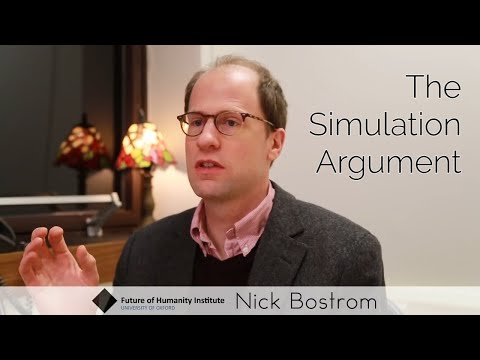
Nick Bostrom - The Simulation Argument (Full)
Oxford philosopher Nick Bostrom lays out the original probabilistic trilemma from "Are You Living in a Computer Simulation?" — the foundational argument this theory page applies to UAP flight characteristics.
![UFOs, Anomalies, & Glitches in the Matrix with Rizwan Virk [Simulation Hypothesis]](/images/thumbs/IWIKsLchK28.jpg)
UFOs, Anomalies, & Glitches in the Matrix with Rizwan Virk [Simulation Hypothesis]
Computer scientist Rizwan Virk applies the simulation hypothesis directly to UAP anomalies, arguing that high-performance flight characteristics read as rendering shortcuts in a simulated reality.

Is life a video game? | Elon Musk | Code Conference 2016
Musk argues the odds we are in "base reality" are "one in billions," citing the trajectory from Pong to photorealistic 3D games as the popularizing case for the simulation argument outside academia.
Sources Cited
- Bostrom, N. (2003). "Are You Living in a Computer Simulation?" Philosophical Quarterly, 53(211).
- Virk, R. (2019). The Simulation Hypothesis: An MIT Computer Scientist Shows Why AI, Quantum Physics, and Eastern Mystics Agree We Are in a Video Game. Bayview Books.
- Bekenstein, J. D. (2003). "Information in the Holographic Universe." Scientific American.
- Bostrom, N. (2005). "The Simulation Argument: FAQ." Journal of Scientific Exploration.
- Fredkin, E. (1990). "An Introduction to Digital Physics." International Journal of Theoretical Physics.
- 't Hooft, G. (1993). "Dimensional Reduction in Quantum Gravity." arXiv:gr-qc/9310026.
- Susskind, L. (1995). "The World as a Hologram." Journal of Mathematical Physics.
- Virk, R. (2023). "UAP as Programmed Rendering Exceptions: A Computer Science Framework." Sol Foundation Proceedings.
- Lloyd, S. (2006). Programming the Universe: A Quantum Computer Scientist Takes on the Cosmos. Knopf.
- Wheeler, J. A. (1989). "Information, Physics, Quantum: The Search for Links." Proceedings of the 3rd International Symposium on Foundations of Quantum Mechanics, Tokyo.
- Zuse, K. (1970). Calculating Space. MIT Technical Translation.
- Wolfram, S. (2002). A New Kind of Science. Wolfram Media.
- Bostrom, N. (2006). "Ethical Implications of the Simulation Argument." Philosophical Studies.
- Gates, S. J. (2010). "Adinkra Symbols and the Mathematical Codes of the Cosmos." Physics World.
- Virk, R. (2021). The Simulated Multiverse. Bayview Books.
Have corrections, additional research, or peer-reviewed sources? Help improve this entry.
Suggest an Edit